COPING WITH
CORRUPTION
THROUGH WORK
ETHIC AND
ACCOUNTABILITY
IN PUBLIC
SERVICE
COPING WITH CORRUPTION THROUGH WORK ETHIC
AND ACCOUNTABILITY IN PUBLIC SERVICE
Transparency International
(TI) is a global coalition against
corruption. It is an international
organization dedicated to
documenting and tracing levels of
government corruption.
01
Country
Rank
Some SEA
Countries
200
8
CPI
Survey
Used*
Confidence
Rating
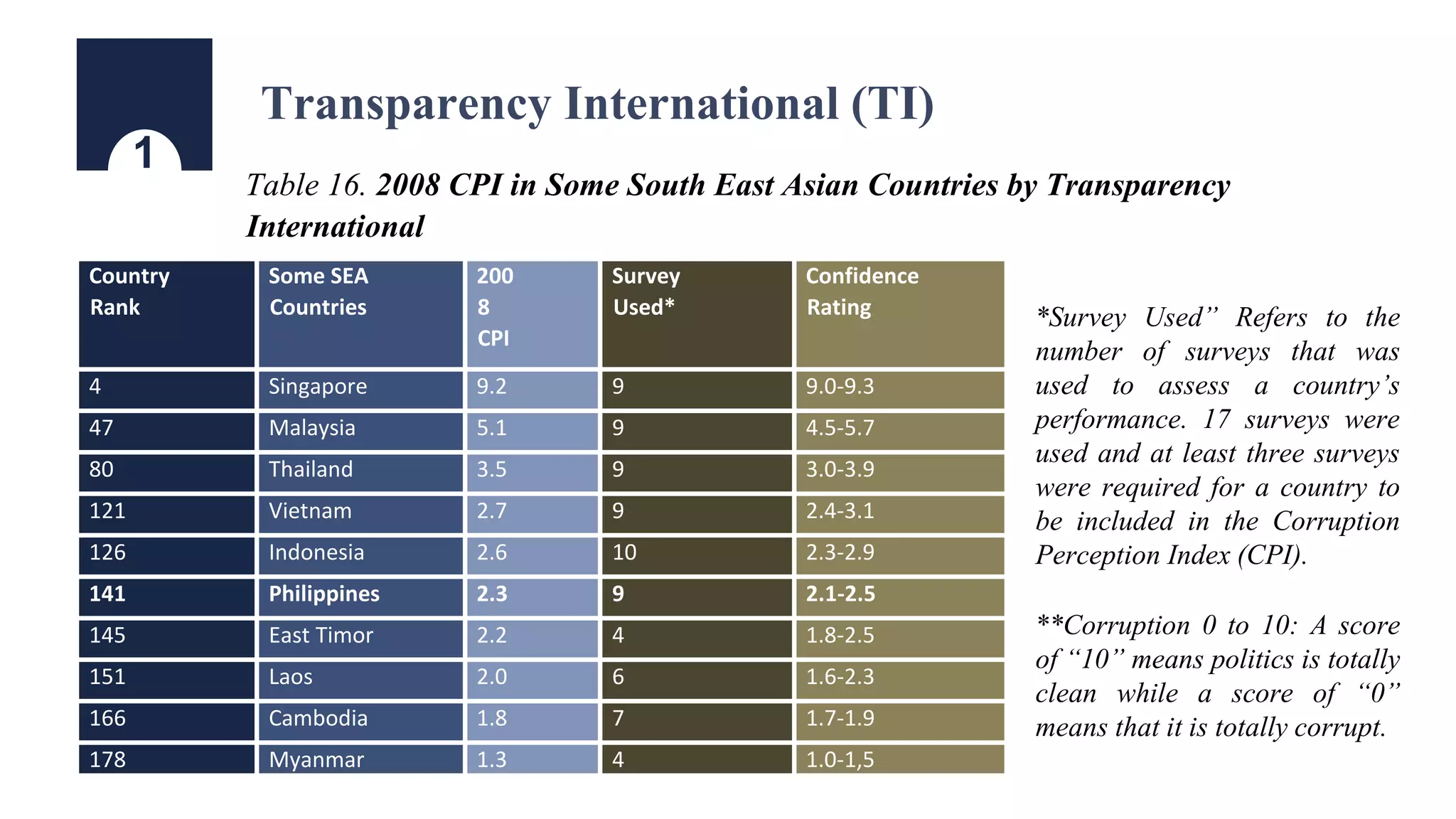
4 Singapore 9.2 9 9.0-9.3
47 Malaysia 5.1 9 4.5-5.7
80 Thailand 3.5 9 3.0-3.9
121 Vietnam 2.7 9 2.4-3.1
126 Indonesia 2.6 10 2.3-2.9
141 Philippines 2.3 9 2.1-2.5
145 East Timor 2.2 4 1.8-2.5
151 Laos 2.0 6 1.6-2.3
166 Cambodia 1.8 7 1.7-1.9
178 Myanmar 1.3 4 1.0-1,5
*Survey Used” Refers to the
number of surveys that was
used to assess a country’s
performance. 17 surveys were
used and at least three surveys
were required for a country to
be included in the Corruption
Perception Index (CPI).
**Corruption 0 to 10: A score
of “10” means politics is totally
clean while a score of “0”
means that it is totally corrupt.
Table 16. 2008 CPI in Some South East Asian Countries by Transparency
International
1
Transparency International (TI)
As stated, Transparency International ranked Philippines as the
141st most corrupt government in the world in 2008. Corruption in
the country is very high; politics is very dishonest as compared to
other neighboring Southeast Asian states. On the contrary,
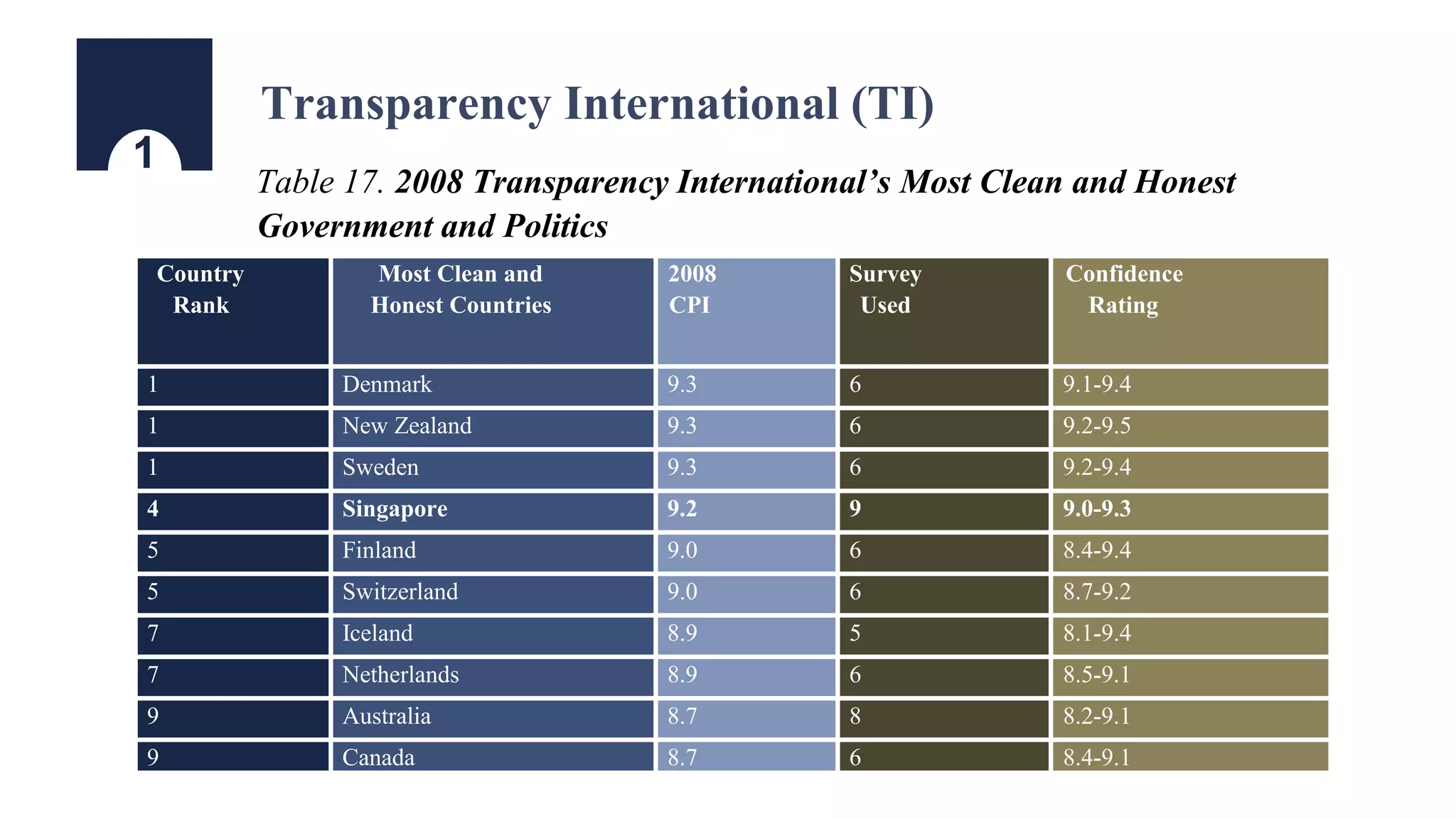
Transparency International also identified 10 of the most clean
and honest states in the world as shown in the table.
Table 16. 2008 CPI in Some South East Asian Countries by Transparency
International
1
Transparency International (TI)
Country
Rank
Most Clean and
Honest Countries
2008
CPI
Survey
Used
Confidence
Rating
1 Denmark 9.3 6 9.1-9.4
1 New Zealand 9.3 6 9.2-9.5
1 Sweden 9.3 6 9.2-9.4
4 Singapore 9.2 9 9.0-9.3
5 Finland 9.0 6 8.4-9.4
5 Switzerland 9.0 6 8.7-9.2
7 Iceland 8.9 5 8.1-9.4
7 Netherlands 8.9 6 8.5-9.1
9 Australia 8.7 8 8.2-9.1
9 Canada 8.7 6 8.4-9.1
Table 17. 2008 Transparency International’s Most Clean and Honest
Government and Politics
1
Transparency International (TI)
COPING WITH CORRUPTION THROUGH WORK ETHIC
AND ACCOUNTABILITY IN PUBLIC SERVICE
Ethics and Governance
The integration of moral values and ethical standards in
public administration is one effective strategy of responsive
and good governance in the midst dishonesty, corruption, and
mediocrity in the public service. Ethical values traits would
ensure proper guidance among government employees only if
these moral recovery principles are enforceable in actions
among all public officials and employees, and punitive in
character whenever violated, suppressed or restricted personal
advantage.
02
COPING WITH CORRUPTION THROUGH WORK ETHIC
AND ACCOUNTABILITY IN PUBLIC SERVICE
Ethics and Governance
Ethics is gaining prominence in the discourse about governance
today. There is a perception that standards in public life are in
decline. This raises questions about the costs of misconduct on the
part of those who have been entrusted with guarding public interests
and resources. These costs are losses in trust and confidence in
public institutions and losses in precious resources which were
meant to support the economic and social development of nations
and peoples.
02
COPING WITH CORRUPTION THROUGH WORK ETHIC
AND ACCOUNTABILITY IN PUBLIC SERVICE
The Culture of Corruption
Corruption means a “failure to carry out proper or public
responsibilities because of the pursuit of personal gain.” In many
countries, graft and corruption has indeed become a culture or a way of
life. The culture of graft and corruption is an administrative issue since
time, particularly in underdeveloped societies, and the Philippines is
privy to this. In most cases, corruption has a material or narrowly
financial character, its most particular political manifestation is bribery or
sleaze. Regarding politics, corruption is understood with officials
performing their public tasks improperly in order to receive individual
repayment.
3
Furthermore, studies of corruption in the Philippines point to these
adversarial effects which include, but not limited to:
3
The Culture of Corruption
Wastage of public resources as when
infrastructure projects are poor; and
substandard and do not last their projected
useful lifetime;
01
Low revenue collection, as when bribes
are paid in lieu of taxes and charges in
revenue collecting agencies;
02
Other socially unfeasible behavior such as
tax evasion and smuggling;
03
Cronyism, the highest form of
corruption expressed in cartels and
monopolies that reduce competitiveness
in industry;
04
Increase in the cost of doing business in the
country
05
Waste in the resources for
development, which postpones the poor
Filipino escape from poverty.
06
COPING WITH CORRUPTION THROUGH WORK ETHIC
AND ACCOUNTABILITY IN PUBLIC SERVICE
Anti-Graft and Corruption Practices
Corruption means a “failure to carry out proper or public
responsibilities because of the pursuit of personal gain.” In many
countries, graft and corruption has indeed become a culture or a way of
life. The culture of graft and corruption is an administrative issue since
time, particularly in underdeveloped societies, and the Philippines is
privy to this. In most cases, corruption has a material or narrowly
financial character, its most particular political manifestation is bribery
or sleaze. Regarding politics, corruption is understood with officials
performing their public tasks improperly in order to receive individual
repayment.
4
4
Anti-Graft and Corruption Practices
A.
Persuading, inducing or influencing
another public officer to perform an
act constituting a violation of rules
and regulations or an offense in
connection with official duties or
allowing himself to be persuaded,
induced or influenced to commit
such violation or offense;
B.
Directly or indirectly requesting
or receiving any gift for himself
or for any other person in
connection with any contract
between the government and
other party;
4
Anti-Graft and Corruption Practices
C.
Accepting or having any
member of his family accept
employee in a private enterprise
which has pending official
business with him;
D.
Causing and undue injury to
any party, including the
government or giving any
private party any unwarranted
benefits in the discharge of
his official functions;
4
Anti-Graft and Corruption Practices
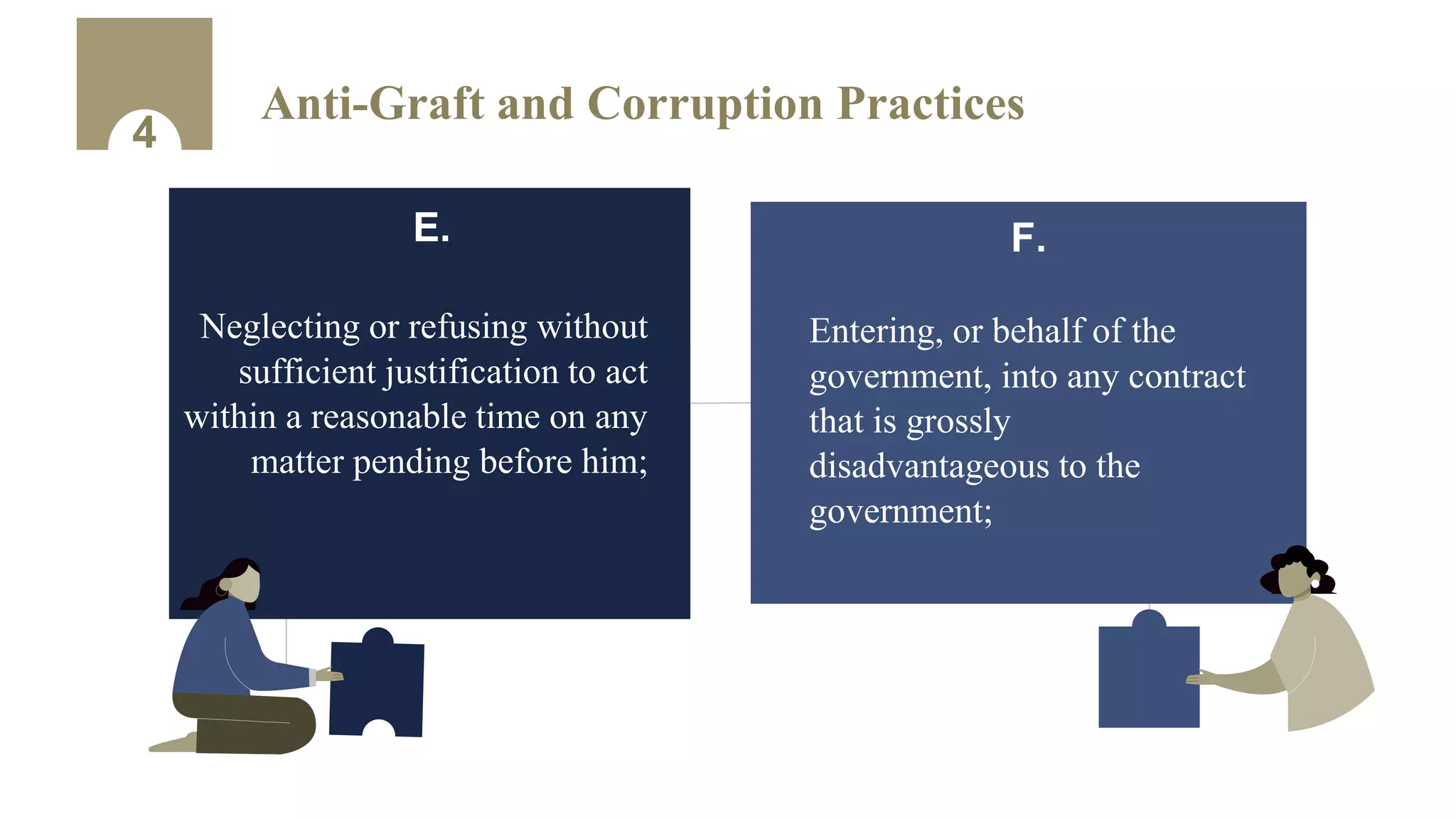
E.
Neglecting or refusing without
sufficient justification to act
within a reasonable time on any
matter pending before him;
F.
Entering, or behalf of the
government, into any contract
that is grossly
disadvantageous to the
government;
4
Anti-Graft and Corruption Practices
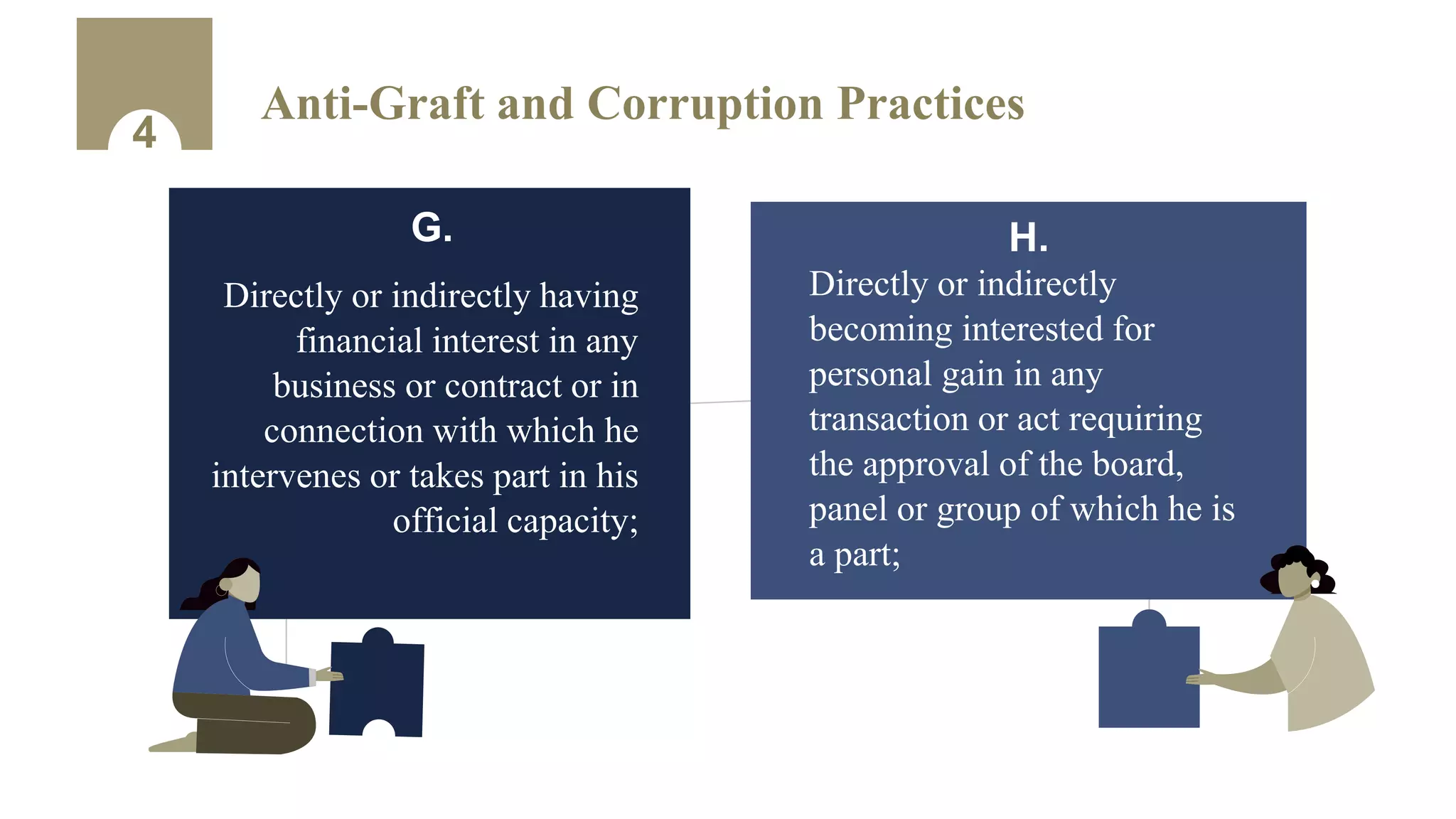
G.
Directly or indirectly having
financial interest in any
business or contract or in
connection with which he
intervenes or takes part in his
official capacity;
H.
Directly or indirectly
becoming interested for
personal gain in any
transaction or act requiring
the approval of the board,
panel or group of which he is
a part;
4
Anti-Graft and Corruption Practices
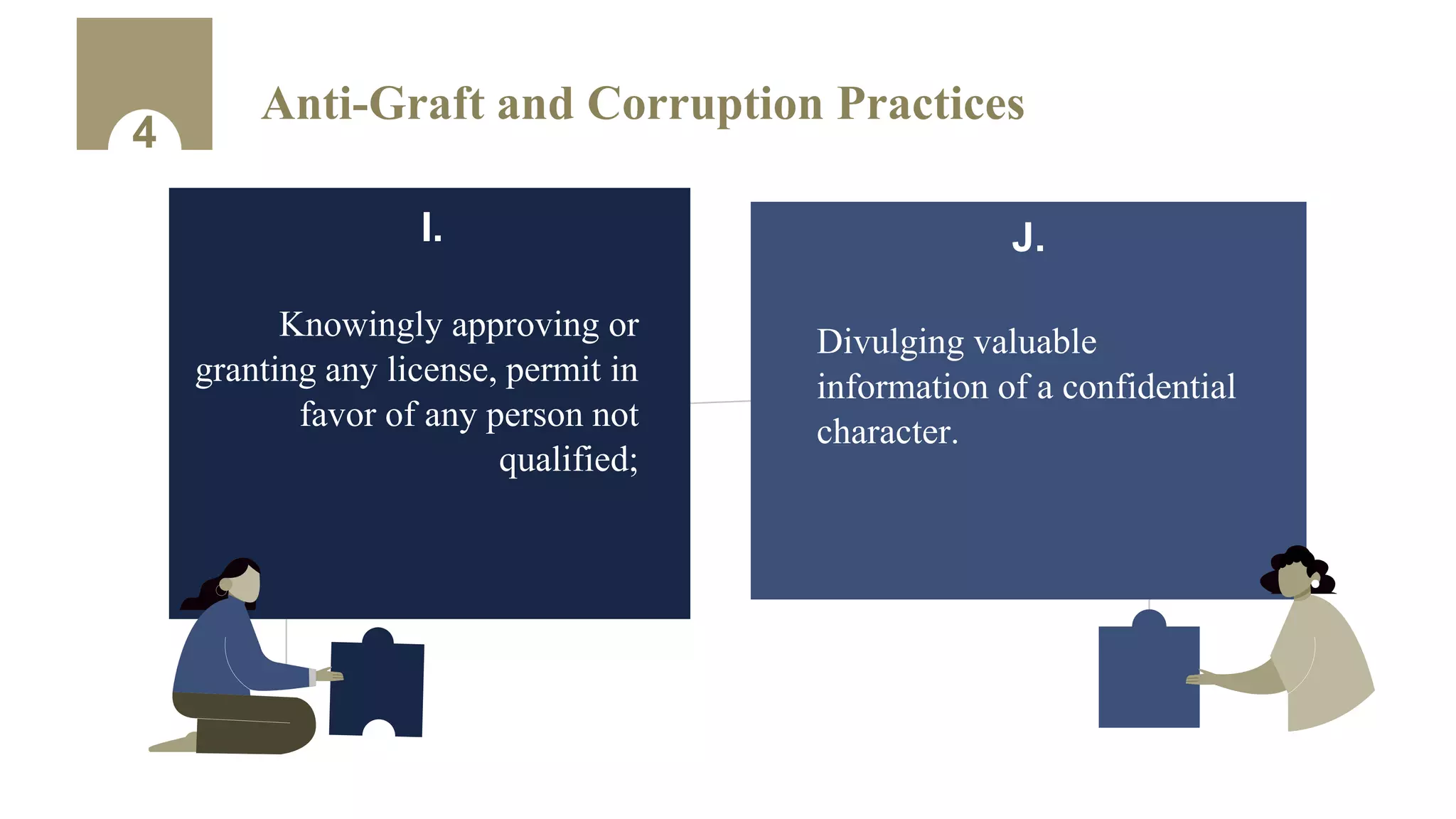
I.
Knowingly approving or
granting any license, permit in
favor of any person not
qualified;
J.
Divulging valuable
information of a confidential
character.
COPING WITH CORRUPTION THROUGH WORK ETHIC
AND ACCOUNTABILITY IN PUBLIC SERVICE
Code of Conduct and Ethical Standards for Public Officials
and Employees (RA6713)
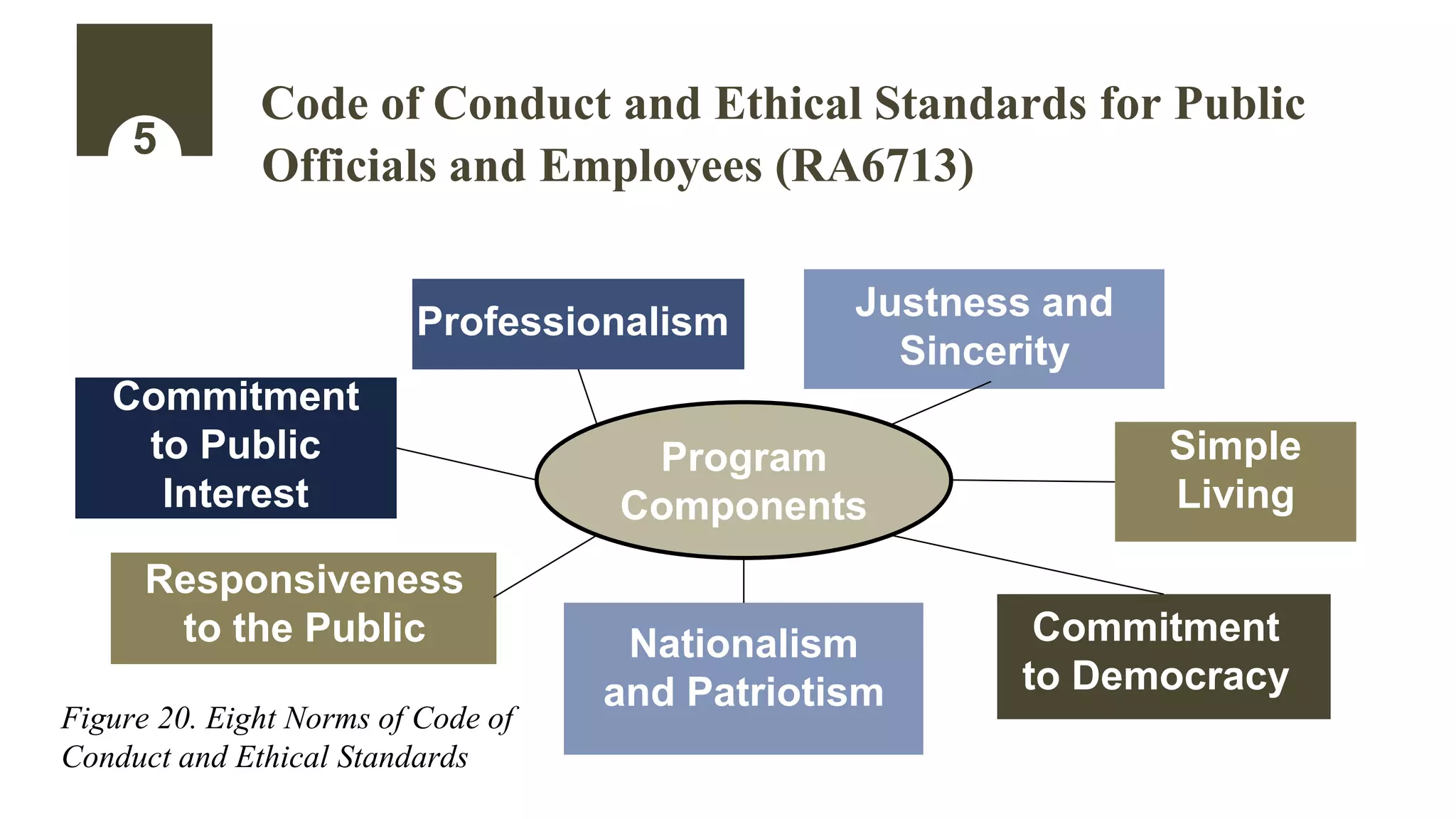
In 1989, the Philippine legislature passed RA 6713, a law
embodying the Code of Conduct and Ethical Standards for
Public Officials and Employees. According to a Civil Service
Commission Report on Ethics and Accountability in 2000, it is
said that the Code spells out in fine details the do’s and don’ts for
government officials and employees in and out of the workplace.
These do’s and don’ts are encapsulated in the eight norms of
conduct to be observed by all government officials and
employees.
5
Commitment
to Public
Interest
Professionalism
Nationalism
and Patriotism
Commitment
to Democracy
Simple
Living
Justness and
Sincerity
Responsiveness
to the Public
5
Code of Conduct and Ethical Standards for Public
Officials and Employees (RA6713)
Program
Components
Figure 20. Eight Norms of Code of
Conduct and Ethical Standards

COPING WITH CORRUPTION THROUGH WORK ETHIC AND ACCOUNTABILITY IN PUBLIC SERVICE.pptx

  • 1.
    COPING WITH CORRUPTION THROUGH WORK ETHICAND ACCOUNTABILITY IN PUBLIC SERVICE
  • 2.
    COPING WITH CORRUPTIONTHROUGH WORK ETHIC AND ACCOUNTABILITY IN PUBLIC SERVICE Transparency International (TI) is a global coalition against corruption. It is an international organization dedicated to documenting and tracing levels of government corruption. 01
  • 3.
    Country Rank Some SEA Countries 200 8 CPI Survey Used* Confidence Rating 4 Singapore9.2 9 9.0-9.3 47 Malaysia 5.1 9 4.5-5.7 80 Thailand 3.5 9 3.0-3.9 121 Vietnam 2.7 9 2.4-3.1 126 Indonesia 2.6 10 2.3-2.9 141 Philippines 2.3 9 2.1-2.5 145 East Timor 2.2 4 1.8-2.5 151 Laos 2.0 6 1.6-2.3 166 Cambodia 1.8 7 1.7-1.9 178 Myanmar 1.3 4 1.0-1,5 *Survey Used” Refers to the number of surveys that was used to assess a country’s performance. 17 surveys were used and at least three surveys were required for a country to be included in the Corruption Perception Index (CPI). **Corruption 0 to 10: A score of “10” means politics is totally clean while a score of “0” means that it is totally corrupt. Table 16. 2008 CPI in Some South East Asian Countries by Transparency International 1 Transparency International (TI)
  • 4.
    As stated, TransparencyInternational ranked Philippines as the 141st most corrupt government in the world in 2008. Corruption in the country is very high; politics is very dishonest as compared to other neighboring Southeast Asian states. On the contrary, Transparency International also identified 10 of the most clean and honest states in the world as shown in the table. Table 16. 2008 CPI in Some South East Asian Countries by Transparency International 1 Transparency International (TI)
  • 5.
    Country Rank Most Clean and HonestCountries 2008 CPI Survey Used Confidence Rating 1 Denmark 9.3 6 9.1-9.4 1 New Zealand 9.3 6 9.2-9.5 1 Sweden 9.3 6 9.2-9.4 4 Singapore 9.2 9 9.0-9.3 5 Finland 9.0 6 8.4-9.4 5 Switzerland 9.0 6 8.7-9.2 7 Iceland 8.9 5 8.1-9.4 7 Netherlands 8.9 6 8.5-9.1 9 Australia 8.7 8 8.2-9.1 9 Canada 8.7 6 8.4-9.1 Table 17. 2008 Transparency International’s Most Clean and Honest Government and Politics 1 Transparency International (TI)
  • 6.
    COPING WITH CORRUPTIONTHROUGH WORK ETHIC AND ACCOUNTABILITY IN PUBLIC SERVICE Ethics and Governance The integration of moral values and ethical standards in public administration is one effective strategy of responsive and good governance in the midst dishonesty, corruption, and mediocrity in the public service. Ethical values traits would ensure proper guidance among government employees only if these moral recovery principles are enforceable in actions among all public officials and employees, and punitive in character whenever violated, suppressed or restricted personal advantage. 02
  • 7.
    COPING WITH CORRUPTIONTHROUGH WORK ETHIC AND ACCOUNTABILITY IN PUBLIC SERVICE Ethics and Governance Ethics is gaining prominence in the discourse about governance today. There is a perception that standards in public life are in decline. This raises questions about the costs of misconduct on the part of those who have been entrusted with guarding public interests and resources. These costs are losses in trust and confidence in public institutions and losses in precious resources which were meant to support the economic and social development of nations and peoples. 02
  • 8.
    COPING WITH CORRUPTIONTHROUGH WORK ETHIC AND ACCOUNTABILITY IN PUBLIC SERVICE The Culture of Corruption Corruption means a “failure to carry out proper or public responsibilities because of the pursuit of personal gain.” In many countries, graft and corruption has indeed become a culture or a way of life. The culture of graft and corruption is an administrative issue since time, particularly in underdeveloped societies, and the Philippines is privy to this. In most cases, corruption has a material or narrowly financial character, its most particular political manifestation is bribery or sleaze. Regarding politics, corruption is understood with officials performing their public tasks improperly in order to receive individual repayment. 3
  • 9.
    Furthermore, studies ofcorruption in the Philippines point to these adversarial effects which include, but not limited to: 3 The Culture of Corruption Wastage of public resources as when infrastructure projects are poor; and substandard and do not last their projected useful lifetime; 01 Low revenue collection, as when bribes are paid in lieu of taxes and charges in revenue collecting agencies; 02 Other socially unfeasible behavior such as tax evasion and smuggling; 03 Cronyism, the highest form of corruption expressed in cartels and monopolies that reduce competitiveness in industry; 04 Increase in the cost of doing business in the country 05 Waste in the resources for development, which postpones the poor Filipino escape from poverty. 06
  • 10.
    COPING WITH CORRUPTIONTHROUGH WORK ETHIC AND ACCOUNTABILITY IN PUBLIC SERVICE Anti-Graft and Corruption Practices Corruption means a “failure to carry out proper or public responsibilities because of the pursuit of personal gain.” In many countries, graft and corruption has indeed become a culture or a way of life. The culture of graft and corruption is an administrative issue since time, particularly in underdeveloped societies, and the Philippines is privy to this. In most cases, corruption has a material or narrowly financial character, its most particular political manifestation is bribery or sleaze. Regarding politics, corruption is understood with officials performing their public tasks improperly in order to receive individual repayment. 4
  • 11.
    4 Anti-Graft and CorruptionPractices A. Persuading, inducing or influencing another public officer to perform an act constituting a violation of rules and regulations or an offense in connection with official duties or allowing himself to be persuaded, induced or influenced to commit such violation or offense; B. Directly or indirectly requesting or receiving any gift for himself or for any other person in connection with any contract between the government and other party;
  • 12.
    4 Anti-Graft and CorruptionPractices C. Accepting or having any member of his family accept employee in a private enterprise which has pending official business with him; D. Causing and undue injury to any party, including the government or giving any private party any unwarranted benefits in the discharge of his official functions;
  • 13.
    4 Anti-Graft and CorruptionPractices E. Neglecting or refusing without sufficient justification to act within a reasonable time on any matter pending before him; F. Entering, or behalf of the government, into any contract that is grossly disadvantageous to the government;
  • 14.
    4 Anti-Graft and CorruptionPractices G. Directly or indirectly having financial interest in any business or contract or in connection with which he intervenes or takes part in his official capacity; H. Directly or indirectly becoming interested for personal gain in any transaction or act requiring the approval of the board, panel or group of which he is a part;
  • 15.
    4 Anti-Graft and CorruptionPractices I. Knowingly approving or granting any license, permit in favor of any person not qualified; J. Divulging valuable information of a confidential character.
  • 16.
    COPING WITH CORRUPTIONTHROUGH WORK ETHIC AND ACCOUNTABILITY IN PUBLIC SERVICE Code of Conduct and Ethical Standards for Public Officials and Employees (RA6713) In 1989, the Philippine legislature passed RA 6713, a law embodying the Code of Conduct and Ethical Standards for Public Officials and Employees. According to a Civil Service Commission Report on Ethics and Accountability in 2000, it is said that the Code spells out in fine details the do’s and don’ts for government officials and employees in and out of the workplace. These do’s and don’ts are encapsulated in the eight norms of conduct to be observed by all government officials and employees. 5
  • 17.
    Commitment to Public Interest Professionalism Nationalism and Patriotism Commitment toDemocracy Simple Living Justness and Sincerity Responsiveness to the Public 5 Code of Conduct and Ethical Standards for Public Officials and Employees (RA6713) Program Components Figure 20. Eight Norms of Code of Conduct and Ethical Standards