6/17/2020 1
Objectives:
 History
 Introduction
 Epidemiology
 Aetiology
 Risk factors
 Pathology
 types
 clinical features
 investigation
 Management
 Complication
6/17/2020 2
Case presentation:
HISTORY:
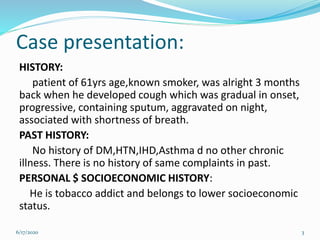
patient of 61yrs age,known smoker, was alright 3 months
back when he developed cough which was gradual in onset,
progressive, containing sputum, aggravated on night,
associated with shortness of breath.
PAST HISTORY:
No history of DM,HTN,IHD,Asthma d no other chronic
illness. There is no history of same complaints in past.
PERSONAL $ SOCIOECONOMIC HISTORY:
He is tobacco addict and belongs to lower socioeconomic
status.
6/17/2020 3
GENERAL PHYSICAL
EXAMINATION:
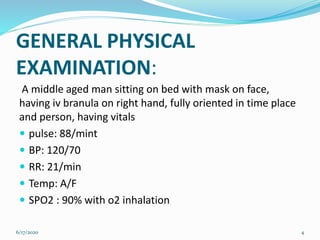
A middle aged man sitting on bed with mask on face,
having iv branula on right hand, fully oriented in time place
and person, having vitals
 pulse: 88/mint
 BP: 120/70
 RR: 21/min
 Temp: A/F
 SPO2 : 90% with o2 inhalation
6/17/2020 4
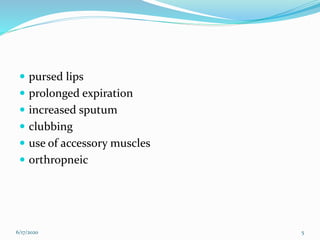
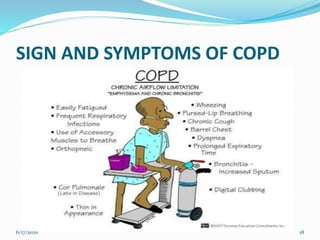
 pursed lips
 prolonged expiration
 increased sputum
 clubbing
 use of accessory muscles
 orthropneic
6/17/2020 5
 SYSTEMIC EXAMINATION:
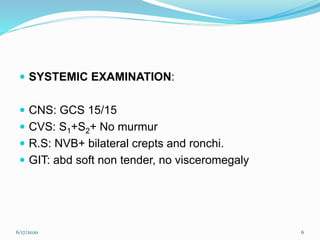
 CNS: GCS 15/15
 CVS: S1+S2+ No murmur
 R.S: NVB+ bilateral crepts and ronchi.
 GIT: abd soft non tender, no visceromegaly
6/17/2020 6
INVESTIGATION:
 CBC
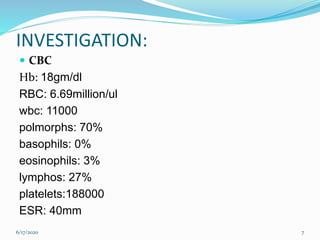
Hb: 18gm/dl
RBC: 6.69million/ul
wbc: 11000
polmorphs: 70%
basophils: 0%
eosinophils: 3%
lymphos: 27%
platelets:188000
ESR: 40mm
6/17/2020 7
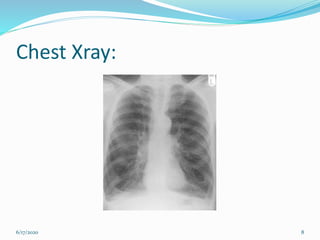
Chest Xray:
6/17/2020 8
Treatment given:
 Oxygen inhalation
 IV Moxifloxacin 400mg
 nebulization with ipratropium and betamethasone
 tab bamifylline 600mg
 anti tussive containg terbutaline and bromohexine given
6/17/2020 9
INTRODUCTION:
 COPD is defined as a preventable and treatable lung
disease with some significant extra pulmonary effects
that may contribute to the severity in individual
patients. The pulmonary component is characterized
by airflow limitation that is not fully reversible. The
airflow limitation is usually progressive and associated
with an abnormal inflammatory response of the lung
to noxious particles or gases
6/17/2020 10
EPIDEMIOLOGY
 Prevalence is directly related to the prevalence of tobacco
smoking and, in low- and middle-income countries, the
use of biomass fuels.
 Current estimates suggest that 80 million people world-
wide suffer from moderate to severe disease. In 2005,
COPD contributed to more than 3 million deaths (5% of
deaths globally), but by 2020 it is forecast to represent the
third most important cause of death world-wide.
6/17/2020 11
AETIOLOGY
 Cigarette smoking represents the most significant risk
factor for COPD and relates to both the amount and
the duration of smoking.
 It is unusual to develop COPD with less than 10 pack
years (1 pack year = 20 cigarettes/day/year) and not all
smokers develop the condition, suggesting that
individual susceptibility factors are important.
6/17/2020 12
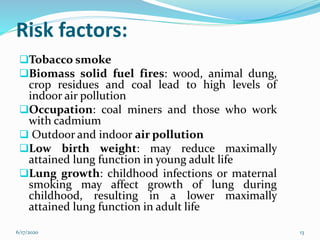
Risk factors:
Tobacco smoke
Biomass solid fuel fires: wood, animal dung,
crop residues and coal lead to high levels of
indoor air pollution
Occupation: coal miners and those who work
with cadmium
 Outdoor and indoor air pollution
Low birth weight: may reduce maximally
attained lung function in young adult life
Lung growth: childhood infections or maternal
smoking may affect growth of lung during
childhood, resulting in a lower maximally
attained lung function in adult life
6/17/2020 13
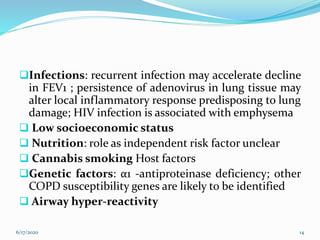
Infections: recurrent infection may accelerate decline
in FEV1 ; persistence of adenovirus in lung tissue may
alter local inflammatory response predisposing to lung
damage; HIV infection is associated with emphysema
 Low socioeconomic status
 Nutrition: role as independent risk factor unclear
 Cannabis smoking Host factors
Genetic factors: α1 -antiproteinase deficiency; other
COPD susceptibility genes are likely to be identified
 Airway hyper-reactivity
6/17/2020 14
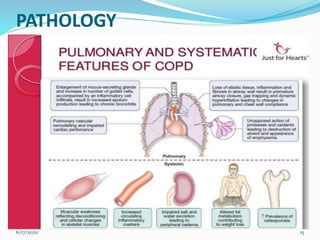
PATHOLOGY
6/17/2020 15
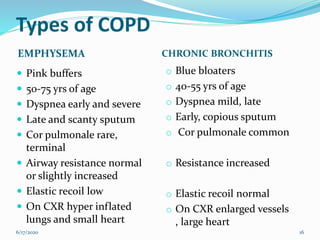
Types of COPD
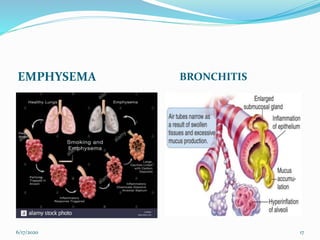
EMPHYSEMA CHRONIC BRONCHITIS
 Pink buffers
 50-75 yrs of age
 Dyspnea early and severe
 Late and scanty sputum
 Cor pulmonale rare,
terminal
 Airway resistance normal
or slightly increased
 Elastic recoil low
 On CXR hyper inflated
lungs and small heart
o Blue bloaters
o 40-55 yrs of age
o Dyspnea mild, late
o Early, copious sputum
o Cor pulmonale common
o Resistance increased
o Elastic recoil normal
o On CXR enlarged vessels
, large heart
6/17/2020 16
EMPHYSEMA BRONCHITIS
6/17/2020 17
SIGN AND SYMPTOMS OF COPD
6/17/2020 18
INVESTIGATION
 CBC to rule out anemia and polycythemia
 CXR
 SPIROMETRY
 HRCT chest
6/17/2020 19
Spirometric classification of COPD
6/17/2020 20
MANAGEMENT
1-SMOKING CESSATION : Reducing the
number of cigarettes smoked each day has little impact
on the course and prognosis of COPD, but complete
cessation is accompanied by an improvement in lung
function and deceleration in the rate of FEV1 decline.
Introduction of non-smoking cooking devices or the use
of alternative fuels should be encouraged.
6/17/2020 21
2-Bronchodilators:
Bronchodilator therapy is central to the management
of breathlessness. The inhaled route is preferred.
 Short-acting bronchodilators, such as the β2 -
agonists salbutamol and terbutaline, or the
anticholinergic, ipratropium bromide, may be used for
patients with mild disease.
 Longer acting bronchodilators, such as the β2 -
agonists salmeterol and formoterol, or the
anticholinergic tiotropium bromide, are more
appropriate for patients with moderate to severe
disease.
6/17/2020 22
 Oral bronchodilator therapy may be contemplated in
patients who cannot use inhaled devices efficiently.
Theophylline preparations improve breathlessness and
quality of life, but their use has been limited by side effects,
unpredictable metabolism and drug interactions.
Bambuterol, a pro-drug of terbutaline, is used on
occasion. Orally active highly selective
phosphodiesterase inhibitors are currently under
development.
6/17/2020 23
3-CORTICOSTEROIDS
 Inhaled corticosteroids (ICS) reduce the frequency and
severity of exacerbations; they are currently
recommended in patients with severe disease (FEV1 <
50%) who report two or more exacerbations requiring
antibiotics or oral steroids per year.
 Regular use is associated with a small improvement in
FEV1 , but they do not alter the natural history of the
FEV1 decline.
 It is more usual to prescribe a fixed combination of an
ICS with a LABA
6/17/2020 24
4-PULMONARY REHABILITATION:
 Exercise should be encouraged at all stages and patients should
be reassured that breathlessness, whilst distressing, is not
dangerous.
 Multidisciplinary programmes that incorporate physical
training, disease education and nutritional counseling reduce
symptoms, improve health status and enhance confidence.
 Most programmes include 2–3 sessions per week, last
between 6 and 12 weeks, and are accompanied by
demonstrable and sustained improvements in exercise tolerance
and health status.
6/17/2020 25
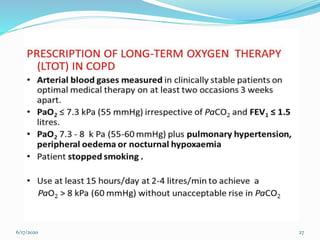
5-OXYGEN THERAPY:
 Long-term domiciliary oxygen therapy (LTOT) has been
shown to be of significant benefit in specific patients .
 It is most conveniently provided by an oxygen concentrator
and patients should be instructed to use oxygen for a
minimum of 15 hours/ day; greater benefits are seen in
patients who receive > 20 hours/day.
 The aim of therapy is to increase the PaO2 to at least 8
kPa (60 mmHg) or SaO2 to at least 90%.
6/17/2020 26
6/17/2020 27
6-SURGERY:
 Young patients in whom large bullae compress surrounding normal
lung tissue, who otherwise have minimal airflow limitation and a lack
of generalized emphysema, may be considered for bullectomy.
 Patients with predominantly upper lobe emphysema, with preserved
gas transference and no evidence of pulmonary hypertension, may
benefit from lung volume reduction surgery (LVRS), in which
peripheral emphysematous lung tissue is resected with the aim of
reducing hyperinflation and decreasing the work of breathing may
lead to improvements in FEV1 , lung volumes, exercise tolerance and
quality of life
6/17/2020 28
Other measures:
 Patients with COPD should be offered an
 annual influenza vaccination and, as appropriate,
pneumococcal vaccination.
 Obesity, poor nutrition, depression and social
isolation should be identified and, if possible,
improved.
 Mucolytic therapy such as acetylcysteine, or
antioxidant agents are occasionally used but with
limited evidence.
6/17/2020 29
PROGNOSIS:
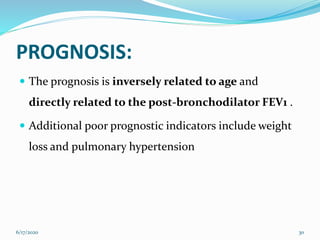
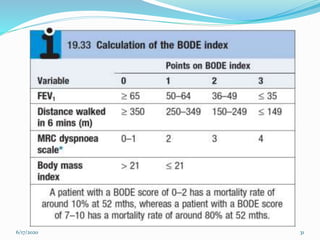
 The prognosis is inversely related to age and
directly related to the post-bronchodilator FEV1 .
 Additional poor prognostic indicators include weight
loss and pulmonary hypertension
6/17/2020 30
6/17/2020 31
6/17/2020 32

Copd (chronic obstructive pulmonary disease)

  • 1.
  • 2.
    Objectives:  History  Introduction Epidemiology  Aetiology  Risk factors  Pathology  types  clinical features  investigation  Management  Complication 6/17/2020 2
  • 3.
    Case presentation: HISTORY: patient of61yrs age,known smoker, was alright 3 months back when he developed cough which was gradual in onset, progressive, containing sputum, aggravated on night, associated with shortness of breath. PAST HISTORY: No history of DM,HTN,IHD,Asthma d no other chronic illness. There is no history of same complaints in past. PERSONAL $ SOCIOECONOMIC HISTORY: He is tobacco addict and belongs to lower socioeconomic status. 6/17/2020 3
  • 4.
    GENERAL PHYSICAL EXAMINATION: A middleaged man sitting on bed with mask on face, having iv branula on right hand, fully oriented in time place and person, having vitals  pulse: 88/mint  BP: 120/70  RR: 21/min  Temp: A/F  SPO2 : 90% with o2 inhalation 6/17/2020 4
  • 5.
     pursed lips prolonged expiration  increased sputum  clubbing  use of accessory muscles  orthropneic 6/17/2020 5
  • 6.
     SYSTEMIC EXAMINATION: CNS: GCS 15/15  CVS: S1+S2+ No murmur  R.S: NVB+ bilateral crepts and ronchi.  GIT: abd soft non tender, no visceromegaly 6/17/2020 6
  • 7.
    INVESTIGATION:  CBC Hb: 18gm/dl RBC:6.69million/ul wbc: 11000 polmorphs: 70% basophils: 0% eosinophils: 3% lymphos: 27% platelets:188000 ESR: 40mm 6/17/2020 7
  • 8.
  • 9.
    Treatment given:  Oxygeninhalation  IV Moxifloxacin 400mg  nebulization with ipratropium and betamethasone  tab bamifylline 600mg  anti tussive containg terbutaline and bromohexine given 6/17/2020 9
  • 10.
    INTRODUCTION:  COPD isdefined as a preventable and treatable lung disease with some significant extra pulmonary effects that may contribute to the severity in individual patients. The pulmonary component is characterized by airflow limitation that is not fully reversible. The airflow limitation is usually progressive and associated with an abnormal inflammatory response of the lung to noxious particles or gases 6/17/2020 10
  • 11.
    EPIDEMIOLOGY  Prevalence isdirectly related to the prevalence of tobacco smoking and, in low- and middle-income countries, the use of biomass fuels.  Current estimates suggest that 80 million people world- wide suffer from moderate to severe disease. In 2005, COPD contributed to more than 3 million deaths (5% of deaths globally), but by 2020 it is forecast to represent the third most important cause of death world-wide. 6/17/2020 11
  • 12.
    AETIOLOGY  Cigarette smokingrepresents the most significant risk factor for COPD and relates to both the amount and the duration of smoking.  It is unusual to develop COPD with less than 10 pack years (1 pack year = 20 cigarettes/day/year) and not all smokers develop the condition, suggesting that individual susceptibility factors are important. 6/17/2020 12
  • 13.
    Risk factors: Tobacco smoke Biomasssolid fuel fires: wood, animal dung, crop residues and coal lead to high levels of indoor air pollution Occupation: coal miners and those who work with cadmium  Outdoor and indoor air pollution Low birth weight: may reduce maximally attained lung function in young adult life Lung growth: childhood infections or maternal smoking may affect growth of lung during childhood, resulting in a lower maximally attained lung function in adult life 6/17/2020 13
  • 14.
    Infections: recurrent infectionmay accelerate decline in FEV1 ; persistence of adenovirus in lung tissue may alter local inflammatory response predisposing to lung damage; HIV infection is associated with emphysema  Low socioeconomic status  Nutrition: role as independent risk factor unclear  Cannabis smoking Host factors Genetic factors: α1 -antiproteinase deficiency; other COPD susceptibility genes are likely to be identified  Airway hyper-reactivity 6/17/2020 14
  • 15.
  • 16.
    Types of COPD EMPHYSEMACHRONIC BRONCHITIS  Pink buffers  50-75 yrs of age  Dyspnea early and severe  Late and scanty sputum  Cor pulmonale rare, terminal  Airway resistance normal or slightly increased  Elastic recoil low  On CXR hyper inflated lungs and small heart o Blue bloaters o 40-55 yrs of age o Dyspnea mild, late o Early, copious sputum o Cor pulmonale common o Resistance increased o Elastic recoil normal o On CXR enlarged vessels , large heart 6/17/2020 16
  • 17.
  • 18.
    SIGN AND SYMPTOMSOF COPD 6/17/2020 18
  • 19.
    INVESTIGATION  CBC torule out anemia and polycythemia  CXR  SPIROMETRY  HRCT chest 6/17/2020 19
  • 20.
  • 21.
    MANAGEMENT 1-SMOKING CESSATION :Reducing the number of cigarettes smoked each day has little impact on the course and prognosis of COPD, but complete cessation is accompanied by an improvement in lung function and deceleration in the rate of FEV1 decline. Introduction of non-smoking cooking devices or the use of alternative fuels should be encouraged. 6/17/2020 21
  • 22.
    2-Bronchodilators: Bronchodilator therapy iscentral to the management of breathlessness. The inhaled route is preferred.  Short-acting bronchodilators, such as the β2 - agonists salbutamol and terbutaline, or the anticholinergic, ipratropium bromide, may be used for patients with mild disease.  Longer acting bronchodilators, such as the β2 - agonists salmeterol and formoterol, or the anticholinergic tiotropium bromide, are more appropriate for patients with moderate to severe disease. 6/17/2020 22
  • 23.
     Oral bronchodilatortherapy may be contemplated in patients who cannot use inhaled devices efficiently. Theophylline preparations improve breathlessness and quality of life, but their use has been limited by side effects, unpredictable metabolism and drug interactions. Bambuterol, a pro-drug of terbutaline, is used on occasion. Orally active highly selective phosphodiesterase inhibitors are currently under development. 6/17/2020 23
  • 24.
    3-CORTICOSTEROIDS  Inhaled corticosteroids(ICS) reduce the frequency and severity of exacerbations; they are currently recommended in patients with severe disease (FEV1 < 50%) who report two or more exacerbations requiring antibiotics or oral steroids per year.  Regular use is associated with a small improvement in FEV1 , but they do not alter the natural history of the FEV1 decline.  It is more usual to prescribe a fixed combination of an ICS with a LABA 6/17/2020 24
  • 25.
    4-PULMONARY REHABILITATION:  Exerciseshould be encouraged at all stages and patients should be reassured that breathlessness, whilst distressing, is not dangerous.  Multidisciplinary programmes that incorporate physical training, disease education and nutritional counseling reduce symptoms, improve health status and enhance confidence.  Most programmes include 2–3 sessions per week, last between 6 and 12 weeks, and are accompanied by demonstrable and sustained improvements in exercise tolerance and health status. 6/17/2020 25
  • 26.
    5-OXYGEN THERAPY:  Long-termdomiciliary oxygen therapy (LTOT) has been shown to be of significant benefit in specific patients .  It is most conveniently provided by an oxygen concentrator and patients should be instructed to use oxygen for a minimum of 15 hours/ day; greater benefits are seen in patients who receive > 20 hours/day.  The aim of therapy is to increase the PaO2 to at least 8 kPa (60 mmHg) or SaO2 to at least 90%. 6/17/2020 26
  • 27.
  • 28.
    6-SURGERY:  Young patientsin whom large bullae compress surrounding normal lung tissue, who otherwise have minimal airflow limitation and a lack of generalized emphysema, may be considered for bullectomy.  Patients with predominantly upper lobe emphysema, with preserved gas transference and no evidence of pulmonary hypertension, may benefit from lung volume reduction surgery (LVRS), in which peripheral emphysematous lung tissue is resected with the aim of reducing hyperinflation and decreasing the work of breathing may lead to improvements in FEV1 , lung volumes, exercise tolerance and quality of life 6/17/2020 28
  • 29.
    Other measures:  Patientswith COPD should be offered an  annual influenza vaccination and, as appropriate, pneumococcal vaccination.  Obesity, poor nutrition, depression and social isolation should be identified and, if possible, improved.  Mucolytic therapy such as acetylcysteine, or antioxidant agents are occasionally used but with limited evidence. 6/17/2020 29
  • 30.
    PROGNOSIS:  The prognosisis inversely related to age and directly related to the post-bronchodilator FEV1 .  Additional poor prognostic indicators include weight loss and pulmonary hypertension 6/17/2020 30
  • 31.
  • 32.