IPY, IYB…:
freeing biodiversity data before the tipping point


              Bruno Danis, Mélianie Raymond

                     www.gbif.org
                   www.biodiversity.aq
Antarctic Biodiversity
• Highly adapted to extreme environment
• High level of endemism
• Mostly marine
• Estimations: possibly 20.000 species
• Under-studied (especially the deep sea)
• Probably very sensitive to CC
• but where’s the data?
Data availability

• Art 3.1 of Antarctic Treaty
• what? where? when?
• widely disseminated, patchy, hardly
  accessible
• (expensive) data and expertise are
  vanishing!
Sharing biodiversity data
• science-based, adaptative
  conservation and management
• testing fundamental theories
• consolidation of the community
• undisputed evidence of change/
  shifts
SCAR-MarBIN
 Marine Biodiversity Information Network

• www.scarmarbin.be
• Main funding: Belgian science Policy office
• International Polar Year 2007/08
• Census of Antarctic Marine Life
• Ocean Biogeographic Information System
• Global Biodiversity Information Network
ANTABIF
 Antarctic Biodiversity Information Facility


• www.biodiversity.aq
• Funding: Belgian science Policy office
• International Year of Biodiversity
• Evolution and Biodiversity in Antarctica
• Australian Antarctic Division
• Global Biodiversity Information Network
GBIF
Global Biodiversity Information Facility

• www.gbif.org
GBIF’s Mandate
”To facilitate free and open access to biodiversity data
worldwide, via the Internet, to underpin scientific
research, conservation and sustainable development.”


                       GBIF is govt-initiated, and govt. funded, in
                       response to government agency needs in
                       biodiversity information access and
                       management;

                       GBIF is in service to science, as a global
                       ‘public good’
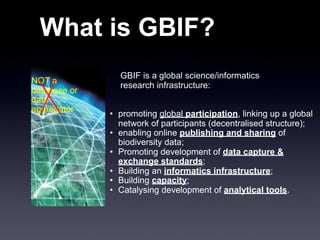
What is GBIF?
                GBIF is a global science/informatics
NOT a
                research infrastructure:
database or
data
aggregator
              • promoting global participation, linking up a global
                network of participants (decentralised structure);
              • enabling online publishing and sharing of
                biodiversity data;
              • Promoting development of data capture &
                exchange standards;
              • Building an informatics infrastructure;
              • Building capacity;
              • Catalysing development of analytical tools.
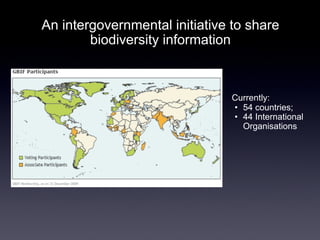
An intergovernmental initiative to share
        biodiversity information


                                Currently:
                                • 54 countries;
                                • 44 International
                                  Organisations
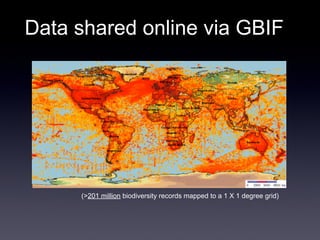
Data shared online via GBIF


     (>201 million biodiversity records mapped to a 1 X 1 degree grid)
General philosophy
• Build a network
• Offer free and open access to data and technology
• Expose all the (biodiversity) data and metadata
• Remain community-driven
• Adopt strong standardization
• Work for science, conservation, management
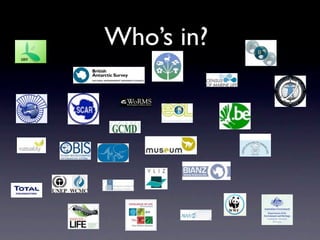
Who’s in?
[results]: webportal

             taxonomy, biogeography
                   vizualisation
                   open access
                 725,000 visitors
                  5,075,000 hits
              32,000,000 dld records
                V2alpha coming up
[results]: RAMS

                                                • The first RAMS
                                                • Board of 60+ editors
     all taxa


  all species
                                                • Feeds WoRMS, CoL and
                                                  EoL
valid species
                                                • 16,475 taxa
                0   3,750 7,500 11,250 15,000
                                                • 9,346 species
[results]: ANTOBIS

             1,088,044 records
                172 datasets
              106 geodatasets
                 5,235 taxa
             Feeds OBIS, GBIF
               Downloadable
                  WebGIS
                Webservices
[apps]: conservation
World Summit on Sustainable Development, 2001: “establish
comprehensive, effectively managed, and ecologically representative
networks of marine protected areas by 2012”
By 2010, collate relevant data for as many of the 11 priority regions
as possible (and other regions as appropriate), and characterise each
region in terms of biodiversity patterns and ecosystem processes,
physical environmental features and human activities.
By end 2011, submit proposals for candidate areas for protection to
the CCAMLR Scientific Committee.
By 2012, submit proposals on a representative system of Southern
Ocean MPAs to the CCAMLR Commission.
[apps]: modeling
Bivalve richness
10 environmental variables
[apps]: response to change
Cope or adapt
Move (deeper, south)
Go extinct


          1976 - 2003
      Over 2-fold decrease / 10 years

      Over 2-fold increase / 10 years
                                        Atkinson et al 2004
[apps]: where should we look?
Southern Limits                         Northern Limits


      Over 2-fold decrease / 10 years

      Over 2-fold increase / 10 years
                                         Barnes Atkinson et al 2004
                                                et al., 2009
[apps]: expedition design


 Limopsis prediction
 model fits actual data
 map shows where to go
[apps]: expedition design


 Limopsis prediction
 model fits actual data
 map shows where to go
!

!"#$%&'(&#&)*+'
!
                   [apps]: data exploration
                                                                                                     Strugnell J. British Antarctic Survey


!
                                                                                                 !
!"#$%&',"!     #$%!&'&()!*+,-%./!'0!())!,(.1*%!/(,2)%!/1&%/!(*3!/2%41%/!0'+*3!51&$1*!%(4$!
4%))!'0!(!67!'0!)(&1&+3%!-8!67!'0!)'*91&+3%!9.13:!0.',!31/&.1-+&1'*!.%4'.3/!1*!;<=>?@(.ABC"!!
#$%!.%3!)1*%!1*314(&%/!&$%!,%(*!2'/1&1'*!'0!&$%!=*&(.4&14!D')(.!E.'*&:!5$14$!3%01*%/!&$%!
,(F1,+,!*'.&$%.*!%F&%*&!'0!&$1/!/&+38"!!="!!;(,2)%!/1&%/"!!A"!!;2%41%/!.14$*%//!G&'&()!*+,-%.!
'0!())!,(.1*%!/2%41%/!.%4'.3%3!1*!&$(&!4%))H"!


                                                         !
"#$%&'!(!"      #$%&'%()*"+,-.$,/'.,0("01"+%2.3"456"01"/%(.3,)"-7528,(9",(".3%":0'.3%$("
[apps]: gaps analysis
• taxonomy: some groups
  under-represented
• spatial: deep-sea, Amundsen
  sea,...
• time: paleontology
• huge datasets are missing
[projects] some examples
ANTABIF (www.biodiversity.aq)
SCAR-MarBIN V2 alpha
Antarctic Field Guides
Georeferenced genetic data
Polar Macroscope Synthesis
Antarctic Biodiversity Atlas
[main] Challenges
Quickly evolving needs from the community
Gaps in the data: taxonomy (microbes, kinetics??),
spatial, temporal, institutional, IPY data
Fear to publish (but happy to use)
The community needs to value the publication of data
Funding: hard to make a DB look sexy...
[vision] The future

• Polar Information Commons (PIC): framework for
  long-term stewardship of polar data
• ongoing applications: fill the gaps, strategic
  conservation planning, optimized expedition
  design,...
• flying across disciplines...?
Jump in!


           www.scarmarbin.be
           www.biodiversity.aq
           www.gbif.org
           www.slideshare.net/scarmarbin

Danis&raymond

  • 1.
    IPY, IYB…: freeing biodiversitydata before the tipping point Bruno Danis, Mélianie Raymond www.gbif.org www.biodiversity.aq
  • 2.
    Antarctic Biodiversity • Highlyadapted to extreme environment • High level of endemism • Mostly marine • Estimations: possibly 20.000 species • Under-studied (especially the deep sea) • Probably very sensitive to CC • but where’s the data?
  • 3.
    Data availability • Art3.1 of Antarctic Treaty • what? where? when? • widely disseminated, patchy, hardly accessible • (expensive) data and expertise are vanishing!
  • 4.
    Sharing biodiversity data •science-based, adaptative conservation and management • testing fundamental theories • consolidation of the community • undisputed evidence of change/ shifts
  • 5.
    SCAR-MarBIN Marine BiodiversityInformation Network • www.scarmarbin.be • Main funding: Belgian science Policy office • International Polar Year 2007/08 • Census of Antarctic Marine Life • Ocean Biogeographic Information System • Global Biodiversity Information Network
  • 6.
    ANTABIF Antarctic BiodiversityInformation Facility • www.biodiversity.aq • Funding: Belgian science Policy office • International Year of Biodiversity • Evolution and Biodiversity in Antarctica • Australian Antarctic Division • Global Biodiversity Information Network
  • 7.
    GBIF Global Biodiversity InformationFacility • www.gbif.org
  • 8.
    GBIF’s Mandate ”To facilitatefree and open access to biodiversity data worldwide, via the Internet, to underpin scientific research, conservation and sustainable development.” GBIF is govt-initiated, and govt. funded, in response to government agency needs in biodiversity information access and management; GBIF is in service to science, as a global ‘public good’
  • 9.
    What is GBIF? GBIF is a global science/informatics NOT a research infrastructure: database or data aggregator • promoting global participation, linking up a global network of participants (decentralised structure); • enabling online publishing and sharing of biodiversity data; • Promoting development of data capture & exchange standards; • Building an informatics infrastructure; • Building capacity; • Catalysing development of analytical tools.
  • 10.
    An intergovernmental initiativeto share biodiversity information Currently: • 54 countries; • 44 International Organisations
  • 11.
    Data shared onlinevia GBIF (>201 million biodiversity records mapped to a 1 X 1 degree grid)
  • 12.
    General philosophy • Builda network • Offer free and open access to data and technology • Expose all the (biodiversity) data and metadata • Remain community-driven • Adopt strong standardization • Work for science, conservation, management
  • 13.
  • 14.
    [results]: webportal taxonomy, biogeography vizualisation open access 725,000 visitors 5,075,000 hits 32,000,000 dld records V2alpha coming up
  • 15.
    [results]: RAMS • The first RAMS • Board of 60+ editors all taxa all species • Feeds WoRMS, CoL and EoL valid species • 16,475 taxa 0 3,750 7,500 11,250 15,000 • 9,346 species
  • 16.
    [results]: ANTOBIS 1,088,044 records 172 datasets 106 geodatasets 5,235 taxa Feeds OBIS, GBIF Downloadable WebGIS Webservices
  • 17.
    [apps]: conservation World Summiton Sustainable Development, 2001: “establish comprehensive, effectively managed, and ecologically representative networks of marine protected areas by 2012” By 2010, collate relevant data for as many of the 11 priority regions as possible (and other regions as appropriate), and characterise each region in terms of biodiversity patterns and ecosystem processes, physical environmental features and human activities. By end 2011, submit proposals for candidate areas for protection to the CCAMLR Scientific Committee. By 2012, submit proposals on a representative system of Southern Ocean MPAs to the CCAMLR Commission.
  • 18.
    [apps]: modeling Bivalve richness 10environmental variables
  • 19.
    [apps]: response tochange Cope or adapt Move (deeper, south) Go extinct 1976 - 2003 Over 2-fold decrease / 10 years Over 2-fold increase / 10 years Atkinson et al 2004
  • 20.
    [apps]: where shouldwe look? Southern Limits Northern Limits Over 2-fold decrease / 10 years Over 2-fold increase / 10 years Barnes Atkinson et al 2004 et al., 2009
  • 21.
    [apps]: expedition design Limopsis prediction model fits actual data map shows where to go
  • 22.
    [apps]: expedition design Limopsis prediction model fits actual data map shows where to go
  • 23.
    ! !"#$%&'(&#&)*+' ! [apps]: data exploration Strugnell J. British Antarctic Survey ! ! !"#$%&',"! #$%!&'&()!*+,-%./!'0!())!,(.1*%!/(,2)%!/1&%/!(*3!/2%41%/!0'+*3!51&$1*!%(4$! 4%))!'0!(!67!'0!)(&1&+3%!-8!67!'0!)'*91&+3%!9.13:!0.',!31/&.1-+&1'*!.%4'.3/!1*!;<=>?@(.ABC"!! #$%!.%3!)1*%!1*314(&%/!&$%!,%(*!2'/1&1'*!'0!&$%!=*&(.4&14!D')(.!E.'*&:!5$14$!3%01*%/!&$%! ,(F1,+,!*'.&$%.*!%F&%*&!'0!&$1/!/&+38"!!="!!;(,2)%!/1&%/"!!A"!!;2%41%/!.14$*%//!G&'&()!*+,-%.! '0!())!,(.1*%!/2%41%/!.%4'.3%3!1*!&$(&!4%))H"! ! "#$%&'!(!" #$%&'%()*"+,-.$,/'.,0("01"+%2.3"456"01"/%(.3,)"-7528,(9",(".3%":0'.3%$("
  • 24.
    [apps]: gaps analysis •taxonomy: some groups under-represented • spatial: deep-sea, Amundsen sea,... • time: paleontology • huge datasets are missing
  • 25.
    [projects] some examples ANTABIF(www.biodiversity.aq) SCAR-MarBIN V2 alpha Antarctic Field Guides Georeferenced genetic data Polar Macroscope Synthesis Antarctic Biodiversity Atlas
  • 26.
    [main] Challenges Quickly evolvingneeds from the community Gaps in the data: taxonomy (microbes, kinetics??), spatial, temporal, institutional, IPY data Fear to publish (but happy to use) The community needs to value the publication of data Funding: hard to make a DB look sexy...
  • 27.
    [vision] The future •Polar Information Commons (PIC): framework for long-term stewardship of polar data • ongoing applications: fill the gaps, strategic conservation planning, optimized expedition design,... • flying across disciplines...?
  • 28.
    Jump in! www.scarmarbin.be www.biodiversity.aq www.gbif.org www.slideshare.net/scarmarbin