COORDINATE ALGEBRA
9th Grade Math
WHAT IS COORDINATE ALGEBRA?
• Coordinate Algebra
• Working with numbers, variables, graphs, statistics, ratios,
and geometry.
• Pulling each area together at the lowest base learning to
build upon as a high school student grows and achieves
grade levels.
• Gives life examples in order to help students understand
how math is used in the real world.
UNIT 1: RELATIONSHIPS BETWEEN
QUANTITIES
• In this unit, you will
• Study quantitative relationships.
• Learn how important units are for
• interpreting problems
• setting up equations.
•The focus will be on both one- and two-variable linear and
exponential equations.
QUANTITIES AND UNITS
• A quantity is an exact amount or measurement.
• Ex: A Quantity of a basket of eggs can be the amount of eggs within the
basket as a total sum: 4 white eggs plus 2 brown eggs equals 6 eggs.
• The quantity of the basket of eggs is 6.
• A more complex quantity is given but then how to convert into units to find
answers?
• Convert 5 miles to feet (Quantity). We know 1 mile is 5,280 feet. To solve the
problem we must look at it as an approximate (close too) the exact solution
or quantity. We then multiply 5 miles by 5, 280 ft. divided by 1 mile. We come
out with 26, 400 ft. as the quantity but the approximate Is the rounded whole
number of 26, 000 ft.
UNIT CONVERSION
• Now Your Turn:
• Convert 60 miles per hour to feet
per minute.
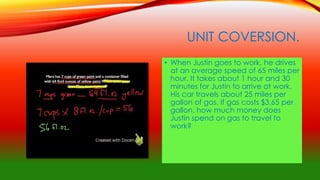
UNIT COVERSION.
• When Justin goes to work, he drives
at an average speed of 65 miles per
hour. It takes about 1 hour and 30
minutes for Justin to arrive at work.
His car travels about 25 miles per
gallon of gas. If gas costs $3.65 per
gallon, how much money does
Justin spend on gas to travel to
work?
HOW TO SOLVE?
• We know that it is 45 miles per hour so
we divide the miles by the time:
•
45 ,𝑚𝑖𝑙𝑒𝑠
60 𝑚𝑖𝑛.
• In order to convert we must use the
amount of feet as well:
•
45 𝑚𝑖𝑙𝑒𝑠
60 𝑚𝑖𝑛.
𝑥
5280 𝑓𝑡
1 𝑚𝑖𝑙𝑒
• We multiply 45 miles times 5,280 ft
because 5,280 ft equals one mile. We
then multiply The hour which is 60
minutes by each mile (1).
• The answer would be 3,960 ft. per min.
• First, calculate the distance Justin
travels.
• 65 miles per hour ● 1.5 hour = 97.5 miles
• Justin can travel 25 miles on 1 gallon of
gas.
• Because 97.5 miles is close to 100 miles,
he needs about 100 ÷ 25 = 4 gallons of
gas.
• To find the cost of gas to travel to work,
multiply cost per gallon by the number
of gallons.
• 4 x $3.65 = $14.60
• Justin spends $14.60 in his travels.
CONVERTING BY A SERIES OF
RATIOS.
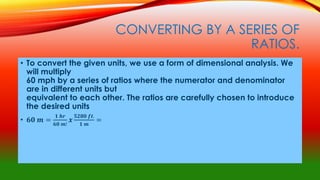
• To convert the given units, we use a form of dimensional analysis. We
will multiply
60 mph by a series of ratios where the numerator and denominator
are in different units but
equivalent to each other. The ratios are carefully chosen to introduce
the desired units
• 𝟔𝟎 𝒎 =
𝟏 𝒉𝒓
𝟔𝟎 𝒎!
𝒙
𝟓𝟐𝟖𝟎 𝒇𝒕.
𝟏 𝒎
=
STRUCTURE OF EXPRESSIONS
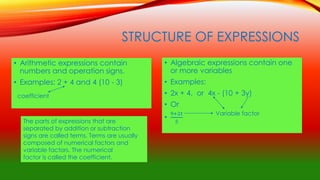
• Arithmetic expressions contain
numbers and operation signs.
• Examples: 2 + 4 and 4 (10 - 3)
• Algebraic expressions contain one
or more variables
• Examples:
• 2x + 4, or 4x - (10 + 3y)
• Or
•
9+2𝑡
5The parts of expressions that are
separated by addition or subtraction
signs are called terms. Terms are usually
composed of numerical factors and
variable factors. The numerical
factor is called the coefficient.
coefficient
Variable factor
UNIT CONVERSION WORD
PROBLEMS
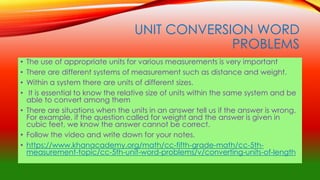
• The use of appropriate units for various measurements is very important
• There are different systems of measurement such as distance and weight.
• Within a system there are units of different sizes.
• It is essential to know the relative size of units within the same system and be
able to convert among them
• There are situations when the units in an answer tell us if the answer is wrong.
For example, if the question called for weight and the answer is given in
cubic feet, we know the answer cannot be correct.
• Follow the video and write down for your notes.
• https://www.khanacademy.org/math/cc-fifth-grade-math/cc-5th-
measurement-topic/cc-5th-unit-word-problems/v/converting-units-of-length
NOW THAT YOU KNOW…
• Complete the conversion worksheets
• Use the conversion sheet handed to you
• Use your notes from this power point
• Show your work
• Use scrap paper
• These are to be turned in before you leave.
• This is a grade for you!

COORDINATE ALGEBRA Unit One Power point

  • 1.
  • 2.
    WHAT IS COORDINATEALGEBRA? • Coordinate Algebra • Working with numbers, variables, graphs, statistics, ratios, and geometry. • Pulling each area together at the lowest base learning to build upon as a high school student grows and achieves grade levels. • Gives life examples in order to help students understand how math is used in the real world.
  • 3.
    UNIT 1: RELATIONSHIPSBETWEEN QUANTITIES • In this unit, you will • Study quantitative relationships. • Learn how important units are for • interpreting problems • setting up equations. •The focus will be on both one- and two-variable linear and exponential equations.
  • 4.
    QUANTITIES AND UNITS •A quantity is an exact amount or measurement. • Ex: A Quantity of a basket of eggs can be the amount of eggs within the basket as a total sum: 4 white eggs plus 2 brown eggs equals 6 eggs. • The quantity of the basket of eggs is 6. • A more complex quantity is given but then how to convert into units to find answers? • Convert 5 miles to feet (Quantity). We know 1 mile is 5,280 feet. To solve the problem we must look at it as an approximate (close too) the exact solution or quantity. We then multiply 5 miles by 5, 280 ft. divided by 1 mile. We come out with 26, 400 ft. as the quantity but the approximate Is the rounded whole number of 26, 000 ft.
  • 5.
    UNIT CONVERSION • NowYour Turn: • Convert 60 miles per hour to feet per minute.
  • 6.
    UNIT COVERSION. • WhenJustin goes to work, he drives at an average speed of 65 miles per hour. It takes about 1 hour and 30 minutes for Justin to arrive at work. His car travels about 25 miles per gallon of gas. If gas costs $3.65 per gallon, how much money does Justin spend on gas to travel to work?
  • 7.
    HOW TO SOLVE? •We know that it is 45 miles per hour so we divide the miles by the time: • 45 ,𝑚𝑖𝑙𝑒𝑠 60 𝑚𝑖𝑛. • In order to convert we must use the amount of feet as well: • 45 𝑚𝑖𝑙𝑒𝑠 60 𝑚𝑖𝑛. 𝑥 5280 𝑓𝑡 1 𝑚𝑖𝑙𝑒 • We multiply 45 miles times 5,280 ft because 5,280 ft equals one mile. We then multiply The hour which is 60 minutes by each mile (1). • The answer would be 3,960 ft. per min. • First, calculate the distance Justin travels. • 65 miles per hour ● 1.5 hour = 97.5 miles • Justin can travel 25 miles on 1 gallon of gas. • Because 97.5 miles is close to 100 miles, he needs about 100 ÷ 25 = 4 gallons of gas. • To find the cost of gas to travel to work, multiply cost per gallon by the number of gallons. • 4 x $3.65 = $14.60 • Justin spends $14.60 in his travels.
  • 8.
    CONVERTING BY ASERIES OF RATIOS. • To convert the given units, we use a form of dimensional analysis. We will multiply 60 mph by a series of ratios where the numerator and denominator are in different units but equivalent to each other. The ratios are carefully chosen to introduce the desired units • 𝟔𝟎 𝒎 = 𝟏 𝒉𝒓 𝟔𝟎 𝒎! 𝒙 𝟓𝟐𝟖𝟎 𝒇𝒕. 𝟏 𝒎 =
  • 9.
    STRUCTURE OF EXPRESSIONS •Arithmetic expressions contain numbers and operation signs. • Examples: 2 + 4 and 4 (10 - 3) • Algebraic expressions contain one or more variables • Examples: • 2x + 4, or 4x - (10 + 3y) • Or • 9+2𝑡 5The parts of expressions that are separated by addition or subtraction signs are called terms. Terms are usually composed of numerical factors and variable factors. The numerical factor is called the coefficient. coefficient Variable factor
  • 10.
    UNIT CONVERSION WORD PROBLEMS •The use of appropriate units for various measurements is very important • There are different systems of measurement such as distance and weight. • Within a system there are units of different sizes. • It is essential to know the relative size of units within the same system and be able to convert among them • There are situations when the units in an answer tell us if the answer is wrong. For example, if the question called for weight and the answer is given in cubic feet, we know the answer cannot be correct. • Follow the video and write down for your notes. • https://www.khanacademy.org/math/cc-fifth-grade-math/cc-5th- measurement-topic/cc-5th-unit-word-problems/v/converting-units-of-length
  • 11.
    NOW THAT YOUKNOW… • Complete the conversion worksheets • Use the conversion sheet handed to you • Use your notes from this power point • Show your work • Use scrap paper • These are to be turned in before you leave. • This is a grade for you!