Dr Mary Varghese
Assistant Professor
Seva Sadan’s College of Education
CO-OPERATIVE LEARNING TECHNIQUES
CO-OPERATIVE
LEARNING
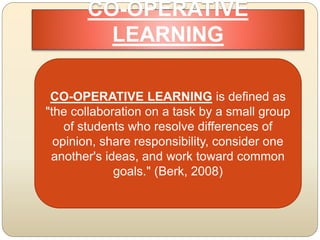
CO-OPERATIVE LEARNING is defined as
"the collaboration on a task by a small group
of students who resolve differences of
opinion, share responsibility, consider one
another's ideas, and work toward common
goals." (Berk, 2008)
CHARACTERISTICS /FIVE
ESSENTIAL ELEMENTS
 1)Positive Interdependence:
 2) Face-to-Face: Promote Interaction
(promote each other’s success)..
 3) Individual Accountability/Personal
Responsibility and group
responsibility
 4) Teamwork Skills: (Interpersonal
and small group skill)
 5) Group Processing:
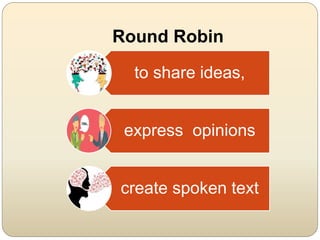
Round Robin
to share ideas,
express opinions
create spoken text
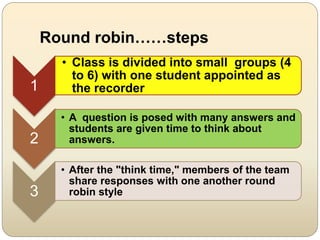
Round robin……steps
1
• Class is divided into small groups (4
to 6) with one student appointed as
the recorder
2
• A question is posed with many answers and
students are given time to think about
answers.
3
• After the "think time," members of the team
share responses with one another round
robin style
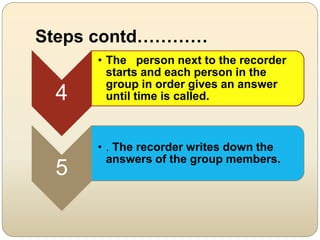
Steps contd…………
4
• The person next to the recorder
starts and each person in the
group in order gives an answer
until time is called.
5
• . The recorder writes down the
answers of the group members.
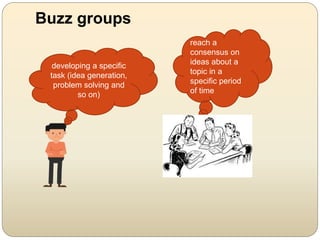
Buzz groups
developing a specific
task (idea generation,
problem solving and
so on)
reach a
consensus on
ideas about a
topic in a
specific period
of time
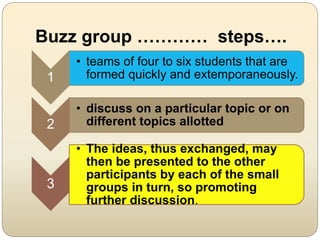
Buzz group ………… steps….
1
• teams of four to six students that are
formed quickly and extemporaneously.
2
• discuss on a particular topic or on
different topics allotted
3
• The ideas, thus exchanged, may
then be presented to the other
participants by each of the small
groups in turn, so promoting
further discussion.
THANK YOU

Co-operative learning

  • 1.
    Dr Mary Varghese AssistantProfessor Seva Sadan’s College of Education CO-OPERATIVE LEARNING TECHNIQUES
  • 2.
    CO-OPERATIVE LEARNING CO-OPERATIVE LEARNING isdefined as "the collaboration on a task by a small group of students who resolve differences of opinion, share responsibility, consider one another's ideas, and work toward common goals." (Berk, 2008)
  • 3.
    CHARACTERISTICS /FIVE ESSENTIAL ELEMENTS 1)Positive Interdependence:  2) Face-to-Face: Promote Interaction (promote each other’s success)..  3) Individual Accountability/Personal Responsibility and group responsibility  4) Teamwork Skills: (Interpersonal and small group skill)  5) Group Processing:
  • 5.
    Round Robin to shareideas, express opinions create spoken text
  • 6.
    Round robin……steps 1 • Classis divided into small groups (4 to 6) with one student appointed as the recorder 2 • A question is posed with many answers and students are given time to think about answers. 3 • After the "think time," members of the team share responses with one another round robin style
  • 7.
    Steps contd………… 4 • Theperson next to the recorder starts and each person in the group in order gives an answer until time is called. 5 • . The recorder writes down the answers of the group members.
  • 8.
    Buzz groups developing aspecific task (idea generation, problem solving and so on) reach a consensus on ideas about a topic in a specific period of time
  • 9.
    Buzz group …………steps…. 1 • teams of four to six students that are formed quickly and extemporaneously. 2 • discuss on a particular topic or on different topics allotted 3 • The ideas, thus exchanged, may then be presented to the other participants by each of the small groups in turn, so promoting further discussion.
  • 10.