
Chapter 2
Considering Self
Amy Eckert/Getty Images
The self is an evolving composite of three
components that develop continually over time based
on life experience.
The Components of Self
GlynisSelinaArban/ContourbyGettyImages
Self-Awareness
Self-awareness is the ability to view yourself as a
unique person and to reflect on your thoughts,
feelings, and behaviors.
Social comparison is observing and assigning
meaning to others’ behavior and then comparing it
with your own.
Self-concept is your overall perception of who you
are, based on the beliefs, attitudes, and values you
have about yourself.
Looking-glass self is your self-concept as shaped by
what you believe others think of you.
Self-Concept
Self-fulfilling prophecies are predictions about
future interactions that lead us to behave in ways
that ensure the interaction unfolds as we predicted.
Self-Concept (cont.)
RonnieKaufman/LarryHirshowitz/GettyImages
Self-Esteem
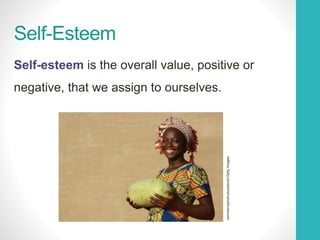
Self-esteem is the overall value, positive or
negative, that we assign to ourselves.
commerceandculturestock/GettyImages
Low Self-Esteem: A Vicious Cycle
Figure 2.1
Self-discrepancy theory suggests that your self-
esteem is determined by how you compare to your
ideal self and ought self.
Self-Esteem (cont.)
AllanGrant/Time&LifePictures/GettyImages
Our selves are shaped by the powerful outside forces
of gender, family, and culture.
The Sources of Self
PaulBradbury/GettyImages
Gender and Self
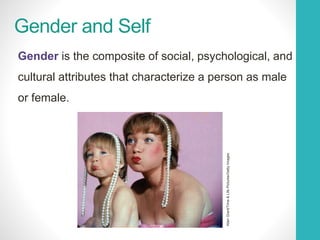
Gender is the composite of social, psychological, and
cultural attributes that characterize a person as male
or female.
AllanGrant/Time&LifePictures/GettyImages
Family and Self
Our interactions with caregivers shape two
dimensions of our behavior:
• Attachment anxiety
• Attachment avoidance
Family and Self (cont.)
There are four attachment styles:
1. Secure attachment
2. Preoccupied attachment
3. Dismissive attachment
4. Fearful attachment
Culture and Self
Culture is an established, coherent set of beliefs,
attitudes, values, and practices shared by a large
group of people.
Belonging to an individualistic or a
collectivistic culture shapes our views of self.
Presenting Your Self
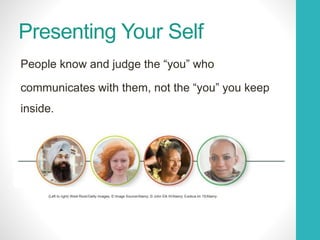
People know and judge the “you” who
communicates with them, not the “you” you keep
inside.
(Left to right) West Rock/Getty Images; © Image Source/Alamy; © John Elk III/Alamy; Exotica.im 15/Alamy
Maintaining Your Public Self
When you communicate with others, you present a
public self or face.
PhotoAP/TheArizonaRepublic,MichaelChow
Maintaining Your Public Self
(cont.)
A mask is a public self designed to conceal your
private self.
Embarrassment can result when information is
revealed that contradicts your face.
The Importance of Online Self-
Presentation
Interacting online gives us the freedom to be flexible
with our identities and to control how others perceive
us.
The Importance of Online Self-
Presentation (cont.)
Always consider the warranting value of information
presented to you online—that is, the degree to which
it is supported by other people and outside evidence.
Improving Your Online
Self-Presentation
What others say about you online is more important
than what you say about yourself.
BenPruchnie/GCImages/GettyImages
Improving Your Online
Self-Presentation (cont.)
Three ways to improve online self-presentation:
1. Be wary of information that contradicts your self-
image.
2. Routinely conduct Web searches on yourself.
3. Keep the interview test in mind.
The Relational Self
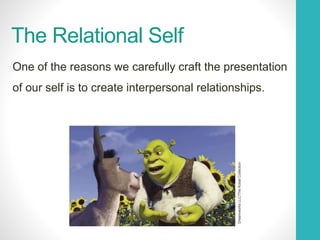
One of the reasons we carefully craft the presentation
of our self is to create interpersonal relationships.
DreamworksLLC/TheKobalCollection
Opening Your Self to Others
According to social penetration theory,
revealing the self to others involves peeling back
or penetrating layers.
There are three layers to the self:
1. Outermost, peripheral layers
2. Intermediate layers
3. Central layers
The Layers of Self
Figure 2.2
Opening Your Self to Others
(cont.)
The revealing of self involves two things:
• Breadth: the number of different
aspects of self revealed at each layer•
Depth: how deeply into each other’s self the
partners have penetrated
Opening Your Self to Others
(cont.)
Intimacy is the feeling of closeness
and “union” that exists between us and our
partners.
CathyYeulet/123RF.com
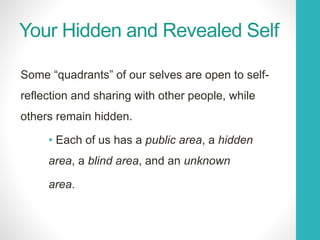
Your Hidden and Revealed Self
Some “quadrants” of our selves are open to self-
reflection and sharing with other people, while
others remain hidden.
• Each of us has a public area, a hidden
area, a blind area, and an unknown
area.
The Johari Window
Figure 2.3
Disclosing Your Self to Others
Self-disclosure is revealing private information
about your self to others.
• Interpersonal process model of
intimacy: the closeness we feel toward
others is created through self-disclosure
and the responsiveness of listeners.
Disclosing Your Self to Others
(cont.)
Self-disclosure:
1. Varies across and within cultures
2. Happens more quickly online
3. Promotes mental health
4. Occurs among men and women equally
Disclosing Your Self to Others
(cont.)
Improve your self-disclosure skills:
1. Know yourself.
2. Know your audience.
3. Don’t force others to self-disclose.
4. Don’t presume gender preferences.
5. Be sensitive to cultural differences.
6. Go slowly.

Reflect and Relate - PowerPoint - Chapter 2

  • 1.
    Chapter 2 Considering Self AmyEckert/Getty Images
  • 2.
    The self isan evolving composite of three components that develop continually over time based on life experience. The Components of Self GlynisSelinaArban/ContourbyGettyImages
  • 3.
    Self-Awareness Self-awareness is theability to view yourself as a unique person and to reflect on your thoughts, feelings, and behaviors. Social comparison is observing and assigning meaning to others’ behavior and then comparing it with your own.
  • 4.
    Self-concept is youroverall perception of who you are, based on the beliefs, attitudes, and values you have about yourself. Looking-glass self is your self-concept as shaped by what you believe others think of you. Self-Concept
  • 5.
    Self-fulfilling prophecies arepredictions about future interactions that lead us to behave in ways that ensure the interaction unfolds as we predicted. Self-Concept (cont.) RonnieKaufman/LarryHirshowitz/GettyImages
  • 6.
    Self-Esteem Self-esteem is theoverall value, positive or negative, that we assign to ourselves. commerceandculturestock/GettyImages
  • 7.
    Low Self-Esteem: AVicious Cycle Figure 2.1
  • 8.
    Self-discrepancy theory suggeststhat your self- esteem is determined by how you compare to your ideal self and ought self. Self-Esteem (cont.) AllanGrant/Time&LifePictures/GettyImages
  • 9.
    Our selves areshaped by the powerful outside forces of gender, family, and culture. The Sources of Self PaulBradbury/GettyImages
  • 10.
    Gender and Self Genderis the composite of social, psychological, and cultural attributes that characterize a person as male or female. AllanGrant/Time&LifePictures/GettyImages
  • 11.
    Family and Self Ourinteractions with caregivers shape two dimensions of our behavior: • Attachment anxiety • Attachment avoidance
  • 12.
    Family and Self(cont.) There are four attachment styles: 1. Secure attachment 2. Preoccupied attachment 3. Dismissive attachment 4. Fearful attachment
  • 13.
    Culture and Self Cultureis an established, coherent set of beliefs, attitudes, values, and practices shared by a large group of people. Belonging to an individualistic or a collectivistic culture shapes our views of self.
  • 14.
    Presenting Your Self Peopleknow and judge the “you” who communicates with them, not the “you” you keep inside. (Left to right) West Rock/Getty Images; © Image Source/Alamy; © John Elk III/Alamy; Exotica.im 15/Alamy
  • 15.
    Maintaining Your PublicSelf When you communicate with others, you present a public self or face. PhotoAP/TheArizonaRepublic,MichaelChow
  • 16.
    Maintaining Your PublicSelf (cont.) A mask is a public self designed to conceal your private self. Embarrassment can result when information is revealed that contradicts your face.
  • 17.
    The Importance ofOnline Self- Presentation Interacting online gives us the freedom to be flexible with our identities and to control how others perceive us.
  • 18.
    The Importance ofOnline Self- Presentation (cont.) Always consider the warranting value of information presented to you online—that is, the degree to which it is supported by other people and outside evidence.
  • 19.
    Improving Your Online Self-Presentation Whatothers say about you online is more important than what you say about yourself. BenPruchnie/GCImages/GettyImages
  • 20.
    Improving Your Online Self-Presentation(cont.) Three ways to improve online self-presentation: 1. Be wary of information that contradicts your self- image. 2. Routinely conduct Web searches on yourself. 3. Keep the interview test in mind.
  • 21.
    The Relational Self Oneof the reasons we carefully craft the presentation of our self is to create interpersonal relationships. DreamworksLLC/TheKobalCollection
  • 22.
    Opening Your Selfto Others According to social penetration theory, revealing the self to others involves peeling back or penetrating layers. There are three layers to the self: 1. Outermost, peripheral layers 2. Intermediate layers 3. Central layers
  • 23.
    The Layers ofSelf Figure 2.2
  • 24.
    Opening Your Selfto Others (cont.) The revealing of self involves two things: • Breadth: the number of different aspects of self revealed at each layer• Depth: how deeply into each other’s self the partners have penetrated
  • 25.
    Opening Your Selfto Others (cont.) Intimacy is the feeling of closeness and “union” that exists between us and our partners. CathyYeulet/123RF.com
  • 26.
    Your Hidden andRevealed Self Some “quadrants” of our selves are open to self- reflection and sharing with other people, while others remain hidden. • Each of us has a public area, a hidden area, a blind area, and an unknown area.
  • 27.
  • 28.
    Disclosing Your Selfto Others Self-disclosure is revealing private information about your self to others. • Interpersonal process model of intimacy: the closeness we feel toward others is created through self-disclosure and the responsiveness of listeners.
  • 29.
    Disclosing Your Selfto Others (cont.) Self-disclosure: 1. Varies across and within cultures 2. Happens more quickly online 3. Promotes mental health 4. Occurs among men and women equally
  • 30.
    Disclosing Your Selfto Others (cont.) Improve your self-disclosure skills: 1. Know yourself. 2. Know your audience. 3. Don’t force others to self-disclose. 4. Don’t presume gender preferences. 5. Be sensitive to cultural differences. 6. Go slowly.