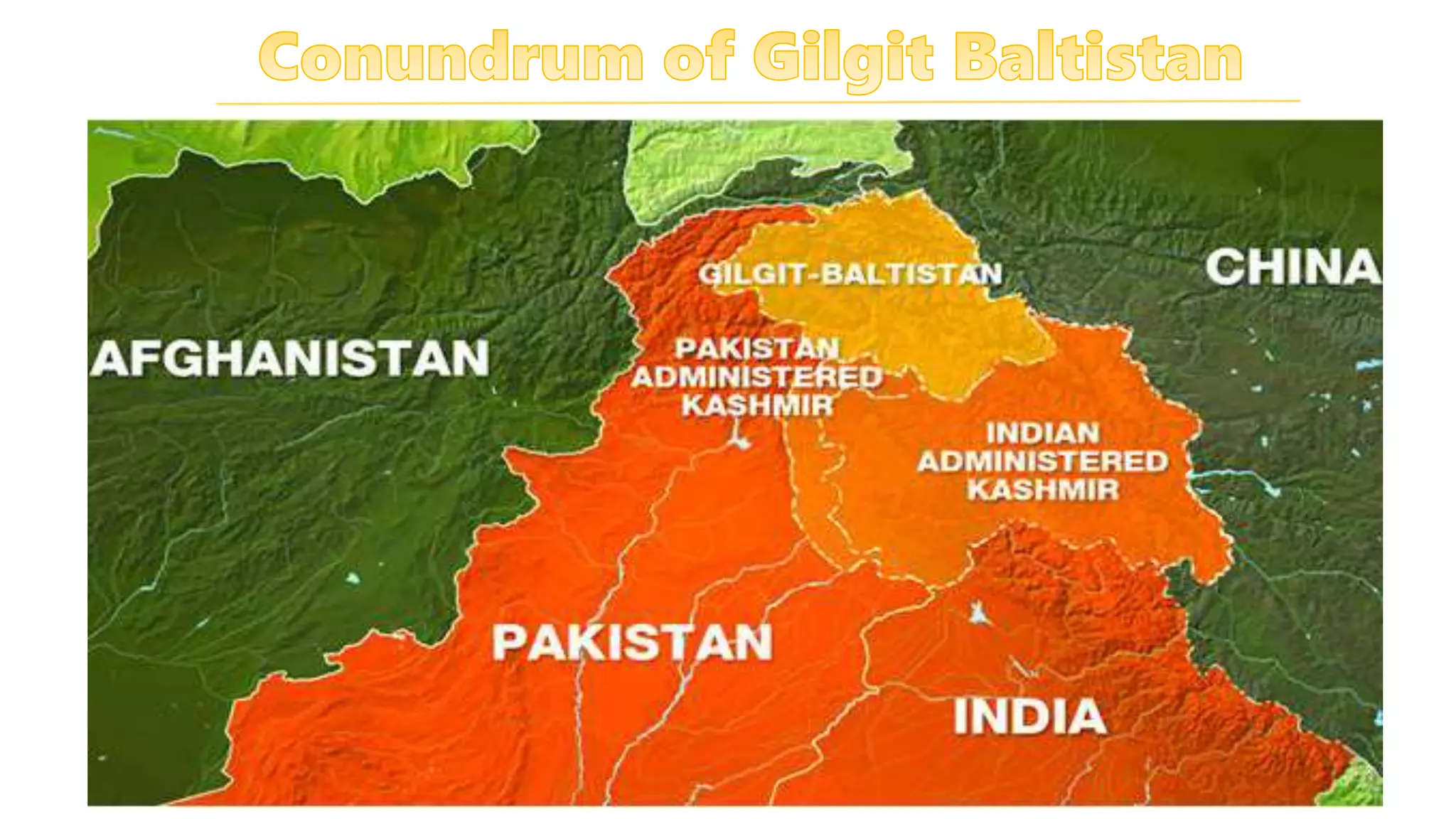
Geography, Demography and Units
• 72971 km₂ of area and Population of 2.5 million (25
lakh)
• Three units, Baltistan, Gilgit, Diamar.
• The Himalia, the Karakorum and Hindukush.
• Five out of fourteen “Eight-thousanders” and 535
internationally recognized mountain peaks
INTRODUCTION
Disputed
Since
1948
Strategic importance
• Position on the globe, climate and highly defensive
mountain ranges.
• shares boundaries with four countries.
• Buffer between USSR and India.
• CPEC
Early History of the region
• human presence since 2000BC
• By 5th century AD Buddhist ruled the region.
• Maqpoon kingdom emerged from Skardu and ruled the
whole region.
• By the 13th century Islam flourished.
• Gulab singh invade and capture under Sikh rule in
1840s.
Reflections of Buddhism in GB
Reflections Maqpoon Kingdom
Reflections of Dogras and Independent
Reflections of early Islam
COLONIAL HISTORY
Dogra Raj -The Godfather of Kashmir and GB Issues
• Sikh dominancy.
• Anglo-Sikh war (1845-46) and Treaty of Amritsar (15 March 1846).
• Establishment of Dogra Raj by Gulaab Singh, under influence of EIC.
• USSR menace and Gilgit scout.
• Dual British-Dogra control.
• British took Gilgit on Lease for 60 years in 1935.
• Abrupt cancelation of the lease on 1 Aug 1947.
• Accession of Kashmir with India.
Independence and Accession with Pakistan
• The Gilgit Revolution followed by an independent State the Islamic
Republic of Gilgit on 1st Nov 1947.
• IRG access with Pakistan unconditionally.
• Baltistan got independent on 14 Aug 1948 and access with Pakistan
Unconditionally.
Sikh Era
British-Dogra
Era
Gilgit scout
Kashmir acceded
to India
POST INDEPENDENT HISTORY
United Nations Security Council Resolution 1948
• India rose the case of Kashmir to UNSC.
• Pakistan declared the whole region, including Gilgit Agency, Diamar, Kargil and
Baltistan, as disputed part of Kashmir to get more votes in plebiscites.
• GB officially and internationally became a part of Kashmir Issue.
• States Subject Rule (as per UNCIP).
FCR- Frontier Crime Regulation
• Pakistan imposed FCR (Black Law) on GB
• Not eligible for Appeal, Wakeel, Daleel.
• Some other Features of FCR are; Arresting without specifying the crime,
collective punishment of family, no system of courts, government can seize
private property, Can punish an individual without due process.
• Restrict the rights of security, dignity, freedom of speech, and other basic
rights.
• Khalisa Sarkar laws were imposed.
Karachi Agreement 1949
• Agreement between GoP and representatives of AJK regarding power
distribution of Kashmir.
• AJK handed over GB to government of Pakistan.
• The documents of this agreement were kept secret till 1990s.
Reforms & Ordinance to Run the Administration of GB
• 1950 Federal Government established Ministry of KANA.
• An Advisory council was established in 1970, consist of 16 members also
given the name as Northern Areas (NA).
• In 1974, demolished the FCR and Princely state (Rajgiri) by Zulfiqar Ali
Bhutto.
• Legal Framework ORDER (LFO) was introduced by Benazir Bhutto
• First ever Party based election were held in GB in 1994, and 24 members
were elected as members of an Executive Council
SELF GOVERNANCE ORDINACE 2009
• Federal cabinet approved the ordinance on Aug 29, 2009.
• The name “Gilgit-Baltistan” was officially recognized.
• A 24 membered assembly (Powers to make laws on 61 subjects) and a chief
minister was granted
• Positions of Governor, and civil service commission, a chief election commissioner
were established.
• Some judicial reforms (Supreme Appellate Court).
THE THREE PROSPECTIVES
Functionalist Prospective
“The society has interrelated parts which influenced each other in a web-like manner”
• GB conundrum is affected by other issues and is effecting many other issues.
GB
CONUNDRUM
KASHMIR
ISSUE
Political
crisis in Pak
INDO-PAK
RELATIION
DOGRA
RAJ
No local
Movement
s
CPEC
PAK-CHINE
RELATION
Pakistan’s
Integrity
UNABLE TO
UTILIZE
RESOURCES
RIGHTS OF
LOCALS
Conflict Prospective
• MECHANICAL SOLIDARITY: Incremental changes in past 75 Years
• LATEST FUNCTION: Came into being unintentionally while trying to win Kashmir.
SOLUTION:
 Research and study the ultimate causes and effect.
 Bring Organic Solidarity.
 Create new organizations (give basic rights).
“Society faces conflicts due to inequalities in class, sects, ethnicity and other centrifugal elements”
CONFLICT FOR INDEPENDENCE: Between Locals and Dogras.
CONFLICT FOR RESOURCES/RULE: Between India and Pakistan.
CONFLICT FOR RIGHTS: Between locals and GOP.
SOLUTION:
 Negotiation between Groups.
 Need strong Social Movement
“Deviances in opinion makes the problem subjective”
• Subjective coating to the issue.
• Each group of the society wants the solution goes in their favor.
SOLUTION:
 Make the system/opinions less rigid.
 Re-Socializing -changing the groups social Values.
Symbolic Interaction

CONUNDRUM OF GILGIT BALTITAN final.ppsx

  • 2.
    Geography, Demography andUnits • 72971 km₂ of area and Population of 2.5 million (25 lakh) • Three units, Baltistan, Gilgit, Diamar. • The Himalia, the Karakorum and Hindukush. • Five out of fourteen “Eight-thousanders” and 535 internationally recognized mountain peaks INTRODUCTION Disputed Since 1948 Strategic importance • Position on the globe, climate and highly defensive mountain ranges. • shares boundaries with four countries. • Buffer between USSR and India. • CPEC
  • 3.
    Early History ofthe region • human presence since 2000BC • By 5th century AD Buddhist ruled the region. • Maqpoon kingdom emerged from Skardu and ruled the whole region. • By the 13th century Islam flourished. • Gulab singh invade and capture under Sikh rule in 1840s. Reflections of Buddhism in GB Reflections Maqpoon Kingdom Reflections of Dogras and Independent Reflections of early Islam
  • 4.
    COLONIAL HISTORY Dogra Raj-The Godfather of Kashmir and GB Issues • Sikh dominancy. • Anglo-Sikh war (1845-46) and Treaty of Amritsar (15 March 1846). • Establishment of Dogra Raj by Gulaab Singh, under influence of EIC. • USSR menace and Gilgit scout. • Dual British-Dogra control. • British took Gilgit on Lease for 60 years in 1935. • Abrupt cancelation of the lease on 1 Aug 1947. • Accession of Kashmir with India. Independence and Accession with Pakistan • The Gilgit Revolution followed by an independent State the Islamic Republic of Gilgit on 1st Nov 1947. • IRG access with Pakistan unconditionally. • Baltistan got independent on 14 Aug 1948 and access with Pakistan Unconditionally. Sikh Era British-Dogra Era Gilgit scout Kashmir acceded to India
  • 5.
    POST INDEPENDENT HISTORY UnitedNations Security Council Resolution 1948 • India rose the case of Kashmir to UNSC. • Pakistan declared the whole region, including Gilgit Agency, Diamar, Kargil and Baltistan, as disputed part of Kashmir to get more votes in plebiscites. • GB officially and internationally became a part of Kashmir Issue. • States Subject Rule (as per UNCIP). FCR- Frontier Crime Regulation • Pakistan imposed FCR (Black Law) on GB • Not eligible for Appeal, Wakeel, Daleel. • Some other Features of FCR are; Arresting without specifying the crime, collective punishment of family, no system of courts, government can seize private property, Can punish an individual without due process. • Restrict the rights of security, dignity, freedom of speech, and other basic rights. • Khalisa Sarkar laws were imposed.
  • 6.
    Karachi Agreement 1949 •Agreement between GoP and representatives of AJK regarding power distribution of Kashmir. • AJK handed over GB to government of Pakistan. • The documents of this agreement were kept secret till 1990s. Reforms & Ordinance to Run the Administration of GB • 1950 Federal Government established Ministry of KANA. • An Advisory council was established in 1970, consist of 16 members also given the name as Northern Areas (NA). • In 1974, demolished the FCR and Princely state (Rajgiri) by Zulfiqar Ali Bhutto. • Legal Framework ORDER (LFO) was introduced by Benazir Bhutto • First ever Party based election were held in GB in 1994, and 24 members were elected as members of an Executive Council
  • 7.
    SELF GOVERNANCE ORDINACE2009 • Federal cabinet approved the ordinance on Aug 29, 2009. • The name “Gilgit-Baltistan” was officially recognized. • A 24 membered assembly (Powers to make laws on 61 subjects) and a chief minister was granted • Positions of Governor, and civil service commission, a chief election commissioner were established. • Some judicial reforms (Supreme Appellate Court).
  • 8.
    THE THREE PROSPECTIVES FunctionalistProspective “The society has interrelated parts which influenced each other in a web-like manner” • GB conundrum is affected by other issues and is effecting many other issues. GB CONUNDRUM KASHMIR ISSUE Political crisis in Pak INDO-PAK RELATIION DOGRA RAJ No local Movement s CPEC PAK-CHINE RELATION Pakistan’s Integrity UNABLE TO UTILIZE RESOURCES RIGHTS OF LOCALS
  • 9.
    Conflict Prospective • MECHANICALSOLIDARITY: Incremental changes in past 75 Years • LATEST FUNCTION: Came into being unintentionally while trying to win Kashmir. SOLUTION:  Research and study the ultimate causes and effect.  Bring Organic Solidarity.  Create new organizations (give basic rights). “Society faces conflicts due to inequalities in class, sects, ethnicity and other centrifugal elements” CONFLICT FOR INDEPENDENCE: Between Locals and Dogras. CONFLICT FOR RESOURCES/RULE: Between India and Pakistan. CONFLICT FOR RIGHTS: Between locals and GOP. SOLUTION:  Negotiation between Groups.  Need strong Social Movement
  • 10.
    “Deviances in opinionmakes the problem subjective” • Subjective coating to the issue. • Each group of the society wants the solution goes in their favor. SOLUTION:  Make the system/opinions less rigid.  Re-Socializing -changing the groups social Values. Symbolic Interaction