 Population: 3.17 Million
which about 2% of the total population
of Pakistan.
 Area: 27,224 Sq Km,
which is roughly 3% of the Pakistan’s total
area.
1998 Census
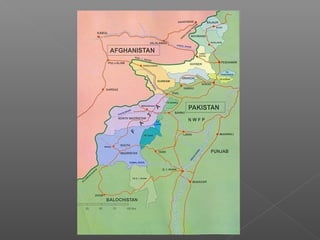
 The Tribal Areas consists of Seven
Agencies, which are administered by a
Political Agent.
 Four Frontier Regions (small pockets of
Tribal Areas) administered under the FCR
from the Settled Districts.
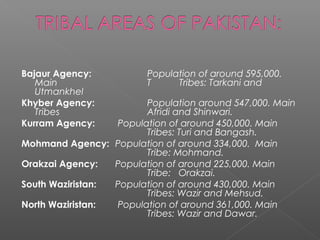
Bajaur Agency: Population of around 595,000.
Main T Tribes: Tarkani and
Utmankhel
Khyber Agency: Population around 547,000. Main
Tribes Afridi and Shinwari.
Kurram Agency: Population of around 450,000. Main
Tribes: Turi and Bangash.
Mohmand Agency: Population of around 334,000. Main
Tribe: Mohmand.
Orakzai Agency: Population of around 225,000. Main
Tribe: Orakzai.
South Waziristan: Population of around 430,000. Main
Tribes: Wazir and Mehsud.
North Waziristan: Population of around 361,000. Main
Tribes: Wazir and Dawar.
• All but one of the Tribal Agencies share
border with Afghanistan (The Durrand-Line).
• 600 Km of the 2500 Km Long Durrani Line lies
in the Tribal Areas.
• All tribes are ethnically Pukhtoon (or
Afghan), Muslim (predominantly Sunni) by
religion, speak Pushtu language, attributes
that they share with their Pukhtoon brothers
in Afghanistan, North- West Frontier and the
Baluchistan Provinces of Pakistan.
• Tribal Areas are usually areas with largely or
exclusively Tribal population, Which are
characterised by its isolation, distinct culture,
primitive traits and the economic backwardness.
(Lokur Committee Report, 1965)
• Tribalism is the belief in fidelity of one’s own kind,
defined by ethnicity, language culture, language
and religion. (John Naisbitt: The Global Paradox)
• Tribal Areas or People are usually excluded from the
normal political, administrative and judicial structures
of the country.
 
• Do the people of the Tribal Areas of
Pakistan have a unique culture,
language, religion or even history?
• Are the exclusions of the people of Tribal
Areas from the mainstream
administrative, political and judicial
systems of the country only because of
the ‘law’.
• Strategic Significance.
• Vulnerabilities.
• Over the millenniums South Asia has seen
many foreign invaders, including the Aryans
and Persians, Greeks (Macedonians),
Mongols, Arabs, Afghans, the British.
• Most of the invaders came to South Asia
through the passes in the present day Tribal
Areas.
• Kabul has been a popular staging post for
many South Asian adventures and has
been eyed with suspicion each India ruler.
 The Mughals who ruled both Delhi and
Kabul (16th
to 18th
century), never totally
subdued the Pukhtoon tribes.
 Remained concerned with keeping the
communication routes to Kabul open.
 1747 Ahmed Khan, established the
Kingdom of Afghanistan, called himself
the Durr-e-Durran, Pearl of Pearls…. The
Durrani Dynasty.
• The Hill Tribes (around the present day Tribal
Areas) were too unruly and never got into
the Imperial Mughal fold.
• The Mughal like all previous Kings were
concerned more with collecting revenue
and left other matters to the tribes.
• Emperor Babur (early 16th
century) in his
memoirs mentions sending a force to the
Bangash Tribe who had refused to pay
taxes. To this day they do not pay any
taxes.
• Tribal people, governed by Customary Law.
• Riwaj (custom) and Nurkh (precedent).
• The highly romanticized Code of Honour.
Custom of Melmastiya, Nanawati and
Badal.
• Main decision making and adjudication
body: The Jirga.
• Jirga means a circle in Mongol and
probably signifies equality of its members.
• Members of Jirgas are usually the influential
and generally women were excluded.
 The British arrived in the region in the 19th
century. Coming from the Punjab
(dislodging the Sikh rule) by a mixture of
conquest, intrigue and agreement.
 Adventures into Afghanistan.
 Two expanding empires; Czarist Russia
and the British Empire. The Great
Game?
 Afghanistan a Buffer State?
• Durrand-Line drawn in 1893. Separating
Colonial India and the Afghanistan.
• In 1901 North West Frontier Province was
created (4 districts separated from the
Punjab) the remaining area between these
districts and the Durrand line became the
Tribal Areas.
• Treaties with the local tribes, to keep the
peace and the communication routes and
means.
• Frontier Crimes Regulation, 1901 (earlier
FCR 1848, 1873 and 1876)
• Concentrates all police, executive and
judicial functions in the Deputy
Commissioner (the Political Agent).
• Principle of collective responsibility and
collective punishment.
• Adjudication through a Jirga. Members
local Maliks, appointed by the Political
Agent.
• Council of Elders (Jirga) decide on points of
fact both in civil as well as criminal cases.
• Decisions of Jirga not binding on the
political Agent.
 Jirgas decided cases under the riwaj
(customary law which is generally
regressive and unusually harsh to
women).
 No legal representation, no cross-
examination.
 Security for Good Behaviour (sec 40, 42)
 No Judicial Review.
 Codification of Customary law. The
evolving customary law frozen in time.
• Trials: no evidence is recorded. No trained
police force, no investigation, no scientific
evidence.
• As Maliks loyal to the Government, Jirgas
open to Government manipulation. Lack
credibility.
• Jirgas good only as a device to reach
settlements.
• Admit here-say evidence.
• Writ of the Government: Protected,
Administered, and Inaccessible.
• Can regular laws be extended without
‘development’.
• The districts of NWFP were developed?
Trained police force (detection and
investigation), courts and prison system.
Lawyers?
• Regular Laws: Financial Commitment.
• The Minto-Morley Reforms. First World War.
Change of British Policy?
• Government of India Act, 1935: ‘Excluded
Areas’.
• Creation of Pakistan.
• The Indian Independence Act abrogated the
agreements with the Tribes.
• Tribal Maliks signed instruments of accession to
Pakistan.
• Independence: did not make any difference
for the people of the Tribal Areas.
• The Constitutions of Pakistan 1958 and 1962
retained the ‘Excluded Area’ device.
• Guarantee of Fundamental Rights: Judicial
Challenges could be raised.
• Declared unconstitutional more then
once.
“….obnoxious to all recognized modern
principles of administration of Justice”
Justice AR Cornelius, Federal Court
• Doctrine of Eclipse.
• Constitution of 1973: Tribal Areas, (called the Federally
Administered tribal Areas).
• Governed by the President through the Governor of the
NWFP.
• General laws of the country. President extends laws
through Presidential Regulations
• Legislators from FATA legislated for rest of the country but
not FATA.
• No Jurisdiction of the Superior Courts not granted
jurisdiction.
• Residents of FATA have Fundamental Rights guaranteed
by the Constitution but no forum to enforce them.
• No political activity, allowed. Elections. Adult Franchise.
• Government Policy in FATA.
• Glorified the FCR and the tribal.
• Rule of Law: Financial Commitment
• Remained Lawless.
• No legitimate economic activity. Trade
and industry.
• No Revenue system. Business? Bank
Loans?
• Defective Criminal Justice System
 Haven for Mafias: Guns, Narcotics,
timber. Smuggling electronic goods etc.
 Grazing grounds for bureaucrats.
 When the Russians finally did invade
Afghanistan, The undeveloped,
inaccessible FATA finally served its
purpose.
 Seven million Automatic Rifles and
grenades, rocket launchers and even
light artillery pieces in FATA and NWFP.
• The fighting between the various
Mujahideen factions at the end of the war.
• The Afghan Civil War.
• Emergence of a group calling themselves
the Taliban.
• Taliban literally means a religious students in
Pushtu. (singular Talib).
• Claim they are religious Students and want
to bring Afghanistan under Islamic Rule.
 Taliban at the time were seen as “fighting
force with decentralized ad faceless
leadership”,
 Took over Kabul in September 1996.
 Recognized only by Pakistan, Saudi Arabia
and UAE.
• Almost all are ethnically Puhktoons (as
against Tajiks and Hazaras).
• Enforce Islamic Law: which provides both
the justification and the legitimacy of there
rule.
 For Taliban and other Militants FATA was
a gift from heaven.
 Spread into the Tribal Areas and some
settled districts of the NWFP.
 Killing of a handful of local Maliks was all
it took to take control of Waziristan.
 Pakistan is now paying dearly its policies
in FATA.
• The people of the Tribal Areas have been forced to
remain in ‘tribalism’ through exclusions created by law.
• The system that has been imposed on the people of FATA
not much better terror regime of the Taliban.
• Peace can only be achieved (and Talibanisation arrested)
by establishing the Rule of Law which requires not only
huge financial commitment will but also strong political.
• A logical first step would be to extend the jurisdiction of
the superior court has to extended to the tribal to FATA.
• Steps need to be taken to a create a legitimate Economy
in the FATA.

Fata

  • 3.
     Population: 3.17Million which about 2% of the total population of Pakistan.  Area: 27,224 Sq Km, which is roughly 3% of the Pakistan’s total area. 1998 Census
  • 4.
     The TribalAreas consists of Seven Agencies, which are administered by a Political Agent.  Four Frontier Regions (small pockets of Tribal Areas) administered under the FCR from the Settled Districts.
  • 5.
    Bajaur Agency: Populationof around 595,000. Main T Tribes: Tarkani and Utmankhel Khyber Agency: Population around 547,000. Main Tribes Afridi and Shinwari. Kurram Agency: Population of around 450,000. Main Tribes: Turi and Bangash. Mohmand Agency: Population of around 334,000. Main Tribe: Mohmand. Orakzai Agency: Population of around 225,000. Main Tribe: Orakzai. South Waziristan: Population of around 430,000. Main Tribes: Wazir and Mehsud. North Waziristan: Population of around 361,000. Main Tribes: Wazir and Dawar.
  • 6.
    • All butone of the Tribal Agencies share border with Afghanistan (The Durrand-Line). • 600 Km of the 2500 Km Long Durrani Line lies in the Tribal Areas. • All tribes are ethnically Pukhtoon (or Afghan), Muslim (predominantly Sunni) by religion, speak Pushtu language, attributes that they share with their Pukhtoon brothers in Afghanistan, North- West Frontier and the Baluchistan Provinces of Pakistan.
  • 7.
    • Tribal Areasare usually areas with largely or exclusively Tribal population, Which are characterised by its isolation, distinct culture, primitive traits and the economic backwardness. (Lokur Committee Report, 1965) • Tribalism is the belief in fidelity of one’s own kind, defined by ethnicity, language culture, language and religion. (John Naisbitt: The Global Paradox) • Tribal Areas or People are usually excluded from the normal political, administrative and judicial structures of the country.  
  • 8.
    • Do thepeople of the Tribal Areas of Pakistan have a unique culture, language, religion or even history? • Are the exclusions of the people of Tribal Areas from the mainstream administrative, political and judicial systems of the country only because of the ‘law’. • Strategic Significance. • Vulnerabilities.
  • 9.
    • Over themillenniums South Asia has seen many foreign invaders, including the Aryans and Persians, Greeks (Macedonians), Mongols, Arabs, Afghans, the British. • Most of the invaders came to South Asia through the passes in the present day Tribal Areas. • Kabul has been a popular staging post for many South Asian adventures and has been eyed with suspicion each India ruler.
  • 10.
     The Mughalswho ruled both Delhi and Kabul (16th to 18th century), never totally subdued the Pukhtoon tribes.  Remained concerned with keeping the communication routes to Kabul open.  1747 Ahmed Khan, established the Kingdom of Afghanistan, called himself the Durr-e-Durran, Pearl of Pearls…. The Durrani Dynasty.
  • 11.
    • The HillTribes (around the present day Tribal Areas) were too unruly and never got into the Imperial Mughal fold. • The Mughal like all previous Kings were concerned more with collecting revenue and left other matters to the tribes. • Emperor Babur (early 16th century) in his memoirs mentions sending a force to the Bangash Tribe who had refused to pay taxes. To this day they do not pay any taxes.
  • 12.
    • Tribal people,governed by Customary Law. • Riwaj (custom) and Nurkh (precedent). • The highly romanticized Code of Honour. Custom of Melmastiya, Nanawati and Badal. • Main decision making and adjudication body: The Jirga. • Jirga means a circle in Mongol and probably signifies equality of its members. • Members of Jirgas are usually the influential and generally women were excluded.
  • 13.
     The Britisharrived in the region in the 19th century. Coming from the Punjab (dislodging the Sikh rule) by a mixture of conquest, intrigue and agreement.  Adventures into Afghanistan.  Two expanding empires; Czarist Russia and the British Empire. The Great Game?  Afghanistan a Buffer State?
  • 14.
    • Durrand-Line drawnin 1893. Separating Colonial India and the Afghanistan. • In 1901 North West Frontier Province was created (4 districts separated from the Punjab) the remaining area between these districts and the Durrand line became the Tribal Areas. • Treaties with the local tribes, to keep the peace and the communication routes and means. • Frontier Crimes Regulation, 1901 (earlier FCR 1848, 1873 and 1876)
  • 15.
    • Concentrates allpolice, executive and judicial functions in the Deputy Commissioner (the Political Agent). • Principle of collective responsibility and collective punishment. • Adjudication through a Jirga. Members local Maliks, appointed by the Political Agent. • Council of Elders (Jirga) decide on points of fact both in civil as well as criminal cases. • Decisions of Jirga not binding on the political Agent.
  • 16.
     Jirgas decidedcases under the riwaj (customary law which is generally regressive and unusually harsh to women).  No legal representation, no cross- examination.  Security for Good Behaviour (sec 40, 42)  No Judicial Review.  Codification of Customary law. The evolving customary law frozen in time.
  • 17.
    • Trials: noevidence is recorded. No trained police force, no investigation, no scientific evidence. • As Maliks loyal to the Government, Jirgas open to Government manipulation. Lack credibility. • Jirgas good only as a device to reach settlements. • Admit here-say evidence. • Writ of the Government: Protected, Administered, and Inaccessible.
  • 18.
    • Can regularlaws be extended without ‘development’. • The districts of NWFP were developed? Trained police force (detection and investigation), courts and prison system. Lawyers? • Regular Laws: Financial Commitment. • The Minto-Morley Reforms. First World War. Change of British Policy? • Government of India Act, 1935: ‘Excluded Areas’.
  • 19.
    • Creation ofPakistan. • The Indian Independence Act abrogated the agreements with the Tribes. • Tribal Maliks signed instruments of accession to Pakistan. • Independence: did not make any difference for the people of the Tribal Areas. • The Constitutions of Pakistan 1958 and 1962 retained the ‘Excluded Area’ device. • Guarantee of Fundamental Rights: Judicial Challenges could be raised.
  • 20.
    • Declared unconstitutionalmore then once. “….obnoxious to all recognized modern principles of administration of Justice” Justice AR Cornelius, Federal Court • Doctrine of Eclipse.
  • 21.
    • Constitution of1973: Tribal Areas, (called the Federally Administered tribal Areas). • Governed by the President through the Governor of the NWFP. • General laws of the country. President extends laws through Presidential Regulations • Legislators from FATA legislated for rest of the country but not FATA. • No Jurisdiction of the Superior Courts not granted jurisdiction. • Residents of FATA have Fundamental Rights guaranteed by the Constitution but no forum to enforce them. • No political activity, allowed. Elections. Adult Franchise.
  • 22.
    • Government Policyin FATA. • Glorified the FCR and the tribal. • Rule of Law: Financial Commitment • Remained Lawless. • No legitimate economic activity. Trade and industry. • No Revenue system. Business? Bank Loans? • Defective Criminal Justice System
  • 23.
     Haven forMafias: Guns, Narcotics, timber. Smuggling electronic goods etc.  Grazing grounds for bureaucrats.  When the Russians finally did invade Afghanistan, The undeveloped, inaccessible FATA finally served its purpose.  Seven million Automatic Rifles and grenades, rocket launchers and even light artillery pieces in FATA and NWFP.
  • 24.
    • The fightingbetween the various Mujahideen factions at the end of the war. • The Afghan Civil War. • Emergence of a group calling themselves the Taliban. • Taliban literally means a religious students in Pushtu. (singular Talib). • Claim they are religious Students and want to bring Afghanistan under Islamic Rule.
  • 25.
     Taliban atthe time were seen as “fighting force with decentralized ad faceless leadership”,  Took over Kabul in September 1996.  Recognized only by Pakistan, Saudi Arabia and UAE. • Almost all are ethnically Puhktoons (as against Tajiks and Hazaras). • Enforce Islamic Law: which provides both the justification and the legitimacy of there rule.
  • 26.
     For Talibanand other Militants FATA was a gift from heaven.  Spread into the Tribal Areas and some settled districts of the NWFP.  Killing of a handful of local Maliks was all it took to take control of Waziristan.  Pakistan is now paying dearly its policies in FATA.
  • 27.
    • The peopleof the Tribal Areas have been forced to remain in ‘tribalism’ through exclusions created by law. • The system that has been imposed on the people of FATA not much better terror regime of the Taliban. • Peace can only be achieved (and Talibanisation arrested) by establishing the Rule of Law which requires not only huge financial commitment will but also strong political. • A logical first step would be to extend the jurisdiction of the superior court has to extended to the tribal to FATA. • Steps need to be taken to a create a legitimate Economy in the FATA.