Controlling 
the Loop of 
Learning 
Christian Bernard T. Ramos 
Learning How to Learn 
University of California, San Diego
Overview 
• The presentation will tackle on how you can take control of your 
learning habits 
• Provide learning exercises that will aid your learning process 
• Discuss the diffuse and focused mode of thinking and when to use 
them 
• Illustration of the habit loop to identify how you can relate and 
modify it to suit your learning 
• Benefits of guilt free sleeping and napping at work 
• Defeat the inner procrastinator inside of us
How the project will be 
used in my life. 
• This project will serve as my reminder on how I 
can learn more effectively as a student 
• I will share this presentation on those I observe 
who are not effectively learning 
• Make this presentation available online to share 
to those interested and showcase what I 
deemed relevant in this course. 
• As a member of an organization I will teach the 
youths the how learn about learning.
Topics that this project will address 
• The habit cycle 
• The two modes of learning-diffuse and 
focused mode 
• Effective sleeping 
• Defeating procrastination
Two Modes of Thinking 
• Diffuse mode- creates new neural 
connections often needed to be able to 
solve difficult/new problems. Looking at 
things broadly from a different perspective 
• Focused mode-concentrating intently on 
things you need to understand. Looking at 
things closely and focus.
Attention 
• To understand the two modes of thinking 
we need to understand attention. 
• “the taking possession by the mind, in 
clear and vivid form, of one of what seems 
several possible objects”( James 1890) 
• Like a Flash Light Selective Attention 
involves focus on a small spatial 
region
Attention 
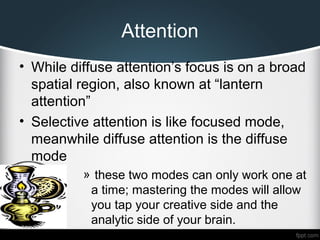
• While diffuse attention’s focus is on a broad 
spatial region, also known at “lantern 
attention” 
• Selective attention is like focused mode, 
meanwhile diffuse attention is the diffuse 
mode 
» these two modes can only work one at 
a time; mastering the modes will allow 
you tap your creative side and the 
analytic side of your brain.
Switching Attention 
• Salvador Dali and Thomas Edison; both 
famous in their respective fields. Created 
creative ways to switch attention from 
focus to diffuse mode by placing 
objects(keys/ball) in their hands when they 
fall asleep or in a deep state of relaxation. 
Dropping the object would wake 
themand thus writing the 
information in diffuse state.
Learning Strategies 
• Alternate focused thinking with diffuse 
thinking; when you get "stuck“, process 
information's by switching modes. 
• Eat your frogs First-start with the hard 
problems so that parts of brain can make 
connections and process information's in other 
ways. 
• Switching Attentions by: Relaxation, 
nap/sleep, exercise or shift gaze.
Sleeping in the Philippines 
• The Philippines is home of the most Business 
Process Outsourcing; this requires the call 
center agents to sleep during the day and work 
at night. 
• Though our culture is known to have “sietas” 
• Siestas has been associated to the 
reduction of coronary mortality because of 
less cardio vascular stress brought by 
daytime sleep.
Sleeping and Napping Studies 
• It was reported that a nap of at least ten 
minutes has been able to show 
improvement cognitive function and 
reduce sleepiness and fatigue. 
• Studies show that pilots given a nap of 30 minutes on 
long flights, displayed a 16% improvement in their 
reaction time. Meanwhile the Pilots who was not given 
a nap time saw a 34% decrease over the 
course of the flight.
Learning through Sleeping 
• Sleeping can wash out the brains toxic 
metabolic byproducts. Sleeping causes 
the brain cells to shrink allowing to release 
the metabolic toxins “poison”. 
• Sleep is critical in thinking and learning, it 
impairs concentration, 
attention and reasoning 
making it difficult to learn.
Sleeping and Memory 
• Cleans up ideas and concepts in learning, by 
erasing irrelevant parts. 
• During sleep brain rehearses neural pattern 
you try to learn 
• Sleep allows you to comprehend problems 
you have difficulties in learning; putting 
neural solution to learning task. 
• Dreaming of what you study can enhance the 
ability to understand by creating chunks.
Sleep Deprivation 
• Heart failure 
• Irregular heartbeat 
• High blood pressure 
• Stroke 
• Diabetes 
• Depression 
• Dying Earlier
Sleep Deprivation
Overcoming Procrastination 
• Procrastination is putting of, delaying or 
postponing something that is of priority. 
• Finding distractions now a days are very 
easy to find with the advance technology 
• Pleasure brought by distraction is only 
temporary, the uneasy feeling really goes 
away once the task has started.
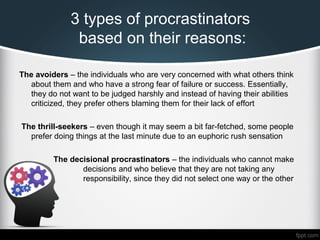
3 types of procrastinators 
based on their reasons: 
The avoiders – the individuals who are very concerned with what others think 
about them and who have a strong fear of failure or success. Essentially, 
they do not want to be judged harshly and instead of having their abilities 
criticized, they prefer others blaming them for their lack of effort 
The thrill-seekers – even though it may seem a bit far-fetched, some people 
prefer doing things at the last minute due to an euphoric rush sensation 
The decisional procrastinators – the individuals who cannot make 
decisions and who believe that they are not taking any 
responsibility, since they did not select one way or the other
Stages of Procrastination
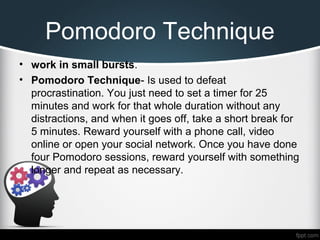
Pomodoro Technique 
• work in small bursts. 
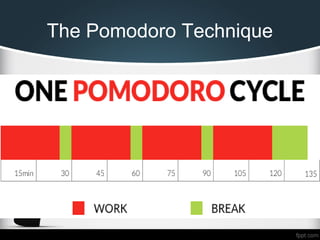
• Pomodoro Technique- Is used to defeat 
procrastination. You just need to set a timer for 25 
minutes and work for that whole duration without any 
distractions, and when it goes off, take a short break for 
5 minutes. Reward yourself with a phone call, video 
online or open your social network. Once you have done 
four Pomodoro sessions, reward yourself with something 
longer and repeat as necessary.
The Pomodoro Technique
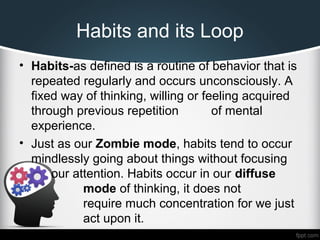
Habits and its Loop 
• Habits-as defined is a routine of behavior that is 
repeated regularly and occurs unconsciously. A 
fixed way of thinking, willing or feeling acquired 
through previous repetition of mental 
experience. 
• Just as our Zombie mode, habits tend to occur 
mindlessly going about things without focusing 
our attention. Habits occur in our diffuse 
mode of thinking, it does not 
require much concentration for we just 
act upon it.
The Habit Loop 
• The Habit loop- is a neurological loop at the 
core of our every habit. The loop consist of 
three components; Cue, Routine and the 
Reward. 
• Cue-The trigger or signal to prompt another 
event 
• Routine- sequence of actions regularly 
followed 
• Reward-a token for an achievement
The Habit Loop
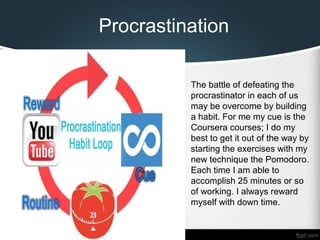
Procrastination 
The battle of defeating the 
procrastinator in each of us 
may be overcome by building 
a habit. For me my cue is the 
Coursera courses; I do my 
best to get it out of the way by 
starting the exercises with my 
new technique the Pomodoro. 
Each time I am able to 
accomplish 25 minutes or so 
of working. I always reward 
myself with down time.
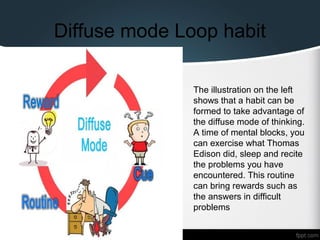
Diffuse mode Loop habit 
The illustration on the left 
shows that a habit can be 
formed to take advantage of 
the diffuse mode of thinking. 
A time of mental blocks, you 
can exercise what Thomas 
Edison did, sleep and recite 
the problems you have 
encountered. This routine 
can bring rewards such as 
the answers in difficult 
problems
Sleeping 
To improve memory and 
simply avoid dying 
earlier. Make it a habit 
that you get enough 
sleep, have a set time for 
sleep and waking up to 
get enough rest. Alarms 
will serve great help. 
Enough sleep can also 
help your memory in 
remembering things and 
overall have a good 
health are its rewards.
Charles Duhigg 
• Author of the Power of Habit, and further 
developed the habit loop. 
• Research shows that much brain activity 
was displayed the first time you do an act; 
but once you get used to it, it just instantly 
occur mindlessly. 
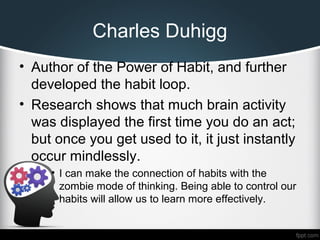
• I can make the connection of habits with the 
zombie mode of thinking. Being able to control our 
habits will allow us to learn more effectively.
Citations 
• http://tdlc.ucsd.edu/educators/educators_webinar_• http://www.webmd.com/sleep-disorders/ 
excessive-sleepiness-10/10- 
results-sleep-loss?page=3 
• http://charlesduhigg.com/the-power-of-habit/

Controlling the Loop of Learning

  • 1.
    Controlling the Loopof Learning Christian Bernard T. Ramos Learning How to Learn University of California, San Diego
  • 2.
    Overview • Thepresentation will tackle on how you can take control of your learning habits • Provide learning exercises that will aid your learning process • Discuss the diffuse and focused mode of thinking and when to use them • Illustration of the habit loop to identify how you can relate and modify it to suit your learning • Benefits of guilt free sleeping and napping at work • Defeat the inner procrastinator inside of us
  • 3.
    How the projectwill be used in my life. • This project will serve as my reminder on how I can learn more effectively as a student • I will share this presentation on those I observe who are not effectively learning • Make this presentation available online to share to those interested and showcase what I deemed relevant in this course. • As a member of an organization I will teach the youths the how learn about learning.
  • 4.
    Topics that thisproject will address • The habit cycle • The two modes of learning-diffuse and focused mode • Effective sleeping • Defeating procrastination
  • 5.
    Two Modes ofThinking • Diffuse mode- creates new neural connections often needed to be able to solve difficult/new problems. Looking at things broadly from a different perspective • Focused mode-concentrating intently on things you need to understand. Looking at things closely and focus.
  • 6.
    Attention • Tounderstand the two modes of thinking we need to understand attention. • “the taking possession by the mind, in clear and vivid form, of one of what seems several possible objects”( James 1890) • Like a Flash Light Selective Attention involves focus on a small spatial region
  • 7.
    Attention • Whilediffuse attention’s focus is on a broad spatial region, also known at “lantern attention” • Selective attention is like focused mode, meanwhile diffuse attention is the diffuse mode » these two modes can only work one at a time; mastering the modes will allow you tap your creative side and the analytic side of your brain.
  • 8.
    Switching Attention •Salvador Dali and Thomas Edison; both famous in their respective fields. Created creative ways to switch attention from focus to diffuse mode by placing objects(keys/ball) in their hands when they fall asleep or in a deep state of relaxation. Dropping the object would wake themand thus writing the information in diffuse state.
  • 9.
    Learning Strategies •Alternate focused thinking with diffuse thinking; when you get "stuck“, process information's by switching modes. • Eat your frogs First-start with the hard problems so that parts of brain can make connections and process information's in other ways. • Switching Attentions by: Relaxation, nap/sleep, exercise or shift gaze.
  • 10.
    Sleeping in thePhilippines • The Philippines is home of the most Business Process Outsourcing; this requires the call center agents to sleep during the day and work at night. • Though our culture is known to have “sietas” • Siestas has been associated to the reduction of coronary mortality because of less cardio vascular stress brought by daytime sleep.
  • 11.
    Sleeping and NappingStudies • It was reported that a nap of at least ten minutes has been able to show improvement cognitive function and reduce sleepiness and fatigue. • Studies show that pilots given a nap of 30 minutes on long flights, displayed a 16% improvement in their reaction time. Meanwhile the Pilots who was not given a nap time saw a 34% decrease over the course of the flight.
  • 12.
    Learning through Sleeping • Sleeping can wash out the brains toxic metabolic byproducts. Sleeping causes the brain cells to shrink allowing to release the metabolic toxins “poison”. • Sleep is critical in thinking and learning, it impairs concentration, attention and reasoning making it difficult to learn.
  • 13.
    Sleeping and Memory • Cleans up ideas and concepts in learning, by erasing irrelevant parts. • During sleep brain rehearses neural pattern you try to learn • Sleep allows you to comprehend problems you have difficulties in learning; putting neural solution to learning task. • Dreaming of what you study can enhance the ability to understand by creating chunks.
  • 14.
    Sleep Deprivation •Heart failure • Irregular heartbeat • High blood pressure • Stroke • Diabetes • Depression • Dying Earlier
  • 15.
  • 16.
    Overcoming Procrastination •Procrastination is putting of, delaying or postponing something that is of priority. • Finding distractions now a days are very easy to find with the advance technology • Pleasure brought by distraction is only temporary, the uneasy feeling really goes away once the task has started.
  • 17.
    3 types ofprocrastinators based on their reasons: The avoiders – the individuals who are very concerned with what others think about them and who have a strong fear of failure or success. Essentially, they do not want to be judged harshly and instead of having their abilities criticized, they prefer others blaming them for their lack of effort The thrill-seekers – even though it may seem a bit far-fetched, some people prefer doing things at the last minute due to an euphoric rush sensation The decisional procrastinators – the individuals who cannot make decisions and who believe that they are not taking any responsibility, since they did not select one way or the other
  • 18.
  • 19.
    Pomodoro Technique •work in small bursts. • Pomodoro Technique- Is used to defeat procrastination. You just need to set a timer for 25 minutes and work for that whole duration without any distractions, and when it goes off, take a short break for 5 minutes. Reward yourself with a phone call, video online or open your social network. Once you have done four Pomodoro sessions, reward yourself with something longer and repeat as necessary.
  • 20.
  • 21.
    Habits and itsLoop • Habits-as defined is a routine of behavior that is repeated regularly and occurs unconsciously. A fixed way of thinking, willing or feeling acquired through previous repetition of mental experience. • Just as our Zombie mode, habits tend to occur mindlessly going about things without focusing our attention. Habits occur in our diffuse mode of thinking, it does not require much concentration for we just act upon it.
  • 22.
    The Habit Loop • The Habit loop- is a neurological loop at the core of our every habit. The loop consist of three components; Cue, Routine and the Reward. • Cue-The trigger or signal to prompt another event • Routine- sequence of actions regularly followed • Reward-a token for an achievement
  • 23.
  • 24.
    Procrastination The battleof defeating the procrastinator in each of us may be overcome by building a habit. For me my cue is the Coursera courses; I do my best to get it out of the way by starting the exercises with my new technique the Pomodoro. Each time I am able to accomplish 25 minutes or so of working. I always reward myself with down time.
  • 25.
    Diffuse mode Loophabit The illustration on the left shows that a habit can be formed to take advantage of the diffuse mode of thinking. A time of mental blocks, you can exercise what Thomas Edison did, sleep and recite the problems you have encountered. This routine can bring rewards such as the answers in difficult problems
  • 26.
    Sleeping To improvememory and simply avoid dying earlier. Make it a habit that you get enough sleep, have a set time for sleep and waking up to get enough rest. Alarms will serve great help. Enough sleep can also help your memory in remembering things and overall have a good health are its rewards.
  • 27.
    Charles Duhigg •Author of the Power of Habit, and further developed the habit loop. • Research shows that much brain activity was displayed the first time you do an act; but once you get used to it, it just instantly occur mindlessly. • I can make the connection of habits with the zombie mode of thinking. Being able to control our habits will allow us to learn more effectively.
  • 28.
    Citations • http://tdlc.ucsd.edu/educators/educators_webinar_•http://www.webmd.com/sleep-disorders/ excessive-sleepiness-10/10- results-sleep-loss?page=3 • http://charlesduhigg.com/the-power-of-habit/