Controlling Stress
Dr Zahiruddin Othman
Jabatan Psikiatri, PPSP
Last updated 03/03/03
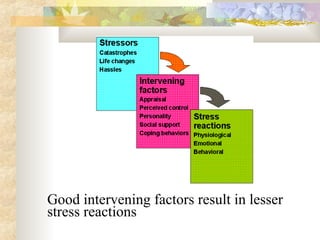
Good intervening factors result in lesser
stress reactions
Alleviating Adaptive Stress
Establish RoutinesEstablish Routines
 Make sure that your life
is ordered
 Daily routines for work
and play
 Regular eating and
exercise
 Go to bed and get up at
regular hours
 Set up regular times for
rest and relaxation
Avoid ChangeAvoid Change
 If the life change
inventory suggests that
you are at risk from too
much change, stop
changing
 e.g. don't move now
 e.g. don't initiate a
lifestyle change now
Alleviating The Stress Of Frustration
 Express your frustration
 Determine your real outcomes

 What do I want?
 How will things be different and better in my life
when I get what I want?
 What are my useful resources?
 What has kept me from reaching this outcome
before?
 Choose alternatives
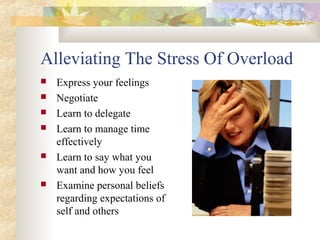
Alleviating The Stress Of Overload
 Express your feelings
 Negotiate
 Learn to delegate
 Learn to manage time
effectively
 Learn to say what you
want and how you feel
 Examine personal beliefs
regarding expectations of
self and others
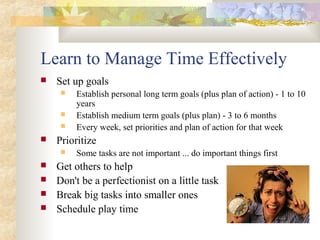
Learn to Manage Time Effectively
 Set up goals
 Establish personal long term goals (plus plan of action) - 1 to 10
years
 Establish medium term goals (plus plan) - 3 to 6 months
 Every week, set priorities and plan of action for that week
 Prioritize
 Some tasks are not important ... do important things first
 Get others to help
 Don't be a perfectionist on a little task
 Break big tasks into smaller ones
 Schedule play time
Reducing Health Risks Associated
With Type A Behavior
 Get rid of activities that are not directly helpful to work,
social life, or economic goals. Schedule more time for
appointments or other tasks. Wake up 15 - 20 minutes
earlier in the day.
 Create a more relaxed or peaceful environment for work.
Organize, get rid of paper and other clutter, add some
personal objects e.g. artwork, toys, etc.
 Think before speaking - try not to blurt out the first thing
that comes to your mind.
 Plan to spend some time alone daydreaming, talking with
friends about non-work activities, browse in a book store
or library.
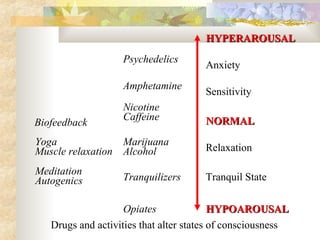
HYPERAROUSALHYPERAROUSAL
HYPOAROUSALHYPOAROUSAL
NORMALNORMAL
Anxiety
Sensitivity
Relaxation
Tranquil State
Opiates
Tranquilizers
Marijuana
Alcohol
Nicotine
Caffeine
Amphetamine
Psychedelics
Meditation
Autogenics
Yoga
Muscle relaxation
Biofeedback
Drugs and activities that alter states of consciousness
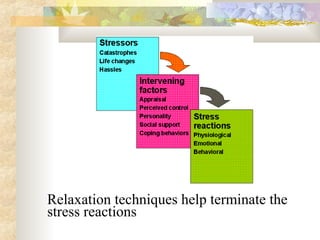
Relaxation techniques help terminate the
stress reactions
Breathing and Relaxation
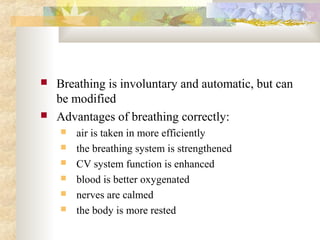
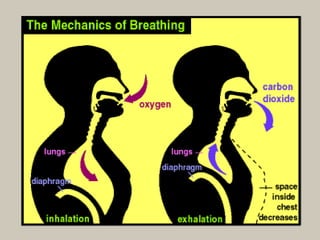
 Breathing is involuntary and automatic, but can
be modified
 Advantages of breathing correctly:
 air is taken in more efficiently
 the breathing system is strengthened
 CV system function is enhanced
 blood is better oxygenated
 nerves are calmed
 the body is more rested
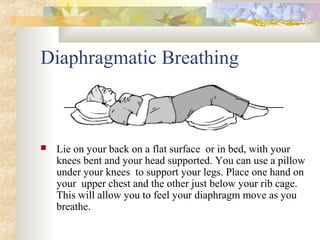
Diaphragmatic Breathing
 Lie on your back on a flat surface or in bed, with your
knees bent and your head supported. You can use a pillow
under your knees to support your legs. Place one hand on
your upper chest and the other just below your rib cage.
This will allow you to feel your diaphragm move as you
breathe.
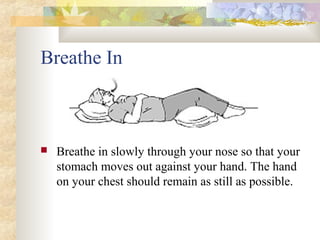
 Breathe in slowly through your nose so that your
stomach moves out against your hand. The hand
on your chest should remain as still as possible.
Breathe In
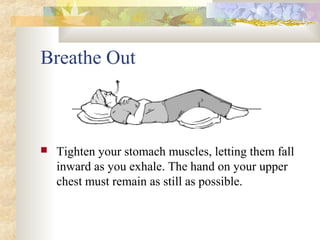
 Tighten your stomach muscles, letting them fall
inward as you exhale. The hand on your upper
chest must remain as still as possible.
Breathe Out
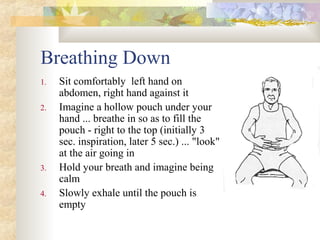
Breathing Down
1. Sit comfortably left hand on
abdomen, right hand against it
2. Imagine a hollow pouch under your
hand ... breathe in so as to fill the
pouch - right to the top (initially 3
sec. inspiration, later 5 sec.) ... "look"
at the air going in
3. Hold your breath and imagine being
calm
4. Slowly exhale until the pouch is
empty
 Practice 10-15 times a day.
 Make it a ritual in the morning, afternoon, and
evening as well as during stressful situations.
 After 1-2 of practice, omit the first step ... only
for learning.
 Regular, consistent practice of these daily
exercises will lead to a calmer and more relaxed
attitude.
Controlled Tempo Breathing
 Either sitting or lying with eyes closed
 Diaphragmatic breathing
 Concentrate on your breathing
 Count number of pulses during normal expiration
(5-10?) ... get into a rhythm of equal pulse beats
during inspiration, holding breath and expiration
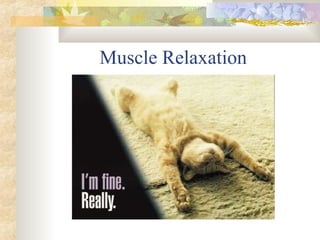
Muscle Relaxation
Introduction
 Key point is that we anticipate and when we
anticipate, we tense our muscles in advance ...
problem comes when we tense our muscles for
something which never happens
 the longer we hold our muscles in a tense
position, the more likely we are to cause a
physical disorder ... therefore we should be able
to know
 a) when they are tense, and
 b) how to consciously relax them
Neuromuscular Exercise
 Since muscles make up a large amount of body
tissue, relaxation of muscle tissue will contribute
greatly to whole body relaxation
 Good, 1995: problems helped by muscle
relaxation include:
 muscle contraction headaches
 neck/back pain
 essential hypertension
 post surgical recovery
The Learning Phase
 Need more structured time involvement,
concentration, and commitment.
 Once you have perfected/ mastered it, you
will be able to choose the particular
exercise sequence that is most beneficial
and that meet your immediate needs.
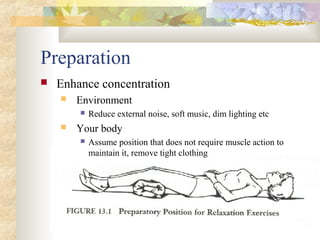
Preparation
 Enhance concentration
 Environment
 Reduce external noise, soft music, dim lighting etc
 Your body
 Assume position that does not require muscle action to
maintain it, remove tight clothing
Lower Extremities Exercise
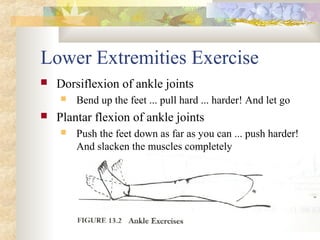
 Dorsiflexion of ankle joints
 Bend up the feet ... pull hard ... harder! And let go
 Plantar flexion of ankle joints
 Push the feet down as far as you can ... push harder!
And slacken the muscles completely
 Hold and then relax while concentrating
on the feeling in the muscles on the
anterior side of the lower leg
 Synchronize with breathing
 Then concentrate on relaxation ... see
the muscle relaxing
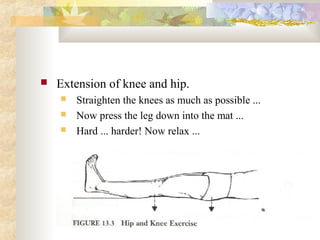
 Extension of knee and hip.
 Straighten the knees as much as possible ...
 Now press the leg down into the mat ...
 Hard ... harder! Now relax ...
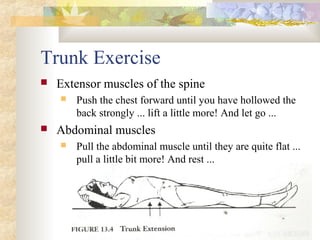
Trunk Exercise
 Extensor muscles of the spine
 Push the chest forward until you have hollowed the
back strongly ... lift a little more! And let go ...
 Abdominal muscles
 Pull the abdominal muscle until they are quite flat ...
pull a little bit more! And rest ...
Upper Extremities Exercise
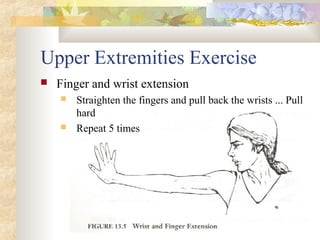
 Finger and wrist extension
 Straighten the fingers and pull back the wrists ... Pull
hard
 Repeat 5 times
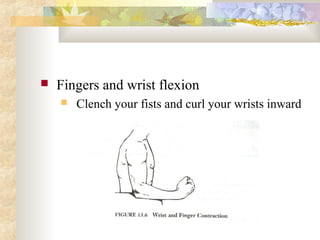
 Fingers and wrist flexion
 Clench your fists and curl your wrists inward
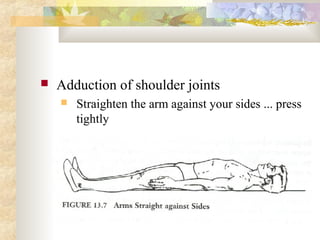
 Adduction of shoulder joints
 Straighten the arm against your sides ... press
tightly
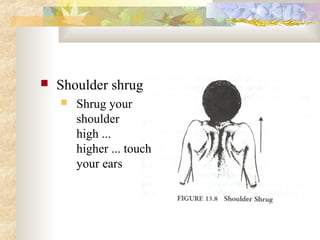
 Shoulder shrug
 Shrug your
shoulder
high ...
higher ... touch
your ears
Head, Neck, and Face Exercise
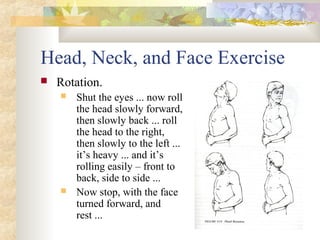
 Rotation.
 Shut the eyes ... now roll
the head slowly forward,
then slowly back ... roll
the head to the right,
then slowly to the left ...
it’s heavy ... and it’s
rolling easily – front to
back, side to side ...
 Now stop, with the face
turned forward, and
rest ...
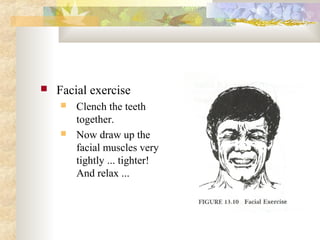
 Facial exercise
 Clench the teeth
together.
 Now draw up the
facial muscles very
tightly ... tighter!
And relax ...
Conclusion
 Don't worry about falling asleep at the
start ... if you are tired this is inevitable
 Concentration will eventually result in
an increased awareness of when
muscles are becoming tense ...
therefore you can relax them
Autogenics and Visual Imagery
Autogenic Relaxation Training
 A form of relaxation involving self-
directed mental imagesmental images of of relaxed states
 Simple yet advanced technique centers on
conditioned patterns of responses that
become associated with particular thoughts
 Easier and faster to learn if you already had
other relaxation skills
Legs Heavy and Warm
 can be done either sitting or lying down
 attempt to produce a feeling of warmth and
heaviness in the legs
 repeated phrases stressing that the leg is
heavy, warm, relaxed and that you are calm
 move to other leg
 continue for five minutes and then rest
quietly
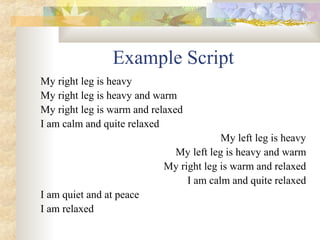
Example Script
My right leg is heavy
My right leg is heavy and warm
My right leg is warm and relaxed
I am calm and quite relaxed
My left leg is heavy
My left leg is heavy and warm
My right leg is warm and relaxed
I am calm and quite relaxed
I am quiet and at peace
I am relaxed
Arms Heavy and Warm
 Attempt to generate a feeling of warmth in
one arm
 Same set of repeated phrases switch to the
other arm
 Continue for five minutes and then rest
quietly
Visual Imagery
1. Quiet room with a soft and comfortable chair ...
four deep breaths ... more slowly (with holding
the breath in) each time ... feel the relaxation
2. Count back from 10 to 0 ... total relaxation at 0
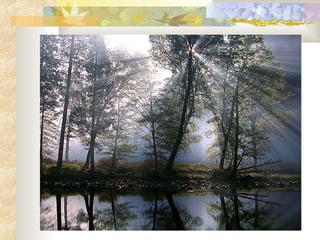
3.3. Go to your special placeGo to your special place ... stay for 4 minutes
(guess - don't time it) ... recall the feelings
4. Attention back to you ... count from 0 to 10 ...
total alertness at 10 ... feel how much more
energy you now have
Stress Reduction Through
Physical Activity
Meditation Vs Physical Activity
 Meditation = prevention of stress response
 Physical activity = dissipation of built up
stress
 e.g. To dissipate stress from fear, ego threat,
etc
 e.g. To decrease reactivity to future stress
 e.g. To achieve well-being and tranquility
Exercise For Well-being And
Tranquility
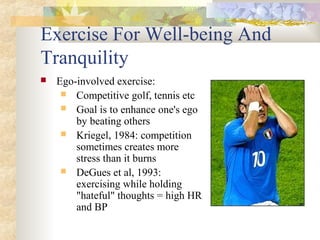
 Ego-involved exercise:
 Competitive golf, tennis etc
 Goal is to enhance one's ego
by beating others
 Kriegel, 1984: competition
sometimes creates more
stress than it burns
 DeGues et al, 1993:
exercising while holding
"hateful" thoughts = high HR
and BP
Ego-void Exercise
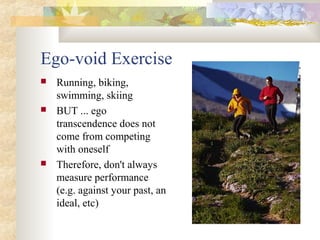
 Running, biking,
swimming, skiing
 BUT ... ego
transcendence does not
come from competing
with oneself
 Therefore, don't always
measure performance
(e.g. against your past, an
ideal, etc)
Our hero is happy after finishing his usual routines

Controlling stress (2003)

  • 1.
    Controlling Stress Dr ZahiruddinOthman Jabatan Psikiatri, PPSP Last updated 03/03/03
  • 2.
    Good intervening factorsresult in lesser stress reactions
  • 3.
    Alleviating Adaptive Stress EstablishRoutinesEstablish Routines  Make sure that your life is ordered  Daily routines for work and play  Regular eating and exercise  Go to bed and get up at regular hours  Set up regular times for rest and relaxation Avoid ChangeAvoid Change  If the life change inventory suggests that you are at risk from too much change, stop changing  e.g. don't move now  e.g. don't initiate a lifestyle change now
  • 4.
    Alleviating The StressOf Frustration  Express your frustration  Determine your real outcomes  What do I want?  How will things be different and better in my life when I get what I want?  What are my useful resources?  What has kept me from reaching this outcome before?  Choose alternatives
  • 5.
    Alleviating The StressOf Overload  Express your feelings  Negotiate  Learn to delegate  Learn to manage time effectively  Learn to say what you want and how you feel  Examine personal beliefs regarding expectations of self and others
  • 6.
    Learn to ManageTime Effectively  Set up goals  Establish personal long term goals (plus plan of action) - 1 to 10 years  Establish medium term goals (plus plan) - 3 to 6 months  Every week, set priorities and plan of action for that week  Prioritize  Some tasks are not important ... do important things first  Get others to help  Don't be a perfectionist on a little task  Break big tasks into smaller ones  Schedule play time
  • 7.
    Reducing Health RisksAssociated With Type A Behavior  Get rid of activities that are not directly helpful to work, social life, or economic goals. Schedule more time for appointments or other tasks. Wake up 15 - 20 minutes earlier in the day.  Create a more relaxed or peaceful environment for work. Organize, get rid of paper and other clutter, add some personal objects e.g. artwork, toys, etc.  Think before speaking - try not to blurt out the first thing that comes to your mind.  Plan to spend some time alone daydreaming, talking with friends about non-work activities, browse in a book store or library.
  • 8.
  • 10.
    Relaxation techniques helpterminate the stress reactions
  • 11.
  • 12.
     Breathing isinvoluntary and automatic, but can be modified  Advantages of breathing correctly:  air is taken in more efficiently  the breathing system is strengthened  CV system function is enhanced  blood is better oxygenated  nerves are calmed  the body is more rested
  • 14.
    Diaphragmatic Breathing  Lieon your back on a flat surface or in bed, with your knees bent and your head supported. You can use a pillow under your knees to support your legs. Place one hand on your upper chest and the other just below your rib cage. This will allow you to feel your diaphragm move as you breathe.
  • 15.
     Breathe inslowly through your nose so that your stomach moves out against your hand. The hand on your chest should remain as still as possible. Breathe In
  • 16.
     Tighten yourstomach muscles, letting them fall inward as you exhale. The hand on your upper chest must remain as still as possible. Breathe Out
  • 17.
    Breathing Down 1. Sitcomfortably left hand on abdomen, right hand against it 2. Imagine a hollow pouch under your hand ... breathe in so as to fill the pouch - right to the top (initially 3 sec. inspiration, later 5 sec.) ... "look" at the air going in 3. Hold your breath and imagine being calm 4. Slowly exhale until the pouch is empty
  • 18.
     Practice 10-15times a day.  Make it a ritual in the morning, afternoon, and evening as well as during stressful situations.  After 1-2 of practice, omit the first step ... only for learning.  Regular, consistent practice of these daily exercises will lead to a calmer and more relaxed attitude.
  • 19.
    Controlled Tempo Breathing Either sitting or lying with eyes closed  Diaphragmatic breathing  Concentrate on your breathing  Count number of pulses during normal expiration (5-10?) ... get into a rhythm of equal pulse beats during inspiration, holding breath and expiration
  • 20.
  • 21.
    Introduction  Key pointis that we anticipate and when we anticipate, we tense our muscles in advance ... problem comes when we tense our muscles for something which never happens  the longer we hold our muscles in a tense position, the more likely we are to cause a physical disorder ... therefore we should be able to know  a) when they are tense, and  b) how to consciously relax them
  • 22.
    Neuromuscular Exercise  Sincemuscles make up a large amount of body tissue, relaxation of muscle tissue will contribute greatly to whole body relaxation  Good, 1995: problems helped by muscle relaxation include:  muscle contraction headaches  neck/back pain  essential hypertension  post surgical recovery
  • 23.
    The Learning Phase Need more structured time involvement, concentration, and commitment.  Once you have perfected/ mastered it, you will be able to choose the particular exercise sequence that is most beneficial and that meet your immediate needs.
  • 24.
    Preparation  Enhance concentration Environment  Reduce external noise, soft music, dim lighting etc  Your body  Assume position that does not require muscle action to maintain it, remove tight clothing
  • 25.
    Lower Extremities Exercise Dorsiflexion of ankle joints  Bend up the feet ... pull hard ... harder! And let go  Plantar flexion of ankle joints  Push the feet down as far as you can ... push harder! And slacken the muscles completely
  • 26.
     Hold andthen relax while concentrating on the feeling in the muscles on the anterior side of the lower leg  Synchronize with breathing  Then concentrate on relaxation ... see the muscle relaxing
  • 27.
     Extension ofknee and hip.  Straighten the knees as much as possible ...  Now press the leg down into the mat ...  Hard ... harder! Now relax ...
  • 28.
    Trunk Exercise  Extensormuscles of the spine  Push the chest forward until you have hollowed the back strongly ... lift a little more! And let go ...  Abdominal muscles  Pull the abdominal muscle until they are quite flat ... pull a little bit more! And rest ...
  • 29.
    Upper Extremities Exercise Finger and wrist extension  Straighten the fingers and pull back the wrists ... Pull hard  Repeat 5 times
  • 30.
     Fingers andwrist flexion  Clench your fists and curl your wrists inward
  • 31.
     Adduction ofshoulder joints  Straighten the arm against your sides ... press tightly
  • 32.
     Shoulder shrug Shrug your shoulder high ... higher ... touch your ears
  • 33.
    Head, Neck, andFace Exercise  Rotation.  Shut the eyes ... now roll the head slowly forward, then slowly back ... roll the head to the right, then slowly to the left ... it’s heavy ... and it’s rolling easily – front to back, side to side ...  Now stop, with the face turned forward, and rest ...
  • 34.
     Facial exercise Clench the teeth together.  Now draw up the facial muscles very tightly ... tighter! And relax ...
  • 35.
    Conclusion  Don't worryabout falling asleep at the start ... if you are tired this is inevitable  Concentration will eventually result in an increased awareness of when muscles are becoming tense ... therefore you can relax them
  • 36.
  • 37.
    Autogenic Relaxation Training A form of relaxation involving self- directed mental imagesmental images of of relaxed states  Simple yet advanced technique centers on conditioned patterns of responses that become associated with particular thoughts  Easier and faster to learn if you already had other relaxation skills
  • 39.
    Legs Heavy andWarm  can be done either sitting or lying down  attempt to produce a feeling of warmth and heaviness in the legs  repeated phrases stressing that the leg is heavy, warm, relaxed and that you are calm  move to other leg  continue for five minutes and then rest quietly
  • 40.
    Example Script My rightleg is heavy My right leg is heavy and warm My right leg is warm and relaxed I am calm and quite relaxed My left leg is heavy My left leg is heavy and warm My right leg is warm and relaxed I am calm and quite relaxed I am quiet and at peace I am relaxed
  • 41.
    Arms Heavy andWarm  Attempt to generate a feeling of warmth in one arm  Same set of repeated phrases switch to the other arm  Continue for five minutes and then rest quietly
  • 43.
    Visual Imagery 1. Quietroom with a soft and comfortable chair ... four deep breaths ... more slowly (with holding the breath in) each time ... feel the relaxation 2. Count back from 10 to 0 ... total relaxation at 0 3.3. Go to your special placeGo to your special place ... stay for 4 minutes (guess - don't time it) ... recall the feelings 4. Attention back to you ... count from 0 to 10 ... total alertness at 10 ... feel how much more energy you now have
  • 45.
  • 46.
    Meditation Vs PhysicalActivity  Meditation = prevention of stress response  Physical activity = dissipation of built up stress  e.g. To dissipate stress from fear, ego threat, etc  e.g. To decrease reactivity to future stress  e.g. To achieve well-being and tranquility
  • 47.
    Exercise For Well-beingAnd Tranquility  Ego-involved exercise:  Competitive golf, tennis etc  Goal is to enhance one's ego by beating others  Kriegel, 1984: competition sometimes creates more stress than it burns  DeGues et al, 1993: exercising while holding "hateful" thoughts = high HR and BP
  • 48.
    Ego-void Exercise  Running,biking, swimming, skiing  BUT ... ego transcendence does not come from competing with oneself  Therefore, don't always measure performance (e.g. against your past, an ideal, etc)
  • 49.
    Our hero ishappy after finishing his usual routines