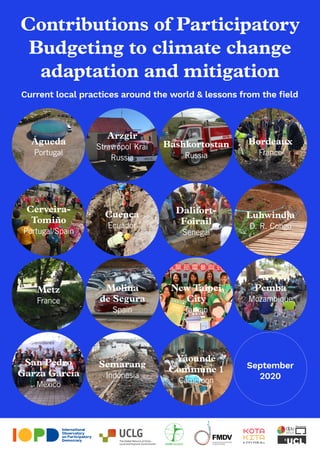
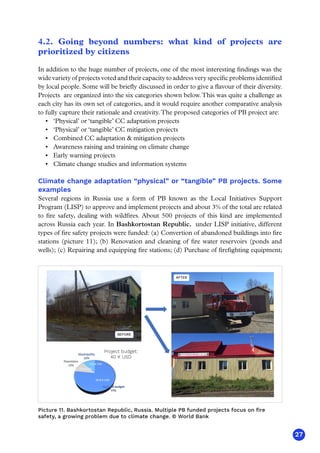
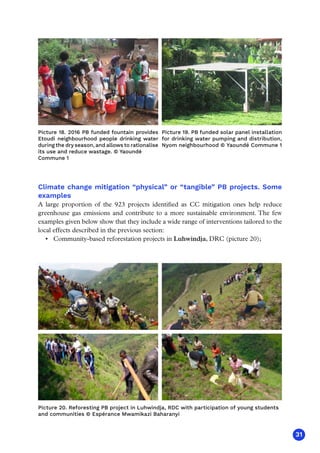
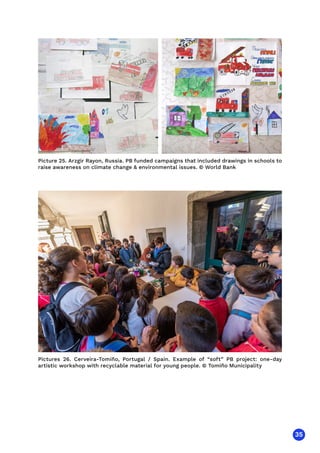
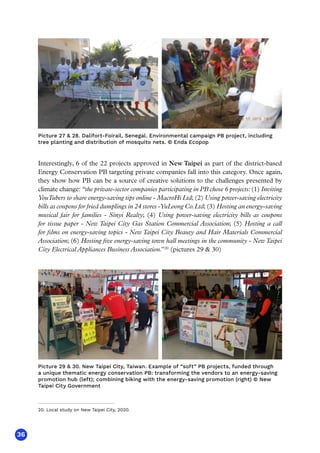
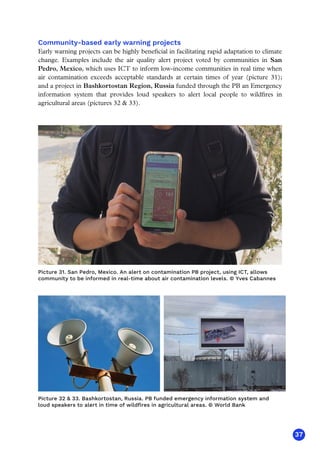
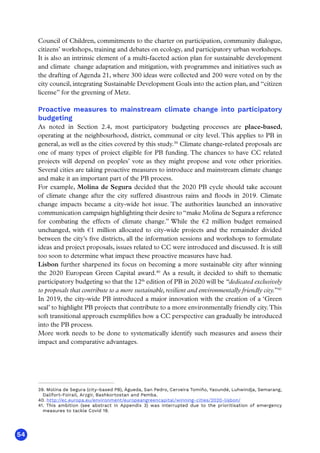
r
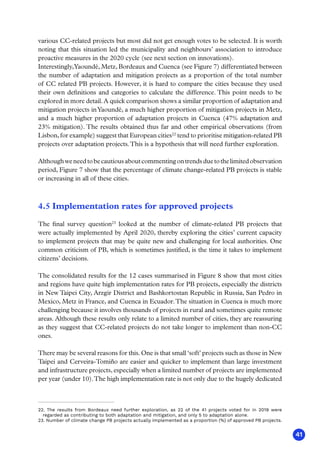
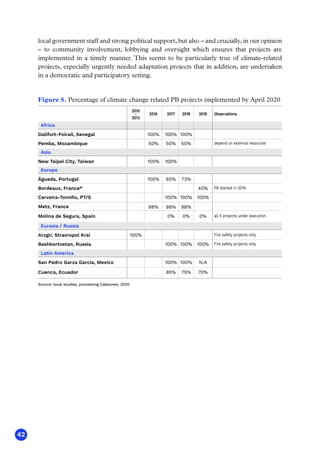
ru
ur
ra
al
l f
fi
ir
re
e s
st
ta
at
ti
io
on
n i
in
n C
Ch
he
er
rn
ny
ya
ae
ev
vs
sk
ky
y v
vi
il
ll
la
ag
ge
e,
, K
Kh
ha
ab
ba
ar
ro
ov
vs
sk
k r
re
eg
gi
io
on
n


Cerveira-
Tomiño
Portugal/Spain
Águeda
Portugal
Molina
de Segura
Spain
Metz
France
Bordeaux
France
Semarang
Indonesia
Arzgir
Stravropol Krai
Russia
Bashkortostan
Russia
Yaoundé
Commune 1
Cameroon
Luhwindja
D. R. Congo
Pemba
Mozambique
San Pedro
Garza García
Mexico
Contributions of Participatory
Budgeting to climate change
adaptation and mitigation
New Taipei
City
Taiwan
Cuenca
Ecuador
Dalifort-
Foirail
Senegal
September
2020
Supporting local authorities
to access funding
Current local practices around the world  lessons from the field
First co-published in September 2020 by
Enda ECOPOP, Complexe SICAP Point E, Avenue Cheikh Anta DIOP, Dakar, Senegal
FMDV, Global Fund for Cities Development, 47 Avenue Pasteur, 93100 Montreuil, France
IOPD, International Observatory for Participatory Democracy, UCLG, Carrer Avinyó, 15, 08002
Barcelona, Spain
Kota Kita Foundation, Jl. Melon Raya no. 53 Karangasem, Surakarta Central Java, Indonesia 57145
UCL / DPU, The Bartlett Development Planning Unit, University College London, 34 Tavistock
Square, London WC1H 9EZ
UCLG, United Cities and Local Governments, Carrer Avinyó, 15, 08002 Barcelona, Spain
Text ©Yves Cabannes, Emeritus Professor of Development Planning, UCL / DPU, 2020
Contributors to the 15 local studies: See list of contributors in Appendix 1
Pictures © Contributors and copyright holders named in captions, 2020
Reviewers: Adrià Duarte, Ahmad Rifai, Bachir Kanouté, Célia Laranjeira, Christine Goldstein, Diego
Emilio Cuesy Edgar, Edson Santos, Espérance Mwamikazi Baharanyi, Hasanatun Nisa Thamrin, Ivan
Shulga, Jean François Habeau, José Manuel Mayor Balsas, Maëlle Despouys and Rita Sampaio.
Graphic design: Inês Veiga, inesveiga@gmail.com
This document is published under a Creative Commons CC BY-NC-SA 3.0 IGO license (CC BY-NC-
SA3.0 1GO). This license allows you to share, copy, redistribute and adapt the work for non-commercial
use, provided the original author and source are credited and that modified versions use the same license.
Attribution should include the following information:
Cabannes,Y. 2020. Contributions of Participatory Budgeting to climate change adaptation and mitigation.
Current local practices around the world  lessons from the field. Barcelona: IOPD; Barcelona: UCLG;
Dakar: Enda ECOPOP; Paris: FMDV; Surakarta: Kota Kita Foundation; London: UCL / DPU.
Further details about Creative Commons licenses are available at
http://creativecommons.org/licenses/
The views expressed in this information product are those of the author and do not necessarily reflect the
views or policies of Co-Publishers.
ISBN: 978-84-09-23062-4
Supporting local authorities
to access funding
Forewords by
Emilia Saiz
Secretary General UCLG
Marc Serra Solé
Councillor Barcelona City Council and Secretary General IOPD
Contributors
Abdulremane Califa Chaca, Achille Noupeou, Ahmad Rifai, Alan C. Wei,
Alexandra Siarri, Anna Sukhova, Bachir Kanouté, Célia Laranjeira, Christine
Goldstein, Dinorah Cantú Pedraza, Diego Emilio Edgar Cuesy, Edson Santos,
Ekaterina Vasilkova, Hasanatun Nisa Thamrin, Idrissa Diallo, Ivan Shulga, José
Manuel Mayor Balsas, José Rubén Fajardo, Juan Pablo Ruiz González, Karen Reiter
Benavides, Maëlle Despouys, Miguel Lazo, Mónica Guerra Stringel, Mwamikazi
Baharanyi Espérance, Nasretdinova Lia Faritovna, Pedro Laice, Thomas Scuderi,
Xabier Macias, Yu-Shen Liu.
Contributions of Participatory
Budgeting to climate change
adaptation and mitigation
Current local practices around the world  lessons from the field
Yves Cabannes
iv
The promotion and support of local democracy is at the core of what United Cities and
Local Governments represents as an international municipal movement. Fostering local
democracy throughout the world is critical to fulfill our role as the guardians of the dreams
and hopes of our communities.
In a time in which recentralization seems to be the norm and in which the public sphere
is often forgotten, the most universal crisis the world has experienced in over 70 years has
made us realize the importance of the protection of the commons and the relevant role
that the spheres of government closest to the citizens need to play in ensuring that policies
are shaped by the shared needs and aspirations of the people.
The pandemic has allowed us to galvanize visions and make connections, it has exposed
the weaknesses of our systems and the way in which our development models will need
to be transformed. It has also made clear that this can only be done with all of us on
board. Co-creation, among spheres of government, and the localization of the SDGs led
by the communities, need to be the way forward to recover from the pandemic but also
to address the structural weaknesses that have driven us to the environmental degradation
that is challenging the survival of our planet.
We now have empirical evidence that governance capacities will need to be enhanced
to deliver adequate responses to complex, global emergencies. The urban and regional
governance spheres will be critical in adapting to the challenges of the post-COVID era
as it is at this level where the most far-reaching reforms will need to take place in order
to accelerate the innovation necessary to make us resilient to new types of global crises
ranging from health to natural disasters, but also to those triggered by extreme inequalities,
political shocks, a more fragile global economy and the unavoidable impact of climate
change.
Regaining the trust of communities towards public institutions, developing their
ownership towards the commons, and their involvement in decision-making will be
indispensable components of the renewed democratic systems that will need to underpin
the transformation of our societies. The sacrifices that will need to be made to rise up
to the challenge of the post-COVID era and the ecological transition will need whole of
society and whole of government approaches based on transparency, open government,
full participation and circular economies.
The membership of UCLG is convinced that the efforts of solidarity displayed by local and
regional governments throughout the current pandemic have become a beacon of security
and should guide not only the transformations we need but also the next generation of
Forewords
v
democratic systems as guarantees of inclusivity, public service delivery, human rights and
ecological transition.
While local democracy is a cornerstone to our free, just societies it cannot be seen in
isolation and it needs to be underpinned and reinforced by national and international
democratic governance systems. Local needs are now, more than ever before, intertwined
with global realities and democratic values will need to reach also the international
multilateral system which will need to support the global response to global challenges.
This publication is a valuable analysis and knowledge-based tool to improve the way in
which local governments face the challenge of mitigating the effects of climate change.
I would like to commend the work of ProfessorYves Cabannes for collecting and analyzing
this varied and interesting list of experiences and most importantly for devoting his life to
promoting strong local governments around the globe.
Collective learning is in the DNA of the local and regional government movement and it is
only possible if we openly share experiences and information.The cases in display in this
publication are a great inspiration to others and a tribute to the power of committed local
and regional governments to sustainability.
Let us be inspired by these efforts to leave no one and no place behind.
Emilia Saiz
United Cities and Local Governments UCLG
Secretary General
vi
Climate is one of the most significant challenges facing humanity, not just for our own
future but for all life on our planet. “There is no planet B”, say the youngsters who are
leading and guiding this struggle in the streets. Human activity is profoundly disrupting
ecosystems, endangering biodiversity and triggering natural disasters that affect the
health and lives of millions of people. It is particularly unfair that the inhabitants of
developing countries who have contributed least to GHG emissions are often the worst
affected by droughts, storms, floods, rising sea levels and other extreme events. This
exacerbates pre-existing tensions and can lead to violence, population displacement and
even armed conflicts.
Dramatic action is needed to avoid these tragic consequences. This will undoubtedly
involve changing our lifestyles: how we produce and consume, how we move around,
and even how we structure our cities and territories. The costs and temporal divergence
between measures that need to be taken in the short term to avoid medium- or long-term
impacts often mean that too little is done too late. The burdens are already being borne
by those least able to bear them, and will become increasingly onerous if far-reaching
measures are not immediately adopted and implemented.
Democratic societies will be at risk unless timely action is taken, as the effects of climate
change could lead to authoritarian and technocratic reactions that displace huge swathes
of the population. The United Nations includes climate action in Objective 13 of its
2030 Agenda, and acknowledges the crosscutting nature of this challenge in Objective
11, which refers to sustainable cities and the need for citizen participation to achieve
meaningful change.
It could be said that cities are largely responsible for this climate crisis as they are the
main sites of economic activity and energy consumption. They must therefore take the
lead in mitigating and adapting to climate change. Many local governments are already
taking innovative measures in this regard, and it is important to spread this momentum
and scale it up to regional, national and international levels. Discussions should extend
beyond governments and citizens to include companies and corporations that need to
take measures to ensure their activities are sustainable.
As a network of local governments committed to improving democracy through active
citizen participation, the International Observatory on Participatory Democracy (IOPD)
aims to accelerate these political changes by sharing, studying and discussing public
policies. Its 2020 work plan prioritises the link between climate change and participation,
following a proposal by Grenoble at the IOPD General Assembly in Iztapalapa (Mexico
City) in 2019. Grenoble is one of the cities at the forefront of the struggle against the
climate emergency, and a candidate for European Green Capital of 2022.
Forewords
vii
Recent years have seen an increasing number of top-down and bottom-up initiatives
with citizens participating in environmental efforts and the fight against climate change.
On the one hand, local governments are promoting participatory processes that involve
citizens in identifying solutions to the climate crisis; and on the other, citizens are using
existing channels such as participatory budgets to propose policies and programmes for
environmental change. Citizen participation can and should be a transformative tool
in tackling climate change. To build more sustainable cities and territories we need to
raise awareness among the population and political leaders, and stimulate and coordinate
collective intelligence.
This publication presents an inspiring sample of the initiatives being developed by local
governments in different regions, showing the capacity for innovation and collective
endeavour at this level of government. The considerable effort involved in compiling and
analysing experiences with participatory budgets in very varied contexts has generated
a very readable selection of case studies, which I recommend as an inspiration for other
cities and governments around the world.
Theproposalofsolidarityparticipatorybudgetsforclimatejusticeisalsoveryencouraging.
As we have already noted, those most affected by climate change are often the least
responsible for it. Transferring funds from the most polluting cities and countries to
enable the communities hardest hit by climate change to organise participatory budgets to
mitigate its effects would be a symbolic measure of global justice. This proposal certainly
deserves to be discussed and studied in our global network of local governments.
Anticipating the author’s metaphor, participatory budgets can and should serve as a
thermometer and barometer to measure and anticipate the effects of climate change. We
should deploy these tools in our cities and communities to keep us in touch with citizens,
understand their problems and demands and monitor all this information efficiently.
I would like to end with special thanks to Professor Yves Cabannes, who coordinated
and wrote this publication with his fellow collaborators. Other contributors who deserve
a special mention include the IOPD technical secretariat, which gathered information on
the case studies; and all the political and technical leaders of cities who spared the time
to share their insights on various experiences, initiatives and challenges. We hope that
this publication will provide a small but valuable contribution to the efforts that cities and
local governments are making to construct a fairer and more democratic, supportive and
sustainable world.
Marc Serra Solé
Councillor for Participation and Citizens Rights, Barcelona City Council
Secretary General of the International Observatory on Participatory Democracy
(IOPD)
viii
This report builds on the abstracts, exchanges and contributions from two international
sessions on contributions of participatory budgeting (PB) to climate change adaptation
and mitigation: IOPD Conference in Mexico, December 2019 and World Urban Forum
in Abu Dhabi, February 2020. It also draws on climate sensitive PB initiatives in 15
participating cities and regions1
from different continents that willingly documented their
ongoing experience.
As developed in section 1, its first objective is to describe and understand what is actually
happening in the field and initiate a reflection on the extent to which PB contributes to
climate change adaptation and mitigation, how it does so, and the current challenges
facing PB actors. Its second objective is to assess the nature and importance of these
contributions: Are they marginal or not? How many projects are implemented each year?
What do they cost and where do the resources come from? Which effects of climate
change do they actually address or aim to address? The report aims as well to highlight
the innovations that local, regional and national actors have introduced to integrate
PB into climate adaptation and mitigation efforts. Its final objective is to advocate for
climate-related participatory budgeting and raise awareness of its huge (and as yet largely
untapped) potential to help mitigate the dramatic impacts that climate change has on
millions of people’s lives.
Section 2 briefly introduces the 15 reference cases and their significance, putting them in
perspective, in terms of size, type and location, and their spread over time. It differentiates
various types of PB sensitive to climate change: territorial or place-based PB are the most
numerous, even if recently thematic or sector-based PB such as eco-citizen PBs or city-
level sustainable development PB are emerging. Three cases combining actor-based and
thematic PB appears as well as a new generation of quite innovative PBs when considering
climate change: Green PB in Schools; Youth PB for climate change or Energy saving PB
with involvement of private companies and their employees. One case of space-based
and actor-based PB, focusing on rural districts with the highest levels of poverty and
migration and exposure to environmental hazards completes the series.
Section 3 summarises and comments on the most striking effects of climate change
alterations faced by the 15 cities or provinces and their perceived vulnerability. It
concludes that in most cities there is not a single but a combination of striking effects in
various cases. Floods, caused by heavy rains as well as sea and river levels rise are the
most frequent, followed by wildfires, heat islands, heat waves and typhoons. It tends to
indicate that climate-sensitive PB has not emerged in different regions by chance or in
1. Águeda, Portugal; Arzgir District [Rayon], Stavropol Regional Republic [Krai], Russia; Bashkortostan Regional
Republic, Russia; Bordeaux, Nouvelle Aquitaine, France ; Cerveira-Tomiño Eurocity, Portugal/ Spain; Cuenca,
Ecuador; Dalifort – Foirail, Dakar; Luhwindja Commune/Chiefery, Democratic Republic of the Congo; Metz,
France ; Molina de Segura, Spain; New Taipei City, Taiwan/Republic of China; Pemba, Mozambique; San
Pedro Garza García, Mexico; Semarang, Indonesia; Yaoundé Commune 1, Cameroon.
Executive Summary
ix
response to international priorities and agendas. It is driven by the need to address very
specific effects of climate change and their dramatic, often multiple impacts on local
communities and settings.
Section 4 examines what kind of projects are prioritized by citizens. It provides the
results of the scrutiny of around 4,400 PB-funded projects and focuses on the number
of approved PB projects that have had an impact on climate change adaptation and
mitigation; their estimated value; their number and value as a percentage of all approved
PB projects; and the percentage that were actually implemented. It concludes that in the
ten cities whose data could be consolidated, citizens approved above 900 projects over a
two years period average, amounting to nearly $US22 million worth of climate adaptation
and/or mitigation projects. This clearly demonstrates the significant contribution that
PB has made to efforts to address the effects of climate change in recent years. This
contribution is even more significant when considering that the cities concerned are
neither particularly rich nor very large.
Section5highlightssomeoftheinnovationsintroducedthatareorganisedunderfourbroad
dimensions: participatory, financial, normative / institutional and spatial.Participatory:
Crucial role of organised communities’ initiative for change; key role as well of PB staff,
at key moments of the process; importance of mediators of different types as interface
between local government and citizens; positive impact of transferring power to people.
Financial: Quite a heterogeneous level of financial contribution through PB from
quite limited to significantly high; multiple ways of mobilising and leveraging
resources for more climate-related PB projects; some cities address creatively the
complex issue of who should cover maintenance and running/ operating costs.
Normative / institutional, relating to PB design and architecture: powerful climate PBs
are part of wider innovative Climate Change strategies  policies  programmes; in
addition, PB are an efficient bridge between two systems: “participation” and “action
for climate change” and this is taken into account by various cities while others take
proactive measures to mainstream climate change into participatory budgeting
Spatial dimension: Cuenca in Ecuador introduced an innovative climate justice index for
PB spatial allocation of resources
Section 6 explores some challenges for the future, acknowledges that most international
organisations have so far paid little attention to the potential contribution that PB
can make to efforts to tackle climate change effects. The report advocates they would
do well to recognise the immense potential of climate-sensitive PB and to provide
substantial support, and proposes to significantly Increase support from multilateral
and bilateral agencies and international NGOs for different PB related activities. It
explores as well what to do with climate change related multiple PB projects that have
not been selected and that are a goldmine to address future and present challenges.
Considering that many least developed countries generate the fewest greenhouse gas
emissions, but are the most exposed to the effects of climate change, we advocate for
Solidarity PBs for Climate Justice.
x
Introduction
1.1. Objectives of this communication: rationale and key issues .............................................. 3
1.2. Methods, tools and research process ...................................................................................... 4
1.3. Limits of this communication: what will not be explored, or not explored enough ..... 5
Brief introduction and significance of the 15 PB reference
cases. Putting the cases in perspective
2.1. Size, type and location ................................................................................................................ 7
2.2. PB experiences through time .................................................................................................. 11
2.3. Universe of study: number of PB funded projects analysed ....................................... 12
2.4. Differentiating various types of PB sensitive to climate change ................................... 14
Most striking effects of climate change alterations faced
by the cities and perceived vulnerability
3.1. Not a single but a combination of striking effects in various cases ................................ 18
3.2. Summary of accounts: floods, wildfires, heat waves, heat islands and more ............ 19
3.3. Preliminary lessons and findings ............................................................................................. 23
Assessment of PB contribution to climate change
adaptation and mitigation
4.1. Number of PB projects approved with an impact on climate change adaptation and
mitigation .................................................................................................................................................. 26
4.2. Going beyond numbers: what kind of projects are prioritized by citizens ............ 27
4.3. Amount of resources for climate change related PB projects ..................................... 38
4.4. Proportion of climate change PB projects in relation to total ..................................... 39
4.5. Projects voted vs projects implemented ................................................................................. 41
1
1
2
3
4
Foreword by Emilia Saiz ..................................................................................................................... iv
Foreword by Marc Serra Solé ............................................................................................................. vi
Executive Summary ............................................................................................................................. viii
Table of contents
xi
Highlights on innovation for better addressing climate
change
5.1. Participatory dimension ................................................................................................................ 44
5.2. Financial dimension ....................................................................................................................... 48
5.3. Institutionalization and norms / PB design and architecture ............................................ 53
5.4. Spatial dimension ........................................................................................................................... 55
Some challenges for the future
6.1. Advocacy for more support to PB with a CC perspective ............................................. 58
6.2. What to do with climate change related PB projects that have not been selected? ... 60
6.3. Advocacy for climate justice  solidarity PB ...................................................................... 62
6.4. Concluding remark: PB as a thermometer and a barometer .......................................... 63
Appendix
1. Contributors to the case studies ..................................................................................................................... 67
2.SurveyonClimatechangeandPB.Outlineofquestionnaire.......................................................... 68
3. Abstracts and participants to Iztapalapa, Mexico networking session [8/12/2019] ....... 69
4. Session program. Networking session, 10th
WUF Abu Dhabi [12/02/2020] ................... 77
5.Abstracts. Networkingsession,10th
WUFAbuDhabi[12/02/2020]........................................... 80
List of Figures
Figure 1. Cities, cases and number of inhabitants in each region ................................................. 8
Figure 2. Position of participating cities on the University of Notre Dame Global
Adaptation Initiative (ND-GAIN) vulnerability and readiness map ..................................... 10
Figure 3. Timeline for PB in the 15 cities and regions covered by this study ............................. 11
Figure4.NumberofPBprojectsapprovedperyearinparticipatingstudiesandregions..... 13
Figure 5. Approximate value of PB projects that contribute to climate adaptation and
mitigation .........................................................................................................................................................................38
Figure 6. Percentage of climate-related PB projects approved in relation to the total
number of PB projects ............................................................................................................................................. 39
Figure 7. Number of approved climate-related projects as a percentage of the total number
of PB projects approved each year .................................................................................................................... 40
Figure 8. Percentage of climate-related PB projects implemented by April 2020 .............. 42
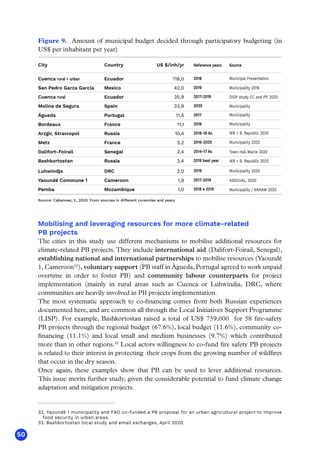
Figure 9. Amount of municipal budget decided through participatory budgeting (in US$
per inhabitant per year) ......................................................................................................................................... 50
1
1
1
5
6
7
xii
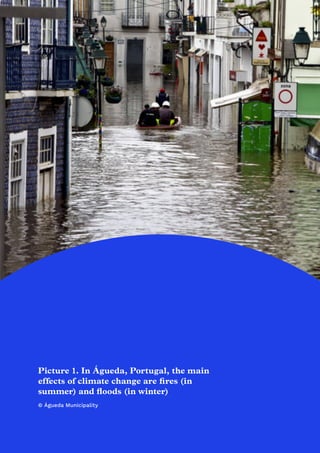
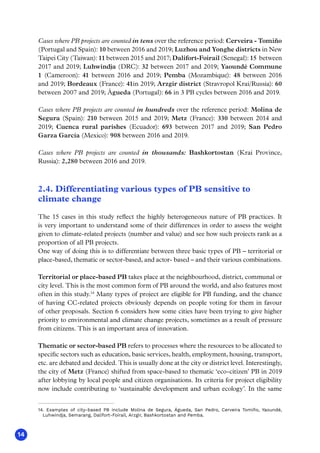
Picture 1. In Águeda, Portugal, the main
effects of climate change are fires (in
summer) and floods (in winter)
© Águeda Municipality
1
This paper explores the extent to which Participatory Budgeting [PB], a form of decision-
making that actively involves citizens in prioritising how public resources are spent,
contributes to climate change adaptation and mitigation. PB is defined as a mechanism or
process whereby people make decisions about the destination of some or all of the public
resources available, or are otherwise associated with the decision-making process.
At present there is virtually no research or publications exploring this link, apart from
rare exceptions such as Budge  Hall’s short report (2019)1
or the seminal methodological
guide to PB and climate change published by ENDA Ecopop (2013). Since the early
phases of PB a good deal of literature has been produced on how it relates to Agenda 21
1. Our Money, our planet: engaging citizens in the climate emergency through participatory democracy, which
includes a report on a series of co-design workshops held between June and September 2019, jointly
published by PB Partners and Share future in 2019.
Introduction
Section 1
2
and sustainable environmental initiatives (see, for instance, Kranz  Silva, 1998),2
but
this mainly relates to the iconic case of Porto Alegre (see in particular Menegat, 2002).3
There have been very few multi-city or comparative approaches to the subject since the
pioneering Spanish compilation on Participatory Budgeting and Agenda 21 (Miranda,
L., 2003),4
which looked at the wave of PB initiatives in Latin America at that time.
Since then, most comparative analysis of PB and the environment has been conducted
in a national context, such as the study on PB in three Polish cities, Katowice, Łódź
and Poznań, which aimed to identify how PB improved the quality of their environment
(Bernaciak, A., 2017).5
Few are grounded in actual practice or give a voice to the actors
leading such processes. They are more reflections based on secondary data, with quite
variable levels of accuracy and thus validity.
This paper aims to show what is currently happening in a selected number of cities,
gather and present sound data, and initiate stakeholder reflection on the extent to which
PB contributes to climate change adaptation and mitigation, how it does so, and the
current challenges facing PB actors.
The conference convened by the International Observatory on Participatory Democracy
(IODP) in Iztapalapa, Mexico in December 2019 was the first international event that
included a session on the direct, multiple and evolving contributions that PB is making in
the highly challenging field of climate adaptation and mitigation.6
The two main lessons
learned from this session were first, that a growing (but still limited) number of cities and
regions are using PB to address the different effects of climate change in specific local
situations – from heatwaves and extreme weather events to fires,floods and rising sea levels.
Second, that a wide range of actors are involved in PB processes that focus on climate
and environmental projects (see abstracts in Annex 3): international organisations such as
South Pole, the European Union KIC programme or the World Bank in Russia; national
and International NGOs such as Kota Kita, FMDV or Enda Ecopop; municipalities such
as Bordeaux and Metz in France,NewTaipei City inTaiwan,Molina de Segura in Spain,or
Lisbon and Águeda in Portugal; national networks of cities such as RAPP, the Portuguese
network of participatory municipalities, or ANAMM, the Mozambican network of local
governments.While these findings were very promising, they also highlighted the need for
further documentation and reflection.Therefore, several organisations led by Kota Kita7
2. Kranz, P. and Silva, N.L.A., 1998. Radical dreams coming through: Local agenda 21 and the participatory
budget, Local Environment: The International Journal of Justice and Sustainability, 3(2), pp. 215-220.
3. Menegat, R., 2002, Participatory democracy and sustainable development: integrated urban environmental
management in Porto Alegre, Brazil, Environment and Urbanization, 4(2), pp. 181-206.
4. Liliana Miranda Sara, compiladora, 2003, Presupuesto participativo y Agenda 21: construyendo ciudades para
la vida, Lima: fondo Editorial del Congreso del Perú. Foro Ciudades para la Vida y Quito: Programa de Gestión
urbana, cuaderno de trabajo 108, 480 pp.
5. Bernaciak, A., Rzeńca, A., Sobol, A. (2017), Participatory Budgeting as a Tool of Environmental Improvements
in Polish Cities, Economic and Environmental Studies, Vol. 17, No. 4 (44/2017), 879-906, Opole University.
6. FMDV (Global Fund for Cities Development), host; co-organizers: RAPP (Portuguese Network of Participatory
Municipalities / Rede de Autarquias participativas de Portugal); Lisbon Municipality, Portugal; Molina de
Segura Municipality, Spain; ENDA Ecopop, Senegal; Kota Kita, Indonesia; World Bank / Russia Local Initiatives
Support Program; South Pole, international organization / Climate KIC, European Union Initiative on Climate;
CES, Centro de Estudos Sociais / Centre for Social Studies, Coimbra University, Portugal London and the
OIDP (International Observatory on Participatory Democracy, Barcelona – See Annex 3.
7. Kota Kita, Indonesia, host; UCL/DPU, FMDV and OIDP – see Annexes 4 and 5.
3
organised a second, follow-up networking session on PB’s contribution to Climate change
adaptation and mitigation at the World Urban Forum in February 2020 (see Annexes 4
and 5 for the programme and abstracts presented at this event).
1.1. Objectives of this communication: rationale and
key issues
This paper builds on the abstracts, exchanges and contributions from the two international
sessions on participatory budgeting. Its main aim is to highlight the contributions and
innovations that have been made in various districts, cities and regions, which are probably
at the forefront of global efforts to use local-level PB to address the challenges presented
by climate change. Therefore, its first objective is to describe and understand what
is actually happening in the field.
The second objective is to assess the nature and importance of these contributions.
Are they marginal or not? How many projects are implemented each year? What do they
cost and where do the resources come from? Which effects of climate change do they
actually address or aim to address? In order to better understand whether projects are
more concerned with adaptation, mitigation, or a mixture of both, we had to examine
each initiative and determine the proportion of projects that were proposed by citizens,
screened and approved by cities, and actually implemented.
The third objective is to highlight the innovations that local, regional and national
actors have introduced to integrate PB into climate adaptation and mitigation efforts. PB
has always addressed environmental concerns, even though climate change was not high
on the agenda when it was first introduced in a couple of Brazilian municipalities 30 years
ago. These innovations show four different aspects of the shift towards ‘climate-sensitive
PB’: (i) Participation – different forms of citizen and local government participation; (ii)
Budgetary, fiscal and financial aspects of PB; (iii) Normative and institutional aspects –
various technical and legal considerations, and the architecture of locally designed PB;
and finally (iv) spatial aspects of PB, which can help us understand whether it can be a
tool for spatial climate justice.
The fourth objective is to generate and strengthen a community of practice whose
members will hopefully be better able to share and disseminate the knowledge and the
know-how generated through PB in quite different settings around the world.
The fifth and final objective of this paper is to advocate for climate-related
participatory budgeting and raise awareness of its huge (and as yet largely untapped)
potential to help mitigate the dramatic impacts that climate change has on millions of
people’s lives.
4
1.2. Methods, tools and research process
In addition to the presentations made at the two networking sessions (see Annexes 3
and 5), which provide unique insights from about 20 specialists, this report also draws
on ongoing PB initiatives in 15 cities and regions, which were documented between
October 2019 and April 2020. This would not have been possible without the committed
practitioners and researchers who gave up their time to document and clarify the answers
to multiple questions. Their contribution is fully acknowledged in the list of contributors
in Annex 1, and this paper should be considered as part of a collective work in progress
to build a knowledge common.
The 15 cities and regions referred to in the study provide a few examples of PB processes
that have started to focus on climate change or contribute to climate change to mitigation
and adaptation efforts. While they are not a proper sample and cannot represent the
breadth and depth of experiences in this field, they can be regarded as reference cities for
innovations.
The two main quantitative and qualitative tools8
used to systematise and compare each
local experience were:
•	 A questionnaire on PB and Climate Change (see Annex 2) that examines (i) the most
striking effects of climate change and perceived level of vulnerability in the city
or province concerned; and (ii) quantitative data such as the number and value of
approved projects that have an impact on climate adaptation and mitigation, and
their number and value as a percentage of total approved PB projects.
•	 PB profiles on 15 cities. The extended questionnaire to establish PB profiles was
identical to the one we used in the early 2000s for comparative research on PB
and municipal finance in 30 cities, which was coordinated by Porto Alegre for
the URBAL network;9
and in 2010 to assess PB’s contribution to the provision
and management of public services in 20 cities.10
Using the same profile allowed
to get a long-term perspective on how the PB process has evolved. The questions
are organised around four dimensions of PB: financial and fiscal, participation,
governance and legal framework, spatial / territorial aspects.
8. Other tools included systematic email exchanges with cities, gathering and analysing visual materials
(pictures, PowerPoint presentations and documentary films), and a desk review.
9. Cabannes, Y. (2003) Participatory budgeting and municipal finance. Base Document. Launch Seminar for
Urbal Network Nº9, Municipal Government of Porto Alegre, Porto Alegre (available in English, French, Italian,
Spanish and Portuguese).
A shorter version is available in English: Cabannes, Y. (2004) Participatory budgeting: a significant contribution
to participatory democracy. In: Environment  Urbanization Vol. 16 Nº1, April 2004, IIED: London.
10. Cabannes, Y. (2014) Contribution of Participatory Budgeting to provision and management of basic services:
Municipal practices and evidence from the field, Working paper, IIED: London (available in Portuguese and
English): http://pubs.iied.org/10713IIED.html
5
1.3. Limits of this communication: what will not be explored,
or not explored enough
Because this paper was limited by time and space constraints, there are a number of
questions that require further attention. They could be addressed in a second, more
research-oriented paper that would:
•	 critically explore different actors’ roles and relationships, looking at how citizens,
communities and authorities interact throughout the process, and identifying key
players in more climate-oriented PB approaches;
•	 provide a deeper account of the wealth of empirical material gathered so far on
new forms of governance to better address the challenges associated with climate
change;
•	 identify the conditions of success, the limitations and challenges faced by cities that
practice climate sensitive PB;
•	 assess the extent to which climate-sensitive PB has been able to reverse climate
change related spatial injustice? What conditions would need to be fulfilled for it to
do more in this respect?
•	 consider the extent to which endogenous knowledge and local expertise are
embedded in PB practices and are especially relevant in tackling climate change.
More attention should be paid to the cultural dimension of local climate-related
practices.
•	 investigate why some cities implement PB with a climate change perspective, while
their neighbours ignore this tool even though they often face the same climatic
challenges.
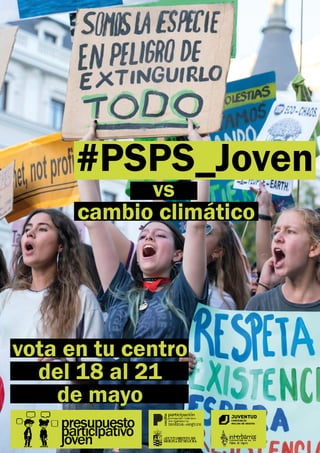
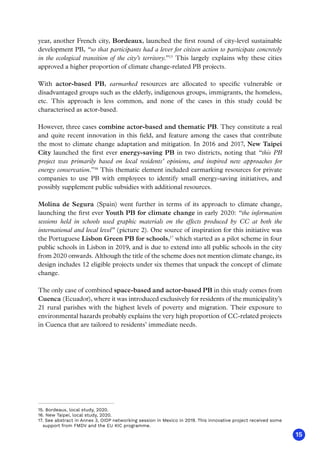
Next Page Picture 2. Poster for the
launching of the Youth Climate PB
2020, Molina de Segura, Spain
© Francisco Oliva Palazón
6
vs
cambio climático
del 18 al 21
vota en tu centro
de mayo
#PSPS_Joven
7
2.1. Size, type and location
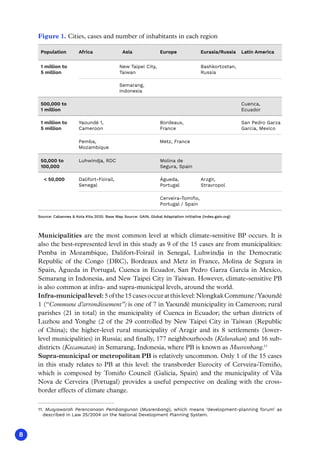
The table in Figure 1 shows that sub-national governments of quite different sizes practice
participatory budgeting with a climate change perspective, and that they operate in
various latitudes and sub-continents with diverse eco-systems and climates (continental,
temperate, arid and semi-arid, tropical and subtropical, equatorial and high-altitude
equatorial climates). These reference cases can therefore help to observe and understand
the specific effects of climate change faced by people in different locations, and the kind
of projects they select to address these effects (see next section).
These 15 experiences reflect the different administrative and political levels at which PB
currently takes place around the world, which are summarised below:
Brief introduction
and significance
of the 15 PB
reference cases.
Putting the cases
in perspective
Section 2
8
Municipalities are the most common level at which climate-sensitive BP occurs. It is
also the best-represented level in this study as 9 of the 15 cases are from municipalities:
Pemba in Mozambique, Dalifort-Foirail in Senegal, Luhwindja in the Democratic
Republic of the Congo (DRC), Bordeaux and Metz in France, Molina de Segura in
Spain, Águeda in Portugal, Cuenca in Ecuador, San Pedro Garza García in Mexico,
Semarang in Indonesia, and New Taipei City in Taiwan. However, climate-sensitive PB
is also common at infra- and supra-municipal levels, around the world.
Infra-municipallevel:5ofthe15casesoccuratthislevel:NlongkakCommune/Yaoundé
1 (“Commune d’arrondissement”) is one of 7 in Yaoundé municipality in Cameroon; rural
parishes (21 in total) in the municipality of Cuenca in Ecuador; the urban districts of
Luzhou and Yonghe (2 of the 29 controlled by New Taipei City in Taiwan (Republic
of China); the higher-level rural municipality of Arzgir and its 8 settlements (lower-
level municipalities) in Russia; and finally, 177 neighbourhoods (Kelurahan) and 16 sub-
districts (Kecamatan) in Semarang, Indonesia, where PB is known as Musrenbang.11
Supra-municipal or metropolitan PB is relatively uncommon. Only 1 of the 15 cases
in this study relates to PB at this level: the transborder Eurocity of Cerveira-Tomiño,
which is composed by Tomiño Council (Galicia, Spain) and the municipality of Vila
Nova de Cerveira (Portugal) provides a useful perspective on dealing with the cross-
border effects of climate change.
11. Musyawarah Perencanaan Pembangunan (Musrenbang), which means ‘development-planning forum’ as
described in Law 25/2004 on the National Development Planning System.
Figure 1. Cities, cases and number of inhabitants in each region
Population Africa Asia Europe Eurasia/Russia Latin America
1 million to
5 million
New Taipei City,
Taiwan
Bashkortostan,
Russia
500,000 to
1 million
Cuenca,
Ecuador
1 million to
5 million
Yaoundé 1,
Cameroon
San Pedro Garza
García, Mexico
Bordeaux,
France
50,000 to
100,000
Luhwindja, RDC Molina de
Segura, Spain
 50,000 Dalifort-Foirail,
Senegal
Arzgir,
Stravropol
Águeda,
Portugal
Source: Cabannes  Kota Kita 2020. Base Map Source: GAIN, Global Adaptation Initiative (index.gain.org)
Semarang,
Indonesia
Pemba,
Mozambique
Metz, France
Cerveira-Tomiño,
Portugal / Spain
9
Regional PB: the one regional-level case in this study comes from the Republic
of Bashkortostan in Russia. In this case, PB resources from the Regional budget are
debated in a decentralised way in settlements and districts (i.e., villages and higher-level
municipalities). However, at the end of the process the budgetary debate and decision on
PB proposals are made by the Bashkortostan Republic authority.
National PB: none of the cases in this study operate at this level. Portugal had planned to
introduce climate into its national PB process in 2020, but was unfortunately interrupted
by the COVID-19 pandemic. It may re-consider this initiative in the future.
The existence of PB at these multiple administrative and political levels raises an important
point: that it is possible to introduce and implement climate-sensitive PB at every level.
What can PB at each tier of government do to optimise its contribution to climate change
adaptation and mitigation? And how can the different levels of PB interact in order to
strengthen democracy and apply the principle of subsidiarity?
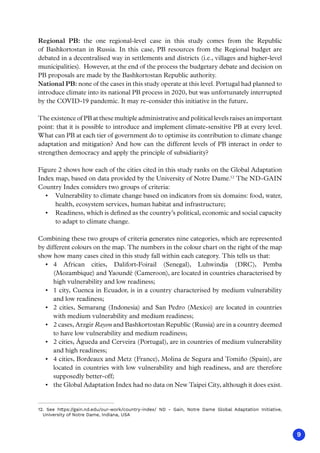
Figure 2 shows how each of the cities cited in this study ranks on the Global Adaptation
Index map, based on data provided by the University of Notre Dame.12
The ND-GAIN
Country Index considers two groups of criteria:
•	 Vulnerability to climate change based on indicators from six domains: food, water,
health, ecosystem services, human habitat and infrastructure;
•	 Readiness, which is defined as the country’s political, economic and social capacity
to adapt to climate change.
Combining these two groups of criteria generates nine categories, which are represented
by different colours on the map. The numbers in the colour chart on the right of the map
show how many cases cited in this study fall within each category. This tells us that:
•	 4 African cities, Dalifort-Foirail (Senegal), Luhwindja (DRC), Pemba
(Mozambique) and Yaoundé (Cameroon), are located in countries characterised by
high vulnerability and low readiness;
•	 1 city, Cuenca in Ecuador, is in a country characterised by medium vulnerability
and low readiness;
•	 2 cities, Semarang (Indonesia) and San Pedro (Mexico) are located in countries
with medium vulnerability and medium readiness;
•	 2 cases, Arzgir Rayon and Bashkortostan Republic (Russia) are in a country deemed
to have low vulnerability and medium readiness;
•	 2 cities, Águeda and Cerveira (Portugal), are in countries of medium vulnerability
and high readiness;
•	 4 cities, Bordeaux and Metz (France), Molina de Segura and Tomiño (Spain), are
located in countries with low vulnerability and high readiness, and are therefore
supposedly better-off;
•	 the Global Adaptation Index had no data on New Taipei City, although it does exist.
12. See https://gain.nd.edu/our-work/country-index/ ND - Gain, Notre Dame Global Adaptation Initiative,
University of Notre Dame, Indiana, USA
San Pedro Garza García (Mexico)
Molina de Segura (Spain)
New Taipei City (Taiwan)
Yaoundé, Commune 1 (Cameroon)
Republic of Bashkortostan (Russia)
Bordeaux (France)
Cuenca (Ecuador) Cerveira-Tomiño (P-S)
Metz (France)
Águeda (Portugal)
Arzgir district, Stravropol Krai (Russia)
Semarang (Indonesia)
Dalifort-Foirail (Senegal)
Luhwindja (Demoratic Republic of Congo) Pemba (Mozambique)
Vulnerability to Climate Change
and Level of readiness
Vulnerability
Combines indicators from six domains:
food, water, health, ecosystem services,
human habitat and infrastructure.
Readiness
Is a country’s political, economic and
social capacity to adapt to climate
change.
Figure 2. Position of participating cities on the University of Notre Dame Global Adaptation Initiative (ND-GAIN) vulnerability and readiness map.
Source: Cabannes  Kota Kita 2020. Base Map Source: GAIN, Global Adaptation Initiative (index.gain.org)
11
The variety of situations in these cases provide numerous opportunities for forward-
looking research. In addition to considering the general contribution that PB can make
to climate adaptation and mitigation, it also raises questions about how its contribution
relates to each country’s level of vulnerability and readiness. Is climate-sensitive PB more
relevant in countries with low levels of readiness and high levels of vulnerability, or is it
relevant everywhere?
Section 3 uses the narratives from different cities to explore the local relevance of national
adaptation initiatives. The hypothesis here is that PB can be an accurate instrument
for reducing vulnerability to climate change and increasing levels of readiness. If this
hypothesis is demonstrated, it would limit the relevance of national-level indexes and
increase the pertinence of PB at every administrative and political level. One logical
consequence of this would be to build city-based indexes instead of national ones.
2.2. PB experiences through time
The various cities and regions participating in the study illustrate the various phases of
PB expansion beyond Brazil. It is highly encouraging to see new climate-sensitive PB
experiences constantly emerging. The spread of PB over time opens the way for further
exploration of its cumulative effects on climate adaptation and mitigation.
Figure 3. Timeline for PB in the 15 cities and regions covered by this study
Source: Local teams; Data processing: Cabannes, 2020
* Águeda: 3 cycles only 2015/2016, 2016/2017 and 2017/2018
* San Pedro: interrupted [2010, 11, 12] because of violence and security issues in Monterrey Metropolitan area
Cuenca
inh 2001
614,539
San Pedro* 123,156
Semarang 1,555,984
Arzgir 26,298
Dalifort-Foirail 37,184
Luhwindja 99,387
Yaoundé 1 410,000
Metz 116,130
Molina de Segura 70,000
Bashkortostan 4,038,151
Águeda 47,729
New Taipei City 4,023,620
Pemba 226,846
Cerveira-Tomiño 37,000
Bordeaux 249,712
Cities 2002 2003 2004 2005 2006 2007 2008 2009 2010 2011 2012 2013 2014 2015 2016 2017 2018 2019
2001 2002 2003 2004 2005 2006 2007 2008 2009 2010 2011 2012 2013 2014 2015 2016 2017 2018 2019
inh
Cities
12
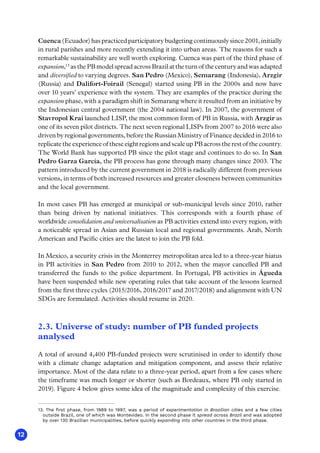
Cuenca(Ecuador)haspracticedparticipatorybudgetingcontinuouslysince2001,initially
in rural parishes and more recently extending it into urban areas. The reasons for such a
remarkable sustainability are well worth exploring. Cuenca was part of the third phase of
expansion,13
as the PB model spread across Brazil at the turn of the century and was adapted
and diversified to varying degrees. San Pedro (Mexico), Semarang (Indonesia), Arzgir
(Russia) and Dalifort-Foirail (Senegal) started using PB in the 2000s and now have
over 10 years’ experience with the system. They are examples of the practice during the
expansion phase, with a paradigm shift in Semarang where it resulted from an initiative by
the Indonesian central government (the 2004 national law). In 2007, the government of
Stavropol Krai launched LISP, the most common form of PB in Russia, with Arzgir as
one of its seven pilot districts. The next seven regional LISPs from 2007 to 2016 were also
driven by regional governments, before the Russian Ministry of Finance decided in 2016 to
replicate the experience of these eight regions and scale up PB across the rest of the country.
The World Bank has supported PB since the pilot stage and continues to do so. In San
Pedro Garza García, the PB process has gone through many changes since 2003. The
pattern introduced by the current government in 2018 is radically different from previous
versions, in terms of both increased resources and greater closeness between communities
and the local government.
In most cases PB has emerged at municipal or sub-municipal levels since 2010, rather
than being driven by national initiatives. This corresponds with a fourth phase of
worldwide consolidation and universalisation as PB activities extend into every region, with
a noticeable spread in Asian and Russian local and regional governments. Arab, North
American and Pacific cities are the latest to join the PB fold.
In Mexico, a security crisis in the Monterrey metropolitan area led to a three-year hiatus
in PB activities in San Pedro from 2010 to 2012, when the mayor cancelled PB and
transferred the funds to the police department. In Portugal, PB activities in Águeda
have been suspended while new operating rules that take account of the lessons learned
from the first three cycles (2015/2016, 2016/2017 and 2017/2018) and alignment with UN
SDGs are formulated. Activities should resume in 2020.
2.3. Universe of study: number of PB funded projects
analysed
A total of around 4,400 PB-funded projects were scrutinised in order to identify those
with a climate change adaptation and mitigation component, and assess their relative
importance. Most of the data relate to a three-year period, apart from a few cases where
the timeframe was much longer or shorter (such as Bordeaux, where PB only started in
2019). Figure 4 below gives some idea of the magnitude and complexity of this exercise.
13. The first phase, from 1989 to 1997, was a period of experimentation in Brazilian cities and a few cities
outside Brazil, one of which was Montevideo. In the second phase it spread across Brazil and was adopted
by over 130 Brazilian municipalities, before quickly expanding into other countries in the third phase.
13
Figure 4. Number of PB projects approved per year in participating studies and regions
Source: Local studies; Data processing and computing, Cabannes, Y., 2020.
Population 2016
Dalifort-Foirail, Senegal 37,184
99,387
226,846
410,000
Luhwindja, RDC
Pemba, Mozambique
Yaoundé Commune 1,
Cameroon
2017 2018 2019 TOTAL Gen. Total Period
Africa
5 5 5 15 15
Observations
± 5 per year
10 10 12 32 from survey
12 12 12 12 48 48 2016-2019 yearly distribution to be reviewed
10 10 10 11 41 150 2012-2019 at least 150
New Taipei City, Taiwan 4,023,620
1,555,984
Semarang, Indonesia
Asia
5 5 5 15 15 still to come
10 10 12 32 N.A [see note]
Águeda, Portugal 47,729
249,712 (2015)
37,000
116,130 (2019)
Bordeaux, France
Cerveira-Tomiño,
Portugal / Spain
Metz, France
Europe
21 26 19 66 66 3 cycles 2015/16; 2016/17; 2017/18
41 41 41 2019 407 ideas  134 selected as envir.
2 2 3 3 10 10 2016-2019 yearly distribution to be reviewed
60 60 330 2014-2019 Q3 Survey
70,000
Molina de Segura, Spain 40 48 55 45 188 210 2015-2019
Arzgir, Stravropol Krai 26,298
4,038,151
Bashkortostan, Russia
Eurasia / Russia
7 8 15 60 2007-2019 60 is an approx number
487 436 598 759 2280 2445 2014-2019 N.A [see note]
San Pedro Garza García,
Mexico
123,156 (2015)
614,539 (2019)
Cuenca, Ecuador
Latin America
235 207 220 246 908 1601 2013-2019 60 is an approx number
210 231 252 683 4000 2001-2019
Probably over 4000 projects in
20 years
Total 807 966 1170 1454 4397 8976
It is still hard to obtain accurate data on the type and value of PB projects in certain
countries and cities. For example, budgetary reporting in Semarang and most Indonesian
cities makes it difficult to identify climate change projects that have been funded through
PB processes. Finalised PB projects are managed by the different departments or agencies
that implement them, and it is impossible to determine whether projects are funded
through PB or conventional government budgets because the records do not distinguish
between them.
Setting aside these difficulties, the central observation is that the number of projects
varies greatly from one city to another, depending on the maximum authorised value of
each project and the total amount debated through PB. These two issues are explored in
the following sections. It should also be noted that the capacity to contribute to climate
adaptation and mitigation varies from city to city, depending on their situation.
14
Cases where PB projects are counted in tens over the reference period: Cerveira - Tomiño
(Portugal and Spain): 10 between 2016 and 2019; Luzhou and Yonghe districts in New
Taipei City (Taiwan): 11 between 2015 and 2017; Dalifort-Foirail (Senegal): 15 between
2017 and 2019; Luhwindja (DRC): 32 between 2017 and 2019; Yaoundé Commune
1 (Cameroon): 41 between 2016 and 2019; Pemba (Mozambique): 48 between 2016
and 2019; Bordeaux (France): 41in 2019; Arzgir district (Stravropol Krai/Russia): 60
between 2007 and 2019; Águeda (Portugal): 66 in 3 PB cycles between 2016 and 2019.
Cases where PB projects are counted in hundreds over the reference period: Molina de
Segura (Spain): 210 between 2015 and 2019; Metz (France): 330 between 2014 and
2019; Cuenca rural parishes (Ecuador): 693 between 2017 and 2019; San Pedro
Garza García (Mexico): 908 between 2016 and 2019.
Cases where PB projects are counted in thousands: Bashkortostan (Krai Province,
Russia): 2,280 between 2016 and 2019.
2.4. Differentiating various types of PB sensitive to
climate change
The 15 cases in this study reflect the highly heterogeneous nature of PB practices. It
is very important to understand some of their differences in order to assess the weight
given to climate-related projects (number and value) and see how such projects rank as a
proportion of all PB projects.
One way of doing this is to differentiate between three basic types of PB – territorial or
place-based, thematic or sector-based, and actor- based – and their various combinations.
Territorial or place-based PB takes place at the neighbourhood, district, communal or
city level. This is the most common form of PB around the world, and also features most
often in this study.14
Many types of project are eligible for PB funding, and the chance
of having CC-related projects obviously depends on people voting for them in favour
of other proposals. Section 6 considers how some cities have been trying to give higher
priority to environmental and climate change projects, sometimes as a result of pressure
from citizens. This is an important area of innovation.
Thematic or sector-based PB refers to processes where the resources to be allocated to
specific sectors such as education, basic services, health, employment, housing, transport,
etc. are debated and decided. This is usually done at the city or district level. Interestingly,
the city of Metz (France) shifted from space-based to thematic ‘eco-citizen’ PB in 2019
after lobbying by local people and citizen organisations. Its criteria for project eligibility
now include contributing to ‘sustainable development and urban ecology’. In the same
14. Examples of city-based PB include Molina de Segura, Águeda, San Pedro, Cerveira Tomiño, Yaoundé,
Luhwindja, Semarang, Dalifort-Foirail, Arzgir, Bashkortostan and Pemba.
15
year, another French city, Bordeaux, launched the first round of city-level sustainable
development PB, “so that participants had a lever for citizen action to participate concretely
in the ecological transition of the city’s territory.”15
This largely explains why these cities
approved a higher proportion of climate change-related PB projects.
With actor-based PB, earmarked resources are allocated to specific vulnerable or
disadvantaged groups such as the elderly, indigenous groups, immigrants, the homeless,
etc. This approach is less common, and none of the cases in this study could be
characterised as actor-based.
However, three cases combine actor-based and thematic PB. They constitute a real
and quite recent innovation in this field, and feature among the cases that contribute
the most to climate change adaptation and mitigation. In 2016 and 2017, New Taipei
City launched the first ever energy-saving PB in two districts, noting that “this PB
project was primarily based on local residents’ opinions, and inspired new approaches for
energy conservation.”16
This thematic element included earmarking resources for private
companies to use PB with employees to identify small energy-saving initiatives, and
possibly supplement public subsidies with additional resources.
Molina de Segura (Spain) went further in terms of its approach to climate change,
launching the first ever Youth PB for climate change in early 2020: “the information
sessions held in schools used graphic materials on the effects produced by CC at both the
international and local level” (picture 2). One source of inspiration for this initiative was
the Portuguese Lisbon Green PB for schools,17
which started as a pilot scheme in four
public schools in Lisbon in 2019, and is due to extend into all public schools in the city
from 2020 onwards. Although the title of the scheme does not mention climate change, its
design includes 12 eligible projects under six themes that unpack the concept of climate
change.
The only case of combined space-based and actor-based PB in this study comes from
Cuenca (Ecuador), where it was introduced exclusively for residents of the municipality’s
21 rural parishes with the highest levels of poverty and migration. Their exposure to
environmental hazards probably explains the very high proportion of CC-related projects
in Cuenca that are tailored to residents’ immediate needs.
15. Bordeaux, local study, 2020.
16. New Taipei, local study, 2020.
17. See abstract in Annex 3, OIDP networking session in Mexico in 2019. This innovative project received some
support from FMDV and the EU KIC programme.
16
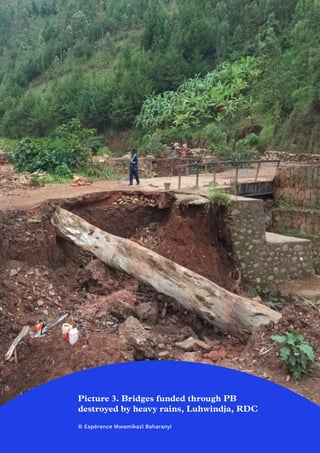
Picture 3. Bridges funded through PB
destroyed by heavy rains, Luhwindja, RDC
© Espérance Mwamikazi Baharanyi
17
Most striking
effects of climate
change alterations
faced by the cities
and perceived
vulnerability
Section 3
This section summarises and comments on the way that cities responded to the following
questions: (1) What are the most striking effects of CC-induced change in the city or
province where PB is taking place? (2) Briefly describe the level of vulnerability in the
city or province where PB is taking place.
Rather than using predefined analytical categories for the effects of / vulnerability to
climate change, each city and region used their own categories and described local
situations in their own words. This proved to be an effective way of identifying categories
based on local realities and perceptions.
18
3.1. Not a single but a combination of striking effects in
various cases
The different testimonies clearly show that most cities are dealing with more than one
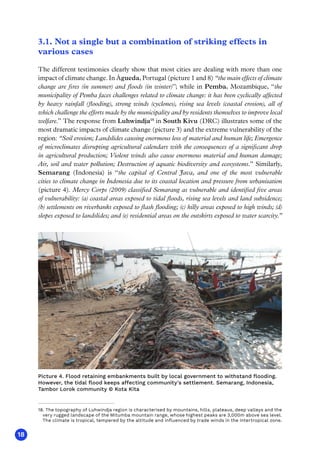
impact of climate change. In Águeda, Portugal (picture 1 and 8) “the main effects of climate
change are fires (in summer) and floods (in winter)”; while in Pemba, Mozambique, “the
municipality of Pemba faces challenges related to climate change: it has been cyclically affected
by heavy rainfall (flooding), strong winds (cyclones), rising sea levels (coastal erosion), all of
which challenge the efforts made by the municipality and by residents themselves to improve local
welfare.” The response from Luhwindja18
in South Kivu (DRC) illustrates some of the
most dramatic impacts of climate change (picture 3) and the extreme vulnerability of the
region: “Soil erosion; Landslides causing enormous loss of material and human life; Emergence
of microclimates disrupting agricultural calendars with the consequences of a significant drop
in agricultural production; Violent winds also cause enormous material and human damage;
Air, soil and water pollution; Destruction of aquatic biodiversity and ecosystems.” Similarly,
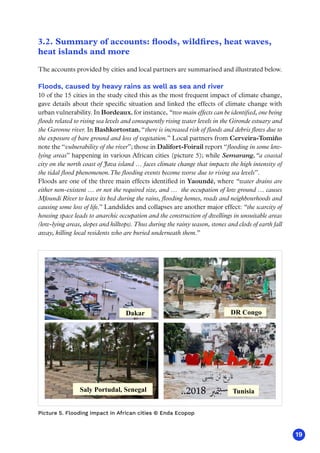
Semarang (Indonesia) is “the capital of Central Java, and one of the most vulnerable
cities to climate change in Indonesia due to its coastal location and pressure from urbanisation
(picture 4). Mercy Corps (2009) classified Semarang as vulnerable and identified five areas
of vulnerability: (a) coastal areas exposed to tidal floods, rising sea levels and land subsidence;
(b) settlements on riverbanks exposed to flash flooding; (c) hilly areas exposed to high winds; (d)
slopes exposed to landslides; and (e) residential areas on the outskirts exposed to water scarcity.”
18. The topography of Luhwindja region is characterised by mountains, hills, plateaus, deep valleys and the
very rugged landscape of the Mitumba mountain range, whose highest peaks are 3,000m above sea level.
The climate is tropical, tempered by the altitude and influenced by trade winds in the intertropical zone.
Picture 4. Flood retaining embankments built by local government to withstand flooding.
However, the tidal flood keeps affecting community's settlement. Semarang, Indonesia,
Tambor Lorok community © Kota Kita
19
3.2. Summary of accounts: floods, wildfires, heat waves,
heat islands and more
The accounts provided by cities and local partners are summarised and illustrated below.
Floods, caused by heavy rains as well as sea and river
10 of the 15 cities in the study cited this as the most frequent impact of climate change,
gave details about their specific situation and linked the effects of climate change with
urban vulnerability. In Bordeaux, for instance, “two main effects can be identified, one being
floods related to rising sea levels and consequently rising water levels in the Gironde estuary and
the Garonne river. In Bashkortostan, “there is increased risk of floods and debris flows due to
the exposure of bare ground and loss of vegetation.” Local partners from Cerveira-Tomiño
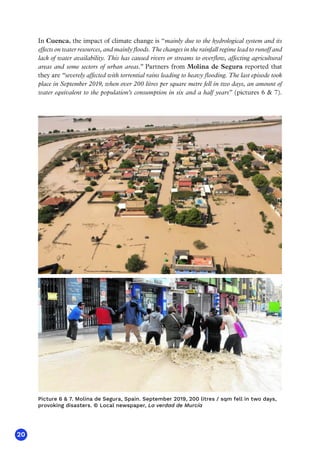
note the “vulnerability of the river”; those in Dalifort-Foirail report “flooding in some low-
lying areas” happening in various African cities (picture 5); while Semarang,“a coastal
city on the north coast of Java island … faces climate change that impacts the high intensity of
the tidal flood phenomenon.The flooding events become worse due to rising sea levels”.
Floods are one of the three main effects identified in Yaoundé, where “water drains are
either non-existent … or not the required size, and … the occupation of low ground … causes
Mfoundi River to leave its bed during the rains, flooding homes, roads and neighbourhoods and
causing some loss of life.” Landslides and collapses are another major effect: “the scarcity of
housing space leads to anarchic occupation and the construction of dwellings in unsuitable areas
(low-lying areas, slopes and hilltops). Thus during the rainy season, stones and clods of earth fall
away, killing local residents who are buried underneath them.”
Picture 5. Flooding impact in African cities © Enda Ecopop
Dakar DR Congo
Tunisia
Saly Portudal, Senegal
20
In Cuenca, the impact of climate change is “mainly due to the hydrological system and its
effects on water resources, and mainly floods. The changes in the rainfall regime lead to runoff and
lack of water availability. This has caused rivers or streams to overflow, affecting agricultural
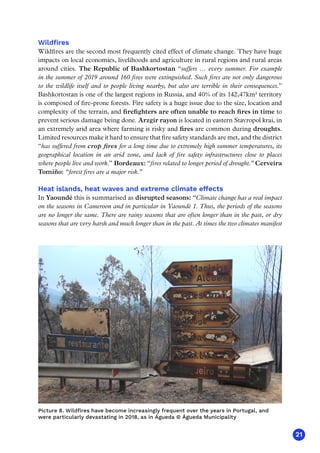
areas and some sectors of urban areas.” Partners from Molina de Segura reported that
they are “severely affected with torrential rains leading to heavy flooding. The last episode took
place in September 2019, when over 200 litres per square metre fell in two days, an amount of
water equivalent to the population’s consumption in six and a half years” (pictures 6  7).
Picture 6  7. Molina de Segura, Spain. September 2019, 200 litres / sqm fell in two days,
provoking disasters. © Local newspaper, La verdad de Murcía
21
Wildfires
Wildfires are the second most frequently cited effect of climate change. They have huge
impacts on local economies, livelihoods and agriculture in rural regions and rural areas
around cities. The Republic of Bashkortostan “suffers … every summer. For example
in the summer of 2019 around 160 fires were extinguished. Such fires are not only dangerous
to the wildlife itself and to people living nearby, but also are terrible in their consequences.”
Bashkortostan is one of the largest regions in Russia, and 40% of its 142,47km² territory
is composed of fire-prone forests. Fire safety is a huge issue due to the size, location and
complexity of the terrain, and firefighters are often unable to reach fires in time to
prevent serious damage being done. Arzgir rayon is located in eastern Stavropol krai, in
an extremely arid area where farming is risky and fires are common during droughts.
Limited resources make it hard to ensure that fire safety standards are met, and the district
“has suffered from crop fires for a long time due to extremely high summer temperatures, its
geographical location in an arid zone, and lack of fire safety infrastructures close to places
where people live and work.” Bordeaux: “fires related to longer period of drought.” Cerveira
Tomiño: “forest fires are a major risk.”
Heat islands, heat waves and extreme climate effects
In Yaoundé this is summarised as disrupted seasons: “Climate change has a real impact
on the seasons in Cameroon and in particular in Yaoundé 1. Thus, the periods of the seasons
are no longer the same. There are rainy seasons that are often longer than in the past, or dry
seasons that are very harsh and much longer than in the past. At times the two climates manifest
Picture 8. Wildfires have become increasingly frequent over the years in Portugal, and
were particularly devastating in 2018, as in Águeda © Águeda Municipality
22
themselves simultaneously with two or three days of freshness and rains followed by four to seven
days of heat wave”… Participants from Metz highlight current and future effects: “…
recurring periods of heatwave/drought during the summer, with foreseeable heat peaks of 50°
under cover within the next 20 years…” In New Taipei, “heat island effect is pronounced in
the districts of Sanchong, Luzhou, Xinzhuang and Banquiao; the temperature in these districts
is higher than in surrounding areas.” Partners from Dalifort-Foirail and Bordeaux also
listed heatwaves as one of the effects of climate change: “Longer droughts, heat islands and
more heatwaves.”
Typhoons
Are cited as a major hazard in Pemba, which is affected by “high winds and cyclones,” and
New Taipei City, where “the major natural hazards we face are typhoons and strong rainfall
over a short period, which leads to flooding and slope-related disasters (such as landslides and
collapses). Temporary power failures may also occur.”
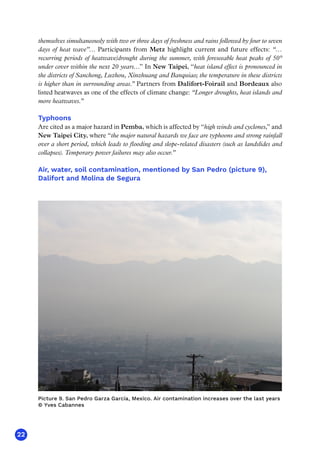
Air, water, soil contamination, mentioned by San Pedro (picture 9),
Dalifort and Molina de Segura
Picture 9. San Pedro Garza García, Mexico. Air contamination increases over the last years
© Yves Cabannes
23
Multiple other effects
Multiple other effects identified in individual cities include:
•	 “Intensification of the greenhouse effect, deterioration in the health of children
and adolescents, including premature deaths and respiratory diseases (San Pedro)
•	 Salts in the soil rising to the surface (Dalifort-Foirail)
•	 Partners from Metz are concerned about the future “gradual extinction of
endemic species (plant and animal) that will not adapt to climate change”; something
that is already happening in San Pedro, Mexico, where “native species and existing
flora and fauna are being replaced, and the migration routes of Monarch butterflies are
changing.”
3.3. Preliminary lessons and findings
The first lesson learned is probably that climate-sensitive PB has not emerged in different
regions by chance or in response to international priorities and agendas. It is driven by the
need to address very specific effects of climate change and their dramatic, often multiple
impacts on local communities and settings.
The second observation is that we need to better understand how the communities and
local governments that design and select priority PB projects perceive the risks associated
with climate change. The relevance of the diverse projects that are prioritised can only be
properly assessed in the light of nuanced local perceptions of the effects of climate change
and detailed local knowledge of levels of vulnerability in permanently evolving situations.
The narratives from participating cities highlight the widespread and increasingly
intense effects of climate change around the world, and suggest that a small but growing
number of cities and regions are using PB as a way of coping with the heavy rains, floods,
heatwaves, wildfires and other effects associated with climate change. The next sections
use the GAIN indicator to explore the extent to which PB projects reduce vulnerability to
and increase “level of preparedness” for such events. If they can do this, PB could be used
as a tool for significant change on the ground that would profoundly alter the situation of
the cities shown on the ND-GAIN vulnerability and readiness map in Figure 2.
24
Picture 10. Footbridge and green urban
circulations funded through PB, Metz, France
© Metz Municipality
25
This assessment is based on the information provided by 15 cities and regions. It examines:
•	 the number of approved PB projects that have had an impact on climate change
adaptation and mitigation, highlighting paradigmatic projects
•	 the estimated value of these projects
•	 the number of PB climate adaptation and mitigation projects as a percentage of all
approved PB projects
•	 the value of PB climate adaptation and mitigation projects as a percentage of the
total value of PB projects
•	 the percentage of projects approved through PB decisions that have actually been
implemented.
Assessment of
PB contribution
to climate change
adaptation and
mitigation
Section 4
26
4.1. Number of PB projects approved with an impact on
climate change adaptation and mitigation
As noted in in paragraph 2.3, this analysis considered about 4,400 PB projects that mainly
fell within a three-year period. Data could be consolidated on 11 out of the 15 cases. As
only four cities were able to differentiate between climate adaptation projects and climate
mitigation projects, the two categories were combined in order to broaden the basis of the
analysis.
One of the major findings is that the review identified 923 projects that contribute to climate
adaption or mitigation in 11 cities and regions. This clearly demonstrates the important
role that PB can and does play in this field. However, the numbers vary considerably from
one case to the next: depending on their size, some cities implement tens of PB-funded
projects each year while others have hundreds, and one region implemented thousands of
PB-funded projects. Four different groups were identified based on the number of PB-
funded projects that have had an impact on CC adaptation and mitigation:
•	 1 to 10 projects: Cerveira-Tomiño implemented 4 projects in 2018 and 2019,
working with a very small budget and a limited number of projects; Arzgir Rayon
implemented 6 projects in 2010, 2012 and 2013, all related to fire safety; and Molina
de Segura implemented 4 projects between 2017 and 2019 – a tiny proportion of
the 210 projects that were funded over this period, and of the many CC-related
proposals that did not get enough votes to be implemented. We will return to this
case later in the report.
•	 10 to 50 projects: Águeda implemented 17 projects (15 of which were mitigation
projects) over three PB cycles (2015-2018); Yaoundé 1 implemented 16 projects
between 2017 and 2019; NewTaipei City implemented 11 projects in two districts
where energy saving projects were implemented in 2016 and 2017; while Bordeaux
implemented 41 projects in 2019, the year it launched the PB process.
•	 50 to 100 projects: Bashkortostan Republic reported on 58 fire safety projects
implemented between 2017 and 2019, but did not provide more general information
on projects that had an impact on climate change.
•	 Above 100 projects: Cuenca was the clear leader in this group with 514 projects,
89% of which were concerned with climate adaptation and 11% with mitigation.
San Pedro Garza García also made a significant contribution with 185 projects;
while Metz funded 120 sustainable development PB projects, 70% of which related
to mitigation and 30% to adaptation to climate change.
27
4.2. Going beyond numbers: what kind of projects are
prioritized by citizens
In addition to the huge number of projects, one of the most interesting findings was the
wide variety of projects voted and their capacity to address very specific problems identified
by local people. Some will be briefly discussed in order to give a flavour of their diversity.
Projects are organized into the six categories shown below.This was quite a challenge as
each city has its own set of categories, and it would require another comparative analysis
to fully capture their rationale and creativity.The proposed categories of PB project are:
•	 ‘Physical’ or ‘tangible’ CC adaptation projects
•	 ‘Physical’ or ‘tangible’ CC mitigation projects
•	 Combined CC adaptation  mitigation projects
•	 Awareness raising and training on climate change
•	 Early warning projects
•	 Climate change studies and information systems
Climate change adaptation “physical” or “tangible” PB projects. Some
examples
Several regions in Russia use a form of PB known as the Local Initiatives Support
Program (LISP) to approve and implement projects and about 3% of the total are related
to fire safety, dealing with wildfires. About 500 projects of this kind are implemented
across Russia each year. In Bashkortostan Republic, under LISP initiative, different
types of fire safety projects were funded: (a) Convertion of abandoned buildings into fire
stations (picture 11); (b) Renovation and cleaning of fire water reservoirs (ponds and
wells); (c) Repairing and equipping fire stations; (d) Purchase of firefighting equipment;
(1) PB Project: Establishing a rural fire station in Chernyaevsky village, Khabarovsk region
BEFORE
AFTER
30.8 K USD
4.6 K USD
4.6 K USD
Project budget:
40 K USD
Picture 11. Bashkortostan Republic, Russia. Multiple PB funded projects focus on fire
safety, a growing problem due to climate change. © World Bank
28
(e) Installation of underground fire safety tanks. Arzgir Rayon and some of its settlements
also voted on projects to convert abandoned buildings into fire stations and renovate and
clean fire water reservoirs (ponds). These projects enabled firefighters to reach most of
the municipality in less than 20 minutes and prevent fires spreading and destroying crops
(picture 12).
Wildfires have become increasingly frequent over the years in Portugal, and were
particularly devastating in 2018.That year, for the first time in the country’s long history
of PB, the municipality of Águeda approved and implemented a €46,600 proposal for a
mega water tank to help local firefighting associations (picture 13).
Picture 13. Águeda, Portugal. PB funded Community water tank to help local associations
in their firefighting actions. © Águeda Municipality
Year 2007: no PB in the region Now: new fire stations created under PB
Example of Fire stations in Arzgir rayon, Stavropol Krai
Fire pond
Arzgir Rayon
Area: 3,383 km2
Population: 24,604 people
Picture 12. Arzgir Rayon, Stravropol Region. PB funded fire stations allow to intervene in
less than 20 minutes within the municipality, reducing the risk of fire expansion. © World
Bank
29
In Dalifort-Foirail, a commune in the metropolitan area of Dakar in Senegal, various
projects approved through PB processes permitted to install rainwater drainage systems
to tackle increasingly frequent problems with flooding (picture 14). PB projects that
combine road improvements with drainage systems are fairly common in flood-prone
areas.They are also essential for citizens and rural communities such as Cuenca, which
have approved and implemented, thanks to PB, many massive water-related projects
representing investments of millions of US dollars over the years (picture 15).
Picture 14. Before and After PB projects. Dalifort-Foirail, Senegal. © Enda ECOPOP
PIC 11
Picture 15. Cuenca. PB Works in villages © Cuenca Municipality
30
In Luhwindja, South Kivu Region, PB projects led to build seven bridges and repair
other infrastructures destroyed by heavy rains and flooding, enabling remote and rural
communities to remain connected despite the dramatic impacts of these events (pictures
16  17).
In Yaoundé 1 PB funded community fountain provides Etoudi neighbourhood people
drinking water during the dry season, and allows to rationalise its use and reduce wastage
(pictures 18  19).
Picture 16  17. Luhwindja, South Kivu Region, bridges. Before and After PB. © Espérance
Mwamikazi Baharanyi
31
PIC 14 LUWINDJA
Climate change mitigation “physical” or “tangible” PB projects. Some
examples
A large proportion of the 923 projects identified as CC mitigation ones help reduce
greenhouse gas emissions and contribute to a more sustainable environment. The few
examples given below show that they include a wide range of interventions tailored to the
local effects described in the previous section:
•	 Community-based reforestation projects in Luhwindja, DRC (picture 20);
Picture 20. Reforesting PB project in Luhwindja, RDC with participation of young students
and communities © Espérance Mwamikazi Baharanyi
PIC 14 LUWINDJA
PIC 14 LUWINDJA
PIC 14 LUWINDJA
Picture 18. 2016 PB funded fountain provides
Etoudi neighbourhood people drinking water
during the dry season, and allows to rationalise
its use and reduce wastage. © Yaoundé
Commune 1
Picture 19. PB funded solar panel installation
for drinking water pumping and distribution,
Nyom neighbourhood © Yaoundé Commune 1
32
Picture 22. Metz, France. Composting close to community gardens [PB project] © Metz
Municipality
Picture 21. Metz, France. Footbridge and green urban circulations. A neighbourhood
Committee proposed a footbridge to connect foot paths they had cleared over the years.
© Metz Municipality
33
Picture 23. PB support to local food chains. © Cuenca Municipality
Climate change adaptation  mitigation combined PB projects
Some of the participating cities, like Bordeaux underlined that some of the projects
selected for the ‘Sustainable Development PB’ initiative address both climate adaptation
and mitigation while dealing with specific aspects of the city’s vulnerability to climate
change.19
The city-wide fruit tree planting and open spaces projects are part of a ‘Grey to
Green’ ethos that aims to transform the ‘city of stone, tarmac and concrete’ into a more
19. Bordeaux level of vulnerability is intrinsically linked to its geography. The 5 main aspects of vulnerability
are: [1] The historic site of the Roman city on the River Garonne makes Bordeaux extremely vulnerable to
rising water levels; [2] The wine economy is fragile, and vines have been badly affected by the weather
(hail, drought), weakening one of the mainstays of local agro-tourism ; [3] Bordeaux Metropolis is only food
self-sufficient for a very short period of 24 hours, and therefore depends on neighbouring land, farmers
and producers and a functioning logistical infrastructure (MIN, road transport...) that is itself dependent
on fossil fuels; [4] The ageing population reflects a major trend in French demography and increases the
city’s vulnerability; [5] Grey urban development with public spaces built around transport links need to be
‘greened’, especially the tramway (Bordeaux, local study, op cit.).
•	 Green urban circulation spaces and community gardens, composting near
community gardens, and greening urban spaces in Metz, France (pictures 21 
22). All these projects show the shift towards eco-citizen PB as a result of lobbying
by civil society;
•	 In San Pedro, Mexico, an urban car park is being transformed in a community
garden; while Lisbon is another one of the growing number of cities that have
approved PB projects to turn car parks into open green space in order to reduce
heatwaves and transform urban landscapes from grey to green;
•	 There are also a small number of highly innovative PB initiatives to support local
food chains and short agro-ecological circuits, such as projects that support the
cultivation of native species in the rural parishes of Cuenca (picture 23).
34
environmentally friendly place (picture 24). In terms of adaptation, greening can reduce
heat islands in public spaces, help create microclimates and insulate nearby buildings
against the heat. Planted species increase biodiversity in public spaces and help combat
desertification, [...] while providing ecological continuity between different natural
environments (wetlands, the Garonne River bed, urban and peri-urban vegetation). In
terms of mitigation, the project contributes to wider efforts to reduce greenhouse gases
and increase carbon sinks in cities.
Picture 24. Fruit tree planting. PB project to “green” a mineral city © Bordeaux Municipality
Raising awareness and training in the field of climate
Another, less common and less expensive type of project was identified, called here ‘soft’
or micro-projects , quite different from “brick and mortar” ones, that broadly fall into the
category of awareness raising and education on climate change.They sometimes involve
and benefit younger segments of the population, as with the youth and drawing campaigns
in Arzgir (picture 25); the two projects approved in Cerveira-Tomiño in 2019, one of
which was a visit to an educational farm and the other a one-day youth art workshop using
recyclable materials (pictures 26); and the ‘environmental campaign’ in Dalifort-Foirail,
which includes tree planting and distributing mosquito nets (pictures 27  28).
35
Picture 25. Arzgir Rayon, Russia. PB funded campaigns that included drawings in schools to
raise awareness on climate change  environmental issues. © World Bank
Pictures 26. Cerveira-Tomiño, Portugal / Spain. Example of “soft” PB project: one-day
artistic workshop with recyclable material for young people. © Tomiño Municipality
36
Interestingly, 6 of the 22 projects approved in New Taipei as part of the district-based
Energy Conservation PB targeting private companies fall into this category. Once again,
they show how PB can be a source of creative solutions to the challenges presented by
climate change: “the private-sector companies participating in PB chose 6 projects:(1) Inviting
YouTubers to share energy-saving tips online - MacroHi Ltd; (2) Using power-saving electricity
bills as coupons for fried dumplings in 24 stores -YuLoong Co.Ltd; (3) Hosting an energy-saving
musical fair for families - Sinyi Realty; (4) Using power-saving electricity bills as coupons
for tissue paper - New Taipei City Gas Station Commercial Association; (5) Hosting a call
for films on energy-saving topics - New Taipei City Beauty and Hair Materials Commercial
Association; (6) Hosting five energy-saving town hall meetings in the community - New Taipei
City Electrical Appliances Business Association.”20
(pictures 29  30)
Picture 27  28. Dalifort-Foirail, Senegal. Environmental campaign PB project, including
tree planting and distribution of mosquito nets. © Enda Ecopop
Picture 29  30. New Taipei City, Taiwan. Example of “soft” PB projects, funded through
a unique thematic energy conservation PB: transforming the vendors to an energy-saving
promotion hub (left); combining biking with the energy-saving promotion (right) © New
Taipei City Government
20. Local study on New Taipei City, 2020.
37
Community-based early warning projects
Early warning projects can be highly beneficial in facilitating rapid adaptation to climate
change. Examples include the air quality alert project voted by communities in San
Pedro, Mexico, which uses ICT to inform low-income communities in real time when
air contamination exceeds acceptable standards at certain times of year (picture 31);
and a project in Bashkortostan Region, Russia funded through the PB an Emergency
information system that provides loud speakers to alert local people to wildfires in
agricultural areas (pictures 32  33).
Picture 32  33. Bashkortostan, Russia. PB funded emergency information system and
loud speakers to alert in time of wildfires in agricultural areas. © World Bank
Picture 31. San Pedro, Mexico. An alert on contamination PB project, using ICT, allows
community to be informed in real-time about air contamination levels. © Yves Cabannes
38
Climate change studies and information systems
In some cities, studies relating to the environment and climate change are eligible as PB
projects. For example, in 2019 citizens in Molina de Segura, Spain, used PB to approve
a €26,000 study on collective electricity consumption as a first step towards finding
solutions based on renewable energies. But such projects are still rare, despite their huge
potential.
4.3. Amount of resources for climate change related PB
projects
Question 4 of the study survey related to the total value of climate change-related PB
projects (see Annex 2). Information was consolidated on 10 of the 15 cities, which is
shown in Figure 5 below, so this complex task is still a work in progress. The value of
completed and ongoing projects was converted into US dollars (calculated at the annual
rate of exchange). The overall sum should be regarded as an order of magnitude rather
than an absolute figure, partly because of fluctuations in the annual exchange rate, and
partly because some cities only reported on certain climate-related projects, such as
the Russian respondents that reported solely on fire safety projects and not all projects
that have an impact on CC adaptation and mitigation. As noted above, cities such as
Semarang, Pemba and Dalifort-Foirail invest heavily in CC-related projects, but their
current financial reporting and data processing systems made it impossible to distinguish
them from PB programmes.This is something that needs to be addressed at some point
in the future.
Source: local studies, 2020. Computing: Cabannes, Y., 2020.
Period
2017-2019
Figure 5. Approximate value of PB projects that contribute to climate adaptation and
mitigation
Yaoundé Commune 1, Cameroon
US $
271 000
Águeda, Portugal 756 000
Bordeaux, France 2 800 000
Cerveira-Tomiño, Portugal / Spain [approx] 62 000
Metz, France 815 000
Molina de Segura, Spain 217 000
Arzgir, Stravropol Krai, Russia 314 000
Bashkortostan, Russia 758 000
San Pedro Garza García, Mexico 2 593 000
Cuenca, Ecuador - rural parishes only 13 300 000
Cities and Regions
Approximate TOTAL for the 10 cities 21 886 000
2016-2019
2019
2016-2019
2017-2019
2017-2019
2010-2013
2017-2019
2017-2019
2017-2019
39
What is clear is the fact that citizens in the 10 cities whose data could be consolidated
approved nearly $US22 million worth of climate adaptation and/or mitigation projects.
This clearly demonstrates the significant contribution that participatory budgeting has
made to efforts to address the effects of climate change in recent years, using endogenous
resources for the benefit of citizens and the planet. This contribution is even more
significant when we consider that the cities concerned are neither particularly rich nor
very large.
4.4. Proportion of climate change PB projects in relation to
total
It is instructive to calculate the number of PB projects concerned with climate change as
a proportion of the total number of PB projects approved during a particular period. A
summary of the current findings is shown in Figures 6 and 7 below.
Figure 6. Percentage of climate change-related PB projects approved in relation to the
total number of PB projects
Molina de Segura, Spain
Bashkortostan, Russia
Luhwindja, RDC
San Pedro Garza García, Mexico
Águeda, Portugal
Metz, France s/total
Arzgir, Stravropol Krai, Russia
Yaoundé Commune 1, Cameroon
Cerveira-Tomiño, Portugal / Spain
Bordeaux, France
Cuenca, Ecuador s/total for rural parishes
New Taipei City Luzhou  Yonghe Districts
2%
100%
3%
27%
28%
39%
40%
44%
49%
57%
66%
77%
Source: local studies 2020. Computing: Cabannes, Y., 2020.
The proportion of CC-related projects varies significantly from city to city. In 10 of the 12
cases presented here, it varies from around 30% in San Pedro (Mexico) and Luhwindja
(DRC) to 100% for energy saving-PB projects in NewTaipei City.
The two cases with a low percentage (Bashkortostan Republic and Molina de Segura) can
be explained by the fact that the Russian respondents only included fire safety projects21
and had quite a high total number of projects; while citizens in Molina de Segura proposed
21. In Bashkortostan, a relatively high number of CC-related projects (58) were funded through PB over the 3
year-period, but the proportion remains low because a total of nearly 3,000 PB [check exact figure] projects
were funded in this period.
40
Figure 7. Number of approved climate-related projects as a percentage of the total number of PB
projects approved each year
Source: Local studies. Processing: Cabannes, Y., 2020.
Notes: Bordeaux – 27 of the 41 approved projects related to climate change (66%), with 21 adaptation projects and 5 adaptation projects.
2010
Dalifort-Foirail, Senegal N.A
N.A
ADAPTATION
Luhwindja, RDC
Pemba, Mozambique
Yaoundé Commune 1,
Cameroon
2012 2013 2015
Africa
Observations
4 out of 12 projects
9 out of 41
Average
27
22
2016 2017
27
2018
20
2019
33
22
New Taipei City, Taiwan
N.A
Semarang, Indonesia
Asia
100 Energy PB 2015, 2017
Águeda, Portugal
Bordeaux, France
Cerveira-Tomiño, PT/S
Metz, France
Europe
58 projects in total
PB started in 2019
4 out of 7 projects
Molina de Segura, Spain
Arzgir, Stravropol Krai
Bashkortostan, Russia
Eurasia / Russia
50 50 33 4 Fire Station projects
Fire related projects only
San Pedro, Mexico
Cuenca,
Ecuador
Latin America
100
39
66
57
2
44
3
28
29
100
39
3,3
32
50
57
3,6
19
66
2,4
2,9
32
MITIGATION 7 out of 41
17
17
A + M 49
49
ADAPTATION 5 5 23
MITIGATION 15 26 47
A + M 2019: Eco-citizen PB
40
20 31 70
ADAPTATION 67 65 68
MITIGATION 11 9 11
A + M 77
78 74 79
rural parishes only
rural parishes only
rural parishes s/total
41
various CC-related projects but most did not get enough votes to be selected. It is worth
noting that this situation led the municipality and neighbours’ association to introduce
proactive measures in the 2020 cycle (see next section on innovations).
Interestingly,Yaoundé, Metz, Bordeaux and Cuenca (see Figure 7) differentiated between
the number of adaptation and mitigation projects as a proportion of the total number
of CC related PB projects. However, it is hard to compare the cities because they used
their own definitions and categories to calculate the difference. This point needs to be
explored in more detail.A quick comparison shows a similar proportion of adaptation and
mitigation projects inYaoundé, a much higher proportion of mitigation projects in Metz,
and a much higher proportion of adaptation projects in Cuenca (47% adaptation and
23% mitigation). The results obtained thus far and other empirical observations (from
Lisbon, for example) suggest that European cities22
tend to prioritise mitigation-related PB
projects over adaptation projects.This is a hypothesis that will need further exploration.
Althoughweneedtobecautiousaboutcommentingontrendsduetothelimitedobservation
period, Figure 7 show that the percentage of climate change-related PB projects is stable
or increasing in all of these cities.
4.5 Implementation rates for approved projects
The final survey question23
looked at the number of climate-related PB projects that
were actually implemented by April 2020, thereby exploring the cities’ current capacity
to implement projects that may be quite new and challenging for local authorities. One
common criticism of PB, which is sometimes justified, is the time it takes to implement
citizens’ decisions.
The consolidated results for the 12 cases summarised in Figure 8 show that most cities
and regions have quite high implementation rates for PB projects, especially the districts
in New Taipei City, Arzgir District and Bashkortostan Republic in Russia, San Pedro in
Mexico, Metz in France, and Cuenca in Ecuador.The situation in Cuenca is much more
challenging because it involves thousands of projects in rural and sometimes quite remote
areas. Although these results only relate to a limited number of cities, they are reassuring
as they suggest that CC-related projects do not take longer to implement than non-CC
ones.
There may be several reasons for this. One is that small ‘soft’ projects such as those in New
Taipei and Cerveira-Tomiño are easier and quicker to implement than large investment
and infrastructure projects, especially when a limited number of projects are implemented
per year (under 10).The high implementation rate is not only due to the hugely dedicated
22. The results from Bordeaux need further exploration, as 22 of the 41 projects voted for in 2019 were
regarded as contributing to both adaptation and mitigation, and only 5 to adaptation alone.
23. Number of climate change PB projects actually implemented as a proportion (%) of approved PB projects.
42
Figure 8. Percentage of climate change related PB projects implemented by April 2020
Source: local studies, processing Cabannes, 2020
2010
-
2013
Dalifort-Foirail, Senegal
Pemba, Mozambique
2016 2017 2018 2019
Africa
100% 100% 100%
50% 50% 50%
Observations
depend on external resources
New Taipei City, Taiwan
Asia
100% 100%
Águeda, Portugal
Bordeaux, France*
Cerveira-Tomiño, PT/S
Metz, France
Europe
100% 65% 73%
40%
100% 100% 100%
98% 98% 98%
Molina de Segura, Spain 0% 0% 0%
Arzgir, Stravropol Krai
Bashkortostan, Russia
Eurasia / Russia
100%
100% 100% 100%
San Pedro Garza García, Mexico
Cuenca, Ecuador
Latin America
100% 100% N.A
85% 75% 70%
PB started in 2019
all 4 projects under execution
Fire safety projects only
local government staff and strong political support, but also – and crucially, in our opinion
– to community involvement, lobbying and oversight which ensures that projects are
implemented in a timely manner. This seems to be particularly true of climate-related
projects, especially urgently needed adaptation projects that in addition, are undertaken
in a democratic and participatory setting.
43
Picture 34. Community-based disaster preparedness
meeting. Active role of local NGOs. Semarang, Indonesia
© Kota Kita Foundation
44
PB is making increasing contributions to climate adaptation and mitigation, and this is the
result of innovative approaches by people and their governments and political will to act.
This section highlights some of these innovations organised under four broad dimensions:
participatory, financial, normative / institutional and spatial.
5.1. Participatory dimension
Innovative PB largely depends on the innovative capacities of citizens (organised or
otherwise) and local governments, and creative links between them during the PB
process. This is particularly important in increasing PB’s contribution to efforts to tackle
climate change.
Highlights on
innovation for
better addressing
climate change
Section 5
45
Crucial role of organised communities’ initiative for change
This is a recurrent theme in the testimonies from participating cities, which show
the remarkable variety of solutions proposed and adopted in different locations. For
example,Yaoundé 1 has ad hoc institutionalised PB committees known as CADEL
in each neighbourhood;24
in Molina de Segura, each district of the municipality has a
working group25
that deals with different aspects of PB (identifying climate-related
needs, gathering information, overseeing project implementation, etc.); while Russia has
initiative groups.26
All bring a common energy to the community and act as agents for
change towards more climate-sensitive PB processes.
24. A. Noupeou (Yaoundé) notes the local authorities’ willingness to work and include CC-related projects, and
the existence of Neighbourhood Development Facilitation Committees (CADEL) in each of the commune’s
41 neighbourhoods.
25. According to JM Balsas: “Based on the participatory budgeting, working groups have been set up in the
different areas to address different needs. Thus, for example, a group called Travesía 5.0 has been created
- in relation to the 5 zones of the municipality - whose purpose is to carry out visits both within and between
the different zones that make up Molina de Segura in order to detect needs; a group called Urban, in charge
of collecting information from the City Hall about the different zones of urban development, or the group
Búho, in charge of following up the proposals of the participatory budget; in addition, there are other groups
that deal with different subjects, such as transport, health or security” Translated with www.DeepL.com/
Translator (free version). Study on Molina de Segura, 2020.
26. “An initiative group usually consists of 4 or 5 local people selected at a community meeting to work
with municipal authorities on ideas for projects approved during meetings. They jointly work on preparing
detailed project proposals for the regional level,” Exchange with Russian case study authors, April - June
2020.
Picture 35. Neighbourhood Forum to identify PB priorities, Yaoundé Commune 1. Neighbour-
hood PB committees known as CADEL are actively involved in these activities. © Yaoundé 1
Commune
46
Critical role and participation of PB staff, at key moments of the process
There are many examples of this, which deserve much broader consideration.
Practicing your claim and showing the example
Celia Laranjeira, the PB coordinator in Águeda, reported that “all the preparations for
face-to-face sessions are done in a sustainable way:the team travels in electric cars,all consumables
are made of recycled materials, voting is done online on tablets to avoid using paper, and when
the team finishes a session (which lasts from about 6pm to 9pm after a 9am to 5pm working day)
they eat at a local restaurant in order to support the local economy in the parishes.”
Training  information on CC projects
PB staff in San Pedro highlight the importance of generating training materials and
focusing on democratic teaching practices such as Eco-workshops (picture 36) that
provide communities and civil servants with resources to facilitate decision making.
This includes covering certain costs, listing potential solutions or identifying alternative
solutions to tackle locally identified problems associated with climate change27
.
27. Local study from San Pedro, 2020.
Picture 36. The Eco-Workshop is a 10 sessions PB activity in public spaces, part of the
Drivers united for change project. Here, neighbours proudly show off their certificate of
participation. © San Pedro Municipality
47
Evaluation and feedback
Respondents from Bordeaux stressed the importance of inbuilt evaluation and feedback
throughout the PB cycle, rather than waiting until it has ended. Tools such as online
satisfaction questionnaires and regular meetings with citizens and elected officials
allow staff to adjust the process as it proceeds and make changes for the next PB cycle.
Participants from San Pedro also emphasised the value of online evaluations. It is worth
noting that PB norms in Bordeaux and San Pedro are determined by local governments,
rather than being in the hands of citizens as they are in Molina de Segura and Brazilian
cities.
Links between Local governments and citizens through PB process
Key role of mediators as interface between LG and citizens
The study identified a range of innovative practices, which merits more in-depth
investigation as they can play a key role in fostering climate-sensitive PB projects that
genuinely address local people’s interests. Four main modes of mediation were identified
and are summarised below:
[i] Internal mediation within the administration, mainly led by PB staff.
[ii] External public support institutions, such as the Centre for the Study of Civil
Initiatives (PB project centre), which supports PB in Bashkortostan:28
“They work closely
with regional governments and are responsible for planning, overall coordination and oversight
of LISP activities (hundreds of municipalities run these processes in each region). Specifically,
they contribute to information campaigns, organise information seminars and training for local
stakeholders (municipal authorities and initiative groups), attend community meetings, monitor
project implementation, etc.
”
[iii] External consulting firms hired for specific tasks such as organising local meetings or
running climate change communication campaigns.
[iv] Active local NGOs that pull together different sources of revenue and mobilise
different kinds of voluntary work. NGOs such as Enda-Ecopop in Dalifort-Foirail, or
Kota Kita Foundation in Semarang (pictures 34  37) and other Indonesian cities do
play a key role as conduits for two-way communication on climate-related issues and
projects, transmitting and acting on requests from the field and informing local people
about the opportunities provided by current climate change policies and programmes.
Yaoundé underlines that the results achieved should not be limited to ASSOAL’s role, a
local NGO heavily involved in awareness raising and communication, but should include
various grassroots networks as well.29
The quality of the relations between NGOs and the
grassroots explains why it worked well.
28. “Centres like this have been created in around 30 regions in Russia, and most of them were created under
LISP project. The idea was that the World Bank builds their capacity to support project implementation in
regions and municipalities”, email exchange with study authors, May 2020.
29. “These innovations related to climate change are the result of ASSOAL’s support, including the
awareness and communication tools. However, it is important to underline that it is ASSOAL alone that
supports the process. The RNHC, National Network of Inhabitants from Cameroon, and the ACBPFL (a
network created in 2010) are directly involved as well in Yaoundé 1”, Local study April 2020.
48
30. The study from Metz gives a detailed account of what the co-construction process entails: “We
built this together: each stage of the process and its evaluation mechanism. Some of the selected ideas
are implemented with residents (see picture of composting site). The criteria for defining and selecting
proposals are formulated with them, every future project is discussed before it is implemented, and we
celebrate together when projects are implemented.”
Transfering power to people
Metz highlighted the city councillors’ desire for direct democracy and their decision
to transfer decision-making powers on participatory budgets to local people, who are
supported by PB staff: “Elected officials are not involved in any stage of the (PB) process.
They vote on the sums needed to fund projects chosen by citizens, without giving themselves the
right to look at the selected proposals … PB as a whole is co-constructed and co-evaluated by
inhabitants. It is a system of direct democracy wanted by the city councillors.
”30
5.2. Financial dimension
Quite a heterogeneous level of financial contribution through PB
In order to understand the extent to which PB currently contributes to climate adaptation
and mitigation, and how this could be increased, we need to consider four points: (a)
the overall municipal budget; (b) the percentage of that budget available for investment
Picture 37. Semarang, Indonesia. Community-based disaster preparedness meeting. Active
role of local NGOs © Kota Kita
49
(capital budget), as PB usually debates some or all of the investment budget; (c) the
percentage of the investment budget earmarked for PB; and (d) the percentage of the PB
budget that will contribute to climate adaptation and mitigation.
The overall municipal budget when divided by the number of inhabitants varies hugely
from one city to the other, reflecting the inequalities of resources available. Their actual
budget spent ranges from US$2,500 per inhabitant in Bordeaux (average over 2018 and
2019) to US$2.6 per inhabitant in Luhwindja (average over 2017, 2018 and 2019), which
is about 1000 times less. African municipalities are the most vulnerable to climate change
but have the least resources (those in this study had less than US$20 per inhabitant per
year). This extreme variation clearly shows that cities are in very different positions in
terms of the public resources available to tackle the challenges presented by climate change.
It is worth noting that the study showed a very limited correlation between the overall
municipal budgets and the budget available for PB. For example, Metz, which had an
overall estimated budget of US$1,959 per inhabitant in 2019, debated US$5.2 per
inhabitant for PB; while the city of Cuenca in Ecuador debated US$35.9 per inhabitant
for rural PB out of an overall executed budget of US$322 per inhabitant (averages for
2017, 2018 and 2019), and a massive US$116 per inhabitant for urban and rural PB in
2018. This is a very important observation, as it suggests that relative contributions are
higher in some of the poorest cities than in richer cities. Luhwindja is the most extreme
example of this, dedicating 60% of its meagre overall budget of US$2.6 per inhabitant
to PB in 2019. When asked about this surprising figure and the high proportion of CC-
related projects, the answer was “Yes, that’s right because there were a lot of problems this
year and we saw fit to do it this way, but that doesn’t mean that 60% (of the budget) will be
debated through PB every year.”31
This shows that the most exposed cities tend to make
much greater efforts to improve poor living conditions and address the dramatic effects
of climate change.
Setting aside the huge variations in resources debated through PB, it is interesting to note
that various cities earmark a significant amount per inhabitant for PB: half of those shown
in Figure 9 below are above the threshold of US$10 per inhabitant per year and Cuenca
with US$ 116 for the municipality as a whole and US$ 35 for rural parishes being the
highest of the series, followed by San Pedro Garza García with US$42 per inhabitant in
2019. Another extremely positive and promising finding is that these figures are rising
around the world, opening up huge possibilities for citizens to prioritise climate change
projects if this is where the most pressing needs are identified. At the other end of the
spectrum, very needy cities that earmark less than US$3 per inhabitant per year for PB
have been able to mobilise some of their meagre resources to be debated through PB.
Proposals to address this disparity through a Climate Solidarity mechanism are discussed
in the final section of this paper.
31. Email exchange with Espérance Mwamikazi Baharanyi, April 2020.
50
Mobilising and leveraging resources for more climate-related
PB projects
The cities in this study use different mechanisms to mobilise additional resources for
climate-related PB projects. They include international aid (Dalifort-Foirail, Senegal),
establishing national and international partnerships to mobilise resources (Yaoundé
1, Cameroon32
), voluntary support (PB staff in Águeda, Portugal agreed to work unpaid
overtime in order to foster PB) and community labour counterparts for project
implementation (mainly in rural areas such as Cuenca or Luhwindja, DRC, where
communities are heavily involved in PB projects implementation.
The most systematic approach to co-financing comes from both Russian experiences
documented here, and are common all through the Local Initiatives Support Programme
(LISP). For example, Bashkortostan raised a total of US$ 759,000 for 58 fire-safety
PB projects through the regional budget (67.6%), local budget (11.6%), community co-
financing (11.1%) and local small and medium businesses (9.7%) which contributed
more than in other regions.33
Local actors willingness to co-fund fire safety PB projects
is related to their interest in protecting their crops from the growing number of wildfires
that occur in the dry season.
Once again, these examples show that PB can be used to lever additional resources.
This issue merits further study, given the considerable potential to fund climate change
adaptation and mitigation projects.
32. Yaoundé 1 municipality and FAO co-funded a PB proposal for an urban agricultural project to improve
food security in urban areas.
33. Bashkortostan local study and email exchanges, April 2020.
Source: Cabannes, Y., 2020. From sources in different curencies and years.
Reference years
2018
Figure 9. Amount of municipal budget decided through participatory budgeting (in
US$ per inhabitant per year)
Cuenca rural + urban
US $/inh/yr
116,0
San Pedro Garza García 42,0
Cuenca rural 35,9
Molina de Segura 33,9
Águeda 11,5
Bordeaux 11,1
Arzgir, Stravropol 10,4
Metz 5,2
Dalifort-Foirail 2,4
Bashkortostan 2,4
City
2019
2017-2019
2020
2017
2019
2018-19 Av.
2016-2020
2014-17 Av.
2019 best year
Source
Municipal Presentation
Luhwindja 2,0
Yaoundé Commune 1 1,9
Pemba 1,0
2019
2017-2019
2018 e 2019
Ecuador
Mexico
Ecuador
Spain
Portugal
France
Russia
France
Senegal
Russia
Country
DRC
Cameroon
Mozambique
Municipality 2019
OIDP study CC and PP. 2020
Municipality
Municipality
Municipality
WB + B. Republic 2020
Municipality 2020
Town Hall Mairie 2020
WB + B. Republic 2020
Municipality 2020
ASSOUAL, 2020
Municipality / ANNAM 2020
51
The complex issue of who should cover maintenance and running/
operating costs
In recent decades a growing number of cities decided that projects which entail running
or maintenance costs would be ineligible for PB funds, on the grounds that they would be
a drain on PB resources. Unfortunately, this means that many different kinds of innovative
proposals have been excluded from the system, especially proposals for climate-related
projects, which often entail maintenance and running costs. The two examples below
show how cities are turning this problem around:
•	 In Metz, France, ideas and proposals with limited operating costs are accepted: “if
a PB idea that is selected for implementation generates reduced operating costs, these are
borne by the city.” PB staff act as brokers, mobilising resources from national and
local institutions. The vast majority of PB projects are managed by local people.
This can be done through community/association agreements for instance for
the management of collective composting sites, shared gardens and orchards, or
individual ones, for the management of book boxes, for example.
•	 When a landfill site was set up with PB resources in Cuenca, Ecuador in 2001, the
municipality and one of the rural parishes signed a social responsibility agreement
relating to its management.Waste recycling activities generated productive jobs, and
resources were increased through a municipal tax on waste. The parish now has a
biogas plant that helps reduce greenhouse gas emissions and is able to maintain it
thanks to this resource.34
Challenges related to massive expansion of resources to PB, opening
up new possibilities for addressing climate change related projects
We have already noted that despite creative measures to leverage additional funding, there
are usually insufficient PB resources to fund all relevant proposals and projects. However,
this is by no means always the case, and some of the cities and countries whose resources
have significantly increased have found that this creates new challenges. Indonesia is
probably one of the most interesting cases in this respect.
In 2021 the government in Semarang will allocate one billion rupiahs (approximately
US$65,000) to each of its 177 neighbourhoods in order to boost local development.This
kind of government initiative can help communities implement targeted, needs-based
projects and prioritise climate-related projects.35
Although these additional resources
represent a huge increase in the context of Indonesian PB (about US$11.5 million), they
are still modest in terms of their per capita value (± US$6.5 per inhabitant). The main
issue is how to implement PB on such a large scale, and what the specific added value of
PB will be in relation to large-scale investments in efforts to combat climate change.Which
actors will be involved?What role can seasoned NGOs such as Kota Kita Foundation play
in scaling up the process? What can be done to ensure that PB remains transparent and
to retain public confidence in the process? Monitoring the implementation of PB projects
34. Narrative translated and adapted from the study on Cuenca, 2020.
35. Semarang local study and email exchanges with Kota Kita, April 2020
52
36. Ibid.
and their use of funds is also a delicate issue, given that “budget monitoring throughout
the PB process is not strong enough.We do not have any mechanism to identify how the budget
was implemented and how the co-production was developed between the community and the
government side.”36
The challenges are even greater for the villages where resources are being massively
transferred. The Director of Kota Kita, A. Rifai, notes that debate around the role and
efficiency of PB has been gaining momentum since 2014, when, after successful lobbying
by civil society, Law 2014/6 “turned village funds into an important factor in bringing
prosperity to villages and remote areas. By 2019, the government had allocated around IDR
112 trillion (US$8 billion), with each of the 74,093 Indonesian villages receiving US$100,000
every year (picture 38). Planners and development practitioners are divided over whether
there should be a strict control mechanism for villages, or whether they should be allowed to
determine their own needs through a facilitated village deliberation process” (see Annexes 3
and 5). Despite these problems, transferring substantial financial resources to villages and
neighbourhoods with a long history of PB should be regarded as a unique opportunity to
scale up climate-sensitive PB to unprecedented levels.
Village budget in indonesia
2015
2016
2017
2018
2019
Total
USD1,472,832,351.9
Average per-Village
USD 20,095.1
Average per-desa
USD 45,651.9
Average per-desa
USD 77,720.2
Average per-desa
USD 99,361.6
Average per-desa
USD 107,071.9
Total
USD 3,382,373,386.3
Total
USD 5,758,568,591.3
Total
USD 7,362,115,193.6
Total
USD 7,933,054,333.9
Picture 38. Evolution of Village Budget in Indonesia. © Kota Kita Foundation
53
5.3. Institutionalization and norms / PB design and
architecture
Climate PBs are part of wider innovative CC strategies  policies 
programmes
Looking beyond the diversity and singularity of experiences in the 15 cities, one can see
that the common thread linking them is that climate-sensitive PB has not appeared by
chance: in New Taipei City, Bordeaux, Cuenca, Metz, Pemba, Semarang and San Pedro,
for instance, these practices are the result of innovate climate change adaptation and
mitigation strategies, policies or programmes. In order to understand PB’s current and
potential role in helping tackle climate change, one needs to consider the wider picture
and the nature of the huge investments and programmes planned by cities such as Pemba
in Mozambique37
or Semarang in Indonesia.38
One issue that needs to be explored in greater depth is the specific roles that PB currently
plays and its many comparative advantages over larger programmes. In other words, we
need to examine the links between CC planning and policies and PB processes in specific
cities. Over the last three decades PB has been a planning school and an opportunity
for citizens to get a greater voice, and improved their ability to influence the planning of
the city they want. This is particularly important when it comes to dealing with climate
change.
PB as an efficient bridge between two systems: “participation” and
“action for climate change”
The accounts from different cities in this study show that climate change-sensitive PB works
best when it is part of city-based strategy to tackle climate change effects, and that it is also
part of a participatory system in which citizens play a specific role,simultaneously enriching
and benefiting from the system. In our view, one of PB’s unique comparative advantages is
that it bridges participatory systems and actions on climate change. Participatory budgeting
in Metz is an excellent example of this, as it is intrinsically linked to both spheres. Having
invested €4 million in 300 PB projects in 5 years, the PB process is closely linked to other
participatory initiatives such as actions by neighbourhood committees, the Municipal
37. Pemba is developing two massive programmes (local study, 2020): [I] COASTAL ADAPTATION PROGRAM
(CAP): [a] Construction of Paquiteque Canal to delay saltwater intrusion due to rising sea levels; [b]
Direct support to communities living along the coast by rotating community savings and credit systems.
The objective is to create food diversification to reduce demand for fish and prevent mangroves from
being cleared; [c] Installing a biological belt to slow winds in the Chiba area; and [II] CLIMATE CHANGE
ADAPTATION PROGRAM (CCAP): [a] Formulate the Local Adaptation Plan, define Climate Change adaptation
priorities; [b] Design an Emergency Guide; [c] Vulnerability assessment and mapping.
38. In Semarang, climate change adaptation and mitigation projects are implemented by the Department
of Public Works and the Department of Public Housing and Settlement. A summarised list of projects
approved for 2018 and 2019, based on the Semarang Budget Realisation Report includes: [a] Department
of Public Works: Flood control programme; Developing and improving flood-control infrastructures;
Procuring flood control pumps; Maintaining flood-control infrastructures; Environmental Department;
Climate Change Mitigation capacity-building programme; Programme to strengthen climate adaptation;
Village/Neighbourhood climate programme; Procuring drainage and river maintenance materials;
Community Empowerment in improving the quality of neighbourhood drainage systems; [b] Department
of Public Housing and Settlement: Green open spaces programme; Maintaining green open spaces; Park
facilities and infrastructures maintenance programme; Park rehabilitation programmes; Constructing
new parks; Pollution and environmental damage control programme; Blue Sky assessments programme;
Procuring tidal flood equipment; Kampung/Neighbourhood climate programme; Monitoring environmental
quality (extracts from Local Study).
54
Council of Children, commitments to the charter on participation, community dialogue,
citizens’ workshops, training and debates on ecology, and participatory urban workshops.
It is also an intrinsic element of a multi-faceted action plan for sustainable development
and climate change adaptation and mitigation, with programmes and initiatives such as
the drafting of Agenda 21, where 300 ideas were collected and 200 were voted on by the
city council, integrating Sustainable Development Goals into the action plan, and “citizen
license” for the greening of Metz.
Proactive measures to mainstream climate change into participatory
budgeting
As noted in Section 2.4, most participatory budgeting processes are place-based,
operating at the neighbourhood, district, communal or city level. This applies to PB in
general, as well as the cities covered by this study.39
Climate change-related proposals are
one of many types of project eligible for PB funding. The chances to have CC related
projects will depend on peoples’ vote as they might propose and vote other priorities.
Several cities are taking proactive measures to introduce and mainstream climate change
and make it an important part of the PB process.
For example, Molina de Segura decided that the 2020 PB cycle should take account
of climate change after the city suffered disastrous rains and floods in 2019. Climate
change impacts became a city-wide hot issue. The authorities launched an innovative
communication campaign highlighting their desire to “make Molina de Segura a reference
for combating the effects of climate change.” While the €2 million budget remained
unchanged, with €1 million allocated to city-wide projects and the remainder divided
between the city’s five districts, all the information sessions and workshops to formulate
ideas and project proposals, issues related to CC were introduced and discussed. It is still
too soon to determine what impact these proactive measures have had.
Lisbon further sharpened its focus on becoming a more sustainable city after winning
the 2020 European Green Capital award.40
As a result, it decided to shift to thematic
participatory budgeting so that the 12th
edition of PB in 2020 will be “dedicated exclusively
to proposals that contribute to a more sustainable,resilient and environmentally friendly city.”41
In 2019, the city-wide PB introduced a major innovation with the creation of a ‘Green
seal’ to highlight PB projects that contribute to a more environmentally friendly city.This
soft transitional approach exemplifies how a CC perspective can gradually be introduced
into the PB process.
More work needs to be done to systematically identify such measures and assess their
impact and comparative advantages.
39. Molina de Segura (city-based PB), Águeda, San Pedro, Cerveira Tomiño, Yaoundé, Luhwindja, Semarang,
Dalifort-Foirail, Arzgir, Bashkortostan and Pemba.
40. http://ec.europa.eu/environment/europeangreencapital/winning-cities/2020-lisbon/
41. This ambition (see abstract in Appendix 3) was interrupted due to the prioritisation of emergency
measures to tackle Covid 19.
55
5.4. Spatial dimension
Introducing a climate justice index for PB spatial allocation of resources:
Lessons from Cuenca
One of the main concerns of the participatory budgeting has been using PB resources to
revertsocialandspatialdisparitiesbychannellingmoreresourcestothemostdisadvantaged
groups, and to territories and spaces most in need. While this is still sometimes the
case, many cities divide PB resources evenly between their different districts and/or
neighbourhoods, and could therefore be criticised for maintaining the social and spatial
status quo.To avoid this pitfall, various cities channel PB resources according to specific
criteria (number of inhabitants, level of services, family income, etc.) that can be adjusted
in order to reach the most deprived or worst-affected territories.
Cuenca uses a very interesting formula to channel resources in a way that better reflects
the social, developmental and environmental conditions in each parish.As a result, each of
the 21 parishes debated quite different amounts, between US$109,000 and US$557,000
through PB in 2019.The introduction of a territorial equity sub-index also represents
an important step in proactively mainstreaming climate change into PB, as it means that
more resources will be directed to parishes with the least environmental services and that
are most vulnerable to drought, fires, floods and frost.
Picture 39. Among the most emblematic Lisbon PB Green seal city wide projects, the
pedestrian and cycling trails between Monsanto Metro park and Eduardo VII, centrally
located park, truly stand out. © Lisbon Municipality
56
The multi-dimensional index that is used to divide $US6.5 million between the 21 rural
parishes is composed of four differently weighted sub-indexes: (1) Population 40%; (2)
Parish Human Development Index 30%; (c) Administrative management 10%, with nine
indicators; and (d) territorial equity 20%.
The territorial equity sub-index is worth a closer look, as it focuses on Territorial
configuration (density, rural area, number of communities) + Environmental services
(for protected, restricted, natural and marginal environments) + Vulnerability to
drought, floods, landslides and frosts.
This innovative approach has been in place for over 10 years, and may partly explain
the very high proportion of resources channelled into climate change adaptation and
mitigation projects in Cuenca. It is certainly a source of inspiration for cities that are
already sensitive to climate change and those that wish to be so.
Next page Picture 40. Results of climate change of
catastrophic rains, floods and landslides. Luhwinja, RDC,
February 2020. The message says: “Three bodies still under
the rubble. We are in Ruzizi, city of Bukavu. Damages
from yesterday's rain. The toll is increasing every second,
my god”. It dramatically summarizes the current and mostly
silenced and invisible situation in thousands of villages and
cities and calls for immediate action and for international
solidarity, as proposed in the next session.
© Espérance Mwamikazi Baharanyi
57
58
6.1. Advocacy for more support to PB with a CC perspective
The cities that participated in this study show that participatory budgeting processes
make a significant contribution to climate change adaptation and mitigation. They also
give people a voice, enabling them to propose innovative ideas and solutions, determine
what should be done, and where in the city to tackle the multiple effects of climate change.
The results of this study also highlight the critical role that local governments, PB staff
and communities play in making these projects possible, and increasing their political,
economic and social capacity to adapt to climate change – i.e., their ‘level of readiness’
(see Global adaptation index map in Figure 2). Nevertheless, much still remains to
be done, and three quite different situations can be identified, leading to three different
actions to be taken:
Some challenges
for the future
Section 6
59
•	 The vast majority of cities are not practicing participatory budgeting.They need to
be better informed about immediate and potential benefits they can obtain with PB
and Climate sensitive PB for citizens and their environment
•	 Some of the thousands of regions, cities and districts that currently practice PB
do so with an environmental perspective, but little is known about them. Many
environmentally friendly processes have been interrupted and not documented,
and there are no multi-lingual reviews of academic and ‘grey’ literature in this field.
Furthermore, most of the information currently available on the web is in English,
and environmentally-friendly PB is predominantly practiced in non-English speaking
cities.
•	 Finally, the cities that contribute most to climate change adaptation and mitigation
through diverse PB practices (most of the participants in this study) are still a tiny
minority. They need support so that they can continue to innovate, constantly
document their experiences, and fund the thousands of ideas that cannot currently
be implemented.
Therefore, it seems natural to call on international institutions that work on climate change
to recognise the knowledge and expertise that PB processes are generating around the
world. Platforms such as the Green Climate Fund, UN agencies that deal with cities and
the environment, and the Intergovernmental Panel on Climate Change have so far paid
little attention to the potential contribution that PB can make to efforts to tackle climate
change. They would do well to recognise the immense potential of climate-sensitive PB
and provide substantial support so that it can be further developed, disseminated and
expanded.
What can be done?
Significantly Increase support from multilateral and bilateral agencies and
international NGOs
In order to substantially extend and develop climate-sensitive and green participatory
budgeting, to formulate knowledge management strategies for city-based research and to
support local institutions, scholars and actors.
Strengthen local government capacities to implement climate-sensitive PB,
primarily through their networks
Local (sub-national) governments can play a key role in extending the use of climate-
sensitive and green PB through their associations at the national, regional and global
levels.They might want to mainstream PB in local practices, while working more closely
with cities and regions that already use climate-sensitive and green PB, so that they can
become resource cities and champions of CC adaptation and mitigation.
60
Further strengthen IODP lobbying and documenting activities
Actions in this field could include gathering more evidence on PB contributions to climate
change adaptation and mitigation, supporting peer-to-peer learning processes, and setting
up a working group or commission to develop and lobby for an international agenda on
participatory budgeting and climate change.
6.2. What to do with climate change related PB projects
that have not been selected?
One general observation about PB processes is that the number of initial ideas proposed
by citizens, local communities and grassroots organisations far outstrips the number of
projects that will be implemented.This is particularly true for climate change-related PB.
Some proposals do not meet the criteria for PB projects, while others will not be put to the
vote because the idea is insufficiently developed, outside the existing policy framework, or
beyond the local government’s jurisdiction. As a result, many creative ideas never come
to fruition. In the 10 years after PB was launched in Lisbon in 2008, a total of 6,204
projects were proposed, 1,957 were put to the vote and 120 projects with a cumulative
value of €33.8 million were approved and implemented (ongoing and completed).42
In
Metz, France, 3,735 projects were proposed in the six PB cycles from 2014 to 2019, with
298 approved and due for implementation by the end of 2020.43
These numbers are not
uncommon, but it is rare to get such a detailed breakdown of the figures.
This is partly due to lack of funds, an issue discussed earlier in this paper, and partly to the
cities’ limited capacity to help citizens and their organisations turn ideas and proposals into
viable, eligible projects. Another point that merits attention is what happens to climate-
related PB projects that are not selected.
The cities in this study deal with this in different ways. In San Pedro, Mexico, the
municipal Secretariat for Innovation and Participation and PB staff provide systematic
follow-up for PB proposals that are not viable in their current form, or which are eligible
but were not approved.The Secretariat considers “these proposals as relevant citizen inputs
for the municipal agenda, so it has established strategies to resolve the citizens’ concern that
motivated the proposal, even if it was unsuccessful. For example, with some proposals were not
viable, the issue was the competence of a parastatal, so the necessary steps are now being taken
to solve the problems identified by the citizens”.44
Respondents from Molina de Segura and
Bordeaux expressed similar concerns about proposals that did not get through the first
round and did not become eligible for voting. Both cities make sure that the people who
presented the proposals are well informed and understand why their project was rejected,
and what can be done to improve its chances in the next PB cycle.
42. Presentation on Lisbon Municipality at the PB networking session of the OIDP Conference in Mexico in
2019.
43. Email exchange with Ms Goldstein, Head of PB in Metz, June 2020.
44. Study on San Pedro, 2020.
61
Végétalisation de l'espace urbain
Les déplacements :
accessibilité et transports doux
Le tri des déchets et les éco-gestes
(ex : compostage)
Pratiquer la promenade en ville Pratiquer le sport en ville Agir pour la sauvegarde de la
biodiversité en ville
Picture 41. Metz. France. Ideas proposed by inhabitants: green public spaces; accessibility
and soft mobility; waste management and eco-gestures (e.g. composting); city walks;
sports in the city; protecting the city's biodiversity. © Metz Municipality
It could be interesting to float these ‘eligible but rejected’ proposals on a city-based
crowdfunding platform, especially proposals for small neighbourhood actions that could
easily be funded in this way. The local government could also earmark some of its PB
budget to top up rejected projects that go on to raise some of the money they need
through crowdfunding.This type of measure would help prevent citizens from becoming
frustrated and disengaging from the PB process.
To further increase the already significant contribution that PB makes to climate change
adaptation and mitigation, all interested parties – from grassroots organisations to local
and national governments and the international agencies that work on environment,
cities and climate change – should focus on the immense reservoir of ideas for projects
of all sizes generated by PB processes. Given their range and variety, project proposals
developed in this context are an invaluable source of local solutions tailored to immediate
and longer-term needs.
As such, it is important to consider how weak proposals based on good ideas can be
improved so that they are eligible for PB funding, and recognise their potential to inform
62
climate-relatedstrategies,policiesandplansbeyondthesettingwheretheywereformulated.
For example, the fire stations financed through PB in Stravroprol region opened the
way for many more to be funded through a federal programme, thereby freeing up PB
resources for other village-level needs.45
B. Kanouté from Enda Ecopop46
also endorses
the complementary strategy of strengthening links between local PB and national policies,
so that greater consideration can be given to PB project proposals that are not approved.
This would require stronger advocacy for change, with national policies that draw on local
data and practices. While they do not offer ready-made solutions, many proposals that
are not funded could provide inspiration for other places facing similar effects of climate
change, such as wildfires, floods and so forth.
6.3. Advocacy for climate justice  solidarity PB
How and to what extent could PB address inter-regional climate injustice from the global
to the local level? Many least developed countries generate the fewest greenhouse gas
emissions, but are the most exposed to the effects of climate change. As B. Kanouté notes,
“Africa is responsible for less than 4% of greenhouse gas emissions. However, out of the 24 most
vulnerable countries, 15 are in Africa”. We need to consider the extent to which local PB
can address this type of climate injustice and the role solidarity can play. Cities such as
Bordeaux, organises its environmental PB projects around three interconnected themes:
ecology, sports  leisure, and solidarity. Similarly, in Metz, all PB proposals are expected
to reflect “the principles of sustainable development in its broadest sense: individual wellbeing,
tackling climate change, solidarity, alternative production and consumption, and protecting
nature”.47
The appeal at the end of Ms Espérance Mwamikazi Baharanyi’s presentation on
Luhwindja for the world forum networking session provides some practical pointers as
to how PB can address climate injustice. Drafted in January 2020, when Sud Kivu was
beset with catastrophic rains, floods and landslides, it captures the symbolic, universal
and emotional dimensions of climate injustice: “As a result of the effects of climate change,
we are currently witnessing the destruction of our infrastructure. Hence efforts of awareness-
raising and mobilization by the Province, Civil Society and Partners are welcome as part of
our Participatory Budget process.Climate change results are currently the following:destruction
of our road infrastructures and our bridges, destruction of houses, markets and schools, rivers
overflowing and human casualties. All this is a source of desolation and despair due to the
inability to find a pressing solution to this problem.We therefore request your technical and
financial support.
” (picture 40)
45. Study from Arzgir (2020), author’s field visit notes (2018) and email exchange with study contributors
(2020).
46. Email exchanges, June 2020.
47. Leaflet on the 2020 participatory eco-citizen budget for the municipality of Metz.
63
Picture 42. Such PB funded projects, essential for providing some drinking water to
communities in longer dry seasons could be multiplied through Solidarity PBs for Climate
Justice © Yaoundé Commune 1
To help redress the balance, we propose Solidarity PBs for Climate Justice. With
this system, a percentage (perhaps 1% or 2%) of PB funds in cities and regions with
high per capita CO2 emissions could be transferred to cities, villages or regions from
poor countries that are dramatically exposed to climate changes effects and where PB
is used to adapt to or mitigate them. Cities such as Luhwindja in South Kivu,Yaoundé
1 (picture 42) or Dalifort-Foirail are obvious candidates for such transfers, but many
other places where local communities and authorities have identified their needs and
formulated and approved priority PB proposals could be supported without too much
bureaucracy, preliminary studies, international flights or expertise eating into their meagre
solidarity resources.This is an invitation to actively engage in solidarity PB and liaise with
the International Observatory of Participatory Democracy (IOPD) for effective action,
as eloquently mentioned by its General Secretary in his foreword. City-to-city financial
transfers could be a way forward for the climate solidarity movement.
64
6.4. Concluding remark: PB as a thermometer and
a barometer
In conclusion, participatory budgeting has two unique properties that are best captured
using climate metaphors:
•	 On the one hand, PB can be seen as a fairly accurate thermometer for climate
change, which is particularly well suited to climate adaptation initiatives. It is a quick
and inexpensive method of identifying who needs what and where in real time, and
of optimising the use of often very limited resources. It pinpoints the places where
fires are occurring, floods are to be expected or bridges have been destroyed by
heavy rains. And its greatest value lies not in identifying only where these events
happen, but to find concrete solutions enabling affected people to cope with the
hardships they create. While the solutions generated through PB processes are not
always perfect and sometimes need technical and social support, they are quite often
imaginative, creative and highly effective.
•	 On the other hand,PB can be seen as a barometer that can help detect and anticipate
the location, timing and severity of the effects of climate change.The narratives from
participating cities eloquently illustrate their multiple impacts and identify certain
trends, showing the anticipatory value of PB project proposals. By providing a form
of early warning system as well as solutions to events that have already happened,
locally grounded PB project proposals can have a global impact by informing the
design of climate adaptation and mitigation programmes and policies.
Why on earth should we spoil such an opportunity, and remain blind to PB as a real
resource for the planet and for the people most exposed to climate change alterations? It
is surely time to wake up to the opportunities that PB offers as a valuable resource for the
places and communities that are most exposed to the effects of climate change.
65
Why on earth
should we
spoil such an
opportunity, and
remain blind
to PB as a real
resource for
the planet and
for the people
most exposed to
climate change
alterations?
66
Section 7 Appendix
1. Contributors to the case studies
2. Survey on Climate change and
PB. Outline of questionnaire
3. Abstracts and participants to
Iztapalapa, Mexico networking
session [8/12/2019]
4. Session program. Networking
session, 10th
WUF Abu Dhabi
[12/02/2020]
5. Abstracts. Networking session,
10th
WUF Abu Dhabi [12/02/2020]
Contributors to the case studies
Águeda, Portugal Célia Laranjeira, Chefe da divisão de Ambiente e Sustentabilidade,
Águeda Municipality; Edson Santos,Vice-Presidente, Águeda Municipality
Arzgir District [Rayon], Stavropol Regional Republic [Krai], Russia Ivan Shulga, Anna
Sukhova, EkaterinaVasilkova,World Bank; Alexey Palaguta, Head of Arzgir Rayon
Bashkortostan Regional Republic, Russia Ivan Shulga, Anna Sukhova, Ekaterina
Vasilkova,World Bank; Nasretdinova Lia Faritovna, Head of the Project PB Center
Bordeaux, Nouvelle Aquitaine, France Maëlle Despouys, Responsible cellule
Concertation Group, Bordeaux Mayor’s Office ; Alexandra Siarri, SecondVice Mayor, in
charge ofThe City ofTomorrow, Social and territorial Cohesion Bordeaux
Cerveira-Tomiño Eurocity (composed of Tomiño, Galiza, Spain and Vila Nova de
Cerveira, Portugal) Xabier Macias,Técnico Programa de CooperaciónTransfronteriza,
Concello deTomiño Municipality
Cuenca, Azuay Province, Ecuador José Rubén Fajardo, City Councilor; Miguel Lazo,
Technical staff, Municipality
Dalifort – Foirail, Dakar, Senegal Idrissa Diallo, Maire de la commune de Dalifort-Foirail;
Bachir Kanouté, Enda Ecopop OIDP África/ Senegal
Luhwindja Commune/ Chefferie, Sud Kivu, Democratic Republic of the Congo
Mwamikazi Baharanyi Espérance, Maire A. Chargé de Développement Durable de la
Commune/ Chefferie.
Metz, France Christine Goldstein, Cheffe de service;Thomas Scuderi, Adjoint au Maire,
Délégué à la Citoyenneté, à la Démocratie Participative et à la Coordination des Adjoints
de Quartier
Molina de Segura, Murcia, Spain José Manuel Mayor Balsas, Molina de Segura
Municipality, PB Coordinator
New Taipei City, Taiwan, Luzhou and Yonghe districts Alan C.Wei, Senior Policy
Advisor, NewTaipei City Government Secretariat;Yu-Shen Liu, Officer, NewTaipei City
Economic Development Department
Pemba, Mozambique Abdulremane Califa Chaca, Director, Pemba Municipality; Pedro
Laice, ANNAM, Associação Nacional dos Municípios de Mozambique
San Pedro Garza García, Nuevo León, Mexico Cantú Pedraza, Dinorah, Secretaria de
Innovación y Participación Ciudadana, Cuesy Edgar, Diego Emilio, PB Coordinador,
Dirección de Participación Ciudadana / Guerra Stringel, Mónica, Coordinadora Jurídica y
de Comunicación Social, Dirección de Innovación, Reiter Benavides, Karen, Coordinadora
de Comunicación, Dirección de Participación Ciudadana, Ruiz González, Juan Pablo,
Coordinador de Sectores, Dirección de Participación Ciudadana
Semarang, Central Java Province, Indonesia Ahmad Rifai, Director, Kota Kita
Foundation; Hasanatun NisaThamrin, Kota Kita Foundation
Yaoundé Commune 1, Cameroon Achille Noupeou, Coordonnateur Adjoint ASSOUAL
67
1.
68
Survey on Climate change and PB. Outline
Guidelines for documenting experiences [exist in French, English,
Portuguese and Spanish]
PB Contributions to climate change adaptation and mitigation. Learning
from experiences to think ahead
1. Climate change in your city or region
Question 1. Which are the most striking effects of climate change alterations in
the city or province where PB is taking place?
Question 2. Briefly introduce the level of vulnerability of the city or the province
where PB is taking place
2. Quantitative Data on PB and climate change
Question 3. Number and list of projects approved that have an impact on climate
change adaptation and mitigation.
At least for 2019, 2018, 2017 or the last 3 years PB was implemented if interrupted.
Important. The projects can be listed under the categories that work better for you, for
instance under the adaptation to the climate hazard they address [floods, heat waves,
sea-level rise, fire, sand winds, air contamination, tsunami, etc.] or the carbon emission
they allow to reduce [for instance introducing renewable energy, soft mobility, water
consumption reduction, urban agriculture and short food circuits, greening the city, etc.],
or other categories you feel relevant.
Question 4. Value of projects approved for climate change adaptation and
mitigation. Same comments as above.
Question 5.  % of climate change adaptation and mitigation approved projects (in
number) in relation to total of projects approved.
At least for 2019, 2018, 2017 or the last 3 years PB was implemented if interrupted.
Question 6. % in value of climate change adaptation and mitigation approved
projects in relation to total amount debated through PB.
At least for 2019, 2018, 2017 or the last 3 years PB was implemented if interrupted.
Question 7. Relation (in %) of projects actually implemented in relation to projects that
were approved through PB decisions [consider only the climate changes effects related
ones]
3. Visual data
•	 at least 2 pictures with captions on projects that you think are the most emblematic
among those funded through PB (if possible, with people on them)
•	 at least 2 pictures with captions on important moments of PB process (meetings,
voting,…)
4. Add any relevant information you feel important
Contact [for OIDP]: Yves Cabannes, email ycabanes@mac.com
2.
69
Abstracts and participants to Iztapalapa,
Mexico networking session [8/12/2019]
Contribución de los presupuestos participativos para la adaptación y la
mitigación climática, en la perspectiva de la construcción del Derecho
a la Ciudad Contribution of participatory budgeting to climate adaptation and
mitigation, from the perspective of the construction of the Right to the City.
Mariana Flores Mayén FMDV, Global Fund for Cities Development / Coordinación
General de Asesores y Asuntos Internacionales, Jefatura de Gobierno de la Ciudad de
México, México
[Palabras de bienvenida /Welcoming and opening of session]
Yves Cabannes FMDV / University College London-DPU
[Moderator]
For the first time at international level, a session will focus on the direct, multiple and
evolving contributions that participatory budgeting (PB) is making to the fierce challenges
of climate adaptation and mitigation. My presentation will briefly introduce the unique
contribution from the panellists, differentiating on the one hand the climate change
effects they are addressing [heat waves, flooding, extreme weather effects, fires, raising
sea levels, etc.] and from which institutional angle they are addressing them: international
organisations such as South Pole or theWorld Bank in Russia; national and International
NGOs such as Kota Kita, FMDV or Enda Tiers Monde; Universities and Research
Centres such as CES in Portugal, Municipalities like Bordeaux and Metz in France,
Pemba and Beira, Mozambique, New Taipei City, Taiwan, Molina de Segura, Spain or
Águeda andValongo, Portugal; National networks of cities such as RAPP, the Portuguese
Networks of Participatory Municipalities or ANAMM, the Mozambican Network of
Local Governments. Such a variety of initiatives and visions, from quite different urban
actors will lead to reflect upon the potential roles of and connections among these actors
to better strengthen Climate Change PBs and upscale their impact. It will be followed
by highlighting some challenges that might be faced in the near future, for instance why
should a PB be thematic only and focusing on environmental / climate changes issues,
while the expectations and needs of citizens are multiple and not limited to climate change?
Could it be focusing on specific groups, for instance the youth that have voiced out their
concern in the streets and at international arenas? This short presentation will mention
how Climate Change related PB might, under some conditions contribute to materialise
the ideals of the Right to the City, as idealised by Henry Lefebvre, 50 years ago.
3.
70
Ahmad Rifai Kota Kita, Indonesia
Since its launch in 2014 through Indonesian National Law No.6 of 2014, village funds
have become an important factor in realizing prosperity in villages and remote areas.
There are approximately 74,093 villages in Indonesia; by 2019, the government have
allocated around IDR 112 Trillion (8 Billion Dollars), with an average village receiving
USD 100,000 each year. Recently, the government also initiate the same formula in
Kelurahan or ‘urban neighbourhood’ by allocating IDR. 3 Billion (USD 213 Million) for
‘earmarking budget’ to fund local development projects. 
The significant amount of village fund allocation has opened up a discourse about the
effectiveness of participatory budgeting. PB mandates the ability of planning and dialogue
between actors in the village to be able to encourage more equitable and equitable
development. However, there’s been consideration about the level of knowledge and
capacity of villages, especially those in remote areas to maintain the budget. Planners
and development practitioners are divided over whether there needs to be a strict control
mechanism to the village, or instead authorize the village to determine its needs through a
facilitated village deliberation process.
Over the past 4 years, the use of village funds has shown a lot of evidence of the
importance of devolution and participatory budgets. The village infrastructure sector
has become very improved in recent years where there are more than 95.2 thousand
kilometres roads; 914 thousand meters of bridges, 22,617 clean water connection units,
2,202 boat supports 14,957 PAUD (Early Childhood Education) units. Practices on the
ground has also pushed the use of budget to mitigate climate change and create a more
adaptive approach to climate change. For example, the Gorontalo municipality, villages
have allocated portions of budget to establish integrated farming system, and the use of
organic fertilizers. In Pidie municipality, Aceh Province, the village budget was made to
protect local forest for local economy of villagers.  They allocate 10 percent of the village
budget for environmental protection.
Alexandra Siarri  Despouys Maëlle Ville de Bordeaux, Francia
Quatre grandes particularités pour le budget participatif :
•	 La co-construction du règlement du budget participatif bordelais par les élus de la
majorité et de l’opposition afin de porter politiquement le dispositif de participation
citoyenne le plus largement possible auprès des citoyens.
•	 Un triptyque habitants, élus, experts notamment au travers du Comité de suivi
composé de bordelais tirés au sort.
•	 Des ateliers de médiation offerts aux porteurs de projets pour passer de « l’idée à
l’image » et les outils de communication personnalisés ont permis à des propositions
créatives d’être mise en lumière.
•	 41 projets lauréats fortement engagés sur le plan environnemental. En effet, le budget
participatif bordelais fut le seul budget participatif en France thématisé autour du
développement durable afin que les participants disposent d’un levier d’action
citoyenne pour participer concrètement à la transition écologique du territoire de la
ville.
71
L’urgence climatique et la crise démocratique, sans aucun doute liées l’une à l’autre, nous
amènent impérativement à considérer nos manières de décider autrement. Nos politiques
publiques doivent désormais s’organiser de manière collective, partagée et durable
dans le temps. L’expérience récente du budget participatif bordelais qui fut thématisée
«Développement durable  » témoigne d’un enthousiasme citoyen, d’une demande de
créativité des habitants et d’interrogation dans la lisibilité de nos politiques publiques.
Aymeric Reymond South Pole - City Finance Lab (CFL), Suiza
With hundreds of cities and local governments across the world declaring climate
emergencies, the need for innovative climate finance solutions has become ever more
pressing. Cities play a key role in reducing global carbon emissions, all while being highly
vulnerable to climate risks. Increasing global urbanisation trends add additional pressure
as nearly 70% of the world’s population is expected to live in urban centres by 2050.With
a mere 15% of climate finance reaching cities through traditional mechanisms, innovative
financing solutions are urgently required to address city-level climate finance barriers.
Since its launch last year, the City Finance Lab (CFL), a joint venture between EIT
Climate-KIC and South Pole, has supported five innovative, replicable and scalable
financing solutions that increase investment in climate-resilient, low-carbon and green
urban projects for sustainable cities in Europe.In its first year of operation,the CFL already
assisted the development of the first-ever Green Participatory Budget that was allocated
an initial EUR 5 million in the city of Lisbon. This scaling and replication potential is
significant when close to 2700 cities across the world have participatory budgets. Scaling
and replication activities play a crucial role in leveraging and attracting additional private
sector capital to close the global sustainable urban infrastructure investment gap.
The CFL presentation will attempt to demonstrate the needs and opportunities represented
by innovative financing mechanisms to stimulate the low-carbon and resilient transition of
cities, through specific cases supported based on previously supported initiatives.
Chieh-Yu Lin Municipality NewTaipei City,Taiwan
Participatory Budgeting for Energy-Saving Projects
New Taipei City (NTPC) is the largest city in Taiwan, surrounding the capital with 4
million residents. Therefore, the electricity usage of both households and commercial
service take the most substantial part of the total energy consumption. In 2017, the
Economic Development Department of NTPC applied the Participatory Budgeting
methods to several pilot energy-saving projects.
To kick off these pilot projects, we chose two administrative districts, Luzhou andYonghe,
to be the demonstration areas. Firstly, we hosted several explanatory meetings to promote
the idea of Participatory Budgeting and to empower the citizens to participate in the
process. In Luzhou, due to the demographic structure, we hosted meetings customized
specifically for six groups of people, including housewives, street vendors, educators,
youth, and village chiefs, to make sure the seminars provide sufficient information. We
also invited foreign immigrants inYonghe to join the meetings to ensure the inclusiveness
of these projects. After citizens attended the training, they were able to initiate discussions
and submit their ideas to the government.
72
Secondly,once the government received those proposals,we invited experts from academia
and the government to host workshops for the participants. These experts would help
them transform ideas into full proposals. Meanwhile, the process embodied the spirit of
discursive democracy by increasing citizen participation. Eventually, through a series of
promotions, a considerable number of residents got out and voted, either by going to a
polling station or through an online platform, to select the proposals they wanted to be
implemented in the areas.
These projects demonstrated the spirit of participatory budgeting and social innovation,
whilethecivilsocietyengagedintheprocessandprovidedtheirfeedbacktothegovernment.
The participants even campaigned for their proposals on the street.These projects were
not only carried out in a local context and, most importantly, they also established a long-
lasting partnership of stakeholders who could carry on New Taipei City’s future energy
policies.
Edson Santos Vice-president of the Municipality of Águeda, Portugal
Contribution of Águeda participatory budgeting to climate adaptation and mitigation
The Municipality of Águeda, within the approved sustainability commitments, has
been developing projects, studies and initiatives aiming climate change adaptation and
mitigation. Since early days, the municipal authority has recognized the importance of the
involvement and commitment of the local communities and citizens in the development
of a fairer municipality, with a better quality of life for all and where each one assumes its
responsibilities for the global environment.
As so, with the Participatory budgeting the Municipality of Águeda intended to reinforce
citizen participation by fostering a strong, active and creative civil society on the path
to sustainable development of the municipality and the promotion of quality of life.
In this sense, the municipal executive understands that it is necessary to promote the
participation of more people, assuming that everyone has potential and can contribute in
some way to the development of their land; that coexistence enables more consistent ties
to be established between citizens; and that this participation translates into learning, in
that way we become aware of the reality of the Municipality and its interconnection with
the region, country and Europe.
In all former editions of Águeda’s Participatory Budgeting, several projects that addressed
directly or indirectly climate change issues, where proposed and democratic selected to
be implemented: firefighting water tank, rehabilitation of green areas and green corridors,
environmental promotion, enhancement of natural resources and landscapes, outdoor
life, among other projects that are helping to better address municipal climate change
goals and commitments.
Giovanni Allegretti Universidad de Coimbra, Portugal
In 2005 the Lazio Region (in Italy) started a regional program to support participatory
budgeting in the cities of its territory. Smaller and bigger cities started to organize their
projects around two axes: 1) Local infrastructures and 2) Environmental improvements
of local policies. A special fund was created in order to support the implementation of
73
final proposals of PB up to a maximum of 300,000 euro in each city. For this, Lazio
established a 5 million Euro budget per year, added to other 10 million, 5 of which
were aimed at discussing regional-level issues (through methods of random selection),
as alternative energy policies. The Lazio Program last until 2009, when a right-wing
government cancelled the measures. But it had a powerful value, leaving memories in
several small cities (like Borbona). Studies done year later showed that a network of
resisting cities was still alive in 2013. Today, is possible still to trace the learnings left by
those periods of experimentation in some local territories. Other regions (likeTuscany and
Emilia Romagna) have been supporting participatory processes, aimed at improving the
policy related to environmental sustainability, trying to extend commitment on dimension
related to social justice and measures linked to visions of alternative economies. Group of
commoners were empowered and new networks were born.The intervention try to focus
on some of these experiences.
Ivan Shulga  Anna Sukhova TheWorld Bank in Russia/ Russia
Local Initiatives Support Program (LISP) is the most widespread participatory budgeting
(PB) model in Russia. It is based on the principles of direct involvement of citizens in
identification and prioritization of projects, co-financing of microprojects by citizens and
local business, and citizen participation in project oversight.While LISP is mainly financed
from regional (sub-national) budgets and administered at the regional level, its main
activities (including awareness campaign, collection and discussion of proposals, actual
works) are being  implemented at the municipal level. LISP projects selection process
consists of two consecutive steps: (i) project proposals are discussed and voted for at the
community meetings; and (ii) the most voted proposals are being assessed and ranked by
the regional level commission based on a set of formal criteria (that include, inter alia, the
criteria aimed to assess the environmental impact of the projects). 
LISP project typology is really demand-driven and reflect actual priorities of the
population. Analysis of the project typology clearly indicates the growing importance
of environmental issues for LISP participants. Specifically, people in participating
municipalities continuously prioritize the projects related to fire safety and solid waste
disposal. Hundreds of such projects in various regions are proposed by citizens and
approved for financing under LISP every year. In selected regions (Stavropol Krai,
Bashkortostan) over 30 projects related to the fire safety and solid waste disposal are
annually financed and implemented. Importantly, the very fact of the strong support of
these projects by population draws attention of policy makers to the corresponding issues
and create incentives for changes in policy priorities. The regional governments start to
actively co-finance such projects, i.e. by providing municipalities implementing fire safety
projects under LISP with new fire engines.    
Given the overall support of the PB/LISP activities by the national ministries of finance,
replicability of the environment related projects, and effective horizontal knowledge
exchange between Russia regions and municipalities, we can expect further increase in
the number of the corresponding projects in the nearest future.
José Manuel Mayor Balsas Ayuntamiento de Molina de Segura, Murcia, España
Desafíos del Presupuesto Participativo de Molina de Segura ante el cambio climático
Desde que el municipio de Molina de Segura (Murcia, España) iniciase su andadura por
los presupuestos participativos en el año 2015, tan solo 5 de las 210 propuestas ganadoras
se encuentran en la línea del medio ambiente y la lucha contra el cambio climático,
representando además la cuantía de éstas menos del 2% del presupuesto participativo de
dicho periodo.
Ante este panorama, el Ayuntamiento ha decidido i) reactivar el Consejo Municipal de
Medio Ambiente y ii) dedicar el importe total del Presupuesto Participativo Joven -35.000
euros- en el que participarán alumnos y alumnas entre 14 y 15 años, a iniciativas que
hagan alusión exclusiva al medio ambiente y a la lucha contra el cambio climático (sin
cuantía máxima por propuesta), con el objetivo de concienciar al alumnado y que éste se
implique en la ejecución de las propuestas ganadoras.
La ciudadanía es consciente de la necesidad de este tipo de propuestas, pues año tras
año son múltiples las iniciativas presentadas a este respecto. Sin embargo, la realidad
del municipio muestra cómo la mayoría de los proyectos relativos a dicha temática no
son priorizados y/o votados, encontrándose aquí el principal desafío. ¿Cómo cambiar
esta realidad? Son diversas las opciones, como por ejemplo incrementar la cuantía del
presupuesto participativo si se considera esta perspectiva, incluir criterios relativos al
medio ambiente a la hora de realizar la priorización de iniciativas, la inclusión de un
cupo fijo -un porcentaje del presupuesto participativo que se dedicase exclusivamente
a iniciativas relacionadas con el cambio climático-, la posibilidad de un presupuesto
participativo temático -con la posibilidad de realizar procesos bianuales si el componente
territorial se encuentra muy arraigado-, o realizar actuaciones relativas al incremento de la
concienciación, como debates, jornadas, seminarios, talleres, etc. relativos a la gobernanza
climática, la sostenibilidad urbana y el derecho a la ciudad.
José Manuel Pereira Ribeiro Alcalde Municipio de Valongo/Rede de Autarquias
Participativas Portugueses, RAPP, Portugal 
The Portuguese Network of Participative Autarquies, an innovative collaborative structure
in Portugal, has promoted a set of good practices at the level of our local democracies, the
democracy of proximity, namely by stimulating the creation of participatory budgets and
other mechanisms of citizen participation in the civic life of local authorities, whether in
a municipality or a parish, with the central objective of increasingly involving citizens in
local governance.
The Network of Participatory Local Authorities is today in Portugal the structure that
trains municipal and community agents for the new dynamics of participatory democracy,
promoting the exchange of experiences and strengthening existing good practices that
make Portugal a unique laboratory in the world for these purposes, extending them to new
mechanisms for citizen involvement in the good public management of the approximately
62 local authorities it represents and to which it permanently gives visibility.
As current President of the Network, and also aware of the environmental and climate
challenges that have increasingly affected people’s daily lives,it is important to maintain this
75
concern, the resolution of which involves a strong collaboration between local authorities
and the community. As such, the aim of this presentation is to present the philosophy and
objectives of the Portuguese Network of Participative Autarquies of Portugal, as well as to
present some of the exemplary work that its members have been developing in order to
signal and address this challenge.
[Portuguese version] A Rede de Autarquias Participativas, estrutura colaborativa inovadora
em Portugal, tem impulsionado um conjunto de boas práticas ao nível das nossas
democracias locais, as democracias de proximidade, designadamente estimulando a
criação de orçamentos participativos e outros mecanismos de participação cidadã na vida
cívica das autarquias, seja num município ou numa freguesia, com o objetivo central de
envolver cada vez mais os cidadãos na governação local.
A Rede de Autarquias Participativas é hoje em Portugal a estrutura que forma agentes
municipais e da comunidade para as novas dinâmicas da democracia participativa,
promovendo a troca de experiências e fortalecendo as boas práticas já existentes e que
tornam Portugal um laboratório ímpar no Mundo nestes desígnios, ampliando-as a
novos mecanismos de envolvimento dos cidadãos na boa gestão pública das cerca de 62
autarquias que representa e a que permanentemente dá visibilidade.
Enquanto atual presidente da Rede, e estando igualmente ciente dos desafios ambientais e
climáticos que têm cada vez mais afetado o dia-a-dia das pessoas, é importante manter ao
de cima esta preocupação, cuja resolução passa precisamente por uma forte colaboração
entre autoridades locais e comunidade. Como tal, pretende-se nesta apresentação dar a
conhecer a filosofia e objetivos da Rede de Autarquias Participativas de Portugal, assim
como dar a conhecer alguns dos trabalhos exemplares que os seus membros têm vindo a
desenvolver na ótica de sinalizar e abordar este desafio.
Miguel Graça  Paulo Francisco Municipalidad de Lisboa, Portugal
A decade of participatory municipal practices in Lisbon: path made and new challenges ahead
In 2008 the city of Lisbon was the first European Capital to implement a process of a
deliberative Participatory Budget.The 2020 edition is going to be dedicated exclusively to
the environment issues and climate changes mitigation.
Amongst the many European cities that have made their path in the last decade, Lisbon is
perhaps a paradigmatic case. It was the first European Capital to implement Participatory
Budgeting (PB), in 2008, but also a leading city in many other public participation
projects.48
Respecting the Lisbon PB49
, throughout the last 11 editions, citizens presented 6.743
proposals, that were adapted to 2.079 projects, that would gather in total 303.208 votes
and that would elect 139 winning projects, corresponding to a total value of investment of
more than 36 million € in all editions.
48. See, for example, a first phase of experiences on this field (like the Decentralized City Council Meetings
[2007] or the Local Housing Program [2008], that conducted the first local non-mandatory public consultation
process), or even to a second wave of local policies focused on co-production and co-thinking processes
(like the BIP/ZIP Program - Priority Intervention Neighbourhoods / Zones [2011] or the Forum for Citizenship
[2014]), or finally to a third phase of public participation policies that are aimed to the general public (like
LisboaParticipa [2017], an online portal aggregating all the participation tools held by the municipality).
49.https://op.lisboaparticipa.pt/home
76
However, the most important innovations of the last edition would be, in the one hand, a
greater democratization of the process through its “(de)digitization” — promoting face-
to-face methods and the involvement of youngsters, seniors and migrants — and, on the
other, the creation of a “Green Seal” respecting PB projects that contribute to a more
environmentally and friendly city.
The goal of this presentation will be to look not only to the several public participation
initiatives developed by the Lisbon Municipality in the last decade, and particular to the
Lisbon PB, but also at the new challenges ahead, at a time when the effect of climate
change is becoming increasingly evident.
Therefore, in the context of the European Green Capital 2020 award50
, which increases
Lisbon’s responsibility to becoming a more sustainable city, we will look more closely at
three projects where citizen involvement will be essential: first, a process where citizens
and enterprises can assume commitments for the Lisbon European Green Capital 2020;
second, the organization of a pilot-project of a “Green” Participatory Budgeting for
Schools; and third, the 12th edition of the Participatory Budget dedicated exclusively to
proposals that contribute to a more sustainable, resilient and environmentally friendly city.
Thomas Scuderi Ville de Metz, France
La nature n’a pas besoin des Hommes, elle se relèvera comme elle l’a toujours fait, l’Homme,
lui, restera à terre. L’urgence écologique nous oblige à trouver des solutions et à reconnecter les
Hommes et la Nature partout. Il n’y a pas de pays qui puisse s’exempter de sa responsabilité,
comme il n’y a pas de territoire qui puisse s’exonérer des solutions à mettre en œuvre.
Engagés pour la démocratie participative, nous savons qu’aucun défi ne peut être relevé
sans les citoyens. La Ville de Metz porte cette volonté et s’est engagée pour inventer avec
ses habitants les solutions locales et durables. En France, les métropoles sont responsables
de 67% des gaz à effet de serre. Nous devons contribuer à protéger la nature, car cela
revient à protéger nos concitoyens.
Metz est une ville pionnière de l’écologie. Avec 600 hectares d’espaces verts, elle fait
partie des villes les plus vertes de France, un territoire où les habitants sont sensibles à
la végétalisation et au changement climatique. Il s’agit aujourd’hui de partager avec les
citoyens les enjeux environnementaux. Que faisons-nous?
Le budget participatif éco-citoyen : Le budget participatif de Metz (un des 1ers
de
France dès 2014) évolue en 2019 et devient le 1er
budget participatif éco-citoyen. En 5
ans, 4 000 000 € ont été investis pour 300 réalisations.
Autres actions  : Permis de végétaliser Metz  : Végétaliser une ville ne dépend pas
uniquement des autorités, mais d’une volonté partagée de remettre l’environnement au
cœur de nos vies et la nature au cœur de la Ville ; Rédaction de l’AGENDA 21 : 300
idées dont 200 votées par les élus ; Actions des comités de quartiers ; Actions du Conseil
Municipal des Enfants  ; Accueil des Objectifs du Développement Durable à Metz  ;
Adhésion charte de la participation ; Concertations avec la population ; Ateliers citoyens :
formation  débat sur l’écologie ; Ateliers urbains participatifs.
50.http://ec.europa.eu/environment/europeangreencapital/winning-cities/2020-lisbon/
77
Session program. Networking session,
10th
WUF Abu Dhabi [12/02/2020]
Contribution of Participatory Budgeting to Climate Adaptation and
Mitigation
1. Summary of the event
Participatory budgeting (PB) processes were introduced in municipalities in Brazil in the
1980s and it has been expanding over the last 30 years, from one experience to over 5000
in municipalities worldwide. PB is an innovative and democratic exercise in where it gives
people power over the allocation of public financial resources designated to their living area,
enabling them to be actively involved in the making and shaping of their neighbourhoods,
while allowing them to examine the most pressing needs and have financial resources to
support them. The principles and ideas associated with PB appeal to a broad spectrum
of citizens, civil society activists, government officials and international agencies, which
helps explain why it has expanded so quickly.
Ultimately,PBpracticesshouldaddressthemosturgentproblemsinthecommunities,while
constructing a new social, political, and spatial justice and order. Climate change impacts
are massively felt all around the world, mostly in urban areas and impacting especially the
most vulnerable groups, worsening their vulnerability. However, in the PB practices in
around 45 countries across the globe, very few that has developed an approach dedicated
to climate change action. The challenges and opportunities of ‘greening’ PB is worth
discussing over, while its sustainable future and scaling-up should be formulated together
among experts, civil society, international organisations, private sectors.The Networking
Session will feature and reflect upon some of the leading practices of integrating climate
change action plan into the PB process from around different regions and cities in the
world [Africa; Asia; Europe; Latin America; Russia] drawing primarily from the IODP
[International Observatory of Participatory Budgeting] network.
The session aims to discuss some of the challenges and opportunities in integrating climate
mitigation and adaptation into local projects that answer the immediate needs of citizens.
It will also discuss and share knowledge, know-how, and methodology to introduce and
formulate climate change approach in the PB process- so that it’d effectively allocate
financial resources for action but also act as a space for articulation of citizen participation
in the planning and development process, helping to unite disparate communities,
overcome differences and create shared ownership of the resilience program in the future.
Finally, through sharing of experiences, the session aims to discuss the high potential for
replication and scaling up of the green PB practices globally.
4.
78
2. Objectives of the session
The Networking Session on the topic of participatory budgeting and climate change
adaptation aims to introduce and disseminate innovative experiences and practices from
around the world. It hopes to discuss in detail, the current challenges and opportunities of
promoting participatory budgeting and civil society action to respond to one of the most
pressing urban problems out there, climate change and its impacts.
Being one of the first platforms that make deliberate connection between the culture/
tradition of participation and democratic governance, urban financing, and climate
change adaptation, the session aims to promote the bottom-up approaches and innovation
in doing climate change-responsive budgeting in cities. It will explore the tradition of
participation and governance in each country/city and what kind of innovations have
been recently applied to support and improve the practices. It will expose at the same
cutting edge experiences from local governments and cities from different regions in the
world
The session, co-organized by, and inviting partners representing academia, municipal
networks, local governments, and civil society organizations, aim to strengthen multi-
stakeholder, global partnership, and alliances on the particular issue.
Finally,the Session aims to identify and discuss the interlinkages of PBs and climate change
adaptation to the fulfilment of several goals in SDGs, primarily Goal 11 (‘inclusive, safe,
and resilient cities and communities’), as well as Goal 1 (‘no poverty’), Goal 8 (‘urgent
action to combat climate change and its impacts), Goal 10 (‘reduced inequalities’), Goal
16, and Goal 17 (‘fostering partnerships).
3. Dialogue Themes to which your event is relevant
Dialogue 2: Driving Sustainable Change in Cities through Culture and Innovation
Dialogue 6: Partnerships and Initiatives Supporting Culture and Innovation in Cities
For the first time at the World Urban Forum a session will focus on the direct, multiple
and evolving contributions that participatory budgeting is making to the fierce challenges
of climate adaptation and mitigation. The session will explore , in line with dialogue 2,
Driving Sustainable Change in Cities through Culture and Innovation, and through
the various presentations how it could be expanded as a prime and innovative instrument
to drive sustainable changes in cities of different types and sizes, with the perspective of
leaving “no places and no one behind”, primarily women and men, affected by the effects
of climate changes in poor neighbourhoods.
Participatory budgeting (PB), under its multiple and adaptative forms, has been a major
innovation in participatory governance worldwide, with more than 5,000 experiences
listed across 40 countries. At its core, a form of decision-making that actively involves the
citizenry in prioritizing spending of public resources.What is unique and directly linked
to dialogue 6 Partnerships and Initiatives Supporting Culture and Innovation in
Cities, is that PB is about partnerships between Local and Regional Governments [more
rarely with central Governments] and a wide range of organized and non-organized
79
citizens.The session will highlight as well how in certain cases, international organizations
and private sector initiative are involved as well to set in motion a multiplying financial
mobilisation effect, that allow to do more with scarce, or limited public resources. PB
generates an innovative democratic and management culture both within the government
sphere [acting as a modernizing factor] and in the city as a whole, generating new form of
multi-stakeholder governance.
4. Promotion of the event
The co-organizers consist of a network of international organizations with members from
around the world whose work focuses on sustainable urban development. The Session
will be promoted by the lead organizer and its partner organizations, through digital
invitation to the contacts’ database and using social media channels of each partners.The
co-organizers will be producing and distributing flyers/brochures, first to be distributed
digitally and in print, to be disseminated during theWUF 10.
5. Monitoring strategy
After the event, a report from the Networking Session will be produced and disseminated
within the lead organizer and its partners’ networks. It will be a reference and guiding
document for the potential future collaborations.
The experts that would have come together for the Networking Session in WUF 10 will
be the first cohort of experts, local governments and organizations with an interest in
Greening Participatory Budgeting. It will be a joint task force committed to the ideas
and courses of action that will be agreed upon during events and activities that we’d
work on together.This implicates in distribution of tasks, follow-up on agreements, and a
timeframe to show expected outputs.
6. Partner organizations and co-host(s)
Kota Kita Foundation, Indonesia, Host
The Bartlett Development Planning Unit / University College London
FMDV (Global Fund for Cities Development)
International Observatory on Participatory Democracy (OIDP), Barcelona
7. Speakers
Yves Cabannes, DPU-UCL  FMDV, Moderator
Ahmad Rifai, Kota Kita, Indonesia, Asia
Lisbon Municipality and NationalAssociation of Participatory Local Governments
from Portugal, Europe
Bachir Kanoute, Enda Ecopop OIDP África, Senegal
Ivan Shulga, Anna Sukhova,World Bank, Russia
Marco Kamiya, Head of Urban Economy and Finance Branch, UN-Habitat, Kenya
Giovanni Allegretti, Coimbra University, Portugal
80
5. Abstracts. Networking session, 10th
WUF
Abu Dhabi [12/02/2020]
Yves Cabannes UCL / DPU and FMDV
[Moderator of the panel]
For the first time at international level [OIDP Conference, Iztapalapa, Mexico, December
2019], a meeting focused on the direct, multiple and evolving contributions that
participatory budgeting (PB) is making to the fierce challenges of climate adaptation
and mitigation. At least, two lessons were learned: first, PBs in a growing – but still
limited - number of cities and regions are addressing quite different climate change effects
depending on specific local situations [heat waves, flooding, extreme weather effects,
fires, raising sea levels, etc.]. The second interesting lesson is that these PB focusing
on climate and environmental projects are driven by quite a large number of actors:
international organisations such as South Pole or the World Bank in Russia; national and
International NGOs such as Kota Kita, FMDV or Enda Tiers Monde; Municipalities
like Bordeaux and Metz in France, New Taipei City, Taiwan, Molina de Segura, Spain or
Águeda and Valongo, Portugal; National networks of cities such as RAPP, the Portuguese
Networks of Participatory Municipalities or ANAMM, the Mozambican Network of
Local Governments. This is very promising.
This communication will focus and discuss to which extent and under which modalities PB
could address climate change inter-regional injustice at global-local level: many countries,
primarily the least developed ones that are insignificantly responsible for greenhouse gas
emissions [GGE] are among the most exposed to climate change effects. As highlighted
by B. Kanouté “Africa is responsible for less than 4% of greenhouse gas emissions. However, out
of the 24 most vulnerable countries, 15 are in Africa”.
We propose to introduce and discuss Solidarity PBs for Climate: PB in cities and
regions with high CO2 emission per inhabitant would channel a portion [1 or 2 % for
instance] of the sums debated through their PB to cities, villages or regions from poor
countries that are dramatically exposed to climate changes effects and that practice PB to
face them. The case of South Kivu villages, such as Luhwindja will illustrate how extreme
rains  flooding destroy lives, bridges, roads and buildings and how meagre resources
debated through PB are bringing life-saving solutions and concrete improvement of living
conditions in extreme environment. The aim of this communication is to hopefully
identify willing cities and regions ready to actively engage in solidarity PBs for Climate.
Ahmad Rifai Kota Kita, Indonesia
PB and Climate Change in Indonesia
Participatory budgeting (PB) has in Indonesian cities is currently marked by the
introduction of Kelurahan Budget (urban areas) following the impressive success of Village
Budget (rural areas). Recently, the government already allocated around IDR. 3 Billion
(USD 213 Million) for ‘earmarking budget’ to fund local development projects. The use
of budget must be proceeded through local Kelurahan Participatory Budgeting. Even
though Kelurahan might have different political dynamic since it does not have autonomy
81
in managing their territory, but proponent of Kelurahan Budget believe that it will further
strengthen local PB and improve urban areas.
Village budget has been implemented since 2014, and the government claims that the
funds has reached 74.093 villages across the nation. The ministry of Village and Under-
developed areas, and Transmigration claims that within 4 years, village infrastructure has
been improved covering 95.2 km roads, 914.000 meters bridges, 22.617 water connection
units, 2.202 boats support and 14.957 early childhood education units.
The new opportunity of Village and Kelurahan Budget has inspired development
practitioners to further enhance the use of funds for climate mitigation and adaptation.
In Indonesian planning context, the national strategy of climate change mitigation and
adaptation has considered the need to mainstream CC into PB processes_ portion of
budget are secured to fund environmental protection, and green projects.
One of the examples can be portrayed from Surakarta (Solo), Central Java, where the
dynamic of PB in Solo has been acknowledged as part of democratic process in the city,
and it has contributed to massive changes in its urban development. In the neighborhoods
and city level, projects are discussed by city stakeholders, starting from its smallest local
unit called RT/RW (block system) people propose their project by territory and follow-up
bigger project at city level. Block grants in the neighborhood level are available to those
who want to propose small scale intervention in their neighborhood (up to IDR.10 Billion
every year).
In responding to climate change, especially after big floods in 2007, Surakarta move
toward preparing their resilience by putting effort to restore Bengawan Solo River and
Kali Pepe River. Between 2009-2012, there has been more than 2000 houses has been
relocated from the riverbanks and claimed the area as the new green spaces in the city.
In the neighborhood level, the city has also recognized the important of preparing green
infrastructure and push forward the creation of Green Kampung in the community.
PROKLIM, pro-climate program based in Kampung is one of the initiatives, by merging
national program to local participatory budgeting. This presentation will give some
examples of green program at community level funded by PB.
Bachir Kanouté Enda Ecopop OIDP África, Senegal
Climate Change, according to the Intergovernmental Panel on Climate Change (IPCC),
can be defined as: “Any change in climate over time, whether due to natural variability
or as a result of human activity”. In the territories, the effects induced by climatic
variations have negative consequences on the periodicity and quantity of rainfall and
their consequences on agricultural production, livestock farming, hygiene and the health
of populations. As for vulnerability to Climate Change, it refers to the degree to which
a system (natural or human) is able or unable to cope with the adverse effects of climate
change.
The African continent is suffering from climate injustice. According to UNEP, Africa
contributeslessthan4%ofgreenhousegasemissionsfromenergyproductionandtransport
and yet, the continent is the most exposed to the effects of Climate Change: 15 out of
82
the 24 countries that are most vulnerable to climate change are African. The impacts
concern food security, housing, living conditions and public institutions, especially those
local institutions lacking human, technical and financial resources.
To face these challenges, there is an absolute need for a paradigm change and to establish
“local agreements between Authorities and Citizens on climate”. The participatory
budgeting approach allows public resources to be redirected towards the essential needs
defined by communities in the face of the challenges of climate change. The participatory
budget allows territorial actors to develop a common agenda built on the foundation of
citizen participation and engagement in the management of climate change issues by
municipal institutions.
Ivan Shulga, Anna Sukhova The World Bank, Russia
Local Initiatives Support Program (LISP) is the most widespread participatory budgeting
(PB) model in Russia. It is based on the principles of direct involvement of citizens in
identification and prioritization of projects, co-financing by citizens and local business,
and citizen participation in project oversight. While LISP is mainly financed from
regional (sub-national) budgets and administered at the regional level, its main activities
are being implemented at the municipal level. LISP projects selection process consists of
two consecutive steps: (i) project proposals are discussed and voted for at the community
meetings; and (ii) the most voted proposals are being assessed and ranked by the regional
level commission based on a set of formal criteria (that include, inter alia, the criteria
aimed to assess the environmental impact of the projects). 
LISP project typology is really demand-driven and reflects actual priorities of the
population. Analysis of the typology clearly indicates the growing importance of
environmental issues for LISP participants. Specifically, people continuously prioritize
the projects related to fire safety. In selected regions (Stavropol Krai, Bashkortostan) over
20 projects related to the fire safety are annually implemented.
The newly established fire safety stations in the former abandoned buildings help prevent
fires by bringing fire engines closer to the places where people live and work. In addition
to social / safety effects (security of human life), the participatory fire safety projects have
economic impact – e.g. crops are being saved from burning in a dryness area in the east
part of Stavropol krai. That is why such projects of high importance to the population are
co-financed by citizens and local business.
Importantly, the very fact of the strong support of these projects by population draws
attention of policy makers to the corresponding issues and create incentives for changes
in policy priorities. The regional governments start to actively co-finance such projects,
e.g. by providing municipalities implementing fire safety projects under LISP with new
fire engines.    
Given the overall support of the PB/LISP activities by the national ministries of finance,
replicability of the environment related projects, and effective horizontal knowledge
exchange between Russia regions and municipalities, we can expect further increase in
the number of the corresponding projects in the nearest future.
83
Marco Kamiya UN-Habitat
The Participatory-Habitat Initiative is an innovative multidimensional approach to
accelerate the 2030 Agenda through Participatory Budgeting. It implements Participatory
Budgeting (PB) together with the use of Information and Communication Technologies
(ICT), promoting United Nations principles, values, and experience to local governments
who wish to accelerate the implementation of the United Nations’ 2030 Agenda for
Sustainable Development.   PB contributes to advancing the 2030 Agenda particularly, in
relation to the inclusiveness aspect of local government governance stated on target 11.1:
“By 2030, enhance inclusive and sustainable urbanization and capacity for participatory,
integrated and sustainable human settlement planning and management in all countries”. 
With the implementation of thematic focused PB, the Initiative is a real and tangible
governance tool that local government can use to take action on SDG target 13.3:
“Improve education, awareness-raising and human and institutional capacity on climate
change mitigation, adaptation, impact reduction and early warning”. With the diffusion
of UN specialized publications and materials, the Initiative advances climate change
awareness amongst citizens and aims to capacitate them to propose participatory budget
investments that addresses climate change in human settlements.  
Miguel Graça and Paulo Francisco Lisbon Municipality
A decade of participatory municipal practices in Lisbon: path made and challenges
ahead in relation to environment and climate changes
Amongst the many European cities that have made their path in the last decade, Lisbon is
perhaps a paradigmatic case. It was the first European Capital to implement Participatory
Budgeting (PB), in 2008, but also a leading city in many other public participation
projects51
. Respecting the Lisbon PB52
, throughout the last 11 editions, citizens presented
6.743 proposals, that were adapted to 2.079 projects, that would gather in total 303.208
votes and that would elect 139 winning projects, corresponding to a total value of
investment of more than 36 million € in all editions.
However, the most important innovations of the last edition would be, in the one hand, a
greater democratization of the process through its “(de)digitization” — promoting face-
to-face methods and the involvement of youngsters, seniors and migrants — and, on the
other, the creation of a “Green Seal” respecting PB projects that contribute to a more
environmentally and friendly city.
The goal of this presentation will be to look not only to the several public participation
initiatives developed by the Lisbon Municipality in the last decade, and particular to the
Lisbon PB, but also at the new challenges ahead, at a time when the effect of climate
change is becoming increasingly evident.
51. See, for example, a first phase of experiences on this field (like the Decentralized City Council Meetings
[2007] or the Local Housing Program [2008], that conducted the first local non-mandatory public
consultation process), or even to a second wave of local policies focused on co-production and co-
thinking processes (like the BIP/ZIP Program - Priority Intervention Neighbourhoods / Zones [2011] or the
Forum for Citizenship [2014]), or finally to a third phase of public participation policies that are aimed
to the general public (like Lisboa Participa [2017], an online portal aggregating all the participation tools
held by the municipality).
52. https://op.lisboaparticipa.pt/home
84
Therefore, in the context of the European Green Capital 2020 award53
, which increases
Lisbon’s responsibility to becoming a more sustainable city, Lisbon local government is
currently considering and implementing three projects where citizen involvement will be
essential to address climate change adaptation and mitigation issues:
First, the organization of a pilot-project of a “Green” Participatory Budgeting for
Schools (already in implementation and that was launched in 2019). Preliminary lessons
will be presented.
Second the “Lisbon Commitment” a process where the Municipality, enterprises and
citizens can assume commitments regarding the sustainable development goals 2030/50
and
Third, the 12th edition of the Participatory Budget to be launched in xxx [which
month?] 2020 dedicated exclusively to proposals that contribute to a more sustainable,
resilient and environmentally friendly city with an overall budget of 5M€.
53. http://ec.europa.eu/environment/europeangreencapital/winning-cities/2020-lisbon/
Supporting local authorities
to access funding
This report builds on the contributions from two international sessions on the contributions
of participatory budgeting (PB) to climate change adaptation and mitigation. It also draws
on PB initiatives in 15 participating cities and regions from different continents. Its first
objective is to describe and understand what is actually happening in the field and explore
the extent to which PB contributes to climate change adaptation and mitigation, how it does
so, and the current challenges facing PB actors. It assesses the nature and importance of
these contributions: Are they marginal or not? How many projects are implemented
each year? What do they cost and where do the resources come from? It highlights the
numerous innovations that actors have introduced to integrate PB into climate adaptation
and mitigation efforts. It finally raises questions for future explorations and
advocates for climate-related participatory budgeting, raising awareness on
its huge (and as yet largely untapped) potential to help addressing
the dramatic impacts that climate change has
on millions of people’s lives.

Contributions participatory budgeting 2 climate change_mitigation_current_local_practices

  • 1.
    r ru ur ra al l f fi ir re e s st ta at ti io on ni in n C Ch he er rn ny ya ae ev vs sk ky y v vi il ll la ag ge e, , K Kh ha ab ba ar ro ov vs sk k r re eg gi io on n Cerveira- Tomiño Portugal/Spain Águeda Portugal Molina de Segura Spain Metz France Bordeaux France Semarang Indonesia Arzgir Stravropol Krai Russia Bashkortostan Russia Yaoundé Commune 1 Cameroon Luhwindja D. R. Congo Pemba Mozambique San Pedro Garza García Mexico Contributions of Participatory Budgeting to climate change adaptation and mitigation New Taipei City Taiwan Cuenca Ecuador Dalifort- Foirail Senegal September 2020 Supporting local authorities to access funding Current local practices around the world lessons from the field
  • 2.
    First co-published inSeptember 2020 by Enda ECOPOP, Complexe SICAP Point E, Avenue Cheikh Anta DIOP, Dakar, Senegal FMDV, Global Fund for Cities Development, 47 Avenue Pasteur, 93100 Montreuil, France IOPD, International Observatory for Participatory Democracy, UCLG, Carrer Avinyó, 15, 08002 Barcelona, Spain Kota Kita Foundation, Jl. Melon Raya no. 53 Karangasem, Surakarta Central Java, Indonesia 57145 UCL / DPU, The Bartlett Development Planning Unit, University College London, 34 Tavistock Square, London WC1H 9EZ UCLG, United Cities and Local Governments, Carrer Avinyó, 15, 08002 Barcelona, Spain Text ©Yves Cabannes, Emeritus Professor of Development Planning, UCL / DPU, 2020 Contributors to the 15 local studies: See list of contributors in Appendix 1 Pictures © Contributors and copyright holders named in captions, 2020 Reviewers: Adrià Duarte, Ahmad Rifai, Bachir Kanouté, Célia Laranjeira, Christine Goldstein, Diego Emilio Cuesy Edgar, Edson Santos, Espérance Mwamikazi Baharanyi, Hasanatun Nisa Thamrin, Ivan Shulga, Jean François Habeau, José Manuel Mayor Balsas, Maëlle Despouys and Rita Sampaio. Graphic design: Inês Veiga, inesveiga@gmail.com This document is published under a Creative Commons CC BY-NC-SA 3.0 IGO license (CC BY-NC- SA3.0 1GO). This license allows you to share, copy, redistribute and adapt the work for non-commercial use, provided the original author and source are credited and that modified versions use the same license. Attribution should include the following information: Cabannes,Y. 2020. Contributions of Participatory Budgeting to climate change adaptation and mitigation. Current local practices around the world lessons from the field. Barcelona: IOPD; Barcelona: UCLG; Dakar: Enda ECOPOP; Paris: FMDV; Surakarta: Kota Kita Foundation; London: UCL / DPU. Further details about Creative Commons licenses are available at http://creativecommons.org/licenses/ The views expressed in this information product are those of the author and do not necessarily reflect the views or policies of Co-Publishers. ISBN: 978-84-09-23062-4 Supporting local authorities to access funding
  • 3.
    Forewords by Emilia Saiz SecretaryGeneral UCLG Marc Serra Solé Councillor Barcelona City Council and Secretary General IOPD Contributors Abdulremane Califa Chaca, Achille Noupeou, Ahmad Rifai, Alan C. Wei, Alexandra Siarri, Anna Sukhova, Bachir Kanouté, Célia Laranjeira, Christine Goldstein, Dinorah Cantú Pedraza, Diego Emilio Edgar Cuesy, Edson Santos, Ekaterina Vasilkova, Hasanatun Nisa Thamrin, Idrissa Diallo, Ivan Shulga, José Manuel Mayor Balsas, José Rubén Fajardo, Juan Pablo Ruiz González, Karen Reiter Benavides, Maëlle Despouys, Miguel Lazo, Mónica Guerra Stringel, Mwamikazi Baharanyi Espérance, Nasretdinova Lia Faritovna, Pedro Laice, Thomas Scuderi, Xabier Macias, Yu-Shen Liu. Contributions of Participatory Budgeting to climate change adaptation and mitigation Current local practices around the world lessons from the field Yves Cabannes
  • 4.
    iv The promotion andsupport of local democracy is at the core of what United Cities and Local Governments represents as an international municipal movement. Fostering local democracy throughout the world is critical to fulfill our role as the guardians of the dreams and hopes of our communities. In a time in which recentralization seems to be the norm and in which the public sphere is often forgotten, the most universal crisis the world has experienced in over 70 years has made us realize the importance of the protection of the commons and the relevant role that the spheres of government closest to the citizens need to play in ensuring that policies are shaped by the shared needs and aspirations of the people. The pandemic has allowed us to galvanize visions and make connections, it has exposed the weaknesses of our systems and the way in which our development models will need to be transformed. It has also made clear that this can only be done with all of us on board. Co-creation, among spheres of government, and the localization of the SDGs led by the communities, need to be the way forward to recover from the pandemic but also to address the structural weaknesses that have driven us to the environmental degradation that is challenging the survival of our planet. We now have empirical evidence that governance capacities will need to be enhanced to deliver adequate responses to complex, global emergencies. The urban and regional governance spheres will be critical in adapting to the challenges of the post-COVID era as it is at this level where the most far-reaching reforms will need to take place in order to accelerate the innovation necessary to make us resilient to new types of global crises ranging from health to natural disasters, but also to those triggered by extreme inequalities, political shocks, a more fragile global economy and the unavoidable impact of climate change. Regaining the trust of communities towards public institutions, developing their ownership towards the commons, and their involvement in decision-making will be indispensable components of the renewed democratic systems that will need to underpin the transformation of our societies. The sacrifices that will need to be made to rise up to the challenge of the post-COVID era and the ecological transition will need whole of society and whole of government approaches based on transparency, open government, full participation and circular economies. The membership of UCLG is convinced that the efforts of solidarity displayed by local and regional governments throughout the current pandemic have become a beacon of security and should guide not only the transformations we need but also the next generation of Forewords
  • 5.
    v democratic systems asguarantees of inclusivity, public service delivery, human rights and ecological transition. While local democracy is a cornerstone to our free, just societies it cannot be seen in isolation and it needs to be underpinned and reinforced by national and international democratic governance systems. Local needs are now, more than ever before, intertwined with global realities and democratic values will need to reach also the international multilateral system which will need to support the global response to global challenges. This publication is a valuable analysis and knowledge-based tool to improve the way in which local governments face the challenge of mitigating the effects of climate change. I would like to commend the work of ProfessorYves Cabannes for collecting and analyzing this varied and interesting list of experiences and most importantly for devoting his life to promoting strong local governments around the globe. Collective learning is in the DNA of the local and regional government movement and it is only possible if we openly share experiences and information.The cases in display in this publication are a great inspiration to others and a tribute to the power of committed local and regional governments to sustainability. Let us be inspired by these efforts to leave no one and no place behind. Emilia Saiz United Cities and Local Governments UCLG Secretary General
  • 6.
    vi Climate is oneof the most significant challenges facing humanity, not just for our own future but for all life on our planet. “There is no planet B”, say the youngsters who are leading and guiding this struggle in the streets. Human activity is profoundly disrupting ecosystems, endangering biodiversity and triggering natural disasters that affect the health and lives of millions of people. It is particularly unfair that the inhabitants of developing countries who have contributed least to GHG emissions are often the worst affected by droughts, storms, floods, rising sea levels and other extreme events. This exacerbates pre-existing tensions and can lead to violence, population displacement and even armed conflicts. Dramatic action is needed to avoid these tragic consequences. This will undoubtedly involve changing our lifestyles: how we produce and consume, how we move around, and even how we structure our cities and territories. The costs and temporal divergence between measures that need to be taken in the short term to avoid medium- or long-term impacts often mean that too little is done too late. The burdens are already being borne by those least able to bear them, and will become increasingly onerous if far-reaching measures are not immediately adopted and implemented. Democratic societies will be at risk unless timely action is taken, as the effects of climate change could lead to authoritarian and technocratic reactions that displace huge swathes of the population. The United Nations includes climate action in Objective 13 of its 2030 Agenda, and acknowledges the crosscutting nature of this challenge in Objective 11, which refers to sustainable cities and the need for citizen participation to achieve meaningful change. It could be said that cities are largely responsible for this climate crisis as they are the main sites of economic activity and energy consumption. They must therefore take the lead in mitigating and adapting to climate change. Many local governments are already taking innovative measures in this regard, and it is important to spread this momentum and scale it up to regional, national and international levels. Discussions should extend beyond governments and citizens to include companies and corporations that need to take measures to ensure their activities are sustainable. As a network of local governments committed to improving democracy through active citizen participation, the International Observatory on Participatory Democracy (IOPD) aims to accelerate these political changes by sharing, studying and discussing public policies. Its 2020 work plan prioritises the link between climate change and participation, following a proposal by Grenoble at the IOPD General Assembly in Iztapalapa (Mexico City) in 2019. Grenoble is one of the cities at the forefront of the struggle against the climate emergency, and a candidate for European Green Capital of 2022. Forewords
  • 7.
    vii Recent years haveseen an increasing number of top-down and bottom-up initiatives with citizens participating in environmental efforts and the fight against climate change. On the one hand, local governments are promoting participatory processes that involve citizens in identifying solutions to the climate crisis; and on the other, citizens are using existing channels such as participatory budgets to propose policies and programmes for environmental change. Citizen participation can and should be a transformative tool in tackling climate change. To build more sustainable cities and territories we need to raise awareness among the population and political leaders, and stimulate and coordinate collective intelligence. This publication presents an inspiring sample of the initiatives being developed by local governments in different regions, showing the capacity for innovation and collective endeavour at this level of government. The considerable effort involved in compiling and analysing experiences with participatory budgets in very varied contexts has generated a very readable selection of case studies, which I recommend as an inspiration for other cities and governments around the world. Theproposalofsolidarityparticipatorybudgetsforclimatejusticeisalsoveryencouraging. As we have already noted, those most affected by climate change are often the least responsible for it. Transferring funds from the most polluting cities and countries to enable the communities hardest hit by climate change to organise participatory budgets to mitigate its effects would be a symbolic measure of global justice. This proposal certainly deserves to be discussed and studied in our global network of local governments. Anticipating the author’s metaphor, participatory budgets can and should serve as a thermometer and barometer to measure and anticipate the effects of climate change. We should deploy these tools in our cities and communities to keep us in touch with citizens, understand their problems and demands and monitor all this information efficiently. I would like to end with special thanks to Professor Yves Cabannes, who coordinated and wrote this publication with his fellow collaborators. Other contributors who deserve a special mention include the IOPD technical secretariat, which gathered information on the case studies; and all the political and technical leaders of cities who spared the time to share their insights on various experiences, initiatives and challenges. We hope that this publication will provide a small but valuable contribution to the efforts that cities and local governments are making to construct a fairer and more democratic, supportive and sustainable world. Marc Serra Solé Councillor for Participation and Citizens Rights, Barcelona City Council Secretary General of the International Observatory on Participatory Democracy (IOPD)
  • 8.
    viii This report buildson the abstracts, exchanges and contributions from two international sessions on contributions of participatory budgeting (PB) to climate change adaptation and mitigation: IOPD Conference in Mexico, December 2019 and World Urban Forum in Abu Dhabi, February 2020. It also draws on climate sensitive PB initiatives in 15 participating cities and regions1 from different continents that willingly documented their ongoing experience. As developed in section 1, its first objective is to describe and understand what is actually happening in the field and initiate a reflection on the extent to which PB contributes to climate change adaptation and mitigation, how it does so, and the current challenges facing PB actors. Its second objective is to assess the nature and importance of these contributions: Are they marginal or not? How many projects are implemented each year? What do they cost and where do the resources come from? Which effects of climate change do they actually address or aim to address? The report aims as well to highlight the innovations that local, regional and national actors have introduced to integrate PB into climate adaptation and mitigation efforts. Its final objective is to advocate for climate-related participatory budgeting and raise awareness of its huge (and as yet largely untapped) potential to help mitigate the dramatic impacts that climate change has on millions of people’s lives. Section 2 briefly introduces the 15 reference cases and their significance, putting them in perspective, in terms of size, type and location, and their spread over time. It differentiates various types of PB sensitive to climate change: territorial or place-based PB are the most numerous, even if recently thematic or sector-based PB such as eco-citizen PBs or city- level sustainable development PB are emerging. Three cases combining actor-based and thematic PB appears as well as a new generation of quite innovative PBs when considering climate change: Green PB in Schools; Youth PB for climate change or Energy saving PB with involvement of private companies and their employees. One case of space-based and actor-based PB, focusing on rural districts with the highest levels of poverty and migration and exposure to environmental hazards completes the series. Section 3 summarises and comments on the most striking effects of climate change alterations faced by the 15 cities or provinces and their perceived vulnerability. It concludes that in most cities there is not a single but a combination of striking effects in various cases. Floods, caused by heavy rains as well as sea and river levels rise are the most frequent, followed by wildfires, heat islands, heat waves and typhoons. It tends to indicate that climate-sensitive PB has not emerged in different regions by chance or in 1. Águeda, Portugal; Arzgir District [Rayon], Stavropol Regional Republic [Krai], Russia; Bashkortostan Regional Republic, Russia; Bordeaux, Nouvelle Aquitaine, France ; Cerveira-Tomiño Eurocity, Portugal/ Spain; Cuenca, Ecuador; Dalifort – Foirail, Dakar; Luhwindja Commune/Chiefery, Democratic Republic of the Congo; Metz, France ; Molina de Segura, Spain; New Taipei City, Taiwan/Republic of China; Pemba, Mozambique; San Pedro Garza García, Mexico; Semarang, Indonesia; Yaoundé Commune 1, Cameroon. Executive Summary
  • 9.
    ix response to internationalpriorities and agendas. It is driven by the need to address very specific effects of climate change and their dramatic, often multiple impacts on local communities and settings. Section 4 examines what kind of projects are prioritized by citizens. It provides the results of the scrutiny of around 4,400 PB-funded projects and focuses on the number of approved PB projects that have had an impact on climate change adaptation and mitigation; their estimated value; their number and value as a percentage of all approved PB projects; and the percentage that were actually implemented. It concludes that in the ten cities whose data could be consolidated, citizens approved above 900 projects over a two years period average, amounting to nearly $US22 million worth of climate adaptation and/or mitigation projects. This clearly demonstrates the significant contribution that PB has made to efforts to address the effects of climate change in recent years. This contribution is even more significant when considering that the cities concerned are neither particularly rich nor very large. Section5highlightssomeoftheinnovationsintroducedthatareorganisedunderfourbroad dimensions: participatory, financial, normative / institutional and spatial.Participatory: Crucial role of organised communities’ initiative for change; key role as well of PB staff, at key moments of the process; importance of mediators of different types as interface between local government and citizens; positive impact of transferring power to people. Financial: Quite a heterogeneous level of financial contribution through PB from quite limited to significantly high; multiple ways of mobilising and leveraging resources for more climate-related PB projects; some cities address creatively the complex issue of who should cover maintenance and running/ operating costs. Normative / institutional, relating to PB design and architecture: powerful climate PBs are part of wider innovative Climate Change strategies policies programmes; in addition, PB are an efficient bridge between two systems: “participation” and “action for climate change” and this is taken into account by various cities while others take proactive measures to mainstream climate change into participatory budgeting Spatial dimension: Cuenca in Ecuador introduced an innovative climate justice index for PB spatial allocation of resources Section 6 explores some challenges for the future, acknowledges that most international organisations have so far paid little attention to the potential contribution that PB can make to efforts to tackle climate change effects. The report advocates they would do well to recognise the immense potential of climate-sensitive PB and to provide substantial support, and proposes to significantly Increase support from multilateral and bilateral agencies and international NGOs for different PB related activities. It explores as well what to do with climate change related multiple PB projects that have not been selected and that are a goldmine to address future and present challenges. Considering that many least developed countries generate the fewest greenhouse gas emissions, but are the most exposed to the effects of climate change, we advocate for Solidarity PBs for Climate Justice.
  • 10.
    x Introduction 1.1. Objectives ofthis communication: rationale and key issues .............................................. 3 1.2. Methods, tools and research process ...................................................................................... 4 1.3. Limits of this communication: what will not be explored, or not explored enough ..... 5 Brief introduction and significance of the 15 PB reference cases. Putting the cases in perspective 2.1. Size, type and location ................................................................................................................ 7 2.2. PB experiences through time .................................................................................................. 11 2.3. Universe of study: number of PB funded projects analysed ....................................... 12 2.4. Differentiating various types of PB sensitive to climate change ................................... 14 Most striking effects of climate change alterations faced by the cities and perceived vulnerability 3.1. Not a single but a combination of striking effects in various cases ................................ 18 3.2. Summary of accounts: floods, wildfires, heat waves, heat islands and more ............ 19 3.3. Preliminary lessons and findings ............................................................................................. 23 Assessment of PB contribution to climate change adaptation and mitigation 4.1. Number of PB projects approved with an impact on climate change adaptation and mitigation .................................................................................................................................................. 26 4.2. Going beyond numbers: what kind of projects are prioritized by citizens ............ 27 4.3. Amount of resources for climate change related PB projects ..................................... 38 4.4. Proportion of climate change PB projects in relation to total ..................................... 39 4.5. Projects voted vs projects implemented ................................................................................. 41 1 1 2 3 4 Foreword by Emilia Saiz ..................................................................................................................... iv Foreword by Marc Serra Solé ............................................................................................................. vi Executive Summary ............................................................................................................................. viii Table of contents
  • 11.
    xi Highlights on innovationfor better addressing climate change 5.1. Participatory dimension ................................................................................................................ 44 5.2. Financial dimension ....................................................................................................................... 48 5.3. Institutionalization and norms / PB design and architecture ............................................ 53 5.4. Spatial dimension ........................................................................................................................... 55 Some challenges for the future 6.1. Advocacy for more support to PB with a CC perspective ............................................. 58 6.2. What to do with climate change related PB projects that have not been selected? ... 60 6.3. Advocacy for climate justice solidarity PB ...................................................................... 62 6.4. Concluding remark: PB as a thermometer and a barometer .......................................... 63 Appendix 1. Contributors to the case studies ..................................................................................................................... 67 2.SurveyonClimatechangeandPB.Outlineofquestionnaire.......................................................... 68 3. Abstracts and participants to Iztapalapa, Mexico networking session [8/12/2019] ....... 69 4. Session program. Networking session, 10th WUF Abu Dhabi [12/02/2020] ................... 77 5.Abstracts. Networkingsession,10th WUFAbuDhabi[12/02/2020]........................................... 80 List of Figures Figure 1. Cities, cases and number of inhabitants in each region ................................................. 8 Figure 2. Position of participating cities on the University of Notre Dame Global Adaptation Initiative (ND-GAIN) vulnerability and readiness map ..................................... 10 Figure 3. Timeline for PB in the 15 cities and regions covered by this study ............................. 11 Figure4.NumberofPBprojectsapprovedperyearinparticipatingstudiesandregions..... 13 Figure 5. Approximate value of PB projects that contribute to climate adaptation and mitigation .........................................................................................................................................................................38 Figure 6. Percentage of climate-related PB projects approved in relation to the total number of PB projects ............................................................................................................................................. 39 Figure 7. Number of approved climate-related projects as a percentage of the total number of PB projects approved each year .................................................................................................................... 40 Figure 8. Percentage of climate-related PB projects implemented by April 2020 .............. 42 Figure 9. Amount of municipal budget decided through participatory budgeting (in US$ per inhabitant per year) ......................................................................................................................................... 50 1 1 1 5 6 7
  • 12.
    xii Picture 1. InÁgueda, Portugal, the main effects of climate change are fires (in summer) and floods (in winter) © Águeda Municipality
  • 13.
    1 This paper exploresthe extent to which Participatory Budgeting [PB], a form of decision- making that actively involves citizens in prioritising how public resources are spent, contributes to climate change adaptation and mitigation. PB is defined as a mechanism or process whereby people make decisions about the destination of some or all of the public resources available, or are otherwise associated with the decision-making process. At present there is virtually no research or publications exploring this link, apart from rare exceptions such as Budge Hall’s short report (2019)1 or the seminal methodological guide to PB and climate change published by ENDA Ecopop (2013). Since the early phases of PB a good deal of literature has been produced on how it relates to Agenda 21 1. Our Money, our planet: engaging citizens in the climate emergency through participatory democracy, which includes a report on a series of co-design workshops held between June and September 2019, jointly published by PB Partners and Share future in 2019. Introduction Section 1
  • 14.
    2 and sustainable environmentalinitiatives (see, for instance, Kranz Silva, 1998),2 but this mainly relates to the iconic case of Porto Alegre (see in particular Menegat, 2002).3 There have been very few multi-city or comparative approaches to the subject since the pioneering Spanish compilation on Participatory Budgeting and Agenda 21 (Miranda, L., 2003),4 which looked at the wave of PB initiatives in Latin America at that time. Since then, most comparative analysis of PB and the environment has been conducted in a national context, such as the study on PB in three Polish cities, Katowice, Łódź and Poznań, which aimed to identify how PB improved the quality of their environment (Bernaciak, A., 2017).5 Few are grounded in actual practice or give a voice to the actors leading such processes. They are more reflections based on secondary data, with quite variable levels of accuracy and thus validity. This paper aims to show what is currently happening in a selected number of cities, gather and present sound data, and initiate stakeholder reflection on the extent to which PB contributes to climate change adaptation and mitigation, how it does so, and the current challenges facing PB actors. The conference convened by the International Observatory on Participatory Democracy (IODP) in Iztapalapa, Mexico in December 2019 was the first international event that included a session on the direct, multiple and evolving contributions that PB is making in the highly challenging field of climate adaptation and mitigation.6 The two main lessons learned from this session were first, that a growing (but still limited) number of cities and regions are using PB to address the different effects of climate change in specific local situations – from heatwaves and extreme weather events to fires,floods and rising sea levels. Second, that a wide range of actors are involved in PB processes that focus on climate and environmental projects (see abstracts in Annex 3): international organisations such as South Pole, the European Union KIC programme or the World Bank in Russia; national and International NGOs such as Kota Kita, FMDV or Enda Ecopop; municipalities such as Bordeaux and Metz in France,NewTaipei City inTaiwan,Molina de Segura in Spain,or Lisbon and Águeda in Portugal; national networks of cities such as RAPP, the Portuguese network of participatory municipalities, or ANAMM, the Mozambican network of local governments.While these findings were very promising, they also highlighted the need for further documentation and reflection.Therefore, several organisations led by Kota Kita7 2. Kranz, P. and Silva, N.L.A., 1998. Radical dreams coming through: Local agenda 21 and the participatory budget, Local Environment: The International Journal of Justice and Sustainability, 3(2), pp. 215-220. 3. Menegat, R., 2002, Participatory democracy and sustainable development: integrated urban environmental management in Porto Alegre, Brazil, Environment and Urbanization, 4(2), pp. 181-206. 4. Liliana Miranda Sara, compiladora, 2003, Presupuesto participativo y Agenda 21: construyendo ciudades para la vida, Lima: fondo Editorial del Congreso del Perú. Foro Ciudades para la Vida y Quito: Programa de Gestión urbana, cuaderno de trabajo 108, 480 pp. 5. Bernaciak, A., Rzeńca, A., Sobol, A. (2017), Participatory Budgeting as a Tool of Environmental Improvements in Polish Cities, Economic and Environmental Studies, Vol. 17, No. 4 (44/2017), 879-906, Opole University. 6. FMDV (Global Fund for Cities Development), host; co-organizers: RAPP (Portuguese Network of Participatory Municipalities / Rede de Autarquias participativas de Portugal); Lisbon Municipality, Portugal; Molina de Segura Municipality, Spain; ENDA Ecopop, Senegal; Kota Kita, Indonesia; World Bank / Russia Local Initiatives Support Program; South Pole, international organization / Climate KIC, European Union Initiative on Climate; CES, Centro de Estudos Sociais / Centre for Social Studies, Coimbra University, Portugal London and the OIDP (International Observatory on Participatory Democracy, Barcelona – See Annex 3. 7. Kota Kita, Indonesia, host; UCL/DPU, FMDV and OIDP – see Annexes 4 and 5.
  • 15.
    3 organised a second,follow-up networking session on PB’s contribution to Climate change adaptation and mitigation at the World Urban Forum in February 2020 (see Annexes 4 and 5 for the programme and abstracts presented at this event). 1.1. Objectives of this communication: rationale and key issues This paper builds on the abstracts, exchanges and contributions from the two international sessions on participatory budgeting. Its main aim is to highlight the contributions and innovations that have been made in various districts, cities and regions, which are probably at the forefront of global efforts to use local-level PB to address the challenges presented by climate change. Therefore, its first objective is to describe and understand what is actually happening in the field. The second objective is to assess the nature and importance of these contributions. Are they marginal or not? How many projects are implemented each year? What do they cost and where do the resources come from? Which effects of climate change do they actually address or aim to address? In order to better understand whether projects are more concerned with adaptation, mitigation, or a mixture of both, we had to examine each initiative and determine the proportion of projects that were proposed by citizens, screened and approved by cities, and actually implemented. The third objective is to highlight the innovations that local, regional and national actors have introduced to integrate PB into climate adaptation and mitigation efforts. PB has always addressed environmental concerns, even though climate change was not high on the agenda when it was first introduced in a couple of Brazilian municipalities 30 years ago. These innovations show four different aspects of the shift towards ‘climate-sensitive PB’: (i) Participation – different forms of citizen and local government participation; (ii) Budgetary, fiscal and financial aspects of PB; (iii) Normative and institutional aspects – various technical and legal considerations, and the architecture of locally designed PB; and finally (iv) spatial aspects of PB, which can help us understand whether it can be a tool for spatial climate justice. The fourth objective is to generate and strengthen a community of practice whose members will hopefully be better able to share and disseminate the knowledge and the know-how generated through PB in quite different settings around the world. The fifth and final objective of this paper is to advocate for climate-related participatory budgeting and raise awareness of its huge (and as yet largely untapped) potential to help mitigate the dramatic impacts that climate change has on millions of people’s lives.
  • 16.
    4 1.2. Methods, toolsand research process In addition to the presentations made at the two networking sessions (see Annexes 3 and 5), which provide unique insights from about 20 specialists, this report also draws on ongoing PB initiatives in 15 cities and regions, which were documented between October 2019 and April 2020. This would not have been possible without the committed practitioners and researchers who gave up their time to document and clarify the answers to multiple questions. Their contribution is fully acknowledged in the list of contributors in Annex 1, and this paper should be considered as part of a collective work in progress to build a knowledge common. The 15 cities and regions referred to in the study provide a few examples of PB processes that have started to focus on climate change or contribute to climate change to mitigation and adaptation efforts. While they are not a proper sample and cannot represent the breadth and depth of experiences in this field, they can be regarded as reference cities for innovations. The two main quantitative and qualitative tools8 used to systematise and compare each local experience were: • A questionnaire on PB and Climate Change (see Annex 2) that examines (i) the most striking effects of climate change and perceived level of vulnerability in the city or province concerned; and (ii) quantitative data such as the number and value of approved projects that have an impact on climate adaptation and mitigation, and their number and value as a percentage of total approved PB projects. • PB profiles on 15 cities. The extended questionnaire to establish PB profiles was identical to the one we used in the early 2000s for comparative research on PB and municipal finance in 30 cities, which was coordinated by Porto Alegre for the URBAL network;9 and in 2010 to assess PB’s contribution to the provision and management of public services in 20 cities.10 Using the same profile allowed to get a long-term perspective on how the PB process has evolved. The questions are organised around four dimensions of PB: financial and fiscal, participation, governance and legal framework, spatial / territorial aspects. 8. Other tools included systematic email exchanges with cities, gathering and analysing visual materials (pictures, PowerPoint presentations and documentary films), and a desk review. 9. Cabannes, Y. (2003) Participatory budgeting and municipal finance. Base Document. Launch Seminar for Urbal Network Nº9, Municipal Government of Porto Alegre, Porto Alegre (available in English, French, Italian, Spanish and Portuguese). A shorter version is available in English: Cabannes, Y. (2004) Participatory budgeting: a significant contribution to participatory democracy. In: Environment Urbanization Vol. 16 Nº1, April 2004, IIED: London. 10. Cabannes, Y. (2014) Contribution of Participatory Budgeting to provision and management of basic services: Municipal practices and evidence from the field, Working paper, IIED: London (available in Portuguese and English): http://pubs.iied.org/10713IIED.html
  • 17.
    5 1.3. Limits ofthis communication: what will not be explored, or not explored enough Because this paper was limited by time and space constraints, there are a number of questions that require further attention. They could be addressed in a second, more research-oriented paper that would: • critically explore different actors’ roles and relationships, looking at how citizens, communities and authorities interact throughout the process, and identifying key players in more climate-oriented PB approaches; • provide a deeper account of the wealth of empirical material gathered so far on new forms of governance to better address the challenges associated with climate change; • identify the conditions of success, the limitations and challenges faced by cities that practice climate sensitive PB; • assess the extent to which climate-sensitive PB has been able to reverse climate change related spatial injustice? What conditions would need to be fulfilled for it to do more in this respect? • consider the extent to which endogenous knowledge and local expertise are embedded in PB practices and are especially relevant in tackling climate change. More attention should be paid to the cultural dimension of local climate-related practices. • investigate why some cities implement PB with a climate change perspective, while their neighbours ignore this tool even though they often face the same climatic challenges. Next Page Picture 2. Poster for the launching of the Youth Climate PB 2020, Molina de Segura, Spain © Francisco Oliva Palazón
  • 18.
    6 vs cambio climático del 18al 21 vota en tu centro de mayo #PSPS_Joven
  • 19.
    7 2.1. Size, typeand location The table in Figure 1 shows that sub-national governments of quite different sizes practice participatory budgeting with a climate change perspective, and that they operate in various latitudes and sub-continents with diverse eco-systems and climates (continental, temperate, arid and semi-arid, tropical and subtropical, equatorial and high-altitude equatorial climates). These reference cases can therefore help to observe and understand the specific effects of climate change faced by people in different locations, and the kind of projects they select to address these effects (see next section). These 15 experiences reflect the different administrative and political levels at which PB currently takes place around the world, which are summarised below: Brief introduction and significance of the 15 PB reference cases. Putting the cases in perspective Section 2
  • 20.
    8 Municipalities are themost common level at which climate-sensitive BP occurs. It is also the best-represented level in this study as 9 of the 15 cases are from municipalities: Pemba in Mozambique, Dalifort-Foirail in Senegal, Luhwindja in the Democratic Republic of the Congo (DRC), Bordeaux and Metz in France, Molina de Segura in Spain, Águeda in Portugal, Cuenca in Ecuador, San Pedro Garza García in Mexico, Semarang in Indonesia, and New Taipei City in Taiwan. However, climate-sensitive PB is also common at infra- and supra-municipal levels, around the world. Infra-municipallevel:5ofthe15casesoccuratthislevel:NlongkakCommune/Yaoundé 1 (“Commune d’arrondissement”) is one of 7 in Yaoundé municipality in Cameroon; rural parishes (21 in total) in the municipality of Cuenca in Ecuador; the urban districts of Luzhou and Yonghe (2 of the 29 controlled by New Taipei City in Taiwan (Republic of China); the higher-level rural municipality of Arzgir and its 8 settlements (lower- level municipalities) in Russia; and finally, 177 neighbourhoods (Kelurahan) and 16 sub- districts (Kecamatan) in Semarang, Indonesia, where PB is known as Musrenbang.11 Supra-municipal or metropolitan PB is relatively uncommon. Only 1 of the 15 cases in this study relates to PB at this level: the transborder Eurocity of Cerveira-Tomiño, which is composed by Tomiño Council (Galicia, Spain) and the municipality of Vila Nova de Cerveira (Portugal) provides a useful perspective on dealing with the cross- border effects of climate change. 11. Musyawarah Perencanaan Pembangunan (Musrenbang), which means ‘development-planning forum’ as described in Law 25/2004 on the National Development Planning System. Figure 1. Cities, cases and number of inhabitants in each region Population Africa Asia Europe Eurasia/Russia Latin America 1 million to 5 million New Taipei City, Taiwan Bashkortostan, Russia 500,000 to 1 million Cuenca, Ecuador 1 million to 5 million Yaoundé 1, Cameroon San Pedro Garza García, Mexico Bordeaux, France 50,000 to 100,000 Luhwindja, RDC Molina de Segura, Spain 50,000 Dalifort-Foirail, Senegal Arzgir, Stravropol Águeda, Portugal Source: Cabannes Kota Kita 2020. Base Map Source: GAIN, Global Adaptation Initiative (index.gain.org) Semarang, Indonesia Pemba, Mozambique Metz, France Cerveira-Tomiño, Portugal / Spain
  • 21.
    9 Regional PB: theone regional-level case in this study comes from the Republic of Bashkortostan in Russia. In this case, PB resources from the Regional budget are debated in a decentralised way in settlements and districts (i.e., villages and higher-level municipalities). However, at the end of the process the budgetary debate and decision on PB proposals are made by the Bashkortostan Republic authority. National PB: none of the cases in this study operate at this level. Portugal had planned to introduce climate into its national PB process in 2020, but was unfortunately interrupted by the COVID-19 pandemic. It may re-consider this initiative in the future. The existence of PB at these multiple administrative and political levels raises an important point: that it is possible to introduce and implement climate-sensitive PB at every level. What can PB at each tier of government do to optimise its contribution to climate change adaptation and mitigation? And how can the different levels of PB interact in order to strengthen democracy and apply the principle of subsidiarity? Figure 2 shows how each of the cities cited in this study ranks on the Global Adaptation Index map, based on data provided by the University of Notre Dame.12 The ND-GAIN Country Index considers two groups of criteria: • Vulnerability to climate change based on indicators from six domains: food, water, health, ecosystem services, human habitat and infrastructure; • Readiness, which is defined as the country’s political, economic and social capacity to adapt to climate change. Combining these two groups of criteria generates nine categories, which are represented by different colours on the map. The numbers in the colour chart on the right of the map show how many cases cited in this study fall within each category. This tells us that: • 4 African cities, Dalifort-Foirail (Senegal), Luhwindja (DRC), Pemba (Mozambique) and Yaoundé (Cameroon), are located in countries characterised by high vulnerability and low readiness; • 1 city, Cuenca in Ecuador, is in a country characterised by medium vulnerability and low readiness; • 2 cities, Semarang (Indonesia) and San Pedro (Mexico) are located in countries with medium vulnerability and medium readiness; • 2 cases, Arzgir Rayon and Bashkortostan Republic (Russia) are in a country deemed to have low vulnerability and medium readiness; • 2 cities, Águeda and Cerveira (Portugal), are in countries of medium vulnerability and high readiness; • 4 cities, Bordeaux and Metz (France), Molina de Segura and Tomiño (Spain), are located in countries with low vulnerability and high readiness, and are therefore supposedly better-off; • the Global Adaptation Index had no data on New Taipei City, although it does exist. 12. See https://gain.nd.edu/our-work/country-index/ ND - Gain, Notre Dame Global Adaptation Initiative, University of Notre Dame, Indiana, USA
  • 22.
    San Pedro GarzaGarcía (Mexico) Molina de Segura (Spain) New Taipei City (Taiwan) Yaoundé, Commune 1 (Cameroon) Republic of Bashkortostan (Russia) Bordeaux (France) Cuenca (Ecuador) Cerveira-Tomiño (P-S) Metz (France) Águeda (Portugal) Arzgir district, Stravropol Krai (Russia) Semarang (Indonesia) Dalifort-Foirail (Senegal) Luhwindja (Demoratic Republic of Congo) Pemba (Mozambique) Vulnerability to Climate Change and Level of readiness Vulnerability Combines indicators from six domains: food, water, health, ecosystem services, human habitat and infrastructure. Readiness Is a country’s political, economic and social capacity to adapt to climate change. Figure 2. Position of participating cities on the University of Notre Dame Global Adaptation Initiative (ND-GAIN) vulnerability and readiness map. Source: Cabannes Kota Kita 2020. Base Map Source: GAIN, Global Adaptation Initiative (index.gain.org)
  • 23.
    11 The variety ofsituations in these cases provide numerous opportunities for forward- looking research. In addition to considering the general contribution that PB can make to climate adaptation and mitigation, it also raises questions about how its contribution relates to each country’s level of vulnerability and readiness. Is climate-sensitive PB more relevant in countries with low levels of readiness and high levels of vulnerability, or is it relevant everywhere? Section 3 uses the narratives from different cities to explore the local relevance of national adaptation initiatives. The hypothesis here is that PB can be an accurate instrument for reducing vulnerability to climate change and increasing levels of readiness. If this hypothesis is demonstrated, it would limit the relevance of national-level indexes and increase the pertinence of PB at every administrative and political level. One logical consequence of this would be to build city-based indexes instead of national ones. 2.2. PB experiences through time The various cities and regions participating in the study illustrate the various phases of PB expansion beyond Brazil. It is highly encouraging to see new climate-sensitive PB experiences constantly emerging. The spread of PB over time opens the way for further exploration of its cumulative effects on climate adaptation and mitigation. Figure 3. Timeline for PB in the 15 cities and regions covered by this study Source: Local teams; Data processing: Cabannes, 2020 * Águeda: 3 cycles only 2015/2016, 2016/2017 and 2017/2018 * San Pedro: interrupted [2010, 11, 12] because of violence and security issues in Monterrey Metropolitan area Cuenca inh 2001 614,539 San Pedro* 123,156 Semarang 1,555,984 Arzgir 26,298 Dalifort-Foirail 37,184 Luhwindja 99,387 Yaoundé 1 410,000 Metz 116,130 Molina de Segura 70,000 Bashkortostan 4,038,151 Águeda 47,729 New Taipei City 4,023,620 Pemba 226,846 Cerveira-Tomiño 37,000 Bordeaux 249,712 Cities 2002 2003 2004 2005 2006 2007 2008 2009 2010 2011 2012 2013 2014 2015 2016 2017 2018 2019 2001 2002 2003 2004 2005 2006 2007 2008 2009 2010 2011 2012 2013 2014 2015 2016 2017 2018 2019 inh Cities
  • 24.
    12 Cuenca(Ecuador)haspracticedparticipatorybudgetingcontinuouslysince2001,initially in rural parishesand more recently extending it into urban areas. The reasons for such a remarkable sustainability are well worth exploring. Cuenca was part of the third phase of expansion,13 as the PB model spread across Brazil at the turn of the century and was adapted and diversified to varying degrees. San Pedro (Mexico), Semarang (Indonesia), Arzgir (Russia) and Dalifort-Foirail (Senegal) started using PB in the 2000s and now have over 10 years’ experience with the system. They are examples of the practice during the expansion phase, with a paradigm shift in Semarang where it resulted from an initiative by the Indonesian central government (the 2004 national law). In 2007, the government of Stavropol Krai launched LISP, the most common form of PB in Russia, with Arzgir as one of its seven pilot districts. The next seven regional LISPs from 2007 to 2016 were also driven by regional governments, before the Russian Ministry of Finance decided in 2016 to replicate the experience of these eight regions and scale up PB across the rest of the country. The World Bank has supported PB since the pilot stage and continues to do so. In San Pedro Garza García, the PB process has gone through many changes since 2003. The pattern introduced by the current government in 2018 is radically different from previous versions, in terms of both increased resources and greater closeness between communities and the local government. In most cases PB has emerged at municipal or sub-municipal levels since 2010, rather than being driven by national initiatives. This corresponds with a fourth phase of worldwide consolidation and universalisation as PB activities extend into every region, with a noticeable spread in Asian and Russian local and regional governments. Arab, North American and Pacific cities are the latest to join the PB fold. In Mexico, a security crisis in the Monterrey metropolitan area led to a three-year hiatus in PB activities in San Pedro from 2010 to 2012, when the mayor cancelled PB and transferred the funds to the police department. In Portugal, PB activities in Águeda have been suspended while new operating rules that take account of the lessons learned from the first three cycles (2015/2016, 2016/2017 and 2017/2018) and alignment with UN SDGs are formulated. Activities should resume in 2020. 2.3. Universe of study: number of PB funded projects analysed A total of around 4,400 PB-funded projects were scrutinised in order to identify those with a climate change adaptation and mitigation component, and assess their relative importance. Most of the data relate to a three-year period, apart from a few cases where the timeframe was much longer or shorter (such as Bordeaux, where PB only started in 2019). Figure 4 below gives some idea of the magnitude and complexity of this exercise. 13. The first phase, from 1989 to 1997, was a period of experimentation in Brazilian cities and a few cities outside Brazil, one of which was Montevideo. In the second phase it spread across Brazil and was adopted by over 130 Brazilian municipalities, before quickly expanding into other countries in the third phase.
  • 25.
    13 Figure 4. Numberof PB projects approved per year in participating studies and regions Source: Local studies; Data processing and computing, Cabannes, Y., 2020. Population 2016 Dalifort-Foirail, Senegal 37,184 99,387 226,846 410,000 Luhwindja, RDC Pemba, Mozambique Yaoundé Commune 1, Cameroon 2017 2018 2019 TOTAL Gen. Total Period Africa 5 5 5 15 15 Observations ± 5 per year 10 10 12 32 from survey 12 12 12 12 48 48 2016-2019 yearly distribution to be reviewed 10 10 10 11 41 150 2012-2019 at least 150 New Taipei City, Taiwan 4,023,620 1,555,984 Semarang, Indonesia Asia 5 5 5 15 15 still to come 10 10 12 32 N.A [see note] Águeda, Portugal 47,729 249,712 (2015) 37,000 116,130 (2019) Bordeaux, France Cerveira-Tomiño, Portugal / Spain Metz, France Europe 21 26 19 66 66 3 cycles 2015/16; 2016/17; 2017/18 41 41 41 2019 407 ideas 134 selected as envir. 2 2 3 3 10 10 2016-2019 yearly distribution to be reviewed 60 60 330 2014-2019 Q3 Survey 70,000 Molina de Segura, Spain 40 48 55 45 188 210 2015-2019 Arzgir, Stravropol Krai 26,298 4,038,151 Bashkortostan, Russia Eurasia / Russia 7 8 15 60 2007-2019 60 is an approx number 487 436 598 759 2280 2445 2014-2019 N.A [see note] San Pedro Garza García, Mexico 123,156 (2015) 614,539 (2019) Cuenca, Ecuador Latin America 235 207 220 246 908 1601 2013-2019 60 is an approx number 210 231 252 683 4000 2001-2019 Probably over 4000 projects in 20 years Total 807 966 1170 1454 4397 8976 It is still hard to obtain accurate data on the type and value of PB projects in certain countries and cities. For example, budgetary reporting in Semarang and most Indonesian cities makes it difficult to identify climate change projects that have been funded through PB processes. Finalised PB projects are managed by the different departments or agencies that implement them, and it is impossible to determine whether projects are funded through PB or conventional government budgets because the records do not distinguish between them. Setting aside these difficulties, the central observation is that the number of projects varies greatly from one city to another, depending on the maximum authorised value of each project and the total amount debated through PB. These two issues are explored in the following sections. It should also be noted that the capacity to contribute to climate adaptation and mitigation varies from city to city, depending on their situation.
  • 26.
    14 Cases where PBprojects are counted in tens over the reference period: Cerveira - Tomiño (Portugal and Spain): 10 between 2016 and 2019; Luzhou and Yonghe districts in New Taipei City (Taiwan): 11 between 2015 and 2017; Dalifort-Foirail (Senegal): 15 between 2017 and 2019; Luhwindja (DRC): 32 between 2017 and 2019; Yaoundé Commune 1 (Cameroon): 41 between 2016 and 2019; Pemba (Mozambique): 48 between 2016 and 2019; Bordeaux (France): 41in 2019; Arzgir district (Stravropol Krai/Russia): 60 between 2007 and 2019; Águeda (Portugal): 66 in 3 PB cycles between 2016 and 2019. Cases where PB projects are counted in hundreds over the reference period: Molina de Segura (Spain): 210 between 2015 and 2019; Metz (France): 330 between 2014 and 2019; Cuenca rural parishes (Ecuador): 693 between 2017 and 2019; San Pedro Garza García (Mexico): 908 between 2016 and 2019. Cases where PB projects are counted in thousands: Bashkortostan (Krai Province, Russia): 2,280 between 2016 and 2019. 2.4. Differentiating various types of PB sensitive to climate change The 15 cases in this study reflect the highly heterogeneous nature of PB practices. It is very important to understand some of their differences in order to assess the weight given to climate-related projects (number and value) and see how such projects rank as a proportion of all PB projects. One way of doing this is to differentiate between three basic types of PB – territorial or place-based, thematic or sector-based, and actor- based – and their various combinations. Territorial or place-based PB takes place at the neighbourhood, district, communal or city level. This is the most common form of PB around the world, and also features most often in this study.14 Many types of project are eligible for PB funding, and the chance of having CC-related projects obviously depends on people voting for them in favour of other proposals. Section 6 considers how some cities have been trying to give higher priority to environmental and climate change projects, sometimes as a result of pressure from citizens. This is an important area of innovation. Thematic or sector-based PB refers to processes where the resources to be allocated to specific sectors such as education, basic services, health, employment, housing, transport, etc. are debated and decided. This is usually done at the city or district level. Interestingly, the city of Metz (France) shifted from space-based to thematic ‘eco-citizen’ PB in 2019 after lobbying by local people and citizen organisations. Its criteria for project eligibility now include contributing to ‘sustainable development and urban ecology’. In the same 14. Examples of city-based PB include Molina de Segura, Águeda, San Pedro, Cerveira Tomiño, Yaoundé, Luhwindja, Semarang, Dalifort-Foirail, Arzgir, Bashkortostan and Pemba.
  • 27.
    15 year, another Frenchcity, Bordeaux, launched the first round of city-level sustainable development PB, “so that participants had a lever for citizen action to participate concretely in the ecological transition of the city’s territory.”15 This largely explains why these cities approved a higher proportion of climate change-related PB projects. With actor-based PB, earmarked resources are allocated to specific vulnerable or disadvantaged groups such as the elderly, indigenous groups, immigrants, the homeless, etc. This approach is less common, and none of the cases in this study could be characterised as actor-based. However, three cases combine actor-based and thematic PB. They constitute a real and quite recent innovation in this field, and feature among the cases that contribute the most to climate change adaptation and mitigation. In 2016 and 2017, New Taipei City launched the first ever energy-saving PB in two districts, noting that “this PB project was primarily based on local residents’ opinions, and inspired new approaches for energy conservation.”16 This thematic element included earmarking resources for private companies to use PB with employees to identify small energy-saving initiatives, and possibly supplement public subsidies with additional resources. Molina de Segura (Spain) went further in terms of its approach to climate change, launching the first ever Youth PB for climate change in early 2020: “the information sessions held in schools used graphic materials on the effects produced by CC at both the international and local level” (picture 2). One source of inspiration for this initiative was the Portuguese Lisbon Green PB for schools,17 which started as a pilot scheme in four public schools in Lisbon in 2019, and is due to extend into all public schools in the city from 2020 onwards. Although the title of the scheme does not mention climate change, its design includes 12 eligible projects under six themes that unpack the concept of climate change. The only case of combined space-based and actor-based PB in this study comes from Cuenca (Ecuador), where it was introduced exclusively for residents of the municipality’s 21 rural parishes with the highest levels of poverty and migration. Their exposure to environmental hazards probably explains the very high proportion of CC-related projects in Cuenca that are tailored to residents’ immediate needs. 15. Bordeaux, local study, 2020. 16. New Taipei, local study, 2020. 17. See abstract in Annex 3, OIDP networking session in Mexico in 2019. This innovative project received some support from FMDV and the EU KIC programme.
  • 28.
    16 Picture 3. Bridgesfunded through PB destroyed by heavy rains, Luhwindja, RDC © Espérance Mwamikazi Baharanyi
  • 29.
    17 Most striking effects ofclimate change alterations faced by the cities and perceived vulnerability Section 3 This section summarises and comments on the way that cities responded to the following questions: (1) What are the most striking effects of CC-induced change in the city or province where PB is taking place? (2) Briefly describe the level of vulnerability in the city or province where PB is taking place. Rather than using predefined analytical categories for the effects of / vulnerability to climate change, each city and region used their own categories and described local situations in their own words. This proved to be an effective way of identifying categories based on local realities and perceptions.
  • 30.
    18 3.1. Not asingle but a combination of striking effects in various cases The different testimonies clearly show that most cities are dealing with more than one impact of climate change. In Águeda, Portugal (picture 1 and 8) “the main effects of climate change are fires (in summer) and floods (in winter)”; while in Pemba, Mozambique, “the municipality of Pemba faces challenges related to climate change: it has been cyclically affected by heavy rainfall (flooding), strong winds (cyclones), rising sea levels (coastal erosion), all of which challenge the efforts made by the municipality and by residents themselves to improve local welfare.” The response from Luhwindja18 in South Kivu (DRC) illustrates some of the most dramatic impacts of climate change (picture 3) and the extreme vulnerability of the region: “Soil erosion; Landslides causing enormous loss of material and human life; Emergence of microclimates disrupting agricultural calendars with the consequences of a significant drop in agricultural production; Violent winds also cause enormous material and human damage; Air, soil and water pollution; Destruction of aquatic biodiversity and ecosystems.” Similarly, Semarang (Indonesia) is “the capital of Central Java, and one of the most vulnerable cities to climate change in Indonesia due to its coastal location and pressure from urbanisation (picture 4). Mercy Corps (2009) classified Semarang as vulnerable and identified five areas of vulnerability: (a) coastal areas exposed to tidal floods, rising sea levels and land subsidence; (b) settlements on riverbanks exposed to flash flooding; (c) hilly areas exposed to high winds; (d) slopes exposed to landslides; and (e) residential areas on the outskirts exposed to water scarcity.” 18. The topography of Luhwindja region is characterised by mountains, hills, plateaus, deep valleys and the very rugged landscape of the Mitumba mountain range, whose highest peaks are 3,000m above sea level. The climate is tropical, tempered by the altitude and influenced by trade winds in the intertropical zone. Picture 4. Flood retaining embankments built by local government to withstand flooding. However, the tidal flood keeps affecting community's settlement. Semarang, Indonesia, Tambor Lorok community © Kota Kita
  • 31.
    19 3.2. Summary ofaccounts: floods, wildfires, heat waves, heat islands and more The accounts provided by cities and local partners are summarised and illustrated below. Floods, caused by heavy rains as well as sea and river 10 of the 15 cities in the study cited this as the most frequent impact of climate change, gave details about their specific situation and linked the effects of climate change with urban vulnerability. In Bordeaux, for instance, “two main effects can be identified, one being floods related to rising sea levels and consequently rising water levels in the Gironde estuary and the Garonne river. In Bashkortostan, “there is increased risk of floods and debris flows due to the exposure of bare ground and loss of vegetation.” Local partners from Cerveira-Tomiño note the “vulnerability of the river”; those in Dalifort-Foirail report “flooding in some low- lying areas” happening in various African cities (picture 5); while Semarang,“a coastal city on the north coast of Java island … faces climate change that impacts the high intensity of the tidal flood phenomenon.The flooding events become worse due to rising sea levels”. Floods are one of the three main effects identified in Yaoundé, where “water drains are either non-existent … or not the required size, and … the occupation of low ground … causes Mfoundi River to leave its bed during the rains, flooding homes, roads and neighbourhoods and causing some loss of life.” Landslides and collapses are another major effect: “the scarcity of housing space leads to anarchic occupation and the construction of dwellings in unsuitable areas (low-lying areas, slopes and hilltops). Thus during the rainy season, stones and clods of earth fall away, killing local residents who are buried underneath them.” Picture 5. Flooding impact in African cities © Enda Ecopop Dakar DR Congo Tunisia Saly Portudal, Senegal
  • 32.
    20 In Cuenca, theimpact of climate change is “mainly due to the hydrological system and its effects on water resources, and mainly floods. The changes in the rainfall regime lead to runoff and lack of water availability. This has caused rivers or streams to overflow, affecting agricultural areas and some sectors of urban areas.” Partners from Molina de Segura reported that they are “severely affected with torrential rains leading to heavy flooding. The last episode took place in September 2019, when over 200 litres per square metre fell in two days, an amount of water equivalent to the population’s consumption in six and a half years” (pictures 6 7). Picture 6 7. Molina de Segura, Spain. September 2019, 200 litres / sqm fell in two days, provoking disasters. © Local newspaper, La verdad de Murcía
  • 33.
    21 Wildfires Wildfires are thesecond most frequently cited effect of climate change. They have huge impacts on local economies, livelihoods and agriculture in rural regions and rural areas around cities. The Republic of Bashkortostan “suffers … every summer. For example in the summer of 2019 around 160 fires were extinguished. Such fires are not only dangerous to the wildlife itself and to people living nearby, but also are terrible in their consequences.” Bashkortostan is one of the largest regions in Russia, and 40% of its 142,47km² territory is composed of fire-prone forests. Fire safety is a huge issue due to the size, location and complexity of the terrain, and firefighters are often unable to reach fires in time to prevent serious damage being done. Arzgir rayon is located in eastern Stavropol krai, in an extremely arid area where farming is risky and fires are common during droughts. Limited resources make it hard to ensure that fire safety standards are met, and the district “has suffered from crop fires for a long time due to extremely high summer temperatures, its geographical location in an arid zone, and lack of fire safety infrastructures close to places where people live and work.” Bordeaux: “fires related to longer period of drought.” Cerveira Tomiño: “forest fires are a major risk.” Heat islands, heat waves and extreme climate effects In Yaoundé this is summarised as disrupted seasons: “Climate change has a real impact on the seasons in Cameroon and in particular in Yaoundé 1. Thus, the periods of the seasons are no longer the same. There are rainy seasons that are often longer than in the past, or dry seasons that are very harsh and much longer than in the past. At times the two climates manifest Picture 8. Wildfires have become increasingly frequent over the years in Portugal, and were particularly devastating in 2018, as in Águeda © Águeda Municipality
  • 34.
    22 themselves simultaneously withtwo or three days of freshness and rains followed by four to seven days of heat wave”… Participants from Metz highlight current and future effects: “… recurring periods of heatwave/drought during the summer, with foreseeable heat peaks of 50° under cover within the next 20 years…” In New Taipei, “heat island effect is pronounced in the districts of Sanchong, Luzhou, Xinzhuang and Banquiao; the temperature in these districts is higher than in surrounding areas.” Partners from Dalifort-Foirail and Bordeaux also listed heatwaves as one of the effects of climate change: “Longer droughts, heat islands and more heatwaves.” Typhoons Are cited as a major hazard in Pemba, which is affected by “high winds and cyclones,” and New Taipei City, where “the major natural hazards we face are typhoons and strong rainfall over a short period, which leads to flooding and slope-related disasters (such as landslides and collapses). Temporary power failures may also occur.” Air, water, soil contamination, mentioned by San Pedro (picture 9), Dalifort and Molina de Segura Picture 9. San Pedro Garza García, Mexico. Air contamination increases over the last years © Yves Cabannes
  • 35.
    23 Multiple other effects Multipleother effects identified in individual cities include: • “Intensification of the greenhouse effect, deterioration in the health of children and adolescents, including premature deaths and respiratory diseases (San Pedro) • Salts in the soil rising to the surface (Dalifort-Foirail) • Partners from Metz are concerned about the future “gradual extinction of endemic species (plant and animal) that will not adapt to climate change”; something that is already happening in San Pedro, Mexico, where “native species and existing flora and fauna are being replaced, and the migration routes of Monarch butterflies are changing.” 3.3. Preliminary lessons and findings The first lesson learned is probably that climate-sensitive PB has not emerged in different regions by chance or in response to international priorities and agendas. It is driven by the need to address very specific effects of climate change and their dramatic, often multiple impacts on local communities and settings. The second observation is that we need to better understand how the communities and local governments that design and select priority PB projects perceive the risks associated with climate change. The relevance of the diverse projects that are prioritised can only be properly assessed in the light of nuanced local perceptions of the effects of climate change and detailed local knowledge of levels of vulnerability in permanently evolving situations. The narratives from participating cities highlight the widespread and increasingly intense effects of climate change around the world, and suggest that a small but growing number of cities and regions are using PB as a way of coping with the heavy rains, floods, heatwaves, wildfires and other effects associated with climate change. The next sections use the GAIN indicator to explore the extent to which PB projects reduce vulnerability to and increase “level of preparedness” for such events. If they can do this, PB could be used as a tool for significant change on the ground that would profoundly alter the situation of the cities shown on the ND-GAIN vulnerability and readiness map in Figure 2.
  • 36.
    24 Picture 10. Footbridgeand green urban circulations funded through PB, Metz, France © Metz Municipality
  • 37.
    25 This assessment isbased on the information provided by 15 cities and regions. It examines: • the number of approved PB projects that have had an impact on climate change adaptation and mitigation, highlighting paradigmatic projects • the estimated value of these projects • the number of PB climate adaptation and mitigation projects as a percentage of all approved PB projects • the value of PB climate adaptation and mitigation projects as a percentage of the total value of PB projects • the percentage of projects approved through PB decisions that have actually been implemented. Assessment of PB contribution to climate change adaptation and mitigation Section 4
  • 38.
    26 4.1. Number ofPB projects approved with an impact on climate change adaptation and mitigation As noted in in paragraph 2.3, this analysis considered about 4,400 PB projects that mainly fell within a three-year period. Data could be consolidated on 11 out of the 15 cases. As only four cities were able to differentiate between climate adaptation projects and climate mitigation projects, the two categories were combined in order to broaden the basis of the analysis. One of the major findings is that the review identified 923 projects that contribute to climate adaption or mitigation in 11 cities and regions. This clearly demonstrates the important role that PB can and does play in this field. However, the numbers vary considerably from one case to the next: depending on their size, some cities implement tens of PB-funded projects each year while others have hundreds, and one region implemented thousands of PB-funded projects. Four different groups were identified based on the number of PB- funded projects that have had an impact on CC adaptation and mitigation: • 1 to 10 projects: Cerveira-Tomiño implemented 4 projects in 2018 and 2019, working with a very small budget and a limited number of projects; Arzgir Rayon implemented 6 projects in 2010, 2012 and 2013, all related to fire safety; and Molina de Segura implemented 4 projects between 2017 and 2019 – a tiny proportion of the 210 projects that were funded over this period, and of the many CC-related proposals that did not get enough votes to be implemented. We will return to this case later in the report. • 10 to 50 projects: Águeda implemented 17 projects (15 of which were mitigation projects) over three PB cycles (2015-2018); Yaoundé 1 implemented 16 projects between 2017 and 2019; NewTaipei City implemented 11 projects in two districts where energy saving projects were implemented in 2016 and 2017; while Bordeaux implemented 41 projects in 2019, the year it launched the PB process. • 50 to 100 projects: Bashkortostan Republic reported on 58 fire safety projects implemented between 2017 and 2019, but did not provide more general information on projects that had an impact on climate change. • Above 100 projects: Cuenca was the clear leader in this group with 514 projects, 89% of which were concerned with climate adaptation and 11% with mitigation. San Pedro Garza García also made a significant contribution with 185 projects; while Metz funded 120 sustainable development PB projects, 70% of which related to mitigation and 30% to adaptation to climate change.
  • 39.
    27 4.2. Going beyondnumbers: what kind of projects are prioritized by citizens In addition to the huge number of projects, one of the most interesting findings was the wide variety of projects voted and their capacity to address very specific problems identified by local people. Some will be briefly discussed in order to give a flavour of their diversity. Projects are organized into the six categories shown below.This was quite a challenge as each city has its own set of categories, and it would require another comparative analysis to fully capture their rationale and creativity.The proposed categories of PB project are: • ‘Physical’ or ‘tangible’ CC adaptation projects • ‘Physical’ or ‘tangible’ CC mitigation projects • Combined CC adaptation mitigation projects • Awareness raising and training on climate change • Early warning projects • Climate change studies and information systems Climate change adaptation “physical” or “tangible” PB projects. Some examples Several regions in Russia use a form of PB known as the Local Initiatives Support Program (LISP) to approve and implement projects and about 3% of the total are related to fire safety, dealing with wildfires. About 500 projects of this kind are implemented across Russia each year. In Bashkortostan Republic, under LISP initiative, different types of fire safety projects were funded: (a) Convertion of abandoned buildings into fire stations (picture 11); (b) Renovation and cleaning of fire water reservoirs (ponds and wells); (c) Repairing and equipping fire stations; (d) Purchase of firefighting equipment; (1) PB Project: Establishing a rural fire station in Chernyaevsky village, Khabarovsk region BEFORE AFTER 30.8 K USD 4.6 K USD 4.6 K USD Project budget: 40 K USD Picture 11. Bashkortostan Republic, Russia. Multiple PB funded projects focus on fire safety, a growing problem due to climate change. © World Bank
  • 40.
    28 (e) Installation ofunderground fire safety tanks. Arzgir Rayon and some of its settlements also voted on projects to convert abandoned buildings into fire stations and renovate and clean fire water reservoirs (ponds). These projects enabled firefighters to reach most of the municipality in less than 20 minutes and prevent fires spreading and destroying crops (picture 12). Wildfires have become increasingly frequent over the years in Portugal, and were particularly devastating in 2018.That year, for the first time in the country’s long history of PB, the municipality of Águeda approved and implemented a €46,600 proposal for a mega water tank to help local firefighting associations (picture 13). Picture 13. Águeda, Portugal. PB funded Community water tank to help local associations in their firefighting actions. © Águeda Municipality Year 2007: no PB in the region Now: new fire stations created under PB Example of Fire stations in Arzgir rayon, Stavropol Krai Fire pond Arzgir Rayon Area: 3,383 km2 Population: 24,604 people Picture 12. Arzgir Rayon, Stravropol Region. PB funded fire stations allow to intervene in less than 20 minutes within the municipality, reducing the risk of fire expansion. © World Bank
  • 41.
    29 In Dalifort-Foirail, acommune in the metropolitan area of Dakar in Senegal, various projects approved through PB processes permitted to install rainwater drainage systems to tackle increasingly frequent problems with flooding (picture 14). PB projects that combine road improvements with drainage systems are fairly common in flood-prone areas.They are also essential for citizens and rural communities such as Cuenca, which have approved and implemented, thanks to PB, many massive water-related projects representing investments of millions of US dollars over the years (picture 15). Picture 14. Before and After PB projects. Dalifort-Foirail, Senegal. © Enda ECOPOP PIC 11 Picture 15. Cuenca. PB Works in villages © Cuenca Municipality
  • 42.
    30 In Luhwindja, SouthKivu Region, PB projects led to build seven bridges and repair other infrastructures destroyed by heavy rains and flooding, enabling remote and rural communities to remain connected despite the dramatic impacts of these events (pictures 16 17). In Yaoundé 1 PB funded community fountain provides Etoudi neighbourhood people drinking water during the dry season, and allows to rationalise its use and reduce wastage (pictures 18 19). Picture 16 17. Luhwindja, South Kivu Region, bridges. Before and After PB. © Espérance Mwamikazi Baharanyi
  • 43.
    31 PIC 14 LUWINDJA Climatechange mitigation “physical” or “tangible” PB projects. Some examples A large proportion of the 923 projects identified as CC mitigation ones help reduce greenhouse gas emissions and contribute to a more sustainable environment. The few examples given below show that they include a wide range of interventions tailored to the local effects described in the previous section: • Community-based reforestation projects in Luhwindja, DRC (picture 20); Picture 20. Reforesting PB project in Luhwindja, RDC with participation of young students and communities © Espérance Mwamikazi Baharanyi PIC 14 LUWINDJA PIC 14 LUWINDJA PIC 14 LUWINDJA Picture 18. 2016 PB funded fountain provides Etoudi neighbourhood people drinking water during the dry season, and allows to rationalise its use and reduce wastage. © Yaoundé Commune 1 Picture 19. PB funded solar panel installation for drinking water pumping and distribution, Nyom neighbourhood © Yaoundé Commune 1
  • 44.
    32 Picture 22. Metz,France. Composting close to community gardens [PB project] © Metz Municipality Picture 21. Metz, France. Footbridge and green urban circulations. A neighbourhood Committee proposed a footbridge to connect foot paths they had cleared over the years. © Metz Municipality
  • 45.
    33 Picture 23. PBsupport to local food chains. © Cuenca Municipality Climate change adaptation mitigation combined PB projects Some of the participating cities, like Bordeaux underlined that some of the projects selected for the ‘Sustainable Development PB’ initiative address both climate adaptation and mitigation while dealing with specific aspects of the city’s vulnerability to climate change.19 The city-wide fruit tree planting and open spaces projects are part of a ‘Grey to Green’ ethos that aims to transform the ‘city of stone, tarmac and concrete’ into a more 19. Bordeaux level of vulnerability is intrinsically linked to its geography. The 5 main aspects of vulnerability are: [1] The historic site of the Roman city on the River Garonne makes Bordeaux extremely vulnerable to rising water levels; [2] The wine economy is fragile, and vines have been badly affected by the weather (hail, drought), weakening one of the mainstays of local agro-tourism ; [3] Bordeaux Metropolis is only food self-sufficient for a very short period of 24 hours, and therefore depends on neighbouring land, farmers and producers and a functioning logistical infrastructure (MIN, road transport...) that is itself dependent on fossil fuels; [4] The ageing population reflects a major trend in French demography and increases the city’s vulnerability; [5] Grey urban development with public spaces built around transport links need to be ‘greened’, especially the tramway (Bordeaux, local study, op cit.). • Green urban circulation spaces and community gardens, composting near community gardens, and greening urban spaces in Metz, France (pictures 21 22). All these projects show the shift towards eco-citizen PB as a result of lobbying by civil society; • In San Pedro, Mexico, an urban car park is being transformed in a community garden; while Lisbon is another one of the growing number of cities that have approved PB projects to turn car parks into open green space in order to reduce heatwaves and transform urban landscapes from grey to green; • There are also a small number of highly innovative PB initiatives to support local food chains and short agro-ecological circuits, such as projects that support the cultivation of native species in the rural parishes of Cuenca (picture 23).
  • 46.
    34 environmentally friendly place(picture 24). In terms of adaptation, greening can reduce heat islands in public spaces, help create microclimates and insulate nearby buildings against the heat. Planted species increase biodiversity in public spaces and help combat desertification, [...] while providing ecological continuity between different natural environments (wetlands, the Garonne River bed, urban and peri-urban vegetation). In terms of mitigation, the project contributes to wider efforts to reduce greenhouse gases and increase carbon sinks in cities. Picture 24. Fruit tree planting. PB project to “green” a mineral city © Bordeaux Municipality Raising awareness and training in the field of climate Another, less common and less expensive type of project was identified, called here ‘soft’ or micro-projects , quite different from “brick and mortar” ones, that broadly fall into the category of awareness raising and education on climate change.They sometimes involve and benefit younger segments of the population, as with the youth and drawing campaigns in Arzgir (picture 25); the two projects approved in Cerveira-Tomiño in 2019, one of which was a visit to an educational farm and the other a one-day youth art workshop using recyclable materials (pictures 26); and the ‘environmental campaign’ in Dalifort-Foirail, which includes tree planting and distributing mosquito nets (pictures 27 28).
  • 47.
    35 Picture 25. ArzgirRayon, Russia. PB funded campaigns that included drawings in schools to raise awareness on climate change environmental issues. © World Bank Pictures 26. Cerveira-Tomiño, Portugal / Spain. Example of “soft” PB project: one-day artistic workshop with recyclable material for young people. © Tomiño Municipality
  • 48.
    36 Interestingly, 6 ofthe 22 projects approved in New Taipei as part of the district-based Energy Conservation PB targeting private companies fall into this category. Once again, they show how PB can be a source of creative solutions to the challenges presented by climate change: “the private-sector companies participating in PB chose 6 projects:(1) Inviting YouTubers to share energy-saving tips online - MacroHi Ltd; (2) Using power-saving electricity bills as coupons for fried dumplings in 24 stores -YuLoong Co.Ltd; (3) Hosting an energy-saving musical fair for families - Sinyi Realty; (4) Using power-saving electricity bills as coupons for tissue paper - New Taipei City Gas Station Commercial Association; (5) Hosting a call for films on energy-saving topics - New Taipei City Beauty and Hair Materials Commercial Association; (6) Hosting five energy-saving town hall meetings in the community - New Taipei City Electrical Appliances Business Association.”20 (pictures 29 30) Picture 27 28. Dalifort-Foirail, Senegal. Environmental campaign PB project, including tree planting and distribution of mosquito nets. © Enda Ecopop Picture 29 30. New Taipei City, Taiwan. Example of “soft” PB projects, funded through a unique thematic energy conservation PB: transforming the vendors to an energy-saving promotion hub (left); combining biking with the energy-saving promotion (right) © New Taipei City Government 20. Local study on New Taipei City, 2020.
  • 49.
    37 Community-based early warningprojects Early warning projects can be highly beneficial in facilitating rapid adaptation to climate change. Examples include the air quality alert project voted by communities in San Pedro, Mexico, which uses ICT to inform low-income communities in real time when air contamination exceeds acceptable standards at certain times of year (picture 31); and a project in Bashkortostan Region, Russia funded through the PB an Emergency information system that provides loud speakers to alert local people to wildfires in agricultural areas (pictures 32 33). Picture 32 33. Bashkortostan, Russia. PB funded emergency information system and loud speakers to alert in time of wildfires in agricultural areas. © World Bank Picture 31. San Pedro, Mexico. An alert on contamination PB project, using ICT, allows community to be informed in real-time about air contamination levels. © Yves Cabannes
  • 50.
    38 Climate change studiesand information systems In some cities, studies relating to the environment and climate change are eligible as PB projects. For example, in 2019 citizens in Molina de Segura, Spain, used PB to approve a €26,000 study on collective electricity consumption as a first step towards finding solutions based on renewable energies. But such projects are still rare, despite their huge potential. 4.3. Amount of resources for climate change related PB projects Question 4 of the study survey related to the total value of climate change-related PB projects (see Annex 2). Information was consolidated on 10 of the 15 cities, which is shown in Figure 5 below, so this complex task is still a work in progress. The value of completed and ongoing projects was converted into US dollars (calculated at the annual rate of exchange). The overall sum should be regarded as an order of magnitude rather than an absolute figure, partly because of fluctuations in the annual exchange rate, and partly because some cities only reported on certain climate-related projects, such as the Russian respondents that reported solely on fire safety projects and not all projects that have an impact on CC adaptation and mitigation. As noted above, cities such as Semarang, Pemba and Dalifort-Foirail invest heavily in CC-related projects, but their current financial reporting and data processing systems made it impossible to distinguish them from PB programmes.This is something that needs to be addressed at some point in the future. Source: local studies, 2020. Computing: Cabannes, Y., 2020. Period 2017-2019 Figure 5. Approximate value of PB projects that contribute to climate adaptation and mitigation Yaoundé Commune 1, Cameroon US $ 271 000 Águeda, Portugal 756 000 Bordeaux, France 2 800 000 Cerveira-Tomiño, Portugal / Spain [approx] 62 000 Metz, France 815 000 Molina de Segura, Spain 217 000 Arzgir, Stravropol Krai, Russia 314 000 Bashkortostan, Russia 758 000 San Pedro Garza García, Mexico 2 593 000 Cuenca, Ecuador - rural parishes only 13 300 000 Cities and Regions Approximate TOTAL for the 10 cities 21 886 000 2016-2019 2019 2016-2019 2017-2019 2017-2019 2010-2013 2017-2019 2017-2019 2017-2019
  • 51.
    39 What is clearis the fact that citizens in the 10 cities whose data could be consolidated approved nearly $US22 million worth of climate adaptation and/or mitigation projects. This clearly demonstrates the significant contribution that participatory budgeting has made to efforts to address the effects of climate change in recent years, using endogenous resources for the benefit of citizens and the planet. This contribution is even more significant when we consider that the cities concerned are neither particularly rich nor very large. 4.4. Proportion of climate change PB projects in relation to total It is instructive to calculate the number of PB projects concerned with climate change as a proportion of the total number of PB projects approved during a particular period. A summary of the current findings is shown in Figures 6 and 7 below. Figure 6. Percentage of climate change-related PB projects approved in relation to the total number of PB projects Molina de Segura, Spain Bashkortostan, Russia Luhwindja, RDC San Pedro Garza García, Mexico Águeda, Portugal Metz, France s/total Arzgir, Stravropol Krai, Russia Yaoundé Commune 1, Cameroon Cerveira-Tomiño, Portugal / Spain Bordeaux, France Cuenca, Ecuador s/total for rural parishes New Taipei City Luzhou Yonghe Districts 2% 100% 3% 27% 28% 39% 40% 44% 49% 57% 66% 77% Source: local studies 2020. Computing: Cabannes, Y., 2020. The proportion of CC-related projects varies significantly from city to city. In 10 of the 12 cases presented here, it varies from around 30% in San Pedro (Mexico) and Luhwindja (DRC) to 100% for energy saving-PB projects in NewTaipei City. The two cases with a low percentage (Bashkortostan Republic and Molina de Segura) can be explained by the fact that the Russian respondents only included fire safety projects21 and had quite a high total number of projects; while citizens in Molina de Segura proposed 21. In Bashkortostan, a relatively high number of CC-related projects (58) were funded through PB over the 3 year-period, but the proportion remains low because a total of nearly 3,000 PB [check exact figure] projects were funded in this period.
  • 52.
    40 Figure 7. Numberof approved climate-related projects as a percentage of the total number of PB projects approved each year Source: Local studies. Processing: Cabannes, Y., 2020. Notes: Bordeaux – 27 of the 41 approved projects related to climate change (66%), with 21 adaptation projects and 5 adaptation projects. 2010 Dalifort-Foirail, Senegal N.A N.A ADAPTATION Luhwindja, RDC Pemba, Mozambique Yaoundé Commune 1, Cameroon 2012 2013 2015 Africa Observations 4 out of 12 projects 9 out of 41 Average 27 22 2016 2017 27 2018 20 2019 33 22 New Taipei City, Taiwan N.A Semarang, Indonesia Asia 100 Energy PB 2015, 2017 Águeda, Portugal Bordeaux, France Cerveira-Tomiño, PT/S Metz, France Europe 58 projects in total PB started in 2019 4 out of 7 projects Molina de Segura, Spain Arzgir, Stravropol Krai Bashkortostan, Russia Eurasia / Russia 50 50 33 4 Fire Station projects Fire related projects only San Pedro, Mexico Cuenca, Ecuador Latin America 100 39 66 57 2 44 3 28 29 100 39 3,3 32 50 57 3,6 19 66 2,4 2,9 32 MITIGATION 7 out of 41 17 17 A + M 49 49 ADAPTATION 5 5 23 MITIGATION 15 26 47 A + M 2019: Eco-citizen PB 40 20 31 70 ADAPTATION 67 65 68 MITIGATION 11 9 11 A + M 77 78 74 79 rural parishes only rural parishes only rural parishes s/total
  • 53.
    41 various CC-related projectsbut most did not get enough votes to be selected. It is worth noting that this situation led the municipality and neighbours’ association to introduce proactive measures in the 2020 cycle (see next section on innovations). Interestingly,Yaoundé, Metz, Bordeaux and Cuenca (see Figure 7) differentiated between the number of adaptation and mitigation projects as a proportion of the total number of CC related PB projects. However, it is hard to compare the cities because they used their own definitions and categories to calculate the difference. This point needs to be explored in more detail.A quick comparison shows a similar proportion of adaptation and mitigation projects inYaoundé, a much higher proportion of mitigation projects in Metz, and a much higher proportion of adaptation projects in Cuenca (47% adaptation and 23% mitigation). The results obtained thus far and other empirical observations (from Lisbon, for example) suggest that European cities22 tend to prioritise mitigation-related PB projects over adaptation projects.This is a hypothesis that will need further exploration. Althoughweneedtobecautiousaboutcommentingontrendsduetothelimitedobservation period, Figure 7 show that the percentage of climate change-related PB projects is stable or increasing in all of these cities. 4.5 Implementation rates for approved projects The final survey question23 looked at the number of climate-related PB projects that were actually implemented by April 2020, thereby exploring the cities’ current capacity to implement projects that may be quite new and challenging for local authorities. One common criticism of PB, which is sometimes justified, is the time it takes to implement citizens’ decisions. The consolidated results for the 12 cases summarised in Figure 8 show that most cities and regions have quite high implementation rates for PB projects, especially the districts in New Taipei City, Arzgir District and Bashkortostan Republic in Russia, San Pedro in Mexico, Metz in France, and Cuenca in Ecuador.The situation in Cuenca is much more challenging because it involves thousands of projects in rural and sometimes quite remote areas. Although these results only relate to a limited number of cities, they are reassuring as they suggest that CC-related projects do not take longer to implement than non-CC ones. There may be several reasons for this. One is that small ‘soft’ projects such as those in New Taipei and Cerveira-Tomiño are easier and quicker to implement than large investment and infrastructure projects, especially when a limited number of projects are implemented per year (under 10).The high implementation rate is not only due to the hugely dedicated 22. The results from Bordeaux need further exploration, as 22 of the 41 projects voted for in 2019 were regarded as contributing to both adaptation and mitigation, and only 5 to adaptation alone. 23. Number of climate change PB projects actually implemented as a proportion (%) of approved PB projects.
  • 54.
    42 Figure 8. Percentageof climate change related PB projects implemented by April 2020 Source: local studies, processing Cabannes, 2020 2010 - 2013 Dalifort-Foirail, Senegal Pemba, Mozambique 2016 2017 2018 2019 Africa 100% 100% 100% 50% 50% 50% Observations depend on external resources New Taipei City, Taiwan Asia 100% 100% Águeda, Portugal Bordeaux, France* Cerveira-Tomiño, PT/S Metz, France Europe 100% 65% 73% 40% 100% 100% 100% 98% 98% 98% Molina de Segura, Spain 0% 0% 0% Arzgir, Stravropol Krai Bashkortostan, Russia Eurasia / Russia 100% 100% 100% 100% San Pedro Garza García, Mexico Cuenca, Ecuador Latin America 100% 100% N.A 85% 75% 70% PB started in 2019 all 4 projects under execution Fire safety projects only Fire safety projects only local government staff and strong political support, but also – and crucially, in our opinion – to community involvement, lobbying and oversight which ensures that projects are implemented in a timely manner. This seems to be particularly true of climate-related projects, especially urgently needed adaptation projects that in addition, are undertaken in a democratic and participatory setting.
  • 55.
    43 Picture 34. Community-baseddisaster preparedness meeting. Active role of local NGOs. Semarang, Indonesia © Kota Kita Foundation
  • 56.
    44 PB is makingincreasing contributions to climate adaptation and mitigation, and this is the result of innovative approaches by people and their governments and political will to act. This section highlights some of these innovations organised under four broad dimensions: participatory, financial, normative / institutional and spatial. 5.1. Participatory dimension Innovative PB largely depends on the innovative capacities of citizens (organised or otherwise) and local governments, and creative links between them during the PB process. This is particularly important in increasing PB’s contribution to efforts to tackle climate change. Highlights on innovation for better addressing climate change Section 5
  • 57.
    45 Crucial role oforganised communities’ initiative for change This is a recurrent theme in the testimonies from participating cities, which show the remarkable variety of solutions proposed and adopted in different locations. For example,Yaoundé 1 has ad hoc institutionalised PB committees known as CADEL in each neighbourhood;24 in Molina de Segura, each district of the municipality has a working group25 that deals with different aspects of PB (identifying climate-related needs, gathering information, overseeing project implementation, etc.); while Russia has initiative groups.26 All bring a common energy to the community and act as agents for change towards more climate-sensitive PB processes. 24. A. Noupeou (Yaoundé) notes the local authorities’ willingness to work and include CC-related projects, and the existence of Neighbourhood Development Facilitation Committees (CADEL) in each of the commune’s 41 neighbourhoods. 25. According to JM Balsas: “Based on the participatory budgeting, working groups have been set up in the different areas to address different needs. Thus, for example, a group called Travesía 5.0 has been created - in relation to the 5 zones of the municipality - whose purpose is to carry out visits both within and between the different zones that make up Molina de Segura in order to detect needs; a group called Urban, in charge of collecting information from the City Hall about the different zones of urban development, or the group Búho, in charge of following up the proposals of the participatory budget; in addition, there are other groups that deal with different subjects, such as transport, health or security” Translated with www.DeepL.com/ Translator (free version). Study on Molina de Segura, 2020. 26. “An initiative group usually consists of 4 or 5 local people selected at a community meeting to work with municipal authorities on ideas for projects approved during meetings. They jointly work on preparing detailed project proposals for the regional level,” Exchange with Russian case study authors, April - June 2020. Picture 35. Neighbourhood Forum to identify PB priorities, Yaoundé Commune 1. Neighbour- hood PB committees known as CADEL are actively involved in these activities. © Yaoundé 1 Commune
  • 58.
    46 Critical role andparticipation of PB staff, at key moments of the process There are many examples of this, which deserve much broader consideration. Practicing your claim and showing the example Celia Laranjeira, the PB coordinator in Águeda, reported that “all the preparations for face-to-face sessions are done in a sustainable way:the team travels in electric cars,all consumables are made of recycled materials, voting is done online on tablets to avoid using paper, and when the team finishes a session (which lasts from about 6pm to 9pm after a 9am to 5pm working day) they eat at a local restaurant in order to support the local economy in the parishes.” Training information on CC projects PB staff in San Pedro highlight the importance of generating training materials and focusing on democratic teaching practices such as Eco-workshops (picture 36) that provide communities and civil servants with resources to facilitate decision making. This includes covering certain costs, listing potential solutions or identifying alternative solutions to tackle locally identified problems associated with climate change27 . 27. Local study from San Pedro, 2020. Picture 36. The Eco-Workshop is a 10 sessions PB activity in public spaces, part of the Drivers united for change project. Here, neighbours proudly show off their certificate of participation. © San Pedro Municipality
  • 59.
    47 Evaluation and feedback Respondentsfrom Bordeaux stressed the importance of inbuilt evaluation and feedback throughout the PB cycle, rather than waiting until it has ended. Tools such as online satisfaction questionnaires and regular meetings with citizens and elected officials allow staff to adjust the process as it proceeds and make changes for the next PB cycle. Participants from San Pedro also emphasised the value of online evaluations. It is worth noting that PB norms in Bordeaux and San Pedro are determined by local governments, rather than being in the hands of citizens as they are in Molina de Segura and Brazilian cities. Links between Local governments and citizens through PB process Key role of mediators as interface between LG and citizens The study identified a range of innovative practices, which merits more in-depth investigation as they can play a key role in fostering climate-sensitive PB projects that genuinely address local people’s interests. Four main modes of mediation were identified and are summarised below: [i] Internal mediation within the administration, mainly led by PB staff. [ii] External public support institutions, such as the Centre for the Study of Civil Initiatives (PB project centre), which supports PB in Bashkortostan:28 “They work closely with regional governments and are responsible for planning, overall coordination and oversight of LISP activities (hundreds of municipalities run these processes in each region). Specifically, they contribute to information campaigns, organise information seminars and training for local stakeholders (municipal authorities and initiative groups), attend community meetings, monitor project implementation, etc. ” [iii] External consulting firms hired for specific tasks such as organising local meetings or running climate change communication campaigns. [iv] Active local NGOs that pull together different sources of revenue and mobilise different kinds of voluntary work. NGOs such as Enda-Ecopop in Dalifort-Foirail, or Kota Kita Foundation in Semarang (pictures 34 37) and other Indonesian cities do play a key role as conduits for two-way communication on climate-related issues and projects, transmitting and acting on requests from the field and informing local people about the opportunities provided by current climate change policies and programmes. Yaoundé underlines that the results achieved should not be limited to ASSOAL’s role, a local NGO heavily involved in awareness raising and communication, but should include various grassroots networks as well.29 The quality of the relations between NGOs and the grassroots explains why it worked well. 28. “Centres like this have been created in around 30 regions in Russia, and most of them were created under LISP project. The idea was that the World Bank builds their capacity to support project implementation in regions and municipalities”, email exchange with study authors, May 2020. 29. “These innovations related to climate change are the result of ASSOAL’s support, including the awareness and communication tools. However, it is important to underline that it is ASSOAL alone that supports the process. The RNHC, National Network of Inhabitants from Cameroon, and the ACBPFL (a network created in 2010) are directly involved as well in Yaoundé 1”, Local study April 2020.
  • 60.
    48 30. The studyfrom Metz gives a detailed account of what the co-construction process entails: “We built this together: each stage of the process and its evaluation mechanism. Some of the selected ideas are implemented with residents (see picture of composting site). The criteria for defining and selecting proposals are formulated with them, every future project is discussed before it is implemented, and we celebrate together when projects are implemented.” Transfering power to people Metz highlighted the city councillors’ desire for direct democracy and their decision to transfer decision-making powers on participatory budgets to local people, who are supported by PB staff: “Elected officials are not involved in any stage of the (PB) process. They vote on the sums needed to fund projects chosen by citizens, without giving themselves the right to look at the selected proposals … PB as a whole is co-constructed and co-evaluated by inhabitants. It is a system of direct democracy wanted by the city councillors. ”30 5.2. Financial dimension Quite a heterogeneous level of financial contribution through PB In order to understand the extent to which PB currently contributes to climate adaptation and mitigation, and how this could be increased, we need to consider four points: (a) the overall municipal budget; (b) the percentage of that budget available for investment Picture 37. Semarang, Indonesia. Community-based disaster preparedness meeting. Active role of local NGOs © Kota Kita
  • 61.
    49 (capital budget), asPB usually debates some or all of the investment budget; (c) the percentage of the investment budget earmarked for PB; and (d) the percentage of the PB budget that will contribute to climate adaptation and mitigation. The overall municipal budget when divided by the number of inhabitants varies hugely from one city to the other, reflecting the inequalities of resources available. Their actual budget spent ranges from US$2,500 per inhabitant in Bordeaux (average over 2018 and 2019) to US$2.6 per inhabitant in Luhwindja (average over 2017, 2018 and 2019), which is about 1000 times less. African municipalities are the most vulnerable to climate change but have the least resources (those in this study had less than US$20 per inhabitant per year). This extreme variation clearly shows that cities are in very different positions in terms of the public resources available to tackle the challenges presented by climate change. It is worth noting that the study showed a very limited correlation between the overall municipal budgets and the budget available for PB. For example, Metz, which had an overall estimated budget of US$1,959 per inhabitant in 2019, debated US$5.2 per inhabitant for PB; while the city of Cuenca in Ecuador debated US$35.9 per inhabitant for rural PB out of an overall executed budget of US$322 per inhabitant (averages for 2017, 2018 and 2019), and a massive US$116 per inhabitant for urban and rural PB in 2018. This is a very important observation, as it suggests that relative contributions are higher in some of the poorest cities than in richer cities. Luhwindja is the most extreme example of this, dedicating 60% of its meagre overall budget of US$2.6 per inhabitant to PB in 2019. When asked about this surprising figure and the high proportion of CC- related projects, the answer was “Yes, that’s right because there were a lot of problems this year and we saw fit to do it this way, but that doesn’t mean that 60% (of the budget) will be debated through PB every year.”31 This shows that the most exposed cities tend to make much greater efforts to improve poor living conditions and address the dramatic effects of climate change. Setting aside the huge variations in resources debated through PB, it is interesting to note that various cities earmark a significant amount per inhabitant for PB: half of those shown in Figure 9 below are above the threshold of US$10 per inhabitant per year and Cuenca with US$ 116 for the municipality as a whole and US$ 35 for rural parishes being the highest of the series, followed by San Pedro Garza García with US$42 per inhabitant in 2019. Another extremely positive and promising finding is that these figures are rising around the world, opening up huge possibilities for citizens to prioritise climate change projects if this is where the most pressing needs are identified. At the other end of the spectrum, very needy cities that earmark less than US$3 per inhabitant per year for PB have been able to mobilise some of their meagre resources to be debated through PB. Proposals to address this disparity through a Climate Solidarity mechanism are discussed in the final section of this paper. 31. Email exchange with Espérance Mwamikazi Baharanyi, April 2020.
  • 62.
    50 Mobilising and leveragingresources for more climate-related PB projects The cities in this study use different mechanisms to mobilise additional resources for climate-related PB projects. They include international aid (Dalifort-Foirail, Senegal), establishing national and international partnerships to mobilise resources (Yaoundé 1, Cameroon32 ), voluntary support (PB staff in Águeda, Portugal agreed to work unpaid overtime in order to foster PB) and community labour counterparts for project implementation (mainly in rural areas such as Cuenca or Luhwindja, DRC, where communities are heavily involved in PB projects implementation. The most systematic approach to co-financing comes from both Russian experiences documented here, and are common all through the Local Initiatives Support Programme (LISP). For example, Bashkortostan raised a total of US$ 759,000 for 58 fire-safety PB projects through the regional budget (67.6%), local budget (11.6%), community co- financing (11.1%) and local small and medium businesses (9.7%) which contributed more than in other regions.33 Local actors willingness to co-fund fire safety PB projects is related to their interest in protecting their crops from the growing number of wildfires that occur in the dry season. Once again, these examples show that PB can be used to lever additional resources. This issue merits further study, given the considerable potential to fund climate change adaptation and mitigation projects. 32. Yaoundé 1 municipality and FAO co-funded a PB proposal for an urban agricultural project to improve food security in urban areas. 33. Bashkortostan local study and email exchanges, April 2020. Source: Cabannes, Y., 2020. From sources in different curencies and years. Reference years 2018 Figure 9. Amount of municipal budget decided through participatory budgeting (in US$ per inhabitant per year) Cuenca rural + urban US $/inh/yr 116,0 San Pedro Garza García 42,0 Cuenca rural 35,9 Molina de Segura 33,9 Águeda 11,5 Bordeaux 11,1 Arzgir, Stravropol 10,4 Metz 5,2 Dalifort-Foirail 2,4 Bashkortostan 2,4 City 2019 2017-2019 2020 2017 2019 2018-19 Av. 2016-2020 2014-17 Av. 2019 best year Source Municipal Presentation Luhwindja 2,0 Yaoundé Commune 1 1,9 Pemba 1,0 2019 2017-2019 2018 e 2019 Ecuador Mexico Ecuador Spain Portugal France Russia France Senegal Russia Country DRC Cameroon Mozambique Municipality 2019 OIDP study CC and PP. 2020 Municipality Municipality Municipality WB + B. Republic 2020 Municipality 2020 Town Hall Mairie 2020 WB + B. Republic 2020 Municipality 2020 ASSOUAL, 2020 Municipality / ANNAM 2020
  • 63.
    51 The complex issueof who should cover maintenance and running/ operating costs In recent decades a growing number of cities decided that projects which entail running or maintenance costs would be ineligible for PB funds, on the grounds that they would be a drain on PB resources. Unfortunately, this means that many different kinds of innovative proposals have been excluded from the system, especially proposals for climate-related projects, which often entail maintenance and running costs. The two examples below show how cities are turning this problem around: • In Metz, France, ideas and proposals with limited operating costs are accepted: “if a PB idea that is selected for implementation generates reduced operating costs, these are borne by the city.” PB staff act as brokers, mobilising resources from national and local institutions. The vast majority of PB projects are managed by local people. This can be done through community/association agreements for instance for the management of collective composting sites, shared gardens and orchards, or individual ones, for the management of book boxes, for example. • When a landfill site was set up with PB resources in Cuenca, Ecuador in 2001, the municipality and one of the rural parishes signed a social responsibility agreement relating to its management.Waste recycling activities generated productive jobs, and resources were increased through a municipal tax on waste. The parish now has a biogas plant that helps reduce greenhouse gas emissions and is able to maintain it thanks to this resource.34 Challenges related to massive expansion of resources to PB, opening up new possibilities for addressing climate change related projects We have already noted that despite creative measures to leverage additional funding, there are usually insufficient PB resources to fund all relevant proposals and projects. However, this is by no means always the case, and some of the cities and countries whose resources have significantly increased have found that this creates new challenges. Indonesia is probably one of the most interesting cases in this respect. In 2021 the government in Semarang will allocate one billion rupiahs (approximately US$65,000) to each of its 177 neighbourhoods in order to boost local development.This kind of government initiative can help communities implement targeted, needs-based projects and prioritise climate-related projects.35 Although these additional resources represent a huge increase in the context of Indonesian PB (about US$11.5 million), they are still modest in terms of their per capita value (± US$6.5 per inhabitant). The main issue is how to implement PB on such a large scale, and what the specific added value of PB will be in relation to large-scale investments in efforts to combat climate change.Which actors will be involved?What role can seasoned NGOs such as Kota Kita Foundation play in scaling up the process? What can be done to ensure that PB remains transparent and to retain public confidence in the process? Monitoring the implementation of PB projects 34. Narrative translated and adapted from the study on Cuenca, 2020. 35. Semarang local study and email exchanges with Kota Kita, April 2020
  • 64.
    52 36. Ibid. and theiruse of funds is also a delicate issue, given that “budget monitoring throughout the PB process is not strong enough.We do not have any mechanism to identify how the budget was implemented and how the co-production was developed between the community and the government side.”36 The challenges are even greater for the villages where resources are being massively transferred. The Director of Kota Kita, A. Rifai, notes that debate around the role and efficiency of PB has been gaining momentum since 2014, when, after successful lobbying by civil society, Law 2014/6 “turned village funds into an important factor in bringing prosperity to villages and remote areas. By 2019, the government had allocated around IDR 112 trillion (US$8 billion), with each of the 74,093 Indonesian villages receiving US$100,000 every year (picture 38). Planners and development practitioners are divided over whether there should be a strict control mechanism for villages, or whether they should be allowed to determine their own needs through a facilitated village deliberation process” (see Annexes 3 and 5). Despite these problems, transferring substantial financial resources to villages and neighbourhoods with a long history of PB should be regarded as a unique opportunity to scale up climate-sensitive PB to unprecedented levels. Village budget in indonesia 2015 2016 2017 2018 2019 Total USD1,472,832,351.9 Average per-Village USD 20,095.1 Average per-desa USD 45,651.9 Average per-desa USD 77,720.2 Average per-desa USD 99,361.6 Average per-desa USD 107,071.9 Total USD 3,382,373,386.3 Total USD 5,758,568,591.3 Total USD 7,362,115,193.6 Total USD 7,933,054,333.9 Picture 38. Evolution of Village Budget in Indonesia. © Kota Kita Foundation
  • 65.
    53 5.3. Institutionalization andnorms / PB design and architecture Climate PBs are part of wider innovative CC strategies policies programmes Looking beyond the diversity and singularity of experiences in the 15 cities, one can see that the common thread linking them is that climate-sensitive PB has not appeared by chance: in New Taipei City, Bordeaux, Cuenca, Metz, Pemba, Semarang and San Pedro, for instance, these practices are the result of innovate climate change adaptation and mitigation strategies, policies or programmes. In order to understand PB’s current and potential role in helping tackle climate change, one needs to consider the wider picture and the nature of the huge investments and programmes planned by cities such as Pemba in Mozambique37 or Semarang in Indonesia.38 One issue that needs to be explored in greater depth is the specific roles that PB currently plays and its many comparative advantages over larger programmes. In other words, we need to examine the links between CC planning and policies and PB processes in specific cities. Over the last three decades PB has been a planning school and an opportunity for citizens to get a greater voice, and improved their ability to influence the planning of the city they want. This is particularly important when it comes to dealing with climate change. PB as an efficient bridge between two systems: “participation” and “action for climate change” The accounts from different cities in this study show that climate change-sensitive PB works best when it is part of city-based strategy to tackle climate change effects, and that it is also part of a participatory system in which citizens play a specific role,simultaneously enriching and benefiting from the system. In our view, one of PB’s unique comparative advantages is that it bridges participatory systems and actions on climate change. Participatory budgeting in Metz is an excellent example of this, as it is intrinsically linked to both spheres. Having invested €4 million in 300 PB projects in 5 years, the PB process is closely linked to other participatory initiatives such as actions by neighbourhood committees, the Municipal 37. Pemba is developing two massive programmes (local study, 2020): [I] COASTAL ADAPTATION PROGRAM (CAP): [a] Construction of Paquiteque Canal to delay saltwater intrusion due to rising sea levels; [b] Direct support to communities living along the coast by rotating community savings and credit systems. The objective is to create food diversification to reduce demand for fish and prevent mangroves from being cleared; [c] Installing a biological belt to slow winds in the Chiba area; and [II] CLIMATE CHANGE ADAPTATION PROGRAM (CCAP): [a] Formulate the Local Adaptation Plan, define Climate Change adaptation priorities; [b] Design an Emergency Guide; [c] Vulnerability assessment and mapping. 38. In Semarang, climate change adaptation and mitigation projects are implemented by the Department of Public Works and the Department of Public Housing and Settlement. A summarised list of projects approved for 2018 and 2019, based on the Semarang Budget Realisation Report includes: [a] Department of Public Works: Flood control programme; Developing and improving flood-control infrastructures; Procuring flood control pumps; Maintaining flood-control infrastructures; Environmental Department; Climate Change Mitigation capacity-building programme; Programme to strengthen climate adaptation; Village/Neighbourhood climate programme; Procuring drainage and river maintenance materials; Community Empowerment in improving the quality of neighbourhood drainage systems; [b] Department of Public Housing and Settlement: Green open spaces programme; Maintaining green open spaces; Park facilities and infrastructures maintenance programme; Park rehabilitation programmes; Constructing new parks; Pollution and environmental damage control programme; Blue Sky assessments programme; Procuring tidal flood equipment; Kampung/Neighbourhood climate programme; Monitoring environmental quality (extracts from Local Study).
  • 66.
    54 Council of Children,commitments to the charter on participation, community dialogue, citizens’ workshops, training and debates on ecology, and participatory urban workshops. It is also an intrinsic element of a multi-faceted action plan for sustainable development and climate change adaptation and mitigation, with programmes and initiatives such as the drafting of Agenda 21, where 300 ideas were collected and 200 were voted on by the city council, integrating Sustainable Development Goals into the action plan, and “citizen license” for the greening of Metz. Proactive measures to mainstream climate change into participatory budgeting As noted in Section 2.4, most participatory budgeting processes are place-based, operating at the neighbourhood, district, communal or city level. This applies to PB in general, as well as the cities covered by this study.39 Climate change-related proposals are one of many types of project eligible for PB funding. The chances to have CC related projects will depend on peoples’ vote as they might propose and vote other priorities. Several cities are taking proactive measures to introduce and mainstream climate change and make it an important part of the PB process. For example, Molina de Segura decided that the 2020 PB cycle should take account of climate change after the city suffered disastrous rains and floods in 2019. Climate change impacts became a city-wide hot issue. The authorities launched an innovative communication campaign highlighting their desire to “make Molina de Segura a reference for combating the effects of climate change.” While the €2 million budget remained unchanged, with €1 million allocated to city-wide projects and the remainder divided between the city’s five districts, all the information sessions and workshops to formulate ideas and project proposals, issues related to CC were introduced and discussed. It is still too soon to determine what impact these proactive measures have had. Lisbon further sharpened its focus on becoming a more sustainable city after winning the 2020 European Green Capital award.40 As a result, it decided to shift to thematic participatory budgeting so that the 12th edition of PB in 2020 will be “dedicated exclusively to proposals that contribute to a more sustainable,resilient and environmentally friendly city.”41 In 2019, the city-wide PB introduced a major innovation with the creation of a ‘Green seal’ to highlight PB projects that contribute to a more environmentally friendly city.This soft transitional approach exemplifies how a CC perspective can gradually be introduced into the PB process. More work needs to be done to systematically identify such measures and assess their impact and comparative advantages. 39. Molina de Segura (city-based PB), Águeda, San Pedro, Cerveira Tomiño, Yaoundé, Luhwindja, Semarang, Dalifort-Foirail, Arzgir, Bashkortostan and Pemba. 40. http://ec.europa.eu/environment/europeangreencapital/winning-cities/2020-lisbon/ 41. This ambition (see abstract in Appendix 3) was interrupted due to the prioritisation of emergency measures to tackle Covid 19.
  • 67.
    55 5.4. Spatial dimension Introducinga climate justice index for PB spatial allocation of resources: Lessons from Cuenca One of the main concerns of the participatory budgeting has been using PB resources to revertsocialandspatialdisparitiesbychannellingmoreresourcestothemostdisadvantaged groups, and to territories and spaces most in need. While this is still sometimes the case, many cities divide PB resources evenly between their different districts and/or neighbourhoods, and could therefore be criticised for maintaining the social and spatial status quo.To avoid this pitfall, various cities channel PB resources according to specific criteria (number of inhabitants, level of services, family income, etc.) that can be adjusted in order to reach the most deprived or worst-affected territories. Cuenca uses a very interesting formula to channel resources in a way that better reflects the social, developmental and environmental conditions in each parish.As a result, each of the 21 parishes debated quite different amounts, between US$109,000 and US$557,000 through PB in 2019.The introduction of a territorial equity sub-index also represents an important step in proactively mainstreaming climate change into PB, as it means that more resources will be directed to parishes with the least environmental services and that are most vulnerable to drought, fires, floods and frost. Picture 39. Among the most emblematic Lisbon PB Green seal city wide projects, the pedestrian and cycling trails between Monsanto Metro park and Eduardo VII, centrally located park, truly stand out. © Lisbon Municipality
  • 68.
    56 The multi-dimensional indexthat is used to divide $US6.5 million between the 21 rural parishes is composed of four differently weighted sub-indexes: (1) Population 40%; (2) Parish Human Development Index 30%; (c) Administrative management 10%, with nine indicators; and (d) territorial equity 20%. The territorial equity sub-index is worth a closer look, as it focuses on Territorial configuration (density, rural area, number of communities) + Environmental services (for protected, restricted, natural and marginal environments) + Vulnerability to drought, floods, landslides and frosts. This innovative approach has been in place for over 10 years, and may partly explain the very high proportion of resources channelled into climate change adaptation and mitigation projects in Cuenca. It is certainly a source of inspiration for cities that are already sensitive to climate change and those that wish to be so. Next page Picture 40. Results of climate change of catastrophic rains, floods and landslides. Luhwinja, RDC, February 2020. The message says: “Three bodies still under the rubble. We are in Ruzizi, city of Bukavu. Damages from yesterday's rain. The toll is increasing every second, my god”. It dramatically summarizes the current and mostly silenced and invisible situation in thousands of villages and cities and calls for immediate action and for international solidarity, as proposed in the next session. © Espérance Mwamikazi Baharanyi
  • 69.
  • 70.
    58 6.1. Advocacy formore support to PB with a CC perspective The cities that participated in this study show that participatory budgeting processes make a significant contribution to climate change adaptation and mitigation. They also give people a voice, enabling them to propose innovative ideas and solutions, determine what should be done, and where in the city to tackle the multiple effects of climate change. The results of this study also highlight the critical role that local governments, PB staff and communities play in making these projects possible, and increasing their political, economic and social capacity to adapt to climate change – i.e., their ‘level of readiness’ (see Global adaptation index map in Figure 2). Nevertheless, much still remains to be done, and three quite different situations can be identified, leading to three different actions to be taken: Some challenges for the future Section 6
  • 71.
    59 • The vastmajority of cities are not practicing participatory budgeting.They need to be better informed about immediate and potential benefits they can obtain with PB and Climate sensitive PB for citizens and their environment • Some of the thousands of regions, cities and districts that currently practice PB do so with an environmental perspective, but little is known about them. Many environmentally friendly processes have been interrupted and not documented, and there are no multi-lingual reviews of academic and ‘grey’ literature in this field. Furthermore, most of the information currently available on the web is in English, and environmentally-friendly PB is predominantly practiced in non-English speaking cities. • Finally, the cities that contribute most to climate change adaptation and mitigation through diverse PB practices (most of the participants in this study) are still a tiny minority. They need support so that they can continue to innovate, constantly document their experiences, and fund the thousands of ideas that cannot currently be implemented. Therefore, it seems natural to call on international institutions that work on climate change to recognise the knowledge and expertise that PB processes are generating around the world. Platforms such as the Green Climate Fund, UN agencies that deal with cities and the environment, and the Intergovernmental Panel on Climate Change have so far paid little attention to the potential contribution that PB can make to efforts to tackle climate change. They would do well to recognise the immense potential of climate-sensitive PB and provide substantial support so that it can be further developed, disseminated and expanded. What can be done? Significantly Increase support from multilateral and bilateral agencies and international NGOs In order to substantially extend and develop climate-sensitive and green participatory budgeting, to formulate knowledge management strategies for city-based research and to support local institutions, scholars and actors. Strengthen local government capacities to implement climate-sensitive PB, primarily through their networks Local (sub-national) governments can play a key role in extending the use of climate- sensitive and green PB through their associations at the national, regional and global levels.They might want to mainstream PB in local practices, while working more closely with cities and regions that already use climate-sensitive and green PB, so that they can become resource cities and champions of CC adaptation and mitigation.
  • 72.
    60 Further strengthen IODPlobbying and documenting activities Actions in this field could include gathering more evidence on PB contributions to climate change adaptation and mitigation, supporting peer-to-peer learning processes, and setting up a working group or commission to develop and lobby for an international agenda on participatory budgeting and climate change. 6.2. What to do with climate change related PB projects that have not been selected? One general observation about PB processes is that the number of initial ideas proposed by citizens, local communities and grassroots organisations far outstrips the number of projects that will be implemented.This is particularly true for climate change-related PB. Some proposals do not meet the criteria for PB projects, while others will not be put to the vote because the idea is insufficiently developed, outside the existing policy framework, or beyond the local government’s jurisdiction. As a result, many creative ideas never come to fruition. In the 10 years after PB was launched in Lisbon in 2008, a total of 6,204 projects were proposed, 1,957 were put to the vote and 120 projects with a cumulative value of €33.8 million were approved and implemented (ongoing and completed).42 In Metz, France, 3,735 projects were proposed in the six PB cycles from 2014 to 2019, with 298 approved and due for implementation by the end of 2020.43 These numbers are not uncommon, but it is rare to get such a detailed breakdown of the figures. This is partly due to lack of funds, an issue discussed earlier in this paper, and partly to the cities’ limited capacity to help citizens and their organisations turn ideas and proposals into viable, eligible projects. Another point that merits attention is what happens to climate- related PB projects that are not selected. The cities in this study deal with this in different ways. In San Pedro, Mexico, the municipal Secretariat for Innovation and Participation and PB staff provide systematic follow-up for PB proposals that are not viable in their current form, or which are eligible but were not approved.The Secretariat considers “these proposals as relevant citizen inputs for the municipal agenda, so it has established strategies to resolve the citizens’ concern that motivated the proposal, even if it was unsuccessful. For example, with some proposals were not viable, the issue was the competence of a parastatal, so the necessary steps are now being taken to solve the problems identified by the citizens”.44 Respondents from Molina de Segura and Bordeaux expressed similar concerns about proposals that did not get through the first round and did not become eligible for voting. Both cities make sure that the people who presented the proposals are well informed and understand why their project was rejected, and what can be done to improve its chances in the next PB cycle. 42. Presentation on Lisbon Municipality at the PB networking session of the OIDP Conference in Mexico in 2019. 43. Email exchange with Ms Goldstein, Head of PB in Metz, June 2020. 44. Study on San Pedro, 2020.
  • 73.
    61 Végétalisation de l'espaceurbain Les déplacements : accessibilité et transports doux Le tri des déchets et les éco-gestes (ex : compostage) Pratiquer la promenade en ville Pratiquer le sport en ville Agir pour la sauvegarde de la biodiversité en ville Picture 41. Metz. France. Ideas proposed by inhabitants: green public spaces; accessibility and soft mobility; waste management and eco-gestures (e.g. composting); city walks; sports in the city; protecting the city's biodiversity. © Metz Municipality It could be interesting to float these ‘eligible but rejected’ proposals on a city-based crowdfunding platform, especially proposals for small neighbourhood actions that could easily be funded in this way. The local government could also earmark some of its PB budget to top up rejected projects that go on to raise some of the money they need through crowdfunding.This type of measure would help prevent citizens from becoming frustrated and disengaging from the PB process. To further increase the already significant contribution that PB makes to climate change adaptation and mitigation, all interested parties – from grassroots organisations to local and national governments and the international agencies that work on environment, cities and climate change – should focus on the immense reservoir of ideas for projects of all sizes generated by PB processes. Given their range and variety, project proposals developed in this context are an invaluable source of local solutions tailored to immediate and longer-term needs. As such, it is important to consider how weak proposals based on good ideas can be improved so that they are eligible for PB funding, and recognise their potential to inform
  • 74.
    62 climate-relatedstrategies,policiesandplansbeyondthesettingwheretheywereformulated. For example, thefire stations financed through PB in Stravroprol region opened the way for many more to be funded through a federal programme, thereby freeing up PB resources for other village-level needs.45 B. Kanouté from Enda Ecopop46 also endorses the complementary strategy of strengthening links between local PB and national policies, so that greater consideration can be given to PB project proposals that are not approved. This would require stronger advocacy for change, with national policies that draw on local data and practices. While they do not offer ready-made solutions, many proposals that are not funded could provide inspiration for other places facing similar effects of climate change, such as wildfires, floods and so forth. 6.3. Advocacy for climate justice solidarity PB How and to what extent could PB address inter-regional climate injustice from the global to the local level? Many least developed countries generate the fewest greenhouse gas emissions, but are the most exposed to the effects of climate change. As B. Kanouté notes, “Africa is responsible for less than 4% of greenhouse gas emissions. However, out of the 24 most vulnerable countries, 15 are in Africa”. We need to consider the extent to which local PB can address this type of climate injustice and the role solidarity can play. Cities such as Bordeaux, organises its environmental PB projects around three interconnected themes: ecology, sports leisure, and solidarity. Similarly, in Metz, all PB proposals are expected to reflect “the principles of sustainable development in its broadest sense: individual wellbeing, tackling climate change, solidarity, alternative production and consumption, and protecting nature”.47 The appeal at the end of Ms Espérance Mwamikazi Baharanyi’s presentation on Luhwindja for the world forum networking session provides some practical pointers as to how PB can address climate injustice. Drafted in January 2020, when Sud Kivu was beset with catastrophic rains, floods and landslides, it captures the symbolic, universal and emotional dimensions of climate injustice: “As a result of the effects of climate change, we are currently witnessing the destruction of our infrastructure. Hence efforts of awareness- raising and mobilization by the Province, Civil Society and Partners are welcome as part of our Participatory Budget process.Climate change results are currently the following:destruction of our road infrastructures and our bridges, destruction of houses, markets and schools, rivers overflowing and human casualties. All this is a source of desolation and despair due to the inability to find a pressing solution to this problem.We therefore request your technical and financial support. ” (picture 40) 45. Study from Arzgir (2020), author’s field visit notes (2018) and email exchange with study contributors (2020). 46. Email exchanges, June 2020. 47. Leaflet on the 2020 participatory eco-citizen budget for the municipality of Metz.
  • 75.
    63 Picture 42. SuchPB funded projects, essential for providing some drinking water to communities in longer dry seasons could be multiplied through Solidarity PBs for Climate Justice © Yaoundé Commune 1 To help redress the balance, we propose Solidarity PBs for Climate Justice. With this system, a percentage (perhaps 1% or 2%) of PB funds in cities and regions with high per capita CO2 emissions could be transferred to cities, villages or regions from poor countries that are dramatically exposed to climate changes effects and where PB is used to adapt to or mitigate them. Cities such as Luhwindja in South Kivu,Yaoundé 1 (picture 42) or Dalifort-Foirail are obvious candidates for such transfers, but many other places where local communities and authorities have identified their needs and formulated and approved priority PB proposals could be supported without too much bureaucracy, preliminary studies, international flights or expertise eating into their meagre solidarity resources.This is an invitation to actively engage in solidarity PB and liaise with the International Observatory of Participatory Democracy (IOPD) for effective action, as eloquently mentioned by its General Secretary in his foreword. City-to-city financial transfers could be a way forward for the climate solidarity movement.
  • 76.
    64 6.4. Concluding remark:PB as a thermometer and a barometer In conclusion, participatory budgeting has two unique properties that are best captured using climate metaphors: • On the one hand, PB can be seen as a fairly accurate thermometer for climate change, which is particularly well suited to climate adaptation initiatives. It is a quick and inexpensive method of identifying who needs what and where in real time, and of optimising the use of often very limited resources. It pinpoints the places where fires are occurring, floods are to be expected or bridges have been destroyed by heavy rains. And its greatest value lies not in identifying only where these events happen, but to find concrete solutions enabling affected people to cope with the hardships they create. While the solutions generated through PB processes are not always perfect and sometimes need technical and social support, they are quite often imaginative, creative and highly effective. • On the other hand,PB can be seen as a barometer that can help detect and anticipate the location, timing and severity of the effects of climate change.The narratives from participating cities eloquently illustrate their multiple impacts and identify certain trends, showing the anticipatory value of PB project proposals. By providing a form of early warning system as well as solutions to events that have already happened, locally grounded PB project proposals can have a global impact by informing the design of climate adaptation and mitigation programmes and policies. Why on earth should we spoil such an opportunity, and remain blind to PB as a real resource for the planet and for the people most exposed to climate change alterations? It is surely time to wake up to the opportunities that PB offers as a valuable resource for the places and communities that are most exposed to the effects of climate change.
  • 77.
    65 Why on earth shouldwe spoil such an opportunity, and remain blind to PB as a real resource for the planet and for the people most exposed to climate change alterations?
  • 78.
    66 Section 7 Appendix 1.Contributors to the case studies 2. Survey on Climate change and PB. Outline of questionnaire 3. Abstracts and participants to Iztapalapa, Mexico networking session [8/12/2019] 4. Session program. Networking session, 10th WUF Abu Dhabi [12/02/2020] 5. Abstracts. Networking session, 10th WUF Abu Dhabi [12/02/2020]
  • 79.
    Contributors to thecase studies Águeda, Portugal Célia Laranjeira, Chefe da divisão de Ambiente e Sustentabilidade, Águeda Municipality; Edson Santos,Vice-Presidente, Águeda Municipality Arzgir District [Rayon], Stavropol Regional Republic [Krai], Russia Ivan Shulga, Anna Sukhova, EkaterinaVasilkova,World Bank; Alexey Palaguta, Head of Arzgir Rayon Bashkortostan Regional Republic, Russia Ivan Shulga, Anna Sukhova, Ekaterina Vasilkova,World Bank; Nasretdinova Lia Faritovna, Head of the Project PB Center Bordeaux, Nouvelle Aquitaine, France Maëlle Despouys, Responsible cellule Concertation Group, Bordeaux Mayor’s Office ; Alexandra Siarri, SecondVice Mayor, in charge ofThe City ofTomorrow, Social and territorial Cohesion Bordeaux Cerveira-Tomiño Eurocity (composed of Tomiño, Galiza, Spain and Vila Nova de Cerveira, Portugal) Xabier Macias,Técnico Programa de CooperaciónTransfronteriza, Concello deTomiño Municipality Cuenca, Azuay Province, Ecuador José Rubén Fajardo, City Councilor; Miguel Lazo, Technical staff, Municipality Dalifort – Foirail, Dakar, Senegal Idrissa Diallo, Maire de la commune de Dalifort-Foirail; Bachir Kanouté, Enda Ecopop OIDP África/ Senegal Luhwindja Commune/ Chefferie, Sud Kivu, Democratic Republic of the Congo Mwamikazi Baharanyi Espérance, Maire A. Chargé de Développement Durable de la Commune/ Chefferie. Metz, France Christine Goldstein, Cheffe de service;Thomas Scuderi, Adjoint au Maire, Délégué à la Citoyenneté, à la Démocratie Participative et à la Coordination des Adjoints de Quartier Molina de Segura, Murcia, Spain José Manuel Mayor Balsas, Molina de Segura Municipality, PB Coordinator New Taipei City, Taiwan, Luzhou and Yonghe districts Alan C.Wei, Senior Policy Advisor, NewTaipei City Government Secretariat;Yu-Shen Liu, Officer, NewTaipei City Economic Development Department Pemba, Mozambique Abdulremane Califa Chaca, Director, Pemba Municipality; Pedro Laice, ANNAM, Associação Nacional dos Municípios de Mozambique San Pedro Garza García, Nuevo León, Mexico Cantú Pedraza, Dinorah, Secretaria de Innovación y Participación Ciudadana, Cuesy Edgar, Diego Emilio, PB Coordinador, Dirección de Participación Ciudadana / Guerra Stringel, Mónica, Coordinadora Jurídica y de Comunicación Social, Dirección de Innovación, Reiter Benavides, Karen, Coordinadora de Comunicación, Dirección de Participación Ciudadana, Ruiz González, Juan Pablo, Coordinador de Sectores, Dirección de Participación Ciudadana Semarang, Central Java Province, Indonesia Ahmad Rifai, Director, Kota Kita Foundation; Hasanatun NisaThamrin, Kota Kita Foundation Yaoundé Commune 1, Cameroon Achille Noupeou, Coordonnateur Adjoint ASSOUAL 67 1.
  • 80.
    68 Survey on Climatechange and PB. Outline Guidelines for documenting experiences [exist in French, English, Portuguese and Spanish] PB Contributions to climate change adaptation and mitigation. Learning from experiences to think ahead 1. Climate change in your city or region Question 1. Which are the most striking effects of climate change alterations in the city or province where PB is taking place? Question 2. Briefly introduce the level of vulnerability of the city or the province where PB is taking place 2. Quantitative Data on PB and climate change Question 3. Number and list of projects approved that have an impact on climate change adaptation and mitigation. At least for 2019, 2018, 2017 or the last 3 years PB was implemented if interrupted. Important. The projects can be listed under the categories that work better for you, for instance under the adaptation to the climate hazard they address [floods, heat waves, sea-level rise, fire, sand winds, air contamination, tsunami, etc.] or the carbon emission they allow to reduce [for instance introducing renewable energy, soft mobility, water consumption reduction, urban agriculture and short food circuits, greening the city, etc.], or other categories you feel relevant. Question 4. Value of projects approved for climate change adaptation and mitigation. Same comments as above. Question 5.  % of climate change adaptation and mitigation approved projects (in number) in relation to total of projects approved. At least for 2019, 2018, 2017 or the last 3 years PB was implemented if interrupted. Question 6. % in value of climate change adaptation and mitigation approved projects in relation to total amount debated through PB. At least for 2019, 2018, 2017 or the last 3 years PB was implemented if interrupted. Question 7. Relation (in %) of projects actually implemented in relation to projects that were approved through PB decisions [consider only the climate changes effects related ones] 3. Visual data • at least 2 pictures with captions on projects that you think are the most emblematic among those funded through PB (if possible, with people on them) • at least 2 pictures with captions on important moments of PB process (meetings, voting,…) 4. Add any relevant information you feel important Contact [for OIDP]: Yves Cabannes, email ycabanes@mac.com 2.
  • 81.
    69 Abstracts and participantsto Iztapalapa, Mexico networking session [8/12/2019] Contribución de los presupuestos participativos para la adaptación y la mitigación climática, en la perspectiva de la construcción del Derecho a la Ciudad Contribution of participatory budgeting to climate adaptation and mitigation, from the perspective of the construction of the Right to the City. Mariana Flores Mayén FMDV, Global Fund for Cities Development / Coordinación General de Asesores y Asuntos Internacionales, Jefatura de Gobierno de la Ciudad de México, México [Palabras de bienvenida /Welcoming and opening of session] Yves Cabannes FMDV / University College London-DPU [Moderator] For the first time at international level, a session will focus on the direct, multiple and evolving contributions that participatory budgeting (PB) is making to the fierce challenges of climate adaptation and mitigation. My presentation will briefly introduce the unique contribution from the panellists, differentiating on the one hand the climate change effects they are addressing [heat waves, flooding, extreme weather effects, fires, raising sea levels, etc.] and from which institutional angle they are addressing them: international organisations such as South Pole or theWorld Bank in Russia; national and International NGOs such as Kota Kita, FMDV or Enda Tiers Monde; Universities and Research Centres such as CES in Portugal, Municipalities like Bordeaux and Metz in France, Pemba and Beira, Mozambique, New Taipei City, Taiwan, Molina de Segura, Spain or Águeda andValongo, Portugal; National networks of cities such as RAPP, the Portuguese Networks of Participatory Municipalities or ANAMM, the Mozambican Network of Local Governments. Such a variety of initiatives and visions, from quite different urban actors will lead to reflect upon the potential roles of and connections among these actors to better strengthen Climate Change PBs and upscale their impact. It will be followed by highlighting some challenges that might be faced in the near future, for instance why should a PB be thematic only and focusing on environmental / climate changes issues, while the expectations and needs of citizens are multiple and not limited to climate change? Could it be focusing on specific groups, for instance the youth that have voiced out their concern in the streets and at international arenas? This short presentation will mention how Climate Change related PB might, under some conditions contribute to materialise the ideals of the Right to the City, as idealised by Henry Lefebvre, 50 years ago. 3.
  • 82.
    70 Ahmad Rifai KotaKita, Indonesia Since its launch in 2014 through Indonesian National Law No.6 of 2014, village funds have become an important factor in realizing prosperity in villages and remote areas. There are approximately 74,093 villages in Indonesia; by 2019, the government have allocated around IDR 112 Trillion (8 Billion Dollars), with an average village receiving USD 100,000 each year. Recently, the government also initiate the same formula in Kelurahan or ‘urban neighbourhood’ by allocating IDR. 3 Billion (USD 213 Million) for ‘earmarking budget’ to fund local development projects.  The significant amount of village fund allocation has opened up a discourse about the effectiveness of participatory budgeting. PB mandates the ability of planning and dialogue between actors in the village to be able to encourage more equitable and equitable development. However, there’s been consideration about the level of knowledge and capacity of villages, especially those in remote areas to maintain the budget. Planners and development practitioners are divided over whether there needs to be a strict control mechanism to the village, or instead authorize the village to determine its needs through a facilitated village deliberation process. Over the past 4 years, the use of village funds has shown a lot of evidence of the importance of devolution and participatory budgets. The village infrastructure sector has become very improved in recent years where there are more than 95.2 thousand kilometres roads; 914 thousand meters of bridges, 22,617 clean water connection units, 2,202 boat supports 14,957 PAUD (Early Childhood Education) units. Practices on the ground has also pushed the use of budget to mitigate climate change and create a more adaptive approach to climate change. For example, the Gorontalo municipality, villages have allocated portions of budget to establish integrated farming system, and the use of organic fertilizers. In Pidie municipality, Aceh Province, the village budget was made to protect local forest for local economy of villagers.  They allocate 10 percent of the village budget for environmental protection. Alexandra Siarri Despouys Maëlle Ville de Bordeaux, Francia Quatre grandes particularités pour le budget participatif : • La co-construction du règlement du budget participatif bordelais par les élus de la majorité et de l’opposition afin de porter politiquement le dispositif de participation citoyenne le plus largement possible auprès des citoyens. • Un triptyque habitants, élus, experts notamment au travers du Comité de suivi composé de bordelais tirés au sort. • Des ateliers de médiation offerts aux porteurs de projets pour passer de « l’idée à l’image » et les outils de communication personnalisés ont permis à des propositions créatives d’être mise en lumière. • 41 projets lauréats fortement engagés sur le plan environnemental. En effet, le budget participatif bordelais fut le seul budget participatif en France thématisé autour du développement durable afin que les participants disposent d’un levier d’action citoyenne pour participer concrètement à la transition écologique du territoire de la ville.
  • 83.
    71 L’urgence climatique etla crise démocratique, sans aucun doute liées l’une à l’autre, nous amènent impérativement à considérer nos manières de décider autrement. Nos politiques publiques doivent désormais s’organiser de manière collective, partagée et durable dans le temps. L’expérience récente du budget participatif bordelais qui fut thématisée «Développement durable  » témoigne d’un enthousiasme citoyen, d’une demande de créativité des habitants et d’interrogation dans la lisibilité de nos politiques publiques. Aymeric Reymond South Pole - City Finance Lab (CFL), Suiza With hundreds of cities and local governments across the world declaring climate emergencies, the need for innovative climate finance solutions has become ever more pressing. Cities play a key role in reducing global carbon emissions, all while being highly vulnerable to climate risks. Increasing global urbanisation trends add additional pressure as nearly 70% of the world’s population is expected to live in urban centres by 2050.With a mere 15% of climate finance reaching cities through traditional mechanisms, innovative financing solutions are urgently required to address city-level climate finance barriers. Since its launch last year, the City Finance Lab (CFL), a joint venture between EIT Climate-KIC and South Pole, has supported five innovative, replicable and scalable financing solutions that increase investment in climate-resilient, low-carbon and green urban projects for sustainable cities in Europe.In its first year of operation,the CFL already assisted the development of the first-ever Green Participatory Budget that was allocated an initial EUR 5 million in the city of Lisbon. This scaling and replication potential is significant when close to 2700 cities across the world have participatory budgets. Scaling and replication activities play a crucial role in leveraging and attracting additional private sector capital to close the global sustainable urban infrastructure investment gap. The CFL presentation will attempt to demonstrate the needs and opportunities represented by innovative financing mechanisms to stimulate the low-carbon and resilient transition of cities, through specific cases supported based on previously supported initiatives. Chieh-Yu Lin Municipality NewTaipei City,Taiwan Participatory Budgeting for Energy-Saving Projects New Taipei City (NTPC) is the largest city in Taiwan, surrounding the capital with 4 million residents. Therefore, the electricity usage of both households and commercial service take the most substantial part of the total energy consumption. In 2017, the Economic Development Department of NTPC applied the Participatory Budgeting methods to several pilot energy-saving projects. To kick off these pilot projects, we chose two administrative districts, Luzhou andYonghe, to be the demonstration areas. Firstly, we hosted several explanatory meetings to promote the idea of Participatory Budgeting and to empower the citizens to participate in the process. In Luzhou, due to the demographic structure, we hosted meetings customized specifically for six groups of people, including housewives, street vendors, educators, youth, and village chiefs, to make sure the seminars provide sufficient information. We also invited foreign immigrants inYonghe to join the meetings to ensure the inclusiveness of these projects. After citizens attended the training, they were able to initiate discussions and submit their ideas to the government.
  • 84.
    72 Secondly,once the governmentreceived those proposals,we invited experts from academia and the government to host workshops for the participants. These experts would help them transform ideas into full proposals. Meanwhile, the process embodied the spirit of discursive democracy by increasing citizen participation. Eventually, through a series of promotions, a considerable number of residents got out and voted, either by going to a polling station or through an online platform, to select the proposals they wanted to be implemented in the areas. These projects demonstrated the spirit of participatory budgeting and social innovation, whilethecivilsocietyengagedintheprocessandprovidedtheirfeedbacktothegovernment. The participants even campaigned for their proposals on the street.These projects were not only carried out in a local context and, most importantly, they also established a long- lasting partnership of stakeholders who could carry on New Taipei City’s future energy policies. Edson Santos Vice-president of the Municipality of Águeda, Portugal Contribution of Águeda participatory budgeting to climate adaptation and mitigation The Municipality of Águeda, within the approved sustainability commitments, has been developing projects, studies and initiatives aiming climate change adaptation and mitigation. Since early days, the municipal authority has recognized the importance of the involvement and commitment of the local communities and citizens in the development of a fairer municipality, with a better quality of life for all and where each one assumes its responsibilities for the global environment. As so, with the Participatory budgeting the Municipality of Águeda intended to reinforce citizen participation by fostering a strong, active and creative civil society on the path to sustainable development of the municipality and the promotion of quality of life. In this sense, the municipal executive understands that it is necessary to promote the participation of more people, assuming that everyone has potential and can contribute in some way to the development of their land; that coexistence enables more consistent ties to be established between citizens; and that this participation translates into learning, in that way we become aware of the reality of the Municipality and its interconnection with the region, country and Europe. In all former editions of Águeda’s Participatory Budgeting, several projects that addressed directly or indirectly climate change issues, where proposed and democratic selected to be implemented: firefighting water tank, rehabilitation of green areas and green corridors, environmental promotion, enhancement of natural resources and landscapes, outdoor life, among other projects that are helping to better address municipal climate change goals and commitments. Giovanni Allegretti Universidad de Coimbra, Portugal In 2005 the Lazio Region (in Italy) started a regional program to support participatory budgeting in the cities of its territory. Smaller and bigger cities started to organize their projects around two axes: 1) Local infrastructures and 2) Environmental improvements of local policies. A special fund was created in order to support the implementation of
  • 85.
    73 final proposals ofPB up to a maximum of 300,000 euro in each city. For this, Lazio established a 5 million Euro budget per year, added to other 10 million, 5 of which were aimed at discussing regional-level issues (through methods of random selection), as alternative energy policies. The Lazio Program last until 2009, when a right-wing government cancelled the measures. But it had a powerful value, leaving memories in several small cities (like Borbona). Studies done year later showed that a network of resisting cities was still alive in 2013. Today, is possible still to trace the learnings left by those periods of experimentation in some local territories. Other regions (likeTuscany and Emilia Romagna) have been supporting participatory processes, aimed at improving the policy related to environmental sustainability, trying to extend commitment on dimension related to social justice and measures linked to visions of alternative economies. Group of commoners were empowered and new networks were born.The intervention try to focus on some of these experiences. Ivan Shulga Anna Sukhova TheWorld Bank in Russia/ Russia Local Initiatives Support Program (LISP) is the most widespread participatory budgeting (PB) model in Russia. It is based on the principles of direct involvement of citizens in identification and prioritization of projects, co-financing of microprojects by citizens and local business, and citizen participation in project oversight.While LISP is mainly financed from regional (sub-national) budgets and administered at the regional level, its main activities (including awareness campaign, collection and discussion of proposals, actual works) are being  implemented at the municipal level. LISP projects selection process consists of two consecutive steps: (i) project proposals are discussed and voted for at the community meetings; and (ii) the most voted proposals are being assessed and ranked by the regional level commission based on a set of formal criteria (that include, inter alia, the criteria aimed to assess the environmental impact of the projects).  LISP project typology is really demand-driven and reflect actual priorities of the population. Analysis of the project typology clearly indicates the growing importance of environmental issues for LISP participants. Specifically, people in participating municipalities continuously prioritize the projects related to fire safety and solid waste disposal. Hundreds of such projects in various regions are proposed by citizens and approved for financing under LISP every year. In selected regions (Stavropol Krai, Bashkortostan) over 30 projects related to the fire safety and solid waste disposal are annually financed and implemented. Importantly, the very fact of the strong support of these projects by population draws attention of policy makers to the corresponding issues and create incentives for changes in policy priorities. The regional governments start to actively co-finance such projects, i.e. by providing municipalities implementing fire safety projects under LISP with new fire engines.     Given the overall support of the PB/LISP activities by the national ministries of finance, replicability of the environment related projects, and effective horizontal knowledge exchange between Russia regions and municipalities, we can expect further increase in the number of the corresponding projects in the nearest future.
  • 86.
    José Manuel MayorBalsas Ayuntamiento de Molina de Segura, Murcia, España Desafíos del Presupuesto Participativo de Molina de Segura ante el cambio climático Desde que el municipio de Molina de Segura (Murcia, España) iniciase su andadura por los presupuestos participativos en el año 2015, tan solo 5 de las 210 propuestas ganadoras se encuentran en la línea del medio ambiente y la lucha contra el cambio climático, representando además la cuantía de éstas menos del 2% del presupuesto participativo de dicho periodo. Ante este panorama, el Ayuntamiento ha decidido i) reactivar el Consejo Municipal de Medio Ambiente y ii) dedicar el importe total del Presupuesto Participativo Joven -35.000 euros- en el que participarán alumnos y alumnas entre 14 y 15 años, a iniciativas que hagan alusión exclusiva al medio ambiente y a la lucha contra el cambio climático (sin cuantía máxima por propuesta), con el objetivo de concienciar al alumnado y que éste se implique en la ejecución de las propuestas ganadoras. La ciudadanía es consciente de la necesidad de este tipo de propuestas, pues año tras año son múltiples las iniciativas presentadas a este respecto. Sin embargo, la realidad del municipio muestra cómo la mayoría de los proyectos relativos a dicha temática no son priorizados y/o votados, encontrándose aquí el principal desafío. ¿Cómo cambiar esta realidad? Son diversas las opciones, como por ejemplo incrementar la cuantía del presupuesto participativo si se considera esta perspectiva, incluir criterios relativos al medio ambiente a la hora de realizar la priorización de iniciativas, la inclusión de un cupo fijo -un porcentaje del presupuesto participativo que se dedicase exclusivamente a iniciativas relacionadas con el cambio climático-, la posibilidad de un presupuesto participativo temático -con la posibilidad de realizar procesos bianuales si el componente territorial se encuentra muy arraigado-, o realizar actuaciones relativas al incremento de la concienciación, como debates, jornadas, seminarios, talleres, etc. relativos a la gobernanza climática, la sostenibilidad urbana y el derecho a la ciudad. José Manuel Pereira Ribeiro Alcalde Municipio de Valongo/Rede de Autarquias Participativas Portugueses, RAPP, Portugal  The Portuguese Network of Participative Autarquies, an innovative collaborative structure in Portugal, has promoted a set of good practices at the level of our local democracies, the democracy of proximity, namely by stimulating the creation of participatory budgets and other mechanisms of citizen participation in the civic life of local authorities, whether in a municipality or a parish, with the central objective of increasingly involving citizens in local governance. The Network of Participatory Local Authorities is today in Portugal the structure that trains municipal and community agents for the new dynamics of participatory democracy, promoting the exchange of experiences and strengthening existing good practices that make Portugal a unique laboratory in the world for these purposes, extending them to new mechanisms for citizen involvement in the good public management of the approximately 62 local authorities it represents and to which it permanently gives visibility. As current President of the Network, and also aware of the environmental and climate challenges that have increasingly affected people’s daily lives,it is important to maintain this
  • 87.
    75 concern, the resolutionof which involves a strong collaboration between local authorities and the community. As such, the aim of this presentation is to present the philosophy and objectives of the Portuguese Network of Participative Autarquies of Portugal, as well as to present some of the exemplary work that its members have been developing in order to signal and address this challenge. [Portuguese version] A Rede de Autarquias Participativas, estrutura colaborativa inovadora em Portugal, tem impulsionado um conjunto de boas práticas ao nível das nossas democracias locais, as democracias de proximidade, designadamente estimulando a criação de orçamentos participativos e outros mecanismos de participação cidadã na vida cívica das autarquias, seja num município ou numa freguesia, com o objetivo central de envolver cada vez mais os cidadãos na governação local. A Rede de Autarquias Participativas é hoje em Portugal a estrutura que forma agentes municipais e da comunidade para as novas dinâmicas da democracia participativa, promovendo a troca de experiências e fortalecendo as boas práticas já existentes e que tornam Portugal um laboratório ímpar no Mundo nestes desígnios, ampliando-as a novos mecanismos de envolvimento dos cidadãos na boa gestão pública das cerca de 62 autarquias que representa e a que permanentemente dá visibilidade. Enquanto atual presidente da Rede, e estando igualmente ciente dos desafios ambientais e climáticos que têm cada vez mais afetado o dia-a-dia das pessoas, é importante manter ao de cima esta preocupação, cuja resolução passa precisamente por uma forte colaboração entre autoridades locais e comunidade. Como tal, pretende-se nesta apresentação dar a conhecer a filosofia e objetivos da Rede de Autarquias Participativas de Portugal, assim como dar a conhecer alguns dos trabalhos exemplares que os seus membros têm vindo a desenvolver na ótica de sinalizar e abordar este desafio. Miguel Graça Paulo Francisco Municipalidad de Lisboa, Portugal A decade of participatory municipal practices in Lisbon: path made and new challenges ahead In 2008 the city of Lisbon was the first European Capital to implement a process of a deliberative Participatory Budget.The 2020 edition is going to be dedicated exclusively to the environment issues and climate changes mitigation. Amongst the many European cities that have made their path in the last decade, Lisbon is perhaps a paradigmatic case. It was the first European Capital to implement Participatory Budgeting (PB), in 2008, but also a leading city in many other public participation projects.48 Respecting the Lisbon PB49 , throughout the last 11 editions, citizens presented 6.743 proposals, that were adapted to 2.079 projects, that would gather in total 303.208 votes and that would elect 139 winning projects, corresponding to a total value of investment of more than 36 million € in all editions. 48. See, for example, a first phase of experiences on this field (like the Decentralized City Council Meetings [2007] or the Local Housing Program [2008], that conducted the first local non-mandatory public consultation process), or even to a second wave of local policies focused on co-production and co-thinking processes (like the BIP/ZIP Program - Priority Intervention Neighbourhoods / Zones [2011] or the Forum for Citizenship [2014]), or finally to a third phase of public participation policies that are aimed to the general public (like LisboaParticipa [2017], an online portal aggregating all the participation tools held by the municipality). 49.https://op.lisboaparticipa.pt/home
  • 88.
    76 However, the mostimportant innovations of the last edition would be, in the one hand, a greater democratization of the process through its “(de)digitization” — promoting face- to-face methods and the involvement of youngsters, seniors and migrants — and, on the other, the creation of a “Green Seal” respecting PB projects that contribute to a more environmentally and friendly city. The goal of this presentation will be to look not only to the several public participation initiatives developed by the Lisbon Municipality in the last decade, and particular to the Lisbon PB, but also at the new challenges ahead, at a time when the effect of climate change is becoming increasingly evident. Therefore, in the context of the European Green Capital 2020 award50 , which increases Lisbon’s responsibility to becoming a more sustainable city, we will look more closely at three projects where citizen involvement will be essential: first, a process where citizens and enterprises can assume commitments for the Lisbon European Green Capital 2020; second, the organization of a pilot-project of a “Green” Participatory Budgeting for Schools; and third, the 12th edition of the Participatory Budget dedicated exclusively to proposals that contribute to a more sustainable, resilient and environmentally friendly city. Thomas Scuderi Ville de Metz, France La nature n’a pas besoin des Hommes, elle se relèvera comme elle l’a toujours fait, l’Homme, lui, restera à terre. L’urgence écologique nous oblige à trouver des solutions et à reconnecter les Hommes et la Nature partout. Il n’y a pas de pays qui puisse s’exempter de sa responsabilité, comme il n’y a pas de territoire qui puisse s’exonérer des solutions à mettre en œuvre. Engagés pour la démocratie participative, nous savons qu’aucun défi ne peut être relevé sans les citoyens. La Ville de Metz porte cette volonté et s’est engagée pour inventer avec ses habitants les solutions locales et durables. En France, les métropoles sont responsables de 67% des gaz à effet de serre. Nous devons contribuer à protéger la nature, car cela revient à protéger nos concitoyens. Metz est une ville pionnière de l’écologie. Avec 600 hectares d’espaces verts, elle fait partie des villes les plus vertes de France, un territoire où les habitants sont sensibles à la végétalisation et au changement climatique. Il s’agit aujourd’hui de partager avec les citoyens les enjeux environnementaux. Que faisons-nous? Le budget participatif éco-citoyen : Le budget participatif de Metz (un des 1ers de France dès 2014) évolue en 2019 et devient le 1er budget participatif éco-citoyen. En 5 ans, 4 000 000 € ont été investis pour 300 réalisations. Autres actions  : Permis de végétaliser Metz  : Végétaliser une ville ne dépend pas uniquement des autorités, mais d’une volonté partagée de remettre l’environnement au cœur de nos vies et la nature au cœur de la Ville ; Rédaction de l’AGENDA 21 : 300 idées dont 200 votées par les élus ; Actions des comités de quartiers ; Actions du Conseil Municipal des Enfants  ; Accueil des Objectifs du Développement Durable à Metz  ; Adhésion charte de la participation ; Concertations avec la population ; Ateliers citoyens : formation débat sur l’écologie ; Ateliers urbains participatifs. 50.http://ec.europa.eu/environment/europeangreencapital/winning-cities/2020-lisbon/
  • 89.
    77 Session program. Networkingsession, 10th WUF Abu Dhabi [12/02/2020] Contribution of Participatory Budgeting to Climate Adaptation and Mitigation 1. Summary of the event Participatory budgeting (PB) processes were introduced in municipalities in Brazil in the 1980s and it has been expanding over the last 30 years, from one experience to over 5000 in municipalities worldwide. PB is an innovative and democratic exercise in where it gives people power over the allocation of public financial resources designated to their living area, enabling them to be actively involved in the making and shaping of their neighbourhoods, while allowing them to examine the most pressing needs and have financial resources to support them. The principles and ideas associated with PB appeal to a broad spectrum of citizens, civil society activists, government officials and international agencies, which helps explain why it has expanded so quickly. Ultimately,PBpracticesshouldaddressthemosturgentproblemsinthecommunities,while constructing a new social, political, and spatial justice and order. Climate change impacts are massively felt all around the world, mostly in urban areas and impacting especially the most vulnerable groups, worsening their vulnerability. However, in the PB practices in around 45 countries across the globe, very few that has developed an approach dedicated to climate change action. The challenges and opportunities of ‘greening’ PB is worth discussing over, while its sustainable future and scaling-up should be formulated together among experts, civil society, international organisations, private sectors.The Networking Session will feature and reflect upon some of the leading practices of integrating climate change action plan into the PB process from around different regions and cities in the world [Africa; Asia; Europe; Latin America; Russia] drawing primarily from the IODP [International Observatory of Participatory Budgeting] network. The session aims to discuss some of the challenges and opportunities in integrating climate mitigation and adaptation into local projects that answer the immediate needs of citizens. It will also discuss and share knowledge, know-how, and methodology to introduce and formulate climate change approach in the PB process- so that it’d effectively allocate financial resources for action but also act as a space for articulation of citizen participation in the planning and development process, helping to unite disparate communities, overcome differences and create shared ownership of the resilience program in the future. Finally, through sharing of experiences, the session aims to discuss the high potential for replication and scaling up of the green PB practices globally. 4.
  • 90.
    78 2. Objectives ofthe session The Networking Session on the topic of participatory budgeting and climate change adaptation aims to introduce and disseminate innovative experiences and practices from around the world. It hopes to discuss in detail, the current challenges and opportunities of promoting participatory budgeting and civil society action to respond to one of the most pressing urban problems out there, climate change and its impacts. Being one of the first platforms that make deliberate connection between the culture/ tradition of participation and democratic governance, urban financing, and climate change adaptation, the session aims to promote the bottom-up approaches and innovation in doing climate change-responsive budgeting in cities. It will explore the tradition of participation and governance in each country/city and what kind of innovations have been recently applied to support and improve the practices. It will expose at the same cutting edge experiences from local governments and cities from different regions in the world The session, co-organized by, and inviting partners representing academia, municipal networks, local governments, and civil society organizations, aim to strengthen multi- stakeholder, global partnership, and alliances on the particular issue. Finally,the Session aims to identify and discuss the interlinkages of PBs and climate change adaptation to the fulfilment of several goals in SDGs, primarily Goal 11 (‘inclusive, safe, and resilient cities and communities’), as well as Goal 1 (‘no poverty’), Goal 8 (‘urgent action to combat climate change and its impacts), Goal 10 (‘reduced inequalities’), Goal 16, and Goal 17 (‘fostering partnerships). 3. Dialogue Themes to which your event is relevant Dialogue 2: Driving Sustainable Change in Cities through Culture and Innovation Dialogue 6: Partnerships and Initiatives Supporting Culture and Innovation in Cities For the first time at the World Urban Forum a session will focus on the direct, multiple and evolving contributions that participatory budgeting is making to the fierce challenges of climate adaptation and mitigation. The session will explore , in line with dialogue 2, Driving Sustainable Change in Cities through Culture and Innovation, and through the various presentations how it could be expanded as a prime and innovative instrument to drive sustainable changes in cities of different types and sizes, with the perspective of leaving “no places and no one behind”, primarily women and men, affected by the effects of climate changes in poor neighbourhoods. Participatory budgeting (PB), under its multiple and adaptative forms, has been a major innovation in participatory governance worldwide, with more than 5,000 experiences listed across 40 countries. At its core, a form of decision-making that actively involves the citizenry in prioritizing spending of public resources.What is unique and directly linked to dialogue 6 Partnerships and Initiatives Supporting Culture and Innovation in Cities, is that PB is about partnerships between Local and Regional Governments [more rarely with central Governments] and a wide range of organized and non-organized
  • 91.
    79 citizens.The session willhighlight as well how in certain cases, international organizations and private sector initiative are involved as well to set in motion a multiplying financial mobilisation effect, that allow to do more with scarce, or limited public resources. PB generates an innovative democratic and management culture both within the government sphere [acting as a modernizing factor] and in the city as a whole, generating new form of multi-stakeholder governance. 4. Promotion of the event The co-organizers consist of a network of international organizations with members from around the world whose work focuses on sustainable urban development. The Session will be promoted by the lead organizer and its partner organizations, through digital invitation to the contacts’ database and using social media channels of each partners.The co-organizers will be producing and distributing flyers/brochures, first to be distributed digitally and in print, to be disseminated during theWUF 10. 5. Monitoring strategy After the event, a report from the Networking Session will be produced and disseminated within the lead organizer and its partners’ networks. It will be a reference and guiding document for the potential future collaborations. The experts that would have come together for the Networking Session in WUF 10 will be the first cohort of experts, local governments and organizations with an interest in Greening Participatory Budgeting. It will be a joint task force committed to the ideas and courses of action that will be agreed upon during events and activities that we’d work on together.This implicates in distribution of tasks, follow-up on agreements, and a timeframe to show expected outputs. 6. Partner organizations and co-host(s) Kota Kita Foundation, Indonesia, Host The Bartlett Development Planning Unit / University College London FMDV (Global Fund for Cities Development) International Observatory on Participatory Democracy (OIDP), Barcelona 7. Speakers Yves Cabannes, DPU-UCL FMDV, Moderator Ahmad Rifai, Kota Kita, Indonesia, Asia Lisbon Municipality and NationalAssociation of Participatory Local Governments from Portugal, Europe Bachir Kanoute, Enda Ecopop OIDP África, Senegal Ivan Shulga, Anna Sukhova,World Bank, Russia Marco Kamiya, Head of Urban Economy and Finance Branch, UN-Habitat, Kenya Giovanni Allegretti, Coimbra University, Portugal
  • 92.
    80 5. Abstracts. Networkingsession, 10th WUF Abu Dhabi [12/02/2020] Yves Cabannes UCL / DPU and FMDV [Moderator of the panel] For the first time at international level [OIDP Conference, Iztapalapa, Mexico, December 2019], a meeting focused on the direct, multiple and evolving contributions that participatory budgeting (PB) is making to the fierce challenges of climate adaptation and mitigation. At least, two lessons were learned: first, PBs in a growing – but still limited - number of cities and regions are addressing quite different climate change effects depending on specific local situations [heat waves, flooding, extreme weather effects, fires, raising sea levels, etc.]. The second interesting lesson is that these PB focusing on climate and environmental projects are driven by quite a large number of actors: international organisations such as South Pole or the World Bank in Russia; national and International NGOs such as Kota Kita, FMDV or Enda Tiers Monde; Municipalities like Bordeaux and Metz in France, New Taipei City, Taiwan, Molina de Segura, Spain or Águeda and Valongo, Portugal; National networks of cities such as RAPP, the Portuguese Networks of Participatory Municipalities or ANAMM, the Mozambican Network of Local Governments. This is very promising. This communication will focus and discuss to which extent and under which modalities PB could address climate change inter-regional injustice at global-local level: many countries, primarily the least developed ones that are insignificantly responsible for greenhouse gas emissions [GGE] are among the most exposed to climate change effects. As highlighted by B. Kanouté “Africa is responsible for less than 4% of greenhouse gas emissions. However, out of the 24 most vulnerable countries, 15 are in Africa”. We propose to introduce and discuss Solidarity PBs for Climate: PB in cities and regions with high CO2 emission per inhabitant would channel a portion [1 or 2 % for instance] of the sums debated through their PB to cities, villages or regions from poor countries that are dramatically exposed to climate changes effects and that practice PB to face them. The case of South Kivu villages, such as Luhwindja will illustrate how extreme rains flooding destroy lives, bridges, roads and buildings and how meagre resources debated through PB are bringing life-saving solutions and concrete improvement of living conditions in extreme environment. The aim of this communication is to hopefully identify willing cities and regions ready to actively engage in solidarity PBs for Climate. Ahmad Rifai Kota Kita, Indonesia PB and Climate Change in Indonesia Participatory budgeting (PB) has in Indonesian cities is currently marked by the introduction of Kelurahan Budget (urban areas) following the impressive success of Village Budget (rural areas). Recently, the government already allocated around IDR. 3 Billion (USD 213 Million) for ‘earmarking budget’ to fund local development projects. The use of budget must be proceeded through local Kelurahan Participatory Budgeting. Even though Kelurahan might have different political dynamic since it does not have autonomy
  • 93.
    81 in managing theirterritory, but proponent of Kelurahan Budget believe that it will further strengthen local PB and improve urban areas. Village budget has been implemented since 2014, and the government claims that the funds has reached 74.093 villages across the nation. The ministry of Village and Under- developed areas, and Transmigration claims that within 4 years, village infrastructure has been improved covering 95.2 km roads, 914.000 meters bridges, 22.617 water connection units, 2.202 boats support and 14.957 early childhood education units. The new opportunity of Village and Kelurahan Budget has inspired development practitioners to further enhance the use of funds for climate mitigation and adaptation. In Indonesian planning context, the national strategy of climate change mitigation and adaptation has considered the need to mainstream CC into PB processes_ portion of budget are secured to fund environmental protection, and green projects. One of the examples can be portrayed from Surakarta (Solo), Central Java, where the dynamic of PB in Solo has been acknowledged as part of democratic process in the city, and it has contributed to massive changes in its urban development. In the neighborhoods and city level, projects are discussed by city stakeholders, starting from its smallest local unit called RT/RW (block system) people propose their project by territory and follow-up bigger project at city level. Block grants in the neighborhood level are available to those who want to propose small scale intervention in their neighborhood (up to IDR.10 Billion every year). In responding to climate change, especially after big floods in 2007, Surakarta move toward preparing their resilience by putting effort to restore Bengawan Solo River and Kali Pepe River. Between 2009-2012, there has been more than 2000 houses has been relocated from the riverbanks and claimed the area as the new green spaces in the city. In the neighborhood level, the city has also recognized the important of preparing green infrastructure and push forward the creation of Green Kampung in the community. PROKLIM, pro-climate program based in Kampung is one of the initiatives, by merging national program to local participatory budgeting. This presentation will give some examples of green program at community level funded by PB. Bachir Kanouté Enda Ecopop OIDP África, Senegal Climate Change, according to the Intergovernmental Panel on Climate Change (IPCC), can be defined as: “Any change in climate over time, whether due to natural variability or as a result of human activity”. In the territories, the effects induced by climatic variations have negative consequences on the periodicity and quantity of rainfall and their consequences on agricultural production, livestock farming, hygiene and the health of populations. As for vulnerability to Climate Change, it refers to the degree to which a system (natural or human) is able or unable to cope with the adverse effects of climate change. The African continent is suffering from climate injustice. According to UNEP, Africa contributeslessthan4%ofgreenhousegasemissionsfromenergyproductionandtransport and yet, the continent is the most exposed to the effects of Climate Change: 15 out of
  • 94.
    82 the 24 countriesthat are most vulnerable to climate change are African. The impacts concern food security, housing, living conditions and public institutions, especially those local institutions lacking human, technical and financial resources. To face these challenges, there is an absolute need for a paradigm change and to establish “local agreements between Authorities and Citizens on climate”. The participatory budgeting approach allows public resources to be redirected towards the essential needs defined by communities in the face of the challenges of climate change. The participatory budget allows territorial actors to develop a common agenda built on the foundation of citizen participation and engagement in the management of climate change issues by municipal institutions. Ivan Shulga, Anna Sukhova The World Bank, Russia Local Initiatives Support Program (LISP) is the most widespread participatory budgeting (PB) model in Russia. It is based on the principles of direct involvement of citizens in identification and prioritization of projects, co-financing by citizens and local business, and citizen participation in project oversight. While LISP is mainly financed from regional (sub-national) budgets and administered at the regional level, its main activities are being implemented at the municipal level. LISP projects selection process consists of two consecutive steps: (i) project proposals are discussed and voted for at the community meetings; and (ii) the most voted proposals are being assessed and ranked by the regional level commission based on a set of formal criteria (that include, inter alia, the criteria aimed to assess the environmental impact of the projects).  LISP project typology is really demand-driven and reflects actual priorities of the population. Analysis of the typology clearly indicates the growing importance of environmental issues for LISP participants. Specifically, people continuously prioritize the projects related to fire safety. In selected regions (Stavropol Krai, Bashkortostan) over 20 projects related to the fire safety are annually implemented. The newly established fire safety stations in the former abandoned buildings help prevent fires by bringing fire engines closer to the places where people live and work. In addition to social / safety effects (security of human life), the participatory fire safety projects have economic impact – e.g. crops are being saved from burning in a dryness area in the east part of Stavropol krai. That is why such projects of high importance to the population are co-financed by citizens and local business. Importantly, the very fact of the strong support of these projects by population draws attention of policy makers to the corresponding issues and create incentives for changes in policy priorities. The regional governments start to actively co-finance such projects, e.g. by providing municipalities implementing fire safety projects under LISP with new fire engines.     Given the overall support of the PB/LISP activities by the national ministries of finance, replicability of the environment related projects, and effective horizontal knowledge exchange between Russia regions and municipalities, we can expect further increase in the number of the corresponding projects in the nearest future.
  • 95.
    83 Marco Kamiya UN-Habitat TheParticipatory-Habitat Initiative is an innovative multidimensional approach to accelerate the 2030 Agenda through Participatory Budgeting. It implements Participatory Budgeting (PB) together with the use of Information and Communication Technologies (ICT), promoting United Nations principles, values, and experience to local governments who wish to accelerate the implementation of the United Nations’ 2030 Agenda for Sustainable Development.   PB contributes to advancing the 2030 Agenda particularly, in relation to the inclusiveness aspect of local government governance stated on target 11.1: “By 2030, enhance inclusive and sustainable urbanization and capacity for participatory, integrated and sustainable human settlement planning and management in all countries”.  With the implementation of thematic focused PB, the Initiative is a real and tangible governance tool that local government can use to take action on SDG target 13.3: “Improve education, awareness-raising and human and institutional capacity on climate change mitigation, adaptation, impact reduction and early warning”. With the diffusion of UN specialized publications and materials, the Initiative advances climate change awareness amongst citizens and aims to capacitate them to propose participatory budget investments that addresses climate change in human settlements.   Miguel Graça and Paulo Francisco Lisbon Municipality A decade of participatory municipal practices in Lisbon: path made and challenges ahead in relation to environment and climate changes Amongst the many European cities that have made their path in the last decade, Lisbon is perhaps a paradigmatic case. It was the first European Capital to implement Participatory Budgeting (PB), in 2008, but also a leading city in many other public participation projects51 . Respecting the Lisbon PB52 , throughout the last 11 editions, citizens presented 6.743 proposals, that were adapted to 2.079 projects, that would gather in total 303.208 votes and that would elect 139 winning projects, corresponding to a total value of investment of more than 36 million € in all editions. However, the most important innovations of the last edition would be, in the one hand, a greater democratization of the process through its “(de)digitization” — promoting face- to-face methods and the involvement of youngsters, seniors and migrants — and, on the other, the creation of a “Green Seal” respecting PB projects that contribute to a more environmentally and friendly city. The goal of this presentation will be to look not only to the several public participation initiatives developed by the Lisbon Municipality in the last decade, and particular to the Lisbon PB, but also at the new challenges ahead, at a time when the effect of climate change is becoming increasingly evident. 51. See, for example, a first phase of experiences on this field (like the Decentralized City Council Meetings [2007] or the Local Housing Program [2008], that conducted the first local non-mandatory public consultation process), or even to a second wave of local policies focused on co-production and co- thinking processes (like the BIP/ZIP Program - Priority Intervention Neighbourhoods / Zones [2011] or the Forum for Citizenship [2014]), or finally to a third phase of public participation policies that are aimed to the general public (like Lisboa Participa [2017], an online portal aggregating all the participation tools held by the municipality). 52. https://op.lisboaparticipa.pt/home
  • 96.
    84 Therefore, in thecontext of the European Green Capital 2020 award53 , which increases Lisbon’s responsibility to becoming a more sustainable city, Lisbon local government is currently considering and implementing three projects where citizen involvement will be essential to address climate change adaptation and mitigation issues: First, the organization of a pilot-project of a “Green” Participatory Budgeting for Schools (already in implementation and that was launched in 2019). Preliminary lessons will be presented. Second the “Lisbon Commitment” a process where the Municipality, enterprises and citizens can assume commitments regarding the sustainable development goals 2030/50 and Third, the 12th edition of the Participatory Budget to be launched in xxx [which month?] 2020 dedicated exclusively to proposals that contribute to a more sustainable, resilient and environmentally friendly city with an overall budget of 5M€. 53. http://ec.europa.eu/environment/europeangreencapital/winning-cities/2020-lisbon/
  • 97.
    Supporting local authorities toaccess funding This report builds on the contributions from two international sessions on the contributions of participatory budgeting (PB) to climate change adaptation and mitigation. It also draws on PB initiatives in 15 participating cities and regions from different continents. Its first objective is to describe and understand what is actually happening in the field and explore the extent to which PB contributes to climate change adaptation and mitigation, how it does so, and the current challenges facing PB actors. It assesses the nature and importance of these contributions: Are they marginal or not? How many projects are implemented each year? What do they cost and where do the resources come from? It highlights the numerous innovations that actors have introduced to integrate PB into climate adaptation and mitigation efforts. It finally raises questions for future explorations and advocates for climate-related participatory budgeting, raising awareness on its huge (and as yet largely untapped) potential to help addressing the dramatic impacts that climate change has on millions of people’s lives.