FMP Contextual
Research
Amy Watson
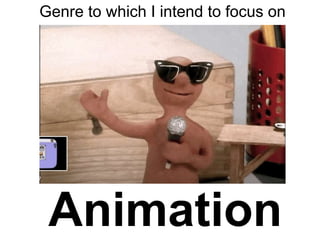
Genre to which I intend to focus on
Animation
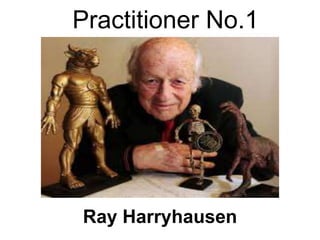
Practitioner No.1
Ray Harryhausen
Ray Harryhausen
Harryhausen was an American animator well known as the
mastermind behind the creation of Dynamation: a form of
animation embedded in the stop motion model animation
legacy.
Most of Harryhausen’s animations involved special effects that
brought more of the stories to the screen, and his work has
become one of the most inspirational legacies in the world of stop
motion.
After his death in 2013, he has been recognised as one of the
mainly inspiring legends of the genre in the minds of those who
wished to pursue a similar career.
His characters for the animations have been made in full detail to
make them more realistic looking, possibly to tell the story in
more detail.
From Animation Art (2005): ‘It came at the impressionable age of 13 when he walked into Grouman’s Chinese Theatre in Hollywood to see some ‘ape picture’ he knew little about. That movie was the 1933 smash hit King Kong and it
would set Harryhausen on the path to becoming the ‘father of modern visual effects’’.
From his school times, Harryhausen conducted experiments, which led to him gaining an opportunity to show his work to his idol, O’Brian
When he became 18, he landed his first professional job as working on the Puppetoons shorts that George Pal was producing at that
time for Paramount pictures .
‘
‘
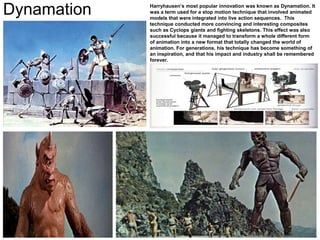
Dynamation Harryhausen’s most popular innovation was known as Dynamation. It
was a term used for a stop motion technique that involved animated
models that were integrated into live action sequences. This
technique conducted more convincing and interesting composites
such as Cyclops giants and fighting skeletons. This effect was also
successful because it managed to transform a whole different form
of animation into a new format that totally changed the world of
animation. For generations, his technique has become something of
an inspiration, and that his impact and industry shall be remembered
forever.
Practitioner No.2
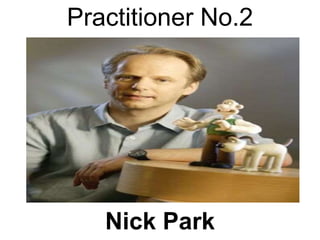
Nick Park
Nick Park
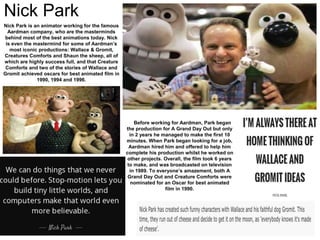
Nick Park is an animator working for the famous
Aardman company, who are the masterminds
behind most of the best animations today. Nick
is even the mastermind for some of Aardman’s
most iconic productions: Wallace & Gromit,
Creatures Comforts and Shaun the sheep, all of
which are highly success full, and that Creature
Comforts and two of the stories of Wallace and
Gromit achieved oscars for best animated film in
1990, 1994 and 1996.
Before working for Aardman, Park began
the production for A Grand Day Out but only
in 2 years he managed to make the first 10
minutes. When Park began looking for a job,
Aardman hired him and offered to help him
complete his production whilst he worked on
other projects. Overall, the film took 6 years
to make, and was broadcasted on television
in 1989. To everyone’s amazement, both A
Grand Day Out and Creature Comforts were
nominated for an Oscar for best animated
film in 1990.
Techniques on Wallace and Gromit
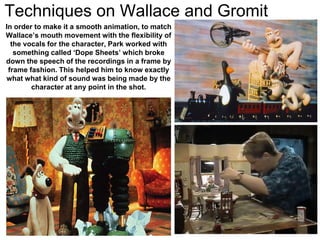
In order to make it a smooth animation, to match
Wallace’s mouth movement with the flexibility of
the vocals for the character, Park worked with
something called ‘Dope Sheets’ which broke
down the speech of the recordings in a frame by
frame fashion. This helped him to know exactly
what what kind of sound was being made by the
character at any point in the shot.
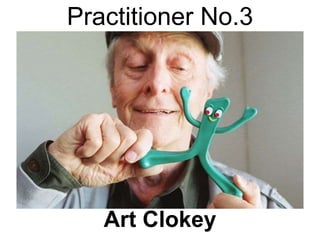
Practitioner No.3
Art Clokey
Art Clokey
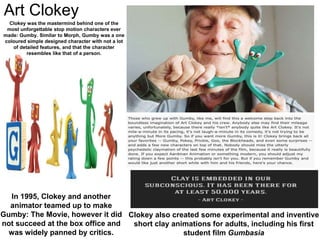
Clokey was the mastermind behind one of the
most unforgettable stop motion characters ever
made: Gumby. Similar to Morph, Gumby was a one
coloured simple designed character with not a lot
of detailed features, and that the character
resembles like that of a person.
Clokey also created some experimental and inventive
short clay animations for adults, including his first
student film Gumbasia
In 1995, Clokey and another
animator teamed up to make
Gumby: The Movie, however it did
not succeed at the box office and
was widely panned by critics.
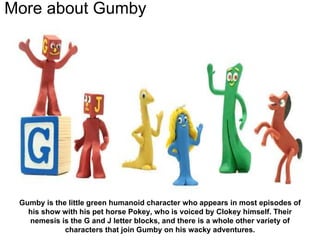
More about Gumby
Gumby is the little green humanoid character who appears in most episodes of
his show with his pet horse Pokey, who is voiced by Clokey himself. Their
nemesis is the G and J letter blocks, and there is a whole other variety of
characters that join Gumby on his wacky adventures.
Theories
Audience Theory
As a whole, this form of entertainment would effect a Mass audience because it would
be shown globally in cinemas and big screens, plus it would appeal to a wide range of
audiences. As these are referred to as a ‘Broadcast’ audience, they would watch this
because most animations are based on reality, but presented in a different way.
Uses & Gratifications
As this theory analyses the thought of reason for watching these films, the most likely
reason would be the idea of Diversion (escapism). This is because of the partial realistic
moments found within these films, such as The Wrong Trousers, where Wallace and
Gromit have a lodger come to stay with them, but the lodger is a criminal, and that at the
beginning, Wallace has to deal with financial problems. So when they reel in the criminal
at the end and gain the reward money, it solves their problems. Throughout the film, the
key parts such as the robbery and the ending with cheese seems realistic and in a way
some people may do in the world. However, some parts are considered not realistic such
s the fact that the criminal is in fact a penguin, and it is not normal everyday for a
penguin to rob a museum. This proves that this genre of entertainment has both sides of
reality within and that animators use both sides to create unique plots.
Reflection
What elements will I be including within my product?
I will include similar techniques and character features to my project in order to make
it smooth and simple. Also, I will make the elements within it seem funny and comedic
because I am aiming to make it a family friendly video.

Contextual research 5

  • 1.
  • 2.
    Genre to whichI intend to focus on Animation
  • 3.
  • 4.
    Ray Harryhausen Harryhausen wasan American animator well known as the mastermind behind the creation of Dynamation: a form of animation embedded in the stop motion model animation legacy. Most of Harryhausen’s animations involved special effects that brought more of the stories to the screen, and his work has become one of the most inspirational legacies in the world of stop motion. After his death in 2013, he has been recognised as one of the mainly inspiring legends of the genre in the minds of those who wished to pursue a similar career. His characters for the animations have been made in full detail to make them more realistic looking, possibly to tell the story in more detail. From Animation Art (2005): ‘It came at the impressionable age of 13 when he walked into Grouman’s Chinese Theatre in Hollywood to see some ‘ape picture’ he knew little about. That movie was the 1933 smash hit King Kong and it would set Harryhausen on the path to becoming the ‘father of modern visual effects’’. From his school times, Harryhausen conducted experiments, which led to him gaining an opportunity to show his work to his idol, O’Brian When he became 18, he landed his first professional job as working on the Puppetoons shorts that George Pal was producing at that time for Paramount pictures . ‘ ‘
  • 5.
    Dynamation Harryhausen’s mostpopular innovation was known as Dynamation. It was a term used for a stop motion technique that involved animated models that were integrated into live action sequences. This technique conducted more convincing and interesting composites such as Cyclops giants and fighting skeletons. This effect was also successful because it managed to transform a whole different form of animation into a new format that totally changed the world of animation. For generations, his technique has become something of an inspiration, and that his impact and industry shall be remembered forever.
  • 6.
  • 7.
    Nick Park Nick Parkis an animator working for the famous Aardman company, who are the masterminds behind most of the best animations today. Nick is even the mastermind for some of Aardman’s most iconic productions: Wallace & Gromit, Creatures Comforts and Shaun the sheep, all of which are highly success full, and that Creature Comforts and two of the stories of Wallace and Gromit achieved oscars for best animated film in 1990, 1994 and 1996. Before working for Aardman, Park began the production for A Grand Day Out but only in 2 years he managed to make the first 10 minutes. When Park began looking for a job, Aardman hired him and offered to help him complete his production whilst he worked on other projects. Overall, the film took 6 years to make, and was broadcasted on television in 1989. To everyone’s amazement, both A Grand Day Out and Creature Comforts were nominated for an Oscar for best animated film in 1990.
  • 8.
    Techniques on Wallaceand Gromit In order to make it a smooth animation, to match Wallace’s mouth movement with the flexibility of the vocals for the character, Park worked with something called ‘Dope Sheets’ which broke down the speech of the recordings in a frame by frame fashion. This helped him to know exactly what what kind of sound was being made by the character at any point in the shot.
  • 9.
  • 10.
    Art Clokey Clokey wasthe mastermind behind one of the most unforgettable stop motion characters ever made: Gumby. Similar to Morph, Gumby was a one coloured simple designed character with not a lot of detailed features, and that the character resembles like that of a person. Clokey also created some experimental and inventive short clay animations for adults, including his first student film Gumbasia In 1995, Clokey and another animator teamed up to make Gumby: The Movie, however it did not succeed at the box office and was widely panned by critics.
  • 11.
    More about Gumby Gumbyis the little green humanoid character who appears in most episodes of his show with his pet horse Pokey, who is voiced by Clokey himself. Their nemesis is the G and J letter blocks, and there is a whole other variety of characters that join Gumby on his wacky adventures.
  • 12.
    Theories Audience Theory As awhole, this form of entertainment would effect a Mass audience because it would be shown globally in cinemas and big screens, plus it would appeal to a wide range of audiences. As these are referred to as a ‘Broadcast’ audience, they would watch this because most animations are based on reality, but presented in a different way. Uses & Gratifications As this theory analyses the thought of reason for watching these films, the most likely reason would be the idea of Diversion (escapism). This is because of the partial realistic moments found within these films, such as The Wrong Trousers, where Wallace and Gromit have a lodger come to stay with them, but the lodger is a criminal, and that at the beginning, Wallace has to deal with financial problems. So when they reel in the criminal at the end and gain the reward money, it solves their problems. Throughout the film, the key parts such as the robbery and the ending with cheese seems realistic and in a way some people may do in the world. However, some parts are considered not realistic such s the fact that the criminal is in fact a penguin, and it is not normal everyday for a penguin to rob a museum. This proves that this genre of entertainment has both sides of reality within and that animators use both sides to create unique plots.
  • 13.
    Reflection What elements willI be including within my product? I will include similar techniques and character features to my project in order to make it smooth and simple. Also, I will make the elements within it seem funny and comedic because I am aiming to make it a family friendly video.