1
Hi	
  everyone,	
  hope	
  you’re	
  enjoying	
  the	
  conference	
  
I’ll	
  start	
  by	
  quickly	
  give	
  you	
  some	
  context	
  to	
  my	
  presenta=on	
  
I	
  work	
  as	
  a	
  Games	
  &	
  Transmedia	
  Strategist	
  for	
  Dubit,	
  a	
  digital	
  entertainment	
  
studio	
  and	
  research	
  agency	
  
My	
  role	
  creates	
  a	
  bridge	
  between	
  the	
  RESEARCH	
  and	
  GAME	
  DEVELOPMENT	
  
teams	
  
One	
  day	
  I’m	
  doing	
  games	
  tes=ng,	
  next	
  day	
  I’ll	
  be	
  working	
  on	
  game	
  design	
  or	
  
involving	
  audiences	
  in	
  media	
  co-­‐crea=on	
  approaches	
  
Oh	
  yeah,	
  and	
  I	
  get	
  to	
  play	
  a	
  few	
  games…	
  
2
Last	
  year	
  I	
  wrote	
  a	
  MASTERS	
  thesis	
  based	
  on	
  a	
  game	
  produced	
  for	
  the	
  BBC	
  
This	
  game	
  was	
  MUDDLE	
  EARTH	
  –	
  a	
  casual	
  quest-­‐based	
  virtual	
  world	
  aimed	
  at	
  
children	
  –	
  developed	
  by	
  Dubit,	
  for	
  whom	
  I	
  work	
  
This	
  presenta=on	
  is	
  based	
  on	
  the	
  study	
  of	
  this	
  game	
  
3
This	
  was	
  essen=ally	
  a	
  study	
  of	
  game	
  produc=on,	
  and	
  followed	
  the	
  adapta=on	
  
journey	
  of	
  the	
  Muddle	
  Earth	
  IP	
  from	
  a	
  children’s	
  book,	
  into	
  a	
  BBC	
  TV	
  series,	
  
and	
  finally	
  into	
  a	
  game.	
  As	
  both	
  game	
  development	
  professional	
  and	
  academic	
  
researcher	
  I	
  wanted	
  to	
  explore	
  how	
  games	
  research	
  could	
  contribute	
  to	
  game	
  
produc=on	
  and	
  to	
  the	
  design	
  of	
  beVer	
  games.	


The	
  main	
  objec=ves	
  of	
  this	
  study	
  were	
  to	
  understand	
  the	
  processes	
  of	
  
adapta=on	
  from	
  other	
  media	
  into	
  games,	
  in	
  the	
  context	
  of	
  cross-­‐media	
  
strategies;	
  and	
  par=cularly	
  explore	
  what	
  happens	
  to	
  narra=ve	
  in	
  its	
  journey	
  
from	
  paper	
  to	
  screens	
  to	
  games.	
  How	
  it’s	
  con=nued,	
  how	
  it	
  is	
  transformed,	
  
how	
  it	
  is	
  integrated	
  into	
  ludic	
  structures	
  by	
  inspiring	
  game	
  mechanics…	
  
4
•  Johnson’s	
  circuit	
  of	
  culture	
  proposes	
  four	
  main	
  interac=ng	
  areas	
  for	
  media	
  
studies	
  –	
  the	
  best	
  way	
  to	
  understand	
  a	
  text	
  is	
  to	
  cover	
  all	
  areas	
  
•  Most	
  Game	
  Studies	
  have	
  typically	
  focused	
  on	
  textual analysis and
player studies
•  But	
  produc=on	
  has	
  oZen	
  been	
  overlooked	
  –	
  frequently	
  due	
  to	
  a	
  lack	
  of	
  
coopera=on	
  between	
  game	
  producers	
  and	
  game	
  academics	
  
5
I	
  was	
  really	
  happy	
  when	
  I	
  read	
  the	
  CfP	
  for	
  this	
  conference,	
  whose	
  objec=ves	
  
were	
  to:	
  
•  trace	
  connec=ons	
  between	
  the	
  narra=ves	
  of	
  contemporary	
  screen	
  media	
  
and	
  their	
  contexts	
  of	
  produc=on	
  
•  explore	
  ways	
  in	
  which	
  stories	
  and	
  their	
  on-­‐screen	
  telling	
  are	
  informed	
  by	
  
contemporary	
  industrial	
  and	
  technological	
  condi=ons	
  
6
The	
  body	
  of	
  academic	
  research	
  on	
  adapta=on	
  of	
  texts	
  from	
  other	
  media	
  into	
  
games	
  and	
  vice-­‐versa	
  is	
  s=ll	
  modest.	
  
Empirical	
  studies	
  of	
  games	
  as	
  adapta=ons,	
  where	
  researchers	
  interview	
  
producers	
  and	
  have	
  access	
  to	
  design	
  and	
  produc=on	
  documents	
  are	
  even	
  
rarer.	
  
But	
  in	
  order	
  to	
  study	
  media	
  texts	
  it	
  is	
  essen=al	
  to	
  understand	
  their	
  contexts	
  of	
  
produc=on.	
  
7
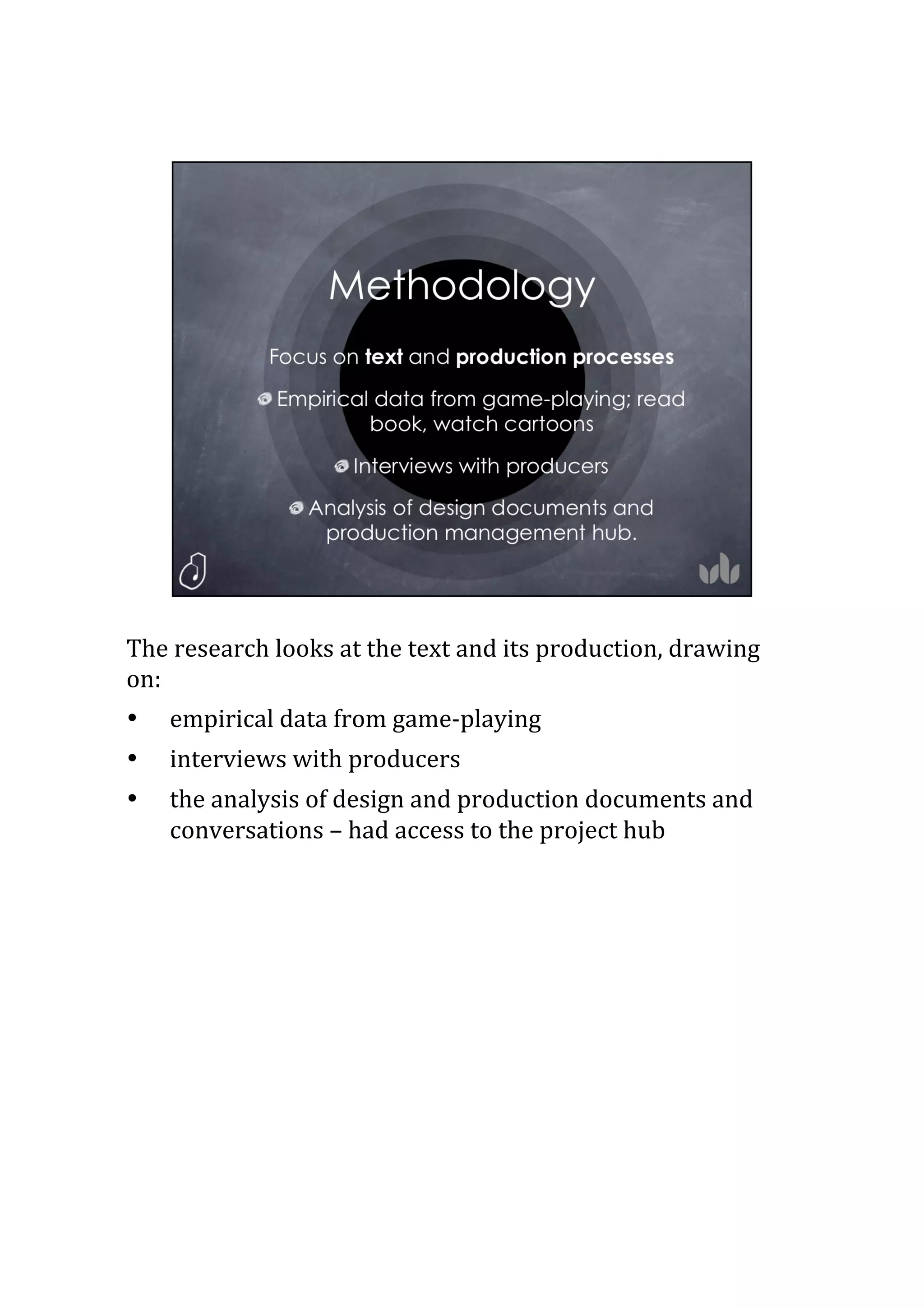
The	
  research	
  looks	
  at	
  the	
  text	
  and	
  its	
  production,	
  drawing	
  
on:	
  
•  empirical	
  data	
  from	
  game-­‐playing	
  
•  interviews	
  with	
  producers	
  
•  the	
  analysis	
  of	
  design	
  and	
  production	
  documents	
  and	
  
conversations	
  –	
  had	
  access	
  to	
  the	
  project	
  hub	
  
8
9
The	
  usefulness	
  of	
  narra-ve	
  theory	
  
•  In	
  a	
  recent	
  ar=cle	
  in	
  Gamasutra,	
  a	
  game	
  cri=c	
  defended	
  that	
  only	
  20%	
  of	
  games	
  
should	
  tell	
  stories	
  –	
  I	
  don’t	
  want	
  to	
  get	
  into	
  the	
  ludology	
  vs.	
  narratology	
  debate,	
  
but	
  even	
  though	
  computer	
  games	
  are	
  indeed	
  games,	
  many	
  of	
  them	
  do	
  try	
  to	
  tell	
  
stories	
  too	
  –	
  especially	
  when	
  they	
  are	
  adapta=ons	
  of	
  exis=ng	
  stories	
  or	
  part	
  of	
  
wider	
  transmedia	
  IPs	
  where	
  narra=ve	
  is	
  important	
  
•  Krzynskwa:	
  narra=ve	
  theory	
  useful	
  –	
  in	
  this	
  case	
  to	
  understand	
  how	
  transla=on	
  
into	
  a	
  different	
  medium	
  transforms	
  the	
  narra=ve	


10
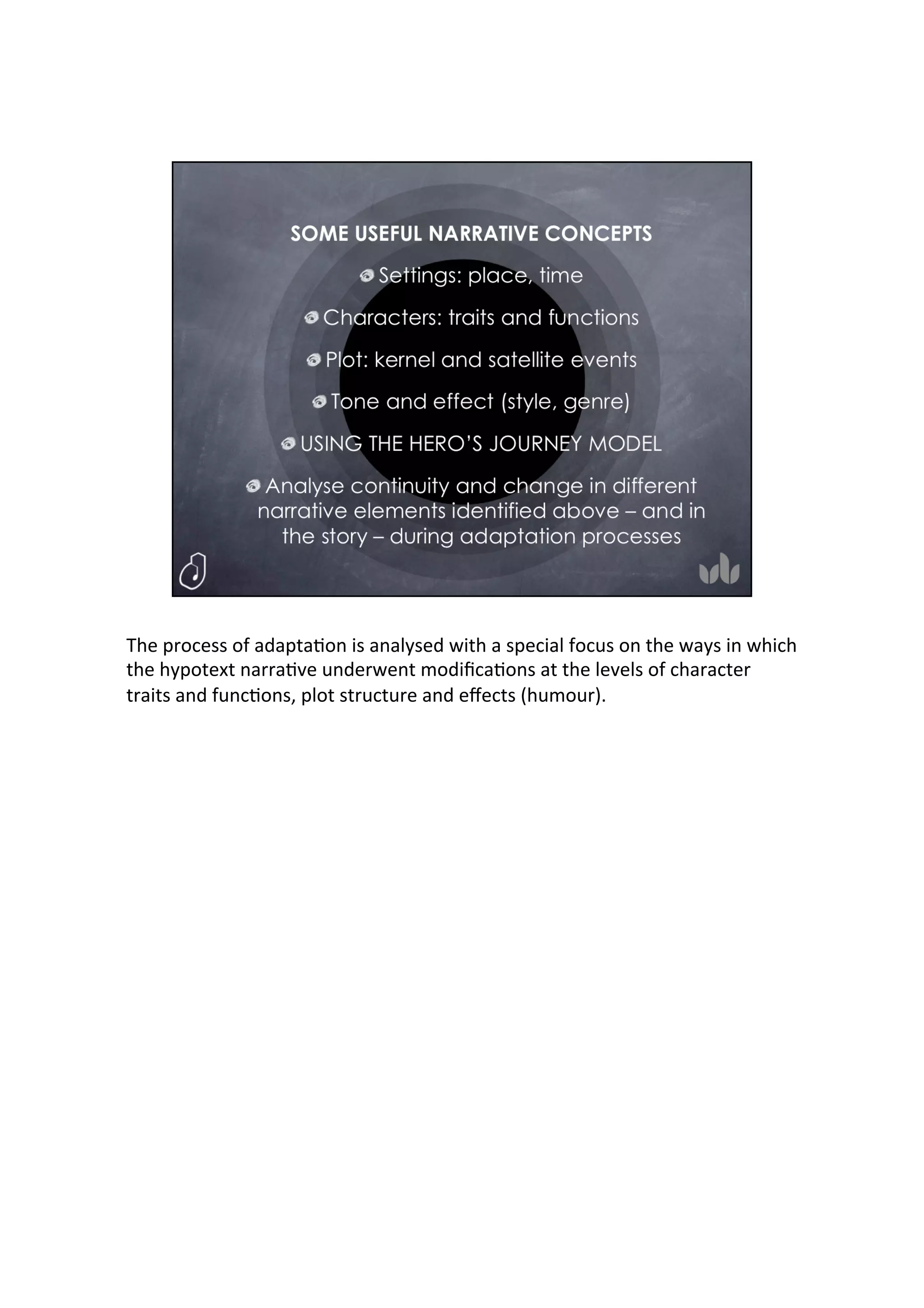
The	
  process	
  of	
  adapta=on	
  is	
  analysed	
  with	
  a	
  special	
  focus	
  on	
  the	
  ways	
  in	
  which	
  
the	
  hypotext	
  narra=ve	
  underwent	
  modifica=ons	
  at	
  the	
  levels	
  of	
  character	
  
traits	
  and	
  func=ons,	
  plot	
  structure	
  and	
  effects	
  (humour).	


11
12
13
14
15
16
17
18
19
20
The	
  TV	
  series	
  
•  Previous	
  adapta=on	
  –	
  Jackanory	
  -­‐	
  virtually	
  a	
  transcrip=on	
  onto	
  TV	
  –	
  
human	
  narrator	
  telling	
  the	
  story	
  with	
  CGI	
  characters	
  –	
  high	
  fidelity	
  to	
  
the	
  book	
  
•  This	
  version	
  of	
  Muddle	
  Earth	
  was	
  not	
  described	
  as	
  an	
  adapta=on,	
  but	
  
instead	
  as	
  a	
  cartoon	
  ‘based	
  on’	
  the	
  book	
  
•  The	
  objec=ve	
  here	
  is	
  to	
  describe	
  the	
  main	
  transforma=ons	
  and	
  
factors	
  behind	
  these	
  
21
22
23
24
25
26
27
28
29
30
31
About	
  Games	
  
•  A	
  computer	
  game	
  is	
  a	
  game,	
  so	
  it’s	
  obvious	
  that	
  there	
  is	
  a	
  ludic	
  
dimension	
  in	
  the	
  ME	
  game	
  –	
  goals,	
  resources,	
  skill,	
  scores,	
  and	
  so	
  on	
  
•  And	
  because	
  it	
  is	
  an	
  online	
  mul--­‐player	
  game	
  where	
  you	
  can	
  see	
  and	
  
contact	
  other	
  people,	
  is	
  clearly	
  a	
  social	
  dimension	
  to	
  playing	
  –	
  of	
  the	
  
player	
  opts	
  to	
  be	
  ‘social’	
  
•  Narra-ve	
  is	
  an	
  important	
  link	
  with	
  original	
  IP	
  –	
  narra=ves	
  acquire	
  
heightened	
  importance	
  in	
  contemporary	
  transmedia	
  contexts	
  –	
  I’m	
  
not	
  saying	
  narrar=ve	
  is	
  the	
  most	
  important	
  dimension	
  (aZer	
  all	
  
games	
  are	
  games),	
  but	
  one	
  that	
  deserves	
  aVen=on	
  
•  Narra=ve	
  in	
  games	
  –	
  especially	
  authored	
  narra=ve	
  -­‐	
  is	
  situated	
  at	
  the	
  
intersec=on	
  of	
  mainly	
  the	
  ludic	
  and	
  representa=onal	
  dimensions	
  –	
  
games	
  tell	
  stories	
  by	
  being	
  played	
  –	
  in	
  games	
  we	
  move	
  from	
  story-­‐
telling	
  to	
  a	
  mix	
  of	
  story-­‐telling	
  and	
  STORY-­‐PLAYING	
  
•  LET’S	
  THEN	
  SEE	
  WHAT	
  HAPPENED	
  TO	
  THE	
  ME	
  NARRATIVE	
  IN	
  THE	
  
GAME	
  –	
  HOW	
  IT	
  CONTINUED	
  AND	
  CHANGED	
  FROM	
  ITS	
  SOURCE	
  
TEXTS	


32
33
34
35
36
37
38
39
40
41
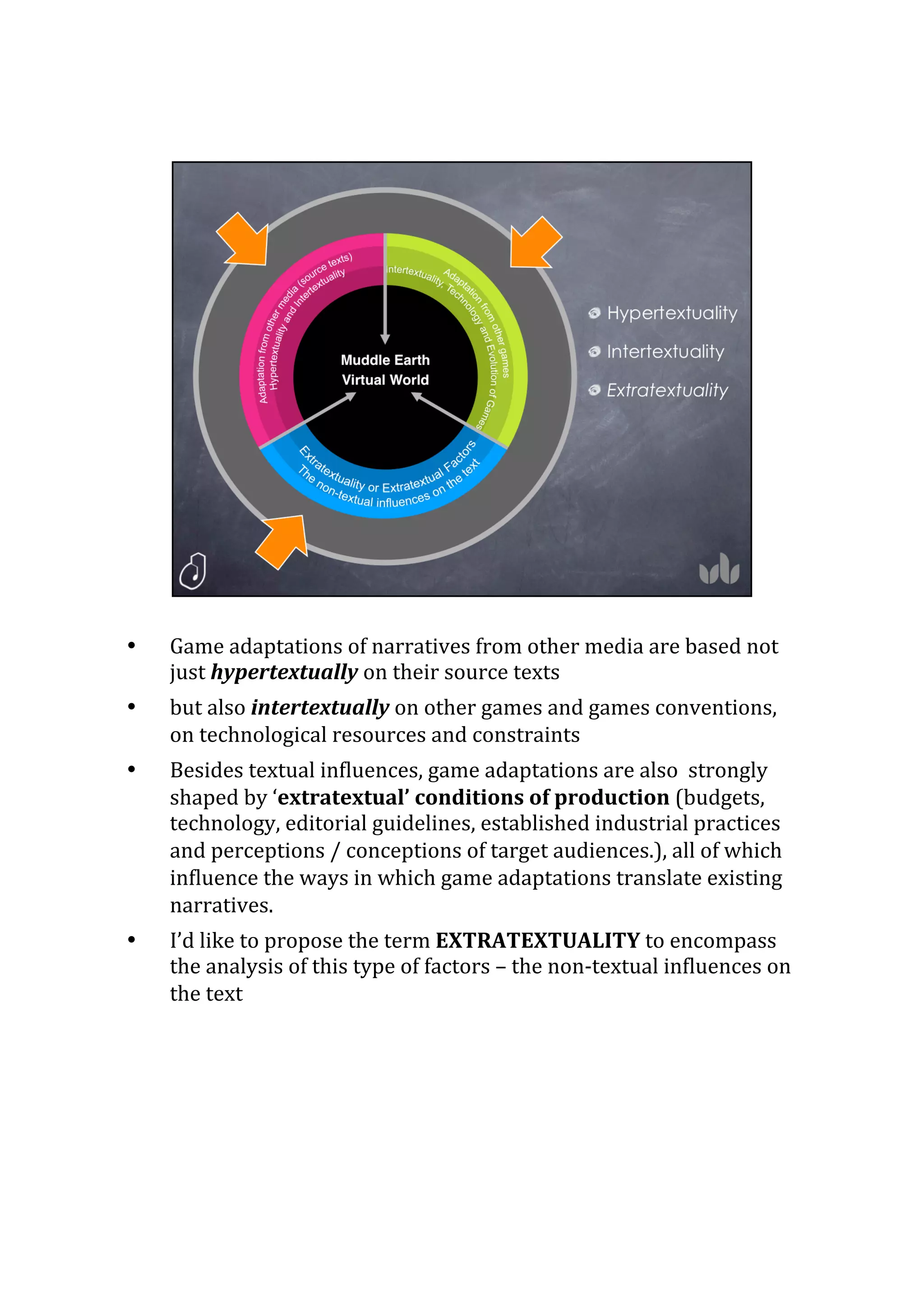
•  Game	
  adaptations	
  of	
  narratives	
  from	
  other	
  media	
  are	
  based	
  not	
  
just	
  hypertextually	
  on	
  their	
  source	
  texts	
  
•  but	
  also	
  intertextually	
  on	
  other	
  games	
  and	
  games	
  conventions,	
  
on	
  technological	
  resources	
  and	
  constraints	
  
•  Besides	
  textual	
  inAluences,	
  game	
  adaptations	
  are	
  also	
  	
  strongly	
  
shaped	
  by	
  ‘extratextual’	
  conditions	
  of	
  production	
  (budgets,	
  
technology,	
  editorial	
  guidelines,	
  established	
  industrial	
  practices	
  
and	
  perceptions	
  /	
  conceptions	
  of	
  target	
  audiences.),	
  all	
  of	
  which	
  
inAluence	
  the	
  ways	
  in	
  which	
  game	
  adaptations	
  translate	
  existing	
  
narratives.	
  
•  I’d	
  like	
  to	
  propose	
  the	
  term	
  EXTRATEXTUALITY	
  to	
  encompass	
  
the	
  analysis	
  of	
  this	
  type	
  of	
  factors	
  –	
  the	
  non-­‐textual	
  inAluences	
  on	
  
the	
  text	
  
42
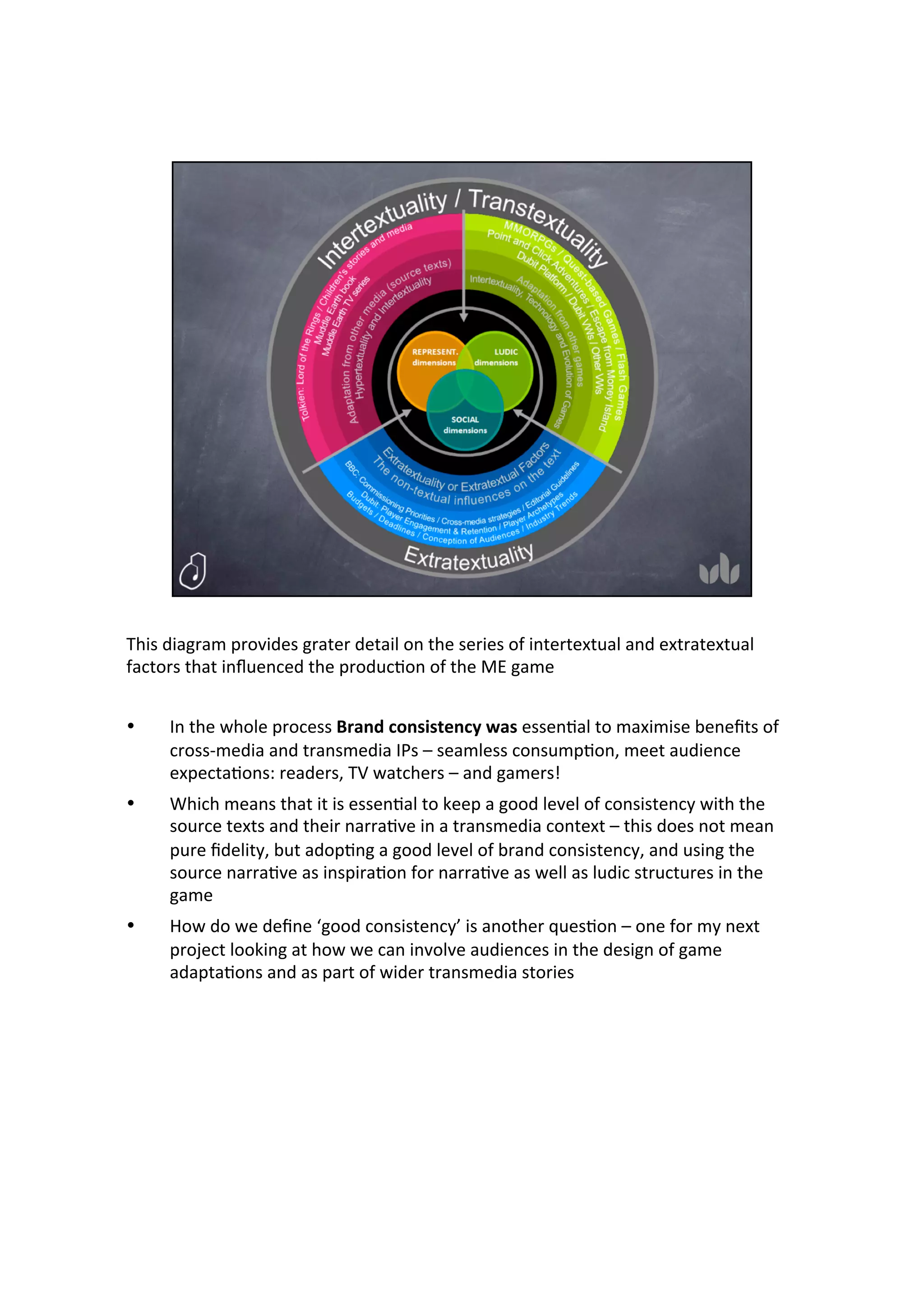
This	
  diagram	
  provides	
  grater	
  detail	
  on	
  the	
  series	
  of	
  intertextual	
  and	
  extratextual	
  
factors	
  that	
  influenced	
  the	
  produc=on	
  of	
  the	
  ME	
  game	


•  In	
  the	
  whole	
  process	
  Brand	
  consistency	
  was	
  essen=al	
  to	
  maximise	
  benefits	
  of	
  
cross-­‐media	
  and	
  transmedia	
  IPs	
  –	
  seamless	
  consump=on,	
  meet	
  audience	
  
expecta=ons:	
  readers,	
  TV	
  watchers	
  –	
  and	
  gamers!	
  
•  Which	
  means	
  that	
  it	
  is	
  essen=al	
  to	
  keep	
  a	
  good	
  level	
  of	
  consistency	
  with	
  the	
  
source	
  texts	
  and	
  their	
  narra=ve	
  in	
  a	
  transmedia	
  context	
  –	
  this	
  does	
  not	
  mean	
  
pure	
  fidelity,	
  but	
  adop=ng	
  a	
  good	
  level	
  of	
  brand	
  consistency,	
  and	
  using	
  the	
  
source	
  narra=ve	
  as	
  inspira=on	
  for	
  narra=ve	
  as	
  well	
  as	
  ludic	
  structures	
  in	
  the	
  
game	
  
•  How	
  do	
  we	
  define	
  ‘good	
  consistency’	
  is	
  another	
  ques=on	
  –	
  one	

  for	
  my	
  next	
  
project	
  looking	
  at	
  how	
  we	
  can	
  involve	
  audiences	
  in	
  the	
  design	
  of	
  game	
  
adapta=ons	
  and	
  as	
  part	
  of	
  wider	
  transmedia	
  stories	
  
43
44

Contemporary.screen.narratives.2012

  • 1.
  • 2.
    Hi  everyone,  hope  you’re  enjoying  the  conference   I’ll  start  by  quickly  give  you  some  context  to  my  presenta=on   I  work  as  a  Games  &  Transmedia  Strategist  for  Dubit,  a  digital  entertainment   studio  and  research  agency   My  role  creates  a  bridge  between  the  RESEARCH  and  GAME  DEVELOPMENT   teams   One  day  I’m  doing  games  tes=ng,  next  day  I’ll  be  working  on  game  design  or   involving  audiences  in  media  co-­‐crea=on  approaches   Oh  yeah,  and  I  get  to  play  a  few  games…   2
  • 3.
    Last  year  I  wrote  a  MASTERS  thesis  based  on  a  game  produced  for  the  BBC   This  game  was  MUDDLE  EARTH  –  a  casual  quest-­‐based  virtual  world  aimed  at   children  –  developed  by  Dubit,  for  whom  I  work   This  presenta=on  is  based  on  the  study  of  this  game   3
  • 4.
    This  was  essen=ally  a  study  of  game  produc=on,  and  followed  the  adapta=on   journey  of  the  Muddle  Earth  IP  from  a  children’s  book,  into  a  BBC  TV  series,   and  finally  into  a  game.  As  both  game  development  professional  and  academic   researcher  I  wanted  to  explore  how  games  research  could  contribute  to  game   produc=on  and  to  the  design  of  beVer  games.     The  main  objec=ves  of  this  study  were  to  understand  the  processes  of   adapta=on  from  other  media  into  games,  in  the  context  of  cross-­‐media   strategies;  and  par=cularly  explore  what  happens  to  narra=ve  in  its  journey   from  paper  to  screens  to  games.  How  it’s  con=nued,  how  it  is  transformed,   how  it  is  integrated  into  ludic  structures  by  inspiring  game  mechanics…   4
  • 5.
    •  Johnson’s  circuit  of  culture  proposes  four  main  interac=ng  areas  for  media   studies  –  the  best  way  to  understand  a  text  is  to  cover  all  areas   •  Most  Game  Studies  have  typically  focused  on  textual analysis and player studies •  But  produc=on  has  oZen  been  overlooked  –  frequently  due  to  a  lack  of   coopera=on  between  game  producers  and  game  academics   5
  • 6.
    I  was  really  happy  when  I  read  the  CfP  for  this  conference,  whose  objec=ves   were  to:   •  trace  connec=ons  between  the  narra=ves  of  contemporary  screen  media   and  their  contexts  of  produc=on   •  explore  ways  in  which  stories  and  their  on-­‐screen  telling  are  informed  by   contemporary  industrial  and  technological  condi=ons   6
  • 7.
    The  body  of  academic  research  on  adapta=on  of  texts  from  other  media  into   games  and  vice-­‐versa  is  s=ll  modest.   Empirical  studies  of  games  as  adapta=ons,  where  researchers  interview   producers  and  have  access  to  design  and  produc=on  documents  are  even   rarer.   But  in  order  to  study  media  texts  it  is  essen=al  to  understand  their  contexts  of   produc=on.   7
  • 8.
    The  research  looks  at  the  text  and  its  production,  drawing   on:   •  empirical  data  from  game-­‐playing   •  interviews  with  producers   •  the  analysis  of  design  and  production  documents  and   conversations  –  had  access  to  the  project  hub   8
  • 9.
  • 10.
    The  usefulness  of  narra-ve  theory   •  In  a  recent  ar=cle  in  Gamasutra,  a  game  cri=c  defended  that  only  20%  of  games   should  tell  stories  –  I  don’t  want  to  get  into  the  ludology  vs.  narratology  debate,   but  even  though  computer  games  are  indeed  games,  many  of  them  do  try  to  tell   stories  too  –  especially  when  they  are  adapta=ons  of  exis=ng  stories  or  part  of   wider  transmedia  IPs  where  narra=ve  is  important   •  Krzynskwa:  narra=ve  theory  useful  –  in  this  case  to  understand  how  transla=on   into  a  different  medium  transforms  the  narra=ve       10
  • 11.
    The  process  of  adapta=on  is  analysed  with  a  special  focus  on  the  ways  in  which   the  hypotext  narra=ve  underwent  modifica=ons  at  the  levels  of  character   traits  and  func=ons,  plot  structure  and  effects  (humour).     11
  • 12.
  • 13.
  • 14.
  • 15.
  • 16.
  • 17.
  • 18.
  • 19.
  • 20.
  • 21.
    The  TV  series   •  Previous  adapta=on  –  Jackanory  -­‐  virtually  a  transcrip=on  onto  TV  –   human  narrator  telling  the  story  with  CGI  characters  –  high  fidelity  to   the  book   •  This  version  of  Muddle  Earth  was  not  described  as  an  adapta=on,  but   instead  as  a  cartoon  ‘based  on’  the  book   •  The  objec=ve  here  is  to  describe  the  main  transforma=ons  and   factors  behind  these   21
  • 22.
  • 23.
  • 24.
  • 25.
  • 26.
  • 27.
  • 28.
  • 29.
  • 30.
  • 31.
  • 32.
    About  Games   • A  computer  game  is  a  game,  so  it’s  obvious  that  there  is  a  ludic   dimension  in  the  ME  game  –  goals,  resources,  skill,  scores,  and  so  on   •  And  because  it  is  an  online  mul--­‐player  game  where  you  can  see  and   contact  other  people,  is  clearly  a  social  dimension  to  playing  –  of  the   player  opts  to  be  ‘social’   •  Narra-ve  is  an  important  link  with  original  IP  –  narra=ves  acquire   heightened  importance  in  contemporary  transmedia  contexts  –  I’m   not  saying  narrar=ve  is  the  most  important  dimension  (aZer  all   games  are  games),  but  one  that  deserves  aVen=on   •  Narra=ve  in  games  –  especially  authored  narra=ve  -­‐  is  situated  at  the   intersec=on  of  mainly  the  ludic  and  representa=onal  dimensions  –   games  tell  stories  by  being  played  –  in  games  we  move  from  story-­‐ telling  to  a  mix  of  story-­‐telling  and  STORY-­‐PLAYING   •  LET’S  THEN  SEE  WHAT  HAPPENED  TO  THE  ME  NARRATIVE  IN  THE   GAME  –  HOW  IT  CONTINUED  AND  CHANGED  FROM  ITS  SOURCE   TEXTS     32
  • 33.
  • 34.
  • 35.
  • 36.
  • 37.
  • 38.
  • 39.
  • 40.
  • 41.
  • 42.
    •  Game  adaptations  of  narratives  from  other  media  are  based  not   just  hypertextually  on  their  source  texts   •  but  also  intertextually  on  other  games  and  games  conventions,   on  technological  resources  and  constraints   •  Besides  textual  inAluences,  game  adaptations  are  also    strongly   shaped  by  ‘extratextual’  conditions  of  production  (budgets,   technology,  editorial  guidelines,  established  industrial  practices   and  perceptions  /  conceptions  of  target  audiences.),  all  of  which   inAluence  the  ways  in  which  game  adaptations  translate  existing   narratives.   •  I’d  like  to  propose  the  term  EXTRATEXTUALITY  to  encompass   the  analysis  of  this  type  of  factors  –  the  non-­‐textual  inAluences  on   the  text   42
  • 43.
    This  diagram  provides  grater  detail  on  the  series  of  intertextual  and  extratextual   factors  that  influenced  the  produc=on  of  the  ME  game     •  In  the  whole  process  Brand  consistency  was  essen=al  to  maximise  benefits  of   cross-­‐media  and  transmedia  IPs  –  seamless  consump=on,  meet  audience   expecta=ons:  readers,  TV  watchers  –  and  gamers!   •  Which  means  that  it  is  essen=al  to  keep  a  good  level  of  consistency  with  the   source  texts  and  their  narra=ve  in  a  transmedia  context  –  this  does  not  mean   pure  fidelity,  but  adop=ng  a  good  level  of  brand  consistency,  and  using  the   source  narra=ve  as  inspira=on  for  narra=ve  as  well  as  ludic  structures  in  the   game   •  How  do  we  define  ‘good  consistency’  is  another  ques=on  –  one  for  my  next   project  looking  at  how  we  can  involve  audiences  in  the  design  of  game   adapta=ons  and  as  part  of  wider  transmedia  stories   43
  • 44.