New Technology in Architecture
Name : Ar. Shahera
Assignment : 1
Generative Design:
Generative design algorithms use computational power to explore numerous
design options based on specified parameters.
Architects can input constraints, and the software generates various design
solutions.
This can lead to more innovative and optimized designs.
AI can rapidly produce visual designs when given specific guidelines, including
photorealistic images.
Architects can leverage generative design software like Stable Diffusion,
Midjourney, Dall-e 2, or Adobe Firefly to investigate different material choices
and spatial designs during the initial project phases.
Furthermore, hand-drawn sketches or existing images can be used as a starting
point for creating more elaborate designs, iterating on them, or making
modifications.
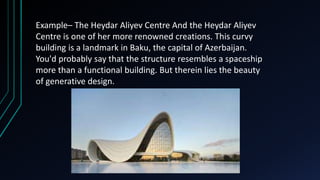
Example– The Heydar Aliyev Centre And the Heydar Aliyev
Centre is one of her more renowned creations. This curvy
building is a landmark in Baku, the capital of Azerbaijan.
You'd probably say that the structure resembles a spaceship
more than a functional building. But therein lies the beauty
of generative design.
Virtual and Augmented Reality (VR/AR):
VR and AR technologies allow architects to create immersive experiences for clients and
stakeholders. VR can be used for virtual walkthroughs of buildings before they are constructed,
while AR can overlay digital information onto the physical world, aiding in design and construction
processes.
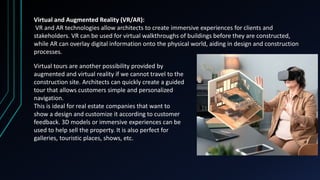
Virtual tours are another possibility provided by
augmented and virtual reality if we cannot travel to the
construction site. Architects can quickly create a guided
tour that allows customers simple and personalized
navigation.
This is ideal for real estate companies that want to
show a design and customize it according to customer
feedback. 3D models or immersive experiences can be
used to help sell the property. It is also perfect for
galleries, touristic places, shows, etc.
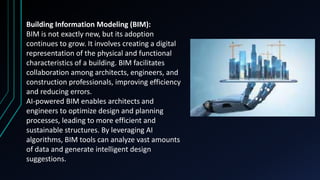
Building Information Modeling (BIM):
BIM is not exactly new, but its adoption
continues to grow. It involves creating a digital
representation of the physical and functional
characteristics of a building. BIM facilitates
collaboration among architects, engineers, and
construction professionals, improving efficiency
and reducing errors.
AI-powered BIM enables architects and
engineers to optimize design and planning
processes, leading to more efficient and
sustainable structures. By leveraging AI
algorithms, BIM tools can analyze vast amounts
of data and generate intelligent design
suggestions.
BIM is increasingly used to improve the control and management of designs. It is a
methodology that digitally and three-dimensionally represents the physical and
functional characteristics of a building, allowing professionals from different areas to
work together in the elaboration of a precise and detailed virtual model, with
valuable information to build and maintain a building. Unlike CAD (Computer Aided
Design), which creates two-dimensional lines without distinguishing between
elements, BIM incorporates multiple properties into each element, in addition to
their graphic representation. This enables users to intelligently manage information
throughout a project's lifecycle, automating processes such as programming,
conceptual design, detailing, analysis, documentation, manufacturing, construction
logistics, operation and maintenance, renovation, and/or demolition.
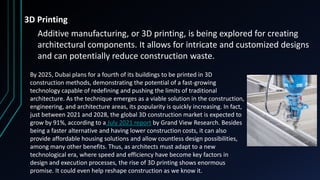
3D Printing
Additive manufacturing, or 3D printing, is being explored for creating
architectural components. It allows for intricate and customized designs
and can potentially reduce construction waste.
By 2025, Dubai plans for a fourth of its buildings to be printed in 3D
construction methods, demonstrating the potential of a fast-growing
technology capable of redefining and pushing the limits of traditional
architecture. As the technique emerges as a viable solution in the construction,
engineering, and architecture areas, its popularity is quickly increasing. In fact,
just between 2021 and 2028, the global 3D construction market is expected to
grow by 91%, according to a July 2021 report by Grand View Research. Besides
being a faster alternative and having lower construction costs, it can also
provide affordable housing solutions and allow countless design possibilities,
among many other benefits. Thus, as architects must adapt to a new
technological era, where speed and efficiency have become key factors in
design and execution processes, the rise of 3D printing shows enormous
promise. It could even help reshape construction as we know it.
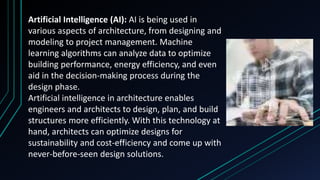
Artificial Intelligence (AI): AI is being used in
various aspects of architecture, from designing and
modeling to project management. Machine
learning algorithms can analyze data to optimize
building performance, energy efficiency, and even
aid in the decision-making process during the
design phase.
Artificial intelligence in architecture enables
engineers and architects to design, plan, and build
structures more efficiently. With this technology at
hand, architects can optimize designs for
sustainability and cost-efficiency and come up with
never-before-seen design solutions.
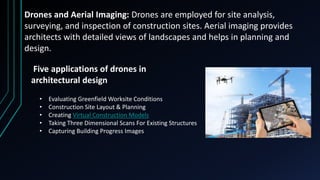
Drones and Aerial Imaging: Drones are employed for site analysis,
surveying, and inspection of construction sites. Aerial imaging provides
architects with detailed views of landscapes and helps in planning and
design.
Five applications of drones in
architectural design
• Evaluating Greenfield Worksite Conditions
• Construction Site Layout & Planning
• Creating Virtual Construction Models
• Taking Three Dimensional Scans For Existing Structures
• Capturing Building Progress Images

New Technology in Architecture march.pptx

  • 1.
    New Technology inArchitecture Name : Ar. Shahera Assignment : 1
  • 2.
    Generative Design: Generative designalgorithms use computational power to explore numerous design options based on specified parameters. Architects can input constraints, and the software generates various design solutions. This can lead to more innovative and optimized designs. AI can rapidly produce visual designs when given specific guidelines, including photorealistic images. Architects can leverage generative design software like Stable Diffusion, Midjourney, Dall-e 2, or Adobe Firefly to investigate different material choices and spatial designs during the initial project phases. Furthermore, hand-drawn sketches or existing images can be used as a starting point for creating more elaborate designs, iterating on them, or making modifications.
  • 3.
    Example– The HeydarAliyev Centre And the Heydar Aliyev Centre is one of her more renowned creations. This curvy building is a landmark in Baku, the capital of Azerbaijan. You'd probably say that the structure resembles a spaceship more than a functional building. But therein lies the beauty of generative design.
  • 4.
    Virtual and AugmentedReality (VR/AR): VR and AR technologies allow architects to create immersive experiences for clients and stakeholders. VR can be used for virtual walkthroughs of buildings before they are constructed, while AR can overlay digital information onto the physical world, aiding in design and construction processes. Virtual tours are another possibility provided by augmented and virtual reality if we cannot travel to the construction site. Architects can quickly create a guided tour that allows customers simple and personalized navigation. This is ideal for real estate companies that want to show a design and customize it according to customer feedback. 3D models or immersive experiences can be used to help sell the property. It is also perfect for galleries, touristic places, shows, etc.
  • 5.
    Building Information Modeling(BIM): BIM is not exactly new, but its adoption continues to grow. It involves creating a digital representation of the physical and functional characteristics of a building. BIM facilitates collaboration among architects, engineers, and construction professionals, improving efficiency and reducing errors. AI-powered BIM enables architects and engineers to optimize design and planning processes, leading to more efficient and sustainable structures. By leveraging AI algorithms, BIM tools can analyze vast amounts of data and generate intelligent design suggestions.
  • 6.
    BIM is increasinglyused to improve the control and management of designs. It is a methodology that digitally and three-dimensionally represents the physical and functional characteristics of a building, allowing professionals from different areas to work together in the elaboration of a precise and detailed virtual model, with valuable information to build and maintain a building. Unlike CAD (Computer Aided Design), which creates two-dimensional lines without distinguishing between elements, BIM incorporates multiple properties into each element, in addition to their graphic representation. This enables users to intelligently manage information throughout a project's lifecycle, automating processes such as programming, conceptual design, detailing, analysis, documentation, manufacturing, construction logistics, operation and maintenance, renovation, and/or demolition.
  • 7.
    3D Printing Additive manufacturing,or 3D printing, is being explored for creating architectural components. It allows for intricate and customized designs and can potentially reduce construction waste. By 2025, Dubai plans for a fourth of its buildings to be printed in 3D construction methods, demonstrating the potential of a fast-growing technology capable of redefining and pushing the limits of traditional architecture. As the technique emerges as a viable solution in the construction, engineering, and architecture areas, its popularity is quickly increasing. In fact, just between 2021 and 2028, the global 3D construction market is expected to grow by 91%, according to a July 2021 report by Grand View Research. Besides being a faster alternative and having lower construction costs, it can also provide affordable housing solutions and allow countless design possibilities, among many other benefits. Thus, as architects must adapt to a new technological era, where speed and efficiency have become key factors in design and execution processes, the rise of 3D printing shows enormous promise. It could even help reshape construction as we know it.
  • 8.
    Artificial Intelligence (AI):AI is being used in various aspects of architecture, from designing and modeling to project management. Machine learning algorithms can analyze data to optimize building performance, energy efficiency, and even aid in the decision-making process during the design phase. Artificial intelligence in architecture enables engineers and architects to design, plan, and build structures more efficiently. With this technology at hand, architects can optimize designs for sustainability and cost-efficiency and come up with never-before-seen design solutions.
  • 9.
    Drones and AerialImaging: Drones are employed for site analysis, surveying, and inspection of construction sites. Aerial imaging provides architects with detailed views of landscapes and helps in planning and design. Five applications of drones in architectural design • Evaluating Greenfield Worksite Conditions • Construction Site Layout & Planning • Creating Virtual Construction Models • Taking Three Dimensional Scans For Existing Structures • Capturing Building Progress Images