Consumer protection act
1986
Bhavna gupta
MBA
142562078
INTRODUCTION
• Before the enactment of the consumer Protection Act,1986 a person
aggrieved by the defective goods or deficiency in service had to
approach the ordinary civil court to get his grievances redressed.
• The proceeding in the ordinary civil court is very complex , expensive
and time consuming .
• In Order to give more protection to the interest of consumers of
goods and service the parliament enacted the consumer Protection
Act 1986
Consumer Protection Act,1986
• In order to provide for better protection of the interests of the consumer the Consumer
Protection Bill, .1986 was introduced in the Lok Sabha on 5th December, 1986.
• The Consumer Protection Act 1986 is a social welfare legislation which was enacted as a result of
widespread consumer protection movement.
Who is a consumer?
Consumer he is a person
• “Who buys any goods for a consideration which has been paid or
promised, or partly paid and partly promised, or under a system of
deferred payment.
• Hires any services for a consideration which has been paid or
promised, or partly paid and partly promised, or under a system of
deferred payment.
Who are not consumers?
• A person who purchased goods for resale
• A person who purchased goods for commercial purpose
• A person who obtains services without consideration
• A person who obtains services under a contract of personal service
• Contractors
• Applicants for jobs
• Persons who filed suits in courts
WHO CAN FILE A COMPLAINT
• A consumer
• Any voluntary consumer association registered under the companies act 1956.
• The central government or state government
• One or more consumer where there are numerous consumers having the same
interest who or which makes a complaint. Thus class action is permissible under
the act
• In case of death of a consumer his legal heir or representative
COMPLAINT
• Any unfair trade practice adopted by the trader
• Defective goods
• Deficiency in service
• Excess price charged by the trader
• Unlawful goods sale, which is hazardous to life and safety when used.
DEFECT
• Fault, Imperfection, Shortcoming in the
a. Quantity
b. Quality
c. Potency
d. Purity
e. Standards.
FILING A COMPLAINT
• No stamp or court fee is needed with state commission nor with
national commission.
• A complaint can be hand written or typed.
• Admitted if it is filed within two years from the date on which the
cause of action has arisen.
According to Three Tier System it is decided in which commission or
forum the hearing of case will be.
Jurisdiction under Consumer Protection Act 1986
Consumer Courts: A three-tier-system.
• National Consumer Dispute Redressal Commission: claims above Rs 1
crore.
• Consumer Dispute Redressal Commission or State Commission:
Claims between 20 lakh to 1 crore.
• Consumer Dispute Redressal Forum or District Forum: Claims up to Rs
20 Lakh.
DISTRICT FORUM
• Each District Forum shall consist of a person who is or has been or is qualified to
be a District Judge who shall be its President two other members , one of whom
shall be a woman possessing a bachelor’s degree from a recognized university,
be a person of ability, integrity and standing and have adequate knowledge and
experience.
• Each member of District Forum shall hold office for a term of 5 years or up to
the age of 65 years which ever is earlier.
• Subject to the other provisions of the Act a District Forum have juridiction to
entertain complaints where the value of the goods and services and the
compensation , if any, claimed does not exceed rs 20 lakhs.
ADistrictForum(powers)
I. To remove the defect pointed out by the appropriate laboratory from
the goods in question
II. To replace the goods with new goods of similar description which
shall be free from any defect
III. To return to the complainant the price, or as the case may be, the
charges paid by the complainant
IV. To pay such amount as may be awarded by it as compensation to the
consumer for any loss or injury suffered by the consumer due to the
negligence of the opposite party
STATE COMMISSION
•Commissionshallhavejurisdictiontoentertaincomplaintswherethevalue
ofthegoodsorservicesandcompensation,ifany,claimexceedsRs.20Lakhs
butdoesnotexceedRs.1CroreandappealsagainsttheordersofanyDistrict
ForumwithintheState.
NATIONAL COMMISSION
• The National Commission’ shall consist of a person who is or has been a Judge of the
Supreme Court, shall be its President. Not less than 4 and not more than such
number of members as may be prescribed and one of whom shall be a woman with
similar qualifications as required in the case of appointment as a member to a
District Forum or a State Commission.
• Every member of the national commission shall have hold office for a term of 5 years
or upto the age of 70 years which ever is earlier.
• The national commission shall have juridiction to entertain complaints where the
value of the goods or services and compensation, if any, the claim exceeds rs 1 crore.
RELIEF GRANTED TO A CONSUMER
• Repair of defective goods.
• Replacement of defective goods.
• Refund of the price paid for the defective goods or service.
• Removal of deficiency in service.
• Refund of extra money charged.
• Withdrawal of goods hazardous to life and safety.
• Compensation for the loss or injury suffered by the consumer due to negligence
of the opposite party.
SMART CONSUMER
CASES
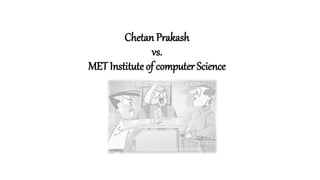
Chetan Prakash
vs.
MET Institute of computer Science
• Prakash was in final year of BSc when he sought admission in the institute
for MCS
• The institute had stipulated that in order to pursue the MCS course,
student has to clear III year exams
• He deposited the fees before declaration of result
• Seeing that he had failed in exams, he tried to withdraw the admission and
requested for a refund, to which the institute did not responded
• Finally, he sent a legal notice to the institute, and then lodged a complaint
in the consumer forum.
Judgement
• The institute had to pay the complainant, Chetan Prakash, Rs 32,000 as compensation for
harassment along with the course fee of Rs.62,200.
Krishnan Kumar Bajaj vs. PepsiCo.
• Bajaj, a resident of Ahmedabad, had purchased a Lay’s packet on 28 June
2010 and sensed its being underweight.
• He wrote twice to the manufacturer. While the first letter got no
response, in reply to the second, it offered Bajaj gifts hamper which he
refused.
• Bajaj approached CERS, who wrote to PepsiCo.
• Company refused to accept their fault and gave several unsatisfactory
clarifications
• CERS took the issue to the Consumer Disputes Redressal Forum, which
also gave a favourable ruling
• The company asked for the bill of purchase which Bajaj could not produce
Judgement
• The Court overruled the argument of his not having a bill
• CERS requested the court to direct PepsiCo to deposit Rs.2,00,000 in the Consumer Welfare
Fund and award Rs.2,75,250 as punitive damages.
• And also to give Rs.75,000 as costs of litigation.
CONCLUSION
• Consumer protection act provide for better protection of the interest of consumer and for that purpose
to make provision for the establishment of the consumer councils and other authorities for settlement
on consumers disputes and for matters connected there with.
Consumer protection act

Consumer protection act

  • 1.
  • 2.
    INTRODUCTION • Before theenactment of the consumer Protection Act,1986 a person aggrieved by the defective goods or deficiency in service had to approach the ordinary civil court to get his grievances redressed. • The proceeding in the ordinary civil court is very complex , expensive and time consuming . • In Order to give more protection to the interest of consumers of goods and service the parliament enacted the consumer Protection Act 1986
  • 3.
    Consumer Protection Act,1986 •In order to provide for better protection of the interests of the consumer the Consumer Protection Bill, .1986 was introduced in the Lok Sabha on 5th December, 1986. • The Consumer Protection Act 1986 is a social welfare legislation which was enacted as a result of widespread consumer protection movement.
  • 4.
    Who is aconsumer? Consumer he is a person • “Who buys any goods for a consideration which has been paid or promised, or partly paid and partly promised, or under a system of deferred payment. • Hires any services for a consideration which has been paid or promised, or partly paid and partly promised, or under a system of deferred payment.
  • 5.
    Who are notconsumers? • A person who purchased goods for resale • A person who purchased goods for commercial purpose • A person who obtains services without consideration • A person who obtains services under a contract of personal service • Contractors • Applicants for jobs • Persons who filed suits in courts
  • 9.
    WHO CAN FILEA COMPLAINT • A consumer • Any voluntary consumer association registered under the companies act 1956. • The central government or state government • One or more consumer where there are numerous consumers having the same interest who or which makes a complaint. Thus class action is permissible under the act • In case of death of a consumer his legal heir or representative
  • 10.
    COMPLAINT • Any unfairtrade practice adopted by the trader • Defective goods • Deficiency in service • Excess price charged by the trader • Unlawful goods sale, which is hazardous to life and safety when used.
  • 11.
    DEFECT • Fault, Imperfection,Shortcoming in the a. Quantity b. Quality c. Potency d. Purity e. Standards.
  • 12.
    FILING A COMPLAINT •No stamp or court fee is needed with state commission nor with national commission. • A complaint can be hand written or typed. • Admitted if it is filed within two years from the date on which the cause of action has arisen. According to Three Tier System it is decided in which commission or forum the hearing of case will be.
  • 13.
    Jurisdiction under ConsumerProtection Act 1986 Consumer Courts: A three-tier-system. • National Consumer Dispute Redressal Commission: claims above Rs 1 crore. • Consumer Dispute Redressal Commission or State Commission: Claims between 20 lakh to 1 crore. • Consumer Dispute Redressal Forum or District Forum: Claims up to Rs 20 Lakh.
  • 14.
    DISTRICT FORUM • EachDistrict Forum shall consist of a person who is or has been or is qualified to be a District Judge who shall be its President two other members , one of whom shall be a woman possessing a bachelor’s degree from a recognized university, be a person of ability, integrity and standing and have adequate knowledge and experience. • Each member of District Forum shall hold office for a term of 5 years or up to the age of 65 years which ever is earlier. • Subject to the other provisions of the Act a District Forum have juridiction to entertain complaints where the value of the goods and services and the compensation , if any, claimed does not exceed rs 20 lakhs.
  • 15.
    ADistrictForum(powers) I. To removethe defect pointed out by the appropriate laboratory from the goods in question II. To replace the goods with new goods of similar description which shall be free from any defect III. To return to the complainant the price, or as the case may be, the charges paid by the complainant IV. To pay such amount as may be awarded by it as compensation to the consumer for any loss or injury suffered by the consumer due to the negligence of the opposite party
  • 16.
  • 17.
    NATIONAL COMMISSION • TheNational Commission’ shall consist of a person who is or has been a Judge of the Supreme Court, shall be its President. Not less than 4 and not more than such number of members as may be prescribed and one of whom shall be a woman with similar qualifications as required in the case of appointment as a member to a District Forum or a State Commission. • Every member of the national commission shall have hold office for a term of 5 years or upto the age of 70 years which ever is earlier. • The national commission shall have juridiction to entertain complaints where the value of the goods or services and compensation, if any, the claim exceeds rs 1 crore.
  • 18.
    RELIEF GRANTED TOA CONSUMER • Repair of defective goods. • Replacement of defective goods. • Refund of the price paid for the defective goods or service. • Removal of deficiency in service. • Refund of extra money charged. • Withdrawal of goods hazardous to life and safety. • Compensation for the loss or injury suffered by the consumer due to negligence of the opposite party.
  • 19.
  • 20.
  • 21.
  • 22.
    • Prakash wasin final year of BSc when he sought admission in the institute for MCS • The institute had stipulated that in order to pursue the MCS course, student has to clear III year exams • He deposited the fees before declaration of result • Seeing that he had failed in exams, he tried to withdraw the admission and requested for a refund, to which the institute did not responded • Finally, he sent a legal notice to the institute, and then lodged a complaint in the consumer forum.
  • 23.
    Judgement • The institutehad to pay the complainant, Chetan Prakash, Rs 32,000 as compensation for harassment along with the course fee of Rs.62,200.
  • 24.
  • 25.
    • Bajaj, aresident of Ahmedabad, had purchased a Lay’s packet on 28 June 2010 and sensed its being underweight. • He wrote twice to the manufacturer. While the first letter got no response, in reply to the second, it offered Bajaj gifts hamper which he refused. • Bajaj approached CERS, who wrote to PepsiCo.
  • 26.
    • Company refusedto accept their fault and gave several unsatisfactory clarifications • CERS took the issue to the Consumer Disputes Redressal Forum, which also gave a favourable ruling • The company asked for the bill of purchase which Bajaj could not produce
  • 27.
    Judgement • The Courtoverruled the argument of his not having a bill • CERS requested the court to direct PepsiCo to deposit Rs.2,00,000 in the Consumer Welfare Fund and award Rs.2,75,250 as punitive damages. • And also to give Rs.75,000 as costs of litigation.
  • 28.
    CONCLUSION • Consumer protectionact provide for better protection of the interest of consumer and for that purpose to make provision for the establishment of the consumer councils and other authorities for settlement on consumers disputes and for matters connected there with.