Objectives
1. To promote and protect the rights of consumers
2. To be established Consumer Protection Council at
   the Central and State level
3. To provide speedy and simple redressal to consumer
   disputes by establishing consumer courts
4. This Act may be called the Consumer Protection Act,
   1986. It extends to the whole of India except the State
   of Jammu and Kashmir
Right of Consumers
(a) The right to be protected against marketing of goods
   which are hazardous to life and property;
(b) The right to be informed about the quality, quantity,
   potency, purity, standard and price of goods to protect the
   consumer against unfair trade practices;
(c) The right to be assured, wherever possible, access to
   an authority of goods at competitive prices;
(d) The right to be heard and to be assured that consumers
   interests will receive due consideration at appropriate
   forums;
(e) The right to seek redressal against unfair trade
   practices or unscrupulous exploitation of consumers; and
(f) The right to consumer education.
Definitions
1) "complainant" means-
   (i) A consumer
   (ii) Any voluntary consumer association registered under
      the Companies Act,1956 or under any other law for the
      time being in force
   (iii) The Central Government or any State Government; .
   [(iv) One or more consumers, where there are numerous
      consumers having the same interest
   (v) In case of death of a consumer, his legal heir or
      representative who or which makes a complaint;
"complaint" means any allegation in writing made by a
    complainant that-
(i) An unfair trade practice or a restrictive trade practice has
    been adopted by any trader or service provider
(ii) The goods bought by him or agreed to be bought by him
    suffer from one or more defects;
(iii)The services hired or availed of or agreed to be hired or
    availed of by him suffer from deficiency in any respect;
(iv) A trader or the service provider, as the case may be,
    has charged for the goods or for the services mentioned
    in the complaint, a price in excess of the price fixed or
    displayed
 "consumer" means any person who-
(i) buys any goods for a consideration which has been
   paid or promised or partly paid and partly promised,
   or under any system of deferred payment and
   includes any user of such goods other than the
   person who buys such goods for consideration paid
   or promised or partly paid or partly promised, or
   under any system of deferred payment when such
   use is made with the approval of such person, but
   does not include a person who obtains such goods
   for resale or for any commercial purpose; or
any services for a consideration which has been paid or
promised or partly paid and partly promised, or under
  any system of deferred payment and includes any
  beneficiary of such services other than the person who
  hires or avails of the services for consideration paid or
  promised, or partly paid and partly promised, or under
  any system of deferred payment,
"consumer dispute" means a dispute where the person
  against whom a complaint has been made, denies or
  disputes the allegations contained in the complaint
"defect" means any fault, imperfection or shortcoming in
  the quality, quantity, potency, purity or standard which
  is required to be maintained by or under any law for
  the time being in force or under any contract, express
  or implied or as is claimed by the trader in any manner
  whatsoever in relation to any goods;
 "deficiency" means any fault, imperfection,
  shortcoming or inadequacy in the quality, nature and
  manner of performance which is required to be
  maintained by or under any law for the time being in
  force or has been undertaken to be performed by a
  person in pursuance of a contract or otherwise in
  relation to any service
"goods" means goods as defined in the Sale of Goods
  Act, 1930
 "unfair trade practice" means a trade practice which, for
   the purpose of promoting the sale, use or supply of any
   goods or for the provision of any service, adopts any
   unfair method or unfair or deceptive practice including
   any of the following practices, namely;-
(1) the practice of making any statement, whether orally or
   in writing or by visible representation which,-
(i) falsely represents that the goods are of a particular
   standard, quality, quantity, grade, composition, style or
   model;
(ii) falsely represents that the services are of a particular
   standard, quality or grade;
iii) Falsely represents any re-built, second-hand, renovated,
   reconditioned or old goods as new goods;
(iv) represents that the goods or services have sponsorship,
   approval, performance, characteristics, accessories, uses or
   benefits which such goods or services do not have;
(v) represents that the seller or the supplier has a sponsorship
   or approval or affiliation which such seller or supplier does
   not have;
(vi)makes a false or misleading representation concerning
   the need for, or the usefulness of, any goods or services;
(vii) gives to the public any warranty or guarantee of the
  performance, efficacy or length of life of a product or
  of any goods that is not based on an adequate or
  proper test thereof
Consumer Protection Council
The Central Consumer Protection Council
consist of the following members
1) Minister in charge of the consumer affairs shall be
    the chairman
2) such number of other official or non-official
    members
 Central Council shall conduct meeting at least once
  in an year. The objects of the Central Council shall
  be to promote and protect the rights of the
  consumers
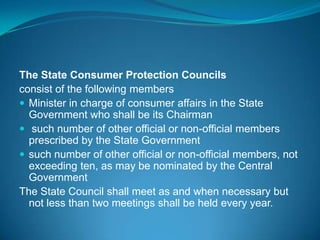
The State Consumer Protection Councils
consist of the following members
 Minister in charge of consumer affairs in the State
  Government who shall be its Chairman
 such number of other official or non-official members
  prescribed by the State Government
 such number of other official or non-official members, not
  exceeding ten, as may be nominated by the Central
  Government
The State Council shall meet as and when necessary but
  not less than two meetings shall be held every year.
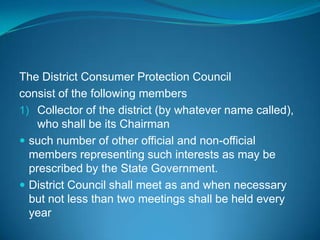
The District Consumer Protection Council
consist of the following members
1) Collector of the district (by whatever name called),
    who shall be its Chairman
 such number of other official and non-official
  members representing such interests as may be
  prescribed by the State Government.
 District Council shall meet as and when necessary
  but not less than two meetings shall be held every
  year
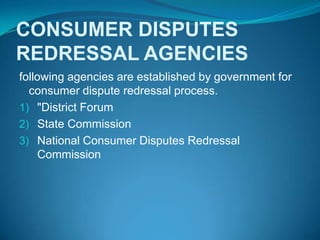
CONSUMER DISPUTES
REDRESSAL AGENCIES
following agencies are established by government for
  consumer dispute redressal process.
1) "District Forum
2) State Commission
3) National Consumer Disputes Redressal
     Commission
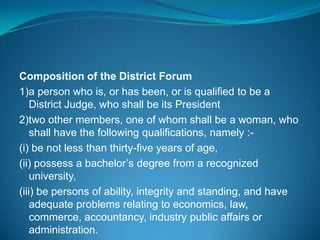
Composition of the District Forum
1)a person who is, or has been, or is qualified to be a
    District Judge, who shall be its President
2)two other members, one of whom shall be a woman, who
    shall have the following qualifications, namely :-
(i) be not less than thirty-five years of age,
(ii) possess a bachelor’s degree from a recognized
    university,
(iii) be persons of ability, integrity and standing, and have
    adequate problems relating to economics, law,
    commerce, accountancy, industry public affairs or
    administration.
 Jurisdiction of the District Forum.--( I) Subject to
 the other provisions of this Act, the District Forum
 shall have jurisdiction to entertain complaints where
 the value of the goods or services and the
 compensation, if any, claimed does not exceed rupees
 twenty lakhs.
Manner in which complaint shall be made
A complaint in may be filed with a District Forum by-
(a) the consumer
(b) any recognised consumer association
(c) one or more consumers
(d) Central or the State Government
 The complaint should be given with required amount
    of fee. Once the compliant is received it should
    proceed with it with in 21 days .
Finding of the District Forum
District forum will have following decisions:
(a) to remove the defect pointed but by the appropriate
  laboratory from the goods in question;
(b) to replace the goods with new goods of similar
  description which shall be free from any defect;
(c) to return to the complainant the price, or, as the case
  may be, the charges paid by the complainant;
(d) to pay such amount as may be awarded by it as
  compensation to the consumer for any loss or injury
  suffered by the consumer due to the negligence of the
  opposite party
e)to remove the defects in goods or deficiencies in the
  services
(f) to discontinue the unfair trade practice
(g) to withdraw the hazardous goods from being offered
  for sale;
(h)to cease manufacture of hazardous goods and to
  desist from offering services which are hazardous in
  nature
(i) to provide for adequate costs to parties
 Appeal.-Any person aggrieved by an order made by
 the District Forum may prefer an appeal against such
 order to the State Commission within a period of
 thirty days from the date of the order, in such form and
 manner as may be prescribed.
Composition of the State
Commission
State Commission shall consist of-
(a) a person who is or has been a Judge of a High
    Court, appointed by the State Government, who
    shall be its President:
(b) not less than two, and not more than such number
    of members, as may be prescribed, and one of
    who shall be a woman.
Jurisdiction of the State Commission
 (i) complaints where the value of the goods or services
  and compensation, if any, claimed exceeds rupees
  exceeds rupees twenty lakhs but does not exceed
  rupees one crore
 (ii) appeals against the orders of any District Forum
  within the State.
 Appeals.--Any person aggrieved by an order made by
 the State Commission in exercise of its powers
 conferred by sub-clause (i) of clause (a) of section 17
 may prefer an appeal against such order to the
 National Commission within a period of thirty days
 from the date of the order in such form and manner as
 may be prescribed.
National Commission
(a) a person who is or has been a Judge of the Supreme
    Court, to be appointed by the Central Government, who
    shall be its President; -
(b) not less than four, and not more than such number of
    members, as may be prescribed, and one of whom shall
    be a woman.
Jurisdiction of the National Commission
(i) complaints where the value of the goods or services
      and compensation, if any(i) complaints where the value
      of the goods or services and compensation, if any
      exceed one crore
(ii) (ii) appeals against the orders of any State
      Commission
Appeal.-Any person, aggrieved by an order made by the
  National Commission in exercise of its powers may
  prefer an appeal against such order of the Supreme
  Court within a period of thirty days from the date of
  the order:
Limitation period. The District Forum, the State
  Commission or the National Commission shall not
  admit a complaint unless it is filed within two years
  from the date on which the cause of action has arisen

Consumer protection act shoaib

  • 2.
    Objectives 1. To promoteand protect the rights of consumers 2. To be established Consumer Protection Council at the Central and State level 3. To provide speedy and simple redressal to consumer disputes by establishing consumer courts 4. This Act may be called the Consumer Protection Act, 1986. It extends to the whole of India except the State of Jammu and Kashmir
  • 3.
    Right of Consumers (a)The right to be protected against marketing of goods which are hazardous to life and property; (b) The right to be informed about the quality, quantity, potency, purity, standard and price of goods to protect the consumer against unfair trade practices; (c) The right to be assured, wherever possible, access to an authority of goods at competitive prices; (d) The right to be heard and to be assured that consumers interests will receive due consideration at appropriate forums; (e) The right to seek redressal against unfair trade practices or unscrupulous exploitation of consumers; and (f) The right to consumer education.
  • 4.
    Definitions 1) "complainant" means- (i) A consumer (ii) Any voluntary consumer association registered under the Companies Act,1956 or under any other law for the time being in force (iii) The Central Government or any State Government; . [(iv) One or more consumers, where there are numerous consumers having the same interest (v) In case of death of a consumer, his legal heir or representative who or which makes a complaint;
  • 5.
    "complaint" means anyallegation in writing made by a complainant that- (i) An unfair trade practice or a restrictive trade practice has been adopted by any trader or service provider (ii) The goods bought by him or agreed to be bought by him suffer from one or more defects; (iii)The services hired or availed of or agreed to be hired or availed of by him suffer from deficiency in any respect; (iv) A trader or the service provider, as the case may be, has charged for the goods or for the services mentioned in the complaint, a price in excess of the price fixed or displayed
  • 6.
     "consumer" meansany person who- (i) buys any goods for a consideration which has been paid or promised or partly paid and partly promised, or under any system of deferred payment and includes any user of such goods other than the person who buys such goods for consideration paid or promised or partly paid or partly promised, or under any system of deferred payment when such use is made with the approval of such person, but does not include a person who obtains such goods for resale or for any commercial purpose; or
  • 7.
    any services fora consideration which has been paid or promised or partly paid and partly promised, or under any system of deferred payment and includes any beneficiary of such services other than the person who hires or avails of the services for consideration paid or promised, or partly paid and partly promised, or under any system of deferred payment,
  • 8.
    "consumer dispute" meansa dispute where the person against whom a complaint has been made, denies or disputes the allegations contained in the complaint "defect" means any fault, imperfection or shortcoming in the quality, quantity, potency, purity or standard which is required to be maintained by or under any law for the time being in force or under any contract, express or implied or as is claimed by the trader in any manner whatsoever in relation to any goods;
  • 9.
     "deficiency" meansany fault, imperfection, shortcoming or inadequacy in the quality, nature and manner of performance which is required to be maintained by or under any law for the time being in force or has been undertaken to be performed by a person in pursuance of a contract or otherwise in relation to any service "goods" means goods as defined in the Sale of Goods Act, 1930
  • 10.
     "unfair tradepractice" means a trade practice which, for the purpose of promoting the sale, use or supply of any goods or for the provision of any service, adopts any unfair method or unfair or deceptive practice including any of the following practices, namely;- (1) the practice of making any statement, whether orally or in writing or by visible representation which,- (i) falsely represents that the goods are of a particular standard, quality, quantity, grade, composition, style or model; (ii) falsely represents that the services are of a particular standard, quality or grade;
  • 11.
    iii) Falsely representsany re-built, second-hand, renovated, reconditioned or old goods as new goods; (iv) represents that the goods or services have sponsorship, approval, performance, characteristics, accessories, uses or benefits which such goods or services do not have; (v) represents that the seller or the supplier has a sponsorship or approval or affiliation which such seller or supplier does not have; (vi)makes a false or misleading representation concerning the need for, or the usefulness of, any goods or services;
  • 12.
    (vii) gives tothe public any warranty or guarantee of the performance, efficacy or length of life of a product or of any goods that is not based on an adequate or proper test thereof
  • 13.
    Consumer Protection Council TheCentral Consumer Protection Council consist of the following members 1) Minister in charge of the consumer affairs shall be the chairman 2) such number of other official or non-official members  Central Council shall conduct meeting at least once in an year. The objects of the Central Council shall be to promote and protect the rights of the consumers
  • 14.
    The State ConsumerProtection Councils consist of the following members  Minister in charge of consumer affairs in the State Government who shall be its Chairman  such number of other official or non-official members prescribed by the State Government  such number of other official or non-official members, not exceeding ten, as may be nominated by the Central Government The State Council shall meet as and when necessary but not less than two meetings shall be held every year.
  • 15.
    The District ConsumerProtection Council consist of the following members 1) Collector of the district (by whatever name called), who shall be its Chairman  such number of other official and non-official members representing such interests as may be prescribed by the State Government.  District Council shall meet as and when necessary but not less than two meetings shall be held every year
  • 16.
    CONSUMER DISPUTES REDRESSAL AGENCIES followingagencies are established by government for consumer dispute redressal process. 1) "District Forum 2) State Commission 3) National Consumer Disputes Redressal Commission
  • 17.
    Composition of theDistrict Forum 1)a person who is, or has been, or is qualified to be a District Judge, who shall be its President 2)two other members, one of whom shall be a woman, who shall have the following qualifications, namely :- (i) be not less than thirty-five years of age, (ii) possess a bachelor’s degree from a recognized university, (iii) be persons of ability, integrity and standing, and have adequate problems relating to economics, law, commerce, accountancy, industry public affairs or administration.
  • 18.
     Jurisdiction ofthe District Forum.--( I) Subject to the other provisions of this Act, the District Forum shall have jurisdiction to entertain complaints where the value of the goods or services and the compensation, if any, claimed does not exceed rupees twenty lakhs.
  • 19.
    Manner in whichcomplaint shall be made A complaint in may be filed with a District Forum by- (a) the consumer (b) any recognised consumer association (c) one or more consumers (d) Central or the State Government The complaint should be given with required amount of fee. Once the compliant is received it should proceed with it with in 21 days .
  • 20.
    Finding of theDistrict Forum District forum will have following decisions: (a) to remove the defect pointed but by the appropriate laboratory from the goods in question; (b) to replace the goods with new goods of similar description which shall be free from any defect; (c) to return to the complainant the price, or, as the case may be, the charges paid by the complainant; (d) to pay such amount as may be awarded by it as compensation to the consumer for any loss or injury suffered by the consumer due to the negligence of the opposite party
  • 21.
    e)to remove thedefects in goods or deficiencies in the services (f) to discontinue the unfair trade practice (g) to withdraw the hazardous goods from being offered for sale; (h)to cease manufacture of hazardous goods and to desist from offering services which are hazardous in nature (i) to provide for adequate costs to parties
  • 22.
     Appeal.-Any personaggrieved by an order made by the District Forum may prefer an appeal against such order to the State Commission within a period of thirty days from the date of the order, in such form and manner as may be prescribed.
  • 23.
    Composition of theState Commission State Commission shall consist of- (a) a person who is or has been a Judge of a High Court, appointed by the State Government, who shall be its President: (b) not less than two, and not more than such number of members, as may be prescribed, and one of who shall be a woman.
  • 24.
    Jurisdiction of theState Commission  (i) complaints where the value of the goods or services and compensation, if any, claimed exceeds rupees exceeds rupees twenty lakhs but does not exceed rupees one crore  (ii) appeals against the orders of any District Forum within the State.
  • 25.
     Appeals.--Any personaggrieved by an order made by the State Commission in exercise of its powers conferred by sub-clause (i) of clause (a) of section 17 may prefer an appeal against such order to the National Commission within a period of thirty days from the date of the order in such form and manner as may be prescribed.
  • 26.
    National Commission (a) aperson who is or has been a Judge of the Supreme Court, to be appointed by the Central Government, who shall be its President; - (b) not less than four, and not more than such number of members, as may be prescribed, and one of whom shall be a woman. Jurisdiction of the National Commission (i) complaints where the value of the goods or services and compensation, if any(i) complaints where the value of the goods or services and compensation, if any exceed one crore (ii) (ii) appeals against the orders of any State Commission
  • 27.
    Appeal.-Any person, aggrievedby an order made by the National Commission in exercise of its powers may prefer an appeal against such order of the Supreme Court within a period of thirty days from the date of the order: Limitation period. The District Forum, the State Commission or the National Commission shall not admit a complaint unless it is filed within two years from the date on which the cause of action has arisen