Presented By-
SourabhVerma (IIM-C)
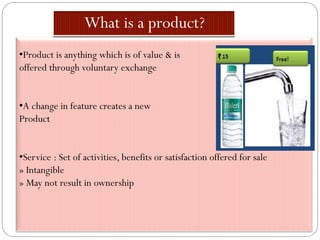
•Product is anything which is of value & is
offered through voluntary exchange
•A change in feature creates a new
Product
•Service : Set of activities, benefits or satisfaction offered for sale
» Intangible
» May not result in ownership
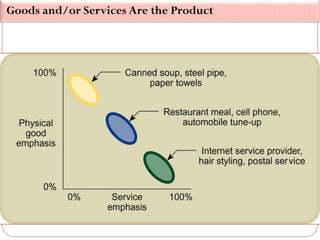
Goods and/or Services Are the Product
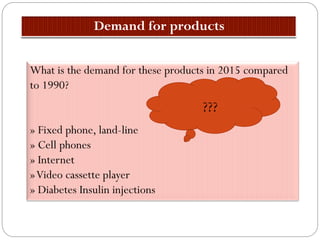
What is the demand for these products in 2015 compared
to 1990?
» Fixed phone, land-line
» Cell phones
» Internet
»Video cassette player
» Diabetes Insulin injections
???
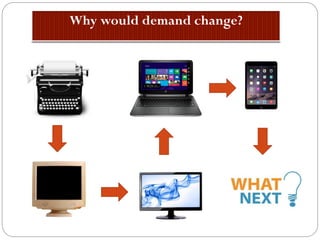
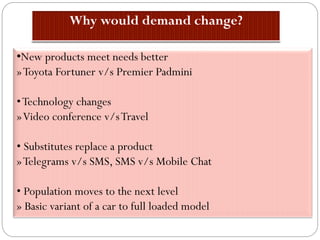
•New products meet needs better
»Toyota Fortuner v/s Premier Padmini
•Technology changes
»Video conference v/sTravel
• Substitutes replace a product
»Telegrams v/s SMS, SMS v/s Mobile Chat
• Population moves to the next level
» Basic variant of a car to full loaded model
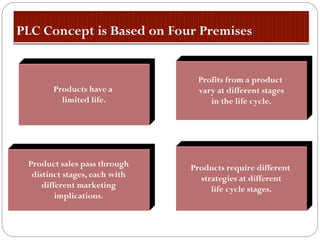
Products have a
limited life.
Product sales pass through
distinct stages, each with
different marketing
implications.
Profits from a product
vary at different stages
in the life cycle.
Products require different
strategies at different
life cycle stages.
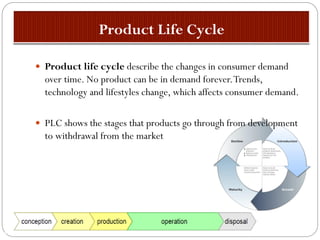
 Product life cycle describe the changes in consumer demand
over time. No product can be in demand forever.Trends,
technology and lifestyles change, which affects consumer demand.
 PLC shows the stages that products go through from development
to withdrawal from the market
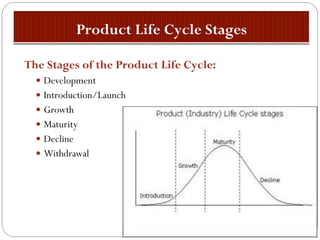
The Stages of the Product Life Cycle:
 Development
 Introduction/Launch
 Growth
 Maturity
 Decline
 Withdrawal
Sales
Time
Development Introduction Growth Maturity Saturation Decline
 Product development
 Introduction
 Growth
 Maturity
 Decline
 Begins when the company
develops a new-product idea
 Sales are zero
 Investment costs are high
 Profits are negative
PLC Stages
 Product development
 Introduction
 Growth
 Maturity
 Decline
 Slow sales growth – cell phones
15 yrs back, Hybrid cars today,
Blu-Ray technology, UHD & 3D
TV
 Intensive promotions,
communications
 Price uncertainty
 Uncertain competition reactions
 Uncertain consumer responses
 Non-existent profits
 Negative cash flow
PLC Stages
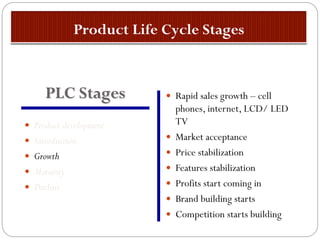
 Product development
 Introduction
 Growth
 Maturity
 Decline
 Rapid sales growth – cell
phones, internet, LCD/ LED
TV
 Market acceptance
 Price stabilization
 Features stabilization
 Profits start coming in
 Brand building starts
 Competition starts building
PLC Stages
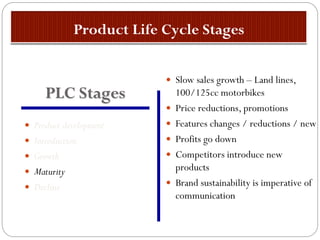
 Product development
 Introduction
 Growth
 Maturity
 Decline
 Slow sales growth – Land lines,
100/125cc motorbikes
 Price reductions, promotions
 Features changes / reductions / new
 Profits go down
 Competitors introduce new
products
 Brand sustainability is imperative of
communication
PLC Stages
 Product development
 Introduction
 Growth
 Maturity
 Decline
 Decline in sales – audio &
video cassette players, pagers,
CTVs
 New products meet satisfaction
 Profits erode
 Communication expenses are
stopped
PLC Stages
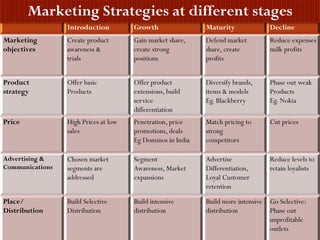
Introduction Growth Maturity Decline
Marketing
objectives
Create product
awareness &
trials
Gain market share,
create strong
positions
Defend market
share, create
profits
Reduce expenses
milk profits
Product
strategy
Offer basic
Products
Offer product
extensions, build
service
differentiation
Diversify brands,
items & models
Eg. Blackberry
Phase out weak
Products
Eg. Nokia
Price High Prices at low
sales
Penetration, price
promotions, deals
Eg Dominos in India
Match pricing to
strong
competitors
Cut prices
Advertising &
Communications
Chosen market
segments are
addressed
Segment
Awareness, Market
expansions
Advertise
Differentiation,
Loyal Customer
retention
Reduce levels to
retain loyalists
Place/
Distribution
Build Selective
Distribution
Build intensive
distribution
Build more intensive
distribution
Go Selective:
Phase out
unprofitable
outlets
Marketing Strategies at different stages
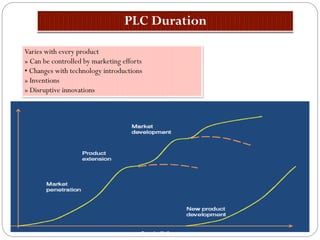
Varies with every product
» Can be controlled by marketing efforts
• Changes with technology introductions
» Inventions
» Disruptive innovations
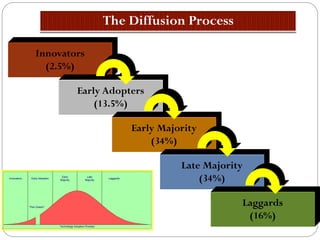
Laggards
Late
Majority
Early
Majority
Early AdoptersInnovators
"The Chasm"
Technology Adoption Process
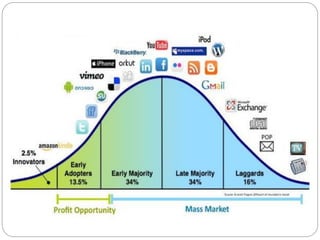
Innovators
(2.5%)
Early Adopters
(13.5%)
Early Majority
(34%)
Late Majority
(34%)
Laggards
(16%)
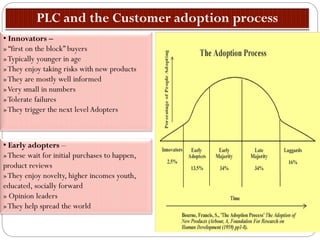
• Innovators –
» “first on the block” buyers
»Typically younger in age
»They enjoy taking risks with new products
»They are mostly well informed
»Very small in numbers
»Tolerate failures
»They trigger the next level Adopters
• Early adopters –
»These wait for initial purchases to happen,
product reviews
»They enjoy novelty, higher incomes youth,
educated, socially forward
» Opinion leaders
»They help spread the world
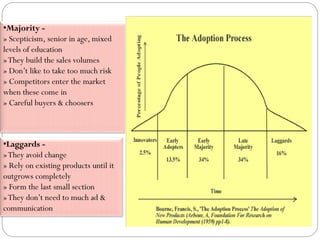
•Majority -
» Scepticism, senior in age, mixed
levels of education
»They build the sales volumes
» Don’t like to take too much risk
» Competitors enter the market
when these come in
» Careful buyers & choosers
•Laggards -
»They avoid change
» Rely on existing products until it
outgrows completely
» Form the last small section
»They don’t need to much ad &
communication
Vs.
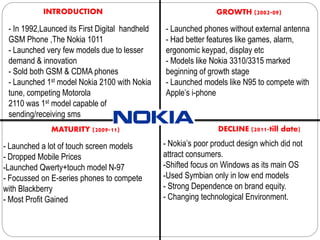
INTRODUCTION GROWTH (2002-09)
MATURITY (2009-11) DECLINE (2011-till date)
- In 1992,Launced its First Digital handheld
GSM Phone ,The Nokia 1011
- Launched very few models due to lesser
demand & innovation
- Sold both GSM & CDMA phones
- Launched 1st model Nokia 2100 with Nokia
tune, competing Motorola
2110 was 1st model capable of
sending/receiving sms
- Launched phones without external antenna
- Had better features like games, alarm,
ergonomic keypad, display etc
- Models like Nokia 3310/3315 marked
beginning of growth stage
- Launched models like N95 to compete with
Apple’s i-phone
- Launched a lot of touch screen models
- Dropped Mobile Prices
-Launched Qwerty+touch model N-97
- Focussed on E-series phones to compete
with Blackberry
- Most Profit Gained
- Nokia’s poor product design which did not
attract consumers.
-Shifted focus on Windows as its main OS
-Used Symbian only in low end models
- Strong Dependence on brand equity.
- Changing technological Environment.
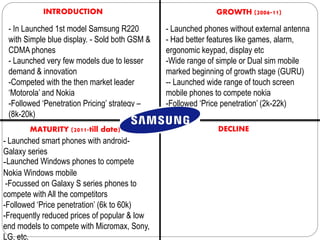
INTRODUCTION GROWTH (2006-11)
MATURITY (2011-till date) DECLINE
- In Launched 1st model Samsung R220
with Simple blue display. - Sold both GSM &
CDMA phones
- Launched very few models due to lesser
demand & innovation
-Competed with the then market leader
‘Motorola’ and Nokia
-Followed ‘Penetration Pricing’ strategy –
(8k-20k)
- Launched phones without external antenna
- Had better features like games, alarm,
ergonomic keypad, display etc
-Wide range of simple or Dual sim mobile
marked beginning of growth stage (GURU)
-- Launched wide range of touch screen
mobile phones to compete nokia
-Followed ‘Price penetration’ (2k-22k)
- Launched smart phones with android-
Galaxy series
-Launched Windows phones to compete
Nokia Windows mobile
-Focussed on Galaxy S series phones to
compete with All the competitors
-Followed ‘Price penetration’ (6k to 60k)
-Frequently reduced prices of popular & low
end models to compete with Micromax, Sony,
LG, etc.
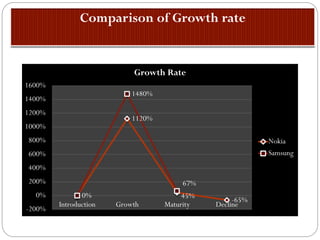
0%
1120%
45%
-65%
0%
1480%
67%
-200%
0%
200%
400%
600%
800%
1000%
1200%
1400%
1600%
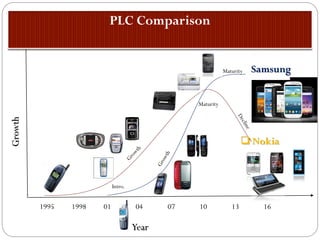
Introduction Growth Maturity Decline
Growth Rate
Nokia
Samsung
1995 1998 01 04 07 10 13 16
Intro. Intro.
Maturity
Maturity
 Nokia
Year
Growth
Samsung
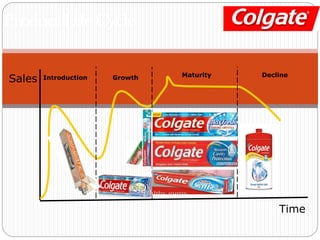
Product Life Cycle
Time
Sales Introduction Growth Maturity Decline
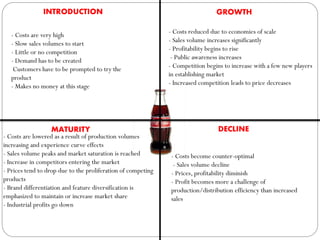
INTRODUCTION
- Costs are very high
- Slow sales volumes to start
- Little or no competition
- Demand has to be created
Customers have to be prompted to try the
product
- Makes no money at this stage
GROWTH
- Costs reduced due to economies of scale
- Sales volume increases significantly
- Profitability begins to rise
- Public awareness increases
- Competition begins to increase with a few new players
in establishing market
- Increased competition leads to price decreases
MATURITY
- Costs are lowered as a result of production volumes
increasing and experience curve effects
- Sales volume peaks and market saturation is reached
- Increase in competitors entering the market
- Prices tend to drop due to the proliferation of competing
products
- Brand differentiation and feature diversification is
emphasized to maintain or increase market share
- Industrial profits go down
DECLINE
- Costs become counter-optimal
- Sales volume decline
- Prices, profitability diminish
- Profit becomes more a challenge of
production/distribution efficiency than increased
sales
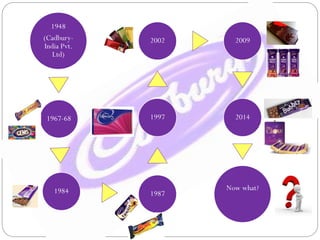
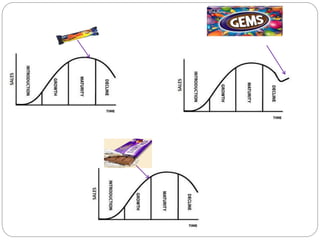
1948
(Cadbury-
India Pvt.
Ltd)
1967-68
1984 1987
1997
2002 2009
2014
Now what?
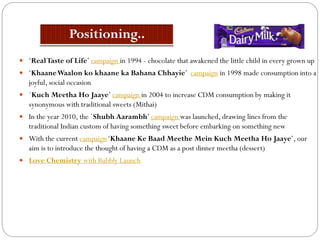
 ‘RealTaste of Life’ campaign in 1994 - chocolate that awakened the little child in every grown up
 ‘KhaaneWaalon ko khaane ka Bahana Chhayie’ campaign in 1998 made consumption into a
joyful, social occasion
 `Kuch Meetha Ho Jaaye’ campaign in 2004 to increase CDM consumption by making it
synonymous with traditional sweets (Mithai)
 In the year 2010, the `Shubh Aarambh’ campaign was launched, drawing lines from the
traditional Indian custom of having something sweet before embarking on something new
 With the current campaign‘Khaane Ke Baad Meethe Mein Kuch Meetha Ho Jaaye’, our
aim is to introduce the thought of having a CDM as a post dinner meetha (dessert)
 Love Chemistry with Bubbly Launch
At the heart of a great brand is a great
product
Thank you

Product life cycle management

  • 1.
  • 2.
    •Product is anythingwhich is of value & is offered through voluntary exchange •A change in feature creates a new Product •Service : Set of activities, benefits or satisfaction offered for sale » Intangible » May not result in ownership
  • 3.
    Goods and/or ServicesAre the Product
  • 4.
    What is thedemand for these products in 2015 compared to 1990? » Fixed phone, land-line » Cell phones » Internet »Video cassette player » Diabetes Insulin injections ???
  • 6.
    •New products meetneeds better »Toyota Fortuner v/s Premier Padmini •Technology changes »Video conference v/sTravel • Substitutes replace a product »Telegrams v/s SMS, SMS v/s Mobile Chat • Population moves to the next level » Basic variant of a car to full loaded model
  • 7.
    Products have a limitedlife. Product sales pass through distinct stages, each with different marketing implications. Profits from a product vary at different stages in the life cycle. Products require different strategies at different life cycle stages.
  • 8.
     Product lifecycle describe the changes in consumer demand over time. No product can be in demand forever.Trends, technology and lifestyles change, which affects consumer demand.  PLC shows the stages that products go through from development to withdrawal from the market
  • 9.
    The Stages ofthe Product Life Cycle:  Development  Introduction/Launch  Growth  Maturity  Decline  Withdrawal
  • 10.
    Sales Time Development Introduction GrowthMaturity Saturation Decline
  • 11.
     Product development Introduction  Growth  Maturity  Decline  Begins when the company develops a new-product idea  Sales are zero  Investment costs are high  Profits are negative PLC Stages
  • 12.
     Product development Introduction  Growth  Maturity  Decline  Slow sales growth – cell phones 15 yrs back, Hybrid cars today, Blu-Ray technology, UHD & 3D TV  Intensive promotions, communications  Price uncertainty  Uncertain competition reactions  Uncertain consumer responses  Non-existent profits  Negative cash flow PLC Stages
  • 13.
     Product development Introduction  Growth  Maturity  Decline  Rapid sales growth – cell phones, internet, LCD/ LED TV  Market acceptance  Price stabilization  Features stabilization  Profits start coming in  Brand building starts  Competition starts building PLC Stages
  • 14.
     Product development Introduction  Growth  Maturity  Decline  Slow sales growth – Land lines, 100/125cc motorbikes  Price reductions, promotions  Features changes / reductions / new  Profits go down  Competitors introduce new products  Brand sustainability is imperative of communication PLC Stages
  • 15.
     Product development Introduction  Growth  Maturity  Decline  Decline in sales – audio & video cassette players, pagers, CTVs  New products meet satisfaction  Profits erode  Communication expenses are stopped PLC Stages
  • 16.
    Introduction Growth MaturityDecline Marketing objectives Create product awareness & trials Gain market share, create strong positions Defend market share, create profits Reduce expenses milk profits Product strategy Offer basic Products Offer product extensions, build service differentiation Diversify brands, items & models Eg. Blackberry Phase out weak Products Eg. Nokia Price High Prices at low sales Penetration, price promotions, deals Eg Dominos in India Match pricing to strong competitors Cut prices Advertising & Communications Chosen market segments are addressed Segment Awareness, Market expansions Advertise Differentiation, Loyal Customer retention Reduce levels to retain loyalists Place/ Distribution Build Selective Distribution Build intensive distribution Build more intensive distribution Go Selective: Phase out unprofitable outlets Marketing Strategies at different stages
  • 17.
    Varies with everyproduct » Can be controlled by marketing efforts • Changes with technology introductions » Inventions » Disruptive innovations
  • 18.
    Laggards Late Majority Early Majority Early AdoptersInnovators "The Chasm" TechnologyAdoption Process Innovators (2.5%) Early Adopters (13.5%) Early Majority (34%) Late Majority (34%) Laggards (16%)
  • 19.
    • Innovators – »“first on the block” buyers »Typically younger in age »They enjoy taking risks with new products »They are mostly well informed »Very small in numbers »Tolerate failures »They trigger the next level Adopters • Early adopters – »These wait for initial purchases to happen, product reviews »They enjoy novelty, higher incomes youth, educated, socially forward » Opinion leaders »They help spread the world
  • 20.
    •Majority - » Scepticism,senior in age, mixed levels of education »They build the sales volumes » Don’t like to take too much risk » Competitors enter the market when these come in » Careful buyers & choosers •Laggards - »They avoid change » Rely on existing products until it outgrows completely » Form the last small section »They don’t need to much ad & communication
  • 23.
  • 24.
    INTRODUCTION GROWTH (2002-09) MATURITY(2009-11) DECLINE (2011-till date) - In 1992,Launced its First Digital handheld GSM Phone ,The Nokia 1011 - Launched very few models due to lesser demand & innovation - Sold both GSM & CDMA phones - Launched 1st model Nokia 2100 with Nokia tune, competing Motorola 2110 was 1st model capable of sending/receiving sms - Launched phones without external antenna - Had better features like games, alarm, ergonomic keypad, display etc - Models like Nokia 3310/3315 marked beginning of growth stage - Launched models like N95 to compete with Apple’s i-phone - Launched a lot of touch screen models - Dropped Mobile Prices -Launched Qwerty+touch model N-97 - Focussed on E-series phones to compete with Blackberry - Most Profit Gained - Nokia’s poor product design which did not attract consumers. -Shifted focus on Windows as its main OS -Used Symbian only in low end models - Strong Dependence on brand equity. - Changing technological Environment.
  • 25.
    INTRODUCTION GROWTH (2006-11) MATURITY(2011-till date) DECLINE - In Launched 1st model Samsung R220 with Simple blue display. - Sold both GSM & CDMA phones - Launched very few models due to lesser demand & innovation -Competed with the then market leader ‘Motorola’ and Nokia -Followed ‘Penetration Pricing’ strategy – (8k-20k) - Launched phones without external antenna - Had better features like games, alarm, ergonomic keypad, display etc -Wide range of simple or Dual sim mobile marked beginning of growth stage (GURU) -- Launched wide range of touch screen mobile phones to compete nokia -Followed ‘Price penetration’ (2k-22k) - Launched smart phones with android- Galaxy series -Launched Windows phones to compete Nokia Windows mobile -Focussed on Galaxy S series phones to compete with All the competitors -Followed ‘Price penetration’ (6k to 60k) -Frequently reduced prices of popular & low end models to compete with Micromax, Sony, LG, etc.
  • 26.
  • 27.
    1995 1998 0104 07 10 13 16 Intro. Intro. Maturity Maturity  Nokia Year Growth Samsung
  • 28.
    Product Life Cycle Time SalesIntroduction Growth Maturity Decline
  • 29.
    INTRODUCTION - Costs arevery high - Slow sales volumes to start - Little or no competition - Demand has to be created Customers have to be prompted to try the product - Makes no money at this stage GROWTH - Costs reduced due to economies of scale - Sales volume increases significantly - Profitability begins to rise - Public awareness increases - Competition begins to increase with a few new players in establishing market - Increased competition leads to price decreases MATURITY - Costs are lowered as a result of production volumes increasing and experience curve effects - Sales volume peaks and market saturation is reached - Increase in competitors entering the market - Prices tend to drop due to the proliferation of competing products - Brand differentiation and feature diversification is emphasized to maintain or increase market share - Industrial profits go down DECLINE - Costs become counter-optimal - Sales volume decline - Prices, profitability diminish - Profit becomes more a challenge of production/distribution efficiency than increased sales
  • 30.
  • 31.
     ‘RealTaste ofLife’ campaign in 1994 - chocolate that awakened the little child in every grown up  ‘KhaaneWaalon ko khaane ka Bahana Chhayie’ campaign in 1998 made consumption into a joyful, social occasion  `Kuch Meetha Ho Jaaye’ campaign in 2004 to increase CDM consumption by making it synonymous with traditional sweets (Mithai)  In the year 2010, the `Shubh Aarambh’ campaign was launched, drawing lines from the traditional Indian custom of having something sweet before embarking on something new  With the current campaign‘Khaane Ke Baad Meethe Mein Kuch Meetha Ho Jaaye’, our aim is to introduce the thought of having a CDM as a post dinner meetha (dessert)  Love Chemistry with Bubbly Launch
  • 33.
    At the heartof a great brand is a great product Thank you