Alberta Agriculture and Rural
        Development

    Kelly Lund: (780) 644-1197
  Ag-Info Line: 310-FARM (3276)
     Toll Free Line: 310-0000
Consumer Basics…
for Renewable Energy
Small Scale Energy Workshop
      Nov 30, Beiseker


     Kelly Lund, AARD, (780) 644-1197
What should a Consumer know?
• Energy Terminology Basics
• Technology Basics
  – Understand the testing and rating system
  – Manage expectations
• Applicable Requirements for your Area
  – Permits and approvals
  – Tax Assessments
• Consumer and Contract (Legal) Basics
Terminology
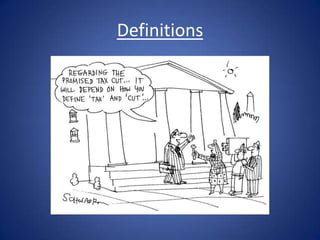
Definitions
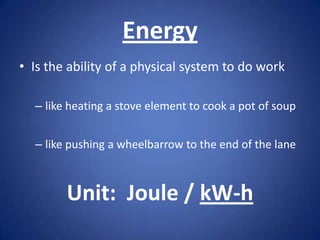
Energy
• Is the ability of a physical system to do work

  – like heating a stove element to cook a pot of soup


  – like pushing a wheelbarrow to the end of the lane


        Unit: Joule / kW-h
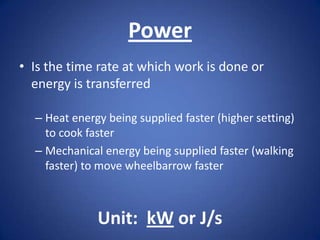
Power
• Is the time rate at which work is done or
  energy is transferred

  – Heat energy being supplied faster (higher setting)
    to cook faster
  – Mechanical energy being supplied faster (walking
    faster) to move wheelbarrow faster


              Unit: kW or J/s
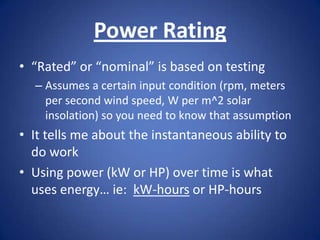
Power Rating
• “Rated” or “nominal” is based on testing
  – Assumes a certain input condition (rpm, meters
    per second wind speed, W per m^2 solar
    insolation) so you need to know that assumption
• It tells me about the instantaneous ability to
  do work
• Using power (kW or HP) over time is what
  uses energy… ie: kW-hours or HP-hours
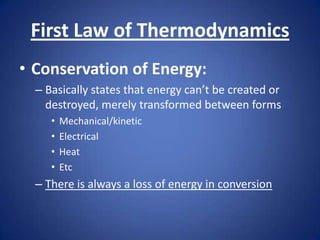
First Law of Thermodynamics
• Conservation of Energy:
  – Basically states that energy can’t be created or
    destroyed, merely transformed between forms
     •   Mechanical/kinetic
     •   Electrical
     •   Heat
     •   Etc
  – There is always a loss of energy in conversion
Technology
RE Equipment
• When we buy RE equipment (solar
  PV, wind, biomass combustion, etc) it will have
  a nominal Power Rating in kilowatts (kW) just
  like a vehicle will have a nominal power rating
  (usually hp), based on some test done at
  specified conditions
Capacity Factor
• The amount of time a generator is operating
  at its rated power
• Capacity factor results from a combined effect
  of the FUEL and the EQUIPMENT
Capacity factor
• 100% capacity factor means it is operating at
  rated power 100% of the time, ie: all 8760 hrs
  in a year
• 50% capacity factor means it is operating at
  rated power 50% of the time,
     • ie: 100% rated power for only 4380 hrs in a year OR
     • 50% of rated power for all 8760 hrs in a year
System considerations
• Determine their system production:
• 1. Click on:
  https://glfc.cfsnet.nfis.org/mapserver/pv/sear
  ch.php?lang=e&prov=alta

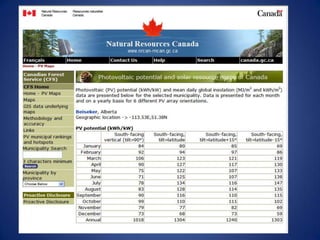
  2. Examine the PV Potential chart to find the
  predicted annual production in kWh. Use the
  column which says South facing tilt = latitude
• An Example:

  Sunnynook, Alberta shows an annual
  production of 1343kWh production for each
  1000 watts of solar modules installed facing
  south and tilted at an angle equivalent to the
  latitude. The latitude of Sunnynook is listed
  under the town name, 51.28 degrees.
• As a comparison, Little Smoky, Alberta would
  have a production rate of 1183kWh at an
  angle of 54.7 degrees, etc.
…I’m going solar!
• How would you size a Renewable Energy
  System?

• For grid-connected installations, you are most
  interested in comparing the annual energy
  production (versus being concerned about
  peak requirements)
Sizing a Renewable Energy System
1. Look at a year’s worth of electricity bills
      -if there is little month-to-month variation, you
      might only look at 2 or 3 months worth and
      multiply to come up with kWh per year

  2. Divide the kWh per year by the number of hours
      in a year (approx 8760)
      -this would give you the size (kW) of a generator
      if it were operating 100% of the time, 24/7, for
      the entire year
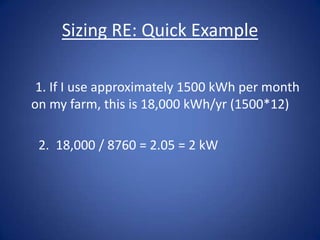
Sizing RE: Quick Example

 1. If I use approximately 1500 kWh per month
on my farm, this is 18,000 kWh/yr (1500*12)

 2. 18,000 / 8760 = 2.05 = 2 kW
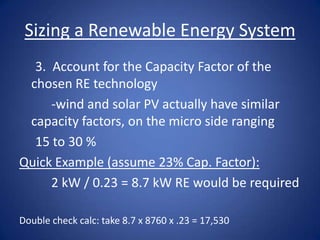
Sizing a Renewable Energy System
  3. Account for the Capacity Factor of the
 chosen RE technology
     -wind and solar PV actually have similar
 capacity factors, on the micro side ranging
  15 to 30 %
Quick Example (assume 23% Cap. Factor):
     2 kW / 0.23 = 8.7 kW RE would be required

Double check calc: take 8.7 x 8760 x .23 = 17,530
Process
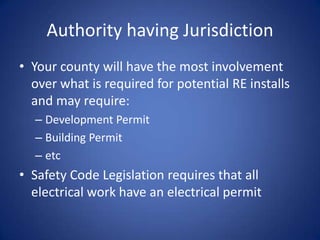
Authority having Jurisdiction
• Your county will have the most involvement
  over what is required for potential RE installs
  and may require:
  – Development Permit
  – Building Permit
  – etc
• Safety Code Legislation requires that all
  electrical work have an electrical permit
Grid Interconnection
• The method of grid interconnection for small
  scale, offset consumption use is applying to be
  a Micro-Generator
• The company that owns the Distribution lines
  that come to your property is the Wire Service
  Provider (WSP). They may do the actual work
  and maintenance of the lines themselves or
  subcontract it.
• The WSP is involved in directly approving
  small Micro-Generators of 10 kW or less
Micro-Generation in Alberta


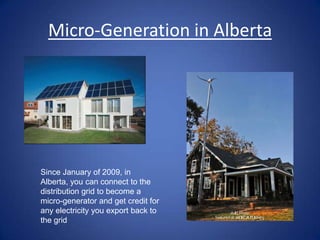
Since January of 2009, in
Alberta, you can connect to the
distribution grid to become a
micro-generator and get credit for
any electricity you export back to
the grid
Micro-Generation in Alberta
• Provides a simplified process for connecting
  your Renewable Energy generator to the grid
• Your project has to qualify by meeting the
  criteria to be a Micro-Generator
• If you meet the safety requirements, you
  cannot be refused connection!
• If you are a small or mini size generator, you
  will be credited for electricity exports at a
  minimum of your retail rate (what you pay)
Micro-Generation in Alberta
• Qualifying:
  – The type of generator (solar PV, wind,
    geothermal, combined heat and power,
    emission based)
  – Intend to offset up to 100% or less of
    annual energy consumption
  – Size of installation (rated kW) is less than
    size of service entrance transformer (with
    kVA being approximately equivalent to kW)
Micro-Generation in Alberta
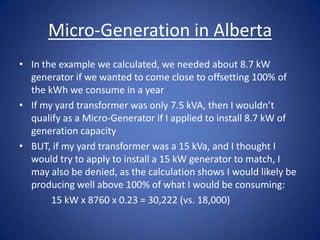
• In the example we calculated, we needed about 8.7 kW
  generator if we wanted to come close to offsetting 100% of
  the kWh we consume in a year
• If my yard transformer was only 7.5 kVA, then I wouldn’t
  qualify as a Micro-Generator if I applied to install 8.7 kW of
  generation capacity
• BUT, if my yard transformer was a 15 kVa, and I thought I
  would try to apply to install a 15 kW generator to match, I
  may also be denied, as the calculation shows I would likely be
  producing well above 100% of what I would be consuming:
       15 kW x 8760 x 0.23 = 30,222 (vs. 18,000)
Purchasing RE Equipment
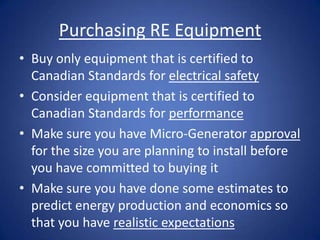
• Buy only equipment that is certified to
  Canadian Standards for electrical safety
• Consider equipment that is certified to
  Canadian Standards for performance
• Make sure you have Micro-Generator approval
  for the size you are planning to install before
  you have committed to buying it
• Make sure you have done some estimates to
  predict energy production and economics so
  that you have realistic expectations
Economics Examples
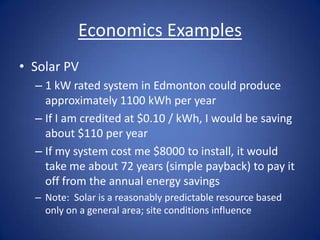
• Solar PV
  – 1 kW rated system in Edmonton could produce
    approximately 1100 kWh per year
  – If I am credited at $0.10 / kWh, I would be saving
    about $110 per year
  – If my system cost me $8000 to install, it would
    take me about 72 years (simple payback) to pay it
    off from the annual energy savings
  – Note: Solar is a reasonably predictable resource based
    only on a general area; site conditions influence
Purchasing RE Equipment
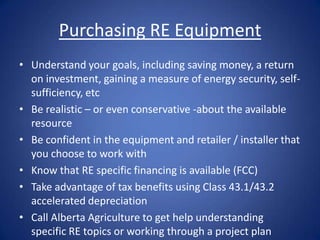
• Understand your goals, including saving money, a return
  on investment, gaining a measure of energy security, self-
  sufficiency, etc
• Be realistic – or even conservative -about the available
  resource
• Be confident in the equipment and retailer / installer that
  you choose to work with
• Know that RE specific financing is available (FCC)
• Take advantage of tax benefits using Class 43.1/43.2
  accelerated depreciation
• Call Alberta Agriculture to get help understanding
  specific RE topics or working through a project plan
Consumer Basics
• Research information on working with
  contractors
  – Advice on how to find out if they are licensed and
    insured – Worker’s Compensation Board coverage
  – Developing a contract that is clear, and fair for all
    parties
  – Warranty issues
Consumer Resources
• Farmers’ Advocate Office
• Carol Goodfellow Assistant Farmers' Advocate
  Land and Energy 780 427-2350
• Graham Gilchrist Assistant Farmers' Advocate
  Rural Affairs 780 427-7956

• http://www.servicealberta.ca/pdf/tipsheets/U
  nfair_Practices_the_Fair_Trading_Act.pdf
Questions?


Kelly Lund, Alberta Agriculture in Edmonton:
         (780) 644-1197 or 310-0000

Consumer Basics for Renewable Energy

  • 1.
    Alberta Agriculture andRural Development Kelly Lund: (780) 644-1197 Ag-Info Line: 310-FARM (3276) Toll Free Line: 310-0000
  • 2.
    Consumer Basics… for RenewableEnergy Small Scale Energy Workshop Nov 30, Beiseker Kelly Lund, AARD, (780) 644-1197
  • 3.
    What should aConsumer know? • Energy Terminology Basics • Technology Basics – Understand the testing and rating system – Manage expectations • Applicable Requirements for your Area – Permits and approvals – Tax Assessments • Consumer and Contract (Legal) Basics
  • 4.
  • 5.
  • 6.
    Energy • Is theability of a physical system to do work – like heating a stove element to cook a pot of soup – like pushing a wheelbarrow to the end of the lane Unit: Joule / kW-h
  • 7.
    Power • Is thetime rate at which work is done or energy is transferred – Heat energy being supplied faster (higher setting) to cook faster – Mechanical energy being supplied faster (walking faster) to move wheelbarrow faster Unit: kW or J/s
  • 8.
    Power Rating • “Rated”or “nominal” is based on testing – Assumes a certain input condition (rpm, meters per second wind speed, W per m^2 solar insolation) so you need to know that assumption • It tells me about the instantaneous ability to do work • Using power (kW or HP) over time is what uses energy… ie: kW-hours or HP-hours
  • 9.
    First Law ofThermodynamics • Conservation of Energy: – Basically states that energy can’t be created or destroyed, merely transformed between forms • Mechanical/kinetic • Electrical • Heat • Etc – There is always a loss of energy in conversion
  • 10.
  • 11.
    RE Equipment • Whenwe buy RE equipment (solar PV, wind, biomass combustion, etc) it will have a nominal Power Rating in kilowatts (kW) just like a vehicle will have a nominal power rating (usually hp), based on some test done at specified conditions
  • 12.
    Capacity Factor • Theamount of time a generator is operating at its rated power • Capacity factor results from a combined effect of the FUEL and the EQUIPMENT
  • 13.
    Capacity factor • 100%capacity factor means it is operating at rated power 100% of the time, ie: all 8760 hrs in a year • 50% capacity factor means it is operating at rated power 50% of the time, • ie: 100% rated power for only 4380 hrs in a year OR • 50% of rated power for all 8760 hrs in a year
  • 14.
    System considerations • Determinetheir system production: • 1. Click on: https://glfc.cfsnet.nfis.org/mapserver/pv/sear ch.php?lang=e&prov=alta 2. Examine the PV Potential chart to find the predicted annual production in kWh. Use the column which says South facing tilt = latitude
  • 15.
    • An Example: Sunnynook, Alberta shows an annual production of 1343kWh production for each 1000 watts of solar modules installed facing south and tilted at an angle equivalent to the latitude. The latitude of Sunnynook is listed under the town name, 51.28 degrees. • As a comparison, Little Smoky, Alberta would have a production rate of 1183kWh at an angle of 54.7 degrees, etc.
  • 17.
    …I’m going solar! •How would you size a Renewable Energy System? • For grid-connected installations, you are most interested in comparing the annual energy production (versus being concerned about peak requirements)
  • 18.
    Sizing a RenewableEnergy System 1. Look at a year’s worth of electricity bills -if there is little month-to-month variation, you might only look at 2 or 3 months worth and multiply to come up with kWh per year 2. Divide the kWh per year by the number of hours in a year (approx 8760) -this would give you the size (kW) of a generator if it were operating 100% of the time, 24/7, for the entire year
  • 19.
    Sizing RE: QuickExample 1. If I use approximately 1500 kWh per month on my farm, this is 18,000 kWh/yr (1500*12) 2. 18,000 / 8760 = 2.05 = 2 kW
  • 20.
    Sizing a RenewableEnergy System 3. Account for the Capacity Factor of the chosen RE technology -wind and solar PV actually have similar capacity factors, on the micro side ranging 15 to 30 % Quick Example (assume 23% Cap. Factor): 2 kW / 0.23 = 8.7 kW RE would be required Double check calc: take 8.7 x 8760 x .23 = 17,530
  • 21.
  • 22.
    Authority having Jurisdiction •Your county will have the most involvement over what is required for potential RE installs and may require: – Development Permit – Building Permit – etc • Safety Code Legislation requires that all electrical work have an electrical permit
  • 23.
    Grid Interconnection • Themethod of grid interconnection for small scale, offset consumption use is applying to be a Micro-Generator • The company that owns the Distribution lines that come to your property is the Wire Service Provider (WSP). They may do the actual work and maintenance of the lines themselves or subcontract it. • The WSP is involved in directly approving small Micro-Generators of 10 kW or less
  • 24.
    Micro-Generation in Alberta SinceJanuary of 2009, in Alberta, you can connect to the distribution grid to become a micro-generator and get credit for any electricity you export back to the grid
  • 25.
    Micro-Generation in Alberta •Provides a simplified process for connecting your Renewable Energy generator to the grid • Your project has to qualify by meeting the criteria to be a Micro-Generator • If you meet the safety requirements, you cannot be refused connection! • If you are a small or mini size generator, you will be credited for electricity exports at a minimum of your retail rate (what you pay)
  • 26.
    Micro-Generation in Alberta •Qualifying: – The type of generator (solar PV, wind, geothermal, combined heat and power, emission based) – Intend to offset up to 100% or less of annual energy consumption – Size of installation (rated kW) is less than size of service entrance transformer (with kVA being approximately equivalent to kW)
  • 27.
    Micro-Generation in Alberta •In the example we calculated, we needed about 8.7 kW generator if we wanted to come close to offsetting 100% of the kWh we consume in a year • If my yard transformer was only 7.5 kVA, then I wouldn’t qualify as a Micro-Generator if I applied to install 8.7 kW of generation capacity • BUT, if my yard transformer was a 15 kVa, and I thought I would try to apply to install a 15 kW generator to match, I may also be denied, as the calculation shows I would likely be producing well above 100% of what I would be consuming: 15 kW x 8760 x 0.23 = 30,222 (vs. 18,000)
  • 28.
    Purchasing RE Equipment •Buy only equipment that is certified to Canadian Standards for electrical safety • Consider equipment that is certified to Canadian Standards for performance • Make sure you have Micro-Generator approval for the size you are planning to install before you have committed to buying it • Make sure you have done some estimates to predict energy production and economics so that you have realistic expectations
  • 29.
    Economics Examples • SolarPV – 1 kW rated system in Edmonton could produce approximately 1100 kWh per year – If I am credited at $0.10 / kWh, I would be saving about $110 per year – If my system cost me $8000 to install, it would take me about 72 years (simple payback) to pay it off from the annual energy savings – Note: Solar is a reasonably predictable resource based only on a general area; site conditions influence
  • 30.
    Purchasing RE Equipment •Understand your goals, including saving money, a return on investment, gaining a measure of energy security, self- sufficiency, etc • Be realistic – or even conservative -about the available resource • Be confident in the equipment and retailer / installer that you choose to work with • Know that RE specific financing is available (FCC) • Take advantage of tax benefits using Class 43.1/43.2 accelerated depreciation • Call Alberta Agriculture to get help understanding specific RE topics or working through a project plan
  • 31.
    Consumer Basics • Researchinformation on working with contractors – Advice on how to find out if they are licensed and insured – Worker’s Compensation Board coverage – Developing a contract that is clear, and fair for all parties – Warranty issues
  • 32.
    Consumer Resources • Farmers’Advocate Office • Carol Goodfellow Assistant Farmers' Advocate Land and Energy 780 427-2350 • Graham Gilchrist Assistant Farmers' Advocate Rural Affairs 780 427-7956 • http://www.servicealberta.ca/pdf/tipsheets/U nfair_Practices_the_Fair_Trading_Act.pdf
  • 33.
    Questions? Kelly Lund, AlbertaAgriculture in Edmonton: (780) 644-1197 or 310-0000