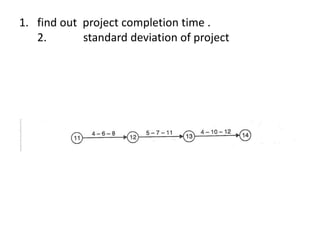
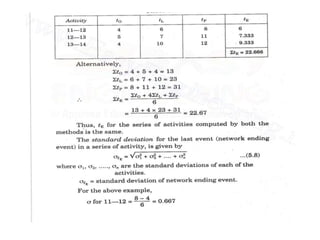
1. find out project completion time .
2. standard deviation of project
Slack (s) :-
• Slack is the time by which occurrence of the event can be
delayed without affecting the scheduled completion time of the
project.
• It is defined as the difference of latest allowable occurrence time
and earliest expected event time for a concerned event.
• S= TL – TE
• Slack can be +ve, -ve or zero.
• Case:1 slack is +ve –
• S > 0 , ( TL > TE )
• +VE Slack for event indicates that it ahead of schedule due
to excess availability of resources to the associated activities.
• Event which has +ve slack called sub- critical event.
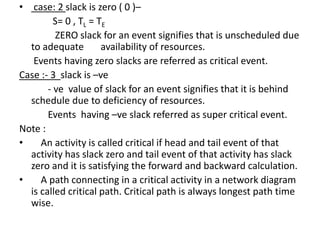
• case: 2 slack is zero ( 0 )–
S= 0 , TL = TE
ZERO slack for an event signifies that is unscheduled due
to adequate availability of resources.
Events having zero slacks are referred as critical event.
Case :- 3 slack is –ve
- ve value of slack for an event signifies that it is behind
schedule due to deficiency of resources.
Events having –ve slack referred as super critical event.
Note :
• An activity is called critical if head and tail event of that
activity has slack zero and tail event of that activity has slack
zero and it is satisfying the forward and backward calculation.
• A path connecting in a critical activity in a network diagram
is called critical path. Critical path is always longest path time
wise.
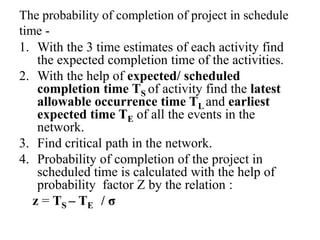
The probability of completion of project in schedule
time -
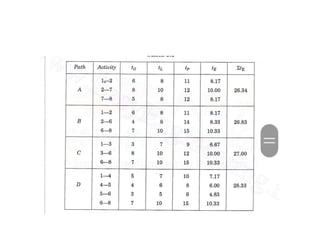
1. With the 3 time estimates of each activity find
the expected completion time of the activities.
2. With the help of expected/ scheduled
completion time TS of activity find the latest
allowable occurrence time TL and earliest
expected time TE of all the events in the
network.
3. Find critical path in the network.
4. Probability of completion of the project in
scheduled time is calculated with the help of
probability factor Z by the relation :
z = TS – TE / σ
construction project management CPM  NOTE 5.pptx

construction project management CPM NOTE 5.pptx

  • 1.
    1. find outproject completion time . 2. standard deviation of project
  • 7.
    Slack (s) :- •Slack is the time by which occurrence of the event can be delayed without affecting the scheduled completion time of the project. • It is defined as the difference of latest allowable occurrence time and earliest expected event time for a concerned event. • S= TL – TE • Slack can be +ve, -ve or zero. • Case:1 slack is +ve – • S > 0 , ( TL > TE ) • +VE Slack for event indicates that it ahead of schedule due to excess availability of resources to the associated activities. • Event which has +ve slack called sub- critical event.
  • 8.
    • case: 2slack is zero ( 0 )– S= 0 , TL = TE ZERO slack for an event signifies that is unscheduled due to adequate availability of resources. Events having zero slacks are referred as critical event. Case :- 3 slack is –ve - ve value of slack for an event signifies that it is behind schedule due to deficiency of resources. Events having –ve slack referred as super critical event. Note : • An activity is called critical if head and tail event of that activity has slack zero and tail event of that activity has slack zero and it is satisfying the forward and backward calculation. • A path connecting in a critical activity in a network diagram is called critical path. Critical path is always longest path time wise.
  • 12.
    The probability ofcompletion of project in schedule time - 1. With the 3 time estimates of each activity find the expected completion time of the activities. 2. With the help of expected/ scheduled completion time TS of activity find the latest allowable occurrence time TL and earliest expected time TE of all the events in the network. 3. Find critical path in the network. 4. Probability of completion of the project in scheduled time is calculated with the help of probability factor Z by the relation : z = TS – TE / σ