Construction Management
1
Players
• Owner – owns project upon completion of
construction
– Private – owner owns land and pays for
construction of facility
• Able to accept/reject bids based on many
parameters including cost, quality, reputation
– Public – owner is government agency, public
pays for facility
• Very strict method of soliciting bids, accepting bids,
writing specs
2
• Design Professionals
– Architects, Engineers, design professionals
• Assist owner in developing plan for facility
• Make sure it is structurally sound
• Make sure all systems, utilities, facilities are
integrated into design
• Responsible for applying for and obtaining all
necessary permits
3
• Contractor
• Contracts to build project to the specs set
forth in the contract for a contracted price
– Contract will subcontract to specialty firms
– Subcontractors may subcontract further
• Project Management
– Acts as owners agent and works with
designers and contractors to insure high
quality and lower cost
4
Construction Project
• Has following characteristics
– Defined goal or objective
– Specific tasks not routinely performed
– Defined beginning and end
– Defined deliverables
– Resources being consumed
5
• To build a project on time and at cost need
a good map to get thru project
– Steps
• Establish project plan/objectives
• Do research into materials and design
• Design, estimate and schedule
• Present design to owner
• Analyze project for viability
• Adjust project plans as needed and go back to
beginning
6
• As the project progresses more
information is known and needs to be
considered
• Good early decisions provide significant
benefits. Ability to influence the project
costs decreases as the project is built
7
Construction Project Categories
• Residential
• Condos, town houses, apartments, single family
homes
• Owners may be development companies or
individual owners
• Fairly low tech
• Building Construction Projects
• Office buildings, large apartment buildings,
shopping malls, theaters
• Dependent on economy
• Designed by architects with engineering support
8
Construction Project Categories
• Heavy Construction
• Roads, bridges, dams, tunnels, water & waste
water systems
• Designed by engineers
• Usually public projects
• Industrial Projects
• Steel mills, petroleum refineries, chemical
processing plants, auto production facilities
• Specialized design and construction
• Limited companies do this work
9
Chronology
• Conceptual Planning
– Owner makes decisions on designers, site,
and project cost and schedule
– Iterative process – add in and delete items to
get desired final product
– Need to gather as much info as possible
• Rehab work uncovers many unknowns
– Permits are started and applications made
– Estimate +/- 25%, Schedule +/- month
10
Chronology
• Schematic Design
– Actual design begins
– Looking at method and materials to use
– Value engineering
– Begin setting up work packages
– Id long lead time items
– Preliminary estimate (+/- 10%) and schedule
are completed
11
Chronology
• Design Development
– Final design phase
– Make system choices based on cost and
schedule
– Prequalification process for bidders
– Contract documents and determination of
work packages – Woodrow Wilson Bridge
– Fair cost estimate and schedule developed
12
Chronology
• Construction
– Mobilization
– Milestones
– Substantial completion
– Punchlist items
– Project Close out
13
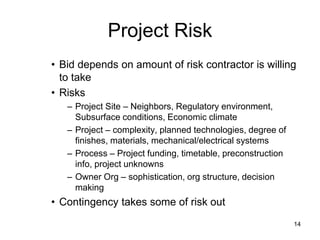
Project Risk
• Bid depends on amount of risk contractor is willing
to take
• Risks
– Project Site – Neighbors, Regulatory environment,
Subsurface conditions, Economic climate
– Project – complexity, planned technologies, degree of
finishes, materials, mechanical/electrical systems
– Process – Project funding, timetable, preconstruction
info, project unknowns
– Owner Org – sophistication, org structure, decision
making
• Contingency takes some of risk out
14
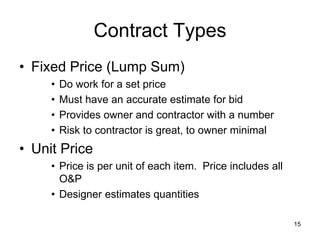
Contract Types
• Fixed Price (Lump Sum)
• Do work for a set price
• Must have an accurate estimate for bid
• Provides owner and contractor with a number
• Risk to contractor is great, to owner minimal
• Unit Price
• Price is per unit of each item. Price includes all
O&P
• Designer estimates quantities
15
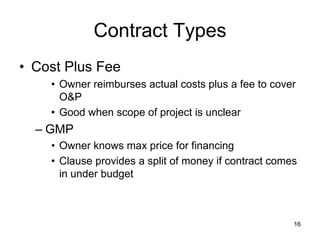
Contract Types
• Cost Plus Fee
• Owner reimburses actual costs plus a fee to cover
O&P
• Good when scope of project is unclear
– GMP
• Owner knows max price for financing
• Clause provides a split of money if contract comes
in under budget
16

Construction Management Lesson - L1.pptx

  • 1.
  • 2.
    Players • Owner –owns project upon completion of construction – Private – owner owns land and pays for construction of facility • Able to accept/reject bids based on many parameters including cost, quality, reputation – Public – owner is government agency, public pays for facility • Very strict method of soliciting bids, accepting bids, writing specs 2
  • 3.
    • Design Professionals –Architects, Engineers, design professionals • Assist owner in developing plan for facility • Make sure it is structurally sound • Make sure all systems, utilities, facilities are integrated into design • Responsible for applying for and obtaining all necessary permits 3
  • 4.
    • Contractor • Contractsto build project to the specs set forth in the contract for a contracted price – Contract will subcontract to specialty firms – Subcontractors may subcontract further • Project Management – Acts as owners agent and works with designers and contractors to insure high quality and lower cost 4
  • 5.
    Construction Project • Hasfollowing characteristics – Defined goal or objective – Specific tasks not routinely performed – Defined beginning and end – Defined deliverables – Resources being consumed 5
  • 6.
    • To builda project on time and at cost need a good map to get thru project – Steps • Establish project plan/objectives • Do research into materials and design • Design, estimate and schedule • Present design to owner • Analyze project for viability • Adjust project plans as needed and go back to beginning 6
  • 7.
    • As theproject progresses more information is known and needs to be considered • Good early decisions provide significant benefits. Ability to influence the project costs decreases as the project is built 7
  • 8.
    Construction Project Categories •Residential • Condos, town houses, apartments, single family homes • Owners may be development companies or individual owners • Fairly low tech • Building Construction Projects • Office buildings, large apartment buildings, shopping malls, theaters • Dependent on economy • Designed by architects with engineering support 8
  • 9.
    Construction Project Categories •Heavy Construction • Roads, bridges, dams, tunnels, water & waste water systems • Designed by engineers • Usually public projects • Industrial Projects • Steel mills, petroleum refineries, chemical processing plants, auto production facilities • Specialized design and construction • Limited companies do this work 9
  • 10.
    Chronology • Conceptual Planning –Owner makes decisions on designers, site, and project cost and schedule – Iterative process – add in and delete items to get desired final product – Need to gather as much info as possible • Rehab work uncovers many unknowns – Permits are started and applications made – Estimate +/- 25%, Schedule +/- month 10
  • 11.
    Chronology • Schematic Design –Actual design begins – Looking at method and materials to use – Value engineering – Begin setting up work packages – Id long lead time items – Preliminary estimate (+/- 10%) and schedule are completed 11
  • 12.
    Chronology • Design Development –Final design phase – Make system choices based on cost and schedule – Prequalification process for bidders – Contract documents and determination of work packages – Woodrow Wilson Bridge – Fair cost estimate and schedule developed 12
  • 13.
    Chronology • Construction – Mobilization –Milestones – Substantial completion – Punchlist items – Project Close out 13
  • 14.
    Project Risk • Biddepends on amount of risk contractor is willing to take • Risks – Project Site – Neighbors, Regulatory environment, Subsurface conditions, Economic climate – Project – complexity, planned technologies, degree of finishes, materials, mechanical/electrical systems – Process – Project funding, timetable, preconstruction info, project unknowns – Owner Org – sophistication, org structure, decision making • Contingency takes some of risk out 14
  • 15.
    Contract Types • FixedPrice (Lump Sum) • Do work for a set price • Must have an accurate estimate for bid • Provides owner and contractor with a number • Risk to contractor is great, to owner minimal • Unit Price • Price is per unit of each item. Price includes all O&P • Designer estimates quantities 15
  • 16.
    Contract Types • CostPlus Fee • Owner reimburses actual costs plus a fee to cover O&P • Good when scope of project is unclear – GMP • Owner knows max price for financing • Clause provides a split of money if contract comes in under budget 16