1
1.0 Introduction
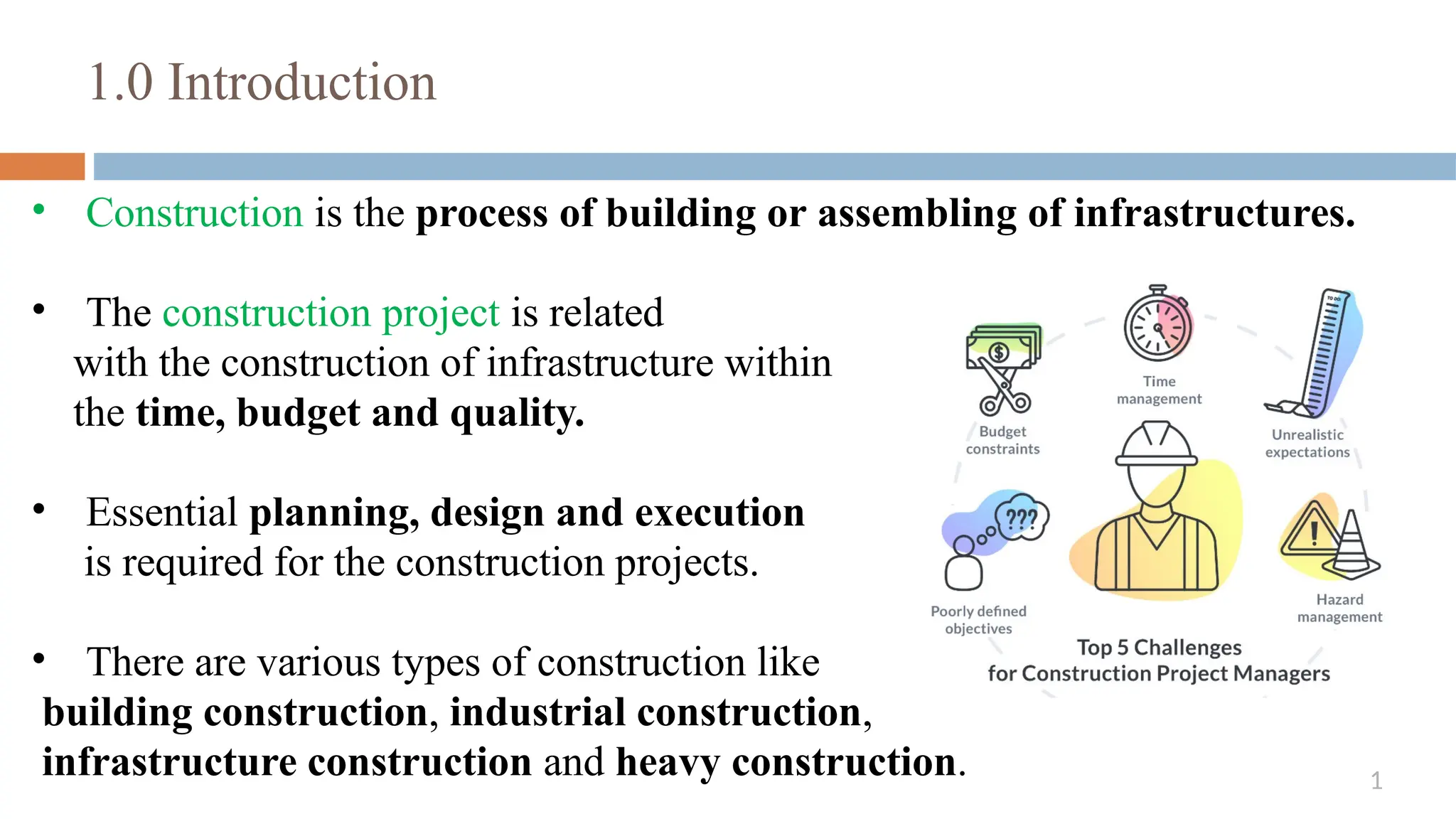
• Constructionis the process of building or assembling of infrastructures.
• The construction project is related
with the construction of infrastructure within
the time, budget and quality.
• Essential planning, design and execution
is required for the construction projects.
• There are various types of construction like
building construction, industrial construction,
infrastructure construction and heavy construction.
2.
2
1.0 Introduction
Classification ofconstruction Industry:
Construction projects can be categorized by nature of construction works,
mode execution, cost and time constraints, the inherent uncertainty.
Based on nature of construction facility, the major construction projects are :
1. Building or light construction : Residential and commercial complexes,
educational and recreational facilities, hospitals and hotels, estates and
offices, warehouse etc.
2. Infrastructure construction project : dam , Cannel, Roadways, Airport,
Transmission line, oil/gas pipe line etc.
3. Industrial construction projects: Steel mills, petroleum refineries, Textile
4. Special purpose construction related projects : environmental works,
emergencies, remedial works,
3.
3
1.1 Construction managementas a discipline
• Construction management is a specialized discipline
within the field of project management that focuses on
planning, coordinating, and overseeing the various
activities involved in construction projects.
• Its primary goal is to ensure that construction projects
are completed on time, within budget, and to the
specified quality standards.
• Construction managers play a crucial role in bridging the
gap between the project's stakeholders, including
owners, designers, contractors, and suppliers, to ensure
a successful project delivery.
4.
4
1.1 Construction managementas a discipline
• Construction management is essential for large
and complex projects, as it helps coordinate the
efforts of various professionals and ensures the
successful completion of projects from start to
finish.
• It requires a combination of technical knowledge,
leadership skills, and the ability to manage
resources effectively.
• Many professionals in this field have
backgrounds in engineering, architecture,
business, or related disciplines.
5.
5
1.1 Construction Managementas a discipline
Key aspects of construction management include
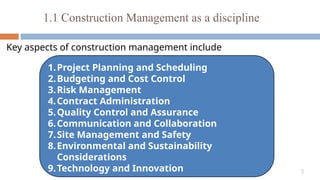
1.Project Planning and Scheduling
2.Budgeting and Cost Control
3.Risk Management
4.Contract Administration
5.Quality Control and Assurance
6.Communication and Collaboration
7.Site Management and Safety
8.Environmental and Sustainability
Considerations
9.Technology and Innovation
6.
6
1.1 Construction Managementas a discipline
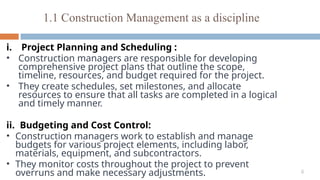
i. Project Planning and Scheduling :
• Construction managers are responsible for developing
comprehensive project plans that outline the scope,
timeline, resources, and budget required for the project.
• They create schedules, set milestones, and allocate
resources to ensure that all tasks are completed in a logical
and timely manner.
ii. Budgeting and Cost Control:
• Construction managers work to establish and manage
budgets for various project elements, including labor,
materials, equipment, and subcontractors.
• They monitor costs throughout the project to prevent
overruns and make necessary adjustments.
7.
7
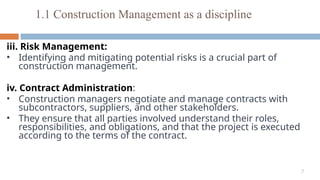
iii. Risk Management:
•Identifying and mitigating potential risks is a crucial part of
construction management.
iv. Contract Administration:
• Construction managers negotiate and manage contracts with
subcontractors, suppliers, and other stakeholders.
• They ensure that all parties involved understand their roles,
responsibilities, and obligations, and that the project is executed
according to the terms of the contract.
1.1 Construction Management as a discipline
8.
8
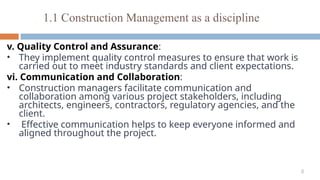
v. Quality Controland Assurance:
• They implement quality control measures to ensure that work is
carried out to meet industry standards and client expectations.
vi. Communication and Collaboration:
• Construction managers facilitate communication and
collaboration among various project stakeholders, including
architects, engineers, contractors, regulatory agencies, and the
client.
• Effective communication helps to keep everyone informed and
aligned throughout the project.
1.1 Construction Management as a discipline
9.
9
vii. Site Managementand Safety:
• Construction managers oversee activities at the construction
site, ensuring that work is carried out safely and efficiently.
• They enforce safety protocols.
viii. Environmental and Sustainability Considerations:
• As sustainability becomes more important in construction,
managers may be involved in implementing environmentally
friendly practices and ensuring projects stick to sustainability
guidelines.
ix. Technology and Innovation:
• Construction management is adapting to technological
advancements, such as project management software, and
remote monitoring tools, which can enhance project efficiency
1.1 Construction Management as a discipline
10.
10
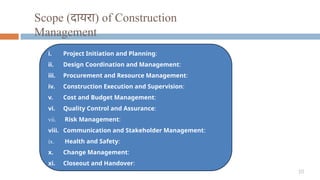
Scope (दायरा) ofConstruction
Management
i. Project Initiation and Planning:
ii. Design Coordination and Management:
iii. Procurement and Resource Management:
iv. Construction Execution and Supervision:
v. Cost and Budget Management:
vi. Quality Control and Assurance:
vii. Risk Management:
viii. Communication and Stakeholder Management:
ix. Health and Safety:
x. Change Management:
xi. Closeout and Handover:
11.
11
Scope of ConstructionManagement
The scope of construction management encompasses a wide
range of responsibilities and activities that cover the entire
lifecycle of a construction project.
The scope of construction management can be broken down into
several key areas:
i. Project Initiation and Planning:
•Defining project objectives, scope, and deliverables.
•Conducting feasibility studies and site assessments.
•Developing project plans, schedules, and budgets.
•Establishing project goals, milestones, and key performance
indicators
12.
12
Scope of ConstructionManagement
ii. Design Coordination and Management:
•Collaborating with architects, engineers, and designers to ensure that
project plans align with client requirements and industry standards.
•Reviewing design documents and identifying potential issues or
conflicts.
•Managing the design review process and incorporating changes as
needed.
iii. Procurement and Resource Management:
•Identifying required materials, equipment, and subcontractors.
•Procuring materials and services in a timely and cost-effective
manner.
13.
13
Scope of ConstructionManagement
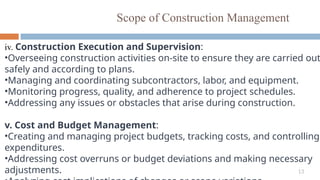
iv. Construction Execution and Supervision:
•Overseeing construction activities on-site to ensure they are carried out
safely and according to plans.
•Managing and coordinating subcontractors, labor, and equipment.
•Monitoring progress, quality, and adherence to project schedules.
•Addressing any issues or obstacles that arise during construction.
v. Cost and Budget Management:
•Creating and managing project budgets, tracking costs, and controlling
expenditures.
•Addressing cost overruns or budget deviations and making necessary
adjustments.
14.
14
Scope of ConstructionManagement
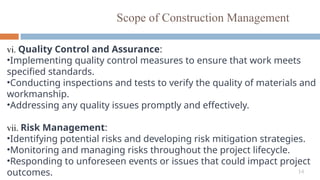
vi. Quality Control and Assurance:
•Implementing quality control measures to ensure that work meets
specified standards.
•Conducting inspections and tests to verify the quality of materials and
workmanship.
•Addressing any quality issues promptly and effectively.
vii. Risk Management:
•Identifying potential risks and developing risk mitigation strategies.
•Monitoring and managing risks throughout the project lifecycle.
•Responding to unforeseen events or issues that could impact project
outcomes.
15.
15
Scope of ConstructionManagement
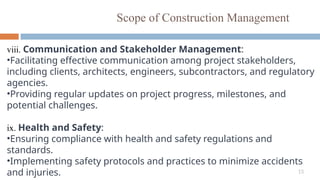
viii. Communication and Stakeholder Management:
•Facilitating effective communication among project stakeholders,
including clients, architects, engineers, subcontractors, and regulatory
agencies.
•Providing regular updates on project progress, milestones, and
potential challenges.
ix. Health and Safety:
•Ensuring compliance with health and safety regulations and
standards.
•Implementing safety protocols and practices to minimize accidents
and injuries.
16.
16
Scope of ConstructionManagement
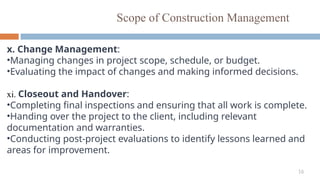
x. Change Management:
•Managing changes in project scope, schedule, or budget.
•Evaluating the impact of changes and making informed decisions.
xi. Closeout and Handover:
•Completing final inspections and ensuring that all work is complete.
•Handing over the project to the client, including relevant
documentation and warranties.
•Conducting post-project evaluations to identify lessons learned and
areas for improvement.
17.
17
1.2 Context (सन्दर्भ)of construction management
• The context of construction management refers to the specific
circumstances, environment, and factors that influence and shape the
practice of construction management within a given project or industry.
• It encompasses (समेट्छ) the unique challenges, opportunities, regulations,
and trends that construction managers must navigate to successfully plan,
execute, and complete construction projects.
• Effective construction managers must have a deep understanding of this
context and be adaptable in their approach to ensure successful project
outcomes.
18.
18
Some key aspectsof the context of construction management:
1.2 Context of construction management
1. Project Type
2. Project Size and Complexity
3. Regulatory and Legal Environment
4. Geographical Considerations
5. Stakeholders and Communication
6. Technological Advancements
7. Sustainability and Environmental
Concerns
8. Labor and Workforce
9. Budget and Funding
10.Market Trends and Economic
Conditions
11.Health and Safety
12.Cultural and Social Factors
19.
19
Project Type: Thenature of the construction project greatly
influences construction management. Residential, commercial,
industrial, infrastructure, and public works projects each have
distinct requirements, codes, regulations, and considerations that
construction managers must address.
Project Size and Complexity: The scale and complexity of a project
impact the construction management approach. Large and complex
projects may require advanced planning, coordination, and
communication strategies.
1.2 Context of construction management
20.
20
Regulatory and LegalEnvironment: Construction projects are
subject to various regulations and codes related to zoning,
building permits, safety standards, environmental impact, and
more. Construction managers need to ensure compliance with
these regulations.
Geographical Considerations: The location of the project can
introduce specific challenges related to climate, topography,
access, and availability of resources. These factors can impact
scheduling, material choices, and overall project logistics.
1.2 Context of construction management
21.
21
Stakeholders and Communication:The number and diversity of
stakeholders, including clients, contractors, architects, engineers,
regulatory agencies, and the public, influence the complexity of
communication and coordination efforts.
Technological Advancements: Emerging technologies,
construction management software, drones, and remote
monitoring tools, are shaping how construction projects are
managed and executed.
Sustainability and Environmental Concerns: Increasing emphasis
on sustainable construction practices and environmental
considerations has led to a shift in how construction projects are
managed, with a focus on minimizing environmental impact and
maximizing resource efficiency.
1.2 Context of construction management
22.
22
Labor and Workforce:Availability of skilled labor, labor unions,
workforce regulations, and demographic trends can impact labor
management and workforce planning.
Budget and Funding: The availability of funds, financing options,
and budget constraints influence decision-making and resource
allocation throughout the project lifecycle.
Market Trends and Economic Conditions: Construction
management strategies may vary based on economic cycles,
market demand, and industry trends. Economic downturns or
upswings can affect project timelines, costs, and resource
availability.
Health and Safety: Occupational health and safety regulations
play a critical role in construction management, impacting work
practices, risk assessment, and safety measures.
1.2 Context of construction management
23.
23
Cultural and SocialFactors: Cultural norms, social expectations,
and community considerations can affect project design,
execution, and community relations.
Client Expectations: Understanding and meeting client
expectations is a fundamental aspect of construction
management. Clear communication and alignment with the client's
vision and goals are essential for project success.
1.2 Context of construction management
24.
24
1.2 Context ofconstruction management
Components of construction management :
Components of construction management is composed of as follows:
1. Physical space
2. Construction materials
3. Machines, equipment and tools
4. Human resources
5. Technology
6. Finance
25.
25
Necessity of constructionmanagement:
1. To effect economy in the cost of construction by adopting new techniques of
construction and supervision (to reduce construction cost).
2. To check the wastage of materials and labors.
3. To arrange the completion of the work in the minimum possible time duration.
4. To improve the quality and speed of work by adopting modern equipment and
machineries
5. To have proper coordination between different agencies (stakeholders) involved
1.2 Context of construction management
26.
26
Construction stakeholders /participants:
The agencies supporting the construction industry include but are not limited to the following:
a. Construction business promoters like government bodies, public and Private enterprises for real estate and industrial
development, and other similar agencies.
b. Construction management consultant firms.
c. Architect/ Engineering associates
d. Construction manpower recruitment and training agencies
e. Construction materials developing, manufacturing, Stoking, transportation and trading firms.
f. Construction plant and machinery manufacturing, distributing and repair and maintenance organizations
g. Banking and financial intuition
h. Risk insurance and legal services companies
i. Construction quality assurance and research and development establishment
j. Contractors and contracting firms
1.2 Context of construction management
27.
27
1.3 Characteristics ofconstruction industry
1. Involvement of many parties in delivering products.
2. Design, construction and maintenance are undertaken by different parties.
3. The products are long lasting and require routine maintenance
4. Difficult to deliver a product because it involves huge amount of information
processing, ambiguities, therefore requires thorough management.
5 Construction products are always initiated by clients, opposite to most of the
industries.
28.
28
1.4 Domestic andGlobal Construction Market
• The first engineering structure to be built in Nepal was an iron bridge over
river Bagmati in 1850.
• The first public water supply system was laid in Kathmandu valley during
1888- 1895.
• The royal palace, the clock tower and the suspension bridge on the river in
Kathmandu were built during these years.
• The first hydro-electric project at Pharphing was completed in 1911.
• The RaxaulAmlekhganj Railway line by M/s Martin and Co. Ltd of Calcutta.
• Dhursingh-Matatirtha Ropeway by M/s Keyner Son and Co. of London, were
constructed in 1926-1927.
29.
29
• Construction activitiesin the country boost up after The First Five Year
Development plan started in 1956
• In 1957 government of Nepal declare construction as the ‘Private sector ’
industry.
• Construction projects like 'Siddhartha Highway', 'Trishuli hydro power', and 'East·
West Highway' etc. were Started in Nepal which were handled by Nepalese
contractors for the first time.
• After the restoration of the parliamentary democracy in 1989, Nepalese
contractors got some favorable condition to develop their capacity and do all
kinds of national construction works as roads, buildings, dams etc. except mega
projects.
1.4 Domestic and Global Construction Market
30.
30
The construction marketin Nepal has been experiencing significant
growth and development in recent years, driven by various factors:
1.Urbanization and Infrastructure Development :
• Rapid urbanization, with a growing population moving to cities
led to increased demand for residential, commercial, and
infrastructure projects, including roads, bridges, airports, and
public facilities.
• Nepal has total potentiality of 83,000 MW Hydro electricity
production. So there is wider scope of hydro electricity market
inside the nation and the possibility of exporting to India as well.
• At present only 4 0 percent of cultivated land is covered by round
the year irrigation. If power supply generation and irrigation is
possible from the same project, it will be beneficial and cost
effective.
1.4 Domestic and Global Construction Market
31.
31
Government Initiatives: governmenthas been investing in large-
scale infrastructure projects to improve connectivity within the
country and with neighboring countries like transportation,
energy.
3. Foreign Investment and Development Projects: Nepal has
been attracting foreign investment for various projects, including
hydropower plants, tourism-related developments, and industrial
zones.
4. Tourism and Hospitality: The tourism industry has led to
demand for hotels, resorts, and other related infrastructure.
Similarly, regional and international airports are the opportunities of the
construction industry in Nepal to boost up tourism industry
5. Post-Earthquake Reconstruction: Nepal was hit by a
devastating earthquake in 2015, which led to a significant effort in
1.4 Domestic and Global Construction Market
32.
32
6. Sustainable Construction:There is a growing awareness of
sustainable and eco-friendly construction practices, particularly in
urban areas.
7. Public Private Partnership in infrastructure development
• The government of Nepal liberalizes its policies after 1980’s.
• Government has released the act related to Build, Operate, Own and Transfer
BOOT Act (PPP)-2063
• Road Sector Policy 1999, BOOT Regulation (PPP) – 2064
• Hydropower Act - 1992, Public Infrastructure Build Operate and Transfer
Policy - 2057
• Private Investment in Infrastructure Build and Operate Ordinance- 2060.
1.4 Domestic and Global Construction Market
33.
33
There is stillsome Opportunity for the contractor through Contractual PPP’ s as:
• Build and Transfer (BT)
• Build, Operate and Transfer (BOT)
• Build, Operate, Own and Transfer (BOOT)
• Build Transfer and Operate (BTO)
• Lease, Operate and Transfer (LOT)
• Develop, Operate and Transfer (DOT)
PPP is regarded as the revolutionary approach towards infrastructure development
which pulling in resources, pulling in expertise, maximizing service delivery,
magnifying scope opportunities and creates the employment Opportunities for the
contractors also.
1.4 Domestic and Global Construction Market
34.
34
Prospective PPP projectsnow in Nepal
• Kathmandu - Terai Fast Track
• East-West Railway
• Kathmandu-Terai Railway
• Kanti Rajpath
• Birgunj-Jitpur Roadway
• Kathmandu Outer Ring Road
• Janakpur-Jayanagar Railway
• Sitapaila-Dharke Roadway
• Airport- Nijgadh, Pokhara, Bhairahawa
• Dry ports
1.4 Domestic and Global Construction Market
• Truck Terminals
• Bus Terminals
• Cable Car and Ropeway
• Road and Infrastructure Maintenance
• Road Intersection
• Sky Bridge
• Sub Way
• Flyovers and Interconnections
• City Parking
35.
35
• It's importantto note that political and economic factors can
influence the construction market in Nepal.
• The country has experienced periods of political instability that
have affected investment and development projects.
1.4 Domestic and Global Construction Market
36.
36
Global Construction Market
•The global construction industry is diverse and dynamic, with
various markets experiencing different levels of growth and
development.
• There are more than 220 top international companies competing with each
other for the global construction tenders.
• In the international market building, transportation and petroleum activity
constitutes the major scope of with building topping the list.
i. The United States has one of the largest construction
industries in the world, encompassing residential, commercial,
infrastructure, and industrial projects.
37.
37
Global Construction Market
Chinahas been a major driver of global construction activity, with
rapid urbanization leading to extensive infrastructure
development, including high-speed rail networks, airports, and
urban expansion.
iii. India's construction industry has been growing steadily, driven
by infrastructure development, urbanization, and affordable
housing initiatives.
iv. European Union have varied Construction markets due to
regional economic conditions. While some Western European
countries focused on renovations and sustainable building
practices, Eastern European nations have been investing in new
infrastructure projects.
v. The Middle East has been known for ambitious construction
projects, particularly in countries like the United Arab Emirates,
38.
38
Global Construction Market
vi.Southeast Asia: Countries like Singapore, Malaysia, and
Thailand have seen substantial infrastructure development and
urban expansion. Southeast Asia's construction market was
buoyed by economic growth, increased foreign investment, and
urbanization.
vii. Australia: Australia's construction industry was marked by
residential construction, infrastructure projects, and mining-
related developments.
viii. African countries were experiencing growth in construction,
with a focus on infrastructure projects such as roads, ports, and
energy facilities. Rapid urbanization was also leading to housing
demand.