Construction Management
and
Entrepreneurship
DEPT. OF CIVIL ENGINEERING. JSSATEB. ABHISHEK R
What is Management?
Management is the organizational process that includes strategic planning, setting objectives,
managing resources, deploying the human and financial assets needed to achieve objectives,
and measuring results. Management also includes recording and storing facts and information
for later use or for others within the organization. Management functions are not limited to
managers and supervisors. Every member of the organization has some management and
reporting functions as part of their job.
DEPT. OF CIVIL ENGINEERING. JSSATEB. ABHISHEK R
Characteristics of Management
Continuous process.
• Continuous planning, organizing, directing and controlling.
Art as well as Science.
• Science teaches to “KNOW” and Art teaches to “DO”
Aims at achieving predetermined objectives.
Factor of production.
• Goals are achieved when resources are effectively co-ordinated by enterprise.
Decision Making.
• Selecting the best among the alternative. Success or failure depends on quality of decision.
DEPT. OF CIVIL ENGINEERING. JSSATEB. ABHISHEK R
Universal Application.
• Principles and concepts of management are applicable to every type of industry. The practice of management is
different from one organisation to another.
Management is needed at all levels.
Aims at maximum profit.
• Effective utilization of resources.
Dynamic.
• Over a period of time new principles, concepts and techniques are developed and adopted.
Management is a discipline, career and profession.
• Field of study having a well defined concepts and principles.
• Marketing Management, Financial Management, Quality Management.
DEPT. OF CIVIL ENGINEERING. JSSATEB. ABHISHEK R
Functions of Management
Planning
Organizing
Staffing
Directing
Controlling
Innovation
Representation
DEPT. OF CIVIL ENGINEERING. JSSATEB. ABHISHEK R
Functions of Management
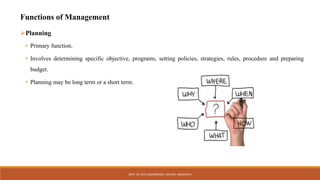
Planning
• Primary function.
• Involves determining specific objective, programs, setting policies, strategies, rules, procedure and preparing
budget.
• Planning may be long term or a short term.
DEPT. OF CIVIL ENGINEERING. JSSATEB. ABHISHEK R
Organizing
• Identification of the activities
• Classification & grouping of activities
• Assignment of duties.
• Delegation of authority & creation of responsibilities.
DEPT. OF CIVIL ENGINEERING. JSSATEB. ABHISHEK R
Staffing
• Managing various position of organization.
• Selecting right person at right position.
• Includes responsibility to recruit such that there is
enough manpower available.
Directing
• Communicating
• Leading
• Motivating
DEPT. OF CIVIL ENGINEERING. JSSATEB. ABHISHEK R
Controlling
• Establishing standards of performance
• Measuring the current performance & comparing it against established
standards.
• Taking action to correct any performance that does not meet those standards.
DEPT. OF CIVIL ENGINEERING. JSSATEB. ABHISHEK R
Innovation
• Creating new ideas which may either result in
development of new products or finding new uses for
old ones.
Representation
• A manager has to act as representative of a company.
• It is the duty of a manager to have a good relationship
with others.
DEPT. OF CIVIL ENGINEERING. JSSATEB. ABHISHEK R
Types of Plans
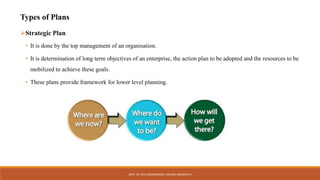
Strategic Plan
• It is done by the top management of an organisation.
• It is determination of long term objectives of an enterprise, the action plan to be adopted and the resources to be
mobilized to achieve these goals.
• These plans provide framework for lower level planning.
DEPT. OF CIVIL ENGINEERING. JSSATEB. ABHISHEK R
Tactical Plan
• Usually developed by middle level mangers to achieve the objectives set in strategic plan.
• Lasts for < 3years.
• Detailing resources & work allocation within each division.
Operational Plan
• They govern day to day operation.
• Single use plan – Developed to achieve a specific goal.
• Standing Plan – For a recurring activity.
DEPT. OF CIVIL ENGINEERING. JSSATEB. ABHISHEK R
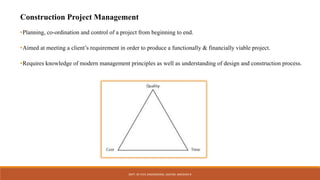
Construction Project Management
•Planning, co-ordination and control of a project from beginning to end.
•Aimed at meeting a client’s requirement in order to produce a functionally & financially viable project.
•Requires knowledge of modern management principles as well as understanding of design and construction process.
DEPT. OF CIVIL ENGINEERING. JSSATEB. ABHISHEK R
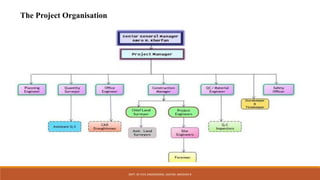
The Project Organisation
DEPT. OF CIVIL ENGINEERING. JSSATEB. ABHISHEK R
Construction Planning & Scheduling
Planning is to set a clear road map and to follow to achieve the goal. And proper scheduling to achieve the
milestone on time.
Planning comprises the breakdown of the whole project into computable, definable and perceptible tasks/activities
and defines the logical interdependences among the activities.
Normally planning answers three main queries: What is to be done? How to do it? Who does it?
Scheduling determines the total duration required for project completion. Which acts as a time table for the
execution of each activity.
This helps to monitor the project and to arrange the requirements (materials, manpower, equipment and cash flow)
for execution of the activities on time
DEPT. OF CIVIL ENGINEERING. JSSATEB. ABHISHEK R
Construction Planning & Scheduling
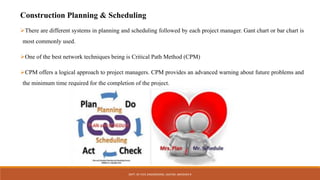
There are different systems in planning and scheduling followed by each project manager. Gant chart or bar chart is
most commonly used.
One of the best network techniques being is Critical Path Method (CPM)
CPM offers a logical approach to project managers. CPM provides an advanced warning about future problems and
the minimum time required for the completion of the project.
DEPT. OF CIVIL ENGINEERING. JSSATEB. ABHISHEK R
Types of Project Plans
Project Feasibility Plan
• Once soundness of idea is convinced.
• Feasibility study team examines the needs of the client and way to fulfil them. It defines the overall scope of
work and breaks it down into various task group.
• Develops the outline plan of work & assess time & cost of accomplishing project.
• This forms the basis for identifying project objectives & developing project plan.
DEPT. OF CIVIL ENGINEERING. JSSATEB. ABHISHEK R
Project Preliminary Plan
• Time schedule and skeleton network to highlight work dependencies project milestone & expected project
completion time.
• Project design & drawing preparation schedule.
• Breakdown of project work into contracts along with schedule of activities, including tender preparation period,
tender finalization period.
• Forecast of resources indicating phased requirement of men, important material & machinery.
• Forecast of fund requirement.
• Staffing.
DEPT. OF CIVIL ENGINEERING. JSSATEB. ABHISHEK R
Project Construction Plan
• Time Plan – Depicts schedule of project.
• Resources Plan – Forecast required resources for completion of project.
• Plan for controlling project – Design of control system, codification system& computerised information.
DEPT. OF CIVIL ENGINEERING. JSSATEB. ABHISHEK R
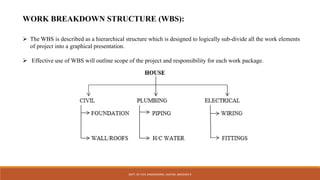
WORK BREAKDOWN STRUCTURE (WBS):
 The WBS is described as a hierarchical structure which is designed to logically sub-divide all the work elements
of project into a graphical presentation.
 Effective use of WBS will outline scope of the project and responsibility for each work package.
DEPT. OF CIVIL ENGINEERING. JSSATEB. ABHISHEK R
GANT CHART
A Gant chart, commonly used in project management, is one of the most popular and useful ways of showing
activities displayed against time.
This allows you to see at a glance,
• What various activities are
• When each activity begins and ends
• How long each activity is scheduled to last
• Where activities overlap with other activities and by how much
• The start and end date of whole project
Planned
Actual
Task name Dec 17 Jan 18 Feb 18 Mar 18 April 18 May 18
Planning
Research
Design
implementation
DEPT. OF CIVIL ENGINEERING. JSSATEB. ABHISHEK R
TERMS AND DEFINITION:
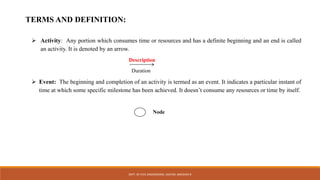
 Activity: Any portion which consumes time or resources and has a definite beginning and an end is called
an activity. It is denoted by an arrow.
Description
Duration
 Event: The beginning and completion of an activity is termed as an event. It indicates a particular instant of
time at which some specific milestone has been achieved. It doesn’t consume any resources or time by itself.
Node
DEPT. OF CIVIL ENGINEERING. JSSATEB. ABHISHEK R
TYPES OF EVENT:
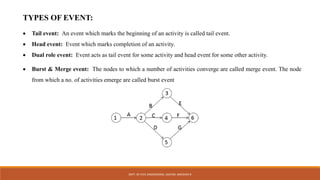
 Tail event: An event which marks the beginning of an activity is called tail event.
 Head event: Event which marks completion of an activity.
 Dual role event: Event acts as tail event for some activity and head event for some other activity.
 Burst & Merge event: The nodes to which a number of activities converge are called merge event. The node
from which a no. of activities emerge are called burst event
DEPT. OF CIVIL ENGINEERING. JSSATEB. ABHISHEK R
INTER-RELATIONSHIP OF EVENTS:
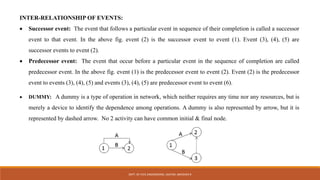
 Successor event: The event that follows a particular event in sequence of their completion is called a successor
event to that event. In the above fig. event (2) is the successor event to event (1). Event (3), (4), (5) are
successor events to event (2).
 Predecessor event: The event that occur before a particular event in the sequence of completion are called
predecessor event. In the above fig. event (1) is the predecessor event to event (2). Event (2) is the predecessor
event to events (3), (4), (5) and events (3), (4), (5) are predecessor event to event (6).
 DUMMY: A dummy is a type of operation in network, which neither requires any time nor any resources, but is
merely a device to identify the dependence among operations. A dummy is also represented by arrow, but it is
represented by dashed arrow. No 2 activity can have common initial & final node.
DEPT. OF CIVIL ENGINEERING. JSSATEB. ABHISHEK R

Construction management

  • 1.
    Construction Management and Entrepreneurship DEPT. OFCIVIL ENGINEERING. JSSATEB. ABHISHEK R
  • 2.
    What is Management? Managementis the organizational process that includes strategic planning, setting objectives, managing resources, deploying the human and financial assets needed to achieve objectives, and measuring results. Management also includes recording and storing facts and information for later use or for others within the organization. Management functions are not limited to managers and supervisors. Every member of the organization has some management and reporting functions as part of their job. DEPT. OF CIVIL ENGINEERING. JSSATEB. ABHISHEK R
  • 3.
    Characteristics of Management Continuousprocess. • Continuous planning, organizing, directing and controlling. Art as well as Science. • Science teaches to “KNOW” and Art teaches to “DO” Aims at achieving predetermined objectives. Factor of production. • Goals are achieved when resources are effectively co-ordinated by enterprise. Decision Making. • Selecting the best among the alternative. Success or failure depends on quality of decision. DEPT. OF CIVIL ENGINEERING. JSSATEB. ABHISHEK R
  • 4.
    Universal Application. • Principlesand concepts of management are applicable to every type of industry. The practice of management is different from one organisation to another. Management is needed at all levels. Aims at maximum profit. • Effective utilization of resources. Dynamic. • Over a period of time new principles, concepts and techniques are developed and adopted. Management is a discipline, career and profession. • Field of study having a well defined concepts and principles. • Marketing Management, Financial Management, Quality Management. DEPT. OF CIVIL ENGINEERING. JSSATEB. ABHISHEK R
  • 5.
  • 6.
    Functions of Management Planning •Primary function. • Involves determining specific objective, programs, setting policies, strategies, rules, procedure and preparing budget. • Planning may be long term or a short term. DEPT. OF CIVIL ENGINEERING. JSSATEB. ABHISHEK R
  • 7.
    Organizing • Identification ofthe activities • Classification & grouping of activities • Assignment of duties. • Delegation of authority & creation of responsibilities. DEPT. OF CIVIL ENGINEERING. JSSATEB. ABHISHEK R
  • 8.
    Staffing • Managing variousposition of organization. • Selecting right person at right position. • Includes responsibility to recruit such that there is enough manpower available. Directing • Communicating • Leading • Motivating DEPT. OF CIVIL ENGINEERING. JSSATEB. ABHISHEK R
  • 9.
    Controlling • Establishing standardsof performance • Measuring the current performance & comparing it against established standards. • Taking action to correct any performance that does not meet those standards. DEPT. OF CIVIL ENGINEERING. JSSATEB. ABHISHEK R
  • 10.
    Innovation • Creating newideas which may either result in development of new products or finding new uses for old ones. Representation • A manager has to act as representative of a company. • It is the duty of a manager to have a good relationship with others. DEPT. OF CIVIL ENGINEERING. JSSATEB. ABHISHEK R
  • 11.
    Types of Plans StrategicPlan • It is done by the top management of an organisation. • It is determination of long term objectives of an enterprise, the action plan to be adopted and the resources to be mobilized to achieve these goals. • These plans provide framework for lower level planning. DEPT. OF CIVIL ENGINEERING. JSSATEB. ABHISHEK R
  • 12.
    Tactical Plan • Usuallydeveloped by middle level mangers to achieve the objectives set in strategic plan. • Lasts for < 3years. • Detailing resources & work allocation within each division. Operational Plan • They govern day to day operation. • Single use plan – Developed to achieve a specific goal. • Standing Plan – For a recurring activity. DEPT. OF CIVIL ENGINEERING. JSSATEB. ABHISHEK R
  • 13.
    Construction Project Management •Planning,co-ordination and control of a project from beginning to end. •Aimed at meeting a client’s requirement in order to produce a functionally & financially viable project. •Requires knowledge of modern management principles as well as understanding of design and construction process. DEPT. OF CIVIL ENGINEERING. JSSATEB. ABHISHEK R
  • 14.
    The Project Organisation DEPT.OF CIVIL ENGINEERING. JSSATEB. ABHISHEK R
  • 15.
    Construction Planning &Scheduling Planning is to set a clear road map and to follow to achieve the goal. And proper scheduling to achieve the milestone on time. Planning comprises the breakdown of the whole project into computable, definable and perceptible tasks/activities and defines the logical interdependences among the activities. Normally planning answers three main queries: What is to be done? How to do it? Who does it? Scheduling determines the total duration required for project completion. Which acts as a time table for the execution of each activity. This helps to monitor the project and to arrange the requirements (materials, manpower, equipment and cash flow) for execution of the activities on time DEPT. OF CIVIL ENGINEERING. JSSATEB. ABHISHEK R
  • 16.
    Construction Planning &Scheduling There are different systems in planning and scheduling followed by each project manager. Gant chart or bar chart is most commonly used. One of the best network techniques being is Critical Path Method (CPM) CPM offers a logical approach to project managers. CPM provides an advanced warning about future problems and the minimum time required for the completion of the project. DEPT. OF CIVIL ENGINEERING. JSSATEB. ABHISHEK R
  • 17.
    Types of ProjectPlans Project Feasibility Plan • Once soundness of idea is convinced. • Feasibility study team examines the needs of the client and way to fulfil them. It defines the overall scope of work and breaks it down into various task group. • Develops the outline plan of work & assess time & cost of accomplishing project. • This forms the basis for identifying project objectives & developing project plan. DEPT. OF CIVIL ENGINEERING. JSSATEB. ABHISHEK R
  • 18.
    Project Preliminary Plan •Time schedule and skeleton network to highlight work dependencies project milestone & expected project completion time. • Project design & drawing preparation schedule. • Breakdown of project work into contracts along with schedule of activities, including tender preparation period, tender finalization period. • Forecast of resources indicating phased requirement of men, important material & machinery. • Forecast of fund requirement. • Staffing. DEPT. OF CIVIL ENGINEERING. JSSATEB. ABHISHEK R
  • 19.
    Project Construction Plan •Time Plan – Depicts schedule of project. • Resources Plan – Forecast required resources for completion of project. • Plan for controlling project – Design of control system, codification system& computerised information. DEPT. OF CIVIL ENGINEERING. JSSATEB. ABHISHEK R
  • 20.
    WORK BREAKDOWN STRUCTURE(WBS):  The WBS is described as a hierarchical structure which is designed to logically sub-divide all the work elements of project into a graphical presentation.  Effective use of WBS will outline scope of the project and responsibility for each work package. DEPT. OF CIVIL ENGINEERING. JSSATEB. ABHISHEK R
  • 21.
    GANT CHART A Gantchart, commonly used in project management, is one of the most popular and useful ways of showing activities displayed against time. This allows you to see at a glance, • What various activities are • When each activity begins and ends • How long each activity is scheduled to last • Where activities overlap with other activities and by how much • The start and end date of whole project Planned Actual Task name Dec 17 Jan 18 Feb 18 Mar 18 April 18 May 18 Planning Research Design implementation DEPT. OF CIVIL ENGINEERING. JSSATEB. ABHISHEK R
  • 22.
    TERMS AND DEFINITION: Activity: Any portion which consumes time or resources and has a definite beginning and an end is called an activity. It is denoted by an arrow. Description Duration  Event: The beginning and completion of an activity is termed as an event. It indicates a particular instant of time at which some specific milestone has been achieved. It doesn’t consume any resources or time by itself. Node DEPT. OF CIVIL ENGINEERING. JSSATEB. ABHISHEK R
  • 23.
    TYPES OF EVENT: Tail event: An event which marks the beginning of an activity is called tail event.  Head event: Event which marks completion of an activity.  Dual role event: Event acts as tail event for some activity and head event for some other activity.  Burst & Merge event: The nodes to which a number of activities converge are called merge event. The node from which a no. of activities emerge are called burst event DEPT. OF CIVIL ENGINEERING. JSSATEB. ABHISHEK R
  • 24.
    INTER-RELATIONSHIP OF EVENTS: Successor event: The event that follows a particular event in sequence of their completion is called a successor event to that event. In the above fig. event (2) is the successor event to event (1). Event (3), (4), (5) are successor events to event (2).  Predecessor event: The event that occur before a particular event in the sequence of completion are called predecessor event. In the above fig. event (1) is the predecessor event to event (2). Event (2) is the predecessor event to events (3), (4), (5) and events (3), (4), (5) are predecessor event to event (6).  DUMMY: A dummy is a type of operation in network, which neither requires any time nor any resources, but is merely a device to identify the dependence among operations. A dummy is also represented by arrow, but it is represented by dashed arrow. No 2 activity can have common initial & final node. DEPT. OF CIVIL ENGINEERING. JSSATEB. ABHISHEK R