CONSTRACTION EQUIPMENT
Presented By:- Er ROHAN V.MISTRI
[Building Construction Technology]
A1 : EXCAVATORS
INTRODUCTION
 It is a common fact that we find a wide variety of
construction machines on every construction sites,
which make the construction jobs easy, safe and
quicker.
 Depending on the application, construction machines are
classified into various categories which we are discussing
here.
 A. Earthmoving equipments
 B. Construction vehicles
 C. Material handling equipments
 D. Construction equipments
GROUP A : EARTHMOVING EQUIPMENTS
 Earthmoving equipment is used in the construction
industry to :
-shift large amounts of earth.
-dig foundations and landscape areas.
A1 : EXCAVATORS
 Excavators are heavy construction equipment consisting of a boom,
stick, bucket and cab on a rotating platform (known as the "house").
 The house sits atop an undercarriage with tracks or wheels.
 Excavators are also called diggers
 Excavators are used in many ways:
1. Digging of trenches, holes, foundations
2. Material handling
3. General grading/landscaping
4. Heavy lift, e.g. lifting and placing of pipes
5. Mining, especially, but not only open-pit mining
6. River dredging
7. Demolition
8. Etc.
A1 : EXCAVATORS
A2 : LOADERS
 A loader is a heavy equipment machine often used in
construction, primarily used to Load material (such as
asphalt, demolition debris, dirt, snow, feed, gravel,
logs, raw minerals, recycled material, rock, sand, and
woodchips) into or onto another type of machinery
(such as a dump truck, conveyor belt, feed- hopper, or
railcar).
LOADERS:-
A3 : SKID STEER LOADERS
 A skid loader or skid-steer loader is a small rigid
frame, engine-powered machine with lift arms
used to attach a wide variety of labor-saving tools
or attachments.
 Though sometimes they are equipped with tracks,
skid- steer loaders are typically four-wheel
vehicles with the wheels mechanically locked in
synchronization on each side, and the left-side
drive wheels can be driven independently of the
right- side drive wheels.
SKID STEER LOADERS:-
GROUP B : CONSTRUCTION VEHICLES
 Engineering or Construction vehicles are heavy-duty
vehicles, specially designed for executing construction
(Civil engineering) tasks, most frequently, ones involving
earth moving.
B1 : DUMPERS
 A dumper is a vehicle designed for carrying bulk
material, often on building sites. Dumpers are
distinguished from dump trucks by configuration: a
dumper is usually an open 4-wheeled vehicle with the
load skip in front of the driver, while a dump truck has
its cab in front of the load.
B1 : DUMPERS
B1 :DUMPERS:-
 The skip can tip to
dump the load; this is
where the name comes
"dumper" came from.
 They are normally
diesel powered.
B3 :TRAILERS:-
 A trailer is generally an unpowered
vehicle pulled by a powered vehicle.
 Commonly, the term
trailer refers to such
vehicles used for
transport of goods and
mate.
B3 :TRAILERS:-
GROUP C :MATERIAL HANDLING EQUIPMENTS
• Material Handling equipments Used For The Movement,
Storage, Control And Protection Of Materials, Goods And
Products Throughout The Process Of Manufacturing,
Distribution, Consumption And Disposal.
C1 :CRANES:-
 It uses one or more simple
machines to create
mechanical advantage and
thus move loads beyond the
normal capability of a man.
 Cranes are commonly
employed in the transport
industry for the loading and
unloading of freight, in the
construction industry for the
movement of materials and in
the manufacturing industry
for the assembling of heavy
equipment.
C2 :CONVEYORS:-
 A conveyor system is a common piece
of mechanical handling equipment that
moves materials from one to another.
location Conveyors are especially
useful in applications involving the
transportation of heavy or bulky
materials.
 Conveyor systems allow quick and
allow efficient transportation for a
wide variety of materials,
CONVEYORS:-
`
C3 :FORKLIFTS:-
A forklift truck (also called a
lift truck, a fork truck, a
forklift, or a tow-motor) is
a powered industrial truck
used to lift and transport
materials.
FORKLIFTS:-
GROUP D :CONSTRUCTION EQUIPMENTS
 Construction equipments have been classified in various
ways. The classification could be on the basis of the
function an equipment performs-for example,
materialloading function, material-transporting function,
etc. I
D1 :TUNNELING ANDHANDLING EQUIPMENTS
 A tunnel boring machine (TBM) also
known as a "mole", is a machine used
to excavate tunnels with a circular
cross section through a variety of soil
and rock strata.
 They can bore through anything from
hard rock to sand.
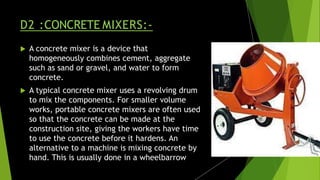
D2 :CONCRETE MIXERS:-
 A concrete mixer is a device that
homogeneously combines cement, aggregate
such as sand or gravel, and water to form
concrete.
 A typical concrete mixer uses a revolving drum
to mix the components. For smaller volume
works, portable concrete mixers are often used
so that the concrete can be made at the
construction site, giving the workers have time
to use the concrete before it hardens. An
alternative to a machine is mixing concrete by
hand. This is usually done in a wheelbarrow
CONCRETE MIXERS:-
D3 :COMPACTORS
 A compactor is a machine ormechanism
used to reduce the size of waste material
or soil through compaction.
 There are following types of compactors
1. Pneumatic tyred Rollar
2. Smooth Wheeled Roller
3. Sheepsfoot roller Roller
4. Track laying vehicle
Pneumatic tyred Rollar:-
Smooth Wheeled Roller:-
Sheepsfoot roller Roller:-
Track laying vehicle:-
THANK YOU

Construction Eqiupment

  • 1.
    CONSTRACTION EQUIPMENT Presented By:-Er ROHAN V.MISTRI [Building Construction Technology] A1 : EXCAVATORS
  • 2.
    INTRODUCTION  It isa common fact that we find a wide variety of construction machines on every construction sites, which make the construction jobs easy, safe and quicker.  Depending on the application, construction machines are classified into various categories which we are discussing here.  A. Earthmoving equipments  B. Construction vehicles  C. Material handling equipments  D. Construction equipments
  • 3.
    GROUP A :EARTHMOVING EQUIPMENTS  Earthmoving equipment is used in the construction industry to : -shift large amounts of earth. -dig foundations and landscape areas.
  • 4.
    A1 : EXCAVATORS Excavators are heavy construction equipment consisting of a boom, stick, bucket and cab on a rotating platform (known as the "house").  The house sits atop an undercarriage with tracks or wheels.  Excavators are also called diggers  Excavators are used in many ways: 1. Digging of trenches, holes, foundations 2. Material handling 3. General grading/landscaping 4. Heavy lift, e.g. lifting and placing of pipes 5. Mining, especially, but not only open-pit mining 6. River dredging 7. Demolition 8. Etc.
  • 5.
  • 6.
    A2 : LOADERS A loader is a heavy equipment machine often used in construction, primarily used to Load material (such as asphalt, demolition debris, dirt, snow, feed, gravel, logs, raw minerals, recycled material, rock, sand, and woodchips) into or onto another type of machinery (such as a dump truck, conveyor belt, feed- hopper, or railcar).
  • 7.
  • 8.
    A3 : SKIDSTEER LOADERS  A skid loader or skid-steer loader is a small rigid frame, engine-powered machine with lift arms used to attach a wide variety of labor-saving tools or attachments.  Though sometimes they are equipped with tracks, skid- steer loaders are typically four-wheel vehicles with the wheels mechanically locked in synchronization on each side, and the left-side drive wheels can be driven independently of the right- side drive wheels.
  • 9.
  • 10.
    GROUP B :CONSTRUCTION VEHICLES  Engineering or Construction vehicles are heavy-duty vehicles, specially designed for executing construction (Civil engineering) tasks, most frequently, ones involving earth moving.
  • 11.
    B1 : DUMPERS A dumper is a vehicle designed for carrying bulk material, often on building sites. Dumpers are distinguished from dump trucks by configuration: a dumper is usually an open 4-wheeled vehicle with the load skip in front of the driver, while a dump truck has its cab in front of the load.
  • 12.
  • 13.
    B1 :DUMPERS:-  Theskip can tip to dump the load; this is where the name comes "dumper" came from.  They are normally diesel powered.
  • 14.
    B3 :TRAILERS:-  Atrailer is generally an unpowered vehicle pulled by a powered vehicle.  Commonly, the term trailer refers to such vehicles used for transport of goods and mate.
  • 15.
  • 16.
    GROUP C :MATERIALHANDLING EQUIPMENTS • Material Handling equipments Used For The Movement, Storage, Control And Protection Of Materials, Goods And Products Throughout The Process Of Manufacturing, Distribution, Consumption And Disposal.
  • 17.
    C1 :CRANES:-  Ituses one or more simple machines to create mechanical advantage and thus move loads beyond the normal capability of a man.  Cranes are commonly employed in the transport industry for the loading and unloading of freight, in the construction industry for the movement of materials and in the manufacturing industry for the assembling of heavy equipment.
  • 18.
    C2 :CONVEYORS:-  Aconveyor system is a common piece of mechanical handling equipment that moves materials from one to another. location Conveyors are especially useful in applications involving the transportation of heavy or bulky materials.  Conveyor systems allow quick and allow efficient transportation for a wide variety of materials,
  • 19.
  • 20.
    C3 :FORKLIFTS:- A forklifttruck (also called a lift truck, a fork truck, a forklift, or a tow-motor) is a powered industrial truck used to lift and transport materials.
  • 21.
  • 22.
    GROUP D :CONSTRUCTIONEQUIPMENTS  Construction equipments have been classified in various ways. The classification could be on the basis of the function an equipment performs-for example, materialloading function, material-transporting function, etc. I
  • 23.
    D1 :TUNNELING ANDHANDLINGEQUIPMENTS  A tunnel boring machine (TBM) also known as a "mole", is a machine used to excavate tunnels with a circular cross section through a variety of soil and rock strata.  They can bore through anything from hard rock to sand.
  • 24.
    D2 :CONCRETE MIXERS:- A concrete mixer is a device that homogeneously combines cement, aggregate such as sand or gravel, and water to form concrete.  A typical concrete mixer uses a revolving drum to mix the components. For smaller volume works, portable concrete mixers are often used so that the concrete can be made at the construction site, giving the workers have time to use the concrete before it hardens. An alternative to a machine is mixing concrete by hand. This is usually done in a wheelbarrow
  • 25.
  • 26.
    D3 :COMPACTORS  Acompactor is a machine ormechanism used to reduce the size of waste material or soil through compaction.  There are following types of compactors 1. Pneumatic tyred Rollar 2. Smooth Wheeled Roller 3. Sheepsfoot roller Roller 4. Track laying vehicle
  • 27.
  • 28.
  • 29.
  • 30.
  • 31.