Construction collaboration: from pre-Web to Web 1.0, to Web 2.0 and beyond …. by Paul Wilkinson (pwcom.co.uk)
Who is Paul Wilkinson? Introducing construction collaboration technologies Development of the UK market Benefits of online collaboration – NCCTP research 2006 Overcoming resistance New directions for collaboration beyond file-sharing (eg: process management, financial control, mobile working) The ‘I’ in BIM the SaaS (Software-as-a-Service) revolution Web 2.0 (and 3.0) Summary PROCESSES NEXT? COLLABORATION 1.0 PEOPLE TECHNOLOGIES AGENDA
Who am I? worked in construction industry since 1987 in-house: Halcrow, Tarmac/Carillion, BIW current/recent clients: BIW, Constructing Excellence, 4Projects, Incite, Slider Studio, tCn, Woobius  author of book on construction  collaboration technologies (2005) Wikipedian (2003), blogger (2005),  Tweeter (2008) PROCESSES NEXT? COLLABORATION 1.0 PEOPLE TECHNOLOGIES AGENDA
Face-to-face Written word Hand drawings Telephone Telegram Telex Fax CAD Email Groupware (eg: Lotus Notes) File transfer protocol (FTP) Websites Intranets, enterprise portals Video- and tele-conferencing Extranets Web-conferencing applications File-sharing (P2P) Instant messaging Discussion forums Wikis Blogs RSS Social networking Social search, tagging, sharing Mashups: Mapping, time-lines, etc Virtual worlds Cloud computing PROCESSES NEXT? COLLABORATION 1.0 PEOPLE TECHNOLOGIES AGENDA Web 2.0 BIM SaaS
PROCESSES NEXT? COLLABORATION 1.0 PEOPLE TECHNOLOGIES AGENDA
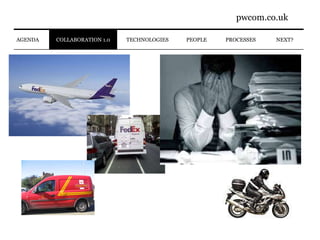
Specs Drawings Minutes Programmes Cost plans correspondence etc Email Fax Courier Post (CD, paper) Traditionally… PROCESSES NEXT? COLLABORATION 1.0 PEOPLE TECHNOLOGIES AGENDA
PROCESSES NEXT? COLLABORATION 1.0 PEOPLE TECHNOLOGIES AGENDA
Traditional AEC collaboration: issues Incompatible IT = unreadable data = heavy reliance on paper Extensive – and expensive – production of paper Email overload No single version of ‘the truth’ ‘ Islands’ of information Poor security Low transparency of information, opaque processes No complete project record, no audit trail, risk of disputes/litigation Low quantity/quality of information for FM or O&M purposes PROCESSES NEXT? COLLABORATION 1.0 PEOPLE TECHNOLOGIES AGENDA
Fewer interoperability issues Less paper Latest information available to all Complete record of project Full information audit trail Single central repository of information Greater re-use of information  (eg: for H&S File, standards, tendering, defects mgmt, O&M, etc) What does it look like…? So collaborate! PROCESSES NEXT? COLLABORATION 1.0 PEOPLE TECHNOLOGIES AGENDA


PROCESSES NEXT? COLLABORATION 1.0 PEOPLE TECHNOLOGIES AGENDA
Technology issues (1): Standards a la “Betamax or VHS”?  Interoperability Cost do we need new hardware/software  (eg: CAD)? new telecoms links? printing costs pushed down supply chain? clients might expect lower fees?  Training Implementation PROCESSES NEXT? COLLABORATION 1.0 PEOPLE TECHNOLOGIES AGENDA
Technology issues (2): Industry slow to adopt new technology Legal status of electronic communication Contractual relationships with technology provider ASP service interruption or unforeseen termination Preference for paper Copyright, archive concerns Suspicion/fear re web-based or web-enabled technologies Security  – hacking, viruses Reliability  – 24/7 access, backup Too transparent  (threat to old-style attitudes) ‘ Dot.com doubt’ – re ASP/SaaS/on-demand providers Too many suppliers Who will survive? PROCESSES NEXT? COLLABORATION 1.0 PEOPLE TECHNOLOGIES AGENDA
Mid 1990s first experiments with project websites Late 1990s project websites used to host documents and drawings 2000 Dot.com boom … and bust! 2000-2002 internet faith low; slow growth for survivors 2003-2005 increased internet faith; more sustained growth; web-based collaboration becoming normal 2008-2009 Recession and the rise of low-cost solutions 2010- Collaboration - so what? What next? PROCESSES NEXT? COLLABORATION 1.0 PEOPLE TECHNOLOGIES AGENDA
PROCESSES NEXT? COLLABORATION 1.0 PEOPLE TECHNOLOGIES AGENDA
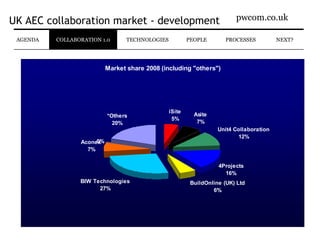
UK market UK AEC collaboration market - development PROCESSES NEXT? COLLABORATION 1.0 PEOPLE TECHNOLOGIES AGENDA Market share Sophistication/functionality 4Projects Aconex BIW Asite Buzzsaw CTSpace Unit4 Cadweb Causeway ePIN ProjectWise Sarcophagus Woobius Union Square iSite Collabor8online CloudsUK StickyWorld
UK AEC collaboration market - development PROCESSES NEXT? COLLABORATION 1.0 PEOPLE TECHNOLOGIES AGENDA
What are the benefits? Market research conducted April-May 2006 User views (not vendor hype) PROCESSES NEXT? COLLABORATION 1.0 PEOPLE TECHNOLOGIES AGENDA
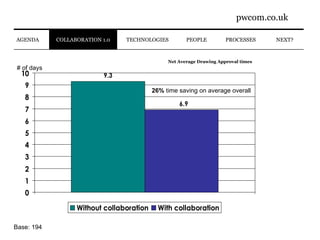
Net Average Drawing Approval times Base: 194 # of days 26%  time saving on average overall PROCESSES NEXT? COLLABORATION 1.0 PEOPLE TECHNOLOGIES AGENDA
Main benefits experienced in project management, communications and team working… Base: 272 PROCESSES NEXT? COLLABORATION 1.0 PEOPLE TECHNOLOGIES AGENDA
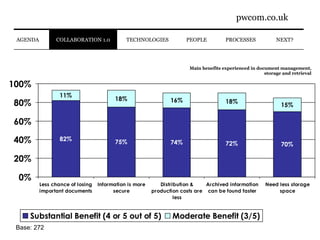
Main benefits experienced in document management, storage and retrieval Base: 272 PROCESSES NEXT? COLLABORATION 1.0 PEOPLE TECHNOLOGIES AGENDA
Main benefits experienced in hand-over, commissioning,  operations and maintenance Base: 105 involved with this phase of projects PROCESSES NEXT? COLLABORATION 1.0 PEOPLE TECHNOLOGIES AGENDA
96% feel they benefit from using the technology Client preference for contractors who are willing to work with or have experience of the technology Several benefits are widely accepted/associated with the technology  (following seen as substantial by 80%+ of users): Documents can be accessed 24/7 Project information available centrally Less money spent on couriers/post Less chance of losing important documents Better audit trail PROCESSES NEXT? COLLABORATION 1.0 PEOPLE TECHNOLOGIES AGENDA
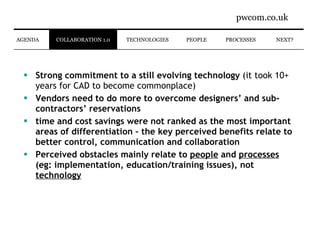
Strong commitment to a still evolving technology  (it took 10+ years for CAD to become commonplace) Vendors need to do more to overcome designers’ and sub-contractors’ reservations time and cost savings were not ranked as the most important areas of differentiation – the key perceived benefits relate to better control, communication and collaboration Perceived obstacles mainly relate to  people  and  processes  (eg: implementation, education/training issues), not  technology PROCESSES NEXT? COLLABORATION 1.0 PEOPLE TECHNOLOGIES AGENDA
Construction collaboration technologies People, processes (80%) and technology (20%) Barriers to adoption: Resistance to principle of collaborative working Resistance to adoption of new technology Overcoming resistance
How will we get there? PROCESSES NEXT? COLLABORATION 1.0 PEOPLE TECHNOLOGIES AGENDA
internet technologies EDMS, FTP, file-sharing, Web 1.0 BIM, Web 2.0, Web 3.0 PROCESSES NEXT? COLLABORATION 1.0 PEOPLE TECHNOLOGIES AGENDA
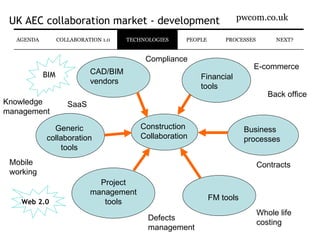
Construction Collaboration Financial tools Business processes CAD/BIM vendors Generic collaboration tools Project management tools FM tools E-commerce Back office Mobile working Contracts Whole life costing Defects management SaaS UK AEC collaboration market - development PROCESSES NEXT? COLLABORATION 1.0 PEOPLE TECHNOLOGIES AGENDA Compliance Knowledge management Web 2.0 BIM
Less about file storage/exchange More about key business processes Move beyond simple processes (eg: RFIs, change orders, transmittals, etc) ‘ Collaboration-plus’ Corporate standards (eg: standard designs, specs) Health and safety management (eg: non-conformance reports) Procurement (ie: e-tendering) Project financial control Quality control (defects/snagging – mobile solutions) Contract change management Facilities management support Development of UK market: ‘collaboration-plus’ PROCESSES NEXT? COLLABORATION 1.0 PEOPLE TECHNOLOGIES AGENDA
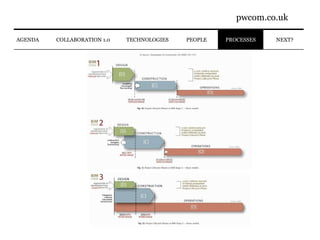
Shift from CAD to BIM “ CAD helps people to draw. BIM helps people to construct.”  (Richard Saxon, Ecobuild, February 2009) “ BIM is not CAD. BIM was never meant to be CAD. CAD is a replacement for pen and paper, a documentation tool.”  ( Pete  Zyskowski ,  Cadalyst ) PROCESSES NEXT? PEOPLE AGENDA COLLABORATION 1.0 TECHNOLOGIES
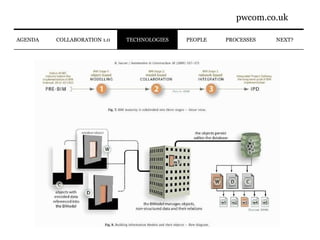
PROCESSES NEXT? PEOPLE AGENDA COLLABORATION 1.0 TECHNOLOGIES
PROCESSES NEXT? PEOPLE AGENDA COLLABORATION 1.0 TECHNOLOGIES http://shop.bsigroup.com/Browse-by-Sector/Building--Construction/Building-Information-Modelling/
Collaboration: to manage the ‘I’ in BIM, “the ins and outs of BIM” – the drawings, the workflows PROCESSES NEXT? PEOPLE AGENDA COLLABORATION 1.0 TECHNOLOGIES
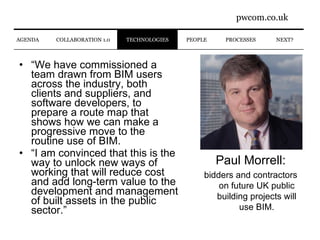
“ We have commissioned a team drawn from BIM users across the industry, both clients and suppliers, and software developers, to prepare a route map that shows how we can make a progressive move to the routine use of BIM. “ I am convinced that this is the way to unlock new ways of working that will reduce cost and add long-term value to the development and management of built assets in the public sector.” PROCESSES NEXT? PEOPLE AGENDA COLLABORATION 1.0 TECHNOLOGIES Paul Morrell: bidders and contractors on future UK public building projects will use BIM.
What is Web 2.0? the use of web technologies and web design to enhance creativity, information sharing, and, most notably, collaboration among users. Not:  one-way, a monologue, received-only Two-way, conversational, participative, active PROCESSES NEXT? PEOPLE AGENDA COLLABORATION 1.0 TECHNOLOGIES
Discussion forums Building Constructing Excellence Home pages Static to configurable iGoogle , Google Alerts Wikis Open -  Wikipedia Organisation -  RIBApedia Internal - Fielden Clegg Bradley Blogs Personal but work-related – eg:  ExtranetEvolution.com Corporate – eg:  SaaStainability.com Media tool – eg:  Brickonomics Micro-blogging – Twitter:  personal ,  corporate ,  media PROCESSES NEXT? PEOPLE AGENDA COLLABORATION 1.0 TECHNOLOGIES “ Wisdom of crowds”
RSS Feed-readers (local or web-based:  Newsgator ,  Google Reader , etc) RSS publishing (from bloggers, media, corporate) Social networking From personal (MySpace, Bebo, Facebook) … …  to professional ( Facebook ,  LinkedIn , Ning) Social search ( Wikia ) Social tagging and sharing ( Del.icio.us , Digg, etc) Sharing: Voice over IP – Skype Calendar – Google Calendar Slides – SlideShare; Photos –  Flickr ; Video –  YouTube Stuff –  Freecycle Mashups: Mapping (Google Maps), time-lines ( Dipity ) Virtual worlds – eg: Second Life PROCESSES NEXT? PEOPLE AGENDA COLLABORATION 1.0 TECHNOLOGIES
internet technologies EDMS, FTP, file-sharing, Web 1.0 Web 2.0, BIM, Web 3.0 hardware & software static, office-based, internal mobile, SaaS, cloud computing PROCESSES NEXT? PEOPLE AGENDA COLLABORATION 1.0 TECHNOLOGIES
PROCESSES NEXT? PEOPLE AGENDA COLLABORATION 1.0 TECHNOLOGIES
For example: Woobius Eye – mobile, real-time augmented reality, location-specific PROCESSES NEXT? PEOPLE AGENDA COLLABORATION 1.0 TECHNOLOGIES
internet technologies EDMS, FTP, file-sharing, Web 1.0 Web 2.0, BIM, Web 3.0 hardware & software static, office-based, internal mobile, SaaS PROCESSES NEXT? COLLABORATION 1.0 PEOPLE TECHNOLOGIES AGENDA industry attitudes contractual, price-driven collaborative, sharing, ‘ best value’ focus
People and processes (1): industry attitudes to collaboration Conservative Slow to change  - inertia Very fragmented  – danger: preach to the converted only, while majority continue with old approaches Focused on delivery , not ‘whole life’ People and processes (2): inter-organisation Necessary evil or a strategic objective? One project at a time or long-term relationships? Contractual or collaborative attitude? Own agenda or mutual objectives? Management approach PROCESSES NEXT? COLLABORATION 1.0 PEOPLE TECHNOLOGIES AGENDA
People and processes (3): intra-organisation attitudes to collaboration ‘ Silo’ dwelling  – department, region, profession Corporate ladder  – different agendas Management  – do managers … Preach collaboration? Practice collaboration? Reward collaboration? Intra-organisational collaborators probably better able to collaborate externally … People and processes (4): individual Age –  older professionals more resistant? Professional learning –  traditional approaches Experience –  tried, trusted techniques ‘ Creative isolation’ –  develop ideas  then  share? PROCESSES NEXT? COLLABORATION 1.0 PEOPLE TECHNOLOGIES AGENDA
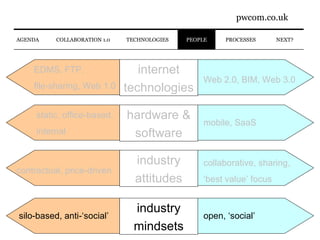
internet technologies EDMS, FTP, file-sharing, Web 1.0 Web 2.0, BIM, Web 3.0 hardware & software static, office-based, internal mobile, SaaS PROCESSES NEXT? AGENDA industry attitudes contractual, price-driven collaborative, sharing, ‘ best value’ focus industry mindsets silo-based, anti-‘social’ open, ‘social’ COLLABORATION 1.0 PEOPLE TECHNOLOGIES
PROCESSES NEXT? AGENDA COLLABORATION 1.0 PEOPLE TECHNOLOGIES
For example: ‘ democratic design’ open-source PROCESSES NEXT? AGENDA COLLABORATION 1.0 PEOPLE TECHNOLOGIES
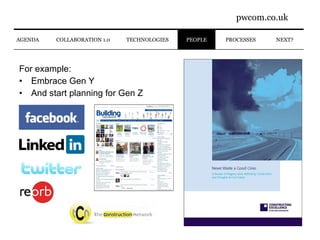
For example: Embrace Gen Y And start planning for Gen Z PROCESSES NEXT? AGENDA COLLABORATION 1.0 PEOPLE TECHNOLOGIES
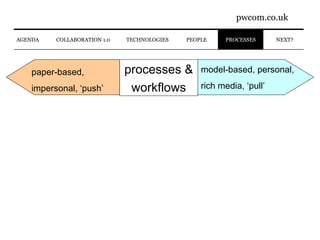
PROCESSES NEXT? AGENDA processes & workflows paper-based, impersonal, ‘push’ model-based, personal,  rich media, ‘pull’ COLLABORATION 1.0 PEOPLE TECHNOLOGIES
NEXT? AGENDA PROCESSES COLLABORATION 1.0 PEOPLE TECHNOLOGIES
For example: video-sharing slideshows photos virtual reality NEXT? AGENDA PROCESSES COLLABORATION 1.0 PEOPLE TECHNOLOGIES
NEXT? AGENDA processes & workflows paper-based, impersonal, ‘push’ model-based, personal,  rich media, ‘pull’ supply chain structures fragmented, dis-enfranchised joined-up, integrated inclusive, end-to-end PROCESSES COLLABORATION 1.0 PEOPLE TECHNOLOGIES
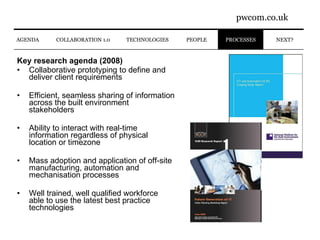
Key research agenda (2008) Collaborative prototyping to define and deliver client requirements Efficient, seamless sharing of information across the built environment stakeholders Ability to interact with real-time information regardless of physical location or timezone Mass adoption and application of off-site manufacturing, automation and mechanisation processes Well trained, well qualified workforce able to use the latest best practice technologies NEXT? AGENDA PROCESSES COLLABORATION 1.0 PEOPLE TECHNOLOGIES
industry time-frames short-term, design and construct long-term, design, build operate, re-use NEXT? AGENDA processes & workflows paper-based, impersonal, ‘push’ model-based, personal,  rich media, ‘pull’ supply chain structures fragmented, dis-enfranchised joined-up, integrated inclusive, end-to-end PROCESSES COLLABORATION 1.0 PEOPLE TECHNOLOGIES
feasibility planning design construction handover Occupation, FM, O&M Whole life information Design IT Construction IT Handover IT Planning IT FM IT interoperability Re-use of existing information … and processes Information as part of the asset NEXT? AGENDA PROCESSES COLLABORATION 1.0 PEOPLE TECHNOLOGIES
For example: 1 : 5 : 200 Be Valuable NEXT? AGENDA PROCESSES COLLABORATION 1.0 PEOPLE TECHNOLOGIES
industry attitudes contractual, price-driven collaborative, sharing, ‘ best value’ focus industry mindsets industry time-frames industry approaches silo-based, anti-‘social’ short-term, design and construct (new) build if possible open, ‘social’ long-term, design, build operate, re-use build if necessary and sustainable NEXT? AGENDA PROCESSES COLLABORATION 1.0 PEOPLE TECHNOLOGIES
UK Gov to focus on two aims: co-ordinate low carbon policy improve government’s return on its investment .   “…  enormous potential …lies in more intelligent use of ICT … in improving communications, reducing or removing transaction costs, transforming the way that buildings are designed, creating more direct links between design and fabrication/assembly, removing the coordination errors that too often block productivity etc.” (Paul Morrell, UK chief construction adviser, December 2009)   NEXT? AGENDA PROCESSES COLLABORATION 1.0 PEOPLE TECHNOLOGIES
Construction collaboration technologies survived the “dot.com doom” Benefits of online collaboration are clear … …  yet overcoming resistance has more to do with changing culture (people and processes) than technology UK market still buoyant, but generic collaborative technologies are spreading, and other vendors could look to expand footprint in AEC market Collaboration vendors, customers and users therefore need to look look beyond file-sharing (eg: process management, financial control, mobile working) understand the SaaS (Software-as-a-Service) or On-Demand revolution embrace BIM, embrace web 2.0 New business models will emerge in next 2-3 years Summary NEXT? AGENDA PROCESSES COLLABORATION 1.0 PEOPLE TECHNOLOGIES
Next? CADaaS – CAD as a Service BIMaaS – BIM as a Service But BIM will require changes, eg: Procurement Contracts Insurance Intellectual property Rise of the tech-Nomad The internet of things Summary NEXT? AGENDA PROCESSES COLLABORATION 1.0 PEOPLE TECHNOLOGIES
Thank you Contact: Paul Wilkinson Blog:  www.extranetevolution.com Email:  [email_address] Tel: +44 (0)20 8858 1104 mob: 07788 445920 Twitter: @EEPaul

Construction Collaboration 2010

  • 1.
    Construction collaboration: frompre-Web to Web 1.0, to Web 2.0 and beyond …. by Paul Wilkinson (pwcom.co.uk)
  • 2.
    Who is PaulWilkinson? Introducing construction collaboration technologies Development of the UK market Benefits of online collaboration – NCCTP research 2006 Overcoming resistance New directions for collaboration beyond file-sharing (eg: process management, financial control, mobile working) The ‘I’ in BIM the SaaS (Software-as-a-Service) revolution Web 2.0 (and 3.0) Summary PROCESSES NEXT? COLLABORATION 1.0 PEOPLE TECHNOLOGIES AGENDA
  • 3.
    Who am I?worked in construction industry since 1987 in-house: Halcrow, Tarmac/Carillion, BIW current/recent clients: BIW, Constructing Excellence, 4Projects, Incite, Slider Studio, tCn, Woobius author of book on construction collaboration technologies (2005) Wikipedian (2003), blogger (2005), Tweeter (2008) PROCESSES NEXT? COLLABORATION 1.0 PEOPLE TECHNOLOGIES AGENDA
  • 4.
    Face-to-face Written wordHand drawings Telephone Telegram Telex Fax CAD Email Groupware (eg: Lotus Notes) File transfer protocol (FTP) Websites Intranets, enterprise portals Video- and tele-conferencing Extranets Web-conferencing applications File-sharing (P2P) Instant messaging Discussion forums Wikis Blogs RSS Social networking Social search, tagging, sharing Mashups: Mapping, time-lines, etc Virtual worlds Cloud computing PROCESSES NEXT? COLLABORATION 1.0 PEOPLE TECHNOLOGIES AGENDA Web 2.0 BIM SaaS
  • 5.
    PROCESSES NEXT? COLLABORATION1.0 PEOPLE TECHNOLOGIES AGENDA
  • 6.
    PROCESSES NEXT? COLLABORATION1.0 PEOPLE TECHNOLOGIES AGENDA
  • 7.
    Specs Drawings MinutesProgrammes Cost plans correspondence etc Email Fax Courier Post (CD, paper) Traditionally… PROCESSES NEXT? COLLABORATION 1.0 PEOPLE TECHNOLOGIES AGENDA
  • 8.
    PROCESSES NEXT? COLLABORATION1.0 PEOPLE TECHNOLOGIES AGENDA
  • 9.
    PROCESSES NEXT? COLLABORATION1.0 PEOPLE TECHNOLOGIES AGENDA
  • 10.
    Traditional AEC collaboration:issues Incompatible IT = unreadable data = heavy reliance on paper Extensive – and expensive – production of paper Email overload No single version of ‘the truth’ ‘ Islands’ of information Poor security Low transparency of information, opaque processes No complete project record, no audit trail, risk of disputes/litigation Low quantity/quality of information for FM or O&M purposes PROCESSES NEXT? COLLABORATION 1.0 PEOPLE TECHNOLOGIES AGENDA
  • 11.
    Fewer interoperability issuesLess paper Latest information available to all Complete record of project Full information audit trail Single central repository of information Greater re-use of information (eg: for H&S File, standards, tendering, defects mgmt, O&M, etc) What does it look like…? So collaborate! PROCESSES NEXT? COLLABORATION 1.0 PEOPLE TECHNOLOGIES AGENDA
  • 12.
  • 13.
  • 14.
  • 15.
    PROCESSES NEXT? COLLABORATION1.0 PEOPLE TECHNOLOGIES AGENDA
  • 16.
    Technology issues (1):Standards a la “Betamax or VHS”? Interoperability Cost do we need new hardware/software (eg: CAD)? new telecoms links? printing costs pushed down supply chain? clients might expect lower fees? Training Implementation PROCESSES NEXT? COLLABORATION 1.0 PEOPLE TECHNOLOGIES AGENDA
  • 17.
    Technology issues (2):Industry slow to adopt new technology Legal status of electronic communication Contractual relationships with technology provider ASP service interruption or unforeseen termination Preference for paper Copyright, archive concerns Suspicion/fear re web-based or web-enabled technologies Security – hacking, viruses Reliability – 24/7 access, backup Too transparent (threat to old-style attitudes) ‘ Dot.com doubt’ – re ASP/SaaS/on-demand providers Too many suppliers Who will survive? PROCESSES NEXT? COLLABORATION 1.0 PEOPLE TECHNOLOGIES AGENDA
  • 18.
    Mid 1990s firstexperiments with project websites Late 1990s project websites used to host documents and drawings 2000 Dot.com boom … and bust! 2000-2002 internet faith low; slow growth for survivors 2003-2005 increased internet faith; more sustained growth; web-based collaboration becoming normal 2008-2009 Recession and the rise of low-cost solutions 2010- Collaboration - so what? What next? PROCESSES NEXT? COLLABORATION 1.0 PEOPLE TECHNOLOGIES AGENDA
  • 19.
    PROCESSES NEXT? COLLABORATION1.0 PEOPLE TECHNOLOGIES AGENDA
  • 20.
    UK market UKAEC collaboration market - development PROCESSES NEXT? COLLABORATION 1.0 PEOPLE TECHNOLOGIES AGENDA Market share Sophistication/functionality 4Projects Aconex BIW Asite Buzzsaw CTSpace Unit4 Cadweb Causeway ePIN ProjectWise Sarcophagus Woobius Union Square iSite Collabor8online CloudsUK StickyWorld
  • 21.
    UK AEC collaborationmarket - development PROCESSES NEXT? COLLABORATION 1.0 PEOPLE TECHNOLOGIES AGENDA
  • 22.
    UK AEC collaborationmarket - development PROCESSES NEXT? COLLABORATION 1.0 PEOPLE TECHNOLOGIES AGENDA
  • 23.
    UK AEC collaborationmarket - development PROCESSES NEXT? COLLABORATION 1.0 PEOPLE TECHNOLOGIES AGENDA
  • 24.
    UK AEC collaborationmarket - development PROCESSES NEXT? COLLABORATION 1.0 PEOPLE TECHNOLOGIES AGENDA
  • 25.
    What are thebenefits? Market research conducted April-May 2006 User views (not vendor hype) PROCESSES NEXT? COLLABORATION 1.0 PEOPLE TECHNOLOGIES AGENDA
  • 26.
    Net Average DrawingApproval times Base: 194 # of days 26% time saving on average overall PROCESSES NEXT? COLLABORATION 1.0 PEOPLE TECHNOLOGIES AGENDA
  • 27.
    Main benefits experiencedin project management, communications and team working… Base: 272 PROCESSES NEXT? COLLABORATION 1.0 PEOPLE TECHNOLOGIES AGENDA
  • 28.
    Main benefits experiencedin document management, storage and retrieval Base: 272 PROCESSES NEXT? COLLABORATION 1.0 PEOPLE TECHNOLOGIES AGENDA
  • 29.
    Main benefits experiencedin hand-over, commissioning, operations and maintenance Base: 105 involved with this phase of projects PROCESSES NEXT? COLLABORATION 1.0 PEOPLE TECHNOLOGIES AGENDA
  • 30.
    96% feel theybenefit from using the technology Client preference for contractors who are willing to work with or have experience of the technology Several benefits are widely accepted/associated with the technology (following seen as substantial by 80%+ of users): Documents can be accessed 24/7 Project information available centrally Less money spent on couriers/post Less chance of losing important documents Better audit trail PROCESSES NEXT? COLLABORATION 1.0 PEOPLE TECHNOLOGIES AGENDA
  • 31.
    Strong commitment toa still evolving technology (it took 10+ years for CAD to become commonplace) Vendors need to do more to overcome designers’ and sub-contractors’ reservations time and cost savings were not ranked as the most important areas of differentiation – the key perceived benefits relate to better control, communication and collaboration Perceived obstacles mainly relate to people and processes (eg: implementation, education/training issues), not technology PROCESSES NEXT? COLLABORATION 1.0 PEOPLE TECHNOLOGIES AGENDA
  • 32.
    Construction collaboration technologiesPeople, processes (80%) and technology (20%) Barriers to adoption: Resistance to principle of collaborative working Resistance to adoption of new technology Overcoming resistance
  • 33.
    How will weget there? PROCESSES NEXT? COLLABORATION 1.0 PEOPLE TECHNOLOGIES AGENDA
  • 34.
    internet technologies EDMS,FTP, file-sharing, Web 1.0 BIM, Web 2.0, Web 3.0 PROCESSES NEXT? COLLABORATION 1.0 PEOPLE TECHNOLOGIES AGENDA
  • 35.
    Construction Collaboration Financialtools Business processes CAD/BIM vendors Generic collaboration tools Project management tools FM tools E-commerce Back office Mobile working Contracts Whole life costing Defects management SaaS UK AEC collaboration market - development PROCESSES NEXT? COLLABORATION 1.0 PEOPLE TECHNOLOGIES AGENDA Compliance Knowledge management Web 2.0 BIM
  • 36.
    Construction Collaboration Financialtools Business processes CAD/BIM vendors Generic collaboration tools Project management tools FM tools E-commerce Back office Mobile working Contracts Whole life costing Defects management SaaS UK AEC collaboration market - development PROCESSES NEXT? COLLABORATION 1.0 PEOPLE TECHNOLOGIES AGENDA Compliance Knowledge management Web 2.0 BIM
  • 37.
    Less about filestorage/exchange More about key business processes Move beyond simple processes (eg: RFIs, change orders, transmittals, etc) ‘ Collaboration-plus’ Corporate standards (eg: standard designs, specs) Health and safety management (eg: non-conformance reports) Procurement (ie: e-tendering) Project financial control Quality control (defects/snagging – mobile solutions) Contract change management Facilities management support Development of UK market: ‘collaboration-plus’ PROCESSES NEXT? COLLABORATION 1.0 PEOPLE TECHNOLOGIES AGENDA
  • 38.
    Shift from CADto BIM “ CAD helps people to draw. BIM helps people to construct.” (Richard Saxon, Ecobuild, February 2009) “ BIM is not CAD. BIM was never meant to be CAD. CAD is a replacement for pen and paper, a documentation tool.” ( Pete Zyskowski , Cadalyst ) PROCESSES NEXT? PEOPLE AGENDA COLLABORATION 1.0 TECHNOLOGIES
  • 39.
    PROCESSES NEXT? PEOPLEAGENDA COLLABORATION 1.0 TECHNOLOGIES
  • 40.
    PROCESSES NEXT? PEOPLEAGENDA COLLABORATION 1.0 TECHNOLOGIES http://shop.bsigroup.com/Browse-by-Sector/Building--Construction/Building-Information-Modelling/
  • 41.
    Collaboration: to managethe ‘I’ in BIM, “the ins and outs of BIM” – the drawings, the workflows PROCESSES NEXT? PEOPLE AGENDA COLLABORATION 1.0 TECHNOLOGIES
  • 42.
    “ We havecommissioned a team drawn from BIM users across the industry, both clients and suppliers, and software developers, to prepare a route map that shows how we can make a progressive move to the routine use of BIM. “ I am convinced that this is the way to unlock new ways of working that will reduce cost and add long-term value to the development and management of built assets in the public sector.” PROCESSES NEXT? PEOPLE AGENDA COLLABORATION 1.0 TECHNOLOGIES Paul Morrell: bidders and contractors on future UK public building projects will use BIM.
  • 43.
    What is Web2.0? the use of web technologies and web design to enhance creativity, information sharing, and, most notably, collaboration among users. Not: one-way, a monologue, received-only Two-way, conversational, participative, active PROCESSES NEXT? PEOPLE AGENDA COLLABORATION 1.0 TECHNOLOGIES
  • 44.
    Discussion forums BuildingConstructing Excellence Home pages Static to configurable iGoogle , Google Alerts Wikis Open - Wikipedia Organisation - RIBApedia Internal - Fielden Clegg Bradley Blogs Personal but work-related – eg: ExtranetEvolution.com Corporate – eg: SaaStainability.com Media tool – eg: Brickonomics Micro-blogging – Twitter: personal , corporate , media PROCESSES NEXT? PEOPLE AGENDA COLLABORATION 1.0 TECHNOLOGIES “ Wisdom of crowds”
  • 45.
    RSS Feed-readers (localor web-based: Newsgator , Google Reader , etc) RSS publishing (from bloggers, media, corporate) Social networking From personal (MySpace, Bebo, Facebook) … … to professional ( Facebook , LinkedIn , Ning) Social search ( Wikia ) Social tagging and sharing ( Del.icio.us , Digg, etc) Sharing: Voice over IP – Skype Calendar – Google Calendar Slides – SlideShare; Photos – Flickr ; Video – YouTube Stuff – Freecycle Mashups: Mapping (Google Maps), time-lines ( Dipity ) Virtual worlds – eg: Second Life PROCESSES NEXT? PEOPLE AGENDA COLLABORATION 1.0 TECHNOLOGIES
  • 46.
    internet technologies EDMS,FTP, file-sharing, Web 1.0 Web 2.0, BIM, Web 3.0 hardware & software static, office-based, internal mobile, SaaS, cloud computing PROCESSES NEXT? PEOPLE AGENDA COLLABORATION 1.0 TECHNOLOGIES
  • 47.
    PROCESSES NEXT? PEOPLEAGENDA COLLABORATION 1.0 TECHNOLOGIES
  • 48.
    PROCESSES NEXT? PEOPLEAGENDA COLLABORATION 1.0 TECHNOLOGIES
  • 49.
    For example: WoobiusEye – mobile, real-time augmented reality, location-specific PROCESSES NEXT? PEOPLE AGENDA COLLABORATION 1.0 TECHNOLOGIES
  • 50.
    internet technologies EDMS,FTP, file-sharing, Web 1.0 Web 2.0, BIM, Web 3.0 hardware & software static, office-based, internal mobile, SaaS PROCESSES NEXT? COLLABORATION 1.0 PEOPLE TECHNOLOGIES AGENDA industry attitudes contractual, price-driven collaborative, sharing, ‘ best value’ focus
  • 51.
    People and processes(1): industry attitudes to collaboration Conservative Slow to change - inertia Very fragmented – danger: preach to the converted only, while majority continue with old approaches Focused on delivery , not ‘whole life’ People and processes (2): inter-organisation Necessary evil or a strategic objective? One project at a time or long-term relationships? Contractual or collaborative attitude? Own agenda or mutual objectives? Management approach PROCESSES NEXT? COLLABORATION 1.0 PEOPLE TECHNOLOGIES AGENDA
  • 52.
    People and processes(3): intra-organisation attitudes to collaboration ‘ Silo’ dwelling – department, region, profession Corporate ladder – different agendas Management – do managers … Preach collaboration? Practice collaboration? Reward collaboration? Intra-organisational collaborators probably better able to collaborate externally … People and processes (4): individual Age – older professionals more resistant? Professional learning – traditional approaches Experience – tried, trusted techniques ‘ Creative isolation’ – develop ideas then share? PROCESSES NEXT? COLLABORATION 1.0 PEOPLE TECHNOLOGIES AGENDA
  • 53.
    internet technologies EDMS,FTP, file-sharing, Web 1.0 Web 2.0, BIM, Web 3.0 hardware & software static, office-based, internal mobile, SaaS PROCESSES NEXT? AGENDA industry attitudes contractual, price-driven collaborative, sharing, ‘ best value’ focus industry mindsets silo-based, anti-‘social’ open, ‘social’ COLLABORATION 1.0 PEOPLE TECHNOLOGIES
  • 54.
    PROCESSES NEXT? AGENDACOLLABORATION 1.0 PEOPLE TECHNOLOGIES
  • 55.
    For example: ‘democratic design’ open-source PROCESSES NEXT? AGENDA COLLABORATION 1.0 PEOPLE TECHNOLOGIES
  • 56.
    For example: EmbraceGen Y And start planning for Gen Z PROCESSES NEXT? AGENDA COLLABORATION 1.0 PEOPLE TECHNOLOGIES
  • 57.
    PROCESSES NEXT? AGENDAprocesses & workflows paper-based, impersonal, ‘push’ model-based, personal, rich media, ‘pull’ COLLABORATION 1.0 PEOPLE TECHNOLOGIES
  • 58.
    NEXT? AGENDA PROCESSESCOLLABORATION 1.0 PEOPLE TECHNOLOGIES
  • 59.
    For example: video-sharingslideshows photos virtual reality NEXT? AGENDA PROCESSES COLLABORATION 1.0 PEOPLE TECHNOLOGIES
  • 60.
    NEXT? AGENDA processes& workflows paper-based, impersonal, ‘push’ model-based, personal, rich media, ‘pull’ supply chain structures fragmented, dis-enfranchised joined-up, integrated inclusive, end-to-end PROCESSES COLLABORATION 1.0 PEOPLE TECHNOLOGIES
  • 61.
    Key research agenda(2008) Collaborative prototyping to define and deliver client requirements Efficient, seamless sharing of information across the built environment stakeholders Ability to interact with real-time information regardless of physical location or timezone Mass adoption and application of off-site manufacturing, automation and mechanisation processes Well trained, well qualified workforce able to use the latest best practice technologies NEXT? AGENDA PROCESSES COLLABORATION 1.0 PEOPLE TECHNOLOGIES
  • 62.
    industry time-frames short-term,design and construct long-term, design, build operate, re-use NEXT? AGENDA processes & workflows paper-based, impersonal, ‘push’ model-based, personal, rich media, ‘pull’ supply chain structures fragmented, dis-enfranchised joined-up, integrated inclusive, end-to-end PROCESSES COLLABORATION 1.0 PEOPLE TECHNOLOGIES
  • 63.
    feasibility planning designconstruction handover Occupation, FM, O&M Whole life information Design IT Construction IT Handover IT Planning IT FM IT interoperability Re-use of existing information … and processes Information as part of the asset NEXT? AGENDA PROCESSES COLLABORATION 1.0 PEOPLE TECHNOLOGIES
  • 64.
    For example: 1: 5 : 200 Be Valuable NEXT? AGENDA PROCESSES COLLABORATION 1.0 PEOPLE TECHNOLOGIES
  • 65.
    industry attitudes contractual,price-driven collaborative, sharing, ‘ best value’ focus industry mindsets industry time-frames industry approaches silo-based, anti-‘social’ short-term, design and construct (new) build if possible open, ‘social’ long-term, design, build operate, re-use build if necessary and sustainable NEXT? AGENDA PROCESSES COLLABORATION 1.0 PEOPLE TECHNOLOGIES
  • 66.
    UK Gov tofocus on two aims: co-ordinate low carbon policy improve government’s return on its investment . “… enormous potential …lies in more intelligent use of ICT … in improving communications, reducing or removing transaction costs, transforming the way that buildings are designed, creating more direct links between design and fabrication/assembly, removing the coordination errors that too often block productivity etc.” (Paul Morrell, UK chief construction adviser, December 2009) NEXT? AGENDA PROCESSES COLLABORATION 1.0 PEOPLE TECHNOLOGIES
  • 67.
    Construction collaboration technologiessurvived the “dot.com doom” Benefits of online collaboration are clear … … yet overcoming resistance has more to do with changing culture (people and processes) than technology UK market still buoyant, but generic collaborative technologies are spreading, and other vendors could look to expand footprint in AEC market Collaboration vendors, customers and users therefore need to look look beyond file-sharing (eg: process management, financial control, mobile working) understand the SaaS (Software-as-a-Service) or On-Demand revolution embrace BIM, embrace web 2.0 New business models will emerge in next 2-3 years Summary NEXT? AGENDA PROCESSES COLLABORATION 1.0 PEOPLE TECHNOLOGIES
  • 68.
    Next? CADaaS –CAD as a Service BIMaaS – BIM as a Service But BIM will require changes, eg: Procurement Contracts Insurance Intellectual property Rise of the tech-Nomad The internet of things Summary NEXT? AGENDA PROCESSES COLLABORATION 1.0 PEOPLE TECHNOLOGIES
  • 69.
    Thank you Contact:Paul Wilkinson Blog: www.extranetevolution.com Email: [email_address] Tel: +44 (0)20 8858 1104 mob: 07788 445920 Twitter: @EEPaul

Editor's Notes

  • #6 IT has often encouraged, not reduced, use of paper enormous data duplication poor use (and re-use) of data spiralling demand for more, better, and richer, data often require substantial human resources to support and maintain
  • #7 Simplified No regulators No policy-makers No end-users/occupiers (unless they are included in the “suppliers and other stakeholders”)
  • #8 Look at why collaboration technologies became popular But note: they are still far from universal!
  • #9 Not just paper Again, hardware production and disposal can be polluting huge waste of other disposables (toner/ink cartridges, etc) Buildings created just to hold paper!
  • #10 Not just the production of paper, of course Also the transport of that paper And its ongoing management – often for years after project delivered for construction projects
  • #12 Clear benefits
  • #21 SaaS or locally hosted? Collaboration only, or ‘collaboration-plus’? Further scope for rationalisation (some vendors less focused on collaboration, looking for niches)
  • #34 80% people and processes, only 20% technologies In the time available, I am going to concentrate on just eight broad areas. No exact divide between these areas There are technology dimensions to them all (and vice versa) But the people and process issues are less easily resolved than the technological ones People collaborate not systems
  • #35 First – computer and internet technologies Old style information-driven approaches New style interaction-driven approaches
  • #39 Massive (over)-production of paper, indiscriminately pushed at every potential team member BIM opportunity to pull the data you need when you need it, and to integrate processes For example: Revolutionise how we manage built environment information Away from production of ‘dumb’ 2D information Towards collaborative development of nD data
  • #40 Moving from simple 2D or 3D CAD through modelling approaches to model-based collaboration and then onto integrated project delivery
  • #43 Moving from simple 2D or 3D CAD through modelling approaches to model-based collaboration and then onto integrated project delivery
  • #47 Second – hardware, software, networks and how we connect to our data has begun to change Last 10 years has seen major change in how we regard IT No longer just locally-hosted, but increasingly anywhere, anytime, on any device
  • #50 on any device Not just laptops or tablets, or iPads But mobile telephones – with real-time interaction with the built environment or with fellow collaborators
  • #51 Third – moving on to people , we have the prevalent attitudes within the industry – the things that Latham, et al wanted to change Of course, these attitudes and behaviours are often the result of how we are educated and developed in our careers Look at these alongside the …
  • #54 And fourth, Industry mindsets As an industry, our professionals are not taught and developed to work in an integrated way Too often silo-based approaches to education, to career development, to incentivisation and reward Also a reluctance to embrace the non-construction professional – the end-user, occupant, owner and/or operator of a built asset – before, during or after the planning, design and construction phase of a project
  • #55 Focus on drawing and document meant focus on paper Could also say the same in the past about email, perhaps?
  • #56 Consult with the people who might use our new built environment Share information through wikis and other open-source projects so that knowledge isn’t trapped – it’s freed for reuse and improvement Enable and encourage feedback loops with simple tools
  • #57 New generation of super-collaborators, super-communicators coming through. Looking to network with their peers No longer email-driven Also need to respond to changes: in demographic patterns Globalisation emergence from a recession and new climate change issues
  • #58 New ways of working are changing the ways in which we might manage our processes. Switching from sequential processing of paper To more contemporaneous sharing of information No longer pushing out paper, but generating shared data that can be ‘pulled’ as required by other team members, and maybe reused in different ways.
  • #59 BIM offers opportunity to speed up what used to be a sequential process and allow some activities to take place simultaneously Massive (over)-production of paper, indiscriminately pushed at every potential team member BIM opportunity to pull the data – single instance - you need when you need it, and to integrate processes
  • #60 Not just design data in BIMs Rich data offers new opportunities to interact: Video, slideshow and photos – all related to one event
  • #61 Reiterates previous point – about integrating supply chain into the process For example: Early engagement Off-site fabrication ‘ lean’ construction
  • #62 Growing number of industry reports pointing the way towards new approaches National Platform for the Built Environment – five key areas identified (2008) SCRI research report (2009) talked about ubiquitous computing, collaboration tools, [and] decision making tools “ The teams involved in the design can be globally dispersed. Free access to information will start to emanate from society and from the industry . ” “ Home working, remote working, mobile working will be much more possible and feasible. ... Technologies like second life might provide the means for the interaction of the whole supply chain and design teams. ... In future, IT will naturally become a part of the life of end-users. IT tools will become much more ubiquitous, pervasive and intuitive. ”
  • #63 Need to look beyond the delivery phase and think about the whole life cost of a proposed built asset Build in feedback loops from owners, occupants, end-users, facilities managers
  • #65 Richard Saxon covered this in detail in his report Be Valuable But we can also use technology For example, to get real-time feedback on the performance of real buildings Feedback loops, sharing data (nationally and internationally)
  • #66 Finally, of the 8, industry approaches Get away from the knee-jerk view that we will always need new buildings and other assets In some cases, we may need to work better with what we have
  • #67 This approach is likely to be highly favoured over the next few years UK Govt likely to be focused on VFM and carbon use The two may well combine to enforce a new focus on more sustainable approaches to construction Know that Paul Morrell’s priorities are.