Constipation
• Very common problem in children
• Affects up to 5-30% of children (diagnosis
dependent).
• Only a third will develop chronic symptoms
requiring referral
• Parent/guardian’s anxiety often outweighs the
symptoms.
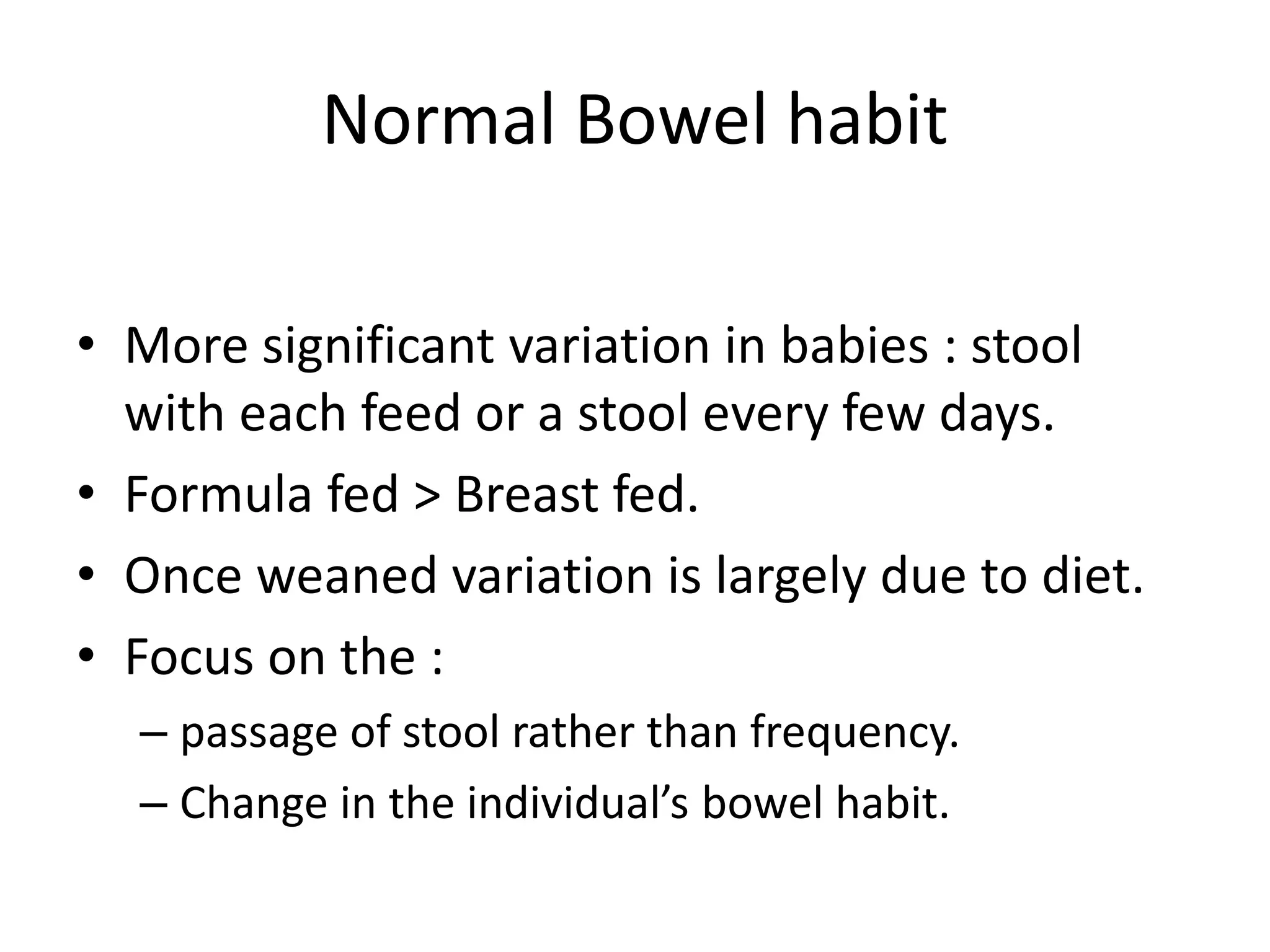
Normal Bowel habit
• More significant variation in babies : stool
with each feed or a stool every few days.
• Formula fed > Breast fed.
• Once weaned variation is largely due to diet.
• Focus on the :
– passage of stool rather than frequency.
– Change in the individual’s bowel habit.
Bristol Stool Chart
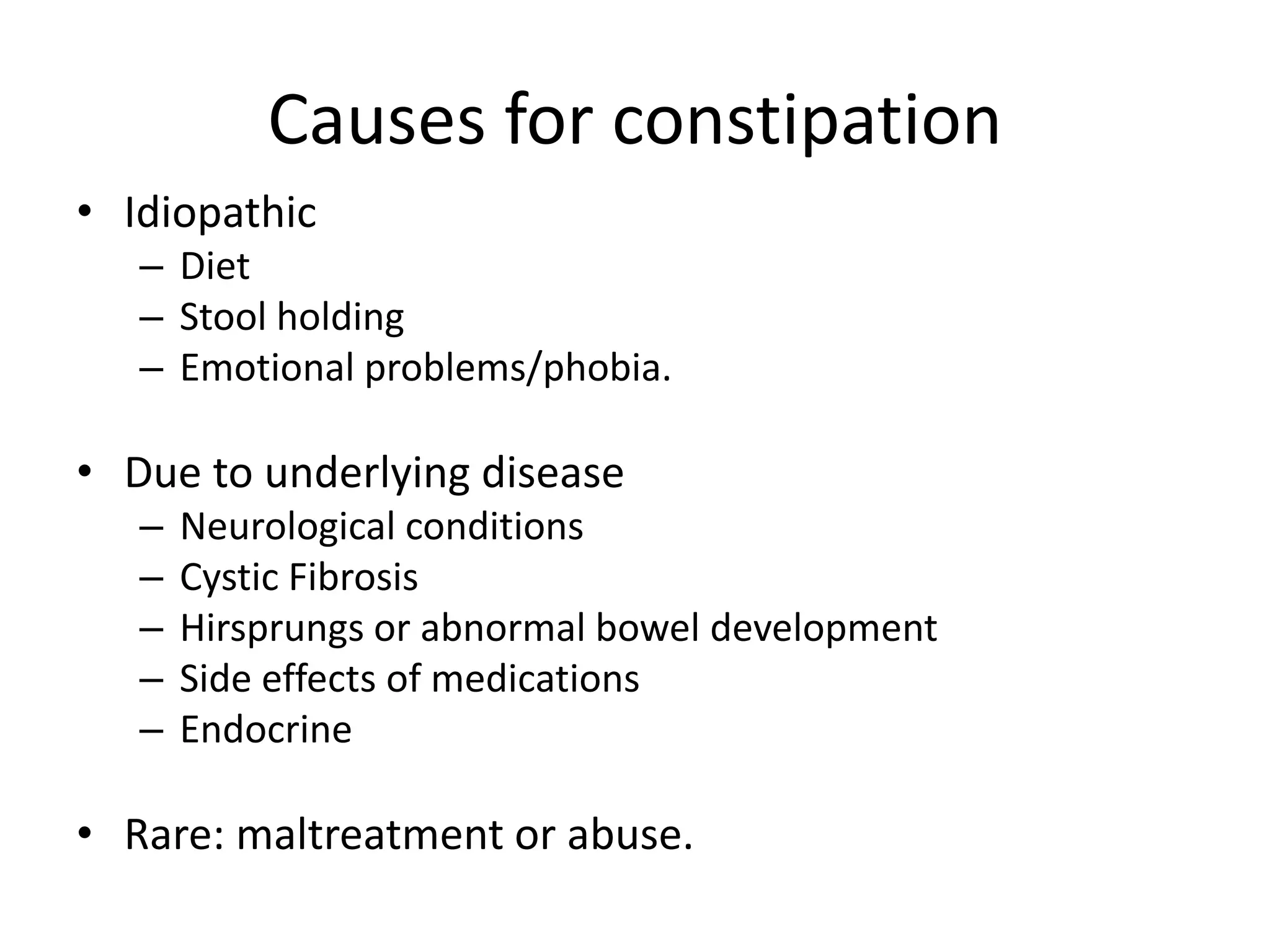
Causes for constipation
• Idiopathic
– Diet
– Stool holding
– Emotional problems/phobia.
• Due to underlying disease
– Neurological conditions
– Cystic Fibrosis
– Hirsprungs or abnormal bowel development
– Side effects of medications
– Endocrine
• Rare: maltreatment or abuse.
Key points indicating constipation
Findings in a child <1 year Findings in child >1year
Key points indicating constipation
Findings in a child <1 year
• <3 type 3 or type 4
stools/week
(excl. Breast fed babies after 6wk)
• Passage of hard large stools
• Type 1 ‘rabbit droppings’
• Distress on stooling
• Bleeding with hard stool
• Straining
• Anal fissures
Findings in child >1year
• <3 type 3/4 stools/week
• Overflow/soiling/smelly
• Type 1 rabbit droppings
• Large infrequent stools that
block the toilet
• Poor appetite
• Waxing and waning abdo pain
• Retentive posturing
• Straining /anal pain
• Anal fissures
• Blood with bowel movements
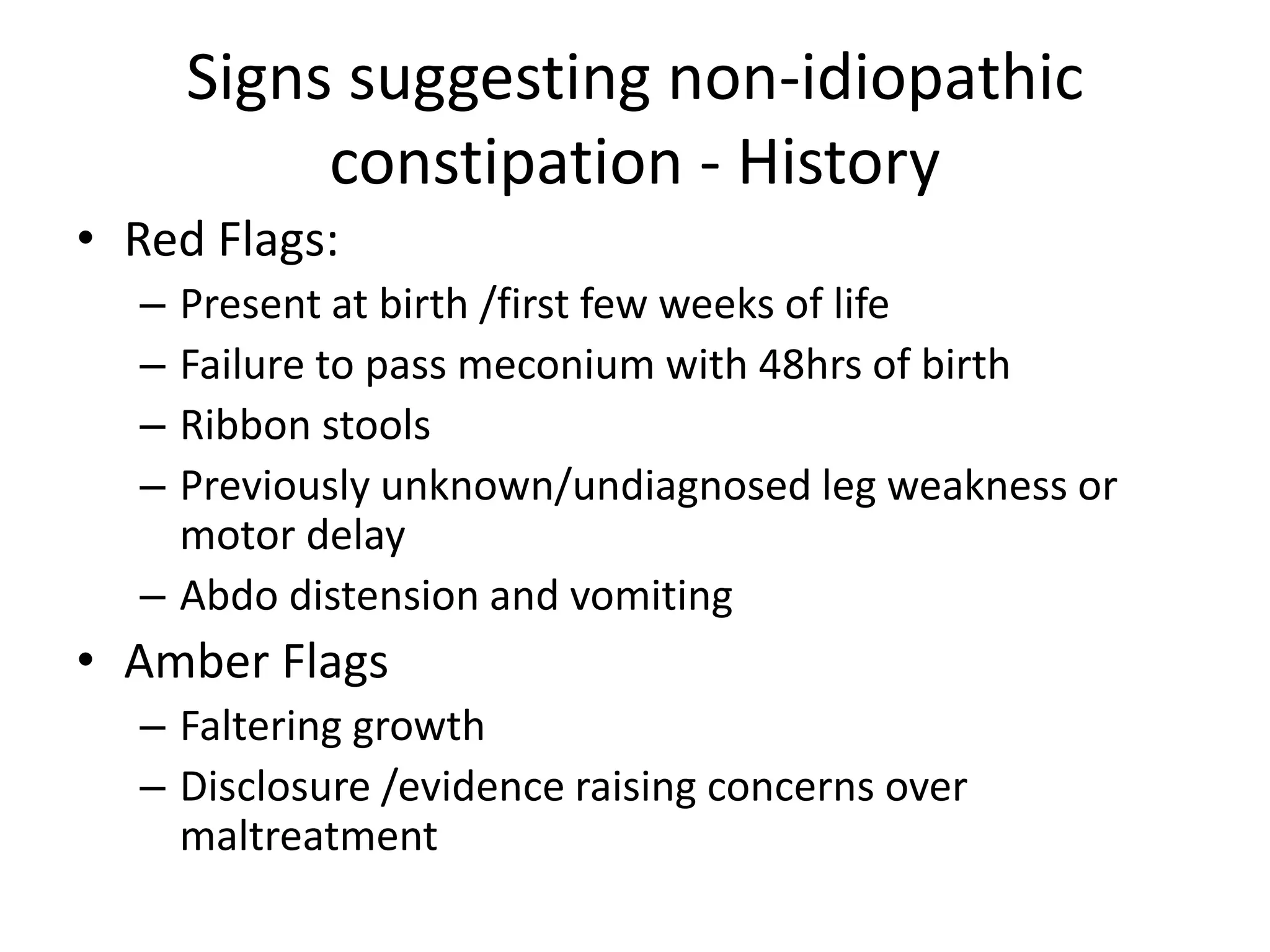
Signs suggesting non-idiopathic
constipation - History
• Red Flags:
– Present at birth /first few weeks of life
– Failure to pass meconium with 48hrs of birth
– Ribbon stools
– Previously unknown/undiagnosed leg weakness or
motor delay
– Abdo distension and vomiting
• Amber Flags
– Faltering growth
– Disclosure /evidence raising concerns over
maltreatment
Signs suggesting non-idiopathic
constipation - Examination
• Red Flags:
– Abnormal appearance/position/patency of anus
– Gross abdo distension
– Abnormal spinal/gluteal examination
– Lower limb deformities
– Abnormal reflexes
Investigate possible underlying causes
• Red flags : Refer urgently – do not treat.
• Faltering growth: Treat and test
– Treat constipation
– Test for coeliac disease and hypothyrodism.
• Possible maltreatment: risk assess and child
protection
• Consider referral if inadequate response to
optimum treatment with 4 week.
Tips for management of early
constipation
• Drinks:
– Ensure adequate fluid intake
– Additional water between feeds
– Diluted fruit juice or pureed fruit/veg
– Avoid fizzy/sugary drinks/milk to quench thirst
– Fruit juices containing fructose/sorbitol have a
laxative action.
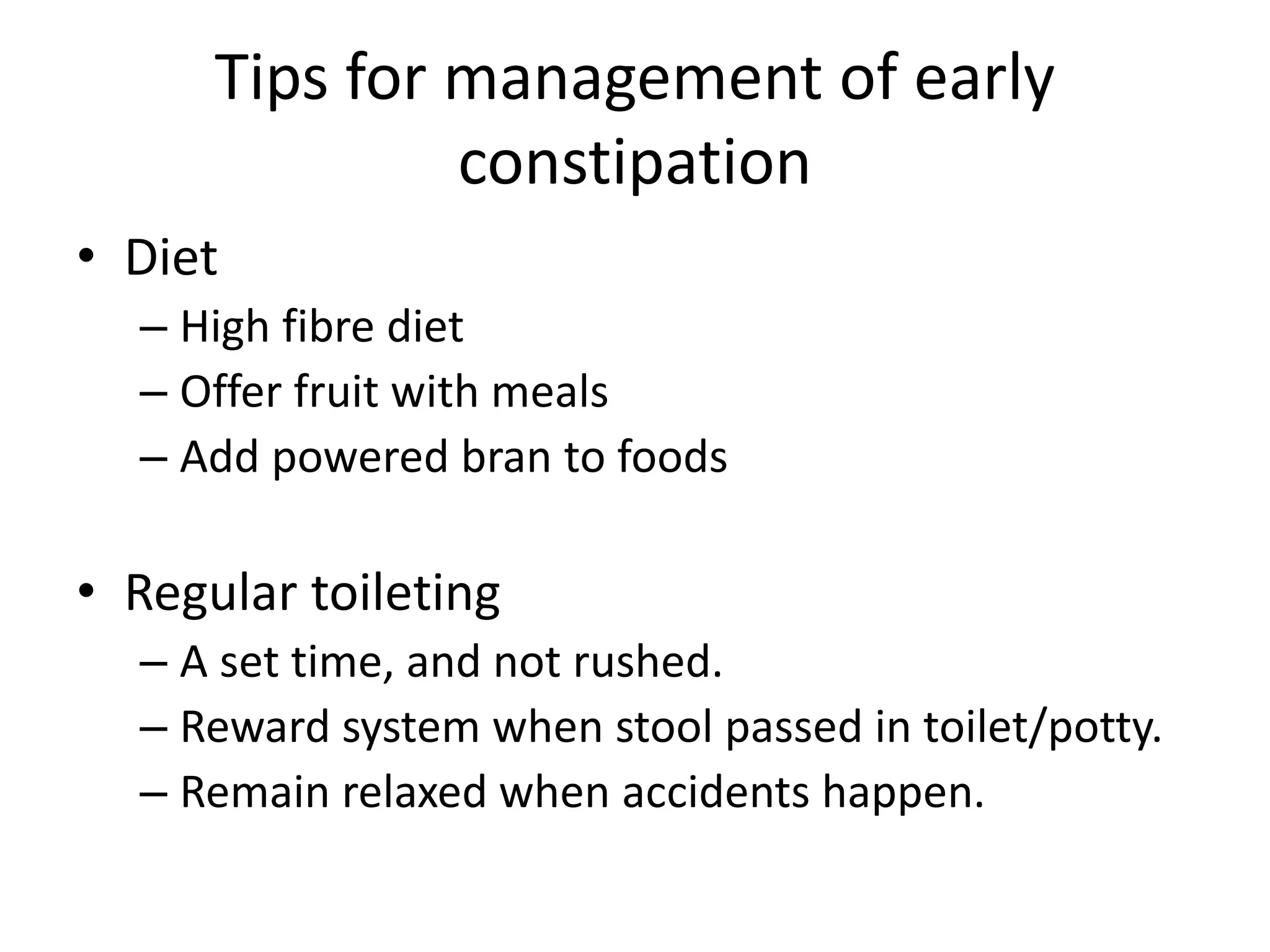
Tips for management of early
constipation
• Diet
– High fibre diet
– Offer fruit with meals
– Add powered bran to foods
• Regular toileting
– A set time, and not rushed.
– Reward system when stool passed in toilet/potty.
– Remain relaxed when accidents happen.
Management of idiopathic
constipation - Impacted
Step 1
• Movicol Paediatric Plain
• Escalating dose regime mixed with a cold drink
Step 2
• If no disimpaction after 2 weeks
• Add stimulant laxative
Step 3
• If unable to tolerate Movicol
• Substitute stimulant laxative +/- osmotic laxative
Management post disimpaction/
constipation without impaction.
• Same steps as above.
• Once disimpacted, maintenance doses approx
half the disimpaction dose.
• Continue at maintenance dose for several
weeks after regular bowel habit established.
• Gradual reduction thereafter, over months.
• Rare occasions where laxatives may be
required for years.

Constipation_in_Children-1.ppt

  • 1.
    Constipation • Very commonproblem in children • Affects up to 5-30% of children (diagnosis dependent). • Only a third will develop chronic symptoms requiring referral • Parent/guardian’s anxiety often outweighs the symptoms.
  • 2.
    Normal Bowel habit •More significant variation in babies : stool with each feed or a stool every few days. • Formula fed > Breast fed. • Once weaned variation is largely due to diet. • Focus on the : – passage of stool rather than frequency. – Change in the individual’s bowel habit.
  • 3.
  • 4.
    Causes for constipation •Idiopathic – Diet – Stool holding – Emotional problems/phobia. • Due to underlying disease – Neurological conditions – Cystic Fibrosis – Hirsprungs or abnormal bowel development – Side effects of medications – Endocrine • Rare: maltreatment or abuse.
  • 5.
    Key points indicatingconstipation Findings in a child <1 year Findings in child >1year
  • 6.
    Key points indicatingconstipation Findings in a child <1 year • <3 type 3 or type 4 stools/week (excl. Breast fed babies after 6wk) • Passage of hard large stools • Type 1 ‘rabbit droppings’ • Distress on stooling • Bleeding with hard stool • Straining • Anal fissures Findings in child >1year • <3 type 3/4 stools/week • Overflow/soiling/smelly • Type 1 rabbit droppings • Large infrequent stools that block the toilet • Poor appetite • Waxing and waning abdo pain • Retentive posturing • Straining /anal pain • Anal fissures • Blood with bowel movements
  • 7.
    Signs suggesting non-idiopathic constipation- History • Red Flags: – Present at birth /first few weeks of life – Failure to pass meconium with 48hrs of birth – Ribbon stools – Previously unknown/undiagnosed leg weakness or motor delay – Abdo distension and vomiting • Amber Flags – Faltering growth – Disclosure /evidence raising concerns over maltreatment
  • 8.
    Signs suggesting non-idiopathic constipation- Examination • Red Flags: – Abnormal appearance/position/patency of anus – Gross abdo distension – Abnormal spinal/gluteal examination – Lower limb deformities – Abnormal reflexes
  • 9.
    Investigate possible underlyingcauses • Red flags : Refer urgently – do not treat. • Faltering growth: Treat and test – Treat constipation – Test for coeliac disease and hypothyrodism. • Possible maltreatment: risk assess and child protection • Consider referral if inadequate response to optimum treatment with 4 week.
  • 10.
    Tips for managementof early constipation • Drinks: – Ensure adequate fluid intake – Additional water between feeds – Diluted fruit juice or pureed fruit/veg – Avoid fizzy/sugary drinks/milk to quench thirst – Fruit juices containing fructose/sorbitol have a laxative action.
  • 11.
    Tips for managementof early constipation • Diet – High fibre diet – Offer fruit with meals – Add powered bran to foods • Regular toileting – A set time, and not rushed. – Reward system when stool passed in toilet/potty. – Remain relaxed when accidents happen.
  • 12.
    Management of idiopathic constipation- Impacted Step 1 • Movicol Paediatric Plain • Escalating dose regime mixed with a cold drink Step 2 • If no disimpaction after 2 weeks • Add stimulant laxative Step 3 • If unable to tolerate Movicol • Substitute stimulant laxative +/- osmotic laxative
  • 13.
    Management post disimpaction/ constipationwithout impaction. • Same steps as above. • Once disimpacted, maintenance doses approx half the disimpaction dose. • Continue at maintenance dose for several weeks after regular bowel habit established. • Gradual reduction thereafter, over months. • Rare occasions where laxatives may be required for years.