Functional Constipation
Infants & Children
Material For Healthcare Professionals Only
BREASTFEEDING IS BEST FOR BABIES
Dr. Hooria Rehman
Assistant Professor
(Pediatrician, Pediatric Gastroenterologist)
Lahore General Hospital
Which of the following is the most common organic
cause of constipation in pediatric patients?
A. Hirschsprung disease
B. Hypokalaemia
C. Imperforate anus
D. Occult spina bifida
Which of the following is the most common organic
cause of constipation in pediatric patients?
A. Hirschsprung disease
B. Hypokalaemia
C. Imperforate anus
D. Occult spina bifida
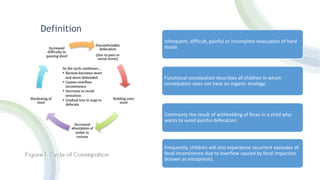
Definition
Infrequent, difficult, painful or incomplete evacuation of hard
stools
Functional constipation describes all children in whom
constipation does not have an organic etiology.
Commonly the result of withholding of feces in a child who
wants to avoid painful defecation.
Frequently, children will also experience recurrent episodes of
fecal incontinence due to overflow caused by fecal impaction
(known as encopresis).
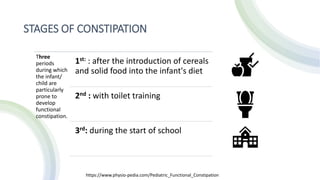
STAGES OF CONSTIPATION
Three
periods
during which
the infant/
child are
particularly
prone to
develop
functional
constipation.
1st: : after the introduction of cereals
and solid food into the infant's diet
2nd : with toilet training
3rd: during the start of school
https://www.physio-pedia.com/Pediatric_Functional_Constipation
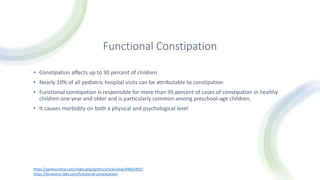
Functional Constipation
• Constipation affects up to 30 percent of children
• Nearly 10% of all pediatric hospital visits can be attributable to constipation
• Functional constipation is responsible for more than 95 percent of cases of constipation in healthy
children one year and older and is particularly common among preschool-age children.
• It causes morbidity on both a physical and psychological level
https://pjmhsonline.com/index.php/pjmhs/article/view/4983/4927
https://ferozsons-labs.com/functional-constipation/
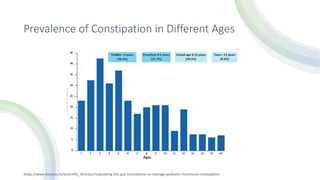
Prevalence of Constipation in Different Ages
https://www.becares.in/Scientific_Articles/modulating-the-gut-microbiome-to-manage-pediatric-functional-constipation
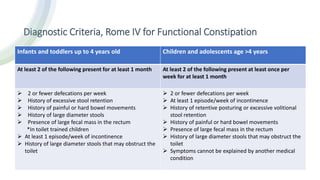
Diagnostic Criteria, Rome IV for Functional Constipation
Infants and toddlers up to 4 years old Children and adolescents age >4 years
At least 2 of the following present for at least 1 month At least 2 of the following present at least once per
week for at least 1 month
 2 or fewer defecations per week
 History of excessive stool retention
 History of painful or hard bowel movements
 History of large diameter stools
 Presence of large fecal mass in the rectum
*In toilet trained children
 At least 1 episode/week of incontinence
 History of large diameter stools that may obstruct the
toilet
 2 or fewer defecations per week
 At least 1 episode/week of incontinence
 History of retentive posturing or excessive volitional
stool retention
 History of painful or hard bowel movements
 Presence of large fecal mass in the rectum
 History of large diameter stools that may obstruct the
toilet
 Symptoms cannot be explained by another medical
condition
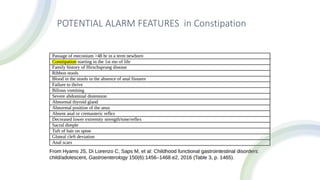
POTENTIAL ALARM FEATURES in Constipation
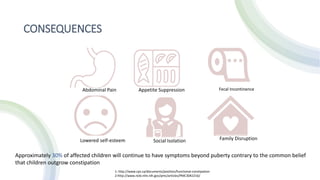
CONSEQUENCES
1: http://www.cps.ca/documents/position/functional-constipation
2:http://www.ncbi.nlm.nih.gov/pmc/articles/PMC3042216/
Approximately 30% of affected children will continue to have symptoms beyond puberty contrary to the common belief
that children outgrow constipation
Abdominal Pain Appetite Suppression Fecal Incontinence
Lowered self-esteem Social Isolation Family Disruption
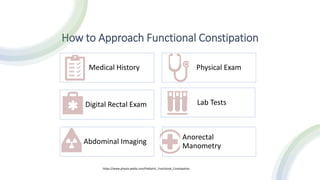
How to Approach Functional Constipation
Medical History Physical Exam
Digital Rectal Exam Lab Tests
Abdominal Imaging
Anorectal
Manometry
https://www.physio-pedia.com/Pediatric_Functional_Constipation
Medical History & Physical Exam
HISTORY
• Age of onset
• Passage of first meconium
• Frequency and consistency of stools
• Abdominal pain, Vomiting , Weight loss
• Fecal incontinence,
• Withholding behavior
• Dietary history
• Stressful life events
• Neurodevelopmental delay
• positive family history for gastrointestinal
disease
EXAMINATION
 Growth Parameters
 Abdominal Exam
 Inspection :Perianal Region
 Inspection : Lumbosacral Region
 Digital Rectal Exam
https://www.physio-pedia.com/Pediatric_Functional_Constipation
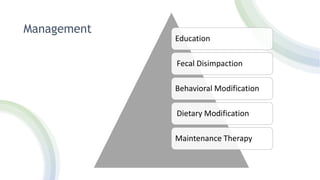
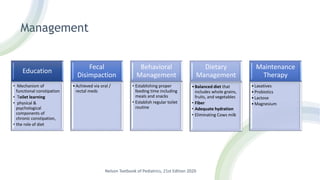
Management
Education
Fecal Disimpaction
Behavioral Modification
Dietary Modification
Maintenance Therapy
Management
Education
• Mechanism of
functional constipation
• Toilet learning
• physical &
psychological
components of
chronic constipation,
• the role of diet
Fecal
Disimpaction
•Achieved via oral /
rectal meds
Behavioral
Management
• Establishing proper
feeding time including
meals and snacks
• Establish regular toilet
routine
Dietary
Management
•Balanced diet that
includes whole grains,
fruits, and vegetables
• Fiber
• Adequate hydration
• Eliminating Cows milk
Maintenance
Therapy
•Laxatives
•Probiotics
•Lactose
•Magnesium
Nelson Textbook of Pediatrics, 21st Edition 2020
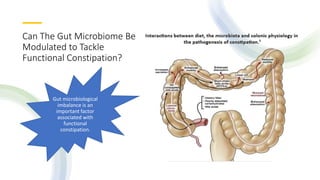
Can The Gut Microbiome Be
Modulated to Tackle
Functional Constipation?
Gut microbiological
imbalance is an
important factor
associated with
functional
constipation.
EMERGING ROLE OF PROBIOTICS
• Administration of Bifidobacterium or Lactobacillus has also
been shown to improve colonic transit times in
constipated patients
• The administration of L reuteri (DSM 17938) in infants
with functional chronic constipation has a positive effect
on bowel frequency.
• Because of their safety profile, probiotics may be an
attractive option in the treatment of functional
constipation.
https://www.uptodate.com/contents/chronic-functional-constipation-and-fecal-incontinence-in-infants-children-and-adolescents-
treatment?search=management%20of%20functional%20constipation%20in%20toddlers&source=search_result&selectedTitle=1~30&usage_type=default&display_rank=1#H4
Coccorullo P et al” Lactobacillus reuteri (DSM 17938) in infants with functional chronic constipation: a double-blind, randomized, placebo-controlled study; J Pediatr. 2010 Oct;157(4):598-602.
EMERGING ROLE OF PROBIOTICS
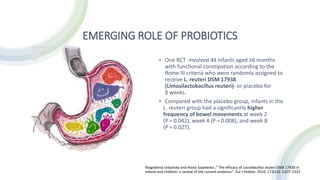
• One RCT involved 44 infants aged ≥6 months
with functional constipation according to the
Rome III criteria who were randomly assigned to
receive L. reuteri DSM 17938
(Limosilactobacillus reuteri)- or placebo for
8 weeks.
• Compared with the placebo group, infants in the
L. reuteri group had a significantly higher
frequency of bowel movements at week 2
(P = 0.042), week 4 (P = 0.008), and week 8
(P = 0.027).
Magdalena Urbańska and Hania Szajewska ;” The efficacy of Lactobacillus reuteri DSM 17938 in
infants and children: a review of the current evidence”: Eur J Pediatr. 2014; 173(10): 1327–1337.
EMERGING ROLE OF PROBIOTICS
Paola Coccorullo et al”Lactobacillus reuteri (DSM 17938) in Infants with Functional Chronic Constipation: A Double-Blind, Randomized, Placebo-Controlled Study ; The Journal of
Pediatrics;Volume 157, Issue 4, October 2010, Pages 598–602
EMERGING ROLE OF LACTOSE
It has prebiotic effects in that it is not completely absorbed in
young infants
It stimulates the development of bifidogenic flora, which in turn
bring the stools of formula-fed infants closer to the stools of
breast-fed infants
Non-hydrolyzed lactose reaches the colon, where it is
metabolized by anaerobic microorganisms, producing an osmotic
laxative
Oscar O Segarra et al ‘ Modification of stool’s water content in constipated infants: management with an adapted infant formula” Infante et al. Nutrition Journal 2011, 10:55
http://www.nutritionj.com/content/10/1/55
EMERGING ROLE OF MAGNESIUM
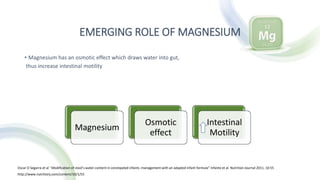
• Magnesium has an osmotic effect which draws water into gut,
thus increase intestinal motility
Oscar O Segarra et al ‘ Modification of stool’s water content in constipated infants: management with an adapted infant formula” Infante et al. Nutrition Journal 2011, 10:55
http://www.nutritionj.com/content/10/1/55
Magnesium
Osmotic
effect
Intestinal
Motility
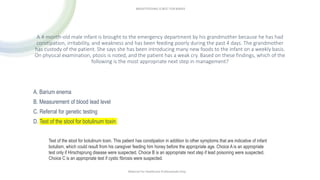
A 4-month-old male infant is brought to the emergency department by his grandmother because he has had
constipation, irritability, and weakness and has been feeding poorly during the past 4 days. The grandmother
has custody of the patient. She says she has been introducing many new foods to the infant on a weekly basis.
On physical examination, ptosis is noted, and the patient has a weak cry. Based on these findings, which of the
following is the most appropriate next step in management?
A. Barium enema
B. Measurement of blood lead level
C. Referral for genetic testing
D. Test of the stool for botulinum toxin
Test of the stool for botulinum toxin. This patient has constipation in addition to other symptoms that are indicative of infant
botulism, which could result from his caregiver feeding him honey before the appropriate age. Choice A is an appropriate
test only if Hirschsprung disease were suspected. Choice B is an appropriate next step if lead poisoning were suspected.
Choice C is an appropriate test if cystic fibrosis were suspected.
A 4-month-old male infant is brought to the emergency department by his grandmother because he has had
constipation, irritability, and weakness and has been feeding poorly during the past 4 days. The grandmother
has custody of the patient. She says she has been introducing many new foods to the infant on a weekly basis.
On physical examination, ptosis is noted, and the patient has a weak cry. Based on these findings, which of the
following is the most appropriate next step in management?
A. Barium enema
B. Measurement of blood lead level
C. Referral for genetic testing
D. Test of the stool for botulinum toxin
Material For Healthcare Professionals Only
BREASTFEEDING IS BEST FOR BABIES
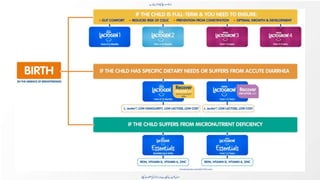
With microbiome enabling ingredients
& Iron for depleting stores
Follow-up formula
(In the absence of breastfeeding)
935-OL6-EOEE
THANK YOU
Material For Healthcare Professionals Only
BREASTFEEDING IS BEST FOR BABIES

Functional Constipation Infants & Children,nestle.pptx

  • 1.
    Functional Constipation Infants &Children Material For Healthcare Professionals Only BREASTFEEDING IS BEST FOR BABIES Dr. Hooria Rehman Assistant Professor (Pediatrician, Pediatric Gastroenterologist) Lahore General Hospital
  • 2.
    Which of thefollowing is the most common organic cause of constipation in pediatric patients? A. Hirschsprung disease B. Hypokalaemia C. Imperforate anus D. Occult spina bifida
  • 3.
    Which of thefollowing is the most common organic cause of constipation in pediatric patients? A. Hirschsprung disease B. Hypokalaemia C. Imperforate anus D. Occult spina bifida
  • 4.
    Definition Infrequent, difficult, painfulor incomplete evacuation of hard stools Functional constipation describes all children in whom constipation does not have an organic etiology. Commonly the result of withholding of feces in a child who wants to avoid painful defecation. Frequently, children will also experience recurrent episodes of fecal incontinence due to overflow caused by fecal impaction (known as encopresis).
  • 5.
    STAGES OF CONSTIPATION Three periods duringwhich the infant/ child are particularly prone to develop functional constipation. 1st: : after the introduction of cereals and solid food into the infant's diet 2nd : with toilet training 3rd: during the start of school https://www.physio-pedia.com/Pediatric_Functional_Constipation
  • 6.
    Functional Constipation • Constipationaffects up to 30 percent of children • Nearly 10% of all pediatric hospital visits can be attributable to constipation • Functional constipation is responsible for more than 95 percent of cases of constipation in healthy children one year and older and is particularly common among preschool-age children. • It causes morbidity on both a physical and psychological level https://pjmhsonline.com/index.php/pjmhs/article/view/4983/4927 https://ferozsons-labs.com/functional-constipation/
  • 7.
    Prevalence of Constipationin Different Ages https://www.becares.in/Scientific_Articles/modulating-the-gut-microbiome-to-manage-pediatric-functional-constipation
  • 8.
    Diagnostic Criteria, RomeIV for Functional Constipation Infants and toddlers up to 4 years old Children and adolescents age >4 years At least 2 of the following present for at least 1 month At least 2 of the following present at least once per week for at least 1 month  2 or fewer defecations per week  History of excessive stool retention  History of painful or hard bowel movements  History of large diameter stools  Presence of large fecal mass in the rectum *In toilet trained children  At least 1 episode/week of incontinence  History of large diameter stools that may obstruct the toilet  2 or fewer defecations per week  At least 1 episode/week of incontinence  History of retentive posturing or excessive volitional stool retention  History of painful or hard bowel movements  Presence of large fecal mass in the rectum  History of large diameter stools that may obstruct the toilet  Symptoms cannot be explained by another medical condition
  • 9.
    POTENTIAL ALARM FEATURESin Constipation
  • 10.
    CONSEQUENCES 1: http://www.cps.ca/documents/position/functional-constipation 2:http://www.ncbi.nlm.nih.gov/pmc/articles/PMC3042216/ Approximately 30%of affected children will continue to have symptoms beyond puberty contrary to the common belief that children outgrow constipation Abdominal Pain Appetite Suppression Fecal Incontinence Lowered self-esteem Social Isolation Family Disruption
  • 11.
    How to ApproachFunctional Constipation Medical History Physical Exam Digital Rectal Exam Lab Tests Abdominal Imaging Anorectal Manometry https://www.physio-pedia.com/Pediatric_Functional_Constipation
  • 12.
    Medical History &Physical Exam HISTORY • Age of onset • Passage of first meconium • Frequency and consistency of stools • Abdominal pain, Vomiting , Weight loss • Fecal incontinence, • Withholding behavior • Dietary history • Stressful life events • Neurodevelopmental delay • positive family history for gastrointestinal disease EXAMINATION  Growth Parameters  Abdominal Exam  Inspection :Perianal Region  Inspection : Lumbosacral Region  Digital Rectal Exam https://www.physio-pedia.com/Pediatric_Functional_Constipation
  • 13.
  • 14.
    Management Education • Mechanism of functionalconstipation • Toilet learning • physical & psychological components of chronic constipation, • the role of diet Fecal Disimpaction •Achieved via oral / rectal meds Behavioral Management • Establishing proper feeding time including meals and snacks • Establish regular toilet routine Dietary Management •Balanced diet that includes whole grains, fruits, and vegetables • Fiber • Adequate hydration • Eliminating Cows milk Maintenance Therapy •Laxatives •Probiotics •Lactose •Magnesium Nelson Textbook of Pediatrics, 21st Edition 2020
  • 15.
    Can The GutMicrobiome Be Modulated to Tackle Functional Constipation? Gut microbiological imbalance is an important factor associated with functional constipation.
  • 16.
    EMERGING ROLE OFPROBIOTICS • Administration of Bifidobacterium or Lactobacillus has also been shown to improve colonic transit times in constipated patients • The administration of L reuteri (DSM 17938) in infants with functional chronic constipation has a positive effect on bowel frequency. • Because of their safety profile, probiotics may be an attractive option in the treatment of functional constipation. https://www.uptodate.com/contents/chronic-functional-constipation-and-fecal-incontinence-in-infants-children-and-adolescents- treatment?search=management%20of%20functional%20constipation%20in%20toddlers&source=search_result&selectedTitle=1~30&usage_type=default&display_rank=1#H4 Coccorullo P et al” Lactobacillus reuteri (DSM 17938) in infants with functional chronic constipation: a double-blind, randomized, placebo-controlled study; J Pediatr. 2010 Oct;157(4):598-602.
  • 17.
    EMERGING ROLE OFPROBIOTICS • One RCT involved 44 infants aged ≥6 months with functional constipation according to the Rome III criteria who were randomly assigned to receive L. reuteri DSM 17938 (Limosilactobacillus reuteri)- or placebo for 8 weeks. • Compared with the placebo group, infants in the L. reuteri group had a significantly higher frequency of bowel movements at week 2 (P = 0.042), week 4 (P = 0.008), and week 8 (P = 0.027). Magdalena Urbańska and Hania Szajewska ;” The efficacy of Lactobacillus reuteri DSM 17938 in infants and children: a review of the current evidence”: Eur J Pediatr. 2014; 173(10): 1327–1337.
  • 18.
    EMERGING ROLE OFPROBIOTICS Paola Coccorullo et al”Lactobacillus reuteri (DSM 17938) in Infants with Functional Chronic Constipation: A Double-Blind, Randomized, Placebo-Controlled Study ; The Journal of Pediatrics;Volume 157, Issue 4, October 2010, Pages 598–602
  • 19.
    EMERGING ROLE OFLACTOSE It has prebiotic effects in that it is not completely absorbed in young infants It stimulates the development of bifidogenic flora, which in turn bring the stools of formula-fed infants closer to the stools of breast-fed infants Non-hydrolyzed lactose reaches the colon, where it is metabolized by anaerobic microorganisms, producing an osmotic laxative Oscar O Segarra et al ‘ Modification of stool’s water content in constipated infants: management with an adapted infant formula” Infante et al. Nutrition Journal 2011, 10:55 http://www.nutritionj.com/content/10/1/55
  • 20.
    EMERGING ROLE OFMAGNESIUM • Magnesium has an osmotic effect which draws water into gut, thus increase intestinal motility Oscar O Segarra et al ‘ Modification of stool’s water content in constipated infants: management with an adapted infant formula” Infante et al. Nutrition Journal 2011, 10:55 http://www.nutritionj.com/content/10/1/55 Magnesium Osmotic effect Intestinal Motility
  • 21.
    A 4-month-old maleinfant is brought to the emergency department by his grandmother because he has had constipation, irritability, and weakness and has been feeding poorly during the past 4 days. The grandmother has custody of the patient. She says she has been introducing many new foods to the infant on a weekly basis. On physical examination, ptosis is noted, and the patient has a weak cry. Based on these findings, which of the following is the most appropriate next step in management? A. Barium enema B. Measurement of blood lead level C. Referral for genetic testing D. Test of the stool for botulinum toxin
  • 22.
    Test of thestool for botulinum toxin. This patient has constipation in addition to other symptoms that are indicative of infant botulism, which could result from his caregiver feeding him honey before the appropriate age. Choice A is an appropriate test only if Hirschsprung disease were suspected. Choice B is an appropriate next step if lead poisoning were suspected. Choice C is an appropriate test if cystic fibrosis were suspected. A 4-month-old male infant is brought to the emergency department by his grandmother because he has had constipation, irritability, and weakness and has been feeding poorly during the past 4 days. The grandmother has custody of the patient. She says she has been introducing many new foods to the infant on a weekly basis. On physical examination, ptosis is noted, and the patient has a weak cry. Based on these findings, which of the following is the most appropriate next step in management? A. Barium enema B. Measurement of blood lead level C. Referral for genetic testing D. Test of the stool for botulinum toxin Material For Healthcare Professionals Only BREASTFEEDING IS BEST FOR BABIES
  • 23.
    With microbiome enablingingredients & Iron for depleting stores Follow-up formula (In the absence of breastfeeding) 935-OL6-EOEE
  • 26.
    THANK YOU Material ForHealthcare Professionals Only BREASTFEEDING IS BEST FOR BABIES

Editor's Notes

  • #3 Hirschsprung disease
  • #4 Hirschsprung disease
  • #7 Hirschsprung disease
  • #11 The gradual decrease in bowel movement frequency with advancing age correlates with changes in transit time and varying patterns of colonic motility 90 percent of normal newborns pass meconium within the first 24 hours of life. Breastfed infants pass a mean of three stools per day. Formula-fed infants pass a mean of two stools per day, but there is variation between formulas
  • #16 Hirschsprung disease
  • #17 The hypothesis that probiotics may have therapeutic potential for the treatment of constipation is supported by data demonstrating differences in the intestinal microbiota between healthy individuals and patients with chronic constipation