The Night Sky
Peoplehave watched the night skies for
millions of years. Some just out of
curiosity. Some out of boredom. Some
looking for portents, either good or bad.
However, the one thing that they all saw
was that there was a pattern in the way
the stars revolved around the heavens.
3.
The Night Sky
Youneed only to look up for a few hours
to begin to see these same patterns
yourself. Like the Sun, stars rise in the
east and set later in the west. Planets
follow this same pattern unless they are
in a retrograde period, though these
periods are not especially common.
4.
What You Needfor Stargazing
You don’t really need anything, but some
things are handy, like…
Complete darkness-Don’t laugh, it’s not
that easy to find. Rural area are slowly
being urbanized, bringing their lights
with them. Light pollution is a real
problem.
5.
What You Need:Darkness
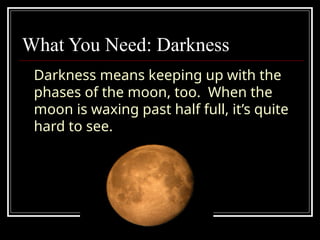
Darkness means keeping up with the
phases of the moon, too. When the
moon is waxing past half full, it’s quite
hard to see.
6.
What You Need:Star Map/
Planesphere
It is handy to have a star map to help get
you oriented.
Star Maps are also called planespheres.
You can find them in hobby stores for a
couple of bucks.
7.
Finding Polaris andWhy
Polaris (or the North Star) is where you
want to start. Because Polaris is aligned
with the Earth’s axis of rotation, it
remains fixed, with all the other planets
and stars appearing to move around it.
It is the one star that remains fixed at all
times.
8.
Getting Oriented orWhere the Heck is
North?
Yea, you have to find north. It’s where Polaris
(or North Star) is. You’ll need a compass or
major highway to orient yourself. Highway 17
is good because it runs due north and south.
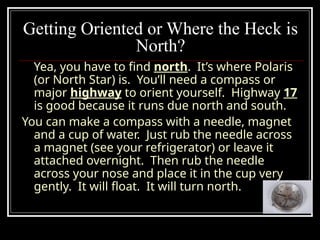
You can make a compass with a needle, magnet
and a cup of water. Just rub the needle across
a magnet (see your refrigerator) or leave it
attached overnight. Then rub the needle
across your nose and place it in the cup very
gently. It will float. It will turn north.
9.
Figuring the Angle
Onceyou’ve decided where north is (right
ascension), face in that direction. Next you
have to figure declination (up and down).
Extend your arm and make a fist. Put the
bottom of your fist on the horizon. The top of
your fist is about 80
higher. Place your other
fist on top of your first. You’ve now measured
160
up from the horizon. Polaris is located
between 250
and 300
above the horizon.
Polaris is faint, so look carefully!
10.
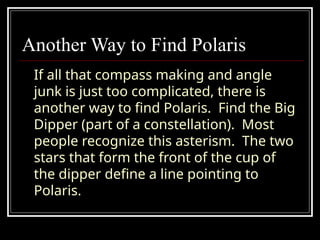
Another Way toFind Polaris
If all that compass making and angle
junk is just too complicated, there is
another way to find Polaris. Find the Big
Dipper (part of a constellation). Most
people recognize this asterism. The two
stars that form the front of the cup of
the dipper define a line pointing to
Polaris.
Now That You’reOriented, It’s Time
to Explore.
You’re pointed in the right direction, but what now.
Stars and constellations move constantly and
seasonally. What am I looking for? What you need
is a star map.
Ursa Minor
Once you’velocated Polaris, you’re
ready to identify your first
constellation. Polaris is the last star
located in the handle of the asterism,
the Little Dipper. The name of the
constellation that contains the Little
Dipper is Ursa Minor or Little Bear.
16.
Ursa Minor
UrsaMinor, also called the Little Dipper, is a
circumpolar constellation. This means it never
sets in the northern sky. The true figure
represented by the stars is the Little Bear.
There are several mythological stories behind
these famous constellations. In Greek myth,
Zeus was having an affair with the lovely
Callisto. When his wife, Hera, found out she
changed Callisto into a bear. Zeus put the bear
in the sky along with the Little Bear, which is
Callisto's son, Arcas.
Ursa Major
Ursa Majoris probably the most famous constellation,
with the exception of Orion. Also known as the Great
Bear, it has a companion called Ursa Minor, or Little Bear.
Everyone living in the Northern Hemisphere has probably
spotted the easily recognized portion of this huge
constellation. The body and tail of the bear make up what
is known as the Big Dipper.
Several different cultures saw a big bear in the sky. The
ancient Greeks had a few different stories to explain how
the animal ended up there. In one story, Hera discovered
Zeus was having an affair with Callisto and turned her
into a bear. Zeus put her in the sky along with her son,
Arcas, who became the Little Bear.
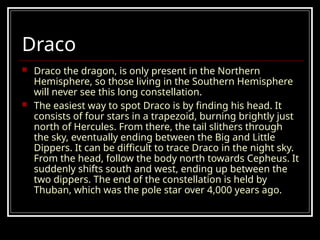
Draco
Draco thedragon, is only present in the Northern
Hemisphere, so those living in the Southern Hemisphere
will never see this long constellation.
The easiest way to spot Draco is by finding his head. It
consists of four stars in a trapezoid, burning brightly just
north of Hercules. From there, the tail slithers through
the sky, eventually ending between the Big and Little
Dippers. It can be difficult to trace Draco in the night sky.
From the head, follow the body north towards Cepheus. It
suddenly shifts south and west, ending up between the
two dippers. The end of the constellation is held by
Thuban, which was the pole star over 4,000 years ago.
Cassiopeia
Cassiopeia wasthe beautiful wife of Cepheus, king of
Ethiopia, and the mother of Andromeda. She is most
famous in connection with the myth of her daughter,
Andromeda. The queen made the mistake of bragging
she was more lovely than the Nereids, or even than Juno
herself. The goddesses were, needless to say, rather
insulted, and went to Neptune, god of the sea, to
complain. Neptune promptly sent a sea monster
(possibly Cetus?) to ravage the coast. The king and queen
were ordered to sacrifice their daughter to appease
Neptune's wrath, and would have done so had Perseus
not arrived to kill the monster in the nick of time. As a
reward, the hero was wedded to the lovely Andromeda.
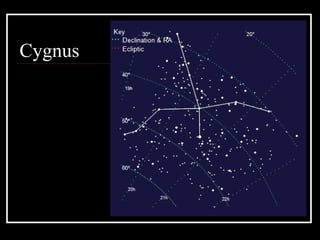
Cygnus isa constellation in the northern sky. Its name
means “the swan” in Latin, and it is most frequently
associated with the myth of Zeus and Leda. The Swan
constellation is easy to find in the sky as it features a well-
known asterism known as the Northern Cross.
Cygnus constellation is associated with several myths,
most frequently the one of the Spartan Queen Leda, who
gave birth to two sets of twins, the immortal Pollux and
Helen and mortal Castor and Clytemnestra, after being
seduced by the god Zeus, who had transformed himself
into a swan. The immortal children were fathered by the
god and the mortal ones by Leda’s husband, King
Tyndareus. Castor and Pollux are represented by the
zodiac constellation Gemini.
Cygnus
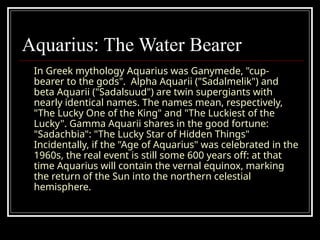
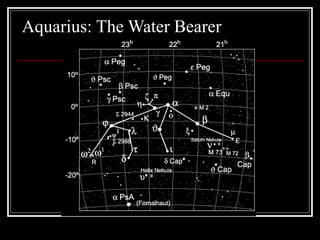
Aquarius: The WaterBearer
In Greek mythology Aquarius was Ganymede, "cup-
bearer to the gods". Alpha Aquarii ("Sadalmelik") and
beta Aquarii ("Sadalsuud") are twin supergiants with
nearly identical names. The names mean, respectively,
"The Lucky One of the King" and "The Luckiest of the
Lucky". Gamma Aquarii shares in the good fortune:
"Sadachbia": "The Lucky Star of Hidden Things"
Incidentally, if the "Age of Aquarius" was celebrated in the
1960s, the real event is still some 600 years off: at that
time Aquarius will contain the vernal equinox, marking
the return of the Sun into the northern celestial
hemisphere.
Aries: the Ram
Aries,"The Ram", is an ancient constellation which was of
considerable importance since the sun passed through it
at the vernal equinox.
This point has now moved into Pisces, but the vernal
equinox is still known as the First Point of Aries. In another
six hundred years the point will have moved into Aquarius.
The Ram in question may have been the one whose
golden fleece was the object of Jason's quest.
There is some reason to believe that the Greeks just took
over a much older horned animal at this time of the year;
the horn being a symbol for fecundity, renewal, and so
on. As the Sun came into this constellation, at the vernal
equinox, the year itself was being renewed.
Cancer The Crab
Thename comes from the Latin; cancer
means crab. The crab in question is the
one sent by Hydra to attack Heracles. It
was only a bit part, but one which
secured its immortality.
Capricornus the Sea-Goat
TheSea Goat or Goat-Fish, as a creature with
the head and body of a goat and the tail of a
fish, may well have originated from Assyro-
Babylonian depictions of their god of wisdom
Oannes, who was half-man, half-fish.
Gemini The Twins
Gemini,the Twins, are really only half-
brothers. They share the same mother (Leda)
but have different fathers. Castor's father was
a king of Sparta, Tyndareus - who would be
chased from his throne but later rescued by
Heracles (who nevertheless wound up killing
him). The father of Pollux was none other than
Zeus, or Jupiter. Zeus visited Leda on her
wedding night in the guise of a swan. Thus the
twins would be born. (In fact two twins came
from this double union, but let's not
complicate the matter even more...)
38.
Leo: The Lion
Thefirst on the list of Heracles' labors was the
task of killing the Nemean Lion, a giant beast
that roamed the hills and the streets of the
Peloponnesian villages, devouring whomever
it met. The animal's skin was impervious to
iron, bronze, and stone. Heracles' arrows
harmlessly bounced off the lion; his sword
bent in two; his wooden club smashed to
pieces. So Heracles wrestled with the beast,
finally choking it to death. He then wrapped
the lion's pelt about him; it would protect him
from the next labor: killing the poisonous
Hydra.
Libra: The Scales
Librameans "The Scales" or "Balance", so named because
when the zodiac was still in its infancy, some four
thousand years ago, the sun passed through this
constellation at the autumnal equinox (21 September). At
the two equinoxes (Spring and Autumn) the hours of
daylight and darkness are equal. As a symbol for equality,
the constellation came to represent Justice in several
middle Eastern cultures. However, the Greeks had a
different perspective; at one time Scorpius, which lies just
to the east, was much larger, and the stars that make up
Libra were then known as the Claws of the Scorpion.
Pisces: The Fish
Piscesis an ancient constellation derived, some say,
from the story of the terrible Greek god Typhon.
(This is not the Chinese word for "big wind", which -
in English - is of course spelled "typhoon". The
French, however, spell this word "typhon", which
adds to the confusion. It is possible that the
Chinese borrowed the word from the Greek. The
modern Greek equivalent is spelled "tau upsilon
phi omega nu" and means "cyclone".)
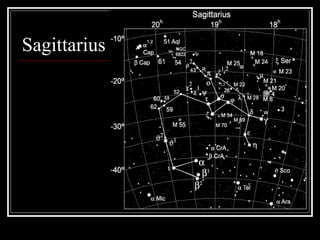
Sagittarius
It was theRomans who named the
constellation Sagittarius ("sagitta" is Latin for
`arrow'), although several stars carry Arabic
names which identify just which portion of the
constellation they represent. Sagittarius has a
muddled history. In ancient times the asterism
of three bright stars in a curved line was seen
as a bow to some, leading both Greek and
Roman writers to confuse the constellation
with Centaurus.
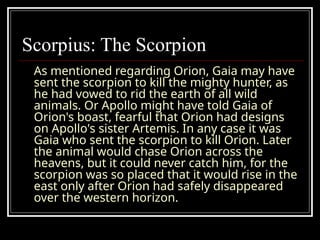
Scorpius: The Scorpion
Asmentioned regarding Orion, Gaia may have
sent the scorpion to kill the mighty hunter, as
he had vowed to rid the earth of all wild
animals. Or Apollo might have told Gaia of
Orion's boast, fearful that Orion had designs
on Apollo's sister Artemis. In any case it was
Gaia who sent the scorpion to kill Orion. Later
the animal would chase Orion across the
heavens, but it could never catch him, for the
scorpion was so placed that it would rise in the
east only after Orion had safely disappeared
over the western horizon.
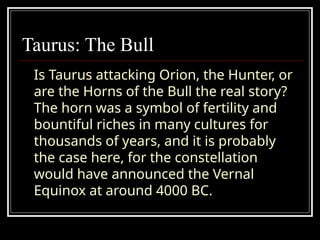
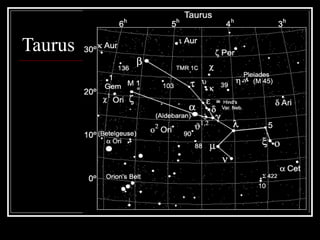
Taurus: The Bull
IsTaurus attacking Orion, the Hunter, or
are the Horns of the Bull the real story?
The horn was a symbol of fertility and
bountiful riches in many cultures for
thousands of years, and it is probably
the case here, for the constellation
would have announced the Vernal
Equinox at around 4000 BC.
Virgo: The Virgin
Virgois the second largest constellation (after
Hydra). As a member of the Zodiac, Virgo has a
number of ancient myths and tales. The Sun
passes through Virgo in mid-September, and is
therefore the constellation that announces the
harvest. Virgo is often represented as a
"maiden" (as its name indicates). In antiquity,
she may have been Isis, the Egyptian
protectress of the living and the dead and the
principal mother goddess.