Constellations:
Mythology & Science
1
What are Constellations?
Constellations are a
group of stars that
form a pattern in the
sky.
The shapes you see all
depend on your point of
view.
Stars in a constellation
are NOT close to each
other, but when viewed
from Earth they seem
to be grouped together.
2
It all depends on your point of view
Stars that seem to be
"close" to each other
actually are quite far
apart.
Depending on your
location, the same object
may appear very
different.
Consider how a car looks
from the side and from
the back.
This picture shows two
different views of the
constellation, The Big
Dipper.
Ursa Major
Earth view
Alien view?
3
Constellation List
The 48 ancient constellations single out
only the bright patterns.
From around 1600 to 1800, astronomers
invented hosts of "modern" constellations
including faint stars and those in the
southern sky that could not be seen from
classical lands.
In the early 20th century, the International
Astronomical Union (IAU) adopted 38 of
the modern constellations and drew
rectangular borders around all 88.
4
Modern List
Some constellations look like what they are supposed to
represent, but most do not. Constellations, both ancient
and modern, are generally meant to honor and represent,
not to portray.
Constellations bring order to the sky by dividing it into
smaller segments, providing a base for naming celestial
objects.
The brighter stars carry "proper names" that come
mostly from Arabic, and have Greek letters and Arabic
numbers to which are affixed the Latin possessive forms
of the constellation names, Vega, for example, also known
as "Alpha of Lyra," or "Alpha Lyrae.”
IAU also adopted three-letter abbreviations for all the
constellations and their possessives, Vega thus becoming
Alpha Lyr.
5
Accepted Constellations
6
Just a to c…
Zodiak (Ζωδιακός)
is a circle of twelve 30°
divisions of celestial
longitude that are
centered upon the ecliptic,
the apparent path of the
Sun across the celestial
sphere over the course of
the year.
Paths of the Moon and
visible planets also remain
close to the ecliptic, within
the belt of the zodiac.
Because the divisions are
regular and do not
correspond exactly to
their twelve constellations.
7
https://commons.wikimedia.org/wiki/User:Tauʻolunga
8
ZODIAC
DIVISIONS
Compass in the Sky
The sky seems to turn as
Earth rotates (around
Polaris)
Polaris: aka the North
Star, directly above the
North Pole
You can use Polaris to
figure out direction &
location
Example: If you are in
Regina at 49 ° latitude,
Polaris is at 49 °
latitude in the sky
9
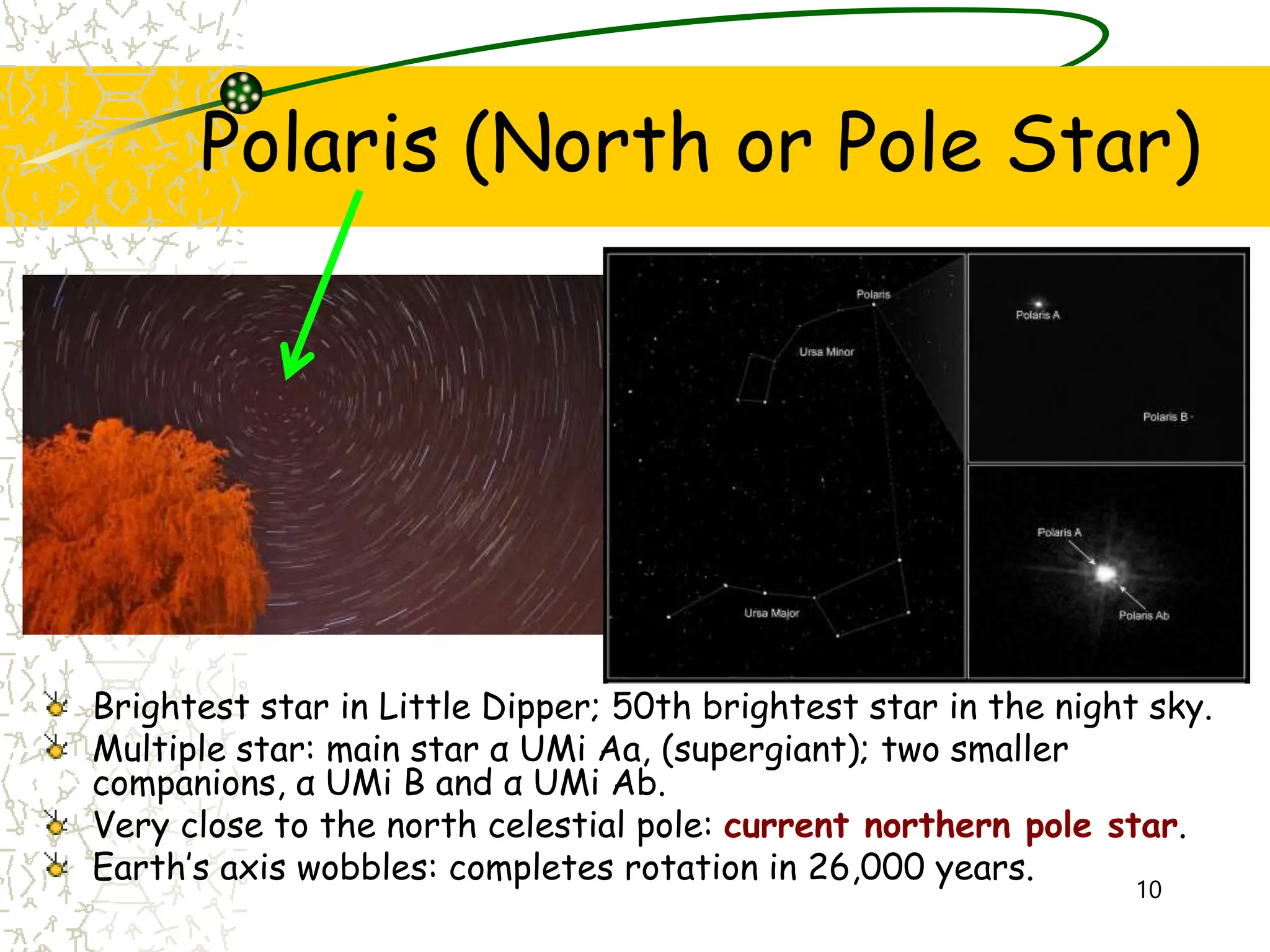
Polaris (North or Pole Star)
Brightest star in Little Dipper; 50th brightest star in the night sky.
Multiple star: main star α UMi Aa, (supergiant); two smaller
companions, α UMi B and α UMi Ab.
Very close to the north celestial pole: current northern pole star.
Earth’s axis wobbles: completes rotation in 26,000 years.
10
Circumpolar or not?
Because of the rotation of the Earth
and its orbit around the Sun, we divide
the constellations into two groups.
Some constellations never rise nor set,
and they are called circumpolar.
The rest are divided into seasonal
constellations.
Which constellations will be circumpolar
and which seasonal depends on your
latitude.
11
Northern & Southern
Constellations in the northern circumpolar sky
include Auriga, Camelopardalis, Cassiopeia,
Cepheus, Draco, Lynx, Perseus, Ursa Major, and
Ursa Minor. These constellations are always
visible in the night sky of the Northern
Hemisphere.
Constellations in the southern circumpolar sky
include Grus, Phoenix, Indus, Tucana, Pavo, Ara,
Eridanus, Hydrus, Horologium, Reticulum,
Octans, Apus, Triangulum Australe, Lupus,
Circinus, Musca, Crux, Centaurus, Carina, Vela,
Puppis, Dorado, and Chamaeleon. These
constellations are always visible in the night sky
of the Southern Hemisphere. 12
Northern Hemisphere
13
Find the Constellations
14
Homer & Constellations
Achilles shield: On it he made the
earth, and sky, and sea, the
weariless sun and the moon waxing
full, and all the constellations that
crown the heavens, Pleiades and
Hyades, the mighty Orion and the
Bear, which men also call by the
name of Wain: she wheels round in
the same place and watches for
Orion, and is the only one not to
bathe in Ocean (Iliad XVIII 486-490).
At that time constellations were
known simply as the objects or
animals which they represented--the
Lyre, for instance, or the Ram, and
not associated with myths.
15
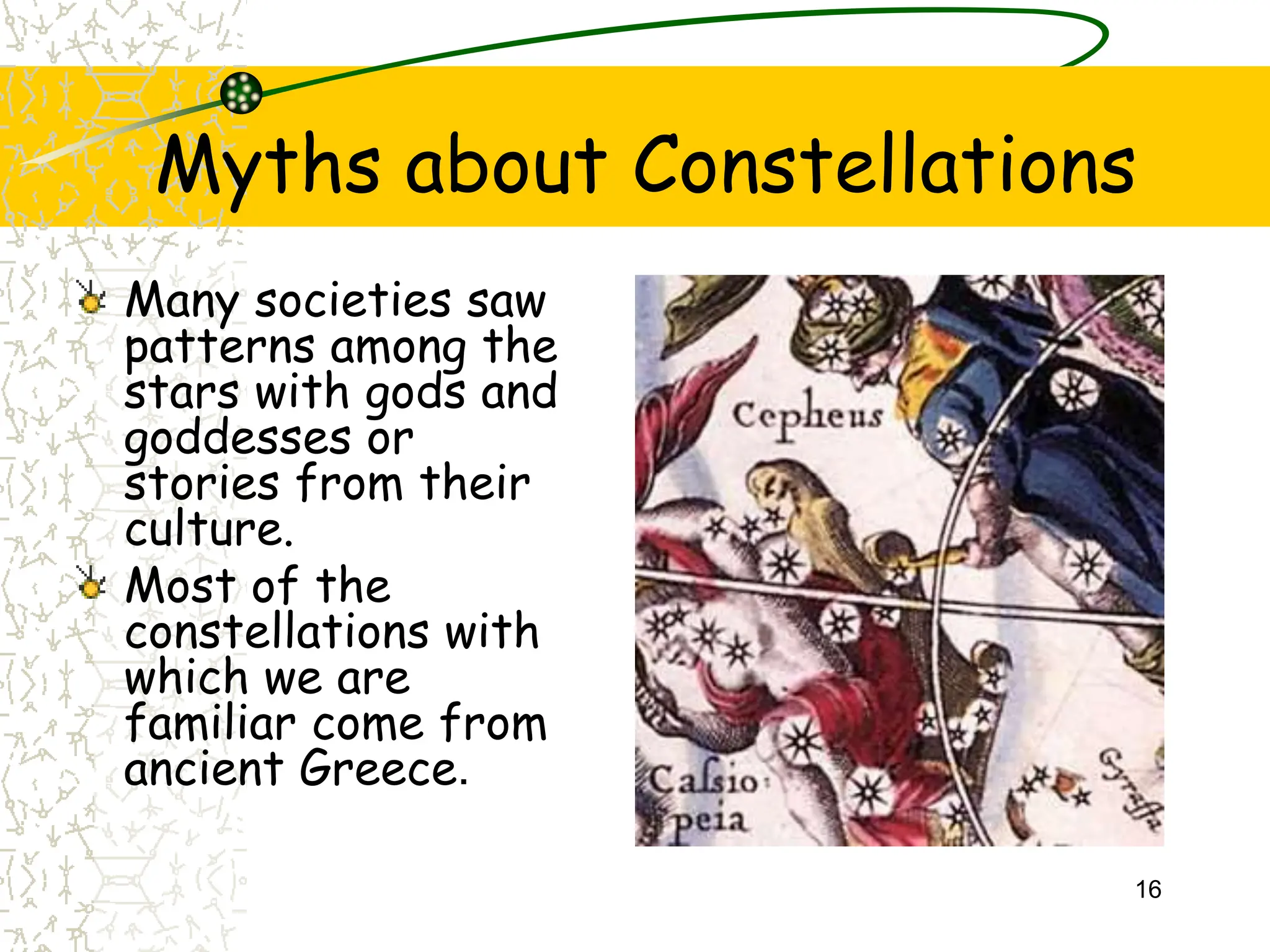
Myths about Constellations
Many societies saw
patterns among the
stars with gods and
goddesses or
stories from their
culture.
Most of the
constellations with
which we are
familiar come from
ancient Greece.
16
Greek Mythology
It is the body of myths
and teachings that
belong to the ancient
Greeks, concerning
their gods and heroes,
the nature of the
world, and the origins
and significance of
their own cult and ritual
practices.
It was a part of the
religion in ancient
Greece.
17
Greek Mythology Top Hits
18
12 Labours of Hercules
Kronos
eats his kids
Prometheus brought fire
Pandora’s
box
Ursa Major
Ursa Major (Great Bear, Big
Dipper) is probably the most
famous constellation, with the
exception of Orion. It has a
companion: Ursa Minor (Little
Bear, Little Dipper).
Most of the constellation is
circumpolar, which means it
can be viewed all year long.
However, parts of the legs will
disappear from the sky in the
fall and reappear in the
winter.
19
Ursa Major Cluster
View from
Arizona’s Kitt
Peak 90-inch
telescope.
20
Leo
The sickle-shaped
head of Leo, the
Lion, is on the
right, the triangle
that makes his his
hindquarters on
the left. Regulus
is at the bottom
of the sickle
toward lower
right.
21
Orion
Most famous seasonal constellation.
Orion's Belt makes the hunter easy to find in the night sky.
Orion Nebula - located in Orion's sword, which hangs from the belt.
– so bright, that even the naked eye can see the fuzzy patch
Nebula- birthplace of stars
22
Orion the Hunter
Orion is the master of the winter skies. He lords
over the heavens from late fall to early spring,
with his hunting dog Sirius trailing at his feet.
Many different civilizations saw this constellation
in the sky. The most famous stories come from
Greek myths.
Orion was a famed hunter, and in one story
boasted that no creature could kill him. Hera then
sent Scorpius, a scorpion to sting the hunter.
Orion smashed the animal with his club, but not
before he was poisoned. Both are now on opposite
sides of the sky. They cannot be seen at the same
time.
23
Family Business
Andromeda was the daughter
of the Aethiopian king Cepheus
and his wife Cassiopeia.
Cassiopeia boasts that
Andromeda is more beautiful
than the Nereids. Andromeda
is chained to a rock as a
sacrifice to the sea monster
Cetus sent by Poseidon, but
she is saved from death by
Perseus.
Greek Ἀνδρομέδα (Androméda):
"ruler of men”, from ἀνήρ,
ἀνδρός (anēr, andrós) "man",
and medon, "ruler".
24
Greek Rational Thought
Greek thinkers of Ionia
questioned viability of the
traditions for the Olympic
deities.
Contact with older
civilizations demonstrated
that Greek folk traditions
were naïve (deities acted
as children!)
Ignore the myths and
trust nothing but what one
can observe with one's own
senses.
Love for collecting facts
and for systematizing
phenomena on a rational
basis.
They conducted inquiries
based largely in inductive
reasoning, gathering data
through observations,
analyzing this "data", and
formulating general
conclusions from their
results.
25
Thales of Miletus: father of Greek Science
Pythagoras of Samos: a2+b2=c2
Hippocrates of Cos: father of Medicine
Democritus of Abdira: matter is atoms
Xenophanes of Colophon: only one God
Anaxagoras of Miletus: divine “nous”
History of the Idea of Critical Thinking
Critical thinking is
traceable to Socrates
2,500 years ago.
Method of probing
questioning that people
could not rationally justify
their confident claims to
knowledge.
Persons (like politicians)
may have power and high
position and yet be deeply
confused and irrational
beneath smooth but
largely empty rhetoric. 26
Socrates
Seek evidence, closely examining
reasoning and assumptions,
analyzing basic concepts, and
tracing out implications not only
of what is said but of what is
done as well.
"Socratic Questioning” is the
best known critical thinking
teaching strategy.
“Dialectic" or the process of
inquiry through reasoning debate:
a process by which the teacher
leads the student to a desired
conclusion by asking a sequence
of questions gauged to instruct
the student through the logic of
his or her own answers.
27
Greek Astronomy
Characterized by seeking a
rational, physical explanation
for celestial phenomena.
Most constellations of the
northern hemisphere derive
from Greek astronomy, as are
the names of many stars,
asteroids, and planets.
Influenced by Egyptian and
Babylonian astronomy; in turn,
it influenced Indian, Arabic-
Islamic and Western
European astronomy.
Antikythera mechanism: the
world’s first analog computer,
built in 1st/2nd century BCE.
28
MODERN ASTROPHYSICS
29
Our universe
30
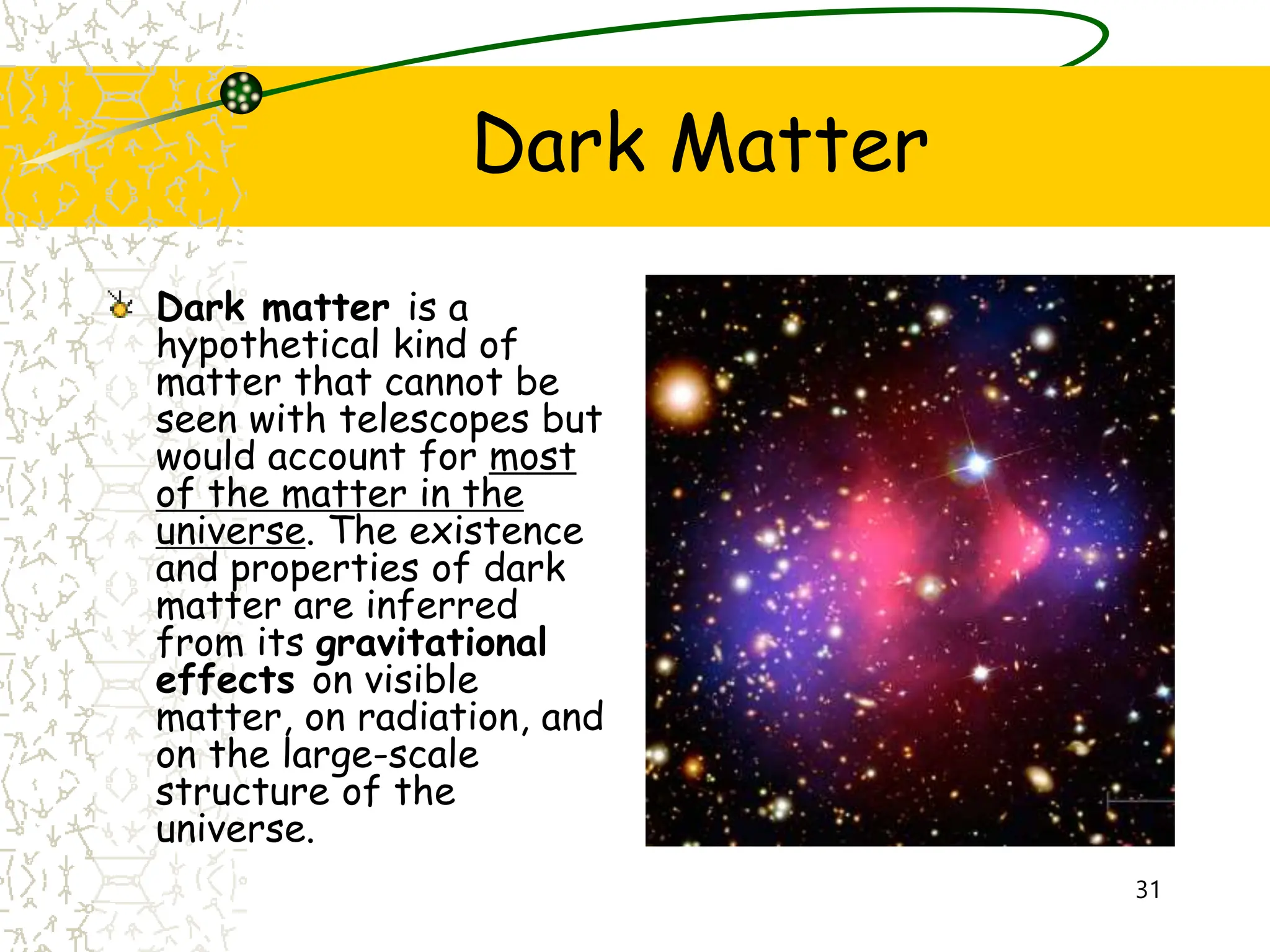
Dark Matter
Dark matter is a
hypothetical kind of
matter that cannot be
seen with telescopes but
would account for most
of the matter in the
universe. The existence
and properties of dark
matter are inferred
from its gravitational
effects on visible
matter, on radiation, and
on the large-scale
structure of the
universe.
31
Dark Energy
In physical
cosmology and
astronomy, dark
energy is an
unknown form of
energy which is
hypothesized to
permeate all of
space, tending to
accelerate the
expansion of the
universe.
32
Eίναι ακαταλαβίστικα;
Γοάζιτ αλλ γκρικ του γιού?
Was it all greek to
you?
33
What did we learn?
A constellation is a group of stars
that form a pattern in the sky
Constellations change position in the
night sky due to Earth’s rotation
Greek mythology makes for great
Hollywood movies
Stars are only a small part of the
universe.
34
THANKS FOR YOUR ATTENTION!
35
Bibliography
https://en.wikipedia.org/wiki/Greek_mythology
http://stars.astro.illinois.edu/sow/const.html
http://www.windows2universe.org/mythology/const_n
av.html
http://www.comfychair.org/~cmbell/myth/myth.html
http://web.ics.purdue.edu/~rauhn/greek_rational_thou
ght.htm
http://www.criticalthinking.org/pages/a-brief-history-
of-the-idea-of-critical-thinking/408
And many others…
36

constellations-grade8-151016222415-lva1-app6891.ppt

  • 1.
  • 2.
    What are Constellations? Constellationsare a group of stars that form a pattern in the sky. The shapes you see all depend on your point of view. Stars in a constellation are NOT close to each other, but when viewed from Earth they seem to be grouped together. 2
  • 3.
    It all dependson your point of view Stars that seem to be "close" to each other actually are quite far apart. Depending on your location, the same object may appear very different. Consider how a car looks from the side and from the back. This picture shows two different views of the constellation, The Big Dipper. Ursa Major Earth view Alien view? 3
  • 4.
    Constellation List The 48ancient constellations single out only the bright patterns. From around 1600 to 1800, astronomers invented hosts of "modern" constellations including faint stars and those in the southern sky that could not be seen from classical lands. In the early 20th century, the International Astronomical Union (IAU) adopted 38 of the modern constellations and drew rectangular borders around all 88. 4
  • 5.
    Modern List Some constellationslook like what they are supposed to represent, but most do not. Constellations, both ancient and modern, are generally meant to honor and represent, not to portray. Constellations bring order to the sky by dividing it into smaller segments, providing a base for naming celestial objects. The brighter stars carry "proper names" that come mostly from Arabic, and have Greek letters and Arabic numbers to which are affixed the Latin possessive forms of the constellation names, Vega, for example, also known as "Alpha of Lyra," or "Alpha Lyrae.” IAU also adopted three-letter abbreviations for all the constellations and their possessives, Vega thus becoming Alpha Lyr. 5
  • 6.
  • 7.
    Zodiak (Ζωδιακός) is acircle of twelve 30° divisions of celestial longitude that are centered upon the ecliptic, the apparent path of the Sun across the celestial sphere over the course of the year. Paths of the Moon and visible planets also remain close to the ecliptic, within the belt of the zodiac. Because the divisions are regular and do not correspond exactly to their twelve constellations. 7 https://commons.wikimedia.org/wiki/User:Tauʻolunga
  • 8.
  • 9.
    Compass in theSky The sky seems to turn as Earth rotates (around Polaris) Polaris: aka the North Star, directly above the North Pole You can use Polaris to figure out direction & location Example: If you are in Regina at 49 ° latitude, Polaris is at 49 ° latitude in the sky 9
  • 10.
    Polaris (North orPole Star) Brightest star in Little Dipper; 50th brightest star in the night sky. Multiple star: main star α UMi Aa, (supergiant); two smaller companions, α UMi B and α UMi Ab. Very close to the north celestial pole: current northern pole star. Earth’s axis wobbles: completes rotation in 26,000 years. 10
  • 11.
    Circumpolar or not? Becauseof the rotation of the Earth and its orbit around the Sun, we divide the constellations into two groups. Some constellations never rise nor set, and they are called circumpolar. The rest are divided into seasonal constellations. Which constellations will be circumpolar and which seasonal depends on your latitude. 11
  • 12.
    Northern & Southern Constellationsin the northern circumpolar sky include Auriga, Camelopardalis, Cassiopeia, Cepheus, Draco, Lynx, Perseus, Ursa Major, and Ursa Minor. These constellations are always visible in the night sky of the Northern Hemisphere. Constellations in the southern circumpolar sky include Grus, Phoenix, Indus, Tucana, Pavo, Ara, Eridanus, Hydrus, Horologium, Reticulum, Octans, Apus, Triangulum Australe, Lupus, Circinus, Musca, Crux, Centaurus, Carina, Vela, Puppis, Dorado, and Chamaeleon. These constellations are always visible in the night sky of the Southern Hemisphere. 12
  • 13.
  • 14.
  • 15.
    Homer & Constellations Achillesshield: On it he made the earth, and sky, and sea, the weariless sun and the moon waxing full, and all the constellations that crown the heavens, Pleiades and Hyades, the mighty Orion and the Bear, which men also call by the name of Wain: she wheels round in the same place and watches for Orion, and is the only one not to bathe in Ocean (Iliad XVIII 486-490). At that time constellations were known simply as the objects or animals which they represented--the Lyre, for instance, or the Ram, and not associated with myths. 15
  • 16.
    Myths about Constellations Manysocieties saw patterns among the stars with gods and goddesses or stories from their culture. Most of the constellations with which we are familiar come from ancient Greece. 16
  • 17.
    Greek Mythology It isthe body of myths and teachings that belong to the ancient Greeks, concerning their gods and heroes, the nature of the world, and the origins and significance of their own cult and ritual practices. It was a part of the religion in ancient Greece. 17
  • 18.
    Greek Mythology TopHits 18 12 Labours of Hercules Kronos eats his kids Prometheus brought fire Pandora’s box
  • 19.
    Ursa Major Ursa Major(Great Bear, Big Dipper) is probably the most famous constellation, with the exception of Orion. It has a companion: Ursa Minor (Little Bear, Little Dipper). Most of the constellation is circumpolar, which means it can be viewed all year long. However, parts of the legs will disappear from the sky in the fall and reappear in the winter. 19
  • 20.
    Ursa Major Cluster Viewfrom Arizona’s Kitt Peak 90-inch telescope. 20
  • 21.
    Leo The sickle-shaped head ofLeo, the Lion, is on the right, the triangle that makes his his hindquarters on the left. Regulus is at the bottom of the sickle toward lower right. 21
  • 22.
    Orion Most famous seasonalconstellation. Orion's Belt makes the hunter easy to find in the night sky. Orion Nebula - located in Orion's sword, which hangs from the belt. – so bright, that even the naked eye can see the fuzzy patch Nebula- birthplace of stars 22
  • 23.
    Orion the Hunter Orionis the master of the winter skies. He lords over the heavens from late fall to early spring, with his hunting dog Sirius trailing at his feet. Many different civilizations saw this constellation in the sky. The most famous stories come from Greek myths. Orion was a famed hunter, and in one story boasted that no creature could kill him. Hera then sent Scorpius, a scorpion to sting the hunter. Orion smashed the animal with his club, but not before he was poisoned. Both are now on opposite sides of the sky. They cannot be seen at the same time. 23
  • 24.
    Family Business Andromeda wasthe daughter of the Aethiopian king Cepheus and his wife Cassiopeia. Cassiopeia boasts that Andromeda is more beautiful than the Nereids. Andromeda is chained to a rock as a sacrifice to the sea monster Cetus sent by Poseidon, but she is saved from death by Perseus. Greek Ἀνδρομέδα (Androméda): "ruler of men”, from ἀνήρ, ἀνδρός (anēr, andrós) "man", and medon, "ruler". 24
  • 25.
    Greek Rational Thought Greekthinkers of Ionia questioned viability of the traditions for the Olympic deities. Contact with older civilizations demonstrated that Greek folk traditions were naïve (deities acted as children!) Ignore the myths and trust nothing but what one can observe with one's own senses. Love for collecting facts and for systematizing phenomena on a rational basis. They conducted inquiries based largely in inductive reasoning, gathering data through observations, analyzing this "data", and formulating general conclusions from their results. 25 Thales of Miletus: father of Greek Science Pythagoras of Samos: a2+b2=c2 Hippocrates of Cos: father of Medicine Democritus of Abdira: matter is atoms Xenophanes of Colophon: only one God Anaxagoras of Miletus: divine “nous”
  • 26.
    History of theIdea of Critical Thinking Critical thinking is traceable to Socrates 2,500 years ago. Method of probing questioning that people could not rationally justify their confident claims to knowledge. Persons (like politicians) may have power and high position and yet be deeply confused and irrational beneath smooth but largely empty rhetoric. 26
  • 27.
    Socrates Seek evidence, closelyexamining reasoning and assumptions, analyzing basic concepts, and tracing out implications not only of what is said but of what is done as well. "Socratic Questioning” is the best known critical thinking teaching strategy. “Dialectic" or the process of inquiry through reasoning debate: a process by which the teacher leads the student to a desired conclusion by asking a sequence of questions gauged to instruct the student through the logic of his or her own answers. 27
  • 28.
    Greek Astronomy Characterized byseeking a rational, physical explanation for celestial phenomena. Most constellations of the northern hemisphere derive from Greek astronomy, as are the names of many stars, asteroids, and planets. Influenced by Egyptian and Babylonian astronomy; in turn, it influenced Indian, Arabic- Islamic and Western European astronomy. Antikythera mechanism: the world’s first analog computer, built in 1st/2nd century BCE. 28
  • 29.
  • 30.
  • 31.
    Dark Matter Dark matteris a hypothetical kind of matter that cannot be seen with telescopes but would account for most of the matter in the universe. The existence and properties of dark matter are inferred from its gravitational effects on visible matter, on radiation, and on the large-scale structure of the universe. 31
  • 32.
    Dark Energy In physical cosmologyand astronomy, dark energy is an unknown form of energy which is hypothesized to permeate all of space, tending to accelerate the expansion of the universe. 32
  • 33.
    Eίναι ακαταλαβίστικα; Γοάζιτ αλλγκρικ του γιού? Was it all greek to you? 33
  • 34.
    What did welearn? A constellation is a group of stars that form a pattern in the sky Constellations change position in the night sky due to Earth’s rotation Greek mythology makes for great Hollywood movies Stars are only a small part of the universe. 34
  • 35.
    THANKS FOR YOURATTENTION! 35
  • 36.