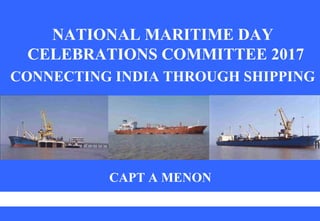
NATIONAL MARITIME DAY
CELEBRATIONS COMMITTEE 2017
CONNECTING INDIA THROUGH SHIPPING
CAPT A MENON
• NATIONAL MARITIME DAY: 5TH
APRIL
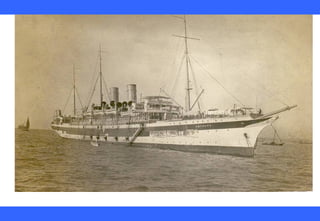
• On this day in 1919 navigation history was
created when SS LOYALTY, the first
Indian Flagged ship of The Scindia Steam
Navigation Co Ltd., journeyed from
Bombay to London.
• For the Indian Shipping Industry it has
been a steady uptrend since then.
• Currently, India has 12 major and 200
notified minor and intermediate ports.
Cargo traffic, which recorded 1,052
Million Metric Tonnes (MMT) in 2015, is
expected to reach 1,758 MMT by 2017
• India’s Ancient and Great Maritime
History
• As early as 3000 BC, a maritime trade
network that incorporated the use of
compasses, planked ships, and trained
navigators that reached parts of western
Asia, Mesopotamia, Africa, and other ports
far beyond their borders. India was then
the light of the world.
An ancient engraving showing an Indian ship
during the Vedic times 1500 to 500 BC.
By the sixth century the Shipping Industry in
India was well developed. Big ships were
built. They could carry anywhere upwards
from 500 men on the high seas.
The Rajavalliya says that the ship in which King
Sinhaba of Bengal (ca. sixth century BCE] sent
Prince Vijaya, accommodated full 700
passengers.
• The ship in which Vijaya’s Pandyan bride was
brought over to Lanka carried 800 passengers
on board. The ship in which the Buddha made
his voyages from Bharukachha (Broach) to the
‘sea of the seven gems’ [Sri Lanka], carried 700
merchants besides himself.
• The Samuddha Vanija Jakarta mentions a ship
that accommodated one thousand carpenters."
Historian Nicolo Conti says: “The natives
of India build some ships larger than ours,
capable of containing 2,000 butts, and with
five sails and as many masts. The lower
part is constructed with triple planks, in
order to withstand the force of the
tempests, to which they are much exposed.
Ships were strong and sturdy”
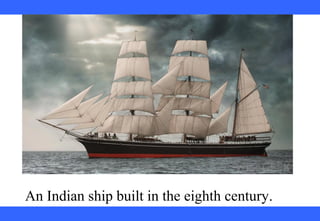
An Indian ship built in the eighth century.
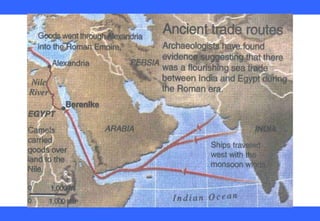
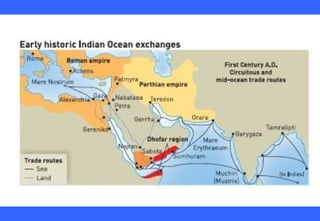
• There was an increase in Roman trade with
India following the Roman annexation of
Egypt. By the time of Augustus up to 120
ships were setting sail every year from Myos
Hormos to India.
• As trade between India and the world increased
spices took over from silk to become the main
import from India to the West.
• The Indian connection with SE Asia proved
vital to the merchants there during the 7th–8th
century.
• Indians were the first settlers in Australia from
4200 years ago. 11 percent of Aboriginal DNA
is of Indian descent.
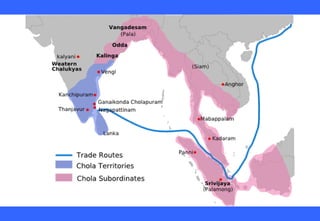
• In the period of 984-1042 CE, the Chola kings
dispatched great naval expeditions which
occupied parts of Burma, Malaya and
Sumatra, while suppressing the piratical
activities of the Sumatra warlords.
• In 1292 CE, when Marco Polo came to India,
he described Indian ships as “built of fir
timber, having a sheath of boards laid over the
planking in every part, caulked with iron nails.
• By the tenth century India had ships were so
huge that about 300 boatmen were needed
to row them. About 3000-4000 gunny bags
could be loaded in each ship. They had many
small rooms for people to live in. These rooms
had arrangements for all kinds of comfort.
• Many Indian ships were built in compartments
so that even if one part was shattered, the next
remained intact, thus enabling the ship to
complete her voyage.
• Today we know it as Subdivision of vessels,
SOLAS, 1974, Chapter II-1 .
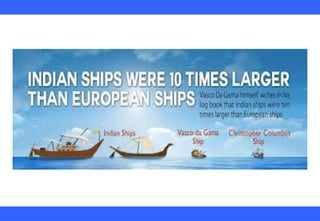
• When the westerners made contact with India,
they were amazed to see their ships. Until the
17th
century, European ships were a maximum
of 600 tonnes. But in India, they saw such big
ships as the Gogha, which was more than
1500 tonnes.
• The Dariya Daulat, built in India which
worked for 87 years without any repairs.
• Indian ships were superior to their British
counterparts both in design and durability. This
so agitated British ship builders on the River
Thames that they protested against the use of
Indian built ships to carry trade from England.
• Consequently, active measures were adopted
to cripple the Indian shipbuilding industries.
This was perhaps the beginning of the end
of Indian shipbuilding.
• THE CURRENT SCENARIO:
• India has a large merchant shipping fleet
and ranked 17th among the developing
countries with average age of the fleet
being 18.03 years.
• India shares only 0.5 % of the global
shipping market.
• CONNECTING INDIA: THE FUTURE
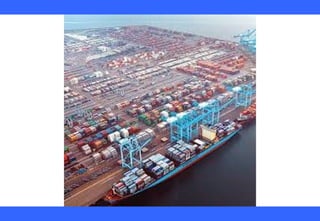
• India's largest container handling port
Jawaharlal Nehru Port Trust (JNPT) has
signed an agreement to raise US$ 400 million
from State Bank of India and Development
Bank of Singapore, to improve the
infrastructure required for doubling its
existing capacity to 9.85 million TEUs
annually.
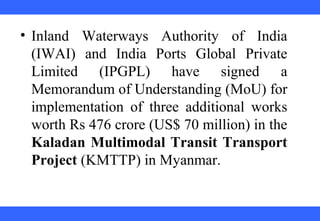
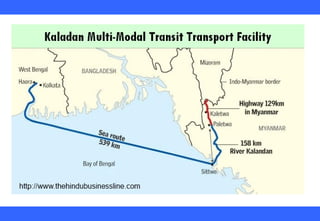
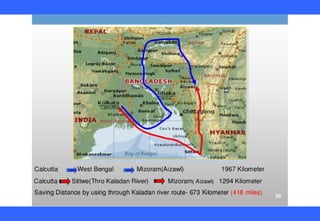
• Inland Waterways Authority of India
(IWAI) and India Ports Global Private
Limited (IPGPL) have signed a
Memorandum of Understanding (MoU) for
implementation of three additional works
worth Rs 476 crore (US$ 70 million) in the
Kaladan Multimodal Transit Transport
Project (KMTTP) in Myanmar.


•   The Maritime India Summit 2016, which 
was  held  in  Mumbai  between  14th-16th 
April,  attracted  investments  worth  Rs 
82,905  crore  (US$  12.18  billion)  across 
141  memorandum  of  understanding 
(MOU)  and  business  agreements,  which 
were  signed  by  various  players  in  the 
maritime sector


• JM  Baxi  Group  has  initiated  talks  with 
Private  Equity  (PE)  funds  to  raise  around 
US$  150-200  million,  for  enhancing port
terminals and container handling facilities.
• DP  World  Pvt.  Ltd,  world’s  fourth  biggest 
container port operator, plans to invest over 
US$1  billion  in  India,  for  augmenting its
port-related operations.


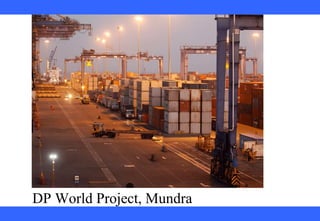
DP World Project, Mundra 


• Jindal  ITF  plans  to  invest  nearly  Rs  500 
crore  (US$  73.48  million)  to  further 
transloading operations in Haldia. 
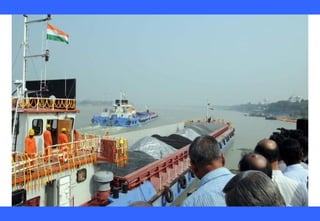
• The  company,  which  already  transports 
imported coal in barges to NTPC's power 
plants in Farakka and Kahalgaon from the 
Sandheads, plans to transload cargo at the 
deep-drafted  location  at  Kanika Sands
and transport it to Haldia.


• AN  MoU  has  been  signed  between  the 
IWAI  and  Dedicated  Freight  Corridor 
Corporation  of  India  (DFCCIL)  to  create 
logistics hubs with rail connectivity at
Varanasi and other places on national
waterways. 
• Thus will provide a seamless, efficient and 
cost-effective cargo transportation solution 
between land and sea.


Construction of the Dedicated Freight Corridor 


• The Visakhapatnam Port Trust (VPT) has 
outlined  an  Rs  3,000  crore  (US$  440.9 
million)  expansion-cum-modernisation 
plan aimed at enhancing the port's capacity 
by nearly 50 per cent. 


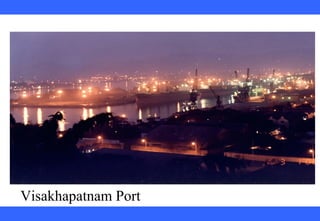
Visakhapatnam Port 


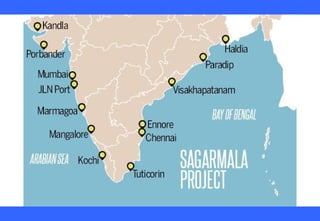
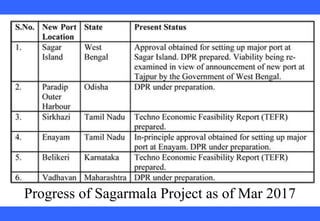
Progress of Sagarmala Project as of Mar 2017


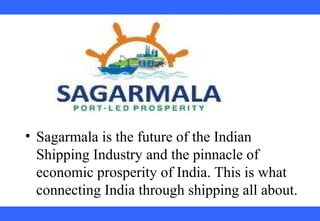
• Sagarmala is the future of the Indian 
Shipping Industry and the pinnacle of 
economic prosperity of India. This is what 
connecting India through shipping all about.


• CHALLENGES TROUBLING THE
INDIAN SHIPPING INDUSTRY
1. Low demand and oversupply
• Demand  from  China,  the  world’s  largest 
importer  of  bulk  commodities  is  slowing 
down,  more  quickly  than  expected.  And 
adding  to  the  existing  troubles  is  the 
delivery of ships whose orders were placed 
before the financial crisis. 


Vessel capacity growth continues to outdo 
demand  that  causes  low  freight  rates 
and affects the market.
• On  the  other  hand,  vessel  valuations 
have  dropped  and  prices  for  scrap 
metal  remain  very  low.  As  a  result, 
many vessel owners have preferred to 
hold  on  to  their  ships  in  wait  for  a 
better future.


2. Governance Issues
-  Major  ports  are  managed  by  the  Central 
Gove  while  minor  ports  are  managerd  by 
State Govt – This leads to disco-ordination.
 - Single National maritime Authority of India.
3. Connectivity
- Rail  –  road  –  inland  waterways  linkage  is 
poor.  To  counter  this,  the  Govt  has  set  up 
Indian port Rail Corp (MoS)


4. Port led Industrialization:
- Poor but huge scope for improvement
- Govt  has  identified  27  potential  coastal 
industrial  corridors  across  three  sectors  – 
energy, material & manufacturing
5. Modernization of ports:
- Siltation  n  poor  dredging,  lack  of 
mechanization of cargo handling facilities, 
congestion & lack of future roadmap


- Dedicated Freight Corridor, 100% FDI in 
port sector, Tax holidays, Building smaller 
ports along the coast and reviving inland 
waterways to ease the load on highways and 
railroads and facilitate regional trade.
Coastal Community:
-  Coastal townships with modern facilities 
need to be created


Thus  we  see  that  a  lot  is  being  done. 
Initiatives are being taken both by the Govt 
and the Industry. PPP is a fantastic route for 
infrastructural development.
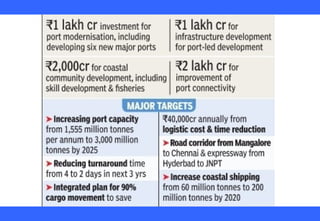
Sagarmala  project  has  huge  potential  with 
projected  investments  of  more  than  Rs 
400,000 crore.
The future of Indian Shipping is bright!


Thus the road is long but the future is bright.
• The woods are lovely, dark and deep.
But I have promises to keep, and miles
to go before I sleep and miles to go
before I sleep
- Robert Frost


THANK YOU

Connecting india nmdcc 2017

  • 1.
    NATIONAL MARITIME DAY CELEBRATIONSCOMMITTEE 2017 CONNECTING INDIA THROUGH SHIPPING CAPT A MENON
  • 2.
    • NATIONAL MARITIMEDAY: 5TH APRIL • On this day in 1919 navigation history was created when SS LOYALTY, the first Indian Flagged ship of The Scindia Steam Navigation Co Ltd., journeyed from Bombay to London.
  • 4.
    • For theIndian Shipping Industry it has been a steady uptrend since then. • Currently, India has 12 major and 200 notified minor and intermediate ports. Cargo traffic, which recorded 1,052 Million Metric Tonnes (MMT) in 2015, is expected to reach 1,758 MMT by 2017
  • 5.
    • India’s Ancientand Great Maritime History • As early as 3000 BC, a maritime trade network that incorporated the use of compasses, planked ships, and trained navigators that reached parts of western Asia, Mesopotamia, Africa, and other ports far beyond their borders. India was then the light of the world.
  • 6.
    An ancient engravingshowing an Indian ship during the Vedic times 1500 to 500 BC.
  • 7.
    By the sixthcentury the Shipping Industry in India was well developed. Big ships were built. They could carry anywhere upwards from 500 men on the high seas. The Rajavalliya says that the ship in which King Sinhaba of Bengal (ca. sixth century BCE] sent Prince Vijaya, accommodated full 700 passengers.
  • 8.
    • The shipin which Vijaya’s Pandyan bride was brought over to Lanka carried 800 passengers on board. The ship in which the Buddha made his voyages from Bharukachha (Broach) to the ‘sea of the seven gems’ [Sri Lanka], carried 700 merchants besides himself. • The Samuddha Vanija Jakarta mentions a ship that accommodated one thousand carpenters."
  • 9.
    Historian Nicolo Contisays: “The natives of India build some ships larger than ours, capable of containing 2,000 butts, and with five sails and as many masts. The lower part is constructed with triple planks, in order to withstand the force of the tempests, to which they are much exposed. Ships were strong and sturdy”
  • 10.
    An Indian shipbuilt in the eighth century.
  • 11.
    • There wasan increase in Roman trade with India following the Roman annexation of Egypt. By the time of Augustus up to 120 ships were setting sail every year from Myos Hormos to India.
  • 14.
    • As tradebetween India and the world increased spices took over from silk to become the main import from India to the West. • The Indian connection with SE Asia proved vital to the merchants there during the 7th–8th century. • Indians were the first settlers in Australia from 4200 years ago. 11 percent of Aboriginal DNA is of Indian descent.
  • 15.
    • In theperiod of 984-1042 CE, the Chola kings dispatched great naval expeditions which occupied parts of Burma, Malaya and Sumatra, while suppressing the piratical activities of the Sumatra warlords. • In 1292 CE, when Marco Polo came to India, he described Indian ships as “built of fir timber, having a sheath of boards laid over the planking in every part, caulked with iron nails.
  • 17.
    • By thetenth century India had ships were so huge that about 300 boatmen were needed to row them. About 3000-4000 gunny bags could be loaded in each ship. They had many small rooms for people to live in. These rooms had arrangements for all kinds of comfort.
  • 18.
    • Many Indianships were built in compartments so that even if one part was shattered, the next remained intact, thus enabling the ship to complete her voyage. • Today we know it as Subdivision of vessels, SOLAS, 1974, Chapter II-1 .
  • 20.
    • When thewesterners made contact with India, they were amazed to see their ships. Until the 17th century, European ships were a maximum of 600 tonnes. But in India, they saw such big ships as the Gogha, which was more than 1500 tonnes. • The Dariya Daulat, built in India which worked for 87 years without any repairs.
  • 21.
    • Indian shipswere superior to their British counterparts both in design and durability. This so agitated British ship builders on the River Thames that they protested against the use of Indian built ships to carry trade from England. • Consequently, active measures were adopted to cripple the Indian shipbuilding industries. This was perhaps the beginning of the end of Indian shipbuilding.
  • 22.
    • THE CURRENTSCENARIO: • India has a large merchant shipping fleet and ranked 17th among the developing countries with average age of the fleet being 18.03 years. • India shares only 0.5 % of the global shipping market.
  • 23.
    • CONNECTING INDIA:THE FUTURE • India's largest container handling port Jawaharlal Nehru Port Trust (JNPT) has signed an agreement to raise US$ 400 million from State Bank of India and Development Bank of Singapore, to improve the infrastructure required for doubling its existing capacity to 9.85 million TEUs annually.
  • 25.
    • Inland WaterwaysAuthority of India (IWAI) and India Ports Global Private Limited (IPGPL) have signed a Memorandum of Understanding (MoU) for implementation of three additional works worth Rs 476 crore (US$ 70 million) in the Kaladan Multimodal Transit Transport Project (KMTTP) in Myanmar.
  • 27.
  • 28.
                        •   The Maritime India Summit 2016, which  was  held in  Mumbai  between  14th-16th  April,  attracted  investments  worth  Rs  82,905  crore  (US$  12.18  billion)  across  141  memorandum  of  understanding  (MOU)  and  business  agreements,  which  were  signed  by  various  players  in  the  maritime sector
  • 29.
                        • JM  Baxi Group  has  initiated  talks  with  Private  Equity  (PE)  funds  to  raise  around  US$  150-200  million,  for  enhancing port terminals and container handling facilities. • DP  World  Pvt.  Ltd,  world’s  fourth  biggest  container port operator, plans to invest over  US$1  billion  in  India,  for  augmenting its port-related operations.
  • 30.
  • 31.
                        • Jindal  ITF plans  to  invest  nearly  Rs  500  crore  (US$  73.48  million)  to  further  transloading operations in Haldia.  • The  company,  which  already  transports  imported coal in barges to NTPC's power  plants in Farakka and Kahalgaon from the  Sandheads, plans to transload cargo at the  deep-drafted  location  at  Kanika Sands and transport it to Haldia.
  • 32.
  • 33.
                        • AN  MoU has  been  signed  between  the  IWAI  and  Dedicated  Freight  Corridor  Corporation  of  India  (DFCCIL)  to  create  logistics hubs with rail connectivity at Varanasi and other places on national waterways.  • Thus will provide a seamless, efficient and  cost-effective cargo transportation solution  between land and sea.
  • 34.
  • 35.
                        • The Visakhapatnam Port Trust (VPT) has  outlined  an Rs  3,000  crore  (US$  440.9  million)  expansion-cum-modernisation  plan aimed at enhancing the port's capacity  by nearly 50 per cent. 
  • 36.
  • 37.
  • 38.
  • 39.
  • 40.
  • 41.
  • 42.
  • 43.
                        • CHALLENGES TROUBLINGTHE INDIAN SHIPPING INDUSTRY 1. Low demand and oversupply • Demand  from  China,  the  world’s  largest  importer  of  bulk  commodities  is  slowing  down,  more  quickly  than  expected.  And  adding  to  the  existing  troubles  is  the  delivery of ships whose orders were placed  before the financial crisis. 
  • 44.
                        Vessel capacity growth continues to outdo  demand  that  causes low  freight  rates  and affects the market. • On  the  other  hand,  vessel  valuations  have  dropped  and  prices  for  scrap  metal  remain  very  low.  As  a  result,  many vessel owners have preferred to  hold  on  to  their  ships  in  wait  for  a  better future.
  • 45.
                        2. Governance Issues - Major  ports  are  managed  by  the  Central  Gove  while  minor  ports  are  managerd  by  State Govt – This leads to disco-ordination.  - Single National maritime Authority of India. 3. Connectivity - Rail  –  road  –  inland  waterways  linkage  is  poor.  To  counter  this,  the  Govt  has  set  up  Indian port Rail Corp (MoS)
  • 46.
                        4. Port ledIndustrialization: - Poor but huge scope for improvement - Govt  has  identified  27  potential  coastal  industrial  corridors  across  three  sectors  –  energy, material & manufacturing 5. Modernization of ports: - Siltation  n  poor  dredging,  lack  of  mechanization of cargo handling facilities,  congestion & lack of future roadmap
  • 47.
  • 48.
                        Thus  we  see that  a  lot  is  being  done.  Initiatives are being taken both by the Govt  and the Industry. PPP is a fantastic route for  infrastructural development. Sagarmala  project  has  huge  potential  with  projected  investments  of  more  than  Rs  400,000 crore. The future of Indian Shipping is bright!
  • 49.
                        Thus the road is long but the future is bright. • The woodsare lovely, dark and deep. But I have promises to keep, and miles to go before I sleep and miles to go before I sleep - Robert Frost
  • 50.