www.brilliantnoise.com | @la_pope
Friends of Search
Connected content
planning
11th February 2016
Agenda
- Connecting with the customer
- Connecting your communications
- Connecting your organisation
- Putting these ideas into practice
What I’m
going to
talk
about…
© Brilliant Noise 2016
Dupain Charles CC BY ND 2.0
There are lots
of dots to
connect when
it comes to
content…
© Brilliant Noise 2016
Brilliant Noise:
Fast change,
lasting impact.
© Brilliant Noise 2016
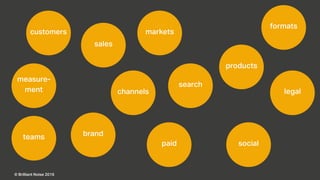
customers
brand
products
teams
channels
formats
markets
paid
search
social
legal
sales
measure-
ment
a-j clicks CC BY ND 2.0
…so many,
that it often
feels easier
not to connect
them at all.
© Brilliant Noise 2016
Giulian Frisoni CC BY 2.0
But that won’t 
build an
efficient,
scaleable, and
successful
content
programme.
© Brilliant Noise 2016
Your customers are more
connected than ever.
And they expect your brand to be
more connected too, with their
needs, their habits and their
experiences.
© Brilliant Noise 2016
Brilliant Noise:
Fast change,
lasting impact.
How?
Connected
content planning
© Brilliant Noise 2016
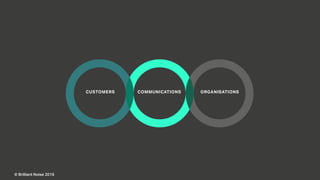
CUSTOMERS COMMUNICATIONS ORGANISATIONS
© Brilliant Noise 2016
CUSTOMERS COMMUNICATIONS ORGANISATIONS
© Brilliant Noise 2016
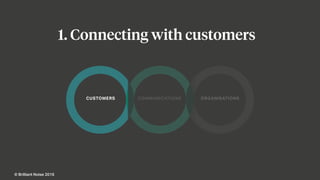
1. Connecting with customers
Rosmarie Voegtli, CC BY 2.0
Connect with
your customer:
move from
messages to
relationships
© Brilliant Noise 2016
Connecting with the customer
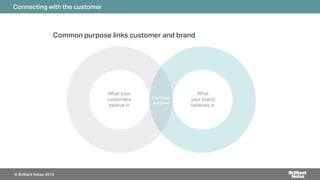
Common purpose links customer and brand
© Brilliant Noise 2016
Connecting with the customer
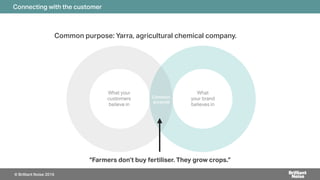
Common purpose: Yarra, agricultural chemical company.
“Farmers don’t buy fertiliser. They grow crops.”
© Brilliant Noise 2016
CUSTOMERS COMMUNICATIONS ORGANISATIONS
© Brilliant Noise 2016
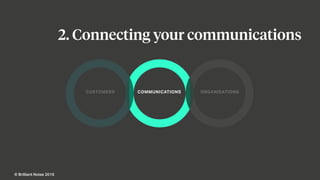
2. Connecting your communications
Brewbooks CC BY SA 2.0
Connect your
communications:
provide the right
content to the
right user at the
right time
© Brilliant Noise 2016
Models for connected
content planning
Connecting your communications
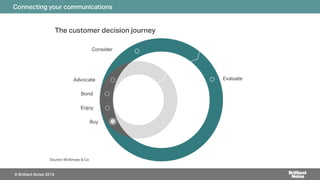
The customer decision journey
© Brilliant Noise 2016
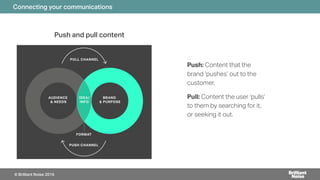
Push and pull content
Connecting your communications
Push: Content that the
brand ‘pushes’ out to the
customer.
Pull: Content the user ‘pulls’
to them by searching for it,
or seeking it out.
AUDIENCE
& NEEDS
BRAND
& PURPOSE
FORMAT
PUSH CHANNEL
PULL CHANNEL
IDEA�
INFO
© Brilliant Noise 2016
Connecting your communications
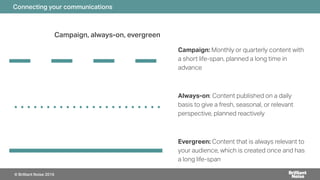
Campaign: Monthly or quarterly content with
a short life-span, planned a long time in
advance
Always-on: Content published on a daily
basis to give a fresh, seasonal, or relevant
perspective, planned reactively
Evergreen: Content that is always relevant to
your audience, which is created once and has
a long life-span
Campaign, always-on, evergreen
© Brilliant Noise 2016
Connecting your communications
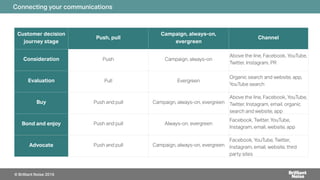
Heading 2
Customer decision
journey stage
Push, pull
Campaign, always-on,
evergreen
Channel
Consideration Push Campaign, always-on
Above the line, Facebook, YouTube,
Twitter, Instagram, PR
Evaluation Pull Evergreen
Organic search and website, app,
YouTube search
Buy Push and pull Campaign, always-on, evergreen
Above the line, Facebook, YouTube,
Twitter, Instagram, email, organic
search and website, app
Bond and enjoy Push and pull Always-on, evergreen
Facebook, Twitter, YouTube,
Instagram, email, website, app
Advocate Push and pull Campaign, always-on, evergreen
Facebook, YouTube, Twitter,
Instagram, email, website, third
party sites
© Brilliant Noise 2016
How do you use these
models to plan connected
content?
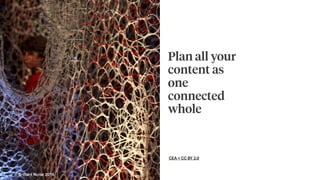
CEA + CC BY 2.0
Plan all your
content as
one
connected
whole
© Brilliant Noise 2016
A connected content
planning method
Ideal if you have lots of stakeholders and/or siloed teams
working on content in insolation.
It works for 5-30 participants.
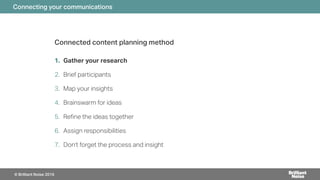
Connected content planning method
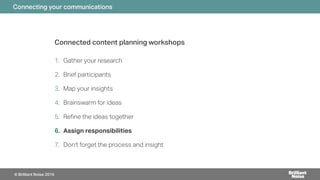
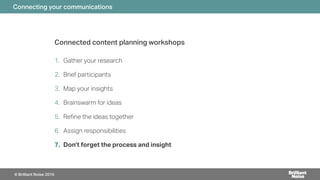
1. Gather your research
2. Brief participants
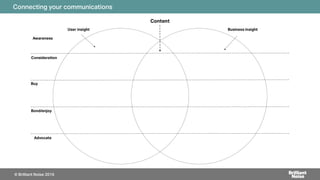
3. Map your insights
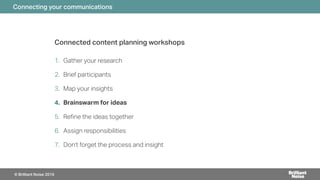
4. Brainswarm for ideas
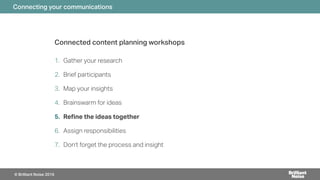
5. Re!ne the ideas together
6. Assign responsibilities
7. Don’t forget the process and insight
Connecting your communications
© Brilliant Noise 2016
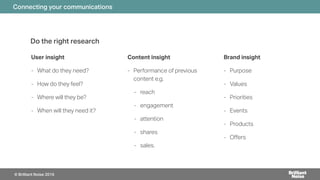
Do the right research
User insight
- What do they need?
- How do they feel?
- Where will they be?
- When will they need it?
Content insight
- Performance of previous
content e.g.
- reach
- engagement
- attention
- shares
- sales.
Brand insight
- Purpose
- Values
- Priorities
- Events
- Products
- O"ers
Connecting your communications
© Brilliant Noise 2016
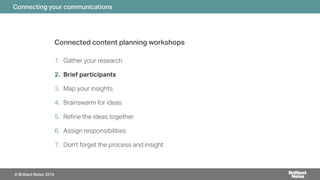
Connected content planning workshops
1. Gather your research
2. Brief participants
3. Map your insights
4. Brainswarm for ideas
5. Re!ne the ideas together
6. Assign responsibilities
7. Don’t forget the process and insight
Connecting your communications
© Brilliant Noise 2016
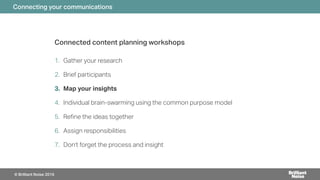
Connected content planning workshops
1. Gather your research
2. Brief participants
3. Map your insights
4. Individual brain-swarming using the common purpose model
5. Re!ne the ideas together
6. Assign responsibilities
7. Don’t forget the process and insight
Connecting your communications
© Brilliant Noise 2016
Connecting your communications
© Brilliant Noise 2016
Connected content planning workshops
1. Gather your research
2. Brief participants
3. Map your insights
4. Brainswarm for ideas
5. Re!ne the ideas together
6. Assign responsibilities
7. Don’t forget the process and insight
Connecting your communications
© Brilliant Noise 2016
William Warby CC BY 2.0
Brainswarming:
create content
ideas alone, then
come together to
discuss and refine
them
© Brilliant Noise 2016
Connected content planning workshops
1. Gather your research
2. Brief participants
3. Map your insights
4. Brainswarm for ideas
5. Re!ne the ideas together
6. Assign responsibilities
7. Don’t forget the process and insight
Connecting your communications
© Brilliant Noise 2016
Connecting your communications
© Brilliant Noise 2016
Connected content planning workshops
1. Gather your research
2. Brief participants
3. Map your insights
4. Brainswarm for ideas
5. Re!ne the ideas together
6. Assign responsibilities
7. Don’t forget the process and insight
Connecting your communications
© Brilliant Noise 2016
Connected content planning workshops
1. Gather your research
2. Brief participants
3. Map your insights
4. Brainswarm for ideas
5. Re!ne the ideas together
6. Assign responsibilities
7. Don’t forget the process and insight
Connecting your communications
© Brilliant Noise 2016
Connecting your communications
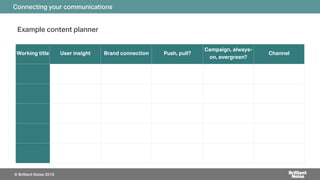
Example content planner
Working title User insight Brand connection Push, pull?
Campaign, always-
on, evergreen?
Channel
© Brilliant Noise 2016
CUSTOMERS COMMUNICATIONS ORGANISATIONS
© Brilliant Noise 2016
3. Connecting your organisation
Steve Bates CC BY 2.0
Connect your
organisation:
build culture and
operations that
support great
content
© Brilliant Noise 2016
It’s about principles,
processes, platforms…
…and, above all, people.
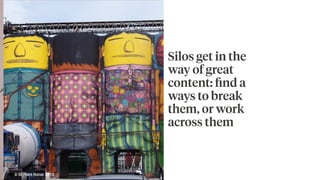
Silos get in the
way of great
content: find a
ways to break
them, or work
across them
© Brilliant Noise 2016
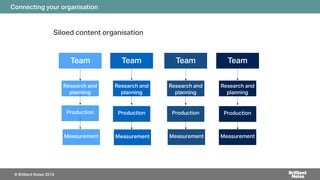
Connecting your organisation
Siloed content organisation
Team
Research and
planning
Production
Measurement
Team
Research and
planning
Production
Measurement
Team
Research and
planning
Production
Measurement
Team
Research and
planning
Production
Measurement
© Brilliant Noise 2016
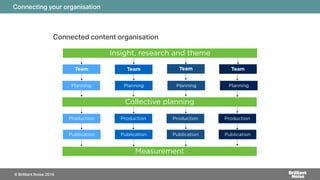
Connecting your organisation
Insight, research and theme
Team Team Team Team
Collective planning
Planning Planning Planning Planning
Production Production Production Production
Measurement
Publication Publication Publication Publication
Connected content organisation
© Brilliant Noise 2016
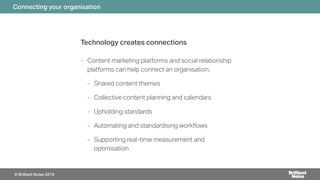
Technology creates connections
- Content marketing platforms and social relationship
platforms can help connect an organisation.
- Shared content themes
- Collective content planning and calendars
- Upholding standards
- Automating and standardising work#ows
- Supporting real-time measurement and
optimisation
Connecting your organisation
© Brilliant Noise 2016
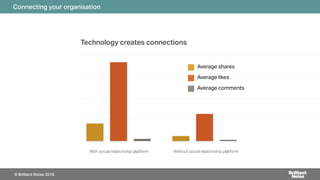
Technology creates connections
Connecting your organisation
© Brilliant Noise 2016
Title
0
350
700
1050
1400
With social relationship platform Without social relationship platform
Average shares
Average likes
Average comments
With social relationship platform Without social relationship platform
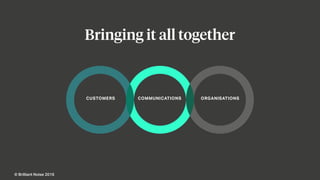
CUSTOMERS COMMUNICATIONS ORGANISATIONS
© Brilliant Noise 2016
Bringing it all together
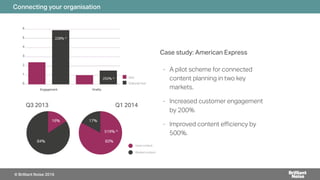
Case study: American Express
Connecting your organisation
- A pilot scheme for connected
content planning in two key
markets.
- Increased customer engagement
by 200%
- Improved content e$ciency by
500%.
© Brilliant Noise 2016
Nicholas Raymond CC BY 2.0
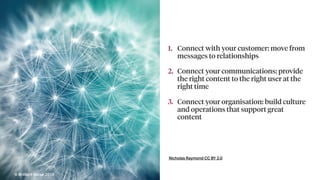
1. Connect with your customer: move from
messages to relationships
2. Connect your communications: provide
the right content to the right user at the
right time
3. Connect your organisation: build culture
and operations that support great
content
© Brilliant Noise 2016
Thank you
www.brilliantnoise.com | @la_pope
lauren.pope@brilliantnoise.com
© Brilliant Noise 2016

Connected content planning: customers, communications, organisations

  • 1.
    www.brilliantnoise.com | @la_pope Friendsof Search Connected content planning 11th February 2016
  • 2.
    Agenda - Connecting withthe customer - Connecting your communications - Connecting your organisation - Putting these ideas into practice What I’m going to talk about… © Brilliant Noise 2016
  • 3.
    Dupain Charles CCBY ND 2.0 There are lots of dots to connect when it comes to content… © Brilliant Noise 2016
  • 4.
    Brilliant Noise: Fast change, lastingimpact. © Brilliant Noise 2016 customers brand products teams channels formats markets paid search social legal sales measure- ment
  • 5.
    a-j clicks CCBY ND 2.0 …so many, that it often feels easier not to connect them at all. © Brilliant Noise 2016
  • 6.
    Giulian Frisoni CCBY 2.0 But that won’t  build an efficient, scaleable, and successful content programme. © Brilliant Noise 2016
  • 7.
    Your customers aremore connected than ever. And they expect your brand to be more connected too, with their needs, their habits and their experiences. © Brilliant Noise 2016
  • 8.
    Brilliant Noise: Fast change, lastingimpact. How? Connected content planning © Brilliant Noise 2016
  • 9.
  • 10.
    CUSTOMERS COMMUNICATIONS ORGANISATIONS ©Brilliant Noise 2016 1. Connecting with customers
  • 11.
    Rosmarie Voegtli, CCBY 2.0 Connect with your customer: move from messages to relationships © Brilliant Noise 2016
  • 12.
    Connecting with thecustomer Common purpose links customer and brand © Brilliant Noise 2016
  • 13.
    Connecting with thecustomer Common purpose: Yarra, agricultural chemical company. “Farmers don’t buy fertiliser. They grow crops.” © Brilliant Noise 2016
  • 14.
    CUSTOMERS COMMUNICATIONS ORGANISATIONS ©Brilliant Noise 2016 2. Connecting your communications
  • 15.
    Brewbooks CC BYSA 2.0 Connect your communications: provide the right content to the right user at the right time © Brilliant Noise 2016
  • 16.
  • 17.
    Connecting your communications Thecustomer decision journey © Brilliant Noise 2016
  • 18.
    Push and pullcontent Connecting your communications Push: Content that the brand ‘pushes’ out to the customer. Pull: Content the user ‘pulls’ to them by searching for it, or seeking it out. AUDIENCE & NEEDS BRAND & PURPOSE FORMAT PUSH CHANNEL PULL CHANNEL IDEA� INFO © Brilliant Noise 2016
  • 19.
    Connecting your communications Campaign:Monthly or quarterly content with a short life-span, planned a long time in advance Always-on: Content published on a daily basis to give a fresh, seasonal, or relevant perspective, planned reactively Evergreen: Content that is always relevant to your audience, which is created once and has a long life-span Campaign, always-on, evergreen © Brilliant Noise 2016
  • 20.
    Connecting your communications Heading2 Customer decision journey stage Push, pull Campaign, always-on, evergreen Channel Consideration Push Campaign, always-on Above the line, Facebook, YouTube, Twitter, Instagram, PR Evaluation Pull Evergreen Organic search and website, app, YouTube search Buy Push and pull Campaign, always-on, evergreen Above the line, Facebook, YouTube, Twitter, Instagram, email, organic search and website, app Bond and enjoy Push and pull Always-on, evergreen Facebook, Twitter, YouTube, Instagram, email, website, app Advocate Push and pull Campaign, always-on, evergreen Facebook, YouTube, Twitter, Instagram, email, website, third party sites © Brilliant Noise 2016
  • 21.
    How do youuse these models to plan connected content?
  • 22.
    CEA + CCBY 2.0 Plan all your content as one connected whole © Brilliant Noise 2016
  • 23.
    A connected content planningmethod Ideal if you have lots of stakeholders and/or siloed teams working on content in insolation. It works for 5-30 participants.
  • 24.
    Connected content planningmethod 1. Gather your research 2. Brief participants 3. Map your insights 4. Brainswarm for ideas 5. Re!ne the ideas together 6. Assign responsibilities 7. Don’t forget the process and insight Connecting your communications © Brilliant Noise 2016
  • 25.
    Do the rightresearch User insight - What do they need? - How do they feel? - Where will they be? - When will they need it? Content insight - Performance of previous content e.g. - reach - engagement - attention - shares - sales. Brand insight - Purpose - Values - Priorities - Events - Products - O"ers Connecting your communications © Brilliant Noise 2016
  • 26.
    Connected content planningworkshops 1. Gather your research 2. Brief participants 3. Map your insights 4. Brainswarm for ideas 5. Re!ne the ideas together 6. Assign responsibilities 7. Don’t forget the process and insight Connecting your communications © Brilliant Noise 2016
  • 27.
    Connected content planningworkshops 1. Gather your research 2. Brief participants 3. Map your insights 4. Individual brain-swarming using the common purpose model 5. Re!ne the ideas together 6. Assign responsibilities 7. Don’t forget the process and insight Connecting your communications © Brilliant Noise 2016
  • 28.
  • 29.
    Connected content planningworkshops 1. Gather your research 2. Brief participants 3. Map your insights 4. Brainswarm for ideas 5. Re!ne the ideas together 6. Assign responsibilities 7. Don’t forget the process and insight Connecting your communications © Brilliant Noise 2016
  • 30.
    William Warby CCBY 2.0 Brainswarming: create content ideas alone, then come together to discuss and refine them © Brilliant Noise 2016
  • 31.
    Connected content planningworkshops 1. Gather your research 2. Brief participants 3. Map your insights 4. Brainswarm for ideas 5. Re!ne the ideas together 6. Assign responsibilities 7. Don’t forget the process and insight Connecting your communications © Brilliant Noise 2016
  • 32.
  • 33.
    Connected content planningworkshops 1. Gather your research 2. Brief participants 3. Map your insights 4. Brainswarm for ideas 5. Re!ne the ideas together 6. Assign responsibilities 7. Don’t forget the process and insight Connecting your communications © Brilliant Noise 2016
  • 34.
    Connected content planningworkshops 1. Gather your research 2. Brief participants 3. Map your insights 4. Brainswarm for ideas 5. Re!ne the ideas together 6. Assign responsibilities 7. Don’t forget the process and insight Connecting your communications © Brilliant Noise 2016
  • 35.
    Connecting your communications Examplecontent planner Working title User insight Brand connection Push, pull? Campaign, always- on, evergreen? Channel © Brilliant Noise 2016
  • 36.
    CUSTOMERS COMMUNICATIONS ORGANISATIONS ©Brilliant Noise 2016 3. Connecting your organisation
  • 37.
    Steve Bates CCBY 2.0 Connect your organisation: build culture and operations that support great content © Brilliant Noise 2016
  • 38.
  • 39.
  • 40.
    Silos get inthe way of great content: find a ways to break them, or work across them © Brilliant Noise 2016
  • 41.
    Connecting your organisation Siloedcontent organisation Team Research and planning Production Measurement Team Research and planning Production Measurement Team Research and planning Production Measurement Team Research and planning Production Measurement © Brilliant Noise 2016
  • 42.
    Connecting your organisation Insight,research and theme Team Team Team Team Collective planning Planning Planning Planning Planning Production Production Production Production Measurement Publication Publication Publication Publication Connected content organisation © Brilliant Noise 2016
  • 43.
    Technology creates connections -Content marketing platforms and social relationship platforms can help connect an organisation. - Shared content themes - Collective content planning and calendars - Upholding standards - Automating and standardising work#ows - Supporting real-time measurement and optimisation Connecting your organisation © Brilliant Noise 2016
  • 44.
    Technology creates connections Connectingyour organisation © Brilliant Noise 2016 Title 0 350 700 1050 1400 With social relationship platform Without social relationship platform Average shares Average likes Average comments With social relationship platform Without social relationship platform
  • 45.
    CUSTOMERS COMMUNICATIONS ORGANISATIONS ©Brilliant Noise 2016 Bringing it all together
  • 46.
    Case study: AmericanExpress Connecting your organisation - A pilot scheme for connected content planning in two key markets. - Increased customer engagement by 200% - Improved content e$ciency by 500%. © Brilliant Noise 2016
  • 47.
    Nicholas Raymond CCBY 2.0 1. Connect with your customer: move from messages to relationships 2. Connect your communications: provide the right content to the right user at the right time 3. Connect your organisation: build culture and operations that support great content © Brilliant Noise 2016
  • 48.
    Thank you www.brilliantnoise.com |@la_pope lauren.pope@brilliantnoise.com © Brilliant Noise 2016

Editor's Notes

  • #2 Name Role Amsterdam anecdote What I’m going to talk about
  • #3 Customer Comms Org Going to share useful models and a POV on how to put it into practice in a connected content planning workshop
  • #4 Getting content right on a consistent basis is HARD WORK. There are so many dots that you need to connect when it comes to content planning
  • #5 …your customers, your brand, your products, your team, multiple channels, different formats, global markets, paid, search, social, legal, sales, measurement…
  • #6 So many in fact, that it can feel a lot easier not to connect them and to approach content in separate chunks.
  • #7 But that’s missing a huge opportunity: to create a content programme that’s efficient, effective and reaches across your whole org. You need a connected content planning approach that joins all the dots.  It should cross silos and channels, and create clarity, not complexity.
  • #8 The imperative is the customer. They’re more connected than ever before: to each other, to info, to brands. Reviews, recommendations, data, the ability to ask a brand a question. And they expect brands to act on this and be more connected to: to their needs, habits and experiences. It’s a big challenge
  • #9 And connected content planning is how your respond.
  • #10 At the start I mentioned three core areas in connected content planning: Customer, comms, organisation I’m going to use those three as the framework for my talk.
  • #11 The first and most important is connecting with your customer.
  • #12 Connecting with your customer means moving from just pushing out messages to having a relationship with the customer. Make them your guiding star.
  • #13 Common purpose is a key step in that - it defines what unites your customer and your brand. To find your common purpose for content across all channels you first need to have a clear understanding of two topics: Your customer: what do your customers believe in? What information do they need? What ideas are they interested in? Your brand: what does your brand stand for? What does it have to offer? You will find your common purpose at the intersection of the two. A good common purpose will take into account how customers use, advocate or connect with your products and services. It doesn’t come from considering how to message customers.
  • #14 Beautifully simple example from Norwegian chemical co and maker of fertiliser, Yarra. They sell fertiliser. Farmers grow crops. Common purpose = growing more or better crops. Will come back to this model again later and explain how you can use it in content planning.
  • #15 Connecting your comms - bring that idea of common purpose into your comms and content planning.
  • #16 Join-up your comms Create a seamless customer experience which provides the right content to the right usr at the right time.
  • #18 The Customer Decision journey is a really useful model for this. It’s an alternative to the sales funnel, that’s more in keeping with the digital landscape. The funnel overemphasised investment in attention, and neglected the opportunity to develop customers into advocates. Consider, evaluate, buy, loyalty loop Think about what your customers need at every stage of their journey, and how your content fits together to meet needs throughout.
  • #19 The idea of ‘push and pull’ is an important one that underpins connected content planning. This model builds on common purpose: users need both push and pull content at different stages in their decision journey, to get the idea of info to them the right place and time. Push content is content which the brand pushes out to the customer. The user chooses to look at or pay attention to it, but they don’t have to make any effort to find it. Pull content is content that the user pulls to them and actively seeks out. This is typified by searching for and directly visiting content.
  • #20 Campaign, always-on and evergreen is another important idea that can help you figure out what content your user needs and when. There are three different cadences of content: campaign, always-on and evergreen. Cadence refers to how often this kind of content is published, and also to its lifespan. Campaign: periodic (often monthly or quarterly) content with a short life-span, e.g. product launches, ‘tent pole’ events. Always-on: content published on a daily basis to give a fresh, seasonal, or relevant perspective e.g. seasonal promotions, reactive content, curated content. Evergreen: content that is always relevant to your audience e.g. how tos, customer service, product information. All three need to be represented to meet the needs of customers at difference stages of their relationship with your brand.
  • #21 The chart above shows how campaign, always-on and evergreen map to the the different stages of the customer decision journey. Campaign content has a significant role to play in the ‘consideration’ phase. Push communications of this kind are good for generating awareness, helping to keep a brand front of mind, and steering the overall impression a customer has. Campaign content can come into play in the ‘buy’ phase, with purchase-focused campaign content. Campaign could also be used to try and generate advocacy. Always-on content plays a role in consideration, buy, bond and enjoy. It can work in a number of ways, from generating awareness, to helping to maintain a relationship with an existing customer through providing offer-based content, content that resonates with the customer’s interests, loyalty offers etc on a regular basis. Evergreen content is the main way that customers evaluate; they are likely to be in research or comparison mode, seeking out content they need. Evergreen is also vital in the later stage of the customer decision journey as it helps to build a lasting relationship in a number of ways.
  • #23 Plan as one connected whole, because that’s how your customers see them.
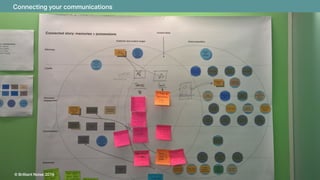
  • #29 Ladder down the idea of common purpose to help plan content. This is something that I use a lot for generating ideas for content in workshops. I print out on a huge piece of paper, put it on the the wall and then cove fit with Post-it notes: customer insight on the left, corresponding to the different stages of the CDJ, then business goals and brand connection points on the right. Then look for content ideas at the centre.
  • #31 Brainstorming sessions are one of the most common ways we try to come up with ideas. But as most of us have experienced, they don’t always work. Introverts, HIPPOS. Dr. Tony McCaffrey suggests ‘brainswarming’ as the right way to approach coming up with a creative solution to a problem as a group. Ants work alone when they’re looking for food. They leave pheromones traces behind them, to pass on the information about what resources they’ve found to help guide the rest of the colony, and make the process of finding food more efficient. You work separately, approaching the problem in different ways, bringing different perspectives, then share your findings and resources, gradually refining towards a solution to the problem. Write down the problem you need to solve on a whiteboard, then sit silently as a team, writing down relevant resources and ideas, before comparing notes, and refining towards a solution.
  • #36 Use your content planner to keep the ideas front of mind. Capture the process and insights, how you came up with the ideas in your content planner or brief Coming up with a set of content themes of streams to help maintain these standards.
  • #38 You need to work hard at building and implementing the systems, culture and governance you need to execute your content strategy.
  • #39 It’s about how you do things: your principles, processes, platforms and technology.
  • #40 It’s about how you do things: your principles, processes, platforms and technology.
  • #41 Explain the image! Big soils in Vancouver, with people painted on them. Silos get in the way, break them or be pragmatic and work across them. Don’t forget that silos are made of and created by people: needs to be handled the right way.
  • #42 Separate processes Duplication and inefficiency at every stage No common goal Impact on the customer = they experience the content in the same way it’s created - disconnected, lumpy.
  • #43 Create points of connection, conversation and collaboration at key points in the production process. insight and theme Aligning plans Measurement - common goal and idea of success
  • #44 Tech can play an important role in connecting organisations. Themes Planning, briefs and calendars Standards and style Workflow Measurement
  • #45 Research for one of our clients who uses an SRP Content that’s published with the SRPi is a lot more successful on every front Why? We’re looking into it. But we’re sure that it’s down to injecting process and governance - they’re not cold and intangible. They’re a super-power.
  • #46 To wrap up, I wanted to share a case study that shows what you can achieve when you bring all three elements together.
  • #47 American Express wanted to get closer to the customer, join up content and bring teams closer together. Pilot scheme in two key markets. Implemented connected planning principles: a common purpose, shared customer insights, connected planning workshops, new principles and processes. The result was a 500% increase in content utilisation in local markets, and a 200% increase in customer engagement. Even in a pilot you can see a dramatic turnaround by implementing connected content principles.
  • #48 Three key takeaways