Coordinator – Subordinator – Conjunctive adverbs
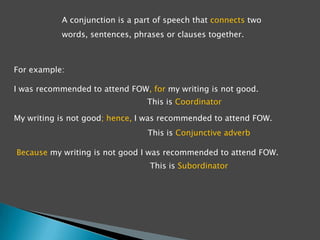
A conjunction is a part of speech that connects two
           words, sentences, phrases or clauses together.


For example:

I was recommended to attend FOW, for my writing is not good.
                                This is Coordinator

My writing is not good; hence, I was recommended to attend FOW.
                                This is Conjunctive adverb

Because my writing is not good I was recommended to attend FOW.
                                 This is Subordinator
Coordinator
To join to ideas together that are equal in value

     FANBOYS: For And Nor But Or Yet So
                     …
    Always need a comma before FANBOYS
Subordinator
To join two sentences together when one idea is less
                important to the other

For example: Although since when while because…
Structure: Subordinator dependent clause, independent clause
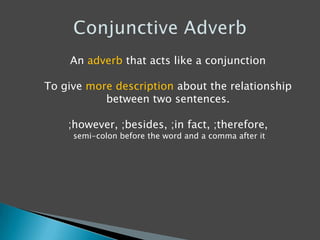
An adverb that acts like a conjunction

To give more description about the relationship
           between two sentences.

    ;however, ;besides, ;in fact, ;therefore,
     semi-colon before the word and a comma after it
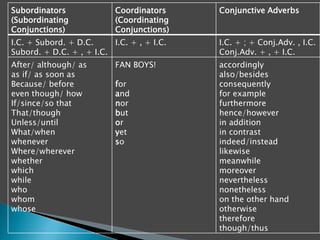
Subordinators              Coordinators     Conjunctive Adverbs
(Subordinating             (Coordinating
Conjunctions)              Conjunctions)
I.C. + Subord. + D.C.     I.C. + , + I.C.   I.C. + ; + Conj.Adv. , I.C.
Subord. + D.C. + , + I.C.                   Conj.Adv. + , + I.C.
After/ although/ as        FAN BOYS!        accordingly
as if/ as soon as                           also/besides
Because/ before            for              consequently
even though/ how           and              for example
If/since/so that           nor              furthermore
That/though                but              hence/however
Unless/until               or               in addition
What/when                  yet              in contrast
whenever                   so               indeed/instead
Where/wherever                              likewise
whether                                     meanwhile
which                                       moreover
while                                       nevertheless
who                                         nonetheless
whom                                        on the other hand
whose                                       otherwise
                                            therefore
                                            though/thus

Conjunction

  • 1.
    Coordinator – Subordinator– Conjunctive adverbs
  • 2.
    A conjunction isa part of speech that connects two words, sentences, phrases or clauses together. For example: I was recommended to attend FOW, for my writing is not good. This is Coordinator My writing is not good; hence, I was recommended to attend FOW. This is Conjunctive adverb Because my writing is not good I was recommended to attend FOW. This is Subordinator
  • 3.
    Coordinator To join toideas together that are equal in value FANBOYS: For And Nor But Or Yet So … Always need a comma before FANBOYS
  • 4.
    Subordinator To join twosentences together when one idea is less important to the other For example: Although since when while because… Structure: Subordinator dependent clause, independent clause
  • 5.
    An adverb thatacts like a conjunction To give more description about the relationship between two sentences. ;however, ;besides, ;in fact, ;therefore, semi-colon before the word and a comma after it
  • 6.
    Subordinators Coordinators Conjunctive Adverbs (Subordinating (Coordinating Conjunctions) Conjunctions) I.C. + Subord. + D.C. I.C. + , + I.C. I.C. + ; + Conj.Adv. , I.C. Subord. + D.C. + , + I.C. Conj.Adv. + , + I.C. After/ although/ as FAN BOYS! accordingly as if/ as soon as also/besides Because/ before for consequently even though/ how and for example If/since/so that nor furthermore That/though but hence/however Unless/until or in addition What/when yet in contrast whenever so indeed/instead Where/wherever likewise whether meanwhile which moreover while nevertheless who nonetheless whom on the other hand whose otherwise therefore though/thus