1
Congestion
Control in
Computer
Networks
2
Presented By
1.Sauda Tus Sahadia
2.Shantanu Mandal
3.Md Azom Uddin
4.Abu Sayed Abdullah
5.Maria Islam
3
Introducti
on
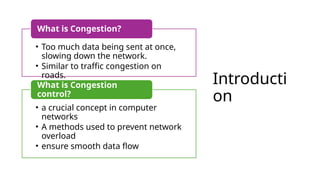
• Too much data being sent at once,
slowing down the network.
• Similar to traffic congestion on
roads.
What is Congestion?
• a crucial concept in computer
networks
• A methods used to prevent network
overload
• ensure smooth data flow
What is Congestion
control?
4
Effects of
Congestio
n Control
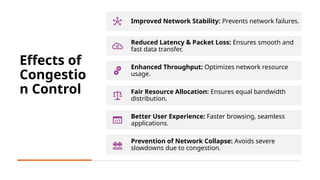
Improved Network Stability: Prevents network failures.
Reduced Latency & Packet Loss: Ensures smooth and
fast data transfer.
Enhanced Throughput: Optimizes network resource
usage.
Fair Resource Allocation: Ensures equal bandwidth
distribution.
Better User Experience: Faster browsing, seamless
applications.
Prevention of Network Collapse: Avoids severe
slowdowns due to congestion.
5
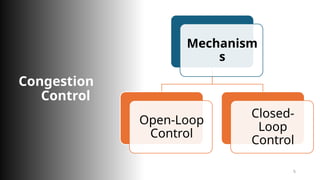
Congestion
Control
Mechanism
s
Open-Loop
Control
Closed-
Loop
Control
6
Open-Loop Congestion Control (Prevention)
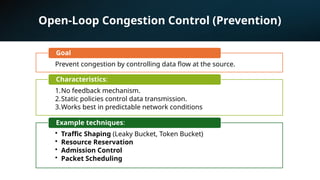
Prevent congestion by controlling data flow at the source.
Goal
1.No feedback mechanism.
2.Static policies control data transmission.
3.Works best in predictable network conditions
Characteristics:
• Traffic Shaping (Leaky Bucket, Token Bucket)
• Resource Reservation
• Admission Control
• Packet Scheduling
Example techniques:
7
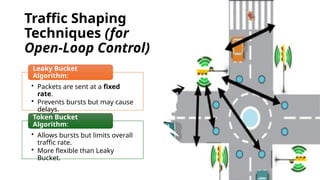
Traffic Shaping
Techniques (for
Open-Loop Control)
• Packets are sent at a fixed
rate.
• Prevents bursts but may cause
delays.
Leaky Bucket
Algorithm:
• Allows bursts but limits overall
traffic rate.
• More flexible than Leaky
Bucket.
Token Bucket
Algorithm:
8
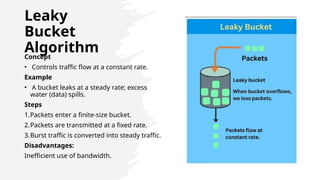
Leaky
Bucket
Algorithm
Concept
• Controls traffic flow at a constant rate.
Example
• A bucket leaks at a steady rate; excess
water (data) spills.
Steps
1.Packets enter a finite-size bucket.
2.Packets are transmitted at a fixed rate.
3.Burst traffic is converted into steady traffic.
Disadvantages:
Inefficient use of bandwidth.
9
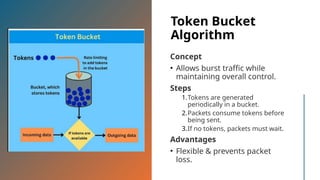
Token Bucket
Algorithm
Concept
• Allows burst traffic while
maintaining overall control.
Steps
1.Tokens are generated
periodically in a bucket.
2.Packets consume tokens before
being sent.
3.If no tokens, packets must wait.
Advantages
• Flexible & prevents packet
loss.
10
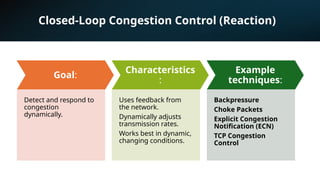
Closed-Loop Congestion Control (Reaction)
Goal:
Detect and respond to
congestion
dynamically.
Characteristics
:
Uses feedback from
the network.
Dynamically adjusts
transmission rates.
Works best in dynamic,
changing conditions.
Example
techniques:
Backpressure
Choke Packets
Explicit Congestion
Notification (ECN)
TCP Congestion
Control
11
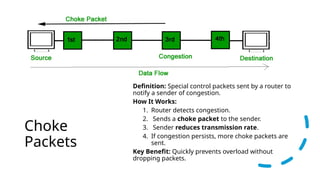
Choke
Packets
Definition: Special control packets sent by a router to
notify a sender of congestion.
How It Works:
1. Router detects congestion.
2. Sends a choke packet to the sender.
3. Sender reduces transmission rate.
4. If congestion persists, more choke packets are
sent.
Key Benefit: Quickly prevents overload without
dropping packets.
12
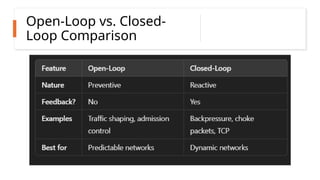
Open-Loop vs. Closed-
Loop Comparison
13
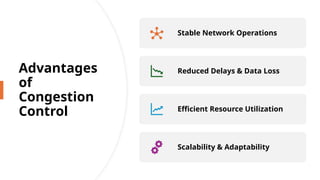
Advantages
of
Congestion
Control
Stable Network Operations
Reduced Delays & Data Loss
Efficient Resource Utilization
Scalability & Adaptability
14
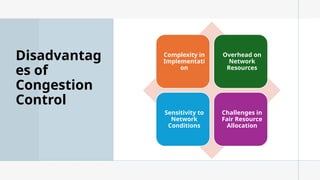
Disadvantag
es of
Congestion
Control
Complexity in
Implementati
on
Overhead on
Network
Resources
Sensitivity to
Network
Conditions
Challenges in
Fair Resource
Allocation
15
Conclusion
Congestion control is
essential for network
performance.
Algorithms like Leaky Bucket
& Token Bucket help
manage data flow.
Proper control ensures a
stable, fast, and reliable
network.

16
Thank You

Congestion Control in Computer networks

  • 1.
  • 2.
    2 Presented By 1.Sauda TusSahadia 2.Shantanu Mandal 3.Md Azom Uddin 4.Abu Sayed Abdullah 5.Maria Islam
  • 3.
    3 Introducti on • Too muchdata being sent at once, slowing down the network. • Similar to traffic congestion on roads. What is Congestion? • a crucial concept in computer networks • A methods used to prevent network overload • ensure smooth data flow What is Congestion control?
  • 4.
    4 Effects of Congestio n Control ImprovedNetwork Stability: Prevents network failures. Reduced Latency & Packet Loss: Ensures smooth and fast data transfer. Enhanced Throughput: Optimizes network resource usage. Fair Resource Allocation: Ensures equal bandwidth distribution. Better User Experience: Faster browsing, seamless applications. Prevention of Network Collapse: Avoids severe slowdowns due to congestion.
  • 5.
  • 6.
    6 Open-Loop Congestion Control(Prevention) Prevent congestion by controlling data flow at the source. Goal 1.No feedback mechanism. 2.Static policies control data transmission. 3.Works best in predictable network conditions Characteristics: • Traffic Shaping (Leaky Bucket, Token Bucket) • Resource Reservation • Admission Control • Packet Scheduling Example techniques:
  • 7.
    7 Traffic Shaping Techniques (for Open-LoopControl) • Packets are sent at a fixed rate. • Prevents bursts but may cause delays. Leaky Bucket Algorithm: • Allows bursts but limits overall traffic rate. • More flexible than Leaky Bucket. Token Bucket Algorithm:
  • 8.
    8 Leaky Bucket Algorithm Concept • Controls trafficflow at a constant rate. Example • A bucket leaks at a steady rate; excess water (data) spills. Steps 1.Packets enter a finite-size bucket. 2.Packets are transmitted at a fixed rate. 3.Burst traffic is converted into steady traffic. Disadvantages: Inefficient use of bandwidth.
  • 9.
    9 Token Bucket Algorithm Concept • Allowsburst traffic while maintaining overall control. Steps 1.Tokens are generated periodically in a bucket. 2.Packets consume tokens before being sent. 3.If no tokens, packets must wait. Advantages • Flexible & prevents packet loss.
  • 10.
    10 Closed-Loop Congestion Control(Reaction) Goal: Detect and respond to congestion dynamically. Characteristics : Uses feedback from the network. Dynamically adjusts transmission rates. Works best in dynamic, changing conditions. Example techniques: Backpressure Choke Packets Explicit Congestion Notification (ECN) TCP Congestion Control
  • 11.
    11 Choke Packets Definition: Special controlpackets sent by a router to notify a sender of congestion. How It Works: 1. Router detects congestion. 2. Sends a choke packet to the sender. 3. Sender reduces transmission rate. 4. If congestion persists, more choke packets are sent. Key Benefit: Quickly prevents overload without dropping packets.
  • 12.
  • 13.
    13 Advantages of Congestion Control Stable Network Operations ReducedDelays & Data Loss Efficient Resource Utilization Scalability & Adaptability
  • 14.
    14 Disadvantag es of Congestion Control Complexity in Implementati on Overheadon Network Resources Sensitivity to Network Conditions Challenges in Fair Resource Allocation
  • 15.
    15 Conclusion Congestion control is essentialfor network performance. Algorithms like Leaky Bucket & Token Bucket help manage data flow. Proper control ensures a stable, fast, and reliable network.
  • 16.