Energy-Efficient Cooperative Download
for Smartphone Users through Contact
Time Estimation
Keiichi Yasumoto, Yu Takamatsu, Weihua Sun, Minoru Ito
Nara Institute of Science and Technology
Organization
2
 Background and Related Work
 Proposed Method
 Experimental Result
 Conclusion
October 10th, 2012IEEEWiMob2012
Contents download from cellular network
3
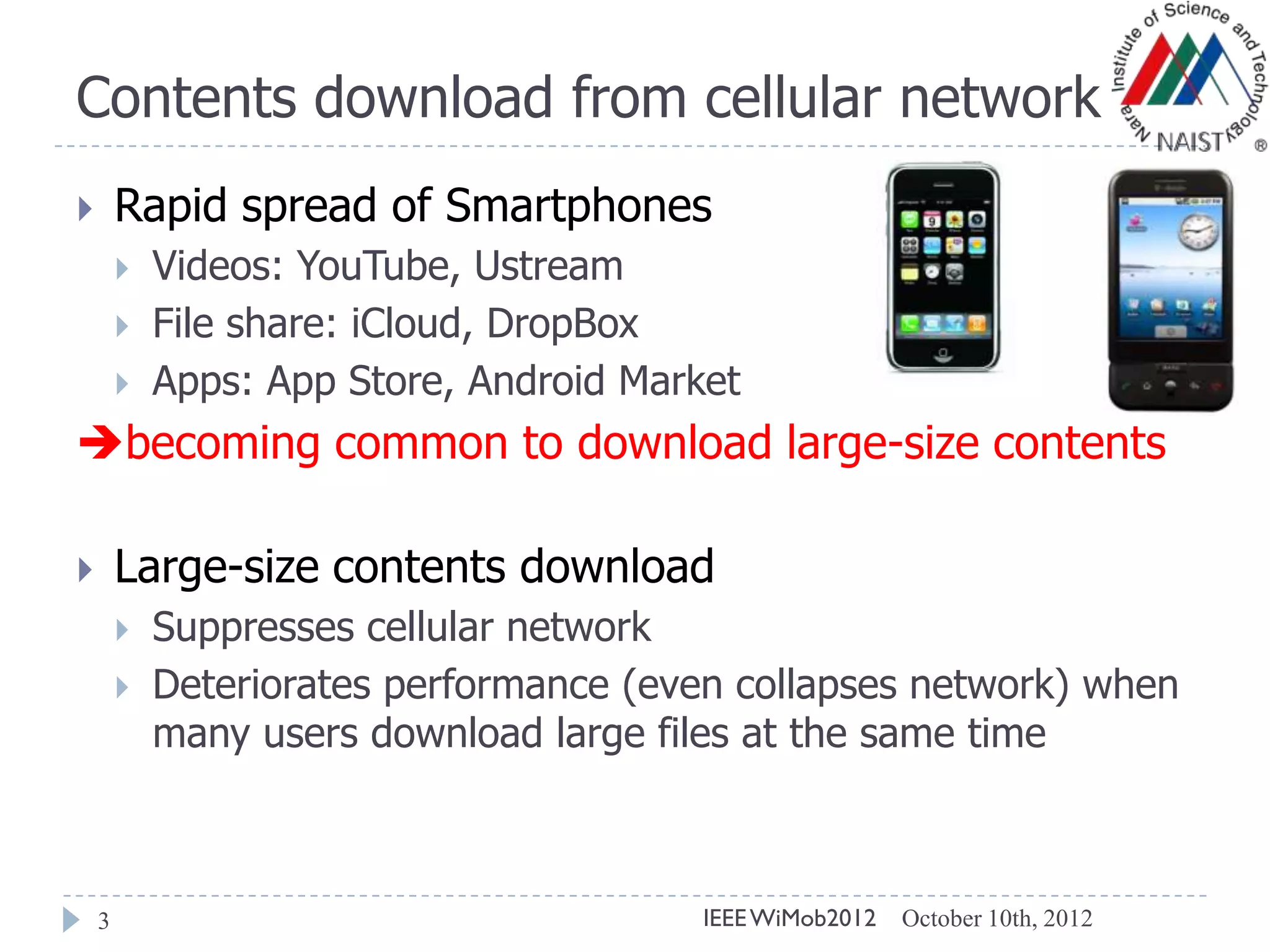
 Rapid spread of Smartphones
 Videos: YouTube, Ustream
 File share: iCloud, DropBox
 Apps: App Store, Android Market
becoming common to download large-size contents
 Large-size contents download
 Suppresses cellular network
 Deteriorates performance (even collapses network) when
many users download large files at the same time
October 10th, 2012IEEEWiMob2012
Countermeasures for cellular suppression
4
 Cellular phone carriers
 Limit total downloadable amount per month (e.g., 7GB)
 Decrease BW of the user who exceeded the limit (e.g., 128Kbps)
 Return to the traditional pay-as-you-go plan
 4G (LTE)
 Takes long time to be available anywhere
 Content size will grow (e.g., by retina display)  we will face
the same problem in the future
Need intrinsic method for reducing cellular traffic
October 10th, 2012IEEEWiMob2012
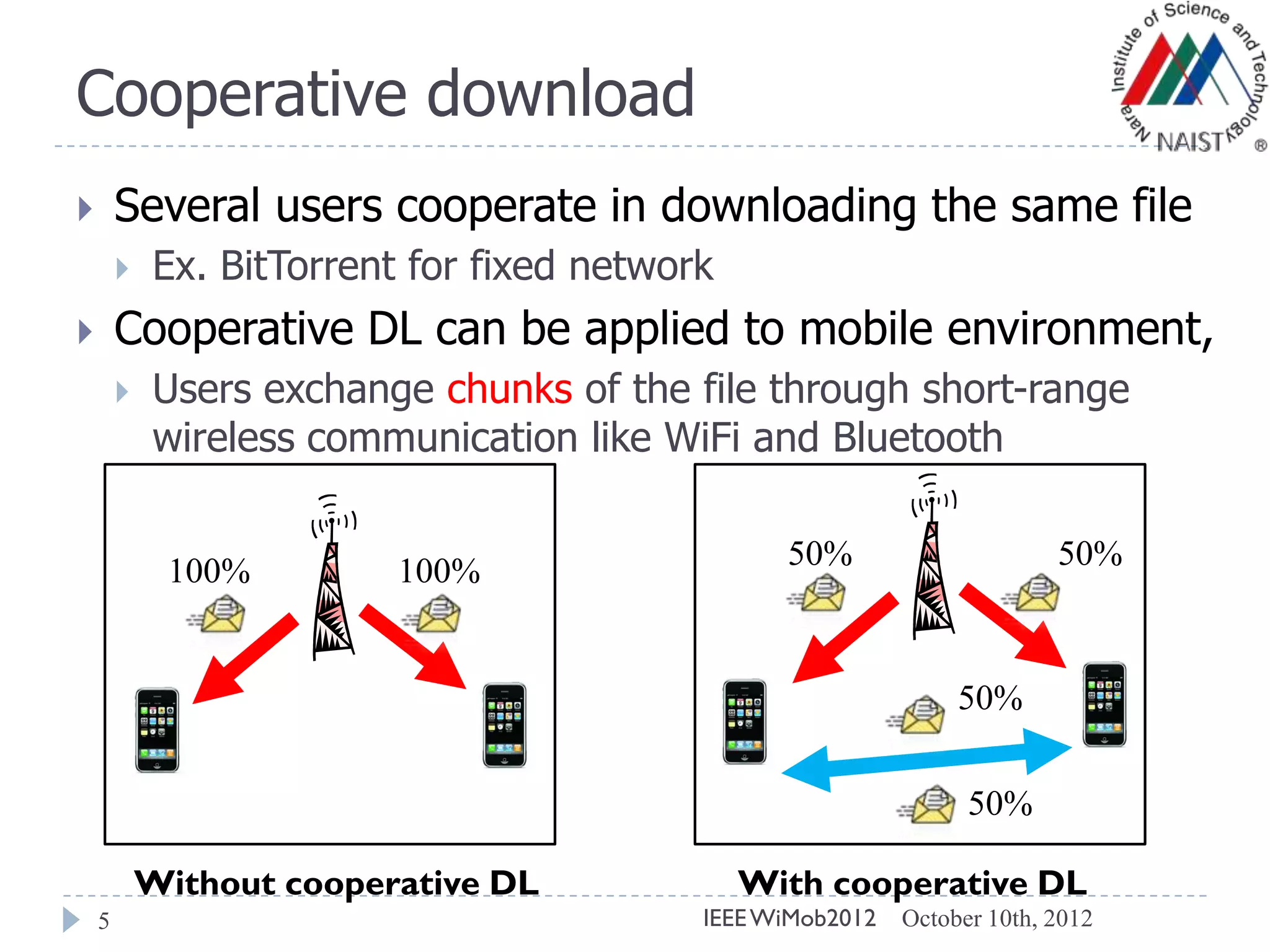
Cooperative download
5
 Several users cooperate in downloading the same file
 Ex. BitTorrent for fixed network
 Cooperative DL can be applied to mobile environment,
 Users exchange chunks of the file through short-range
wireless communication like WiFi and Bluetooth
100% 100% 50% 50%
50%
50%
Without cooperative DL With cooperative DL
October 10th, 2012IEEEWiMob2012
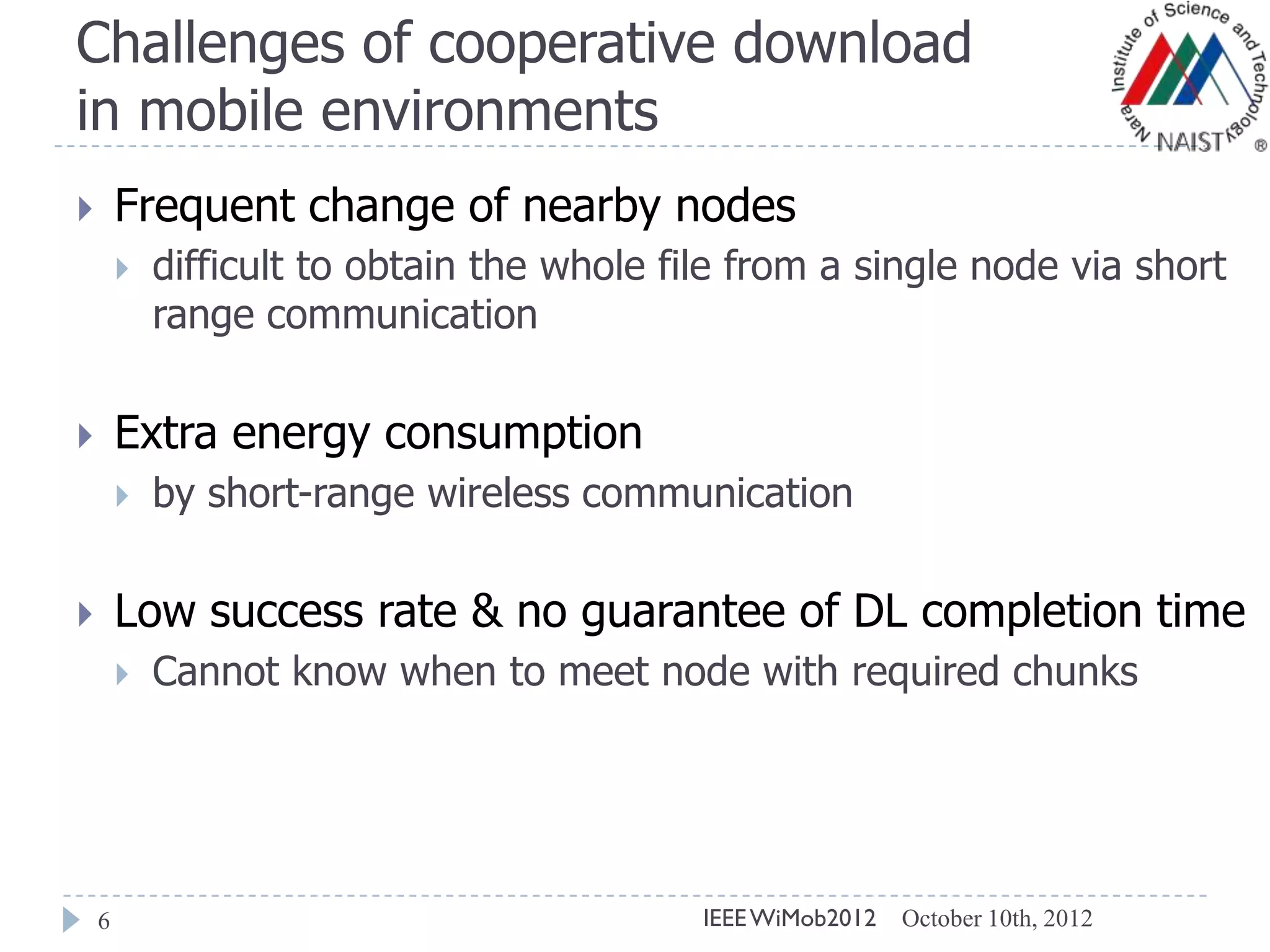
Challenges of cooperative download
in mobile environments
6
 Frequent change of nearby nodes
 difficult to obtain the whole file from a single node via short
range communication
 Extra energy consumption
 by short-range wireless communication
 Low success rate & no guarantee of DL completion time
 Cannot know when to meet node with required chunks
October 10th, 2012IEEEWiMob2012
Related work
October 10th, 2012IEEEWiMob20127
 Adapt P2P technologies for mobile environments [5-8][13-14]
 May not complete acquisition of the whole due to user mobility
 Apply cooperative DL to vehicular environments [9-12]
 Take vehicular mobility into account and achieve efficient DL rate
 Do not consider energy-efficiency
 Realize content exchange in public transportation [15,16]
 Identify users collocating in train/bus during commute, allow users
to exchange files
 Do not tell when content acquisition completes
 Utilize both WiFi and cellular [4]
 Achieve complete acquisition by specified deadline using cellular
 Consume extra energy for frequent beacon exchanges via WiFi
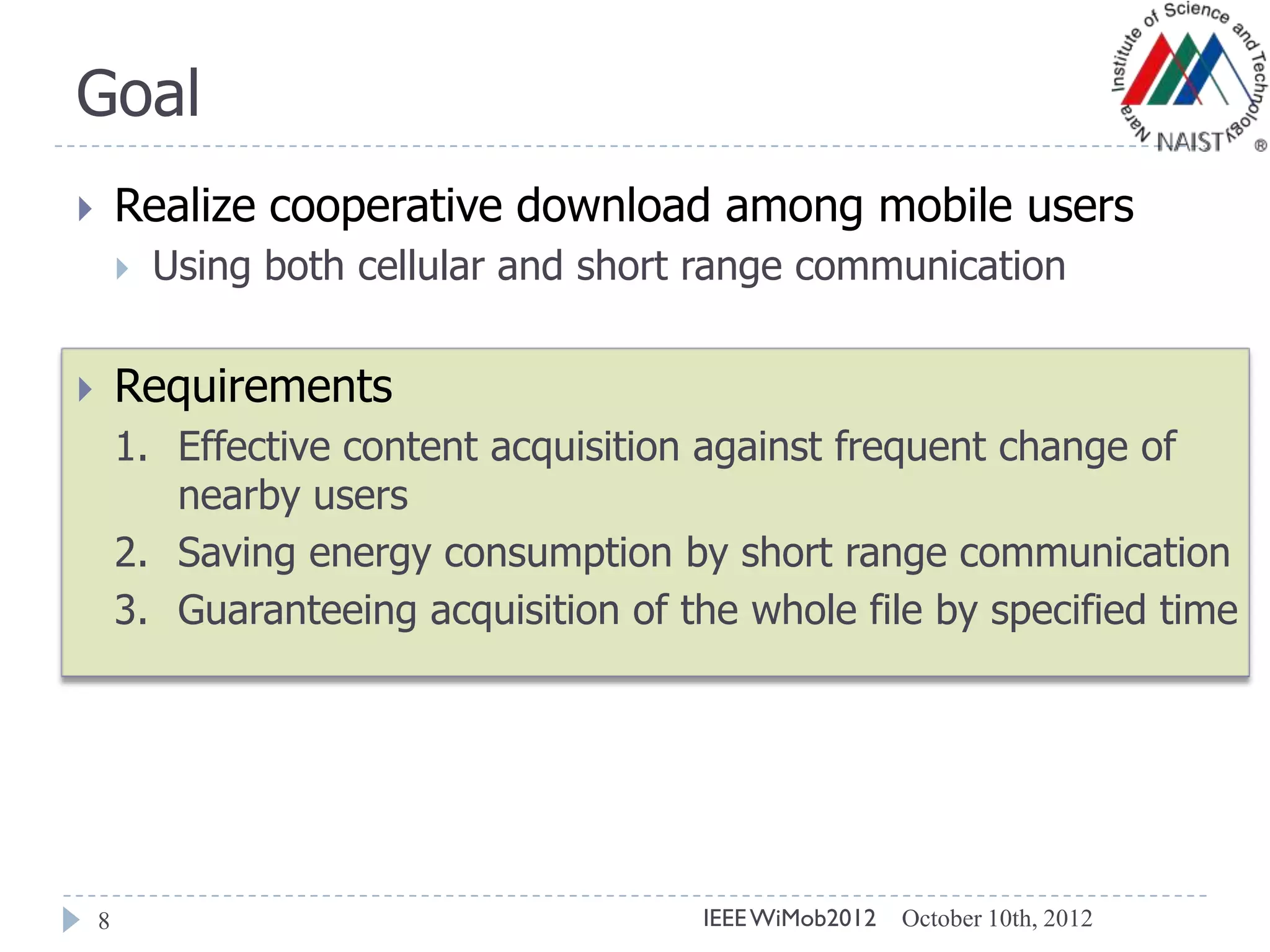
Goal
8
 Realize cooperative download among mobile users
 Using both cellular and short range communication
 Requirements
1. Effective content acquisition against frequent change of
nearby users
2. Saving energy consumption by short range communication
3. Guaranteeing acquisition of the whole file by specified time
October 10th, 2012IEEEWiMob2012
Organization
9
 Background and Related Work
 Proposed Method
 Experimental Result
 Conclusion
October 10th, 2012IEEEWiMob2012
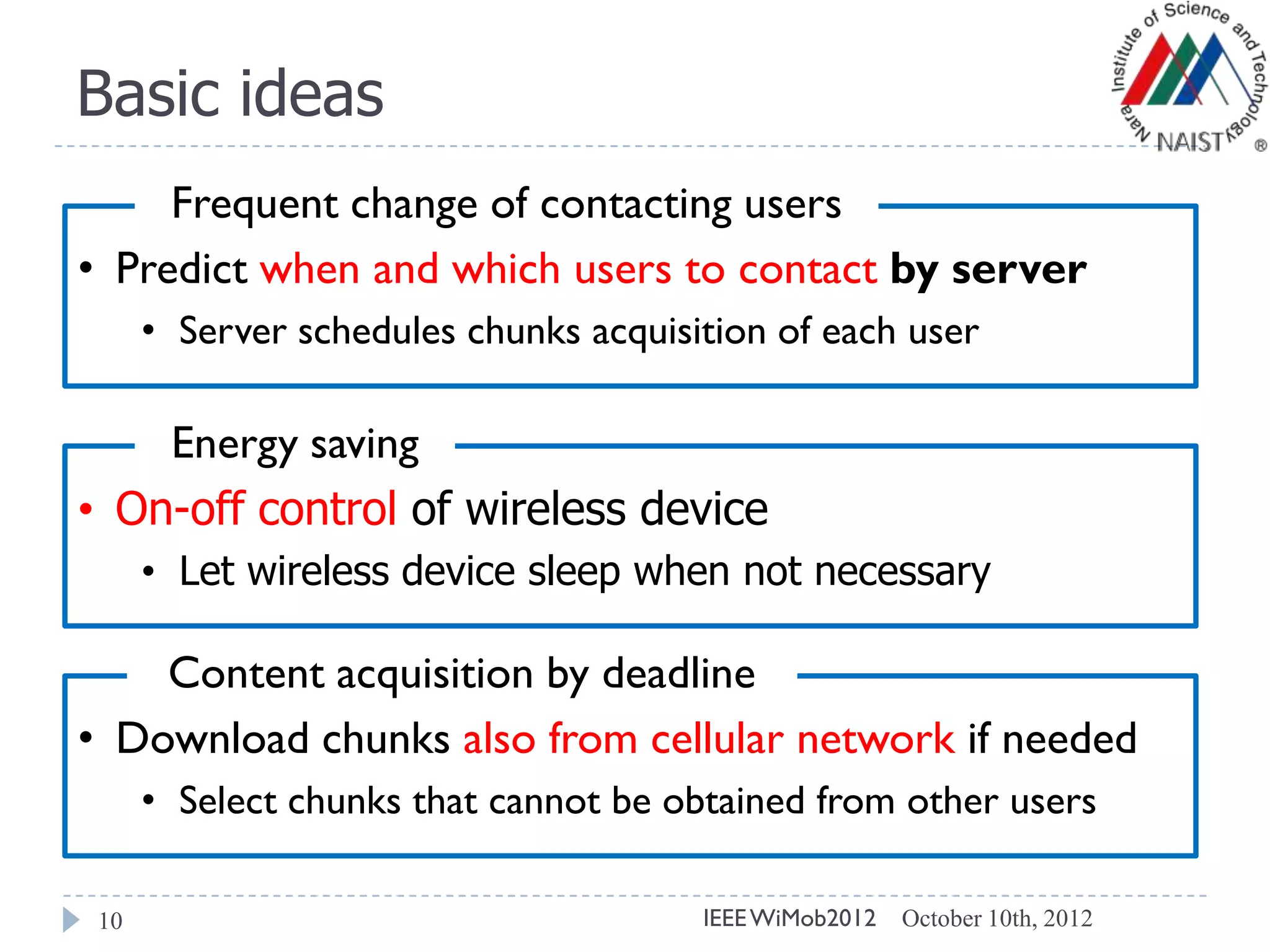
Basic ideas
10
• Predict when and which users to contact by server
• Server schedules chunks acquisition of each user
Frequent change of contacting users
• On-off control of wireless device
• Let wireless device sleep when not necessary
Energy saving
• Download chunks also from cellular network if needed
• Select chunks that cannot be obtained from other users
Content acquisition by deadline
October 10th, 2012IEEEWiMob2012
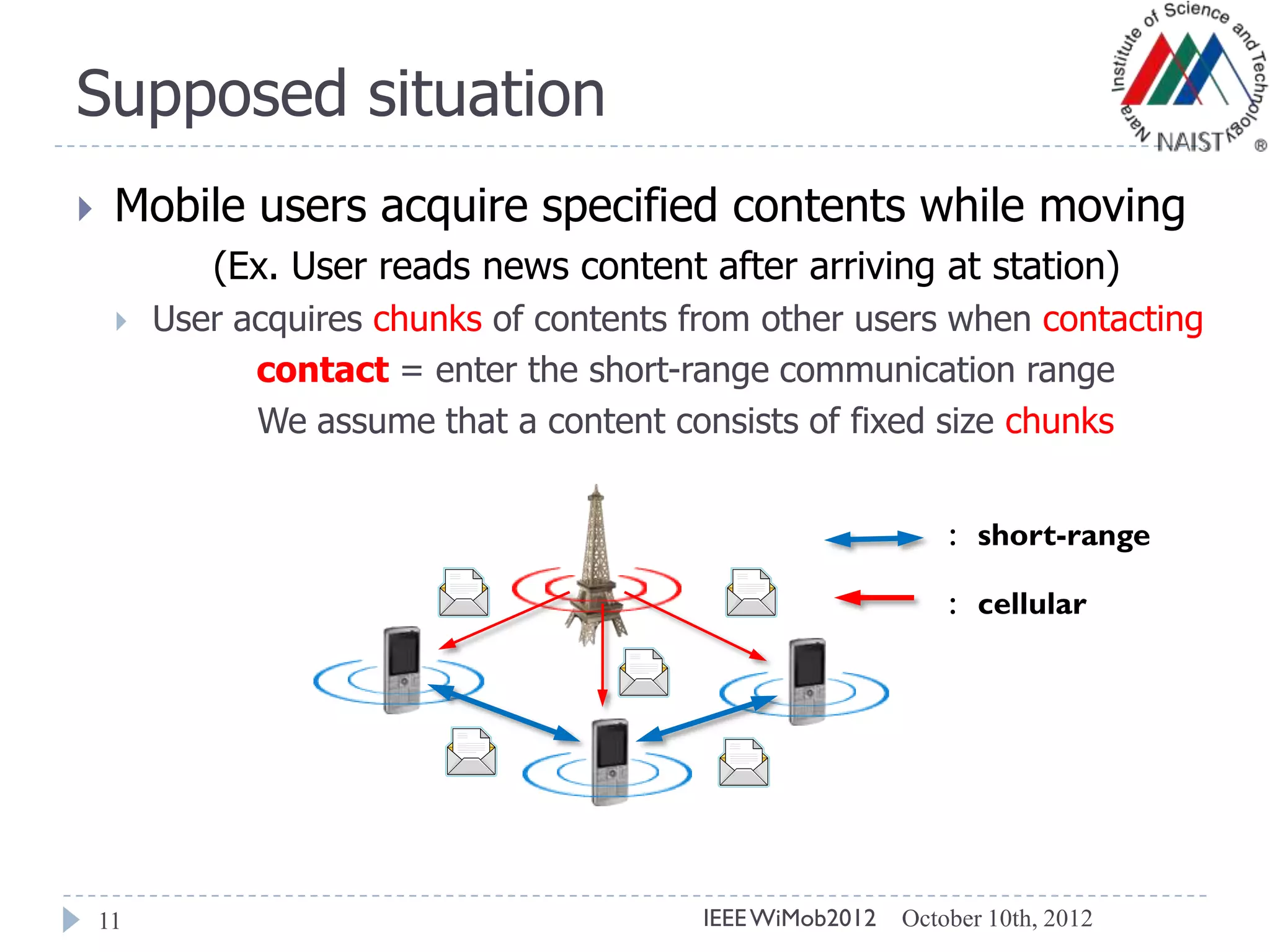
Supposed situation
11
 Mobile users acquire specified contents while moving
(Ex. User reads news content after arriving at station)
 User acquires chunks of contents from other users when contacting
contact = enter the short-range communication range
We assume that a content consists of fixed size chunks
: short-range
: cellular
October 10th, 2012IEEEWiMob2012
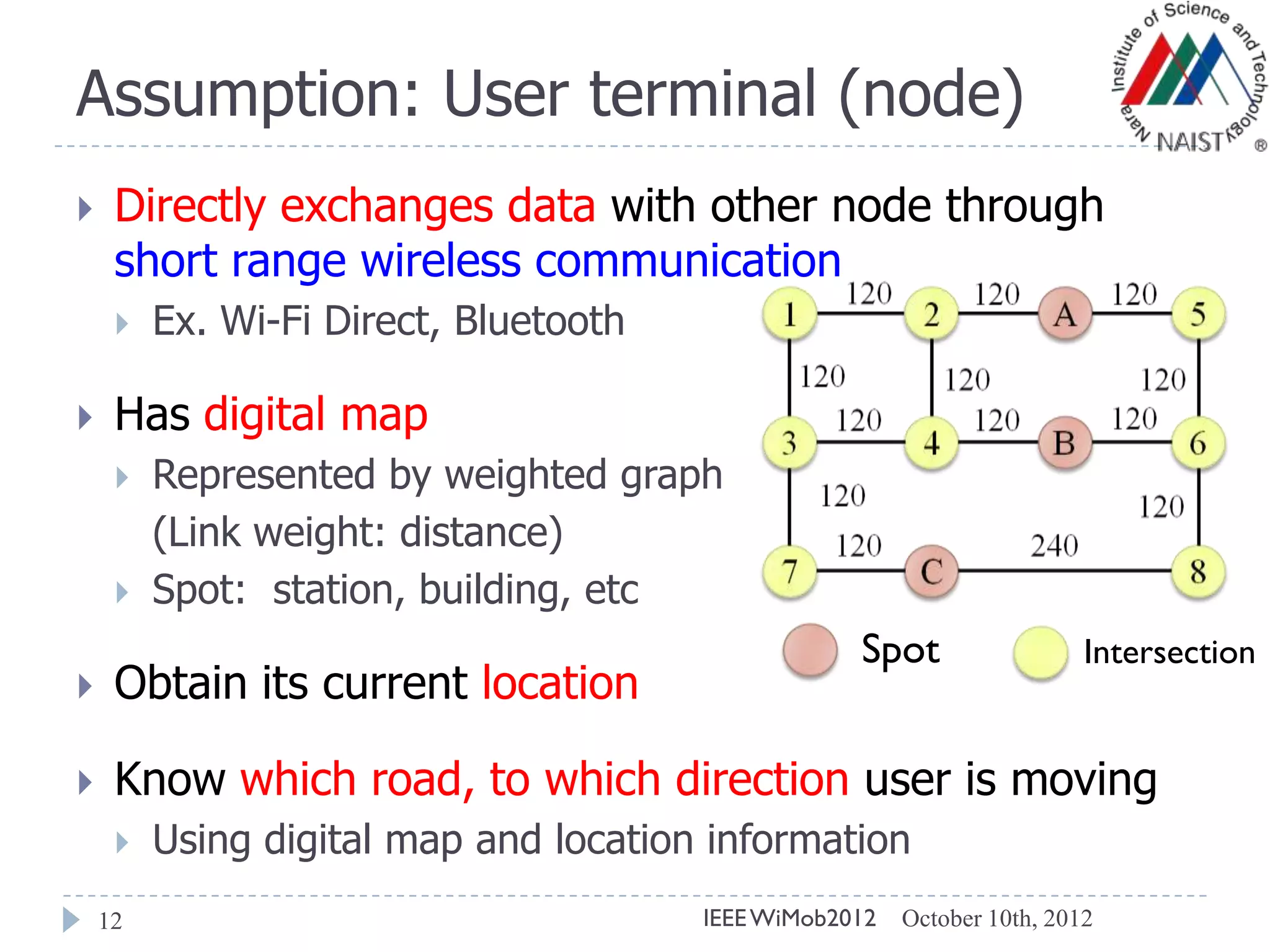
Assumption: User terminal (node)
12
 Directly exchanges data with other node through
short range wireless communication
 Ex. Wi-Fi Direct, Bluetooth
 Has digital map
 Represented by weighted graph
(Link weight: distance)
 Spot: station, building, etc
 Obtain its current location
 Know which road, to which direction user is moving
 Using digital map and location information
October 10th, 2012IEEEWiMob2012
Spot Intersection
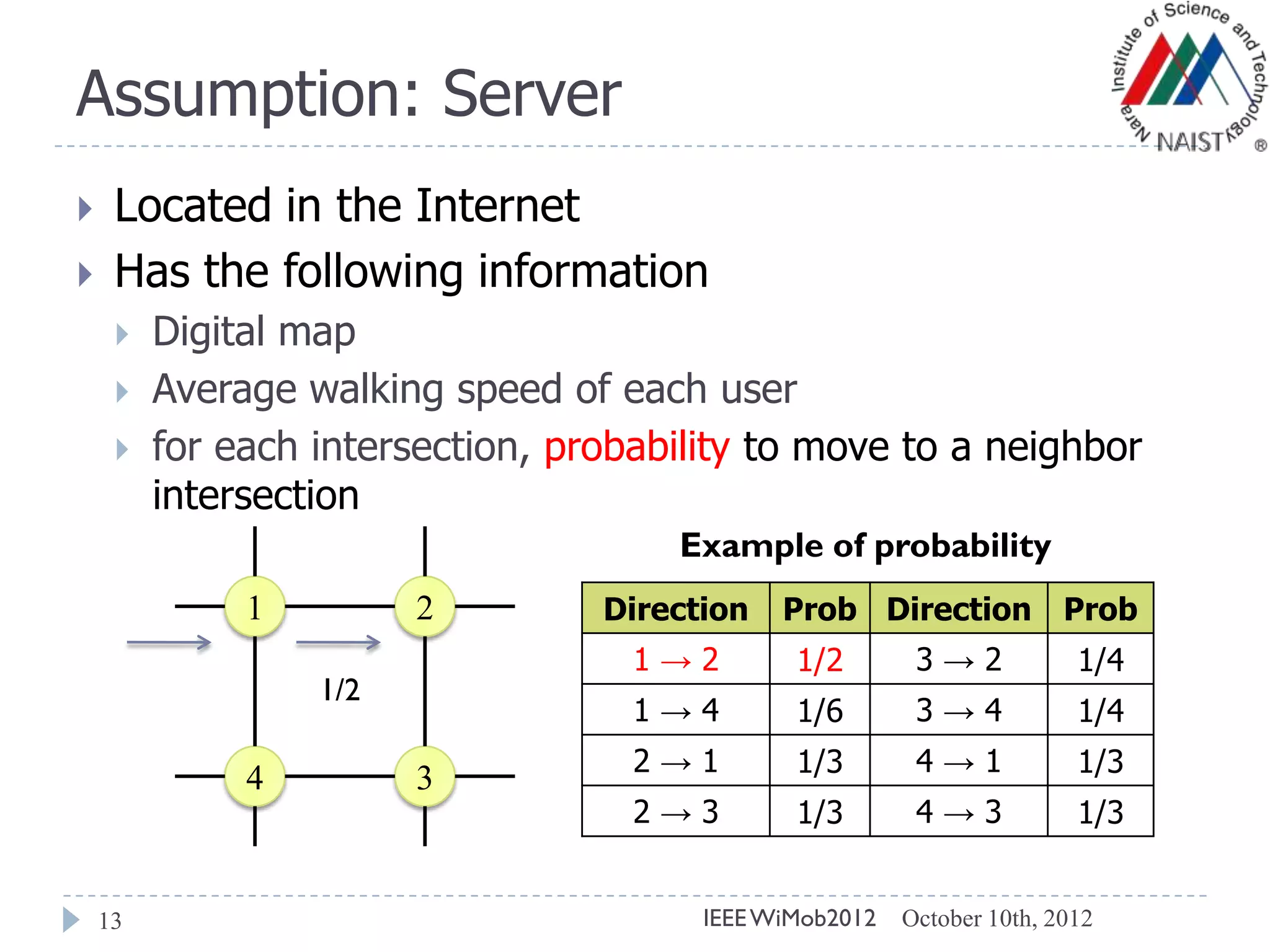
Assumption: Server
13
 Located in the Internet
 Has the following information
 Digital map
 Average walking speed of each user
 for each intersection, probability to move to a neighbor
intersection
1 2
4 3
Direction Prob Direction Prob
1 → 2 1/2 3 → 2 1/4
1 → 4 1/6 3 → 4 1/4
2 → 1 1/3 4 → 1 1/3
2 → 3 1/3 4 → 3 1/3
Example of probability
October 10th, 2012IEEEWiMob2012
1/2
Outline of proposed method
14
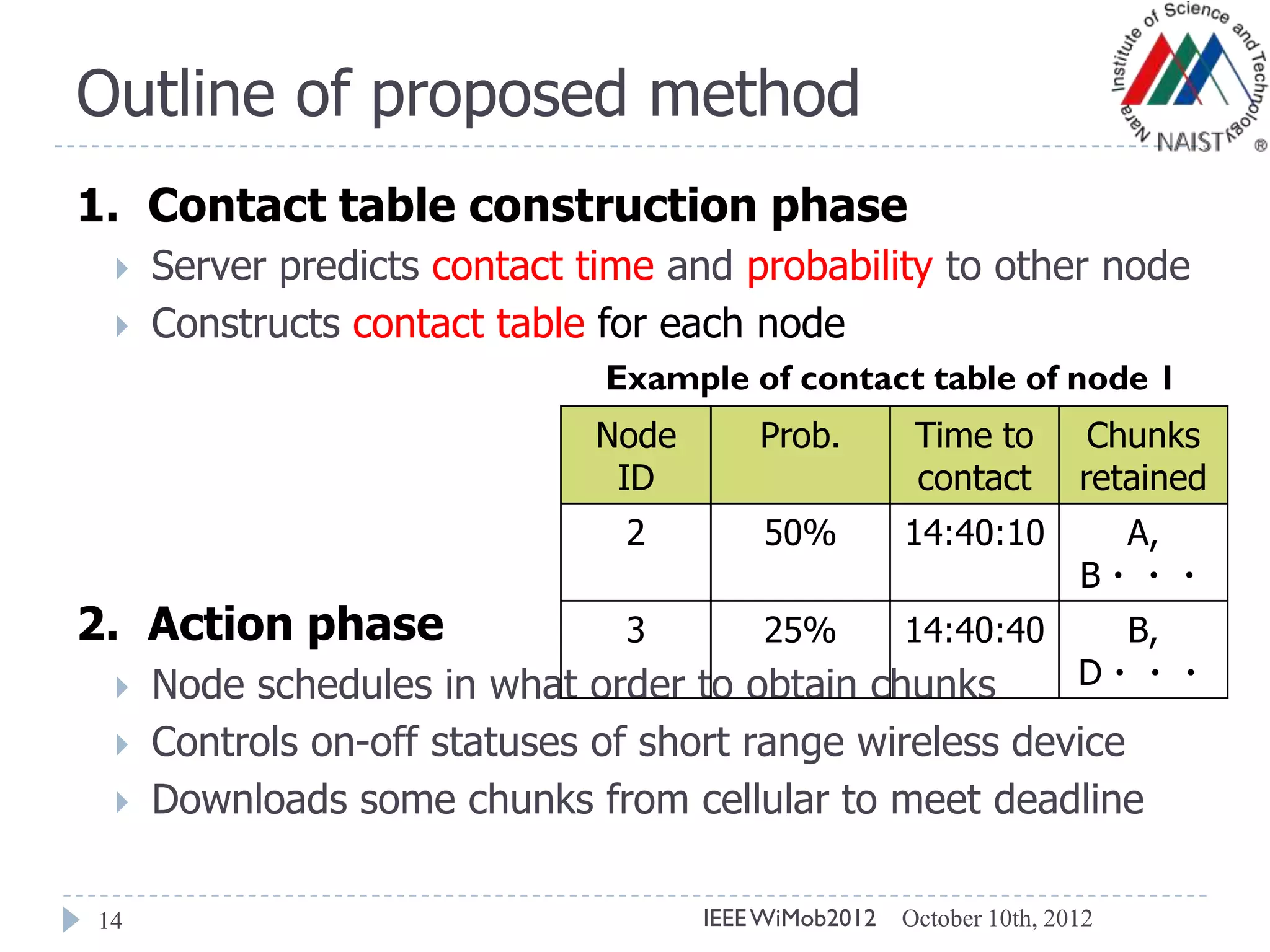
1. Contact table construction phase
 Server predicts contact time and probability to other node
 Constructs contact table for each node
2. Action phase
 Node schedules in what order to obtain chunks
 Controls on-off statuses of short range wireless device
 Downloads some chunks from cellular to meet deadline
Node
ID
Prob. Time to
contact
Chunks
retained
2 50% 14:40:10 A,
B・・・
3 25% 14:40:40 B,
D・・・
Example of contact table of node 1
October 10th, 2012IEEEWiMob2012
Contact table construction (1/2)
15
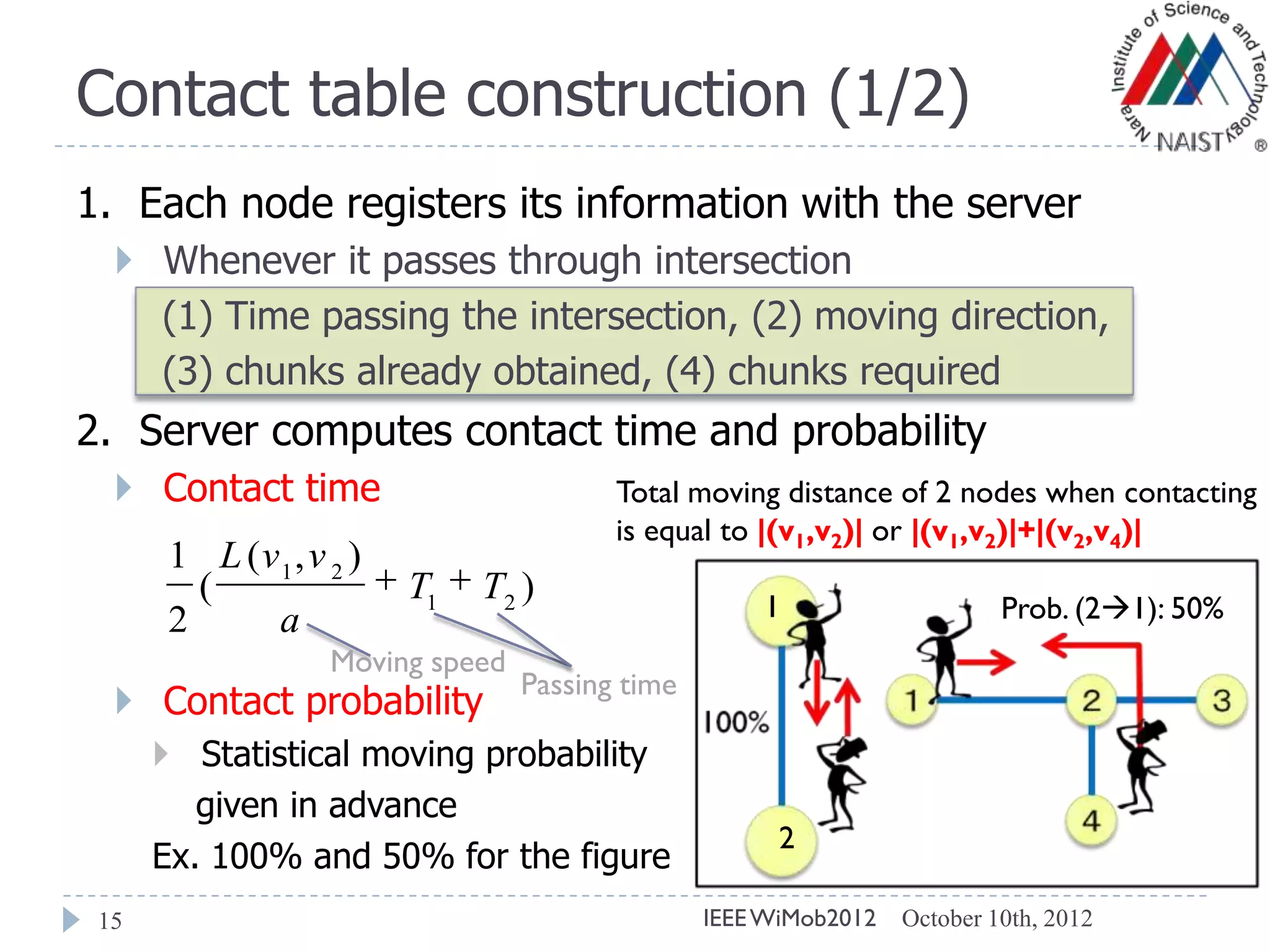
1. Each node registers its information with the server
 Whenever it passes through intersection
(1) Time passing the intersection, (2) moving direction,
(3) chunks already obtained, (4) chunks required
2. Server computes contact time and probability
 Contact time
 Contact probability
 Statistical moving probability
given in advance
Ex. 100% and 50% for the figure
October 10th, 2012IEEEWiMob2012
Prob. (21): 50%
Total moving distance of 2 nodes when contacting
is equal to |(v1,v2)| or |(v1,v2)|+|(v2,v4)|
1
2
1
2
(
L(v1
,v2
)
a
T1
T2
)
Passing time
Moving speed
Contact table construction (2/2)
October 10th, 2012IEEE WiMob201216
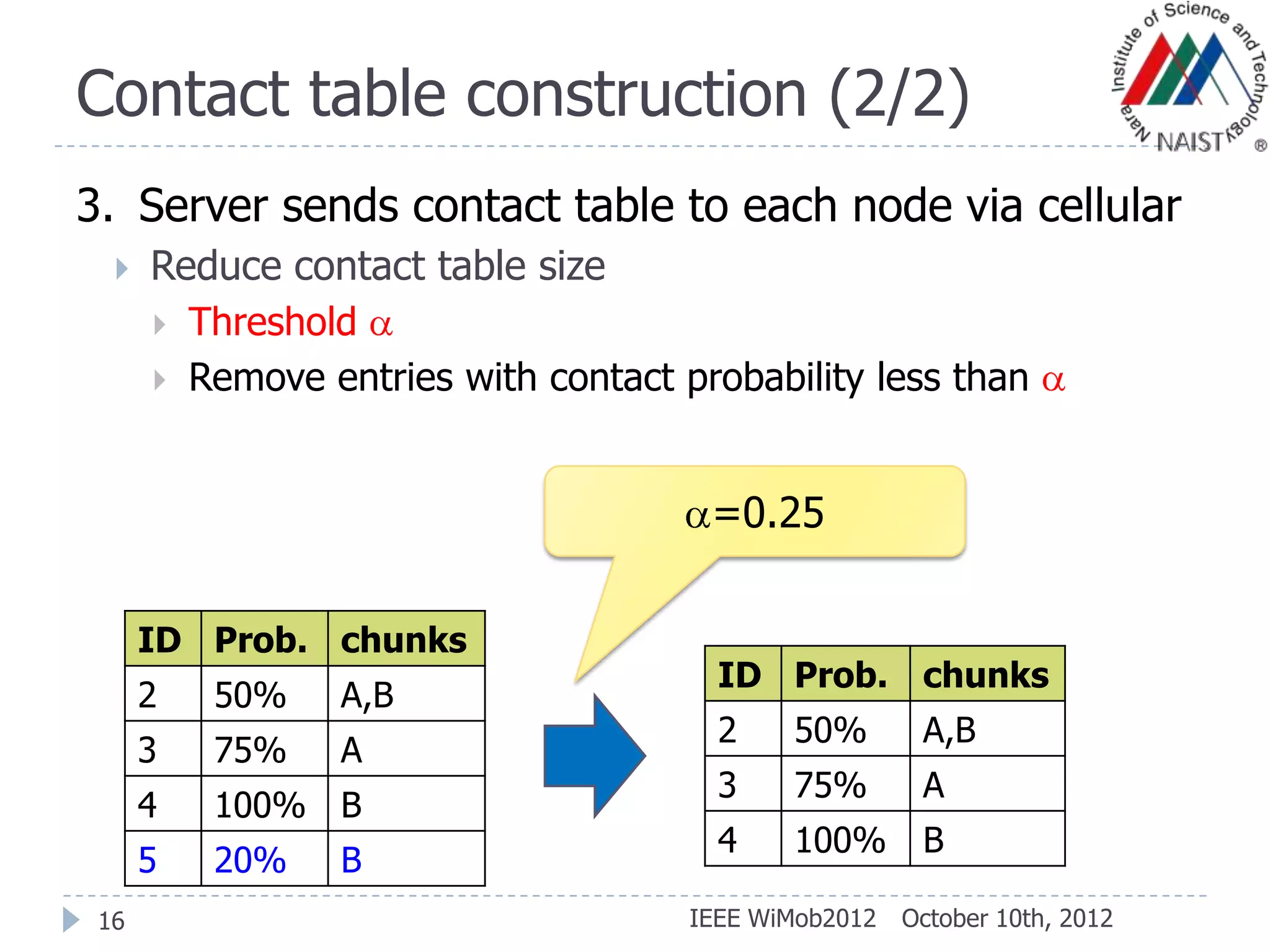
3. Server sends contact table to each node via cellular
 Reduce contact table size
 Threshold
 Remove entries with contact probability less than
ID Prob. chunks
2 50% A,B
3 75% A
4 100% B
5 20% B
ID Prob. chunks
2 50% A,B
3 75% A
4 100% B
=0.25
Action phase
- select chunks to obtain during contact time -
17
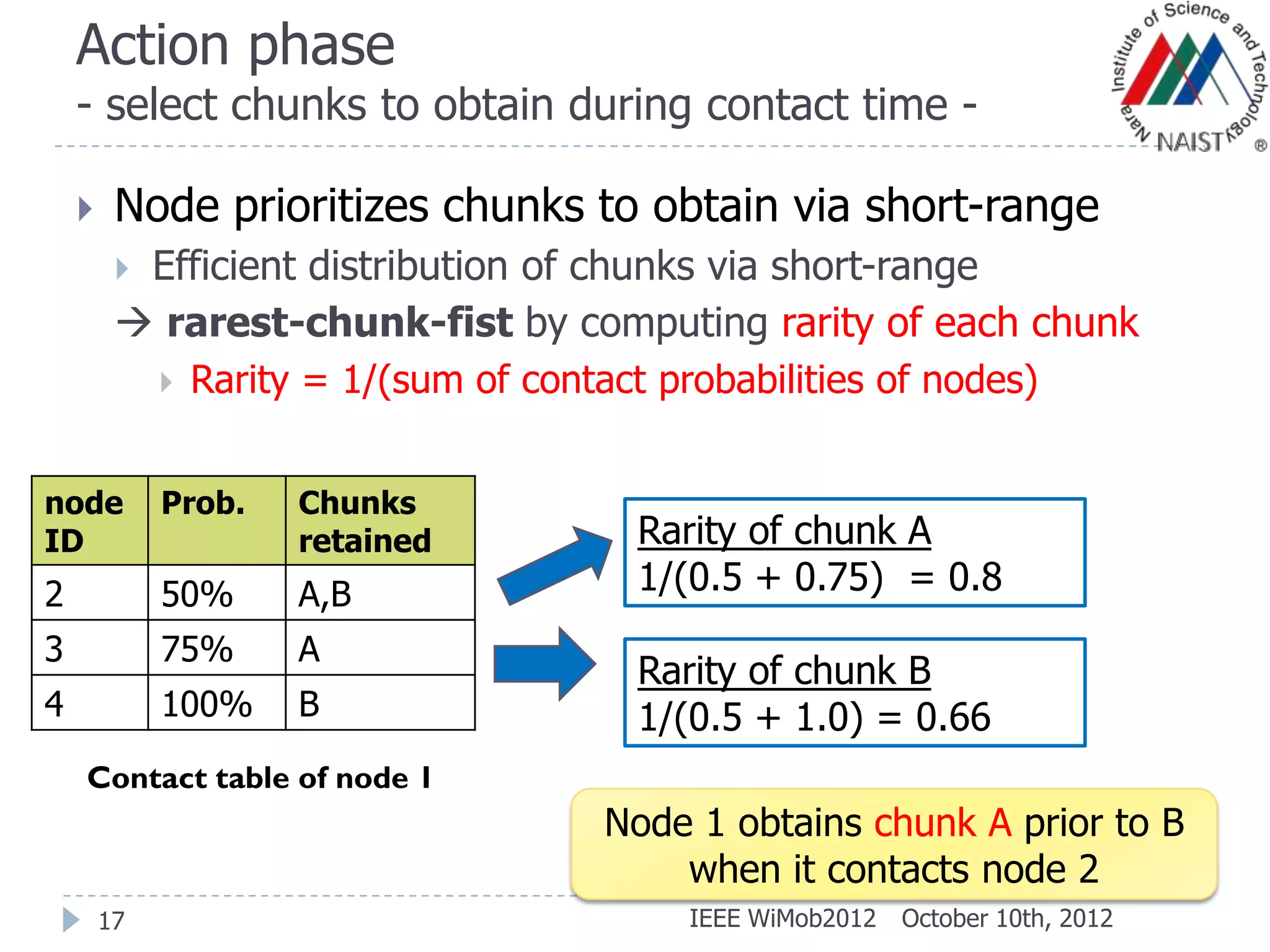
 Node prioritizes chunks to obtain via short-range
 Efficient distribution of chunks via short-range
 rarest-chunk-fist by computing rarity of each chunk
 Rarity = 1/(sum of contact probabilities of nodes)
node
ID
Prob. Chunks
retained
2 50% A,B
3 75% A
4 100% B
Rarity of chunk A
1/(0.5 + 0.75) = 0.8
Rarity of chunk B
1/(0.5 + 1.0) = 0.66
Node 1 obtains chunk A prior to B
when it contacts node 2
October 10th, 2012IEEE WiMob2012
Contact table of node 1
Action phase
- download of chunks from cellular network -
 Complete acquisition of the whole file by deadline
 Each node download chunks from cellular network
 Line of chunk acquisition ratio equal to elapsed time ratio
 Download a chunk when the ratio is below the line
 Select rare chunks
Chunksacquisitionratio[%]
100
Time Deadline
Do not download
chunks
Download chunks
18 October 10th, 2012IEEEWiMob2012
Update period of contact table
19
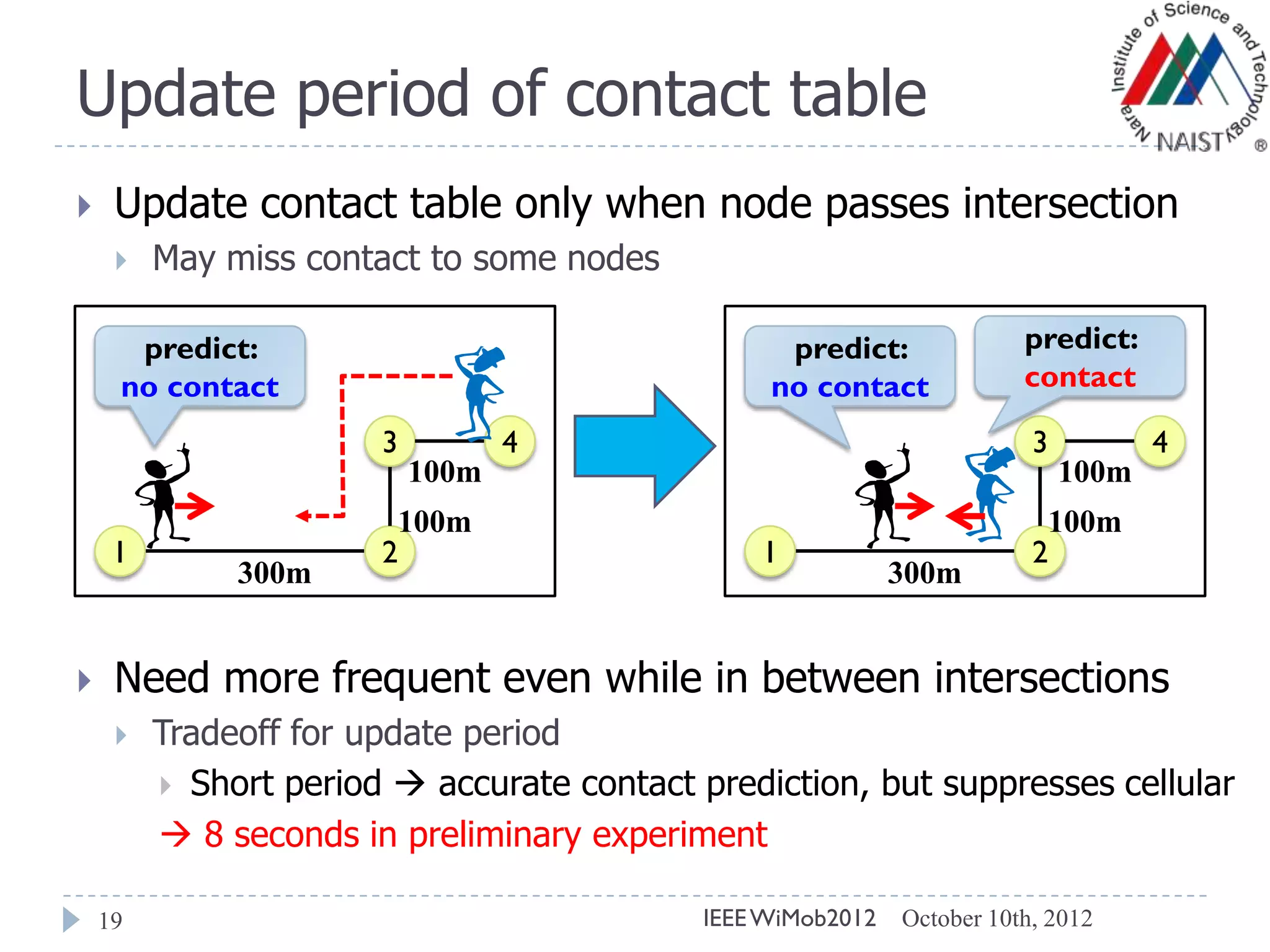
 Update contact table only when node passes intersection
 May miss contact to some nodes
 Need more frequent even while in between intersections
 Tradeoff for update period
 Short period  accurate contact prediction, but suppresses cellular
 8 seconds in preliminary experiment
21
3 4
300m
100m
100m
21
3 4
300m
100m
100m
predict:
no contact
predict:
no contact
predict:
contact
October 10th, 2012IEEEWiMob2012
Organization
20
 Background and Related Work
 Proposed Method
 Experimental Result
 Conclusion
October 10th, 2012IEEEWiMob2012
Experiments: purpose and metrics
21
 Purpose
 Confirm to what extent our method can reduce cellular
traffic while suppressing extra energy consumption
 Metrics
 Number of chunks obtained through short-range /node
 battery consumption / node
October 10th, 2012IEEEWiMob2012
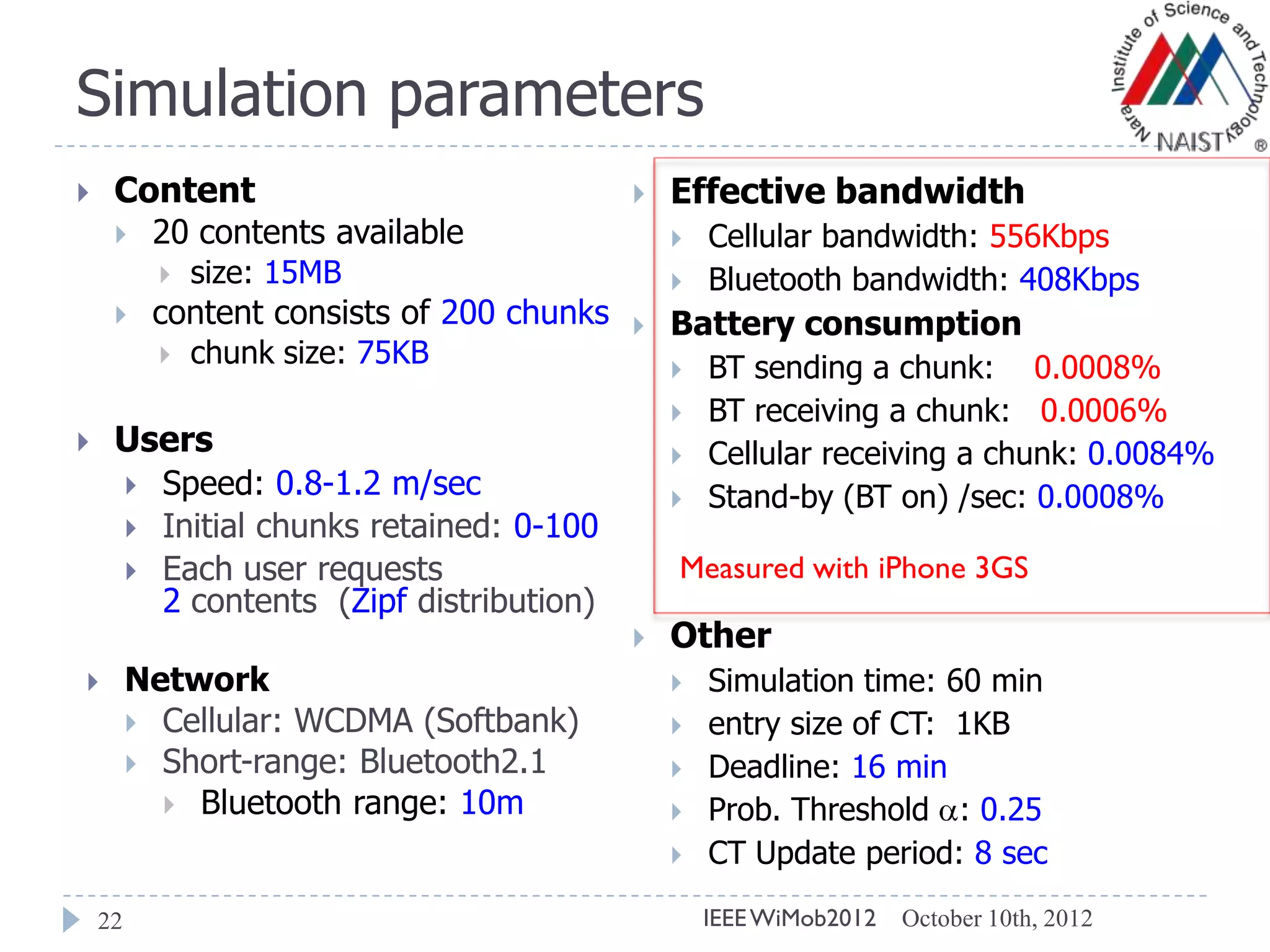
Simulation parameters
22
 Content
 20 contents available
 size: 15MB
 content consists of 200 chunks
 chunk size: 75KB
 Users
 Speed: 0.8-1.2 m/sec
 Initial chunks retained: 0-100
 Each user requests
2 contents (Zipf distribution)
 Network
 Cellular: WCDMA (Softbank)
 Short-range: Bluetooth2.1
 Bluetooth range: 10m
 Effective bandwidth
 Cellular bandwidth: 556Kbps
 Bluetooth bandwidth: 408Kbps
 Battery consumption
 BT sending a chunk: 0.0008%
 BT receiving a chunk: 0.0006%
 Cellular receiving a chunk: 0.0084%
 Stand-by (BT on) /sec: 0.0008%
 Other
 Simulation time: 60 min
 entry size of CT: 1KB
 Deadline: 16 min
 Prob. Threshold : 0.25
 CT Update period: 8 sec
October 10th, 2012IEEEWiMob2012
Measured with iPhone 3GS
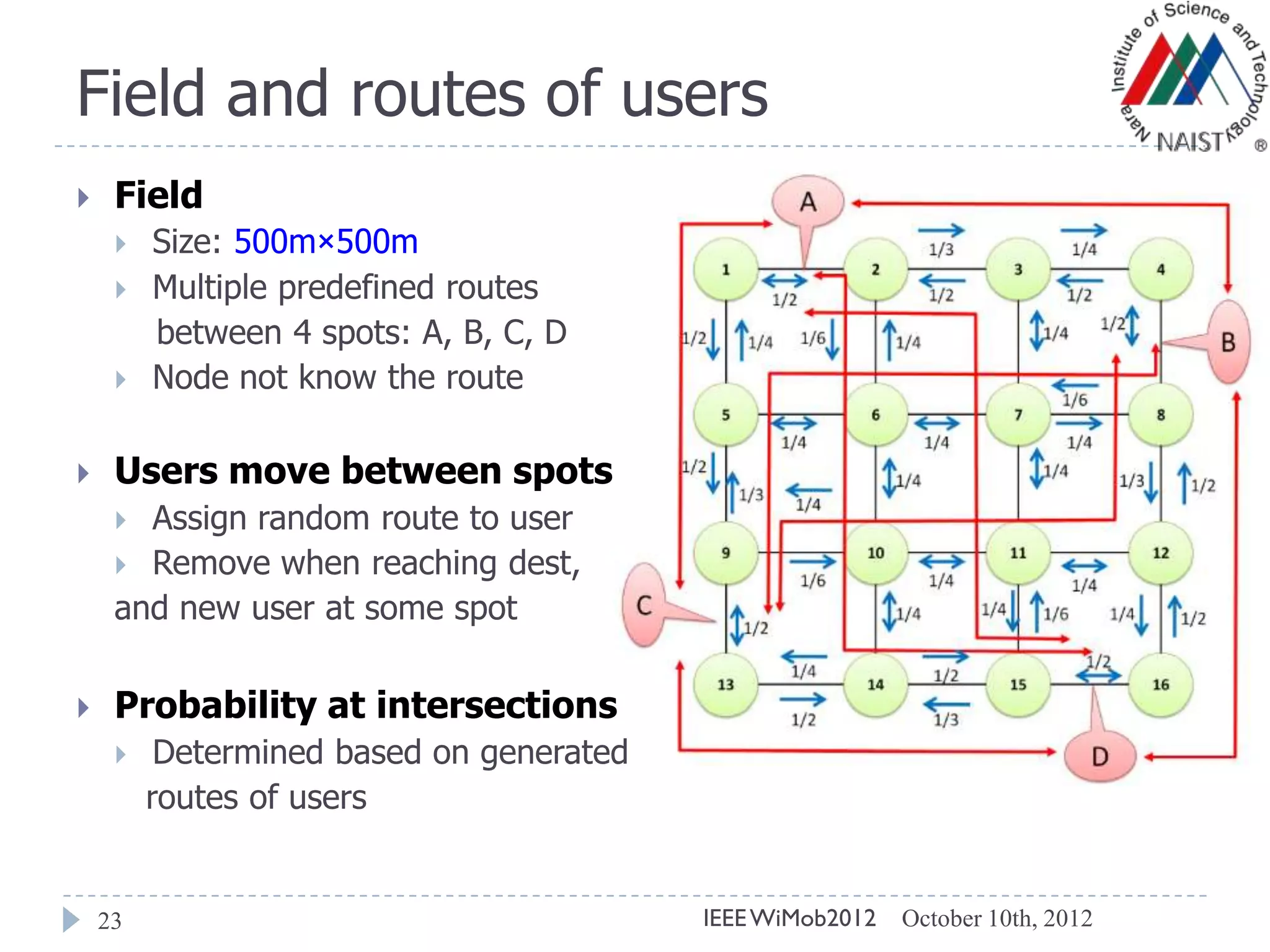
Field and routes of users
23
 Field
 Size: 500m×500m
 Multiple predefined routes
between 4 spots: A, B, C, D
 Node not know the route
 Users move between spots
 Assign random route to user
 Remove when reaching dest,
and new user at some spot
 Probability at intersections
 Determined based on generated
routes of users
October 10th, 2012IEEEWiMob2012
Comparative methods
24
 Always-turn-on method
 Always turns on Bluetooth device
 Randomly selects a chunk to obtain via Bluetooth
 Contact oracle method (ideal, but cannot be implemented)
 Knows when to contact nodes having required chunks with no cost
 Turns on Bluetooth device only when contacting the target nodes
 Select a chunk to obtain by rarest-chunk-first (same as proposed)
 Download chunk from cellular similarly to our method
October 10th, 2012IEEEWiMob2012
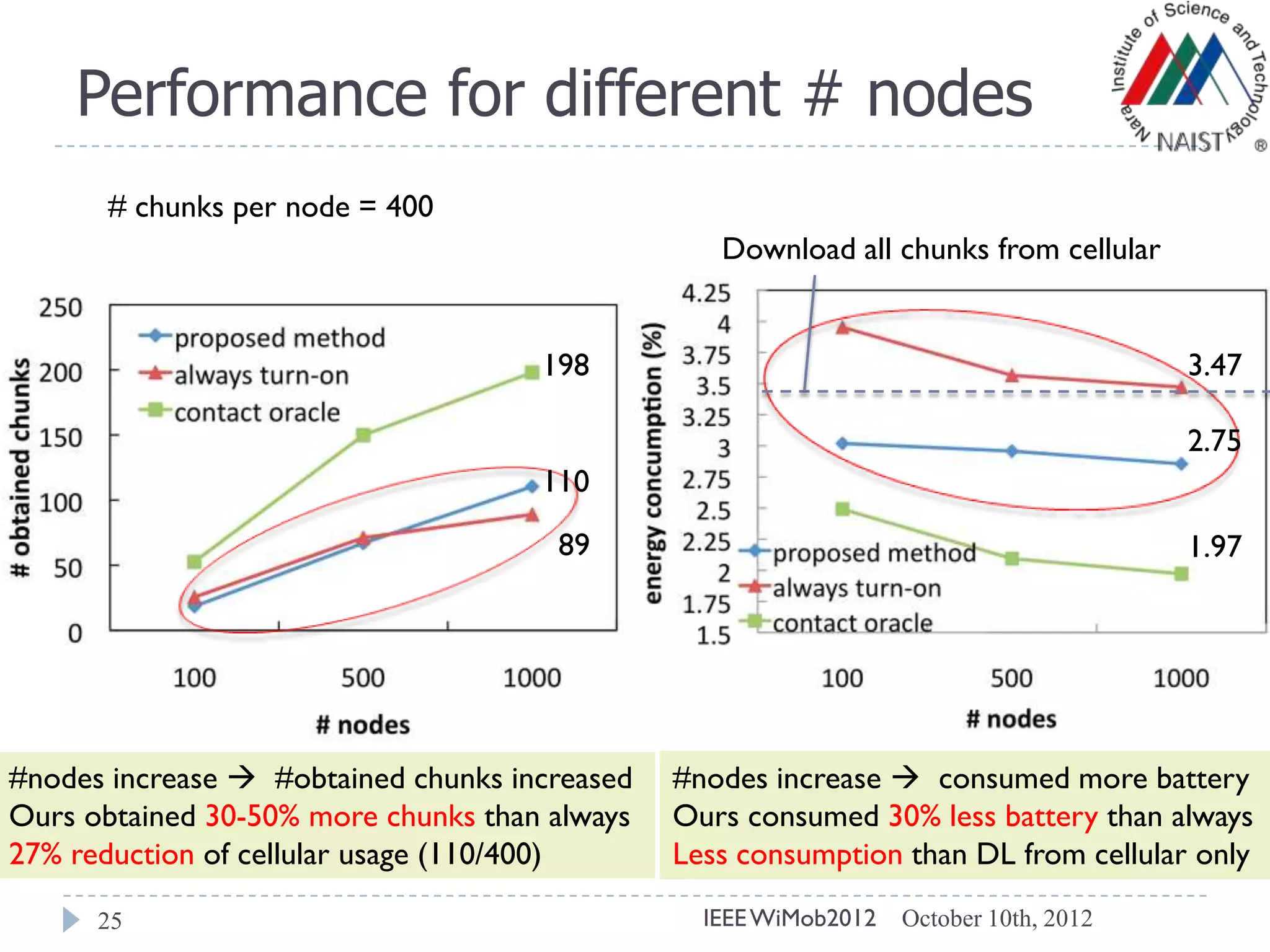
Performance for different # nodes
October 10th, 2012IEEEWiMob201225
Download all chunks from cellular
# chunks per node = 400
#nodes increase  #obtained chunks increased
Ours obtained 30-50% more chunks than always
27% reduction of cellular usage (110/400)
#nodes increase  consumed more battery
Ours consumed 30% less battery than always
Less consumption than DL from cellular only
89
110
198 3.47
2.75
1.97
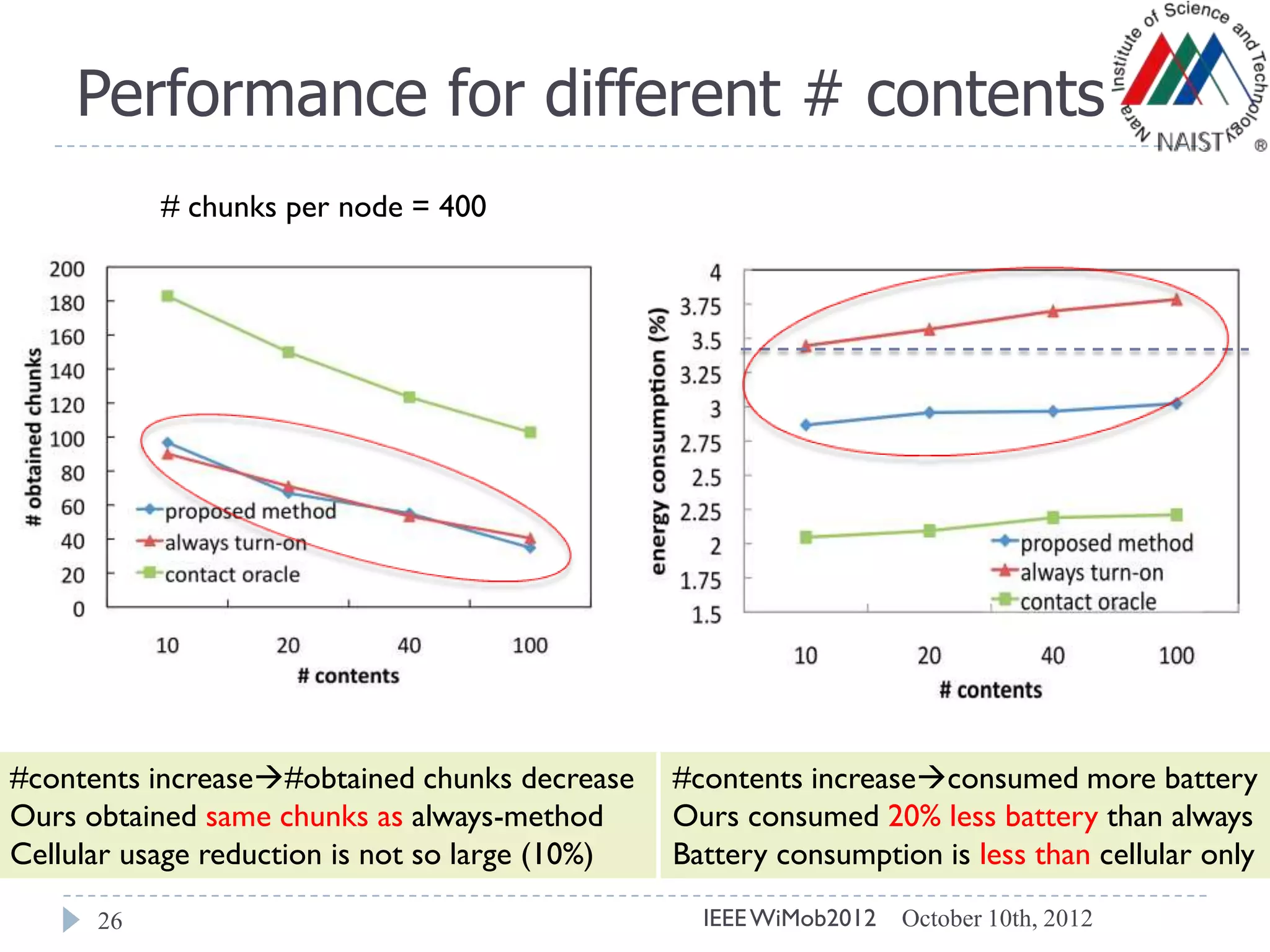
Performance for different # contents
October 10th, 2012IEEEWiMob201226
#contents increase#obtained chunks decrease
Ours obtained same chunks as always-method
Cellular usage reduction is not so large (10%)
#contents increaseconsumed more battery
Ours consumed 20% less battery than always
Battery consumption is less than cellular only
# chunks per node = 400
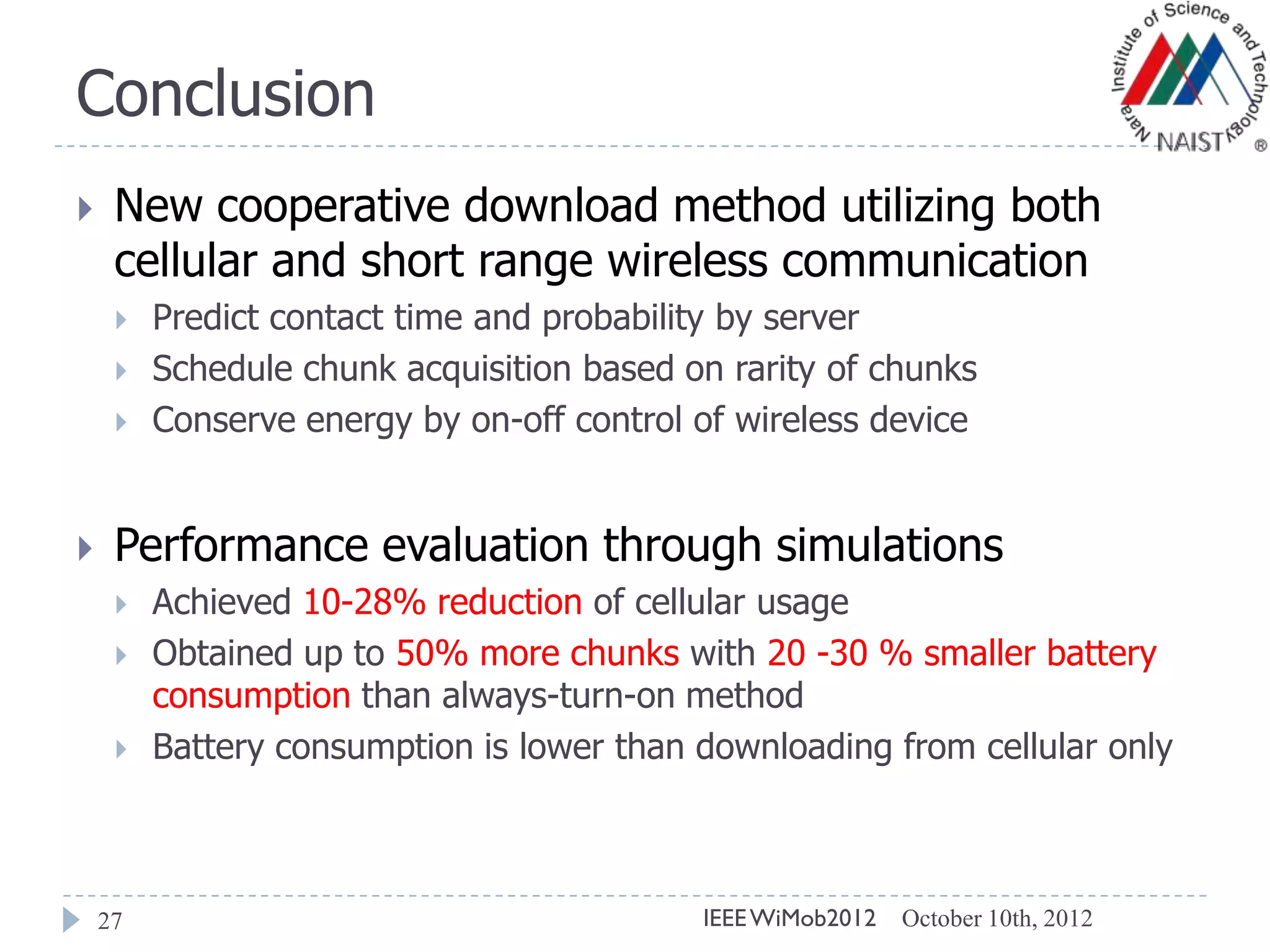
Conclusion
27
 New cooperative download method utilizing both
cellular and short range wireless communication
 Predict contact time and probability by server
 Schedule chunk acquisition based on rarity of chunks
 Conserve energy by on-off control of wireless device
 Performance evaluation through simulations
 Achieved 10-28% reduction of cellular usage
 Obtained up to 50% more chunks with 20 -30 % smaller battery
consumption than always-turn-on method
 Battery consumption is lower than downloading from cellular only
October 10th, 2012IEEEWiMob2012

Energy-Efficient Cooperative Download for Smartphone Users through Contact Time Estimation

  • 1.
    Energy-Efficient Cooperative Download forSmartphone Users through Contact Time Estimation Keiichi Yasumoto, Yu Takamatsu, Weihua Sun, Minoru Ito Nara Institute of Science and Technology
  • 2.
    Organization 2  Background andRelated Work  Proposed Method  Experimental Result  Conclusion October 10th, 2012IEEEWiMob2012
  • 3.
    Contents download fromcellular network 3  Rapid spread of Smartphones  Videos: YouTube, Ustream  File share: iCloud, DropBox  Apps: App Store, Android Market becoming common to download large-size contents  Large-size contents download  Suppresses cellular network  Deteriorates performance (even collapses network) when many users download large files at the same time October 10th, 2012IEEEWiMob2012
  • 4.
    Countermeasures for cellularsuppression 4  Cellular phone carriers  Limit total downloadable amount per month (e.g., 7GB)  Decrease BW of the user who exceeded the limit (e.g., 128Kbps)  Return to the traditional pay-as-you-go plan  4G (LTE)  Takes long time to be available anywhere  Content size will grow (e.g., by retina display)  we will face the same problem in the future Need intrinsic method for reducing cellular traffic October 10th, 2012IEEEWiMob2012
  • 5.
    Cooperative download 5  Severalusers cooperate in downloading the same file  Ex. BitTorrent for fixed network  Cooperative DL can be applied to mobile environment,  Users exchange chunks of the file through short-range wireless communication like WiFi and Bluetooth 100% 100% 50% 50% 50% 50% Without cooperative DL With cooperative DL October 10th, 2012IEEEWiMob2012
  • 6.
    Challenges of cooperativedownload in mobile environments 6  Frequent change of nearby nodes  difficult to obtain the whole file from a single node via short range communication  Extra energy consumption  by short-range wireless communication  Low success rate & no guarantee of DL completion time  Cannot know when to meet node with required chunks October 10th, 2012IEEEWiMob2012
  • 7.
    Related work October 10th,2012IEEEWiMob20127  Adapt P2P technologies for mobile environments [5-8][13-14]  May not complete acquisition of the whole due to user mobility  Apply cooperative DL to vehicular environments [9-12]  Take vehicular mobility into account and achieve efficient DL rate  Do not consider energy-efficiency  Realize content exchange in public transportation [15,16]  Identify users collocating in train/bus during commute, allow users to exchange files  Do not tell when content acquisition completes  Utilize both WiFi and cellular [4]  Achieve complete acquisition by specified deadline using cellular  Consume extra energy for frequent beacon exchanges via WiFi
  • 8.
    Goal 8  Realize cooperativedownload among mobile users  Using both cellular and short range communication  Requirements 1. Effective content acquisition against frequent change of nearby users 2. Saving energy consumption by short range communication 3. Guaranteeing acquisition of the whole file by specified time October 10th, 2012IEEEWiMob2012
  • 9.
    Organization 9  Background andRelated Work  Proposed Method  Experimental Result  Conclusion October 10th, 2012IEEEWiMob2012
  • 10.
    Basic ideas 10 • Predictwhen and which users to contact by server • Server schedules chunks acquisition of each user Frequent change of contacting users • On-off control of wireless device • Let wireless device sleep when not necessary Energy saving • Download chunks also from cellular network if needed • Select chunks that cannot be obtained from other users Content acquisition by deadline October 10th, 2012IEEEWiMob2012
  • 11.
    Supposed situation 11  Mobileusers acquire specified contents while moving (Ex. User reads news content after arriving at station)  User acquires chunks of contents from other users when contacting contact = enter the short-range communication range We assume that a content consists of fixed size chunks : short-range : cellular October 10th, 2012IEEEWiMob2012
  • 12.
    Assumption: User terminal(node) 12  Directly exchanges data with other node through short range wireless communication  Ex. Wi-Fi Direct, Bluetooth  Has digital map  Represented by weighted graph (Link weight: distance)  Spot: station, building, etc  Obtain its current location  Know which road, to which direction user is moving  Using digital map and location information October 10th, 2012IEEEWiMob2012 Spot Intersection
  • 13.
    Assumption: Server 13  Locatedin the Internet  Has the following information  Digital map  Average walking speed of each user  for each intersection, probability to move to a neighbor intersection 1 2 4 3 Direction Prob Direction Prob 1 → 2 1/2 3 → 2 1/4 1 → 4 1/6 3 → 4 1/4 2 → 1 1/3 4 → 1 1/3 2 → 3 1/3 4 → 3 1/3 Example of probability October 10th, 2012IEEEWiMob2012 1/2
  • 14.
    Outline of proposedmethod 14 1. Contact table construction phase  Server predicts contact time and probability to other node  Constructs contact table for each node 2. Action phase  Node schedules in what order to obtain chunks  Controls on-off statuses of short range wireless device  Downloads some chunks from cellular to meet deadline Node ID Prob. Time to contact Chunks retained 2 50% 14:40:10 A, B・・・ 3 25% 14:40:40 B, D・・・ Example of contact table of node 1 October 10th, 2012IEEEWiMob2012
  • 15.
    Contact table construction(1/2) 15 1. Each node registers its information with the server  Whenever it passes through intersection (1) Time passing the intersection, (2) moving direction, (3) chunks already obtained, (4) chunks required 2. Server computes contact time and probability  Contact time  Contact probability  Statistical moving probability given in advance Ex. 100% and 50% for the figure October 10th, 2012IEEEWiMob2012 Prob. (21): 50% Total moving distance of 2 nodes when contacting is equal to |(v1,v2)| or |(v1,v2)|+|(v2,v4)| 1 2 1 2 ( L(v1 ,v2 ) a T1 T2 ) Passing time Moving speed
  • 16.
    Contact table construction(2/2) October 10th, 2012IEEE WiMob201216 3. Server sends contact table to each node via cellular  Reduce contact table size  Threshold  Remove entries with contact probability less than ID Prob. chunks 2 50% A,B 3 75% A 4 100% B 5 20% B ID Prob. chunks 2 50% A,B 3 75% A 4 100% B =0.25
  • 17.
    Action phase - selectchunks to obtain during contact time - 17  Node prioritizes chunks to obtain via short-range  Efficient distribution of chunks via short-range  rarest-chunk-fist by computing rarity of each chunk  Rarity = 1/(sum of contact probabilities of nodes) node ID Prob. Chunks retained 2 50% A,B 3 75% A 4 100% B Rarity of chunk A 1/(0.5 + 0.75) = 0.8 Rarity of chunk B 1/(0.5 + 1.0) = 0.66 Node 1 obtains chunk A prior to B when it contacts node 2 October 10th, 2012IEEE WiMob2012 Contact table of node 1
  • 18.
    Action phase - downloadof chunks from cellular network -  Complete acquisition of the whole file by deadline  Each node download chunks from cellular network  Line of chunk acquisition ratio equal to elapsed time ratio  Download a chunk when the ratio is below the line  Select rare chunks Chunksacquisitionratio[%] 100 Time Deadline Do not download chunks Download chunks 18 October 10th, 2012IEEEWiMob2012
  • 19.
    Update period ofcontact table 19  Update contact table only when node passes intersection  May miss contact to some nodes  Need more frequent even while in between intersections  Tradeoff for update period  Short period  accurate contact prediction, but suppresses cellular  8 seconds in preliminary experiment 21 3 4 300m 100m 100m 21 3 4 300m 100m 100m predict: no contact predict: no contact predict: contact October 10th, 2012IEEEWiMob2012
  • 20.
    Organization 20  Background andRelated Work  Proposed Method  Experimental Result  Conclusion October 10th, 2012IEEEWiMob2012
  • 21.
    Experiments: purpose andmetrics 21  Purpose  Confirm to what extent our method can reduce cellular traffic while suppressing extra energy consumption  Metrics  Number of chunks obtained through short-range /node  battery consumption / node October 10th, 2012IEEEWiMob2012
  • 22.
    Simulation parameters 22  Content 20 contents available  size: 15MB  content consists of 200 chunks  chunk size: 75KB  Users  Speed: 0.8-1.2 m/sec  Initial chunks retained: 0-100  Each user requests 2 contents (Zipf distribution)  Network  Cellular: WCDMA (Softbank)  Short-range: Bluetooth2.1  Bluetooth range: 10m  Effective bandwidth  Cellular bandwidth: 556Kbps  Bluetooth bandwidth: 408Kbps  Battery consumption  BT sending a chunk: 0.0008%  BT receiving a chunk: 0.0006%  Cellular receiving a chunk: 0.0084%  Stand-by (BT on) /sec: 0.0008%  Other  Simulation time: 60 min  entry size of CT: 1KB  Deadline: 16 min  Prob. Threshold : 0.25  CT Update period: 8 sec October 10th, 2012IEEEWiMob2012 Measured with iPhone 3GS
  • 23.
    Field and routesof users 23  Field  Size: 500m×500m  Multiple predefined routes between 4 spots: A, B, C, D  Node not know the route  Users move between spots  Assign random route to user  Remove when reaching dest, and new user at some spot  Probability at intersections  Determined based on generated routes of users October 10th, 2012IEEEWiMob2012
  • 24.
    Comparative methods 24  Always-turn-onmethod  Always turns on Bluetooth device  Randomly selects a chunk to obtain via Bluetooth  Contact oracle method (ideal, but cannot be implemented)  Knows when to contact nodes having required chunks with no cost  Turns on Bluetooth device only when contacting the target nodes  Select a chunk to obtain by rarest-chunk-first (same as proposed)  Download chunk from cellular similarly to our method October 10th, 2012IEEEWiMob2012
  • 25.
    Performance for different# nodes October 10th, 2012IEEEWiMob201225 Download all chunks from cellular # chunks per node = 400 #nodes increase  #obtained chunks increased Ours obtained 30-50% more chunks than always 27% reduction of cellular usage (110/400) #nodes increase  consumed more battery Ours consumed 30% less battery than always Less consumption than DL from cellular only 89 110 198 3.47 2.75 1.97
  • 26.
    Performance for different# contents October 10th, 2012IEEEWiMob201226 #contents increase#obtained chunks decrease Ours obtained same chunks as always-method Cellular usage reduction is not so large (10%) #contents increaseconsumed more battery Ours consumed 20% less battery than always Battery consumption is less than cellular only # chunks per node = 400
  • 27.
    Conclusion 27  New cooperativedownload method utilizing both cellular and short range wireless communication  Predict contact time and probability by server  Schedule chunk acquisition based on rarity of chunks  Conserve energy by on-off control of wireless device  Performance evaluation through simulations  Achieved 10-28% reduction of cellular usage  Obtained up to 50% more chunks with 20 -30 % smaller battery consumption than always-turn-on method  Battery consumption is lower than downloading from cellular only October 10th, 2012IEEEWiMob2012