ConfidenceMichael Bewell
The intention....At selection / interview days enable you to:Be less nervousStop responding randomly or just brain dumpGet away from thinking ‘did they understand’Have more confidenceBe more focussed and structuredSkilfully get your message across and positively persuadeRespond from a foundation of strength
Areas to coverBeliefsStrengthsCommunicationMotivation
ActivityWhat do you believe makes an excellent professional?Think, pair then share
Three key ingredients Bloom's Taxonomy  [for learning] says:Cognitive domainPsychomotor domainAffective domainAttitude will determine your altitude in your career
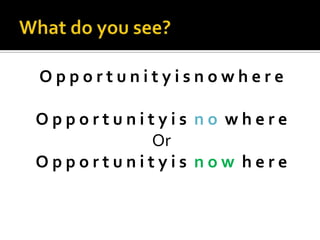
What do you see?O p p o r t u n i t y i s n o w h e r eO p p o r t u n i t y i s n o w h e r eOrO p p o r t u n i t y i s n o w  h e r e
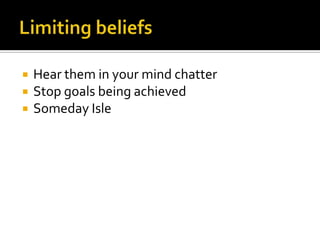
Limiting beliefsHear them in your mind chatterStop goals being achievedSomeday Isle
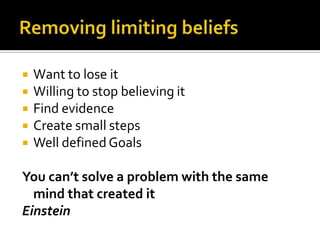
Removing limiting beliefsWant to lose it Willing to stop believing itFind evidenceCreate small stepsWell defined GoalsYou can’t solve a problem with the same mind that created itEinstein
ActivityA 2 minute challenge to remember 40 objects Do you believe you can?
ActivityDescribe your best present self (in the context of being an excellent professional MFL teacher):What was the task you were doing?Who were you doing it with?What are the others saying about you?How did you look or sound?What tools, approach or methods were you using?
Activity“Rotating clipboards”; pass your sheet to a colleague.  In 2 min they will write a time they have seen you at your best answering the same questions 	Keep rotating to get ~ 10ish statements for each person
Kolb and 4MAT modelWhy? Reason for learningWhat? Facts and conceptsHow? Process and practiceWhat if? Variations and tests
iSPARK by Rob Cameroni must focus on ISituationPartActionsResultKnowledge
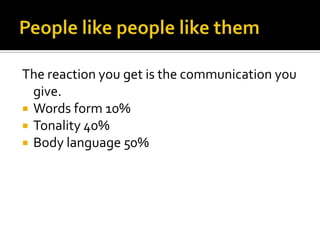
People like people like themThe reaction you get is the communication you give.Words form 10%Tonality 40%Body language 50%
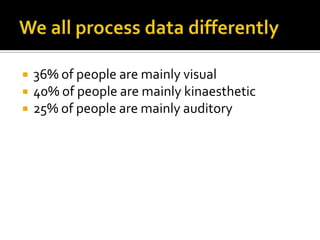
We all process data differently36% of people are mainly visual40% of people are mainly kinaesthetic25% of people are mainly auditory
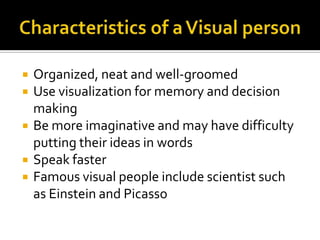
Characteristics of a Visual personOrganized, neat and well-groomedUse visualization for memory and decision makingBe more imaginative and may have difficulty putting their ideas in wordsSpeak fasterFamous visual people include scientist such as Einstein and Picasso
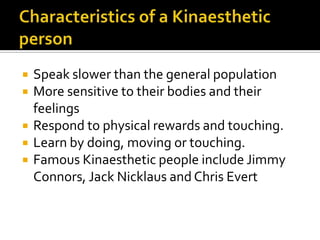
Characteristics of a Kinaesthetic personSpeak slower than the general populationMore sensitive to their bodies and their feelingsRespond to physical rewards and touching.Learn by doing, moving or touching.Famous Kinaesthetic people include Jimmy Connors, Jack Nicklaus and Chris Evert
Characteristics of an Auditory personPerceive and represent sequencesAble to remember directions or instructions more easilyLearn by listening and asking questionsEasily distracted by noiseFamous auditory people include song writers like Mozart, the Beatles, Paul Simon
Activity Describe your strengths in the style of a kinaesthetic, auditory or visual personPairsCan your partner spot the style you are using?
What if.....anxiety strikes?Visualising a positive outcomeAnchoring to positive emotionsReframing to use your strengths
A final thought.When you define your goal.  AFFIRM it.We are what we think. All that we are arises. With our thoughts, we make our world. BuddhaI figured that if I said it enough, I would convince the world that I really was the greatest.MuhammedAli
Resourceshttp://tinyurl.com/persuasion2011http:// tinyurl.com/words-that-changewww.doctorbewellsblog@mbewell

Confidence

  • 1.
  • 2.
    The intention....At selection/ interview days enable you to:Be less nervousStop responding randomly or just brain dumpGet away from thinking ‘did they understand’Have more confidenceBe more focussed and structuredSkilfully get your message across and positively persuadeRespond from a foundation of strength
  • 3.
  • 4.
    ActivityWhat do youbelieve makes an excellent professional?Think, pair then share
  • 5.
    Three key ingredientsBloom's Taxonomy [for learning] says:Cognitive domainPsychomotor domainAffective domainAttitude will determine your altitude in your career
  • 6.
    What do yousee?O p p o r t u n i t y i s n o w h e r eO p p o r t u n i t y i s n o w h e r eOrO p p o r t u n i t y i s n o w h e r e
  • 7.
    Limiting beliefsHear themin your mind chatterStop goals being achievedSomeday Isle
  • 8.
    Removing limiting beliefsWantto lose it Willing to stop believing itFind evidenceCreate small stepsWell defined GoalsYou can’t solve a problem with the same mind that created itEinstein
  • 9.
    ActivityA 2 minutechallenge to remember 40 objects Do you believe you can?
  • 10.
    ActivityDescribe your bestpresent self (in the context of being an excellent professional MFL teacher):What was the task you were doing?Who were you doing it with?What are the others saying about you?How did you look or sound?What tools, approach or methods were you using?
  • 11.
    Activity“Rotating clipboards”; passyour sheet to a colleague. In 2 min they will write a time they have seen you at your best answering the same questions Keep rotating to get ~ 10ish statements for each person
  • 12.
    Kolb and 4MATmodelWhy? Reason for learningWhat? Facts and conceptsHow? Process and practiceWhat if? Variations and tests
  • 13.
    iSPARK by RobCameroni must focus on ISituationPartActionsResultKnowledge
  • 14.
    People like peoplelike themThe reaction you get is the communication you give.Words form 10%Tonality 40%Body language 50%
  • 15.
    We all processdata differently36% of people are mainly visual40% of people are mainly kinaesthetic25% of people are mainly auditory
  • 16.
    Characteristics of aVisual personOrganized, neat and well-groomedUse visualization for memory and decision makingBe more imaginative and may have difficulty putting their ideas in wordsSpeak fasterFamous visual people include scientist such as Einstein and Picasso
  • 17.
    Characteristics of aKinaesthetic personSpeak slower than the general populationMore sensitive to their bodies and their feelingsRespond to physical rewards and touching.Learn by doing, moving or touching.Famous Kinaesthetic people include Jimmy Connors, Jack Nicklaus and Chris Evert
  • 18.
    Characteristics of anAuditory personPerceive and represent sequencesAble to remember directions or instructions more easilyLearn by listening and asking questionsEasily distracted by noiseFamous auditory people include song writers like Mozart, the Beatles, Paul Simon
  • 19.
    Activity Describe yourstrengths in the style of a kinaesthetic, auditory or visual personPairsCan your partner spot the style you are using?
  • 20.
    What if.....anxiety strikes?Visualisinga positive outcomeAnchoring to positive emotionsReframing to use your strengths
  • 21.
    A final thought.Whenyou define your goal.  AFFIRM it.We are what we think. All that we are arises. With our thoughts, we make our world. BuddhaI figured that if I said it enough, I would convince the world that I really was the greatest.MuhammedAli
  • 22.