Chronic & Conditioned
Gingival Overgrowth:
Presented By:
Dr Randa Youssef
Ass. Prof . Of Pediatric Dentistry & Dental Public
Health, Cairo university
I. PLAQUE-INDUCED Gingivitis
1. Simple chronic gingivitis
2. Conditional gingival enlargement
A.Hormonal:
 *Puberty gingivitis
B.Drugs:
 *Dilantin Gingival hyperplasia
C.Nutritional:
 *Scorbiotic gingivitis
II.GENETIC:
Gingival Fibromatosis, Chediak Higashi, Ehler
Danlos Syndrome, & Hypophosphatasia.
Chronic Gingivitis in Children
Plaque induced gingivitis
Simple Chronic Gingivitis
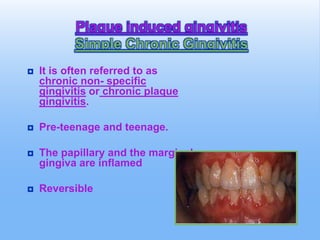
 It is often referred to as
chronic non- specific
gingivitis or chronic plaque
gingivitis.
 Pre-teenage and teenage.
 The papillary and the marginal
gingiva are inflamed
 Reversible
 Local factors:
1. Plaque accumulation 2. Calculus
3. Erupting tooth 4.Malocclusion
5.Disuse 6.Mouth breathing
 Systemic factors:
1. Hormonal disturbance 2. Diabetes mellitus
3. Blood dyscariasis 4. Nutritional
deficiency
Etiology
Clinical appearance
 Gingiva looks red at the marginal zone
 Loss of stippling
 False (pseudo-pockets) due to gingival
enlargement
Treatment
 Control the local and systemic predisposing
factors
 Good oral hygiene
 Oral prophylaxis
 A type of gingivitis associated with puberty which,
characterized by gingival enlargement
Etiology:
 Hormonal changes during puberty which, exaggerated
tissue response to local factor.
 Sub-clinical nutritional deficiency
Clinical features:
 The marginal gingiva appears red and easily bleed
by touch so patient usually avoid brushing his teeth.
 Usually confined to the anterior segment .
 Interdental papillae are bulbous which are far greater
than gingival enlargements associated with local
factors.
Conditional gingival enlargement
Puberty gingivitis
 Improve oral hygiene
 Removal of local irritant
 Restoration of carious teeth
 Dietary recommendations to ensure an adequate
nutritional status.
 Surgical removal of the thickened fibrotic marginal
and interdental tissue if no respond to the local or
systemic therapy.
 N.B. The case is spontaneously regressed at age of
18 years
Treatment
Etiology
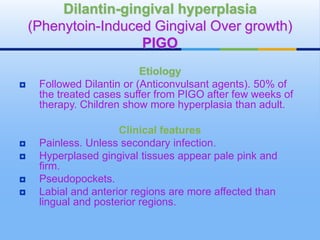
 Followed Dilantin or (Anticonvulsant agents). 50% of
the treated cases suffer from PIGO after few weeks of
therapy. Children show more hyperplasia than adult.
Clinical features
 Painless. Unless secondary infection.
 Hyperplased gingival tissues appear pale pink and
firm.
 Pseudopockets.
 Labial and anterior regions are more affected than
lingual and posterior regions.
Dilantin-gingival hyperplasia
(Phenytoin-Induced Gingival Over growth)
PIGO
PIGO
 Bad esthetic
 Difficulties in mastication
 Speech impairment
 Delayed teeth eruption
 Tissue trauma and periodontal disease
Treatment
 Elimination of local irritating factors
 Antihistamine and antibiotic therapy may decrease the
gingival inflammation as well as folic acid vitamin and
alkaline mouth rinse.
 In mild condition, daily meticulous oral hygiene prevent
further development of the condition.
 In sever cases, surgical removal of the over growth
tissues
 Consultation with the physician to use alternative drug.
Complications
Vitamin C (ascorbic acid) is essential for:
 Development of collagen C.T., dentine and bone.
 Enter in the formation of cementing substance of
capillary epithelium.
So its deficiency lead to:
 Decrease of the fiber content of periodontal ligaments
due to inhibition to normal replacement.
 Defects in the capillaries integrity causing hemorrhage.
Etiology
 Severe clinical scorbutic gingivitis is rare in children.
 However, it may occur in children allergic to fruit juices
when adequate supplement of vitamin C is neglected.
Scorbutic Gingivitis
 The involvement is usually limited to the marginal tissues
and papillae
 The child with scorbutic gingivitis may complain of sever
pain, and spontaneous hemorrhage.
 Petechiae and tendency to hematoma
Therapeutic consideration
 Vitamin C supplementation indicated only when there
are clinical or laboratory suggestive of vitamin C
deficiency.
 Usual dose 250-500mg/day.
 Correction of diet
 Improvement of oral hygiene
Clinical manifestation
Etiology:
 Unknown causes - its occurrence may follow a familial
pattern. characterized by a slow, progressive
enlargement of the gingiva
Clinical characteristics
 Free and attached gingiva.
 Painless.
 Enlarged gingival tissues are firm and dense (fell like
bone on palpation).
 Pale in color with coarse stippling.
 Enlargement may be localized or generalized.
 The gingival tissues appear normal at birth but begin to
enlarge with the eruption of the primary teeth. Although
mild cases are observed, the gingival tissues usually
continue to enlarge with the eruption of the permanent
teeth until the tissues cover the clinical crowns of the
teeth.
Gingival fibromatosis
(Idiopathic or Familial)
 Retardation of teeth eruption
 Teeth displacement
 Secondary gingival inflammation due to traumatic
injuries of the gingiva during mastication.
Treatment
 Surgical removal of the hyperplastic tissue. However,
Hyperplasia can recur within few months after the
surgical procedure.
 Excessive bleeding during surgery is common, therefore
quadrant surgery is usually recommended.
Complications
Periodontitis
 Periodontitis is an inflammatory disease of the gingiva and the
deeper tissues of the periodontium, which is characterized by:
1. Pocket formation
2. Destruction of the supporting alveolar bone
 Forms of periodontitis
 Prepubertal periodontitis, which occur in children and it is
classified into
1. localized and generalized Prepubertal periodotitis.
2. Juvenile periodontitis
3. Rapidly progressing periodontitis
4. Adult periodontitis
 From the etiological factors of the generalized Prepubertal
periodontitis is the Papillon le fevere syndrom or Hyperkeratosis
palmoplantaris. Chediak Hegashi, Hypophosphatasia and Ehler
Danlos Syndrome
Periodontitis
 It is a rare genetic condition inherited as autosomal recessive
trait.
 Severe gingival inflammation and exfoliation of both primary
and permanent dentition.
 The hyperkeratosis is limited to the palms of the hands and
soles of the feet.
 The periodontal involvement and alveolar bone loss start
between second and third year and progress till the fifth year of
age (complete primary teeth loss).
 The same cycle accompanied the permanent teeth.
 Prognosis is bad
 A complete denture inserted at early age.
Papillon le fevre syndrom
DD
 Eher Danlos Sydrome
 Hypophosphatasia
 Chediak Hegashi Sydrome
Thanks

Conditioned gingivitis

  • 1.
    Chronic & Conditioned GingivalOvergrowth: Presented By: Dr Randa Youssef Ass. Prof . Of Pediatric Dentistry & Dental Public Health, Cairo university
  • 2.
    I. PLAQUE-INDUCED Gingivitis 1.Simple chronic gingivitis 2. Conditional gingival enlargement A.Hormonal:  *Puberty gingivitis B.Drugs:  *Dilantin Gingival hyperplasia C.Nutritional:  *Scorbiotic gingivitis II.GENETIC: Gingival Fibromatosis, Chediak Higashi, Ehler Danlos Syndrome, & Hypophosphatasia. Chronic Gingivitis in Children
  • 3.
    Plaque induced gingivitis SimpleChronic Gingivitis  It is often referred to as chronic non- specific gingivitis or chronic plaque gingivitis.  Pre-teenage and teenage.  The papillary and the marginal gingiva are inflamed  Reversible
  • 4.
     Local factors: 1.Plaque accumulation 2. Calculus 3. Erupting tooth 4.Malocclusion 5.Disuse 6.Mouth breathing  Systemic factors: 1. Hormonal disturbance 2. Diabetes mellitus 3. Blood dyscariasis 4. Nutritional deficiency Etiology
  • 5.
    Clinical appearance  Gingivalooks red at the marginal zone  Loss of stippling  False (pseudo-pockets) due to gingival enlargement Treatment  Control the local and systemic predisposing factors  Good oral hygiene  Oral prophylaxis
  • 6.
     A typeof gingivitis associated with puberty which, characterized by gingival enlargement Etiology:  Hormonal changes during puberty which, exaggerated tissue response to local factor.  Sub-clinical nutritional deficiency Clinical features:  The marginal gingiva appears red and easily bleed by touch so patient usually avoid brushing his teeth.  Usually confined to the anterior segment .  Interdental papillae are bulbous which are far greater than gingival enlargements associated with local factors. Conditional gingival enlargement Puberty gingivitis
  • 7.
     Improve oralhygiene  Removal of local irritant  Restoration of carious teeth  Dietary recommendations to ensure an adequate nutritional status.  Surgical removal of the thickened fibrotic marginal and interdental tissue if no respond to the local or systemic therapy.  N.B. The case is spontaneously regressed at age of 18 years Treatment
  • 8.
    Etiology  Followed Dilantinor (Anticonvulsant agents). 50% of the treated cases suffer from PIGO after few weeks of therapy. Children show more hyperplasia than adult. Clinical features  Painless. Unless secondary infection.  Hyperplased gingival tissues appear pale pink and firm.  Pseudopockets.  Labial and anterior regions are more affected than lingual and posterior regions. Dilantin-gingival hyperplasia (Phenytoin-Induced Gingival Over growth) PIGO
  • 9.
  • 10.
     Bad esthetic Difficulties in mastication  Speech impairment  Delayed teeth eruption  Tissue trauma and periodontal disease Treatment  Elimination of local irritating factors  Antihistamine and antibiotic therapy may decrease the gingival inflammation as well as folic acid vitamin and alkaline mouth rinse.  In mild condition, daily meticulous oral hygiene prevent further development of the condition.  In sever cases, surgical removal of the over growth tissues  Consultation with the physician to use alternative drug. Complications
  • 11.
    Vitamin C (ascorbicacid) is essential for:  Development of collagen C.T., dentine and bone.  Enter in the formation of cementing substance of capillary epithelium. So its deficiency lead to:  Decrease of the fiber content of periodontal ligaments due to inhibition to normal replacement.  Defects in the capillaries integrity causing hemorrhage. Etiology  Severe clinical scorbutic gingivitis is rare in children.  However, it may occur in children allergic to fruit juices when adequate supplement of vitamin C is neglected. Scorbutic Gingivitis
  • 12.
     The involvementis usually limited to the marginal tissues and papillae  The child with scorbutic gingivitis may complain of sever pain, and spontaneous hemorrhage.  Petechiae and tendency to hematoma Therapeutic consideration  Vitamin C supplementation indicated only when there are clinical or laboratory suggestive of vitamin C deficiency.  Usual dose 250-500mg/day.  Correction of diet  Improvement of oral hygiene Clinical manifestation
  • 13.
    Etiology:  Unknown causes- its occurrence may follow a familial pattern. characterized by a slow, progressive enlargement of the gingiva Clinical characteristics  Free and attached gingiva.  Painless.  Enlarged gingival tissues are firm and dense (fell like bone on palpation).  Pale in color with coarse stippling.  Enlargement may be localized or generalized.  The gingival tissues appear normal at birth but begin to enlarge with the eruption of the primary teeth. Although mild cases are observed, the gingival tissues usually continue to enlarge with the eruption of the permanent teeth until the tissues cover the clinical crowns of the teeth. Gingival fibromatosis (Idiopathic or Familial)
  • 15.
     Retardation ofteeth eruption  Teeth displacement  Secondary gingival inflammation due to traumatic injuries of the gingiva during mastication. Treatment  Surgical removal of the hyperplastic tissue. However, Hyperplasia can recur within few months after the surgical procedure.  Excessive bleeding during surgery is common, therefore quadrant surgery is usually recommended. Complications
  • 17.
  • 18.
     Periodontitis isan inflammatory disease of the gingiva and the deeper tissues of the periodontium, which is characterized by: 1. Pocket formation 2. Destruction of the supporting alveolar bone  Forms of periodontitis  Prepubertal periodontitis, which occur in children and it is classified into 1. localized and generalized Prepubertal periodotitis. 2. Juvenile periodontitis 3. Rapidly progressing periodontitis 4. Adult periodontitis  From the etiological factors of the generalized Prepubertal periodontitis is the Papillon le fevere syndrom or Hyperkeratosis palmoplantaris. Chediak Hegashi, Hypophosphatasia and Ehler Danlos Syndrome Periodontitis
  • 19.
     It isa rare genetic condition inherited as autosomal recessive trait.  Severe gingival inflammation and exfoliation of both primary and permanent dentition.  The hyperkeratosis is limited to the palms of the hands and soles of the feet.  The periodontal involvement and alveolar bone loss start between second and third year and progress till the fifth year of age (complete primary teeth loss).  The same cycle accompanied the permanent teeth.  Prognosis is bad  A complete denture inserted at early age. Papillon le fevre syndrom
  • 21.
    DD  Eher DanlosSydrome  Hypophosphatasia  Chediak Hegashi Sydrome
  • 22.