Emerging Issues in
Entrepreneurship
Chapter-8
Chapter Highlights
Social issues: Social entrepreneurship
Gender issues: Women entrepreneurship
Minority issues: Minority entrepreneurship
Environmental issues: Eco-efficiency and ecopreneruship
Social Entrepreneurship
Meaning
 Social entrepreneurship is applying practical, innovative and sustainable
approaches to benefit the society. Its main emphasis is to uplift the standard of
marginalized and poor people in the society. The areas of social
entrepreneurship are education, health, welfare, human rights, environment,
economic development, agriculture etc. The key concepts of social
entrepreneurship are innovation, market orientation and systems change.
 Social entrepreneurs are drivers of change. Together with institutions,
networks, and communities, social entrepreneurs create solutions that are
efficient, sustainable, transparent, and have measurable impact.
 Philanthropists, social activists, environmentalists, and other socially-oriented
practitioners are often referred to as social entrepreneurs. Social entrepreneurs
can include a range of career types and professional backgrounds, ranging
from social work and community development to entrepreneurship and
environmental science.
Dhrumus and Suntali Foundation
Thus Social entrepreneurship is-
 About applying practical, innovative and sustainable approaches to benefit
society in general, with an emphasis on those who are marginalized and poor.
 A term that captures a unique approach to economic and social problems, an
approach that cuts across sectors and disciplines grounded in certain values and
processes that are common to each social entrepreneur, independent of whether
his/ her area of focus has been education, health, welfare reform, human rights,
workers' rights, environment, economic development, agriculture, etc., or
whether the organizations they set up are non-profit or for-profit entities.
 It is this approach that sets the social entrepreneur apart from the rest of the
crowd of well-meaning people and organizations who dedicate their lives to
social improvement.
 Muhammad Yunus’ Grameen Bank which spearheaded microfinance
globally.
Social Entrepreneurship
1. Ambitious: They like to tackle major social issues.
2. Mission driven: They are dedicated towards generating social values, not
wealth.
3. Skills regarding resource management: They have limited access to capital
and market support system. So, they must be skilled at mobilizing human,
financial and political resources.
4. Result oriented: They are hard working and result oriented. They always
work to bring social changes.
Traits/Characteristics of Social Entrepreneurs
Models/Types of Social Entrepreneurship
1. Leveraged Non-profit ventures
 The entrepreneur sets up a non-profit organization to drive the adoption of an
innovation that addresses a market or government failure. This model tackle
market failures that are extremely difficult to resolve with a for-profit model. In
doing so, the entrepreneur engages a cross section of society, including private
and public organizations, to drive forward the innovation . Non-profit ventures
continuously depend on outside philanthropic funding, but their longer term
sustainability is often enhanced given that the partners have a vested interest in
the continuation of the venture.
 Enterprises serving the bottom of the pyramid
(the largest, but poorest socio-economic group)
2. Hybrid non-profit ventures
 This model tends to serve “populations that have been excluded or
underserved by mainstream markets.” Making a profit is possible, but the
organization isn’t predicated on it. The enterprise recovers some of its costs
by selling a product or service.
 To be able to sustain the transformation activities in full and address the needs
of clients, who are often poor or marginalized from society, the entrepreneur
must mobilize other sources of funding from the public and/or
philanthropic sectors. Such funds can be in the form of grants or loans.
Models/Types of Social Entrepreneurship
3. Social business ventures
 The entrepreneur sets up a for-profit entity or business to provide a social
or ecological product or service. Wealth accumulation is not a priority and
profits are reinvested in the enterprise to fund expansion. The entrepreneur of
a social business venture seeks investors who are interested in combining
financial and social returns on their investments.
Models/Types of Social Entrepreneurship
Gender Issue: Women Entrepreneurship
Women Entrepreneurship
Types of Women Entrepreneurs
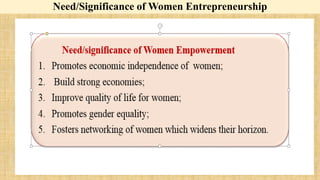
Need/Significance of Women Entrepreneurship
Problems/Future Challenges of Women Entrepreneurship
Success Factors for Women Entrepreneurship
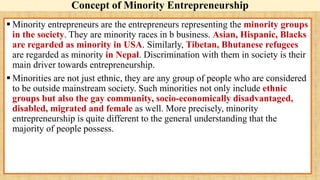
 Minority entrepreneurs are the entrepreneurs representing the minority groups
in the society. They are minority races in b business. Asian, Hispanic, Blacks
are regarded as minority in USA. Similarly, Tibetan, Bhutanese refugees
are regarded as minority in Nepal. Discrimination with them in society is their
main driver towards entrepreneurship.
 Minorities are not just ethnic, they are any group of people who are considered
to be outside mainstream society. Such minorities not only include ethnic
groups but also the gay community, socio-economically disadvantaged,
disabled, migrated and female as well. More precisely, minority
entrepreneurship is quite different to the general understanding that the
majority of people possess.
Concept of Minority Entrepreneurship
Their level of success depends on-
 Education and training
 Resource availability
 Attitude of society
 Government support
Minority Entrepreneurship
 Ecopreneurship is a term coined to represent the process of principles of
entrepreneurship being applied to create businesses that solve environmental
problems or operate sustainably. The term began to be widely used in the
1990s, and it is otherwise referred to as "environmental
entrepreneurship.”
 At a very basic level, an ecopreneur is a person or entity which
provides environmentally friendly services, goods, and technology such
as recycling, green construction, or organic food.
 The term ecopreneur became quite popular in recent times as people and
organizations became more concerned about environmental degradation
caused by the activities of large companies who are only concerned about
economic success.
Ecopreneurship
 The word ecopreneur is a portmanteau of
“ecological” and “entrepreneur.” An ecopreneur
is an individual who is focused on ecologically-
friendly issues and causes, attempting to do
business in a way which benefits the
environment.
 He may not be a person or entity only involved
in products like solar powered cells, water
conservation system or compostable packaging.
In fact, an ecopreneur is anyone who ranks
environment more than or equally to profits as
his most effective criteria as a business owner.
Ecopreneurship
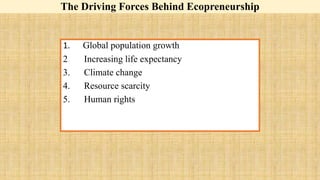
1. Global population growth
2 Increasing life expectancy
3. Climate change
4. Resource scarcity
5. Human rights
The Driving Forces Behind Ecopreneurship
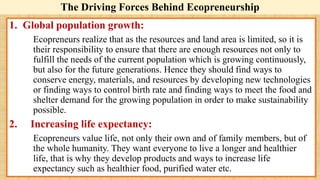
1. Global population growth:
Ecopreneurs realize that as the resources and land area is limited, so it is
their responsibility to ensure that there are enough resources not only to
fulfill the needs of the current population which is growing continuously,
but also for the future generations. Hence they should find ways to
conserve energy, materials, and resources by developing new technologies
or finding ways to control birth rate and finding ways to meet the food and
shelter demand for the growing population in order to make sustainability
possible.
2. Increasing life expectancy:
Ecopreneurs value life, not only their own and of family members, but of
the whole humanity. They want everyone to live a longer and healthier
life, that is why they develop products and ways to increase life
expectancy such as healthier food, purified water etc.
The Driving Forces Behind Ecopreneurship
3. Climate change: Climate shapes the way we live on this planet and the way
we live, work and play is advertently changing the climate. The pollutants
released in the air due to use of fossil fuels is adversely affecting the climate. In
order to sustain the climate, ecopreneurs are involved in finding alternate ways to
produce energy such as using wind, water and solar energy.
4. Resource scarcity: The diminishing natural resources are a great issue as
we will be left with no natural resources if we do not sustain them. In order to
sustain them, ecopreneurs constantly look for alternatives by recycling them or
using a cheaper, abundantly available resource if possible.
5. Human rights: The concern of human rights has been commonly seen in
each and every segment of the society. Now, it has been the matter of global
concern. The issue of human rights has made people aware of the global concern
such as climate change, resource scarcity etc.
Ecopreneurs can utilize green issues as a competitive advantage for
their enterprises on the basis of the four principles known as Natural
Step principles. The guidelines in these principles are-
1. Energy and resource use efficiency and maximization
2. Ecosystem Services
3. Natural step principles
4. Eco- efficiency and eco- effectiveness
Principles of Ecopreneurship
1. Energy and resource use efficiency and maximization: By
minimizing waste production and maximizing reuse of waste streams,
sustainable business can potentially significantly increase profits.
2. Ecosystem Services: Services related to protection of ecosystem and
natural resources and preventing environmental degradation can be an inspiration
for a green business idea for ecopreneurs.
3. Natural step principles: ecopreneurs can see potential risks, such as
extinction of substances extracted from the Earth’s crust or overharvesting etc, as
opportunities for success through green business.
4. Eco- efficiency and eco- effectiveness: ecopreneurs should find
methods of decreasing waste while increasing productivity such that the waste of
the production process and the product itself can be the raw materials of a new
product of service.
Principles of Ecopreneurship

Emerging issues.....

  • 1.
  • 2.
    Chapter Highlights Social issues:Social entrepreneurship Gender issues: Women entrepreneurship Minority issues: Minority entrepreneurship Environmental issues: Eco-efficiency and ecopreneruship
  • 3.
    Social Entrepreneurship Meaning  Socialentrepreneurship is applying practical, innovative and sustainable approaches to benefit the society. Its main emphasis is to uplift the standard of marginalized and poor people in the society. The areas of social entrepreneurship are education, health, welfare, human rights, environment, economic development, agriculture etc. The key concepts of social entrepreneurship are innovation, market orientation and systems change.  Social entrepreneurs are drivers of change. Together with institutions, networks, and communities, social entrepreneurs create solutions that are efficient, sustainable, transparent, and have measurable impact.  Philanthropists, social activists, environmentalists, and other socially-oriented practitioners are often referred to as social entrepreneurs. Social entrepreneurs can include a range of career types and professional backgrounds, ranging from social work and community development to entrepreneurship and environmental science. Dhrumus and Suntali Foundation
  • 4.
    Thus Social entrepreneurshipis-  About applying practical, innovative and sustainable approaches to benefit society in general, with an emphasis on those who are marginalized and poor.  A term that captures a unique approach to economic and social problems, an approach that cuts across sectors and disciplines grounded in certain values and processes that are common to each social entrepreneur, independent of whether his/ her area of focus has been education, health, welfare reform, human rights, workers' rights, environment, economic development, agriculture, etc., or whether the organizations they set up are non-profit or for-profit entities.  It is this approach that sets the social entrepreneur apart from the rest of the crowd of well-meaning people and organizations who dedicate their lives to social improvement.  Muhammad Yunus’ Grameen Bank which spearheaded microfinance globally. Social Entrepreneurship
  • 5.
    1. Ambitious: Theylike to tackle major social issues. 2. Mission driven: They are dedicated towards generating social values, not wealth. 3. Skills regarding resource management: They have limited access to capital and market support system. So, they must be skilled at mobilizing human, financial and political resources. 4. Result oriented: They are hard working and result oriented. They always work to bring social changes. Traits/Characteristics of Social Entrepreneurs
  • 6.
    Models/Types of SocialEntrepreneurship 1. Leveraged Non-profit ventures  The entrepreneur sets up a non-profit organization to drive the adoption of an innovation that addresses a market or government failure. This model tackle market failures that are extremely difficult to resolve with a for-profit model. In doing so, the entrepreneur engages a cross section of society, including private and public organizations, to drive forward the innovation . Non-profit ventures continuously depend on outside philanthropic funding, but their longer term sustainability is often enhanced given that the partners have a vested interest in the continuation of the venture.  Enterprises serving the bottom of the pyramid (the largest, but poorest socio-economic group)
  • 7.
    2. Hybrid non-profitventures  This model tends to serve “populations that have been excluded or underserved by mainstream markets.” Making a profit is possible, but the organization isn’t predicated on it. The enterprise recovers some of its costs by selling a product or service.  To be able to sustain the transformation activities in full and address the needs of clients, who are often poor or marginalized from society, the entrepreneur must mobilize other sources of funding from the public and/or philanthropic sectors. Such funds can be in the form of grants or loans. Models/Types of Social Entrepreneurship
  • 8.
    3. Social businessventures  The entrepreneur sets up a for-profit entity or business to provide a social or ecological product or service. Wealth accumulation is not a priority and profits are reinvested in the enterprise to fund expansion. The entrepreneur of a social business venture seeks investors who are interested in combining financial and social returns on their investments. Models/Types of Social Entrepreneurship
  • 9.
    Gender Issue: WomenEntrepreneurship
  • 10.
  • 11.
    Types of WomenEntrepreneurs
  • 12.
  • 13.
    Problems/Future Challenges ofWomen Entrepreneurship
  • 14.
    Success Factors forWomen Entrepreneurship
  • 15.
     Minority entrepreneursare the entrepreneurs representing the minority groups in the society. They are minority races in b business. Asian, Hispanic, Blacks are regarded as minority in USA. Similarly, Tibetan, Bhutanese refugees are regarded as minority in Nepal. Discrimination with them in society is their main driver towards entrepreneurship.  Minorities are not just ethnic, they are any group of people who are considered to be outside mainstream society. Such minorities not only include ethnic groups but also the gay community, socio-economically disadvantaged, disabled, migrated and female as well. More precisely, minority entrepreneurship is quite different to the general understanding that the majority of people possess. Concept of Minority Entrepreneurship
  • 16.
    Their level ofsuccess depends on-  Education and training  Resource availability  Attitude of society  Government support Minority Entrepreneurship
  • 17.
     Ecopreneurship isa term coined to represent the process of principles of entrepreneurship being applied to create businesses that solve environmental problems or operate sustainably. The term began to be widely used in the 1990s, and it is otherwise referred to as "environmental entrepreneurship.”  At a very basic level, an ecopreneur is a person or entity which provides environmentally friendly services, goods, and technology such as recycling, green construction, or organic food.  The term ecopreneur became quite popular in recent times as people and organizations became more concerned about environmental degradation caused by the activities of large companies who are only concerned about economic success. Ecopreneurship
  • 18.
     The wordecopreneur is a portmanteau of “ecological” and “entrepreneur.” An ecopreneur is an individual who is focused on ecologically- friendly issues and causes, attempting to do business in a way which benefits the environment.  He may not be a person or entity only involved in products like solar powered cells, water conservation system or compostable packaging. In fact, an ecopreneur is anyone who ranks environment more than or equally to profits as his most effective criteria as a business owner. Ecopreneurship
  • 19.
    1. Global populationgrowth 2 Increasing life expectancy 3. Climate change 4. Resource scarcity 5. Human rights The Driving Forces Behind Ecopreneurship
  • 20.
    The Driving ForcesBehind Ecopreneurship 1. Global population growth: Ecopreneurs realize that as the resources and land area is limited, so it is their responsibility to ensure that there are enough resources not only to fulfill the needs of the current population which is growing continuously, but also for the future generations. Hence they should find ways to conserve energy, materials, and resources by developing new technologies or finding ways to control birth rate and finding ways to meet the food and shelter demand for the growing population in order to make sustainability possible. 2. Increasing life expectancy: Ecopreneurs value life, not only their own and of family members, but of the whole humanity. They want everyone to live a longer and healthier life, that is why they develop products and ways to increase life expectancy such as healthier food, purified water etc.
  • 21.
    The Driving ForcesBehind Ecopreneurship 3. Climate change: Climate shapes the way we live on this planet and the way we live, work and play is advertently changing the climate. The pollutants released in the air due to use of fossil fuels is adversely affecting the climate. In order to sustain the climate, ecopreneurs are involved in finding alternate ways to produce energy such as using wind, water and solar energy. 4. Resource scarcity: The diminishing natural resources are a great issue as we will be left with no natural resources if we do not sustain them. In order to sustain them, ecopreneurs constantly look for alternatives by recycling them or using a cheaper, abundantly available resource if possible. 5. Human rights: The concern of human rights has been commonly seen in each and every segment of the society. Now, it has been the matter of global concern. The issue of human rights has made people aware of the global concern such as climate change, resource scarcity etc.
  • 22.
    Ecopreneurs can utilizegreen issues as a competitive advantage for their enterprises on the basis of the four principles known as Natural Step principles. The guidelines in these principles are- 1. Energy and resource use efficiency and maximization 2. Ecosystem Services 3. Natural step principles 4. Eco- efficiency and eco- effectiveness Principles of Ecopreneurship
  • 23.
    1. Energy andresource use efficiency and maximization: By minimizing waste production and maximizing reuse of waste streams, sustainable business can potentially significantly increase profits. 2. Ecosystem Services: Services related to protection of ecosystem and natural resources and preventing environmental degradation can be an inspiration for a green business idea for ecopreneurs. 3. Natural step principles: ecopreneurs can see potential risks, such as extinction of substances extracted from the Earth’s crust or overharvesting etc, as opportunities for success through green business. 4. Eco- efficiency and eco- effectiveness: ecopreneurs should find methods of decreasing waste while increasing productivity such that the waste of the production process and the product itself can be the raw materials of a new product of service. Principles of Ecopreneurship