Communication Skills and Health Professions Education
(Medu)
(1) Concepts in Teaching and Learning
Medical Education Department
Dr Mohamed Hassan Taha
Assistant Professor of Medical Education
MBBS, PG Dip, MSc (HPE), PhD
Learning Objectives:
By the end of this lecture you should be able to:
1. Demonstrate un understanding of the definitions of learning and
explain how does learning take place.
2. Explain how does human memory work.
3. Explain the Skills of learning and how to develop these skills
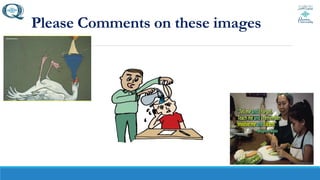
Please Comments on these images
Definitions of Learning:
1. “a persisting change in human performance or performance
potential . . . (brought) about as a result of the learner’s
interaction with the environment” (Driscoll, 1994, pp. 8-9).
2. “the relatively permanent change in a person’s knowledge or
behavior due to experience” (Mayer, 1982, p. 1040).
3. “an enduring change in behavior, or in the capacity to behave
in a given fashion, which results from practice or other forms of
experience” (Shuell, 1986, p. 412).
Definitions of Learning:
Learning is defined as a long-term change in mental representation
and associations as a result of experience.
It is also a means through which we acquire not only knowledge
but also values, attitudes & emotional reactions.
forgetting
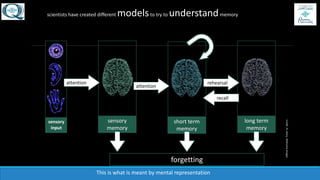
scientists have created different modelsto try to understandmemory
sensory
input
sensory
memory
long term
memory
Multi store model
of memory
short term
memory
rehearsal
attention
attention rehearsal
recall
Credit;N.Seery,WellcomeImages
This is what is meant by mental representation
Sensory memory
Stimuli are received from the senses: sight; hearing; taste; smell;
touch;
By paying attention to these stimuli, they enter sensory memory
Sensory memory lasts 0.25-2 seconds
Short term memory lasts
Short term memory lasts up to 30 seconds
It can store 5-9 items at a time
“chunking” information makes it easier to remember
E.g
• 0534845932 is hard to remember
• 053 484 59 32 is much easier to remember
Information must be rehearsed to be remembered.
If a distraction stops you from rehearsing, you will forget in just a few seconds
Rehearsal and recall make things more likely to be remembered
Long term memory
Memories can be stored there for your whole lifetime
Rehearsal and recall make things more likely to be remembered
Long term memory can be divided into different aspects such as:
• how to do tasks
• facts and information
• how things are related to each other
Long term memory
Memories can be stored there for your whole lifetime
Rehearsal and recall make things more likely to be remembered
Long term memory can be divided into different aspects such as:
• how to do tasks
• facts and information
• how things are related to each other
There is no limit to how much you can store
in long term memory
Forgetting; How does it occur?
Without recall and rehearsal, memories are likely to be forgotten
Brain damage and some diseases can also affect memory.
Alzheimer’s disease sufferers lose their short term memory at first.
The disease often progresses to affect long term memory too.
Sometimes brain damage can cause loss of long term memory, but
short term memory can still be working well
Learning is affected by
Learning is affected by several factors like
1. Culture,
2. Intelligence,
3. Experience ,
4. and Environment.
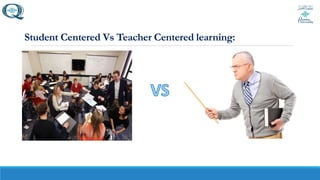
Student Centered Vs Teacher Centered learning:
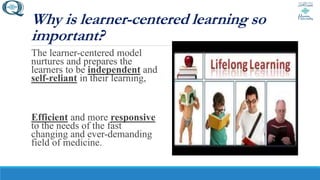
Why is learner-centered learning so
important?
The learner-centered model
nurtures and prepares the
learners to be independent and
self-reliant in their learning,
Efficient and more responsive
to the needs of the fast
changing and ever-demanding
field of medicine.
Featured of leaner-centered learning:
1. Learning is active and self-directed
2. Active reflection and discovery enhance the learning
3. Motivation to learn is intrinsic
4. Learning is an individual as well as a social and collaborative
activity
Featured of leaner-centered learning:
5. Teachers act as a facilitator
6. Learning is a shared and joint activity between the teacher and student
7. Learner determines (with support from teachers) own goals, methods of
achieving the goals, and assessment process
8. Skills of learning improve the learning
Teacher Centered learning
Knowledge is transmitted from professor to student.
Emphasis is on acquisition of knowledge outside the context in
which it will be used.
Instructor’s role is to be primary information giver and primary
evaluator.
Emphasis is on right answers.
Culture is competitive and individualistic.
Please Comments on these images
Comparison between learner centered
learning and teaching centered learning
Passive vs Active Learning
Motivation to learn?
Learning Skills: (Meta-Cognition)
Definition of metacognition:
higher-order thinking that enables understanding, analysis, and
control of one’s cognitive processes, especially when engaged in
learning
What do we mean by higher order thinking:
How to develop metacognitive skills
(Learning Skills):
Metacognition consist of the three basic simple steps:
1. Identifying the needs
2. Developing and implementing a plan of learning
3. Monitoring and evaluating the progress
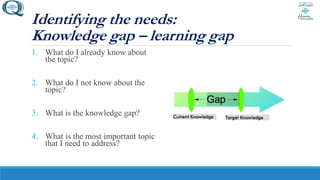
Identifying the needs:
Knowledge gap – learning gap
1. What do I already know about
the topic?
2. What do I not know about the
topic?
3. What is the knowledge gap?
4. What is the most important topic
that I need to address?
Developing and implementing plan of
learning:
1. What learning strategy is most likely help me achieve the target?
2. What alternative do I have?
3. Is it the best strategy?
4. What are the resources I need?
5. Do I have prior success with this strategy?
6. What is the type of monitoring and evaluation most suitable for
this particular strategy?
Monitoring and evaluating the progress
1. What is the progress so far?
2. Is the time frame realistic?
3. Do I need to change the learning strategy?
4. What is the most important determinant of my success or failure?
5. What have I learned from the process that would help me in
future?
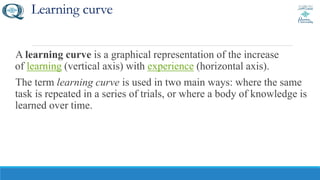
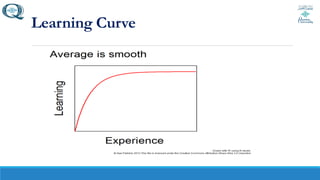
Learning curve
A learning curve is a graphical representation of the increase
of learning (vertical axis) with experience (horizontal axis).
The term learning curve is used in two main ways: where the same
task is repeated in a series of trials, or where a body of knowledge is
learned over time.
Learning Curve
What have you learned so far about:
Learning
Memory
Teacher centred vs student centered learning
Active Vs Passive Learning
Metacognition
Learning Curve
Share your experience After doing this
exercise last week:
Learning Objectives:
By the end of this lecture you should be able to:
1. Demonstrate un understanding of the definitions of learning and
explain how does learning take place.
2. Explain how does human memory work.
3. Explain the Skills of learning and how to develop these skills
Communication Skills and Health Professions Education
(Medu)
(1) Concepts in Teaching and Learning
Medical Education Department

Concepts in teaching and learning

  • 1.
    Communication Skills andHealth Professions Education (Medu) (1) Concepts in Teaching and Learning Medical Education Department Dr Mohamed Hassan Taha Assistant Professor of Medical Education MBBS, PG Dip, MSc (HPE), PhD
  • 2.
    Learning Objectives: By theend of this lecture you should be able to: 1. Demonstrate un understanding of the definitions of learning and explain how does learning take place. 2. Explain how does human memory work. 3. Explain the Skills of learning and how to develop these skills
  • 3.
    Please Comments onthese images
  • 4.
    Definitions of Learning: 1.“a persisting change in human performance or performance potential . . . (brought) about as a result of the learner’s interaction with the environment” (Driscoll, 1994, pp. 8-9). 2. “the relatively permanent change in a person’s knowledge or behavior due to experience” (Mayer, 1982, p. 1040). 3. “an enduring change in behavior, or in the capacity to behave in a given fashion, which results from practice or other forms of experience” (Shuell, 1986, p. 412).
  • 5.
    Definitions of Learning: Learningis defined as a long-term change in mental representation and associations as a result of experience. It is also a means through which we acquire not only knowledge but also values, attitudes & emotional reactions.
  • 6.
    forgetting scientists have createddifferent modelsto try to understandmemory sensory input sensory memory long term memory Multi store model of memory short term memory rehearsal attention attention rehearsal recall Credit;N.Seery,WellcomeImages This is what is meant by mental representation
  • 7.
    Sensory memory Stimuli arereceived from the senses: sight; hearing; taste; smell; touch; By paying attention to these stimuli, they enter sensory memory Sensory memory lasts 0.25-2 seconds
  • 8.
    Short term memorylasts Short term memory lasts up to 30 seconds It can store 5-9 items at a time “chunking” information makes it easier to remember E.g • 0534845932 is hard to remember • 053 484 59 32 is much easier to remember Information must be rehearsed to be remembered. If a distraction stops you from rehearsing, you will forget in just a few seconds Rehearsal and recall make things more likely to be remembered
  • 9.
    Long term memory Memoriescan be stored there for your whole lifetime Rehearsal and recall make things more likely to be remembered Long term memory can be divided into different aspects such as: • how to do tasks • facts and information • how things are related to each other
  • 10.
    Long term memory Memoriescan be stored there for your whole lifetime Rehearsal and recall make things more likely to be remembered Long term memory can be divided into different aspects such as: • how to do tasks • facts and information • how things are related to each other There is no limit to how much you can store in long term memory
  • 11.
    Forgetting; How doesit occur? Without recall and rehearsal, memories are likely to be forgotten Brain damage and some diseases can also affect memory. Alzheimer’s disease sufferers lose their short term memory at first. The disease often progresses to affect long term memory too. Sometimes brain damage can cause loss of long term memory, but short term memory can still be working well
  • 12.
    Learning is affectedby Learning is affected by several factors like 1. Culture, 2. Intelligence, 3. Experience , 4. and Environment.
  • 13.
    Student Centered VsTeacher Centered learning:
  • 14.
    Why is learner-centeredlearning so important? The learner-centered model nurtures and prepares the learners to be independent and self-reliant in their learning, Efficient and more responsive to the needs of the fast changing and ever-demanding field of medicine.
  • 15.
    Featured of leaner-centeredlearning: 1. Learning is active and self-directed 2. Active reflection and discovery enhance the learning 3. Motivation to learn is intrinsic 4. Learning is an individual as well as a social and collaborative activity
  • 16.
    Featured of leaner-centeredlearning: 5. Teachers act as a facilitator 6. Learning is a shared and joint activity between the teacher and student 7. Learner determines (with support from teachers) own goals, methods of achieving the goals, and assessment process 8. Skills of learning improve the learning
  • 17.
    Teacher Centered learning Knowledgeis transmitted from professor to student. Emphasis is on acquisition of knowledge outside the context in which it will be used. Instructor’s role is to be primary information giver and primary evaluator. Emphasis is on right answers. Culture is competitive and individualistic.
  • 18.
    Please Comments onthese images
  • 19.
    Comparison between learnercentered learning and teaching centered learning
  • 20.
  • 21.
  • 22.
    Learning Skills: (Meta-Cognition) Definitionof metacognition: higher-order thinking that enables understanding, analysis, and control of one’s cognitive processes, especially when engaged in learning
  • 23.
    What do wemean by higher order thinking:
  • 24.
    How to developmetacognitive skills (Learning Skills): Metacognition consist of the three basic simple steps: 1. Identifying the needs 2. Developing and implementing a plan of learning 3. Monitoring and evaluating the progress
  • 25.
    Identifying the needs: Knowledgegap – learning gap 1. What do I already know about the topic? 2. What do I not know about the topic? 3. What is the knowledge gap? 4. What is the most important topic that I need to address?
  • 26.
    Developing and implementingplan of learning: 1. What learning strategy is most likely help me achieve the target? 2. What alternative do I have? 3. Is it the best strategy? 4. What are the resources I need? 5. Do I have prior success with this strategy? 6. What is the type of monitoring and evaluation most suitable for this particular strategy?
  • 27.
    Monitoring and evaluatingthe progress 1. What is the progress so far? 2. Is the time frame realistic? 3. Do I need to change the learning strategy? 4. What is the most important determinant of my success or failure? 5. What have I learned from the process that would help me in future?
  • 28.
    Learning curve A learningcurve is a graphical representation of the increase of learning (vertical axis) with experience (horizontal axis). The term learning curve is used in two main ways: where the same task is repeated in a series of trials, or where a body of knowledge is learned over time.
  • 29.
  • 30.
    What have youlearned so far about: Learning Memory Teacher centred vs student centered learning Active Vs Passive Learning Metacognition Learning Curve
  • 31.
    Share your experienceAfter doing this exercise last week:
  • 32.
    Learning Objectives: By theend of this lecture you should be able to: 1. Demonstrate un understanding of the definitions of learning and explain how does learning take place. 2. Explain how does human memory work. 3. Explain the Skills of learning and how to develop these skills
  • 33.
    Communication Skills andHealth Professions Education (Medu) (1) Concepts in Teaching and Learning Medical Education Department