PREPARED BY
ARUNIMA M JOSEPH
MSC (N) II YR
CONCEPTS,TYPES,VI
SION
MISSION
STATEMENTS,
PHILOSOPHYAIMS
AND OBJECTIVES
OF NURSING
MANAGEMENT
INTRODUCT
ION
CONCEPTS IN NURSING
MANAGEMENT
•Effective
Communications
•Resource
Management
•Effective
Communications
TYPES OF
MANAGEMEN
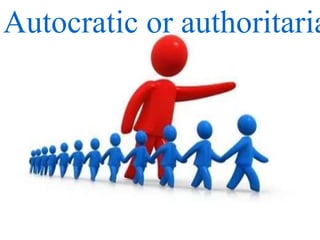
T• Autocratic or
authoritarian
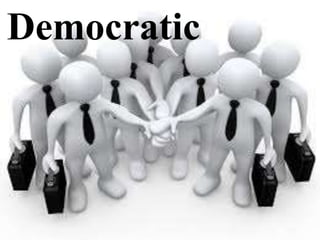
• Democratic
• Participative
• Laissez faire
Autocratic or authoritaria
Democratic
Participative
Laissez faire
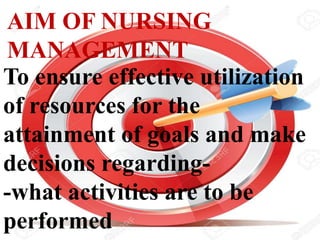
AIM OF NURSING
MANAGEMENT
To ensure effective utilization
of resources for the
attainment of goals and make
decisions regarding-
-what activities are to be
performed
OBJECTIVE OF NURSING
MANAGEMENT
The overall objective is to enable
different limbs of nursing organization
to function harmoniously in happy
coordination blending themselves into
a composite personality to facilitate
growth and development of
individuals and through them of the
NATURE OF
OBJECTIVES1.Objectives from hierarchy
2.Multiplicity of objectives
3.Objectives have time limit
4.Objectives have different
priorities
5.Objectives are inter related and
inter dependent
FORMULATION OF
NURSING OBJECTIVES
• On the basis of national health
policy
• Needs of the population
• Priority areas for
improvement of basic nursing
and midwifery
• Resources available
• Active participation
• Philosophy of nursing
services
• Philosophy of nursing
services
CHARACTERISTICS OF
NURSING OBJECTIVES
• Specific
• Measurable
• Achievable
• Realistic and
relevant
• Timebound
CLASSIFICATION OF
NURSING
OBJECTIVES
a) level of objectives
1. Major or organizational
objectives
2. Departmental objectives
3. Group objectives
4. Unit objectives
(b) Types of objectives
1. Profit objectives: these are framed
according to owner’s point of view,
where profit or money return is the
motto of having health or nursing
services. These types are framed
mostly in private sector. E.g money
return
2. Service objectives: keeping in
mind the patient’s interests. E.g
3. Social objectives: these are
formulated in the light of
public interests who are
concerned with their welfare.
E.g. values in the interest of
public welfare
4. Personal objectives: these
are based on employees,
(c) Based on Hierarchy or
operational objectives:
1. Primary objectives: The main
primary objectives of hospital
services are to provide the
curative services byensuring
patient care to indoor patients.
2. Subsidiary objectives: these
objectives are based on the
EXAMPLE FOR OBJECTIVES
Objectives are-
1. To provide efficient social life to
nurses and thus prepare them in
the art of living together.
2. To bring school or college and
community closer to each other
.3. To prepare the nurse for some
specialized vocation.
4. To help the nurses in
unfolding, blossoming of
personality.
5. To enable the nurse to have the
right type of philosophy in life.
6. To conserve all the good
practices and conventions of the
7. To help in the realization of
objectives of education as laid down by
the experts according to their selected
vocation or profession.
8. To bring harmony between and the
tasks.
9. To make maximum use of all
educational facilities in order to attain
the desired objectives and to help
minimize the wastage.
Philosophy in management
consists of an integrated set of
assumptions and beliefs about
the way the things are,purpose of
activities and the way these
should be. The decision makers
of the organization create these
assumptionsand beliefs to define
the vision of the organization.
• Basic to any philosophy of
nursing seems to three
concepts-
• 1. -Reverence for the gift of life.
• 2. -respect for the dignity,
worth, autonomy and
individuality of each human
• IT HELPS IN –
• -To provide best possible patient
care with minimum inputs to
obtain the maximum results.
• -To provide high quality care
based on strong commitments to
practice, education, research,
innovation and collaboration.
• -To strengthen staff development
• To facilitate inter and intra
departmental coordination for
efficiency of hospital
administration.
• -To be a leader in providing
excellence in nursing practice
and service to community.
• -To assist individual in disease
prevention, promotion of health,
STANDARDS FOR EVALUATING
NURSING PHILOSOPHY
• 1. The philosophy should be
available in written form in
nursing department.
• 2. It should be developed by
nursing personnel, consumers and
other health care workers.
• 3. It should reflect the meaning of
clinical practice of nursing. The
• 4. It should include humanity,
society, health, nursing, nursing
process and self care relevant to
community, law
• like external forces like personnel,
clients, material resources, research,
education and family.
• 5. It should support the philosophy
of the organization.
VISION - the strongly felt aim or
calling. It defines where the
profession wants to be in future. it
reflects the optimize view of the
professions future.
MISSION -defines where the
profession is going now, basically
describing the purpose. Why this
MISSION STATEMENT
-it concentrates on present and
informs you about the desired
level of performance.
-it will be achieved.
-it reflect the purpose or
broader for being in existence
• -it serves as an ongoing guide
without a time frame.
• -the mission can remain same for
decades, if crafted well.
• -it provides a path to realize the
mission in line with its values.
• -it directs bearing on the bottom
line and success in profession
VISION STATEMENT
-Outlines what the profession wants
to be.
-It concentrates on the future.
-It is a source of inspiration.
-It provides clear decision making
criteria.
-Its more specific in terms of
objective and future state.
-It is related to some form of
The vision is SMART
S Specific
M Measurable
AAchievable
R Relevant
T Time bound
Which comes first it depends on
new start up.
FEATURES OF VISION
STATEMENT
• -Clarity and lack of ambiguity.
• -Paint a vivid and clear
picture.
• -Describing a bright future
[hope]
• -Memorable and engaging
IN NURSING PROFESSION
Nurses as a national leader
among academic health
centers.
To build on traditional
mission of patient care,
education and research.
• Adapting organization to succeed
in changing environment.
• Working collaboratively and
partner with our professional
colleagues, individuals and
communities.
• To improve outcomes
• To provide care to patients and
their families in a respectful caring
manner.
• To provide education that
empowers families and staff to
make decisions about health care.
• To provide information system that
serve uses by making data readily
accessible for clinical management
decision making, quality improvement,
education and research.
• To improve quality care by assuming
that patients and families receive
nursing care that has been
demonstrated by research
APPROACHES FOR VISION AND
MISSION STATEMENT FORMATION
One alternative approach “Draw- See-
Think-Plan
Draw- What is the ideal image or the
desired end state?
See- What is today’s situation? What is
the gap from ideal and why?
Think- What specific actions must be
taken to close the gap between today’s
Concept ppt

Concept ppt

  • 1.
    PREPARED BY ARUNIMA MJOSEPH MSC (N) II YR
  • 2.
  • 3.
  • 4.
  • 5.
    TYPES OF MANAGEMEN T• Autocraticor authoritarian • Democratic • Participative • Laissez faire
  • 6.
  • 7.
  • 8.
  • 9.
  • 10.
    AIM OF NURSING MANAGEMENT Toensure effective utilization of resources for the attainment of goals and make decisions regarding- -what activities are to be performed
  • 11.
    OBJECTIVE OF NURSING MANAGEMENT Theoverall objective is to enable different limbs of nursing organization to function harmoniously in happy coordination blending themselves into a composite personality to facilitate growth and development of individuals and through them of the
  • 12.
    NATURE OF OBJECTIVES1.Objectives fromhierarchy 2.Multiplicity of objectives 3.Objectives have time limit 4.Objectives have different priorities 5.Objectives are inter related and inter dependent
  • 13.
    FORMULATION OF NURSING OBJECTIVES •On the basis of national health policy • Needs of the population • Priority areas for improvement of basic nursing and midwifery
  • 14.
    • Resources available •Active participation • Philosophy of nursing services • Philosophy of nursing services
  • 15.
    CHARACTERISTICS OF NURSING OBJECTIVES •Specific • Measurable • Achievable • Realistic and relevant • Timebound
  • 16.
    CLASSIFICATION OF NURSING OBJECTIVES a) levelof objectives 1. Major or organizational objectives 2. Departmental objectives 3. Group objectives 4. Unit objectives
  • 17.
    (b) Types ofobjectives 1. Profit objectives: these are framed according to owner’s point of view, where profit or money return is the motto of having health or nursing services. These types are framed mostly in private sector. E.g money return 2. Service objectives: keeping in mind the patient’s interests. E.g
  • 18.
    3. Social objectives:these are formulated in the light of public interests who are concerned with their welfare. E.g. values in the interest of public welfare 4. Personal objectives: these are based on employees,
  • 19.
    (c) Based onHierarchy or operational objectives: 1. Primary objectives: The main primary objectives of hospital services are to provide the curative services byensuring patient care to indoor patients. 2. Subsidiary objectives: these objectives are based on the
  • 20.
    EXAMPLE FOR OBJECTIVES Objectivesare- 1. To provide efficient social life to nurses and thus prepare them in the art of living together. 2. To bring school or college and community closer to each other .3. To prepare the nurse for some specialized vocation.
  • 21.
    4. To helpthe nurses in unfolding, blossoming of personality. 5. To enable the nurse to have the right type of philosophy in life. 6. To conserve all the good practices and conventions of the
  • 22.
    7. To helpin the realization of objectives of education as laid down by the experts according to their selected vocation or profession. 8. To bring harmony between and the tasks. 9. To make maximum use of all educational facilities in order to attain the desired objectives and to help minimize the wastage.
  • 23.
    Philosophy in management consistsof an integrated set of assumptions and beliefs about the way the things are,purpose of activities and the way these should be. The decision makers of the organization create these assumptionsand beliefs to define the vision of the organization.
  • 24.
    • Basic toany philosophy of nursing seems to three concepts- • 1. -Reverence for the gift of life. • 2. -respect for the dignity, worth, autonomy and individuality of each human
  • 25.
    • IT HELPSIN – • -To provide best possible patient care with minimum inputs to obtain the maximum results. • -To provide high quality care based on strong commitments to practice, education, research, innovation and collaboration. • -To strengthen staff development
  • 26.
    • To facilitateinter and intra departmental coordination for efficiency of hospital administration. • -To be a leader in providing excellence in nursing practice and service to community. • -To assist individual in disease prevention, promotion of health,
  • 27.
    STANDARDS FOR EVALUATING NURSINGPHILOSOPHY • 1. The philosophy should be available in written form in nursing department. • 2. It should be developed by nursing personnel, consumers and other health care workers. • 3. It should reflect the meaning of clinical practice of nursing. The

  • 28.
    • 4. Itshould include humanity, society, health, nursing, nursing process and self care relevant to community, law • like external forces like personnel, clients, material resources, research, education and family. • 5. It should support the philosophy of the organization.
  • 30.
    VISION - thestrongly felt aim or calling. It defines where the profession wants to be in future. it reflects the optimize view of the professions future. MISSION -defines where the profession is going now, basically describing the purpose. Why this
  • 31.
    MISSION STATEMENT -it concentrateson present and informs you about the desired level of performance. -it will be achieved. -it reflect the purpose or broader for being in existence
  • 32.
    • -it servesas an ongoing guide without a time frame. • -the mission can remain same for decades, if crafted well. • -it provides a path to realize the mission in line with its values. • -it directs bearing on the bottom line and success in profession
  • 33.
    VISION STATEMENT -Outlines whatthe profession wants to be. -It concentrates on the future. -It is a source of inspiration. -It provides clear decision making criteria. -Its more specific in terms of objective and future state. -It is related to some form of
  • 34.
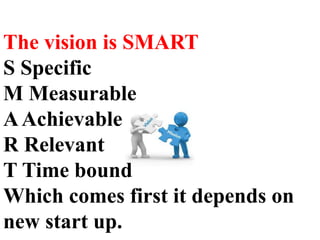
    The vision isSMART S Specific M Measurable AAchievable R Relevant T Time bound Which comes first it depends on new start up.
  • 35.
    FEATURES OF VISION STATEMENT •-Clarity and lack of ambiguity. • -Paint a vivid and clear picture. • -Describing a bright future [hope] • -Memorable and engaging
  • 36.
    IN NURSING PROFESSION Nursesas a national leader among academic health centers. To build on traditional mission of patient care, education and research.
  • 37.
    • Adapting organizationto succeed in changing environment. • Working collaboratively and partner with our professional colleagues, individuals and communities. • To improve outcomes
  • 38.
    • To providecare to patients and their families in a respectful caring manner. • To provide education that empowers families and staff to make decisions about health care.
  • 39.
    • To provideinformation system that serve uses by making data readily accessible for clinical management decision making, quality improvement, education and research. • To improve quality care by assuming that patients and families receive nursing care that has been demonstrated by research
  • 40.
    APPROACHES FOR VISIONAND MISSION STATEMENT FORMATION One alternative approach “Draw- See- Think-Plan Draw- What is the ideal image or the desired end state? See- What is today’s situation? What is the gap from ideal and why? Think- What specific actions must be taken to close the gap between today’s