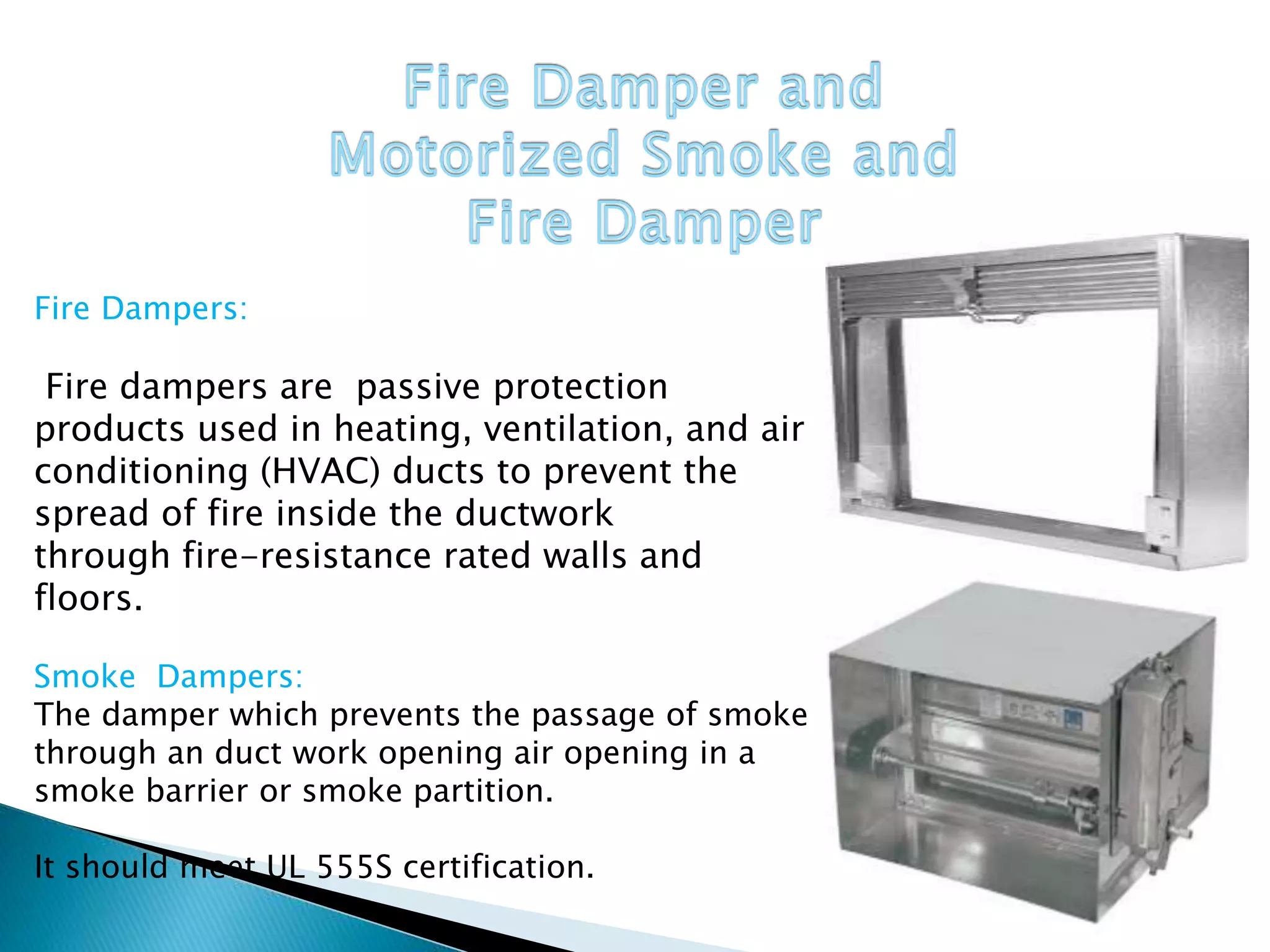
Fire Dampers:
Fire dampers are passive protection
products used in heating, ventilation, and air
conditioning (HVAC) ducts to prevent the
spread of fire inside the ductwork
through fire-resistance rated walls and
floors.
Smoke Dampers:
The damper which prevents the passage of smoke
through an duct work opening air opening in a
smoke barrier or smoke partition.
It should meet UL 555S certification.
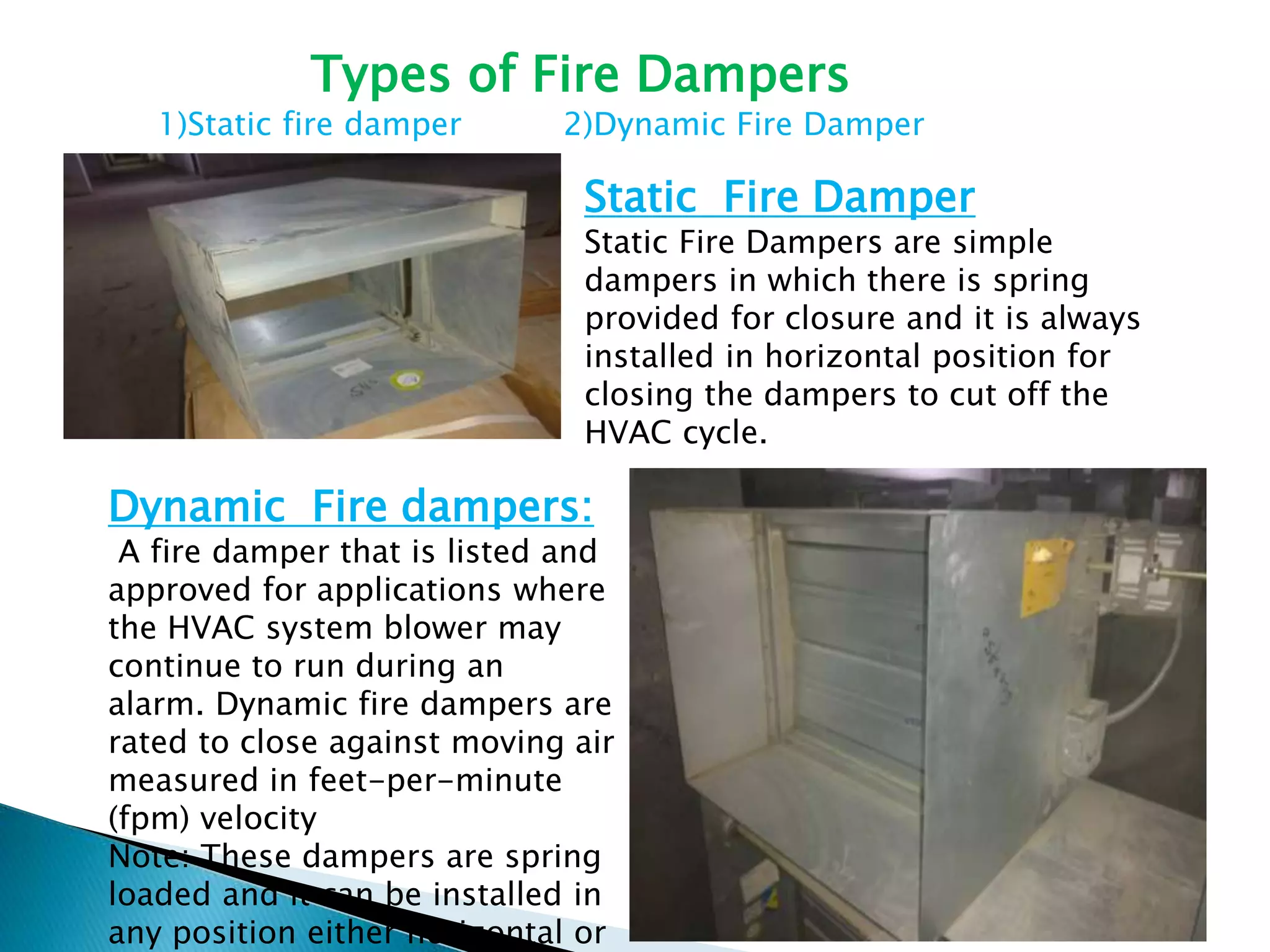
Dynamic Fire dampers:
A fire damper that is listed and
approved for applications where
the HVAC system blower may
continue to run during an
alarm. Dynamic fire dampers are
rated to close against moving air
measured in feet-per-minute
(fpm) velocity
Note: These dampers are spring
loaded and it can be installed in
any position either horizontal or
Static Fire Damper
Static Fire Dampers are simple
dampers in which there is spring
provided for closure and it is always
installed in horizontal position for
closing the dampers to cut off the
HVAC cycle.
Types of Fire Dampers
1)Static fire damper 2)Dynamic Fire Damper
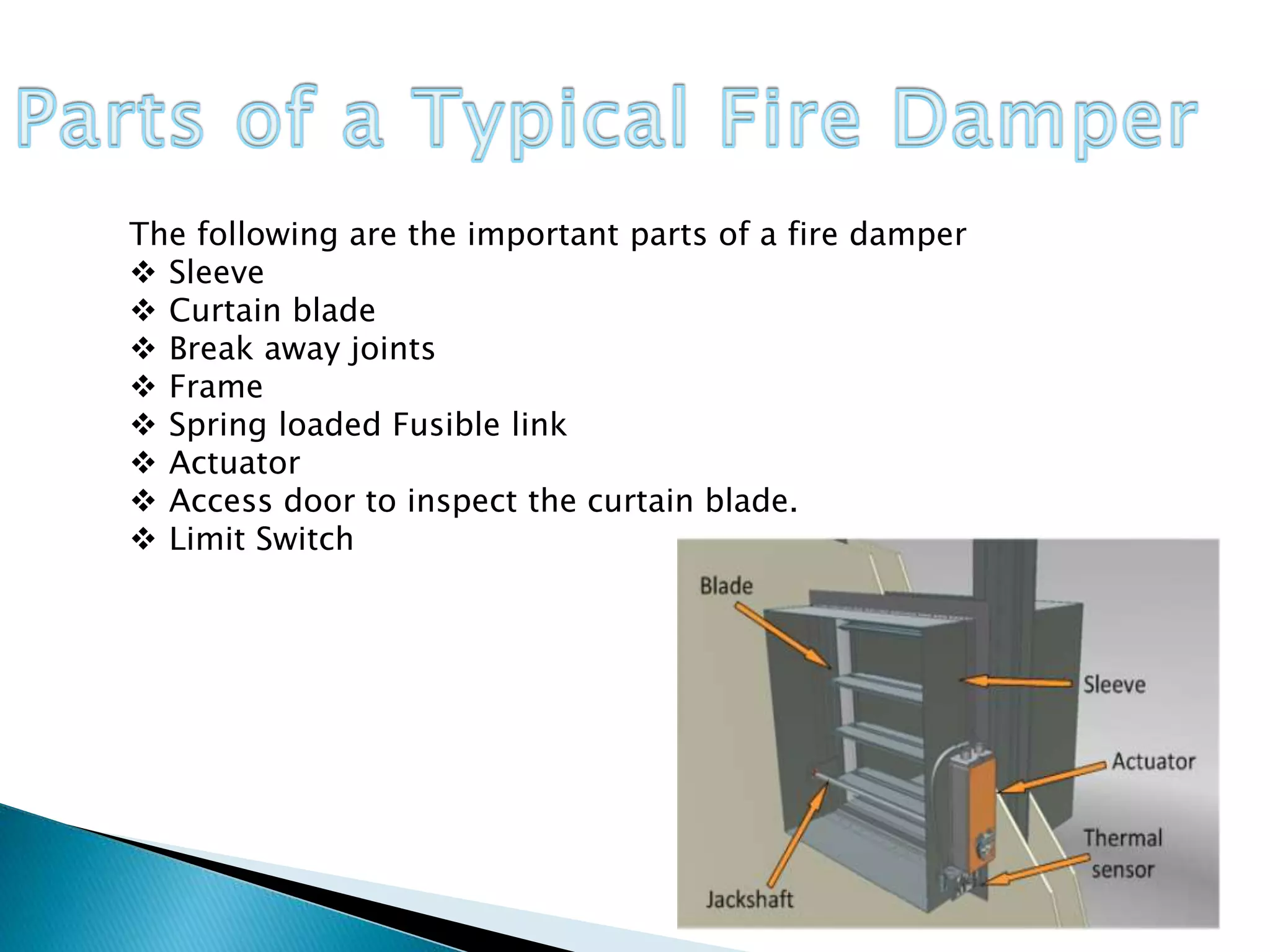
The following are the important parts of a fire damper
 Sleeve
 Curtain blade
 Break away joints
 Frame
 Spring loaded Fusible link
 Actuator
 Access door to inspect the curtain blade.
 Limit Switch
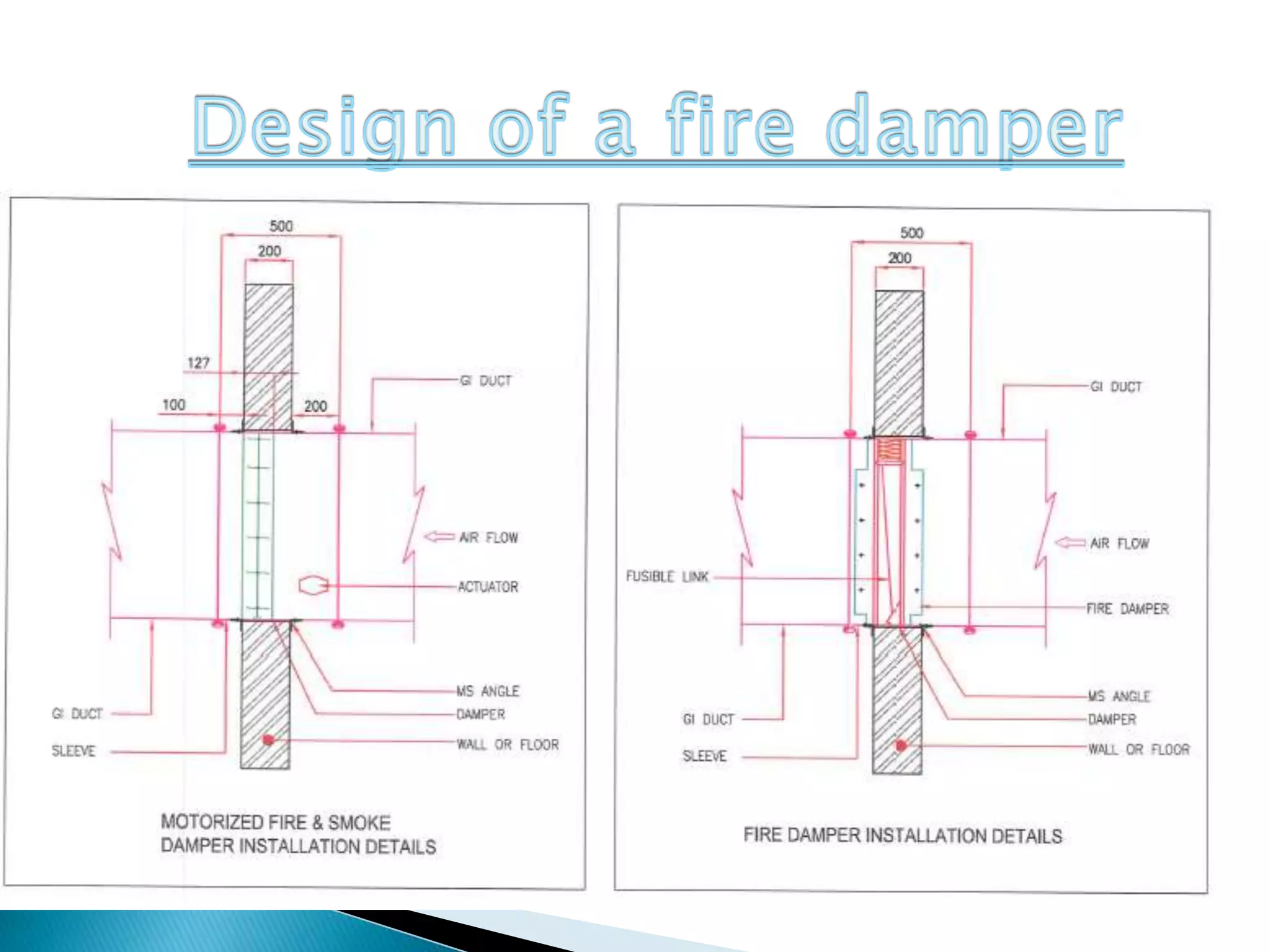
Sleeve:
The sleeve is not the part of the fire damper. It is provided for
connection of duct.
Generally length and thickness of sleeve is 500mm and
1.6mm.
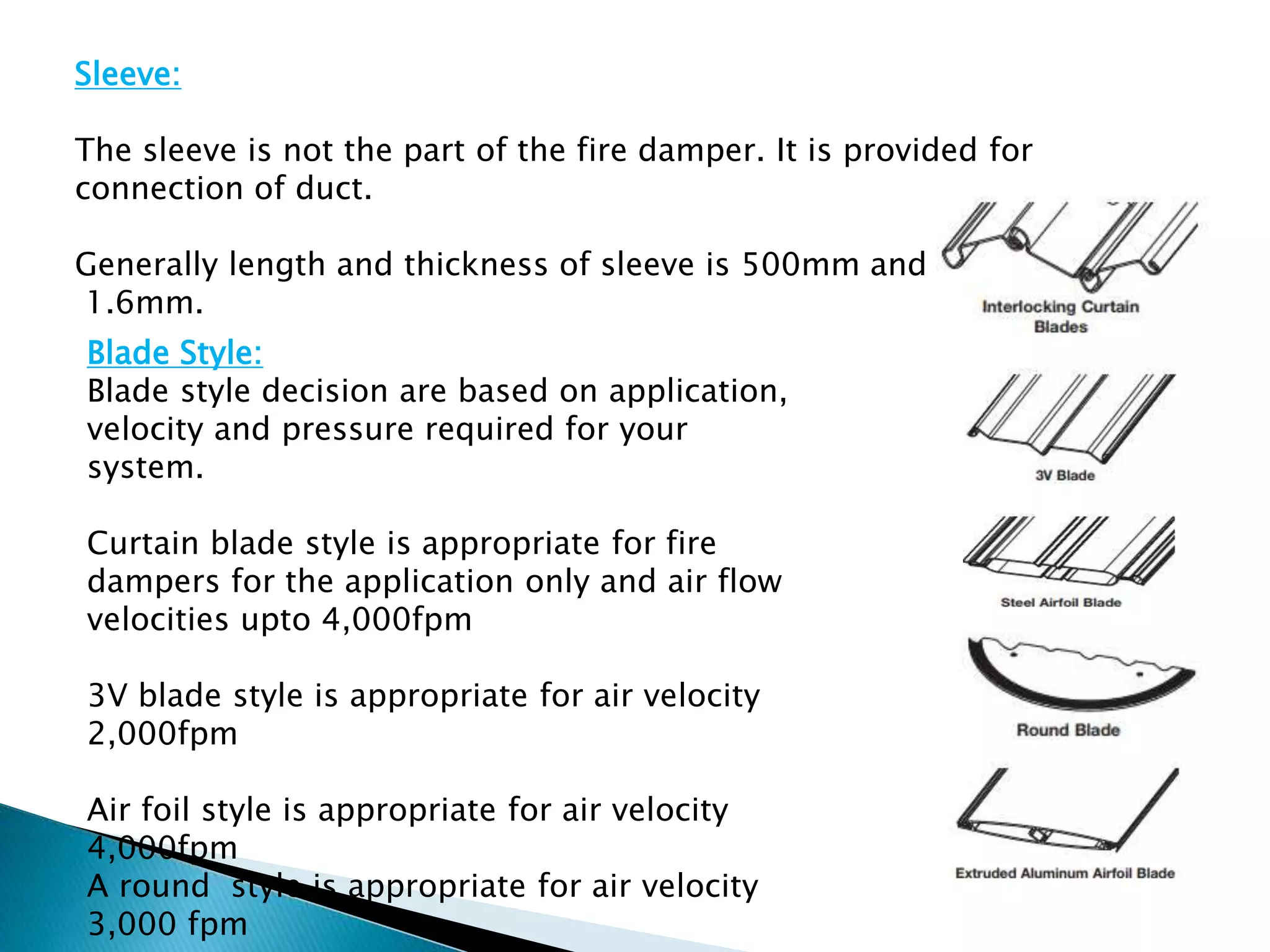
Blade Style:
Blade style decision are based on application,
velocity and pressure required for your
system.
Curtain blade style is appropriate for fire
dampers for the application only and air flow
velocities upto 4,000fpm
3V blade style is appropriate for air velocity
2,000fpm
Air foil style is appropriate for air velocity
4,000fpm
A round style is appropriate for air velocity
3,000 fpm
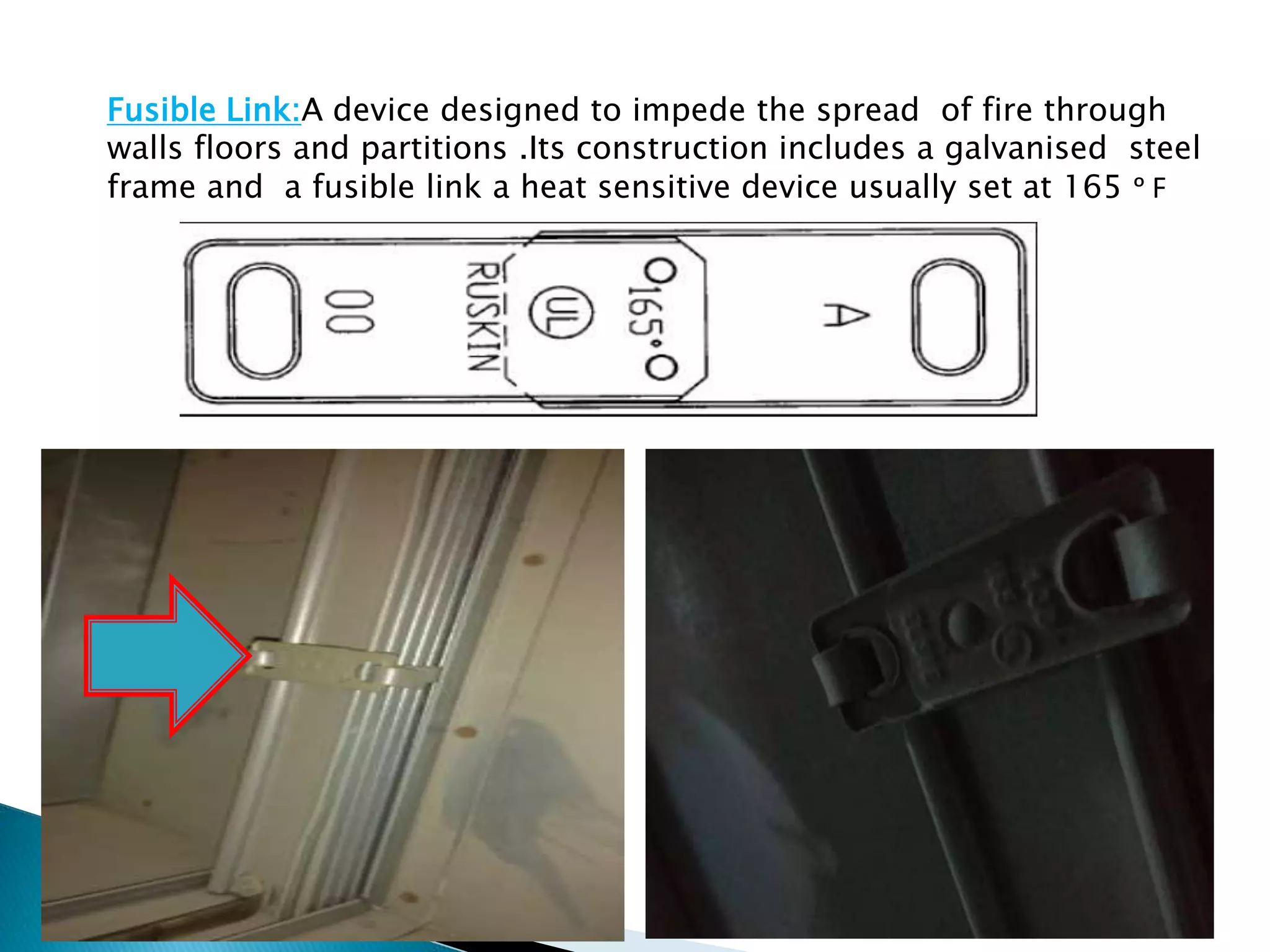
Fusible Link:A device designed to impede the spread of fire through
walls floors and partitions .Its construction includes a galvanised steel
frame and a fusible link a heat sensitive device usually set at 165 ᵒ F
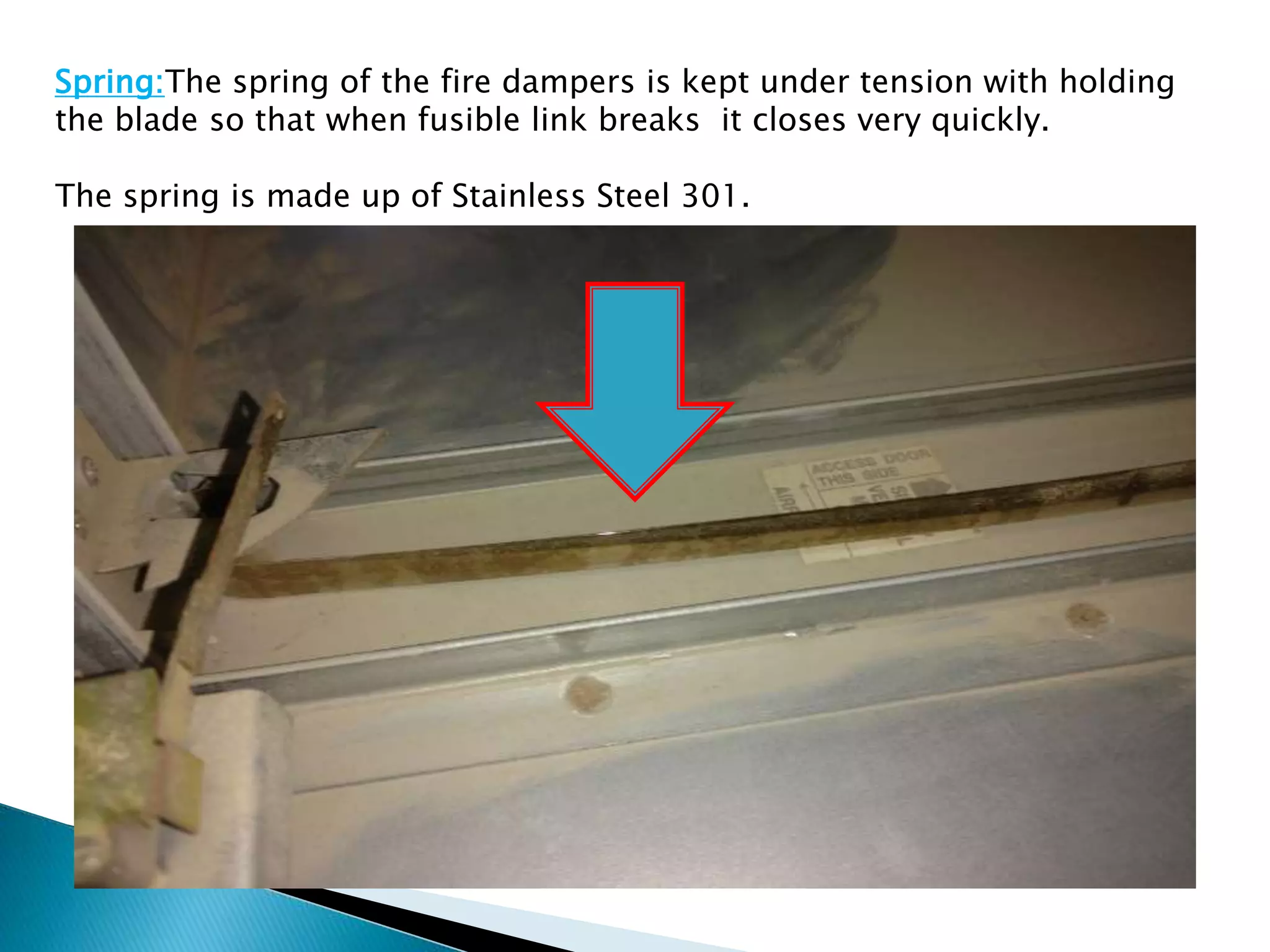
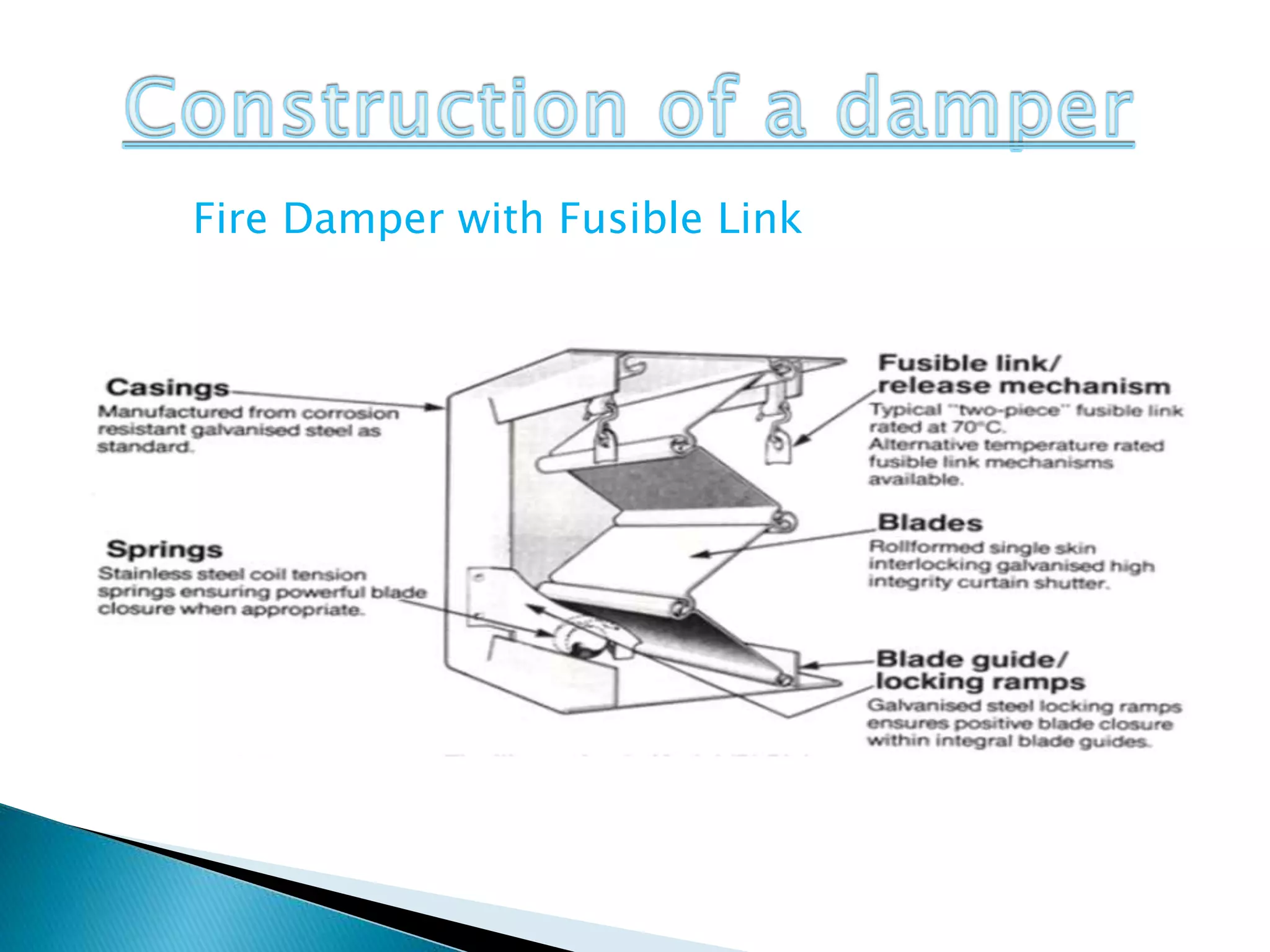
Spring:The spring of the fire dampers is kept under tension with holding
the blade so that when fusible link breaks it closes very quickly.
The spring is made up of Stainless Steel 301.
Rating of Fire Dampers
Fire Resisting Rating of fire dampers:
Fire and combination fire smoke dampers installed in walls, floors,
or partitions are required by the applicable building code to have a
fire resistance rating.
Note: If Wall, ceiling or floor assemeblies with a fire rating of less
than 3 hours then fire damper shall be of rating of 1⅟2 hours
If Wall, ceiling or floor assemeblies with a fire rating of equal or
more then 3 hours then fire damper shall be of rating of 3 hours
Elevated temp.rating :
The 2015 international building codes requires the minimum
temperature of 250 ᵒF (121 ᵒ) rating.
Operational Rating :
Operational ratings are dependent on the damper’s size and
installed actuator. Both UL 555 and UL 555S require a
combination fire smoke damper and its installed actuator be
rated for a maximum airflow rate (velocity in ft/min) through
the open damper and a maximum pressure (in. wg) across the
closed damper. The installed actuator must operate the
damper open and close against these rated velocities and
pressures. Greenheck combination fire smoke dampers with
3V blades are rated up to 2,000 ft/min (10.2 m/s) and
pressure up to 6 in. wg (1.5 kPa). The airfoil blade models are
rated up to 4000 ft/min (20.3 m/s) and pressure up to 8 in.
wg (2 kPa).
Dynamic rated fire dampers are typically rated without actuators.
Round, curtain style fire, and multi-blade fire dampers meet the
requirement of UL 555 with airflow ratings up to 4,000 ft/min
(20.3 m/s) and pressure up to 10 in. wg (2.5 kPa). Considerations
of blade style, fire resistance rating, and leakage rating lead
directly to the selection of an appropriate Greenheck fire,
combination fire smoke or smoke damper model. Once an
appropriate damper model has been selected, its elevated
temperature and operational ratings should be compared with the
requirements for these ratings.....
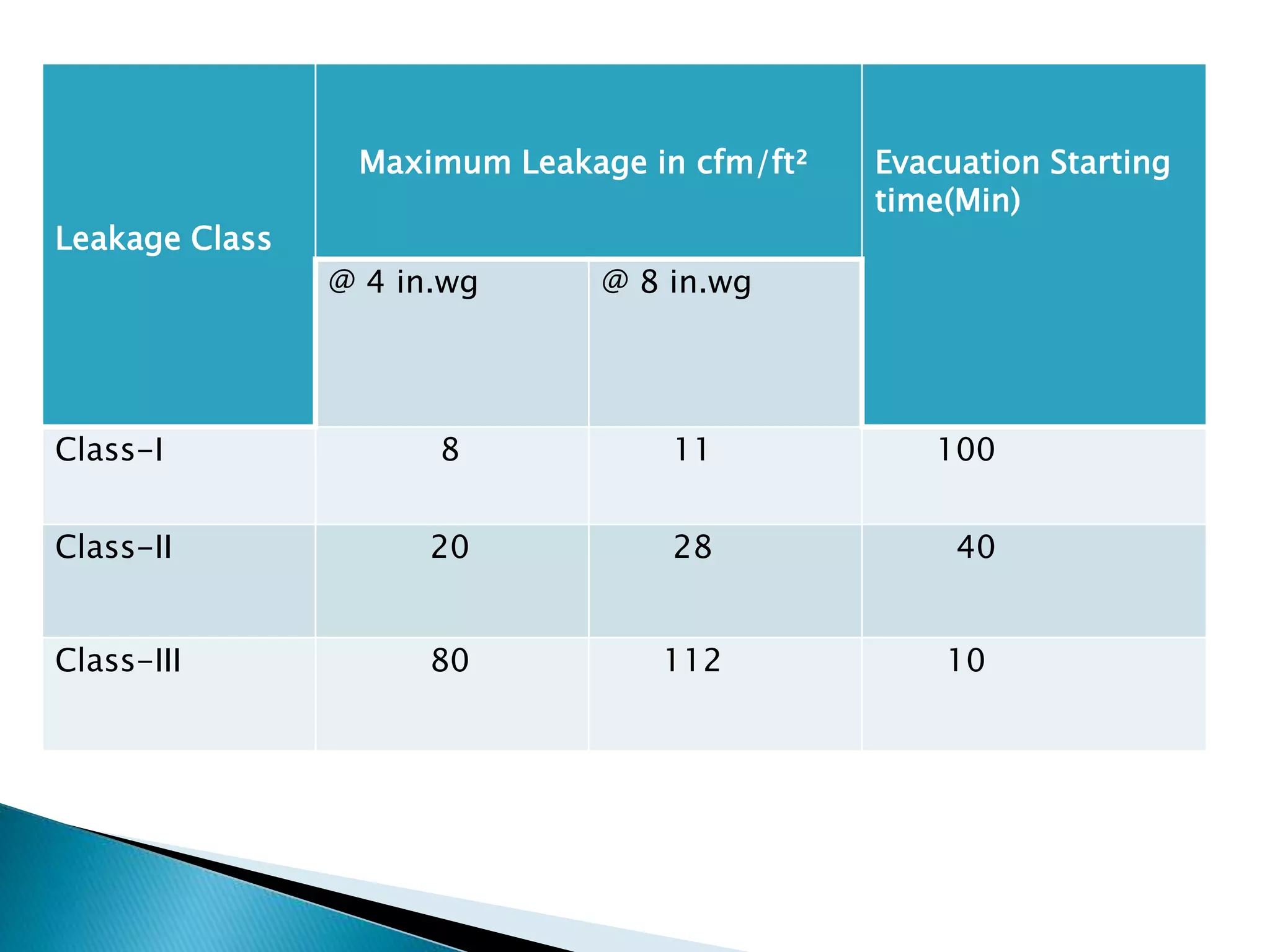
Leakage Class
Maximum Leakage in cfm/ft² Evacuation Starting
time(Min)
@ 4 in.wg @ 8 in.wg
Class-I 8 11 100
Class-II 20 28 40
Class-III 80 112 10
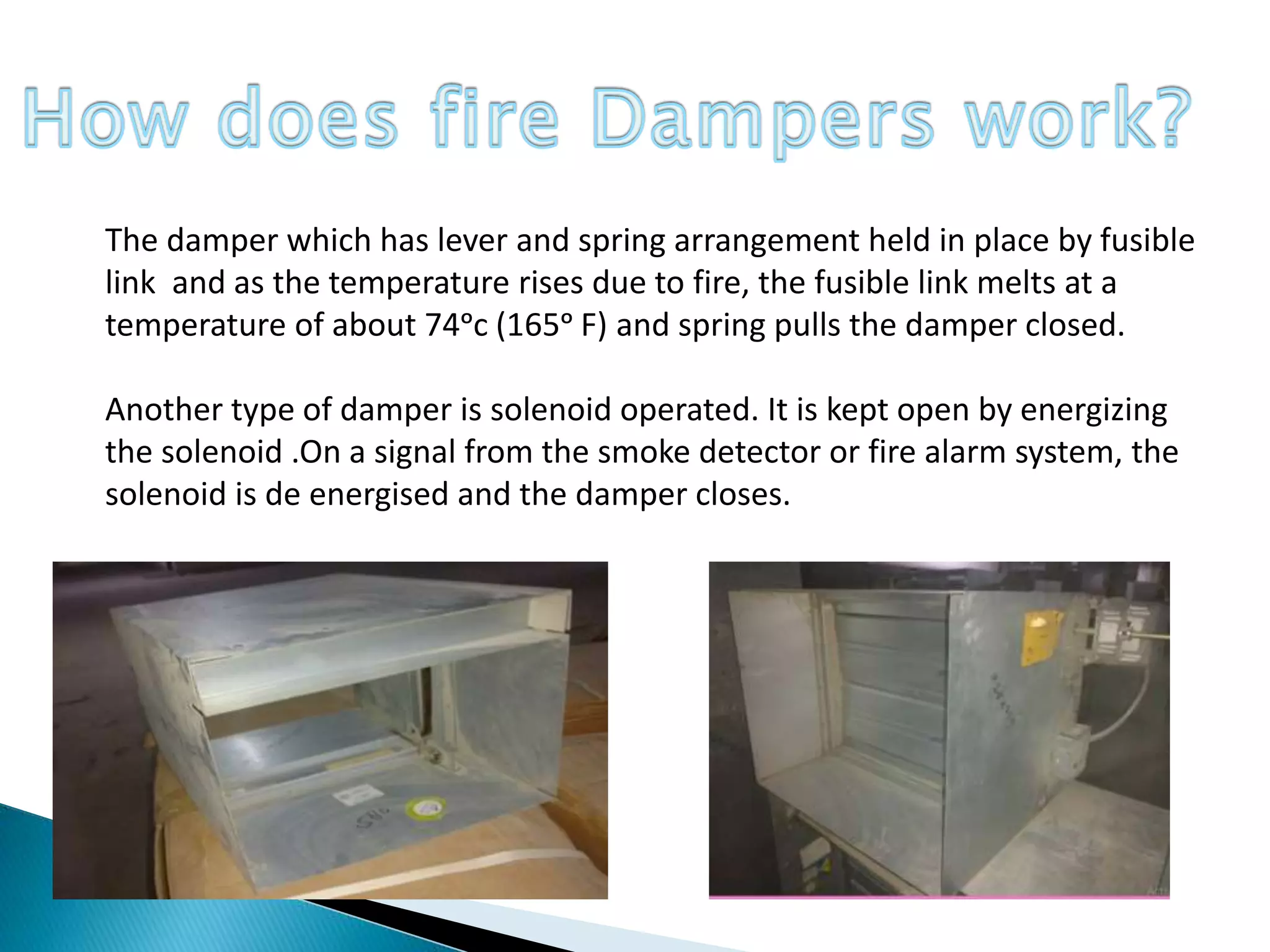
The damper which has lever and spring arrangement held in place by fusible
link and as the temperature rises due to fire, the fusible link melts at a
temperature of about 74ᵒc (165ᵒ F) and spring pulls the damper closed.
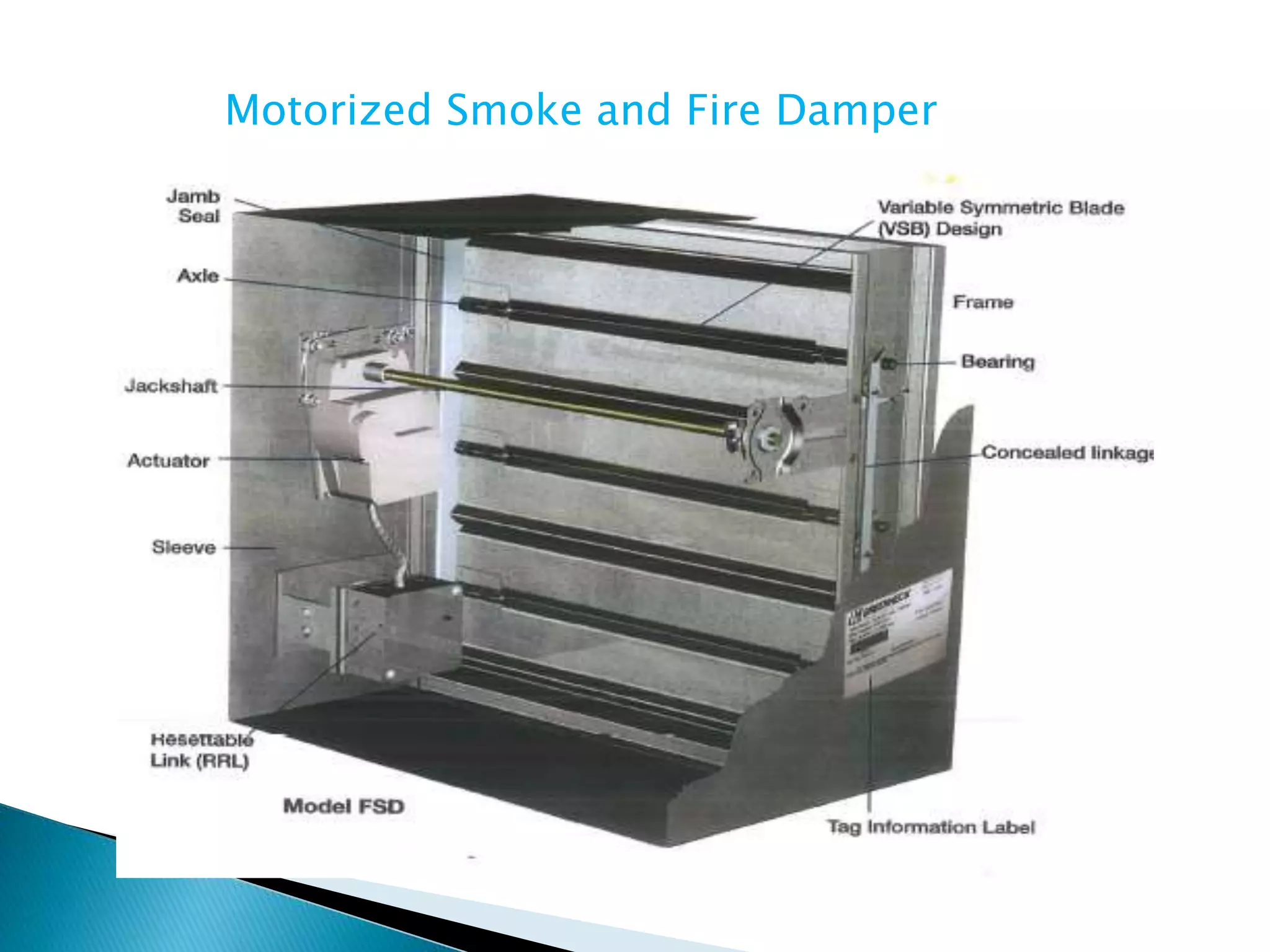
Another type of damper is solenoid operated. It is kept open by energizing
the solenoid .On a signal from the smoke detector or fire alarm system, the
solenoid is de energised and the damper closes.
Fire Damper with Fusible Link
Motorized Smoke and Fire Damper
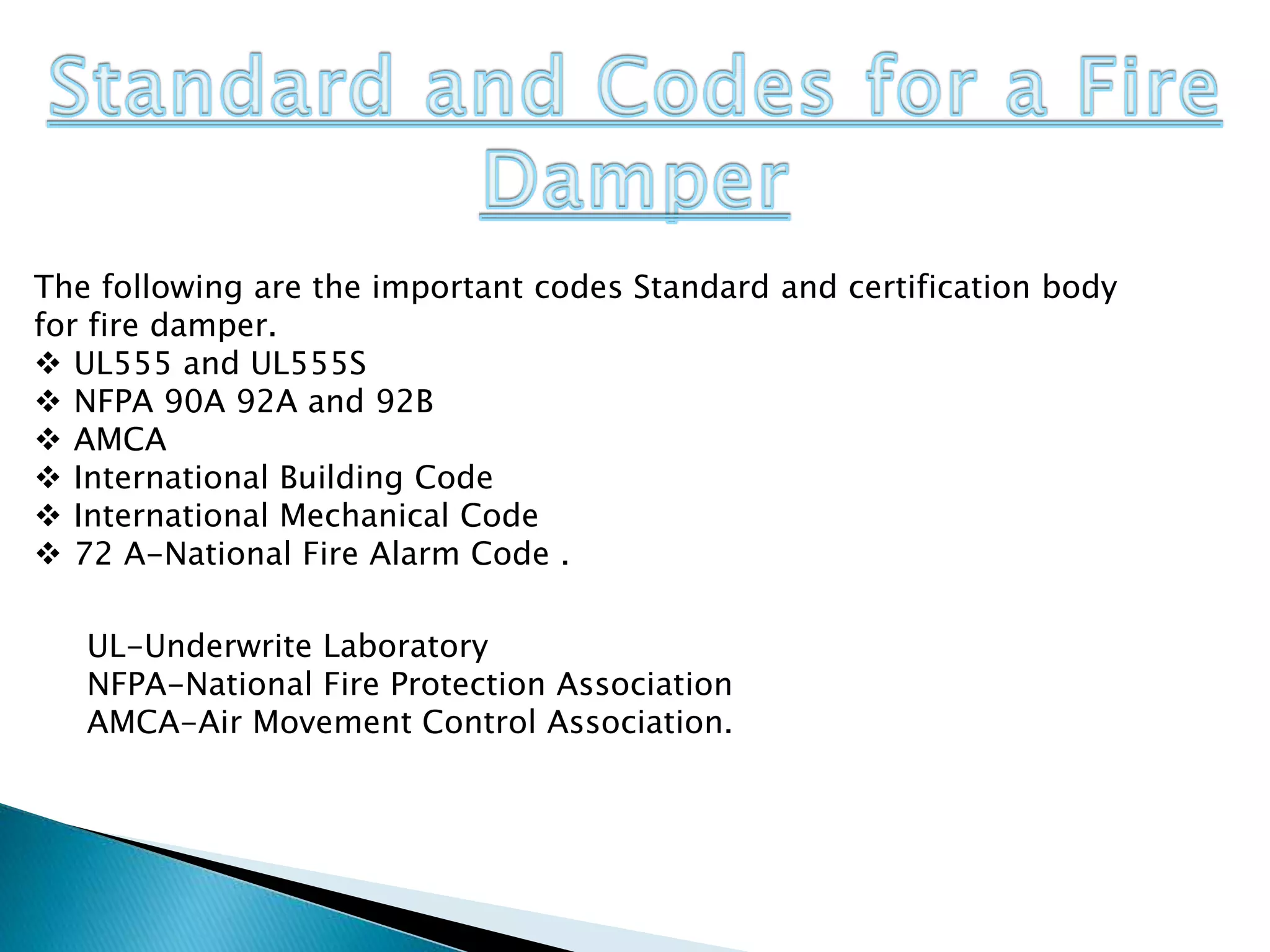
The following are the important codes Standard and certification body
for fire damper.
 UL555 and UL555S
 NFPA 90A 92A and 92B
 AMCA
 International Building Code
 International Mechanical Code
 72 A-National Fire Alarm Code .
UL-Underwrite Laboratory
NFPA-National Fire Protection Association
AMCA-Air Movement Control Association.
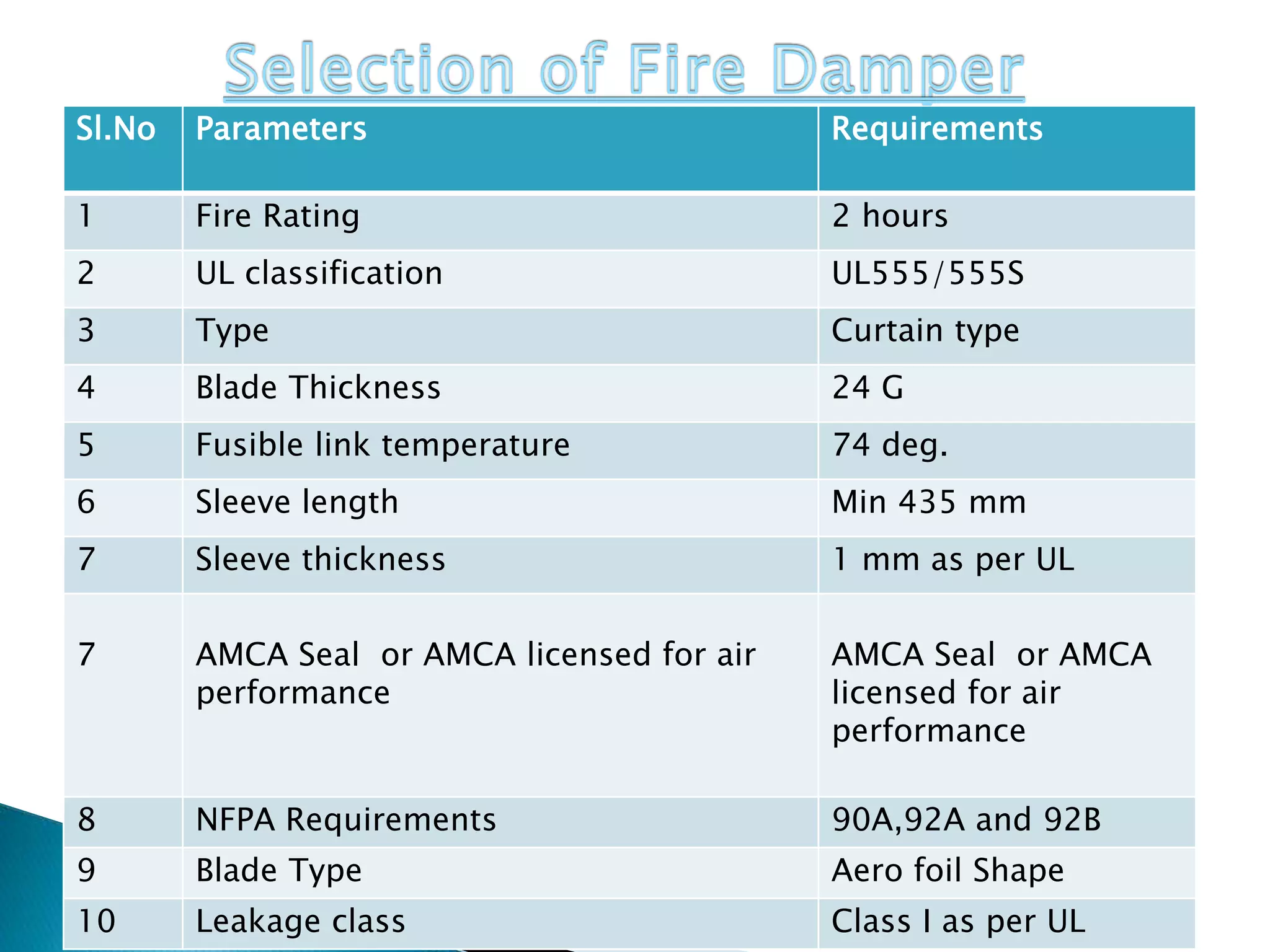
Sl.No Parameters Requirements
1 Fire Rating 2 hours
2 UL classification UL555/555S
3 Type Curtain type
4 Blade Thickness 24 G
5 Fusible link temperature 74 deg.
6 Sleeve length Min 435 mm
7 Sleeve thickness 1 mm as per UL
7 AMCA Seal or AMCA licensed for air
performance
AMCA Seal or AMCA
licensed for air
performance
8 NFPA Requirements 90A,92A and 92B
9 Blade Type Aero foil Shape
10 Leakage class Class I as per UL
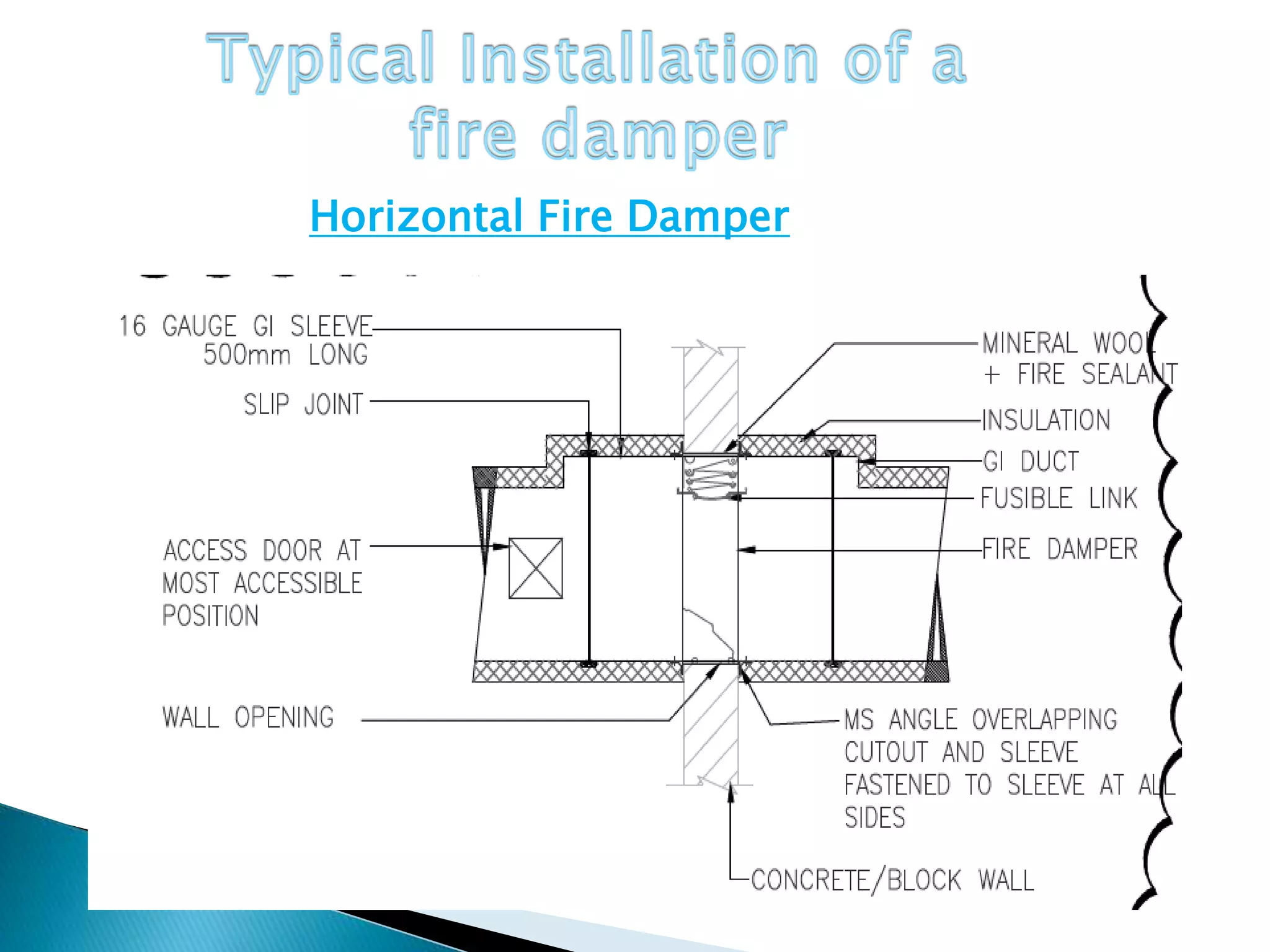
Horizontal Fire Damper
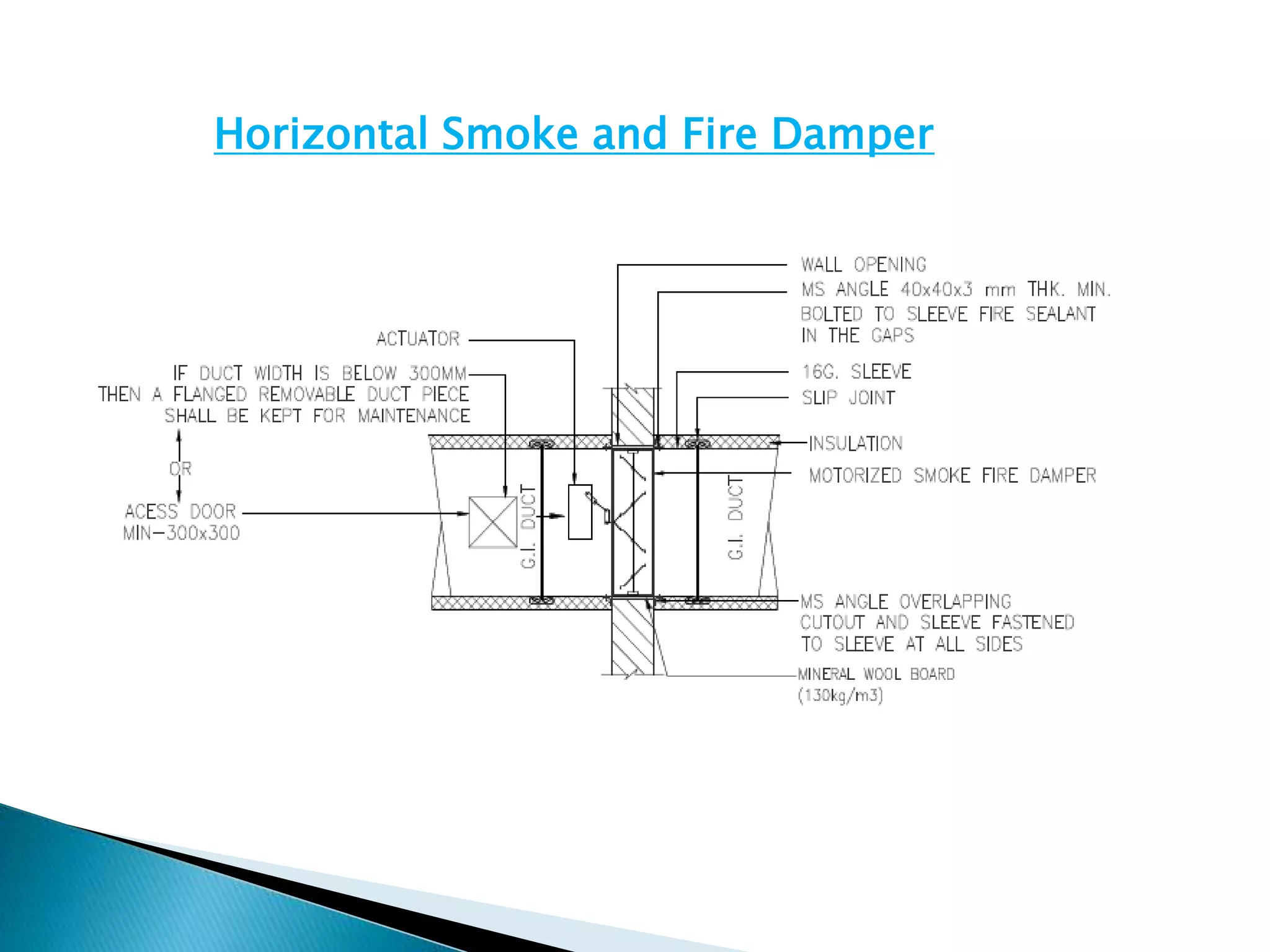
Horizontal Smoke and Fire Damper
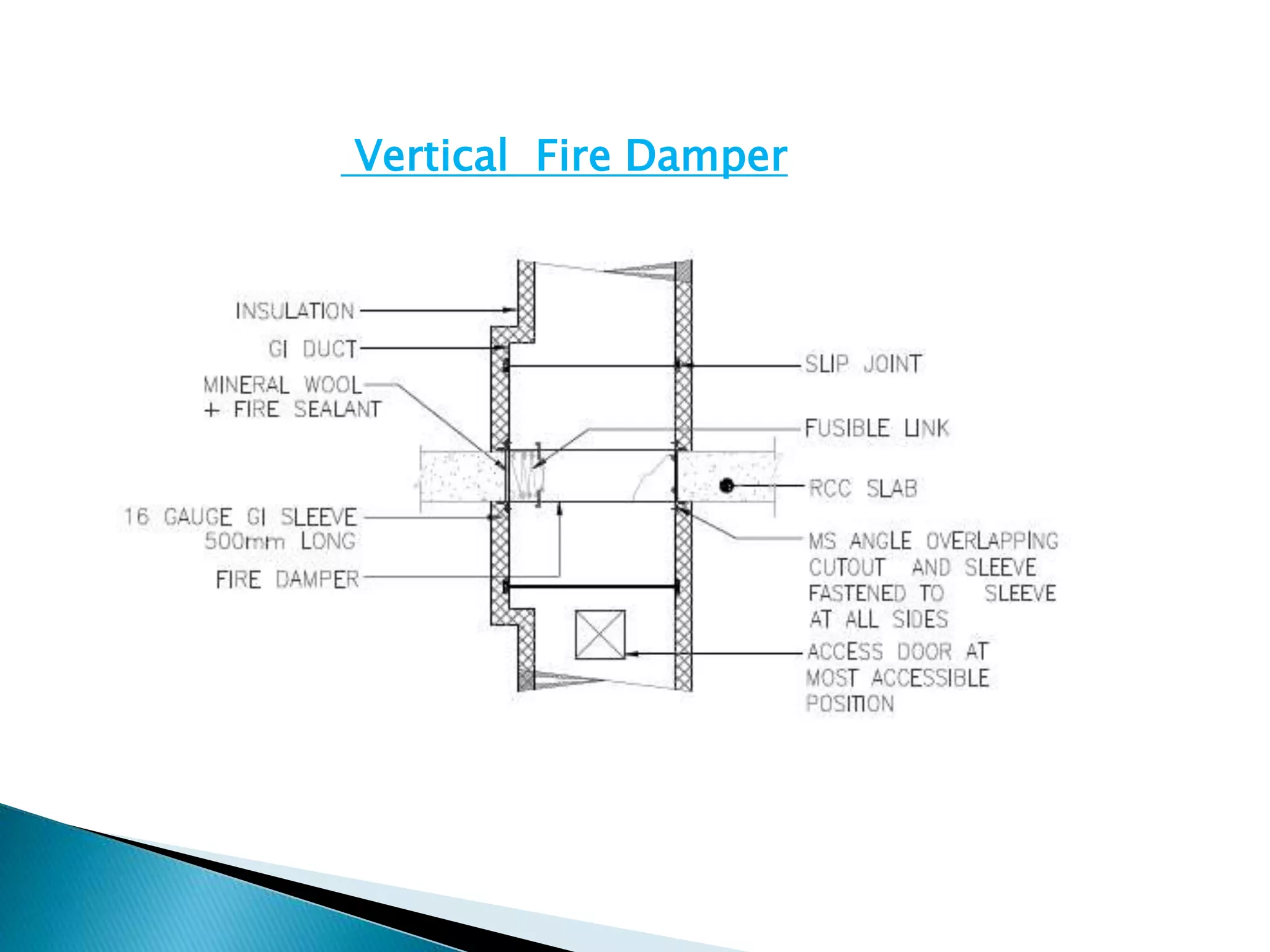
Vertical Fire Damper
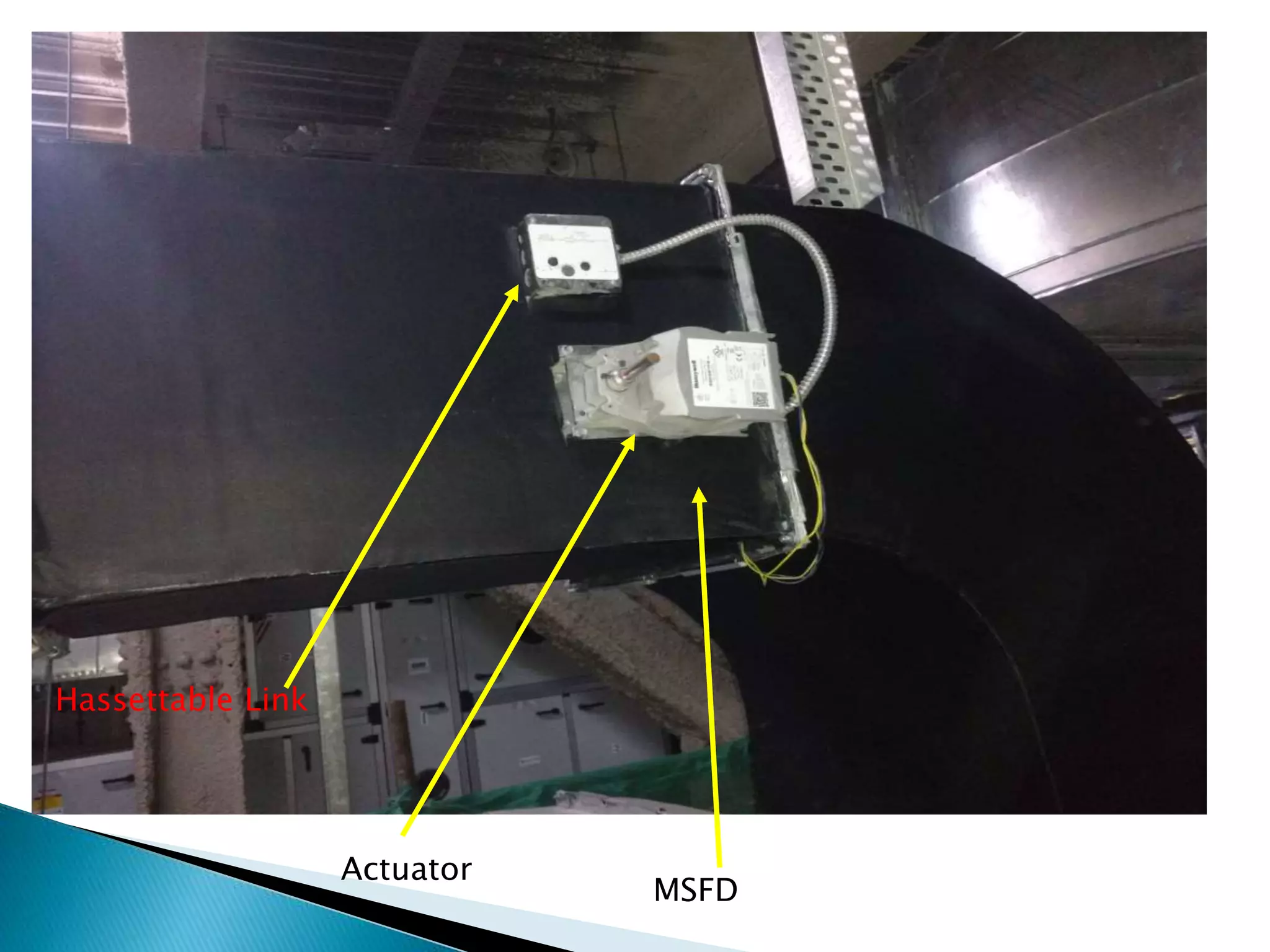
Actuator
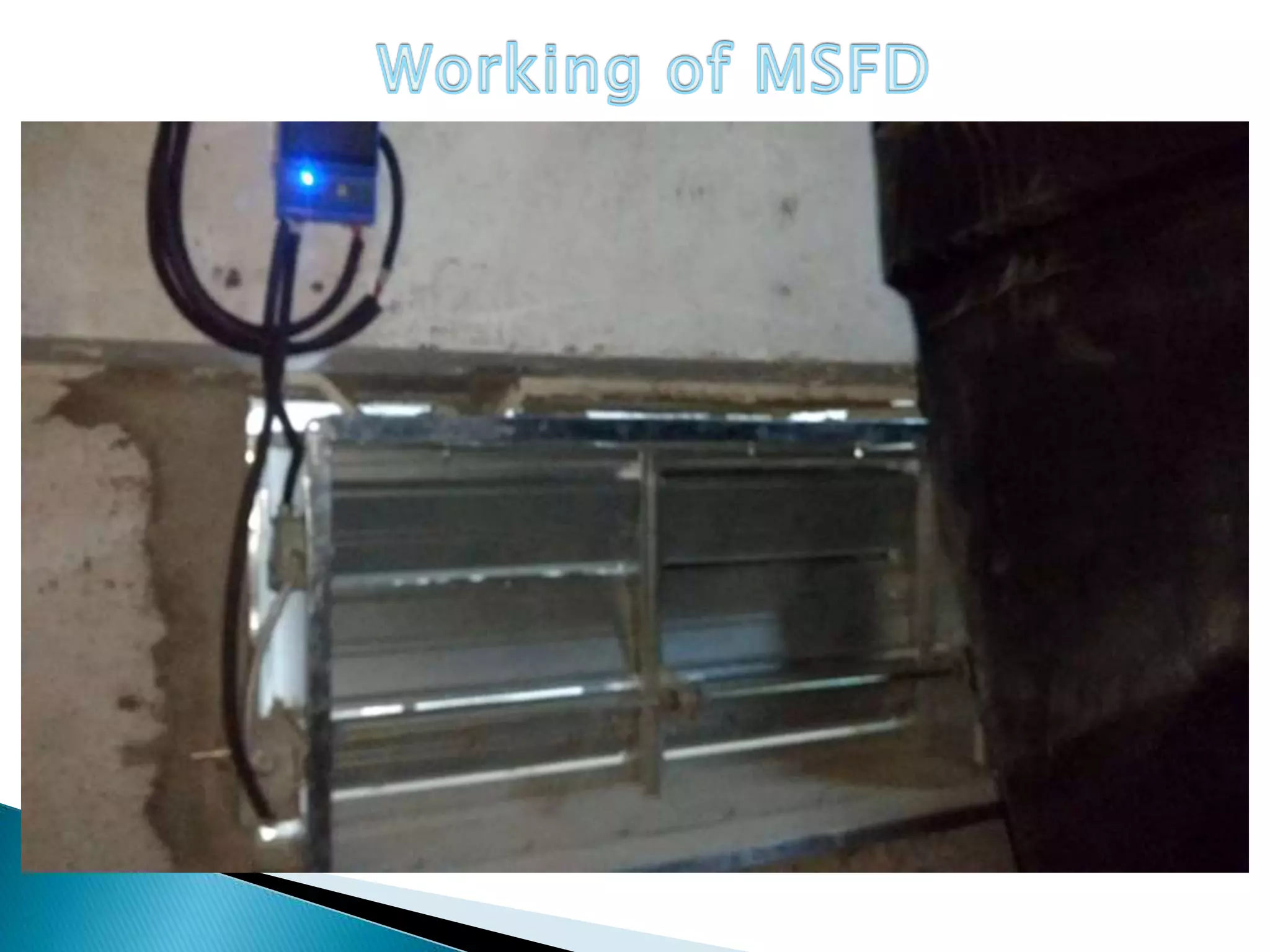
MSFD
Hassettable Link
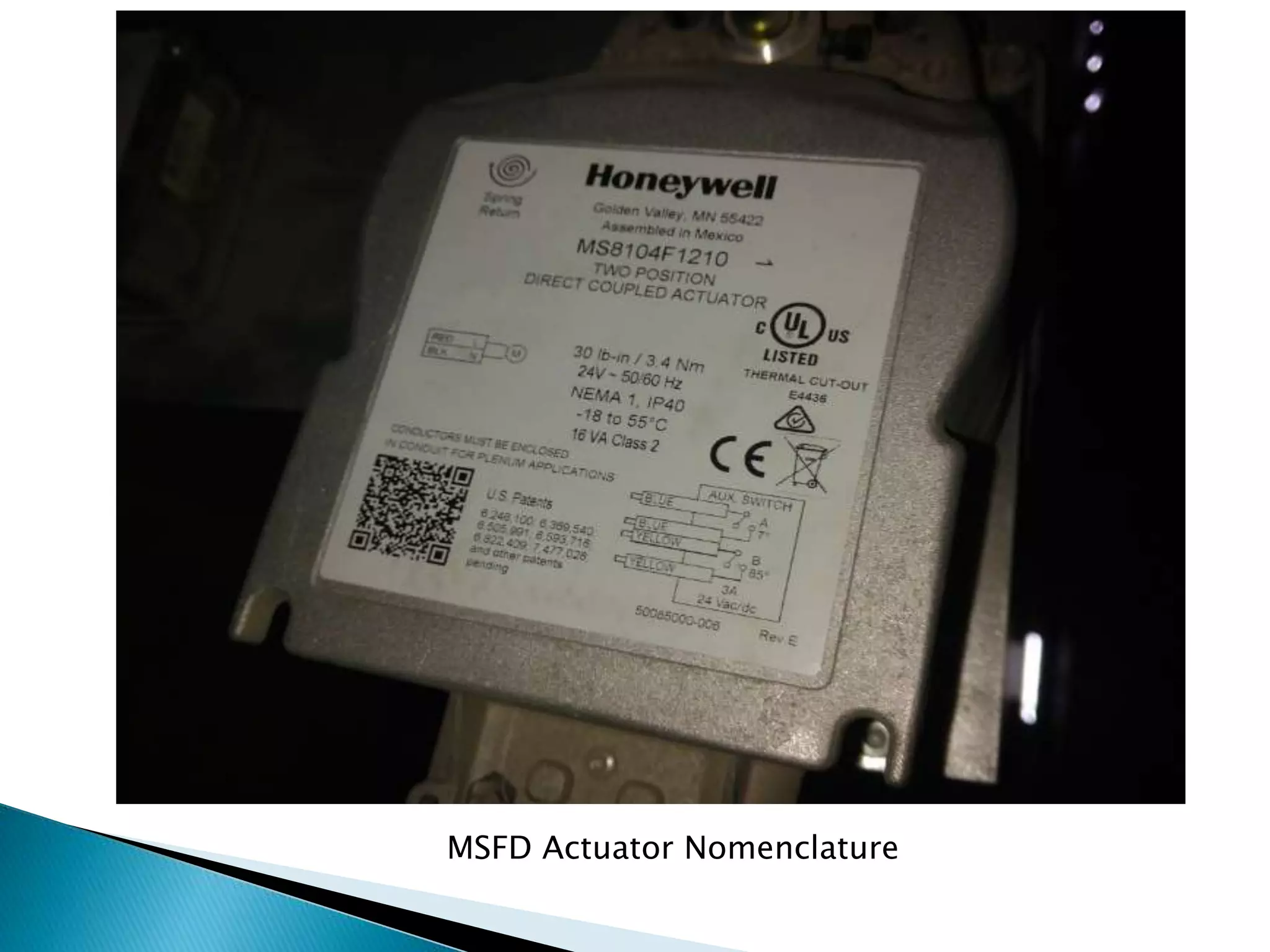
MSFD Actuator Nomenclature
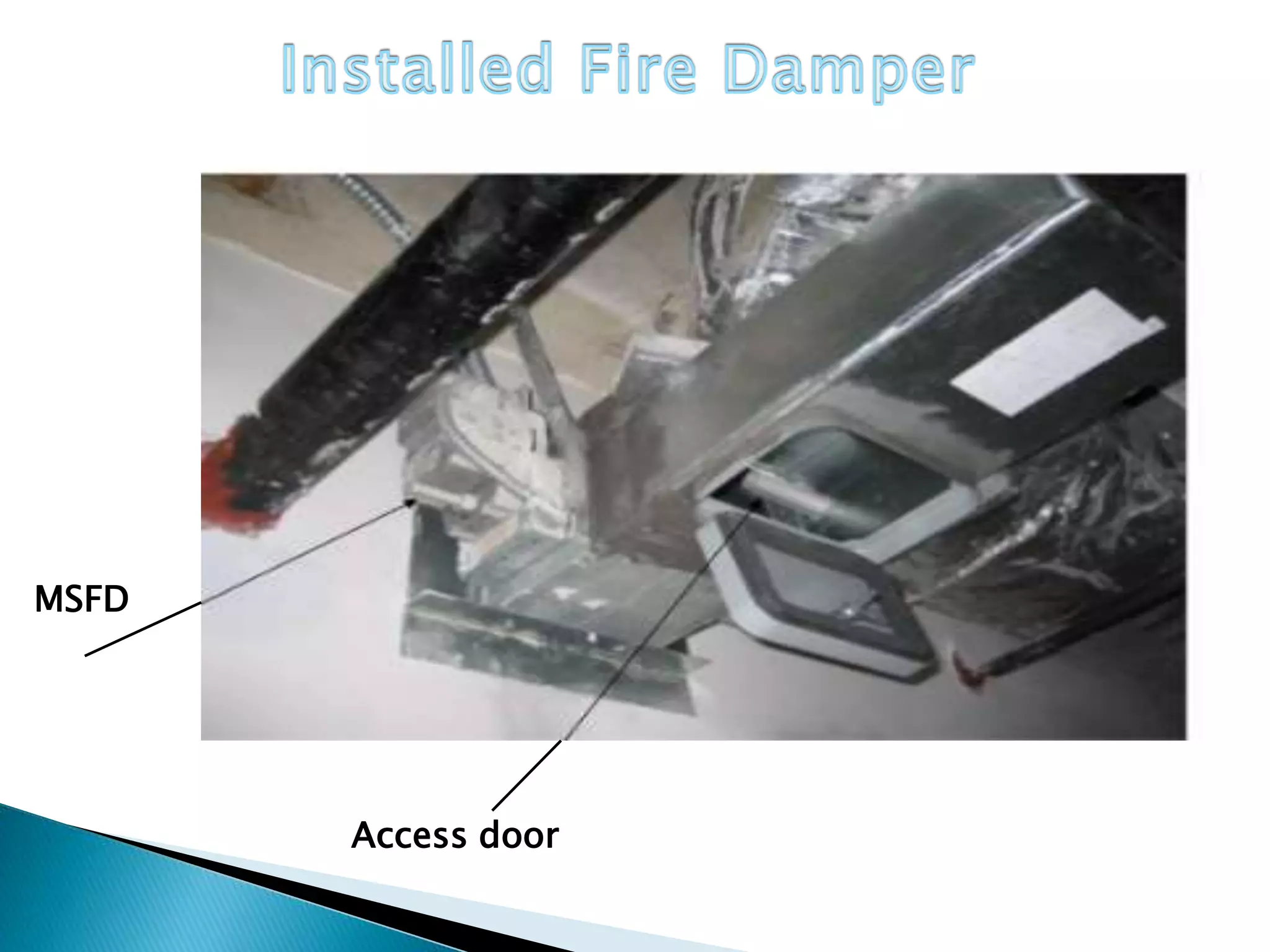
MSFD
Access door
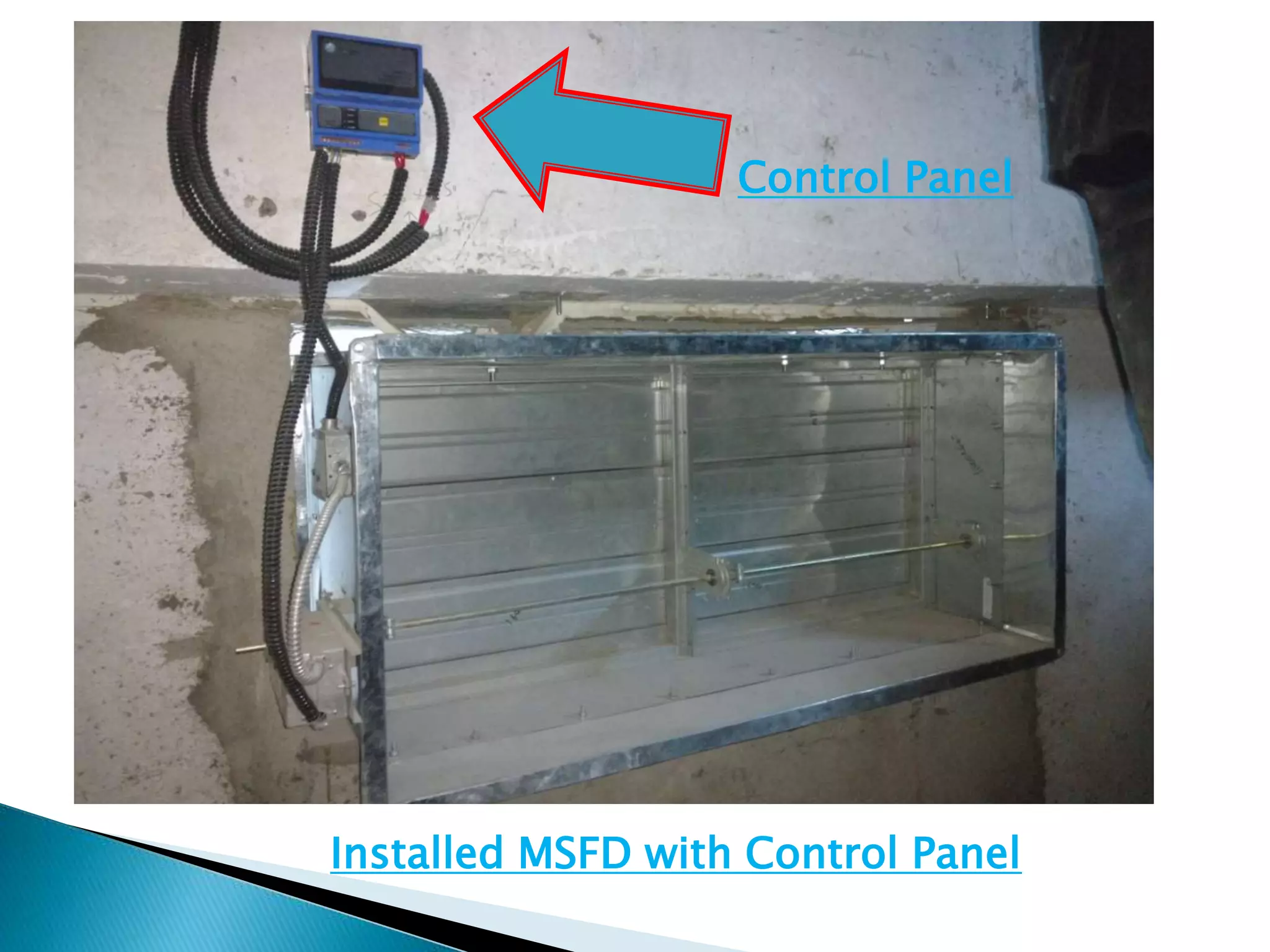
Installed MSFD with Control Panel
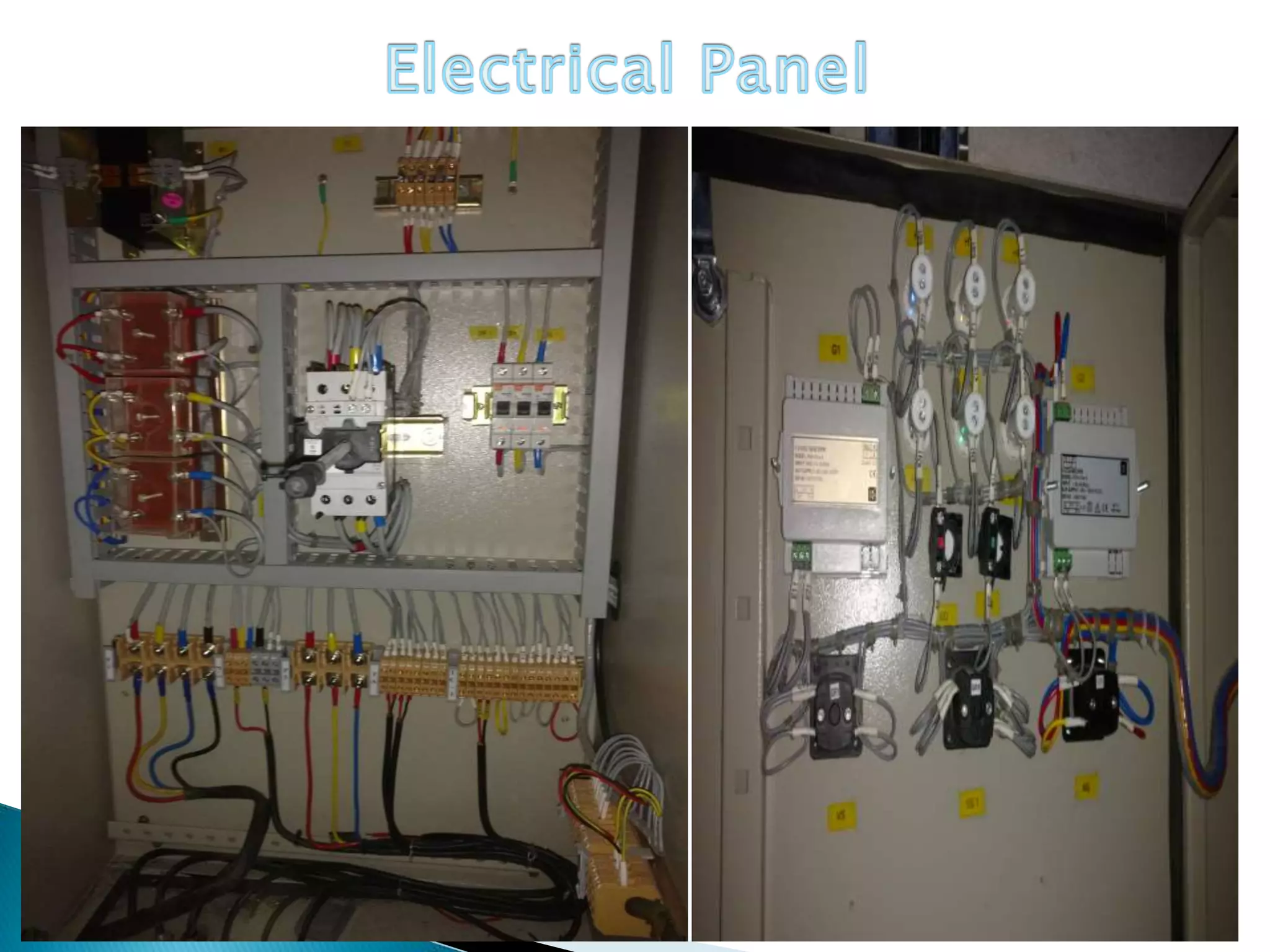
Control Panel
Concept of Fire damper by Md Yusuf

Concept of Fire damper by Md Yusuf

  • 2.
    Fire Dampers: Fire dampersare passive protection products used in heating, ventilation, and air conditioning (HVAC) ducts to prevent the spread of fire inside the ductwork through fire-resistance rated walls and floors. Smoke Dampers: The damper which prevents the passage of smoke through an duct work opening air opening in a smoke barrier or smoke partition. It should meet UL 555S certification.
  • 3.
    Dynamic Fire dampers: Afire damper that is listed and approved for applications where the HVAC system blower may continue to run during an alarm. Dynamic fire dampers are rated to close against moving air measured in feet-per-minute (fpm) velocity Note: These dampers are spring loaded and it can be installed in any position either horizontal or Static Fire Damper Static Fire Dampers are simple dampers in which there is spring provided for closure and it is always installed in horizontal position for closing the dampers to cut off the HVAC cycle. Types of Fire Dampers 1)Static fire damper 2)Dynamic Fire Damper
  • 4.
    The following arethe important parts of a fire damper  Sleeve  Curtain blade  Break away joints  Frame  Spring loaded Fusible link  Actuator  Access door to inspect the curtain blade.  Limit Switch
  • 5.
    Sleeve: The sleeve isnot the part of the fire damper. It is provided for connection of duct. Generally length and thickness of sleeve is 500mm and 1.6mm. Blade Style: Blade style decision are based on application, velocity and pressure required for your system. Curtain blade style is appropriate for fire dampers for the application only and air flow velocities upto 4,000fpm 3V blade style is appropriate for air velocity 2,000fpm Air foil style is appropriate for air velocity 4,000fpm A round style is appropriate for air velocity 3,000 fpm
  • 6.
    Fusible Link:A devicedesigned to impede the spread of fire through walls floors and partitions .Its construction includes a galvanised steel frame and a fusible link a heat sensitive device usually set at 165 ᵒ F
  • 7.
    Spring:The spring ofthe fire dampers is kept under tension with holding the blade so that when fusible link breaks it closes very quickly. The spring is made up of Stainless Steel 301.
  • 8.
    Rating of FireDampers Fire Resisting Rating of fire dampers: Fire and combination fire smoke dampers installed in walls, floors, or partitions are required by the applicable building code to have a fire resistance rating. Note: If Wall, ceiling or floor assemeblies with a fire rating of less than 3 hours then fire damper shall be of rating of 1⅟2 hours If Wall, ceiling or floor assemeblies with a fire rating of equal or more then 3 hours then fire damper shall be of rating of 3 hours
  • 9.
    Elevated temp.rating : The2015 international building codes requires the minimum temperature of 250 ᵒF (121 ᵒ) rating. Operational Rating : Operational ratings are dependent on the damper’s size and installed actuator. Both UL 555 and UL 555S require a combination fire smoke damper and its installed actuator be rated for a maximum airflow rate (velocity in ft/min) through the open damper and a maximum pressure (in. wg) across the closed damper. The installed actuator must operate the damper open and close against these rated velocities and pressures. Greenheck combination fire smoke dampers with 3V blades are rated up to 2,000 ft/min (10.2 m/s) and pressure up to 6 in. wg (1.5 kPa). The airfoil blade models are rated up to 4000 ft/min (20.3 m/s) and pressure up to 8 in. wg (2 kPa).
  • 10.
    Dynamic rated firedampers are typically rated without actuators. Round, curtain style fire, and multi-blade fire dampers meet the requirement of UL 555 with airflow ratings up to 4,000 ft/min (20.3 m/s) and pressure up to 10 in. wg (2.5 kPa). Considerations of blade style, fire resistance rating, and leakage rating lead directly to the selection of an appropriate Greenheck fire, combination fire smoke or smoke damper model. Once an appropriate damper model has been selected, its elevated temperature and operational ratings should be compared with the requirements for these ratings.....
  • 11.
    Leakage Class Maximum Leakagein cfm/ft² Evacuation Starting time(Min) @ 4 in.wg @ 8 in.wg Class-I 8 11 100 Class-II 20 28 40 Class-III 80 112 10
  • 12.
    The damper whichhas lever and spring arrangement held in place by fusible link and as the temperature rises due to fire, the fusible link melts at a temperature of about 74ᵒc (165ᵒ F) and spring pulls the damper closed. Another type of damper is solenoid operated. It is kept open by energizing the solenoid .On a signal from the smoke detector or fire alarm system, the solenoid is de energised and the damper closes.
  • 14.
    Fire Damper withFusible Link
  • 15.
  • 16.
    The following arethe important codes Standard and certification body for fire damper.  UL555 and UL555S  NFPA 90A 92A and 92B  AMCA  International Building Code  International Mechanical Code  72 A-National Fire Alarm Code . UL-Underwrite Laboratory NFPA-National Fire Protection Association AMCA-Air Movement Control Association.
  • 17.
    Sl.No Parameters Requirements 1Fire Rating 2 hours 2 UL classification UL555/555S 3 Type Curtain type 4 Blade Thickness 24 G 5 Fusible link temperature 74 deg. 6 Sleeve length Min 435 mm 7 Sleeve thickness 1 mm as per UL 7 AMCA Seal or AMCA licensed for air performance AMCA Seal or AMCA licensed for air performance 8 NFPA Requirements 90A,92A and 92B 9 Blade Type Aero foil Shape 10 Leakage class Class I as per UL
  • 18.
  • 19.
  • 20.
  • 21.
  • 22.
  • 23.
  • 24.
    Installed MSFD withControl Panel Control Panel