Engineering Department
MAB Fire Protection PVT Ltd
Prepared on July 2013
Project:
Installation of Fire Suppression System at SuperNet Head
Office (WTC)
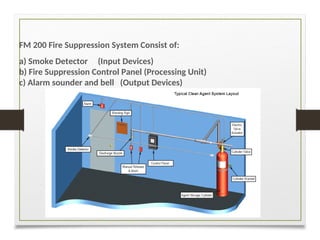
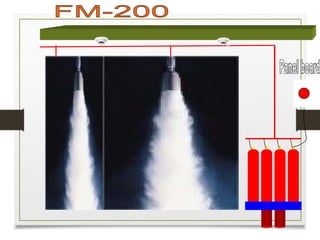
FM 200 Fire Suppression System Consist of:
a) Smoke Detector (Input Devices)
b) Fire Suppression Control Panel (Processing Unit)
c) Alarm sounder and bell (Output Devices)
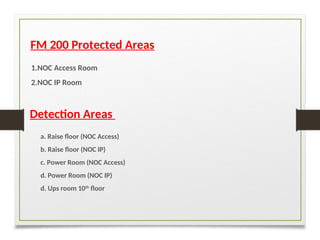
FM 200 Protected Areas
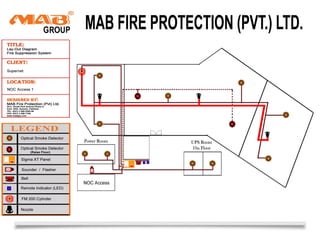
1.NOC Access Room
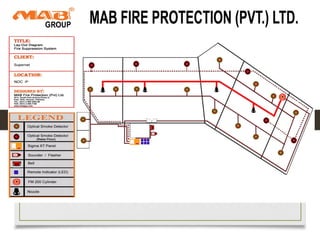
2.NOC IP Room
Detection Areas
a. Raise floor (NOC Access)
b. Raise floor (NOC IP)
c. Power Room (NOC Access)
d. Power Room (NOC IP)
d. Ups room 10th
floor
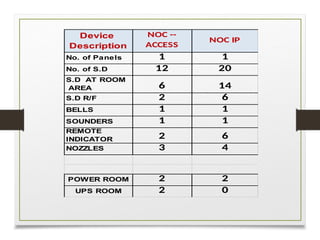
Device
Description
NOC --
ACCESS
NOC IP
No. of Panels 1 1
No. of S.D 12 20
S.D AT ROOM
AREA 6 14
S.D R/F 2 6
BELLS 1 1
SOUNDERS 1 1
REMOTE
INDICATOR 2 6
NOZZLES 3 4
POWER ROOM 2 2
UPS ROOM 2 0
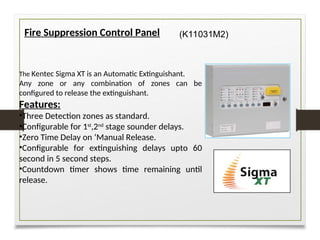
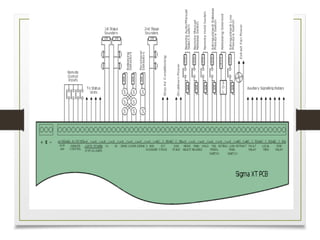
Fire Suppression Control Panel
The Kentec Sigma XT is an Automatic Extinguishant.
Any zone or any combination of zones can be
configured to release the extinguishant.
Features:
•Three Detection zones as standard.
•Configurable for 1st
,2nd
stage sounder delays.
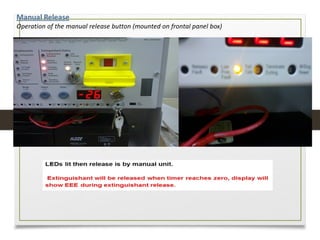
•Zero Time Delay on ‘Manual Release.
•Configurable for extinguishing delays upto 60
second in 5 second steps.
•Countdown timer shows time remaining until
release.
(K11031M2)
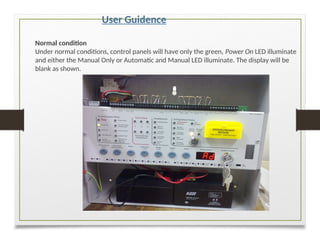
Normal condition
Under normal conditions, control panels will have only the green, Power On LED illuminate
and either the Manual Only or Automatic and Manual LED illuminate. The display will be
blank as shown.
User Guidence
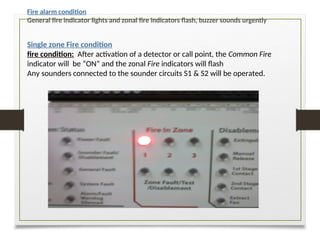
Single zone Fire condition
fire condition: After activation of a detector or call point, the Common Fire
indicator will be “ON” and the zonal Fire indicators will flash
Any sounders connected to the sounder circuits S1 & S2 will be operated.
Fire alarm condition
General fire indicator lights and zonal fire indicators flash, buzzer sounds urgently
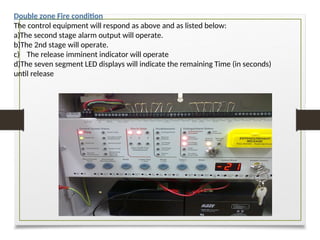
Double zone Fire condition
The control equipment will respond as above and as listed below:
a)The second stage alarm output will operate.
b)The 2nd stage will operate.
c) The release imminent indicator will operate
d)The seven segment LED displays will indicate the remaining Time (in seconds)
until release
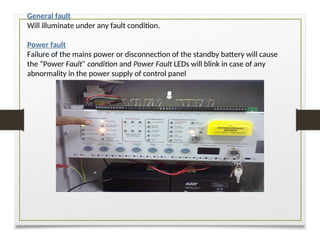
General fault
Will illuminate under any fault condition.
Power fault
Failure of the mains power or disconnection of the standby battery will cause
the “Power Fault” condition and Power Fault LEDs will blink in case of any
abnormality in the power supply of control panel
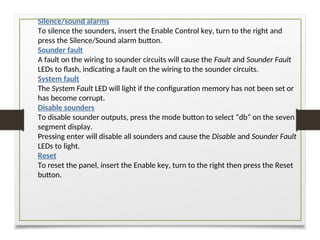
Silence/sound alarms
To silence the sounders, insert the Enable Control key, turn to the right and
press the Silence/Sound alarm button.
Sounder fault
A fault on the wiring to sounder circuits will cause the Fault and Sounder Fault
LEDs to flash, indicating a fault on the wiring to the sounder circuits.
System fault
The System Fault LED will light if the configuration memory has not been set or
has become corrupt.
Disable sounders
To disable sounder outputs, press the mode button to select “db” on the seven
segment display.
Pressing enter will disable all sounders and cause the Disable and Sounder Fault
LEDs to light.
Reset
To reset the panel, insert the Enable key, turn to the right then press the Reset
button.
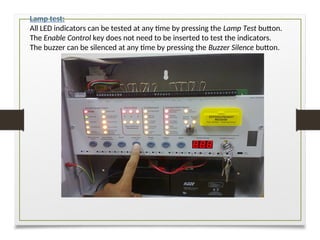
Lamp test:
All LED indicators can be tested at any time by pressing the Lamp Test button.
The Enable Control key does not need to be inserted to test the indicators.
The buzzer can be silenced at any time by pressing the Buzzer Silence button.
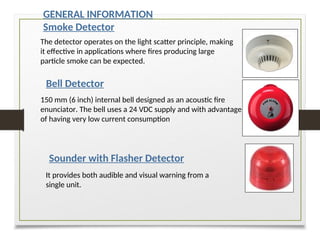
GENERAL INFORMATION
Smoke Detector
Bell Detector
Sounder with Flasher Detector
The detector operates on the light scatter principle, making
it effective in applications where fires producing large
particle smoke can be expected.
150 mm (6 inch) internal bell designed as an acoustic fire
enunciator. The bell uses a 24 VDC supply and with advantage
of having very low current consumption
It provides both audible and visual warning from a
single unit.
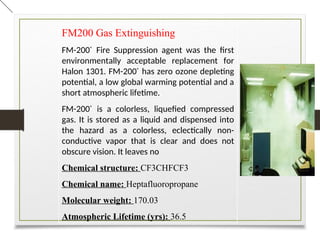
FM200 Gas Extinguishing
FM-200®
Fire Suppression agent was the first
environmentally acceptable replacement for
Halon 1301. FM-200®
has zero ozone depleting
potential, a low global warming potential and a
short atmospheric lifetime.
FM-200®
is a colorless, liquefied compressed
gas. It is stored as a liquid and dispensed into
the hazard as a colorless, eclectically non-
conductive vapor that is clear and does not
obscure vision. It leaves no
Chemical structure: CF3CHFCF3
Chemical name: Heptafluoropropane
Molecular weight: 170.03
Atmospheric Lifetime (yrs): 36.5
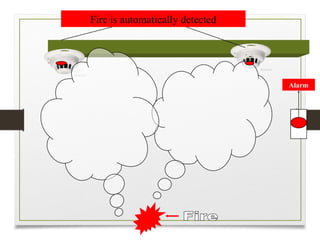
Smokedetectors
Alarm
Fire is automatically detected
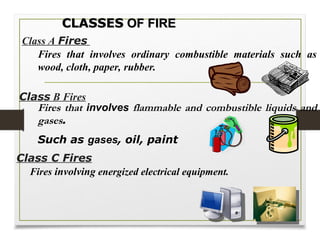
Class A Fires
Fires that involves ordinary combustible materials such as
wood, cloth, paper, rubber.
Class B Fires
Fires that involves flammable and combustible liquids and
gases.
Such as gases, oil, paint
Class C Fires
Fires involving energized electrical equipment.
CLASSES
CLASSES OF FIRE
OF FIRE
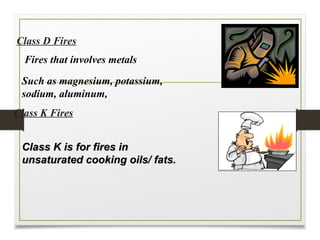
Class D Fires
Fires that involves metals
Class K is for fires in
unsaturated cooking oils/ fats.
Class K Fires
Such as magnesium, potassium,
sodium, aluminum,
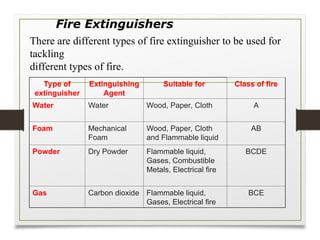
Fire Extinguishers
There are different types of fire extinguisher to be used for
tackling
different types of fire.
Type of
extinguisher
Extinguishing
Agent
Suitable for Class of fire
Water Water Wood, Paper, Cloth A
Foam Mechanical
Foam
Wood, Paper, Cloth
and Flammable liquid
AB
Powder Dry Powder Flammable liquid,
Gases, Combustible
Metals, Electrical fire
BCDE
Gas Carbon dioxide Flammable liquid,
Gases, Electrical fire
BCE
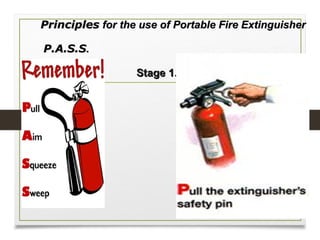
Principles
Principles for the use of Portable Fire Extinguisher
for the use of Portable Fire Extinguisher
P.A.S.S
P.A.S.S.
.
Stage 1.
Stage 1.
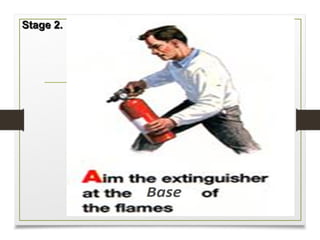
Stage 2.
Stage 2.
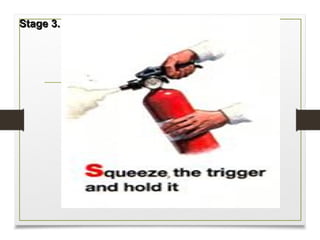
Stage 3.
Stage 3.
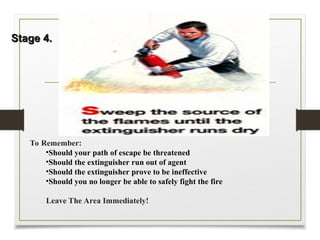
Stage 4.
Stage 4.
To Remember:
•Should your path of escape be threatened
•Should the extinguisher run out of agent
•Should the extinguisher prove to be ineffective
•Should you no longer be able to safely fight the fire
Leave The Area Immediately!
~~~The End~~~~

Fair Alarma system (Supernet)-)FSS System.ppt

  • 1.
    Engineering Department MAB FireProtection PVT Ltd Prepared on July 2013 Project: Installation of Fire Suppression System at SuperNet Head Office (WTC)
  • 2.
    FM 200 FireSuppression System Consist of: a) Smoke Detector (Input Devices) b) Fire Suppression Control Panel (Processing Unit) c) Alarm sounder and bell (Output Devices)
  • 3.
    FM 200 ProtectedAreas 1.NOC Access Room 2.NOC IP Room Detection Areas a. Raise floor (NOC Access) b. Raise floor (NOC IP) c. Power Room (NOC Access) d. Power Room (NOC IP) d. Ups room 10th floor
  • 4.
    Device Description NOC -- ACCESS NOC IP No.of Panels 1 1 No. of S.D 12 20 S.D AT ROOM AREA 6 14 S.D R/F 2 6 BELLS 1 1 SOUNDERS 1 1 REMOTE INDICATOR 2 6 NOZZLES 3 4 POWER ROOM 2 2 UPS ROOM 2 0
  • 5.
    Fire Suppression ControlPanel The Kentec Sigma XT is an Automatic Extinguishant. Any zone or any combination of zones can be configured to release the extinguishant. Features: •Three Detection zones as standard. •Configurable for 1st ,2nd stage sounder delays. •Zero Time Delay on ‘Manual Release. •Configurable for extinguishing delays upto 60 second in 5 second steps. •Countdown timer shows time remaining until release. (K11031M2)
  • 7.
    Normal condition Under normalconditions, control panels will have only the green, Power On LED illuminate and either the Manual Only or Automatic and Manual LED illuminate. The display will be blank as shown. User Guidence
  • 8.
    Single zone Firecondition fire condition: After activation of a detector or call point, the Common Fire indicator will be “ON” and the zonal Fire indicators will flash Any sounders connected to the sounder circuits S1 & S2 will be operated. Fire alarm condition General fire indicator lights and zonal fire indicators flash, buzzer sounds urgently
  • 9.
    Double zone Firecondition The control equipment will respond as above and as listed below: a)The second stage alarm output will operate. b)The 2nd stage will operate. c) The release imminent indicator will operate d)The seven segment LED displays will indicate the remaining Time (in seconds) until release
  • 11.
    General fault Will illuminateunder any fault condition. Power fault Failure of the mains power or disconnection of the standby battery will cause the “Power Fault” condition and Power Fault LEDs will blink in case of any abnormality in the power supply of control panel
  • 12.
    Silence/sound alarms To silencethe sounders, insert the Enable Control key, turn to the right and press the Silence/Sound alarm button. Sounder fault A fault on the wiring to sounder circuits will cause the Fault and Sounder Fault LEDs to flash, indicating a fault on the wiring to the sounder circuits. System fault The System Fault LED will light if the configuration memory has not been set or has become corrupt. Disable sounders To disable sounder outputs, press the mode button to select “db” on the seven segment display. Pressing enter will disable all sounders and cause the Disable and Sounder Fault LEDs to light. Reset To reset the panel, insert the Enable key, turn to the right then press the Reset button.
  • 13.
    Lamp test: All LEDindicators can be tested at any time by pressing the Lamp Test button. The Enable Control key does not need to be inserted to test the indicators. The buzzer can be silenced at any time by pressing the Buzzer Silence button.
  • 14.
    GENERAL INFORMATION Smoke Detector BellDetector Sounder with Flasher Detector The detector operates on the light scatter principle, making it effective in applications where fires producing large particle smoke can be expected. 150 mm (6 inch) internal bell designed as an acoustic fire enunciator. The bell uses a 24 VDC supply and with advantage of having very low current consumption It provides both audible and visual warning from a single unit.
  • 15.
    FM200 Gas Extinguishing FM-200® FireSuppression agent was the first environmentally acceptable replacement for Halon 1301. FM-200® has zero ozone depleting potential, a low global warming potential and a short atmospheric lifetime. FM-200® is a colorless, liquefied compressed gas. It is stored as a liquid and dispensed into the hazard as a colorless, eclectically non- conductive vapor that is clear and does not obscure vision. It leaves no Chemical structure: CF3CHFCF3 Chemical name: Heptafluoropropane Molecular weight: 170.03 Atmospheric Lifetime (yrs): 36.5
  • 17.
  • 20.
    Class A Fires Firesthat involves ordinary combustible materials such as wood, cloth, paper, rubber. Class B Fires Fires that involves flammable and combustible liquids and gases. Such as gases, oil, paint Class C Fires Fires involving energized electrical equipment. CLASSES CLASSES OF FIRE OF FIRE
  • 21.
    Class D Fires Firesthat involves metals Class K is for fires in Class K is for fires in unsaturated cooking oils/ fats. unsaturated cooking oils/ fats. Class K Fires Such as magnesium, potassium, sodium, aluminum,
  • 22.
    Fire Extinguishers There aredifferent types of fire extinguisher to be used for tackling different types of fire. Type of extinguisher Extinguishing Agent Suitable for Class of fire Water Water Wood, Paper, Cloth A Foam Mechanical Foam Wood, Paper, Cloth and Flammable liquid AB Powder Dry Powder Flammable liquid, Gases, Combustible Metals, Electrical fire BCDE Gas Carbon dioxide Flammable liquid, Gases, Electrical fire BCE
  • 23.
    Principles Principles for theuse of Portable Fire Extinguisher for the use of Portable Fire Extinguisher P.A.S.S P.A.S.S. . Stage 1. Stage 1.
  • 24.
  • 25.
  • 26.
    Stage 4. Stage 4. ToRemember: •Should your path of escape be threatened •Should the extinguisher run out of agent •Should the extinguisher prove to be ineffective •Should you no longer be able to safely fight the fire Leave The Area Immediately!
  • 27.