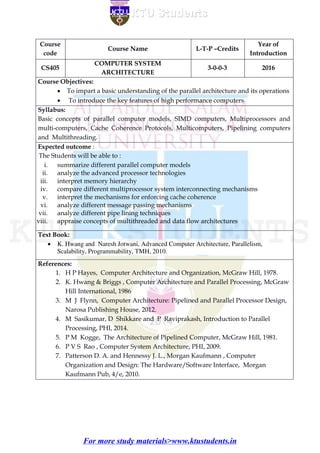
Course
code
Course Name L-T-P –Credits
Year of
Introduction
CS405
COMPUTER SYSTEM
ARCHITECTURE
3-0-0-3 2016
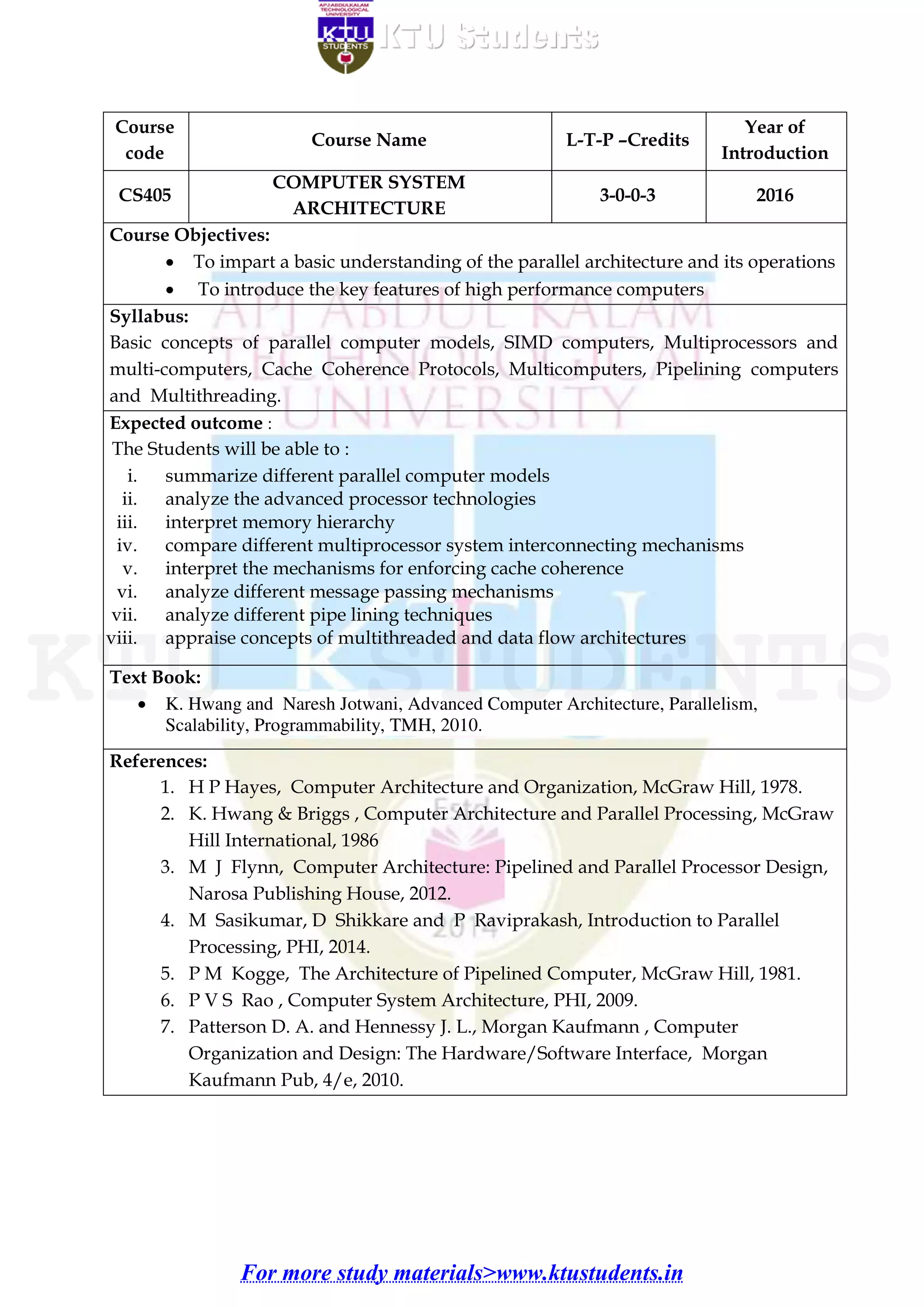
Course Objectives:
 To impart a basic understanding of the parallel architecture and its operations
 To introduce the key features of high performance computers
Syllabus:
Basic concepts of parallel computer models, SIMD computers, Multiprocessors and
multi-computers, Cache Coherence Protocols, Multicomputers, Pipelining computers
and Multithreading.
Expected outcome :
The Students will be able to :
i. summarize different parallel computer models
ii. analyze the advanced processor technologies
iii. interpret memory hierarchy
iv. compare different multiprocessor system interconnecting mechanisms
v. interpret the mechanisms for enforcing cache coherence
vi. analyze different message passing mechanisms
vii. analyze different pipe lining techniques
viii. appraise concepts of multithreaded and data flow architectures
Text Book:
 K. Hwang and Naresh Jotwani, Advanced Computer Architecture, Parallelism,
Scalability, Programmability, TMH, 2010.
References:
1. H P Hayes, Computer Architecture and Organization, McGraw Hill, 1978.
2. K. Hwang & Briggs , Computer Architecture and Parallel Processing, McGraw
Hill International, 1986
3. M J Flynn, Computer Architecture: Pipelined and Parallel Processor Design,
Narosa Publishing House, 2012.
4. M Sasikumar, D Shikkare and P Raviprakash, Introduction to Parallel
Processing, PHI, 2014.
5. P M Kogge, The Architecture of Pipelined Computer, McGraw Hill, 1981.
6. P V S Rao , Computer System Architecture, PHI, 2009.
7. Patterson D. A. and Hennessy J. L., Morgan Kaufmann , Computer
Organization and Design: The Hardware/Software Interface, Morgan
Kaufmann Pub, 4/e, 2010.
For more study materials>www.ktustudents.in
KTU STUDENTS
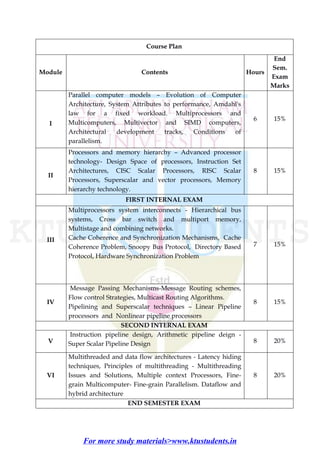
Course Plan
Module Contents Hours
End
Sem.
Exam
Marks
I
Parallel computer models – Evolution of Computer
Architecture, System Attributes to performance, Amdahl's
law for a fixed workload. Multiprocessors and
Multicomputers, Multivector and SIMD computers,
Architectural development tracks, Conditions of
parallelism.
6 15%
II
Processors and memory hierarchy – Advanced processor
technology- Design Space of processors, Instruction Set
Architectures, CISC Scalar Processors, RISC Scalar
Processors, Superscalar and vector processors, Memory
hierarchy technology.
8 15%
FIRST INTERNAL EXAM
III
Multiprocessors system interconnects - Hierarchical bus
systems, Cross bar switch and multiport memory,
Multistage and combining networks.
Cache Coherence and Synchronization Mechanisms, Cache
Coherence Problem, Snoopy Bus Protocol, Directory Based
Protocol, Hardware Synchronization Problem
7 15%
IV
Message Passing Mechanisms-Message Routing schemes,
Flow control Strategies, Multicast Routing Algorithms.
Pipelining and Superscalar techniques – Linear Pipeline
processors and Nonlinear pipeline processors
8 15%
SECOND INTERNAL EXAM
V
Instruction pipeline design, Arithmetic pipeline deign -
Super Scalar Pipeline Design 8 20%
VI
Multithreaded and data flow architectures - Latency hiding
techniques, Principles of multithreading - Multithreading
Issues and Solutions, Multiple context Processors, Fine-
grain Multicomputer- Fine-grain Parallelism. Dataflow and
hybrid architecture
8 20%
END SEMESTER EXAM
For more study materials>www.ktustudents.in
KTU STUDENTS
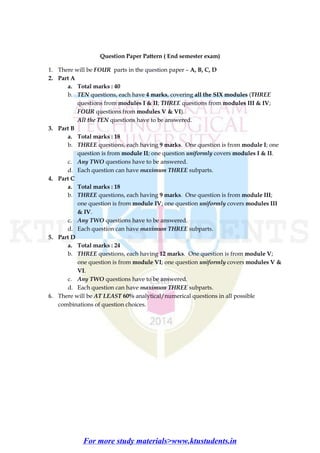
Question Paper Pattern ( End semester exam)
1. There will be FOUR parts in the question paper – A, B, C, D
2. Part A
a. Total marks : 40
b. TEN questions, each have 4 marks, covering all the SIX modules (THREE
questions from modules I & II; THREE questions from modules III & IV;
FOUR questions from modules V & VI).
All the TEN questions have to be answered.
3. Part B
a. Total marks : 18
b. THREE questions, each having 9 marks. One question is from module I; one
question is from module II; one question uniformly covers modules I & II.
c. Any TWO questions have to be answered.
d. Each question can have maximum THREE subparts.
4. Part C
a. Total marks : 18
b. THREE questions, each having 9 marks. One question is from module III;
one question is from module IV; one question uniformly covers modules III
& IV.
c. Any TWO questions have to be answered.
d. Each question can have maximum THREE subparts.
5. Part D
a. Total marks : 24
b. THREE questions, each having 12 marks. One question is from module V;
one question is from module VI; one question uniformly covers modules V &
VI.
c. Any TWO questions have to be answered.
d. Each question can have maximum THREE subparts.
6. There will be AT LEAST 60% analytical/numerical questions in all possible
combinations of question choices.
For more study materials>www.ktustudents.in
KTU STUDENTS

computer system architecture

  • 1.
    Course code Course Name L-T-P–Credits Year of Introduction CS405 COMPUTER SYSTEM ARCHITECTURE 3-0-0-3 2016 Course Objectives:  To impart a basic understanding of the parallel architecture and its operations  To introduce the key features of high performance computers Syllabus: Basic concepts of parallel computer models, SIMD computers, Multiprocessors and multi-computers, Cache Coherence Protocols, Multicomputers, Pipelining computers and Multithreading. Expected outcome : The Students will be able to : i. summarize different parallel computer models ii. analyze the advanced processor technologies iii. interpret memory hierarchy iv. compare different multiprocessor system interconnecting mechanisms v. interpret the mechanisms for enforcing cache coherence vi. analyze different message passing mechanisms vii. analyze different pipe lining techniques viii. appraise concepts of multithreaded and data flow architectures Text Book:  K. Hwang and Naresh Jotwani, Advanced Computer Architecture, Parallelism, Scalability, Programmability, TMH, 2010. References: 1. H P Hayes, Computer Architecture and Organization, McGraw Hill, 1978. 2. K. Hwang & Briggs , Computer Architecture and Parallel Processing, McGraw Hill International, 1986 3. M J Flynn, Computer Architecture: Pipelined and Parallel Processor Design, Narosa Publishing House, 2012. 4. M Sasikumar, D Shikkare and P Raviprakash, Introduction to Parallel Processing, PHI, 2014. 5. P M Kogge, The Architecture of Pipelined Computer, McGraw Hill, 1981. 6. P V S Rao , Computer System Architecture, PHI, 2009. 7. Patterson D. A. and Hennessy J. L., Morgan Kaufmann , Computer Organization and Design: The Hardware/Software Interface, Morgan Kaufmann Pub, 4/e, 2010. For more study materials>www.ktustudents.in KTU STUDENTS
  • 2.
    Course Plan Module ContentsHours End Sem. Exam Marks I Parallel computer models – Evolution of Computer Architecture, System Attributes to performance, Amdahl's law for a fixed workload. Multiprocessors and Multicomputers, Multivector and SIMD computers, Architectural development tracks, Conditions of parallelism. 6 15% II Processors and memory hierarchy – Advanced processor technology- Design Space of processors, Instruction Set Architectures, CISC Scalar Processors, RISC Scalar Processors, Superscalar and vector processors, Memory hierarchy technology. 8 15% FIRST INTERNAL EXAM III Multiprocessors system interconnects - Hierarchical bus systems, Cross bar switch and multiport memory, Multistage and combining networks. Cache Coherence and Synchronization Mechanisms, Cache Coherence Problem, Snoopy Bus Protocol, Directory Based Protocol, Hardware Synchronization Problem 7 15% IV Message Passing Mechanisms-Message Routing schemes, Flow control Strategies, Multicast Routing Algorithms. Pipelining and Superscalar techniques – Linear Pipeline processors and Nonlinear pipeline processors 8 15% SECOND INTERNAL EXAM V Instruction pipeline design, Arithmetic pipeline deign - Super Scalar Pipeline Design 8 20% VI Multithreaded and data flow architectures - Latency hiding techniques, Principles of multithreading - Multithreading Issues and Solutions, Multiple context Processors, Fine- grain Multicomputer- Fine-grain Parallelism. Dataflow and hybrid architecture 8 20% END SEMESTER EXAM For more study materials>www.ktustudents.in KTU STUDENTS
  • 3.
    Question Paper Pattern( End semester exam) 1. There will be FOUR parts in the question paper – A, B, C, D 2. Part A a. Total marks : 40 b. TEN questions, each have 4 marks, covering all the SIX modules (THREE questions from modules I & II; THREE questions from modules III & IV; FOUR questions from modules V & VI). All the TEN questions have to be answered. 3. Part B a. Total marks : 18 b. THREE questions, each having 9 marks. One question is from module I; one question is from module II; one question uniformly covers modules I & II. c. Any TWO questions have to be answered. d. Each question can have maximum THREE subparts. 4. Part C a. Total marks : 18 b. THREE questions, each having 9 marks. One question is from module III; one question is from module IV; one question uniformly covers modules III & IV. c. Any TWO questions have to be answered. d. Each question can have maximum THREE subparts. 5. Part D a. Total marks : 24 b. THREE questions, each having 12 marks. One question is from module V; one question is from module VI; one question uniformly covers modules V & VI. c. Any TWO questions have to be answered. d. Each question can have maximum THREE subparts. 6. There will be AT LEAST 60% analytical/numerical questions in all possible combinations of question choices. For more study materials>www.ktustudents.in KTU STUDENTS