5
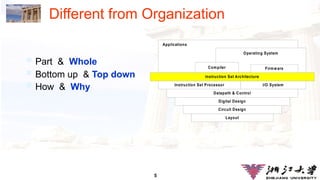
Different from Organization
InstructionSet Architecture
Applications
Operating System
Firmware
Compiler
Instruction Set Processor I/O System
Datapath & Control
Digital Design
Circuit Design
Layout
Bottom up & Top down
How & Why
Part & Whole
6.
6
1.6
2021/9/12
Course Objectives
The objectiveof this course
systemically learn the fundamental concepts and design
approaches of computer architecture using quantitative
approaches from the view of the whole computer system.
Learn the ideas and approaches to improve the performance of
computer system via exploring ILP, DLP, and TLP.
Grasp the hardware design tools and environment, design and
implement the hardware with Verilog language in vivado
environment on FPGA board.
7.
7
1.7
2021/9/12
Textbook
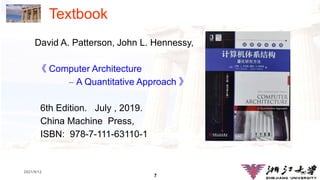
David A. Patterson,John L. Hennessy,
《 Computer Architecture
– A Quantitative Approach 》
6th Edition. July , 2019.
China Machine Press,
ISBN: 978-7-111-63110-1
8.
8
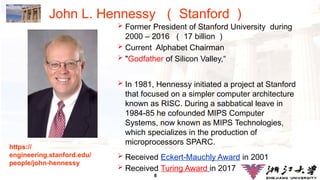
John L. Hennessy( Stanford )
Former President of Stanford University during
2000 – 2016 ( 17 billion )
Current Alphabet Chairman
"Godfather of Silicon Valley,“
In 1981, Hennessy initiated a project at Stanford
that focused on a simpler computer architecture
known as RISC. During a sabbatical leave in
1984-85 he cofounded MIPS Computer
Systems, now known as MIPS Technologies,
which specializes in the production of
microprocessors SPARC.
Received Eckert-Mauchly Award in 2001
Received Turing Award in 2017
https://
engineering.stanford.edu/
people/john-hennessy
9.
9
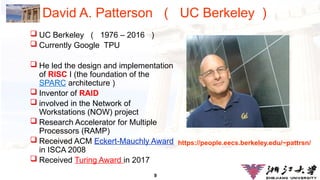
David A. Patterson( UC Berkeley )
UC Berkeley ( 1976 – 2016 )
Currently Google TPU
He led the design and implementation
of RISC I (the foundation of the
SPARC architecture )
Inventor of RAID
involved in the Network of
Workstations (NOW) project
Research Accelerator for Multiple
Processors (RAMP)
Received ACM Eckert-Mauchly Award
in ISCA 2008
Received Turing Award in 2017
https://people.eecs.berkeley.edu/~pattrsn/
10.
10
1.10
2021/9/12
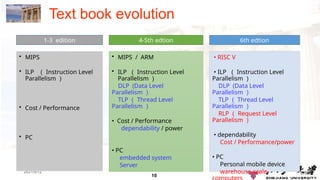
Text book evolution
1-3edition
• MIPS
• ILP ( Instruction Level
Parallelism )
• Cost / Performance
• PC
4-5th edtion
• MIPS / ARM
• ILP ( Instruction Level
Parallelism )
DLP (Data Level
Parallelism )
TLP ( Thread Level
Parallelism )
• Cost / Performance
dependability / power
• PC
embedded system
Server
6th edtion
• RISC V
• ILP ( Instruction Level
Parallelism )
DLP (Data Level
Parallelism )
TLP ( Thread Level
Parallelism )
RLP ( Request Level
Parallelism )
• dependability
Cost / Performance/power
• PC
Personal mobile device
warehouse-scale
11.
11
1.11
2021/9/12
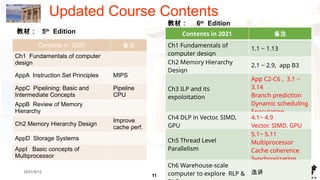
Updated Course Contents
Contentsin 2020 备注
Ch1 Fundamentals of computer
design
AppA Instruction Set Principles MIPS
AppC Pipelining: Basic and
Intermediate Concepts
Pipeline
CPU
AppB Review of Memory
Hierarchy
Ch2 Memory Hierarchy Design
Improve
cache perf.
AppD Storage Systems
AppI Basic concepts of
Multiprocessor
教材: 5th
Edition
教材: 6th
Edition
Contents in 2021 备注
Ch1 Fundamentals of
computer design
1.1 ~ 1.13
Ch2 Memory Hierarchy
Design
2.1 ~ 2.9, app B3
Ch3 ILP and its
expoloitation
App C2-C6 , 3.1 ~
3.14
Branch prediction
Dynamic scheduling
Speculation
Ch4 DLP in Vector, SIMD,
GPU
4.1~ 4.9
Vector. SIMD. GPU
Ch5 Thread Level
Parallelism
5.1~ 5.11
Multiprocessor
Cache coherence
Synchronization
Ch6 Warehouse-scale
computer to explore RLP & 选讲
12.
12
1.12
2021/9/12
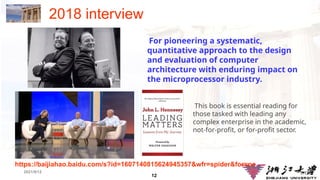
2018 interview
This bookis essential reading for
those tasked with leading any
complex enterprise in the academic,
not-for-profit, or for-profit sector.
For pioneering a systematic,
quantitative approach to the design
and evaluation of computer
architecture with enduring impact on
the microprocessor industry.
https://baijiahao.baidu.com/s?id=1607140815624945357&wfr=spider&for=pc
13.
13
1.13
2021/9/12
How ?
Concepts, Ideasand Principles
Quantitative approaches
Hit the problem and right way to solve problem
As a man sows, so he shall reap.
一分耕耘一分收获
14.
14
1.14
2021/9/12
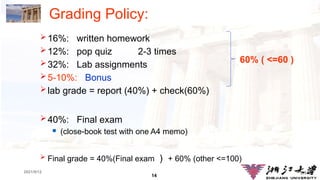
Grading Policy:
16%: writtenhomework
12%: pop quiz 2-3 times
32%: Lab assignments
5-10%: Bonus
lab grade = report (40%) + check(60%)
40%: Final exam
(close-book test with one A4 memo)
Final grade = 40%(Final exam ) + 60% (other <=100)
60% ( <=60 )
15.
15
1.15
2021/9/12
Homeworks (16%)
Total 4-5times, once per chapter
Submission deadline will be normally one week after
assigned, and will be announced on course
website.
For doing homework, discussion is greatly
encouraged, but every student is required to Do and
Submit the homework individually on time.
Submission Naming rule
StID_name_hw1.doc
16.
16
1.16
2021/9/12
Lab assignments
Lab1----Implement pipelinedCPU with forwarding paths and
prediction-not-taken supporting RISC V 32i instructions.
Lab2----Implement Interruption and Exception on CPU of Lab
1).
Lab3----Implement a 2-way associative cache
Lab4----Adding the cache into the pipelined CPU in Lab 2).
Lab5----Expend the pipelined CPU to support multi-cycle
operations: integer multiplier, integer divider / remainder
operation, issue in order and complete out of order, detecting
pipeline hazards ( WAW, RAW)
Lab6----Implement the Dynamic Scheduling (Scoreboard or
Tomasulo), implement a dynamic scheduling pipelined CPU.
17.
17
1.17
2021/9/12
Labs ( 32%)
Dothe lab by group of 2 members and submit lab
report to website.
Grading (report 40% + check 60%)/per lab
Lab1 3 weeks, 6%
Lab2 2 weeks, 4%
Lab3 1 weeks, 3%
Lab4 2 weeks, 4%
Lab5 3 weeks, 7%
Lab6 4 weeks, 8%
18.
18
1.18
2021/9/12
Submission Policy:
Allthe homeworks (individually) and lab reports (in group)
are required to be submitted to the course website on
time.
Submission deadline will be announced on course
website.
All assignments in this course should be turned in
by the specified due date. Late assignment is
NOT accepted.
19.
19
1.19
2021/9/12
Honest Policy
Be HONESTin your work!
Found copy & be copied in the homework or lab report ,
you get ZERO for one submission and also get 10% off
in the final grade !
#6 This course is opended for both the sinor undergraduate students and MD graduate students.
The objective of this course is to introduce the fundamental techniques on which high-performance computing is based, and to develop the foundations for analyzing the benefits of design options in computer architecture.
#8 MIPS (originally an acronym for Microprocessor without Interlocked Pipeline Stages) is a RISC microprocessor architecture developed by MIPS Technologies.
In 1990’s it’s estimated that one of the three RISC chip were based on MIPS.
MIPS CPU architecture greatly influenced later RISC architectures. DEC alpha is one instrance.
#9 RISC: Reduced Instruction Set Computer
emphasizing the insight that simplified instructions which "do less" may still provide for higher performance if this simplicity can be utilized to make instructions execute very quickly.
RISC families include DEC Alpha, ARM, MIPS, PA-RISC, Power Architecture (including PowerPC), SuperH, and SPARC.
SPARC: Scalable Processor Architecture, RISC microa-rchitecture Instruction Set Arcthitecture designed by SUN microsystem in 1985.
RAID: Redundant Array of Independent Disks. Inexpensive.
A Case for Redundant Arrays of Inexpensive Disks, 1988, two key design goals: increased data reliability and increased input/output performance.
NOW: Network of Workstation.
The RAMP Gold project is a new effort to produce fully parameterized manycore emulations using FPGAs to help accelerate hardware and software research
ISCA: International Symposium on Computer Architecture.
#10 Most significant change is
Due to computer technology evolvement, the first three editions focused primarily on Instruction level Parallelism, But the 4th edition have a equal focus on Thread level parallelism. And Data-level parallelim.
Put more emphasis on Dependability and topics of power, because power becomes the dominant factor in determine how much circus can be placed on a chip.
Because the book size of 3rd edition is already large enough. The 4th edition would become unacceptable if the book size are too large. Some contents and materials are moved to companion CD.
#12 This is the picture taken when he received the Eckert-Mauchly Award on ISCA’2008.






![COA_UNIT-1new[1].pdf](https://cdn.slidesharecdn.com/ss_thumbnails/coaunit-1new1-230919072310-a464b1d1-thumbnail.jpg?width=640&height=640&fit=bounds)


