The Computer Science behind a
Modern Distributed Database
Dan Larkin-York
Chicago / February 20, 2018
www.arangodb.com
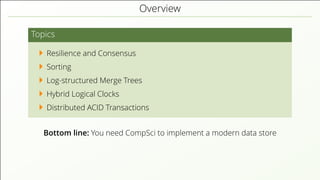
Overview
Topics
Resilience and Consensus
Sorting
Log-structured Merge Trees
Hybrid Logical Clocks
Distributed ACID Transactions
Bottom line: You need CompSci to implement a modern data store
Resilience and Consensus
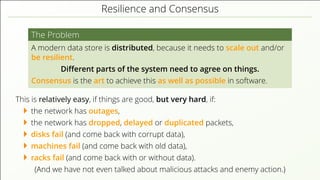
The Problem
A modern data store is distributed,
Resilience and Consensus
The Problem
A modern data store is distributed, because it needs to scale out and/or
be resilient.
Resilience and Consensus
The Problem
A modern data store is distributed, because it needs to scale out and/or
be resilient.
Different parts of the system need to agree on things.
Resilience and Consensus
The Problem
A modern data store is distributed, because it needs to scale out and/or
be resilient.
Different parts of the system need to agree on things.
Consensus is the art to achieve this as well as possible in software.
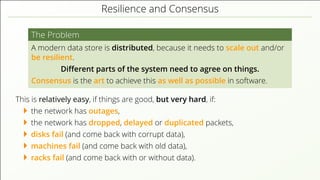
This is relatively easy, if things are good, but very hard, if:
Resilience and Consensus
The Problem
A modern data store is distributed, because it needs to scale out and/or
be resilient.
Different parts of the system need to agree on things.
Consensus is the art to achieve this as well as possible in software.
This is relatively easy, if things are good, but very hard, if:
the network has outages,
the network has dropped, delayed or duplicated packets,
disks fail (and come back with corrupt data),
machines fail (and come back with old data),
racks fail (and come back with or without data).
Resilience and Consensus
The Problem
A modern data store is distributed, because it needs to scale out and/or
be resilient.
Different parts of the system need to agree on things.
Consensus is the art to achieve this as well as possible in software.
This is relatively easy, if things are good, but very hard, if:
the network has outages,
the network has dropped, delayed or duplicated packets,
disks fail (and come back with corrupt data),
machines fail (and come back with old data),
racks fail (and come back with or without data).
(And we have not even talked about malicious attacks and enemy action.)
Paxos and Raft
Traditionally, one uses the Paxos Consensus Protocol (1989 . . . 1998).
More recently, Raft (2013) has been proposed.
Paxos is a challenge to understand and to implement efficiently.
Various variants exist.
Raft is designed to be understandable.
Paxos and Raft
Traditionally, one uses the Paxos Consensus Protocol (1989 . . . 1998).
More recently, Raft (2013) has been proposed.
Paxos is a challenge to understand and to implement efficiently.
Various variants exist.
Raft is designed to be understandable.
My advice:
First try to understand Paxos for some time (do not implement it!), then
enjoy the beauty of Raft,
Paxos and Raft
Traditionally, one uses the Paxos Consensus Protocol (1989 . . . 1998).
More recently, Raft (2013) has been proposed.
Paxos is a challenge to understand and to implement efficiently.
Various variants exist.
Raft is designed to be understandable.
My advice:
First try to understand Paxos for some time (do not implement it!), then
enjoy the beauty of Raft, but do not implement it either!
Paxos and Raft
Traditionally, one uses the Paxos Consensus Protocol (1989 . . . 1998).
More recently, Raft (2013) has been proposed.
Paxos is a challenge to understand and to implement efficiently.
Various variants exist.
Raft is designed to be understandable.
My advice:
First try to understand Paxos for some time (do not implement it!), then
enjoy the beauty of Raft, but do not implement it either!
Use some battle-tested implementation you trust!
Paxos and Raft
Traditionally, one uses the Paxos Consensus Protocol (1989 . . . 1998).
More recently, Raft (2013) has been proposed.
Paxos is a challenge to understand and to implement efficiently.
Various variants exist.
Raft is designed to be understandable.
My advice:
First try to understand Paxos for some time (do not implement it!), then
enjoy the beauty of Raft, but do not implement it either!
Use some battle-tested implementation you trust!
But most importantly: DO NOT TRY TO INVENT YOUR OWN!
Raft in a slide
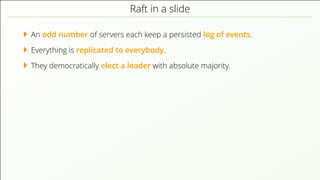
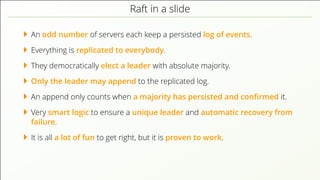
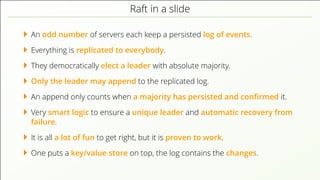
An odd number of servers each keep a persisted log of events.
Raft in a slide
An odd number of servers each keep a persisted log of events.
Everything is replicated to everybody.
Raft in a slide
An odd number of servers each keep a persisted log of events.
Everything is replicated to everybody.
They democratically elect a leader with absolute majority.
Raft in a slide
An odd number of servers each keep a persisted log of events.
Everything is replicated to everybody.
They democratically elect a leader with absolute majority.
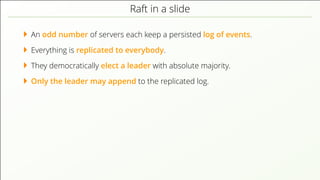
Only the leader may append to the replicated log.
Raft in a slide
An odd number of servers each keep a persisted log of events.
Everything is replicated to everybody.
They democratically elect a leader with absolute majority.
Only the leader may append to the replicated log.
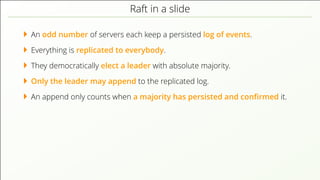
An append only counts when a majority has persisted and confirmed it.
Raft in a slide
An odd number of servers each keep a persisted log of events.
Everything is replicated to everybody.
They democratically elect a leader with absolute majority.
Only the leader may append to the replicated log.
An append only counts when a majority has persisted and confirmed it.
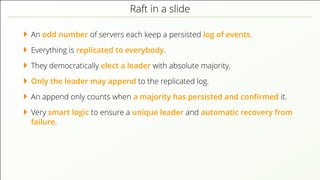
Very smart logic to ensure a unique leader and automatic recovery from
failure.
Raft in a slide
An odd number of servers each keep a persisted log of events.
Everything is replicated to everybody.
They democratically elect a leader with absolute majority.
Only the leader may append to the replicated log.
An append only counts when a majority has persisted and confirmed it.
Very smart logic to ensure a unique leader and automatic recovery from
failure.
It is all a lot of fun to get right, but it is proven to work.
Raft in a slide
An odd number of servers each keep a persisted log of events.
Everything is replicated to everybody.
They democratically elect a leader with absolute majority.
Only the leader may append to the replicated log.
An append only counts when a majority has persisted and confirmed it.
Very smart logic to ensure a unique leader and automatic recovery from
failure.
It is all a lot of fun to get right, but it is proven to work.
One puts a key/value store on top, the log contains the changes.
Raft demo
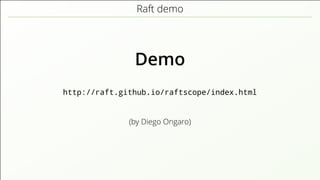
Demo
http://raft.github.io/raftscope/index.html
(by Diego Ongaro)
Sorting
The Problem
Data stores need indexes. In practice, we need to sort things.
Sorting
The Problem
Data stores need indexes. In practice, we need to sort things.
Most published algorithms are rubbish on modern hardware.
Sorting
The Problem
Data stores need indexes. In practice, we need to sort things.
Most published algorithms are rubbish on modern hardware.
The problem is no longer the comparison computations but the data
movement.
Sorting
The Problem
Data stores need indexes. In practice, we need to sort things.
Most published algorithms are rubbish on modern hardware.
The problem is no longer the comparison computations but the data
movement.
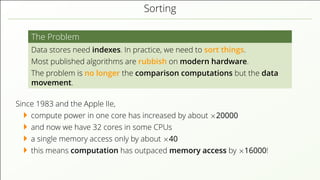
Since 1983 and the Apple IIe,
compute power in one core has increased by about ×20000
and now we have 32 cores in some CPUs
a single memory access only by about ×40
this means computation has outpaced memory access by ×16000!
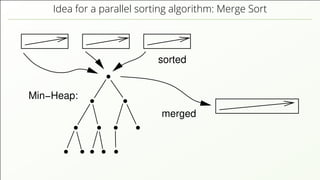
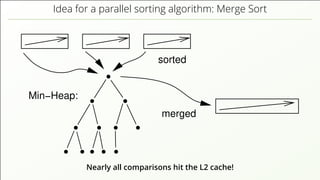
Idea for a parallel sorting algorithm: Merge Sort
Min−Heap:
sorted
merged
Idea for a parallel sorting algorithm: Merge Sort
Min−Heap:
sorted
merged
Nearly all comparisons hit the L2 cache!
Log structured merge trees (LSM-trees)
The Problem
People rightfully expect from a data store, that it
can hold more data than the available RAM,
works well with SSDs and spinning rust,
allows fast bulk inserts into large data sets, and
provides fast reads in a hot set that fits into RAM.
Log structured merge trees (LSM-trees)
The Problem
People rightfully expect from a data store, that it
can hold more data than the available RAM,
works well with SSDs and spinning rust,
allows fast bulk inserts into large data sets, and
provides fast reads in a hot set that fits into RAM.
Traditional B-tree based structures often fail to deliver with the last 2.
Log structured merge trees (LSM-trees)
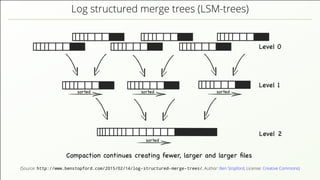
(Source: http://www.benstopford.com/2015/02/14/log-structured-merge-trees/, Author: Ben Stopford, License: Creative Commons)
Log structured merge trees (LSM-trees)
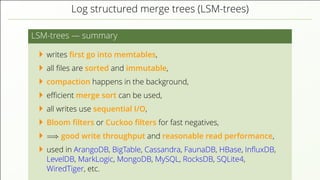
LSM-trees — summary
writes first go into memtables,
all files are sorted and immutable,
compaction happens in the background,
efficient merge sort can be used,
all writes use sequential I/O,
Bloom filters or Cuckoo filters for fast negatives,
=⇒ good write throughput and reasonable read performance,
used in ArangoDB, BigTable, Cassandra, FaunaDB, HBase, InfluxDB,
LevelDB, MarkLogic, MongoDB, MySQL, RocksDB, SQLite4,
WiredTiger, etc.
Hybrid Logical Clocks (HLC)
The Problem
Clocks in different nodes of distributed systems are not in sync.
Hybrid Logical Clocks (HLC)
The Problem
Clocks in different nodes of distributed systems are not in sync.
general relativity poses fundamental obstructions to synchronicity,
in practice, clock skew happens,
Google can use atomic clocks,
even with NTP (network time protocol) we have to live with ≈ 20ms.
Hybrid Logical Clocks (HLC)
The Problem
Clocks in different nodes of distributed systems are not in sync.
general relativity poses fundamental obstructions to synchronicity,
in practice, clock skew happens,
Google can use atomic clocks,
even with NTP (network time protocol) we have to live with ≈ 20ms.
Therefore, we cannot compare time stamps from different nodes!
Hybrid Logical Clocks (HLC)
The Problem
Clocks in different nodes of distributed systems are not in sync.
general relativity poses fundamental obstructions to synchronicity,
in practice, clock skew happens,
Google can use atomic clocks,
even with NTP (network time protocol) we have to live with ≈ 20ms.
Therefore, we cannot compare time stamps from different nodes!
Why would this help?
establish “happened after” relationship between events,
e.g. for conflict resolution, log sorting, detecting network delays,
time to live could be implemented easily.
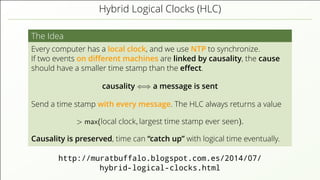
Hybrid Logical Clocks (HLC)
The Idea
Every computer has a local clock, and we use NTP to synchronize.
Hybrid Logical Clocks (HLC)
The Idea
Every computer has a local clock, and we use NTP to synchronize.
If two events on different machines are linked by causality, the cause
should have a smaller time stamp than the effect.
Hybrid Logical Clocks (HLC)
The Idea
Every computer has a local clock, and we use NTP to synchronize.
If two events on different machines are linked by causality, the cause
should have a smaller time stamp than the effect.
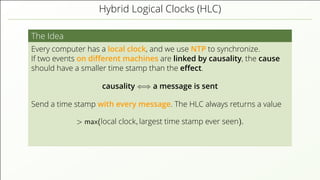
causality ⇐⇒ a message is sent
Send a time stamp with every message. The HLC always returns a value
> max(local clock, largest time stamp ever seen).
Hybrid Logical Clocks (HLC)
The Idea
Every computer has a local clock, and we use NTP to synchronize.
If two events on different machines are linked by causality, the cause
should have a smaller time stamp than the effect.
causality ⇐⇒ a message is sent
Send a time stamp with every message. The HLC always returns a value
> max(local clock, largest time stamp ever seen).
Causality is preserved, time can “catch up” with logical time eventually.
http://muratbuffalo.blogspot.com.es/2014/07/
hybrid-logical-clocks.html
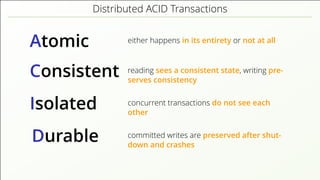
Distributed ACID Transactions
Atomic either happens in its entirety or not at all
Consistent reading sees a consistent state, writing pre-
serves consistency
Isolated concurrent transactions do not see each
other
Durable committed writes are preserved after shut-
down and crashes
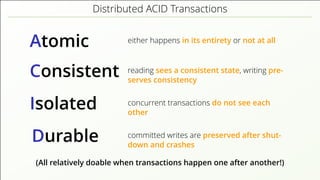
Distributed ACID Transactions
Atomic either happens in its entirety or not at all
Consistent reading sees a consistent state, writing pre-
serves consistency
Isolated concurrent transactions do not see each
other
Durable committed writes are preserved after shut-
down and crashes
(All relatively doable when transactions happen one after another!)
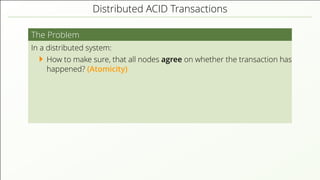
Distributed ACID Transactions
The Problem
In a distributed system:
How to make sure, that all nodes agree on whether the transaction has
happened? (Atomicity)
Distributed ACID Transactions
The Problem
In a distributed system:
How to make sure, that all nodes agree on whether the transaction has
happened? (Atomicity)
How to create a consistent snapshot across nodes? (Consistency)
Distributed ACID Transactions
The Problem
In a distributed system:
How to make sure, that all nodes agree on whether the transaction has
happened? (Atomicity)
How to create a consistent snapshot across nodes? (Consistency)
How to hide ongoing activities until commit? (Isolation)
Distributed ACID Transactions
The Problem
In a distributed system:
How to make sure, that all nodes agree on whether the transaction has
happened? (Atomicity)
How to create a consistent snapshot across nodes? (Consistency)
How to hide ongoing activities until commit? (Isolation)
How to handle lost nodes? (Durability)
Distributed ACID Transactions
The Problem
In a distributed system:
How to make sure, that all nodes agree on whether the transaction has
happened? (Atomicity)
How to create a consistent snapshot across nodes? (Consistency)
How to hide ongoing activities until commit? (Isolation)
How to handle lost nodes? (Durability)
We have to take replication, resilience and failover into account.
Distributed ACID Transactions
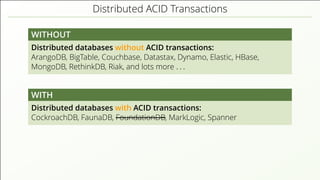
WITHOUT
Distributed databases without ACID transactions:
ArangoDB, BigTable, Couchbase, Datastax, Dynamo, Elastic, HBase,
MongoDB, RethinkDB, Riak, and lots more . . .
WITH
Distributed databases with ACID transactions:
CockroachDB, FaunaDB, FoundationDB, MarkLogic, Spanner
Distributed ACID Transactions
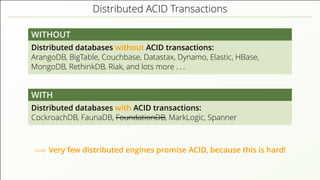
WITHOUT
Distributed databases without ACID transactions:
ArangoDB, BigTable, Couchbase, Datastax, Dynamo, Elastic, HBase,
MongoDB, RethinkDB, Riak, and lots more . . .
WITH
Distributed databases with ACID transactions:
CockroachDB, FaunaDB, FoundationDB, MarkLogic, Spanner
=⇒ Very few distributed engines promise ACID, because this is hard!
Distributed ACID Transactions
Basic Idea
Use Multi Version Concurrency Control (MVCC), i.e. multiple
revisions of a data item are kept.
Distributed ACID Transactions
Basic Idea
Use Multi Version Concurrency Control (MVCC), i.e. multiple
revisions of a data item are kept.
Do writes and replication decentrally and distributed, without them
becoming visible from other transactions.
Distributed ACID Transactions
Basic Idea
Use Multi Version Concurrency Control (MVCC), i.e. multiple
revisions of a data item are kept.
Do writes and replication decentrally and distributed, without them
becoming visible from other transactions.
Then have some place, where there is a switch, which decides when
the transaction becomes visible.
Distributed ACID Transactions
Basic Idea
Use Multi Version Concurrency Control (MVCC), i.e. multiple
revisions of a data item are kept.
Do writes and replication decentrally and distributed, without them
becoming visible from other transactions.
Then have some place, where there is a switch, which decides when
the transaction becomes visible.
These “switches” need to
be persisted somewhere (durability),
scale out (no bottleneck for commit/abort),
be replicated (no single point of failure),
be resilient in case of fail-over (fault-tolerance).
Distributed ACID Transactions
Basic Idea
Use Multi Version Concurrency Control (MVCC), i.e. multiple
revisions of a data item are kept.
Do writes and replication decentrally and distributed, without them
becoming visible from other transactions.
Then have some place, where there is a switch, which decides when
the transaction becomes visible.
These “switches” need to
be persisted somewhere (durability),
scale out (no bottleneck for commit/abort),
be replicated (no single point of failure),
be resilient in case of fail-over (fault-tolerance).
Transaction visibility needs to be implemented (MVCC), so comparing
time stamps play a crucial role.
Thank you!
Further questions?
Follow us on twitter: @arangodb
Join our slack: slack.arangodb.com
Download and documentation: https://arangodb.com
Issues and source (Star us!):
https://github.com/arangodb/arangodb
Info and slides:
https://arangodb.com/speakers/daniel-larkin-york
Links
http://the-paper-trail.org/blog/consensus-protocols-paxos
https://raft.github.io
https://en.wikipedia.org/wiki/Merge_sort
http:
//www.benstopford.com/2015/02/14/log-structured-merge-trees/
http://muratbuffalo.blogspot.com.es/2014/07/
hybrid-logical-clocks.html
https://research.google.com/archive/spanner.html
https:
//www.cockroachlabs.com/docs/cockroachdb-architecture.html
https://www.arangodb.com
http://mesos.apache.org

The Computer Science Behind a modern Distributed Database

  • 1.
    The Computer Sciencebehind a Modern Distributed Database Dan Larkin-York Chicago / February 20, 2018 www.arangodb.com
  • 2.
    Overview Topics Resilience and Consensus Sorting Log-structuredMerge Trees Hybrid Logical Clocks Distributed ACID Transactions Bottom line: You need CompSci to implement a modern data store
  • 3.
    Resilience and Consensus TheProblem A modern data store is distributed,
  • 4.
    Resilience and Consensus TheProblem A modern data store is distributed, because it needs to scale out and/or be resilient.
  • 5.
    Resilience and Consensus TheProblem A modern data store is distributed, because it needs to scale out and/or be resilient. Different parts of the system need to agree on things.
  • 6.
    Resilience and Consensus TheProblem A modern data store is distributed, because it needs to scale out and/or be resilient. Different parts of the system need to agree on things. Consensus is the art to achieve this as well as possible in software. This is relatively easy, if things are good, but very hard, if:
  • 7.
    Resilience and Consensus TheProblem A modern data store is distributed, because it needs to scale out and/or be resilient. Different parts of the system need to agree on things. Consensus is the art to achieve this as well as possible in software. This is relatively easy, if things are good, but very hard, if: the network has outages, the network has dropped, delayed or duplicated packets, disks fail (and come back with corrupt data), machines fail (and come back with old data), racks fail (and come back with or without data).
  • 8.
    Resilience and Consensus TheProblem A modern data store is distributed, because it needs to scale out and/or be resilient. Different parts of the system need to agree on things. Consensus is the art to achieve this as well as possible in software. This is relatively easy, if things are good, but very hard, if: the network has outages, the network has dropped, delayed or duplicated packets, disks fail (and come back with corrupt data), machines fail (and come back with old data), racks fail (and come back with or without data). (And we have not even talked about malicious attacks and enemy action.)
  • 9.
    Paxos and Raft Traditionally,one uses the Paxos Consensus Protocol (1989 . . . 1998). More recently, Raft (2013) has been proposed. Paxos is a challenge to understand and to implement efficiently. Various variants exist. Raft is designed to be understandable.
  • 10.
    Paxos and Raft Traditionally,one uses the Paxos Consensus Protocol (1989 . . . 1998). More recently, Raft (2013) has been proposed. Paxos is a challenge to understand and to implement efficiently. Various variants exist. Raft is designed to be understandable. My advice: First try to understand Paxos for some time (do not implement it!), then enjoy the beauty of Raft,
  • 11.
    Paxos and Raft Traditionally,one uses the Paxos Consensus Protocol (1989 . . . 1998). More recently, Raft (2013) has been proposed. Paxos is a challenge to understand and to implement efficiently. Various variants exist. Raft is designed to be understandable. My advice: First try to understand Paxos for some time (do not implement it!), then enjoy the beauty of Raft, but do not implement it either!
  • 12.
    Paxos and Raft Traditionally,one uses the Paxos Consensus Protocol (1989 . . . 1998). More recently, Raft (2013) has been proposed. Paxos is a challenge to understand and to implement efficiently. Various variants exist. Raft is designed to be understandable. My advice: First try to understand Paxos for some time (do not implement it!), then enjoy the beauty of Raft, but do not implement it either! Use some battle-tested implementation you trust!
  • 13.
    Paxos and Raft Traditionally,one uses the Paxos Consensus Protocol (1989 . . . 1998). More recently, Raft (2013) has been proposed. Paxos is a challenge to understand and to implement efficiently. Various variants exist. Raft is designed to be understandable. My advice: First try to understand Paxos for some time (do not implement it!), then enjoy the beauty of Raft, but do not implement it either! Use some battle-tested implementation you trust! But most importantly: DO NOT TRY TO INVENT YOUR OWN!
  • 14.
    Raft in aslide An odd number of servers each keep a persisted log of events.
  • 15.
    Raft in aslide An odd number of servers each keep a persisted log of events. Everything is replicated to everybody.
  • 16.
    Raft in aslide An odd number of servers each keep a persisted log of events. Everything is replicated to everybody. They democratically elect a leader with absolute majority.
  • 17.
    Raft in aslide An odd number of servers each keep a persisted log of events. Everything is replicated to everybody. They democratically elect a leader with absolute majority. Only the leader may append to the replicated log.
  • 18.
    Raft in aslide An odd number of servers each keep a persisted log of events. Everything is replicated to everybody. They democratically elect a leader with absolute majority. Only the leader may append to the replicated log. An append only counts when a majority has persisted and confirmed it.
  • 19.
    Raft in aslide An odd number of servers each keep a persisted log of events. Everything is replicated to everybody. They democratically elect a leader with absolute majority. Only the leader may append to the replicated log. An append only counts when a majority has persisted and confirmed it. Very smart logic to ensure a unique leader and automatic recovery from failure.
  • 20.
    Raft in aslide An odd number of servers each keep a persisted log of events. Everything is replicated to everybody. They democratically elect a leader with absolute majority. Only the leader may append to the replicated log. An append only counts when a majority has persisted and confirmed it. Very smart logic to ensure a unique leader and automatic recovery from failure. It is all a lot of fun to get right, but it is proven to work.
  • 21.
    Raft in aslide An odd number of servers each keep a persisted log of events. Everything is replicated to everybody. They democratically elect a leader with absolute majority. Only the leader may append to the replicated log. An append only counts when a majority has persisted and confirmed it. Very smart logic to ensure a unique leader and automatic recovery from failure. It is all a lot of fun to get right, but it is proven to work. One puts a key/value store on top, the log contains the changes.
  • 22.
  • 23.
    Sorting The Problem Data storesneed indexes. In practice, we need to sort things.
  • 24.
    Sorting The Problem Data storesneed indexes. In practice, we need to sort things. Most published algorithms are rubbish on modern hardware.
  • 25.
    Sorting The Problem Data storesneed indexes. In practice, we need to sort things. Most published algorithms are rubbish on modern hardware. The problem is no longer the comparison computations but the data movement.
  • 26.
    Sorting The Problem Data storesneed indexes. In practice, we need to sort things. Most published algorithms are rubbish on modern hardware. The problem is no longer the comparison computations but the data movement. Since 1983 and the Apple IIe, compute power in one core has increased by about ×20000 and now we have 32 cores in some CPUs a single memory access only by about ×40 this means computation has outpaced memory access by ×16000!
  • 27.
    Idea for aparallel sorting algorithm: Merge Sort Min−Heap: sorted merged
  • 28.
    Idea for aparallel sorting algorithm: Merge Sort Min−Heap: sorted merged Nearly all comparisons hit the L2 cache!
  • 29.
    Log structured mergetrees (LSM-trees) The Problem People rightfully expect from a data store, that it can hold more data than the available RAM, works well with SSDs and spinning rust, allows fast bulk inserts into large data sets, and provides fast reads in a hot set that fits into RAM.
  • 30.
    Log structured mergetrees (LSM-trees) The Problem People rightfully expect from a data store, that it can hold more data than the available RAM, works well with SSDs and spinning rust, allows fast bulk inserts into large data sets, and provides fast reads in a hot set that fits into RAM. Traditional B-tree based structures often fail to deliver with the last 2.
  • 31.
    Log structured mergetrees (LSM-trees) (Source: http://www.benstopford.com/2015/02/14/log-structured-merge-trees/, Author: Ben Stopford, License: Creative Commons)
  • 32.
    Log structured mergetrees (LSM-trees) LSM-trees — summary writes first go into memtables, all files are sorted and immutable, compaction happens in the background, efficient merge sort can be used, all writes use sequential I/O, Bloom filters or Cuckoo filters for fast negatives, =⇒ good write throughput and reasonable read performance, used in ArangoDB, BigTable, Cassandra, FaunaDB, HBase, InfluxDB, LevelDB, MarkLogic, MongoDB, MySQL, RocksDB, SQLite4, WiredTiger, etc.
  • 33.
    Hybrid Logical Clocks(HLC) The Problem Clocks in different nodes of distributed systems are not in sync.
  • 34.
    Hybrid Logical Clocks(HLC) The Problem Clocks in different nodes of distributed systems are not in sync. general relativity poses fundamental obstructions to synchronicity, in practice, clock skew happens, Google can use atomic clocks, even with NTP (network time protocol) we have to live with ≈ 20ms.
  • 35.
    Hybrid Logical Clocks(HLC) The Problem Clocks in different nodes of distributed systems are not in sync. general relativity poses fundamental obstructions to synchronicity, in practice, clock skew happens, Google can use atomic clocks, even with NTP (network time protocol) we have to live with ≈ 20ms. Therefore, we cannot compare time stamps from different nodes!
  • 36.
    Hybrid Logical Clocks(HLC) The Problem Clocks in different nodes of distributed systems are not in sync. general relativity poses fundamental obstructions to synchronicity, in practice, clock skew happens, Google can use atomic clocks, even with NTP (network time protocol) we have to live with ≈ 20ms. Therefore, we cannot compare time stamps from different nodes! Why would this help? establish “happened after” relationship between events, e.g. for conflict resolution, log sorting, detecting network delays, time to live could be implemented easily.
  • 37.
    Hybrid Logical Clocks(HLC) The Idea Every computer has a local clock, and we use NTP to synchronize.
  • 38.
    Hybrid Logical Clocks(HLC) The Idea Every computer has a local clock, and we use NTP to synchronize. If two events on different machines are linked by causality, the cause should have a smaller time stamp than the effect.
  • 39.
    Hybrid Logical Clocks(HLC) The Idea Every computer has a local clock, and we use NTP to synchronize. If two events on different machines are linked by causality, the cause should have a smaller time stamp than the effect. causality ⇐⇒ a message is sent Send a time stamp with every message. The HLC always returns a value > max(local clock, largest time stamp ever seen).
  • 40.
    Hybrid Logical Clocks(HLC) The Idea Every computer has a local clock, and we use NTP to synchronize. If two events on different machines are linked by causality, the cause should have a smaller time stamp than the effect. causality ⇐⇒ a message is sent Send a time stamp with every message. The HLC always returns a value > max(local clock, largest time stamp ever seen). Causality is preserved, time can “catch up” with logical time eventually. http://muratbuffalo.blogspot.com.es/2014/07/ hybrid-logical-clocks.html
  • 41.
    Distributed ACID Transactions Atomiceither happens in its entirety or not at all Consistent reading sees a consistent state, writing pre- serves consistency Isolated concurrent transactions do not see each other Durable committed writes are preserved after shut- down and crashes
  • 42.
    Distributed ACID Transactions Atomiceither happens in its entirety or not at all Consistent reading sees a consistent state, writing pre- serves consistency Isolated concurrent transactions do not see each other Durable committed writes are preserved after shut- down and crashes (All relatively doable when transactions happen one after another!)
  • 43.
    Distributed ACID Transactions TheProblem In a distributed system: How to make sure, that all nodes agree on whether the transaction has happened? (Atomicity)
  • 44.
    Distributed ACID Transactions TheProblem In a distributed system: How to make sure, that all nodes agree on whether the transaction has happened? (Atomicity) How to create a consistent snapshot across nodes? (Consistency)
  • 45.
    Distributed ACID Transactions TheProblem In a distributed system: How to make sure, that all nodes agree on whether the transaction has happened? (Atomicity) How to create a consistent snapshot across nodes? (Consistency) How to hide ongoing activities until commit? (Isolation)
  • 46.
    Distributed ACID Transactions TheProblem In a distributed system: How to make sure, that all nodes agree on whether the transaction has happened? (Atomicity) How to create a consistent snapshot across nodes? (Consistency) How to hide ongoing activities until commit? (Isolation) How to handle lost nodes? (Durability)
  • 47.
    Distributed ACID Transactions TheProblem In a distributed system: How to make sure, that all nodes agree on whether the transaction has happened? (Atomicity) How to create a consistent snapshot across nodes? (Consistency) How to hide ongoing activities until commit? (Isolation) How to handle lost nodes? (Durability) We have to take replication, resilience and failover into account.
  • 48.
    Distributed ACID Transactions WITHOUT Distributeddatabases without ACID transactions: ArangoDB, BigTable, Couchbase, Datastax, Dynamo, Elastic, HBase, MongoDB, RethinkDB, Riak, and lots more . . . WITH Distributed databases with ACID transactions: CockroachDB, FaunaDB, FoundationDB, MarkLogic, Spanner
  • 49.
    Distributed ACID Transactions WITHOUT Distributeddatabases without ACID transactions: ArangoDB, BigTable, Couchbase, Datastax, Dynamo, Elastic, HBase, MongoDB, RethinkDB, Riak, and lots more . . . WITH Distributed databases with ACID transactions: CockroachDB, FaunaDB, FoundationDB, MarkLogic, Spanner =⇒ Very few distributed engines promise ACID, because this is hard!
  • 50.
    Distributed ACID Transactions BasicIdea Use Multi Version Concurrency Control (MVCC), i.e. multiple revisions of a data item are kept.
  • 51.
    Distributed ACID Transactions BasicIdea Use Multi Version Concurrency Control (MVCC), i.e. multiple revisions of a data item are kept. Do writes and replication decentrally and distributed, without them becoming visible from other transactions.
  • 52.
    Distributed ACID Transactions BasicIdea Use Multi Version Concurrency Control (MVCC), i.e. multiple revisions of a data item are kept. Do writes and replication decentrally and distributed, without them becoming visible from other transactions. Then have some place, where there is a switch, which decides when the transaction becomes visible.
  • 53.
    Distributed ACID Transactions BasicIdea Use Multi Version Concurrency Control (MVCC), i.e. multiple revisions of a data item are kept. Do writes and replication decentrally and distributed, without them becoming visible from other transactions. Then have some place, where there is a switch, which decides when the transaction becomes visible. These “switches” need to be persisted somewhere (durability), scale out (no bottleneck for commit/abort), be replicated (no single point of failure), be resilient in case of fail-over (fault-tolerance).
  • 54.
    Distributed ACID Transactions BasicIdea Use Multi Version Concurrency Control (MVCC), i.e. multiple revisions of a data item are kept. Do writes and replication decentrally and distributed, without them becoming visible from other transactions. Then have some place, where there is a switch, which decides when the transaction becomes visible. These “switches” need to be persisted somewhere (durability), scale out (no bottleneck for commit/abort), be replicated (no single point of failure), be resilient in case of fail-over (fault-tolerance). Transaction visibility needs to be implemented (MVCC), so comparing time stamps play a crucial role.
  • 55.
    Thank you! Further questions? Followus on twitter: @arangodb Join our slack: slack.arangodb.com Download and documentation: https://arangodb.com Issues and source (Star us!): https://github.com/arangodb/arangodb Info and slides: https://arangodb.com/speakers/daniel-larkin-york
  • 56.