Understanding
Storage I/O Under
Load
Avi Kivity, CTO
Pavel Emelyanov, Principal Engineer
Presenter
2
Avi Kivity
● Original maintainer of Linux KVM - Kernel-based
Virtual Machine
● Co-maintainer of Seastar, ScyllaDB
● Co-founder of ScyllaDB
Presenter
3
Pavel Emelyanov
● Ex Linux kernel hacker
● Founder of the CRIU project
● Co-maintainer of Seastar & ScyllaDB
4
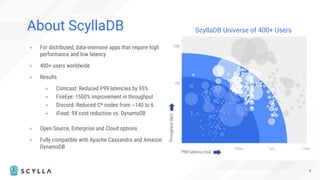
+ For distributed, data-intensive apps that require high
performance and low latency
+ 400+ users worldwide
+ Results
+ Comcast: Reduced P99 latencies by 95%
+ FireEye: 1500% improvement in throughput
+ Discord: Reduced C* nodes from ~140 to 6
+ iFood: 9X cost reduction vs. DynamoDB
+ Open Source, Enterprise and Cloud options
+ Fully compatible with Apache Cassandra and Amazon
DynamoDB
About ScyllaDB
1ms <1ms
10ms
1M
10M
ScyllaDB Universe of 400+ Users
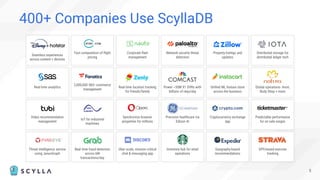
400+ Companies Use ScyllaDB
Seamless experiences
across content + devices
Fast computation of flight
pricing
Corporate fleet
management
Real-time analytics
2,000,000 SKU -commerce
management
Real-time location tracking
for friends/family
Video recommendation
management
IoT for industrial
machines
Synchronize browser
properties for millions
Threat intelligence service
using JanusGraph
Real time fraud detection
across 6M
transactions/day
Uber scale, mission critical
chat & messaging app
5
Network security threat
detection
Power ~50M X1 DVRs with
billions of reqs/day
Precision healthcare via
Edison AI
Inventory hub for retail
operations
Property listings and
updates
Unified ML feature store
across the business
Cryptocurrency exchange
app
Geography-based
recommendations
Distributed storage for
distributed ledger tech
Global operations- Avon,
Body Shop + more
Predictable performance
for on sale surges
GPS-based exercise
tracking
Part I
Mixed Workloads
6
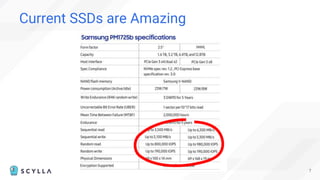
Current SSDs are Amazing
7
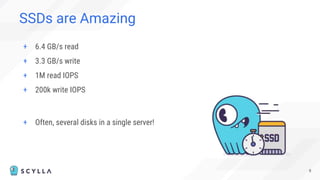
SSDs are Amazing
+ 6.4 GB/s read
+ 3.3 GB/s write
+ 1M read IOPS
+ 200k write IOPS
+ Often, several disks in a single server!
8
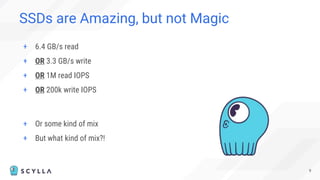
SSDs are Amazing, but not Magic
+ 6.4 GB/s read
+ OR 3.3 GB/s write
+ OR 1M read IOPS
+ OR 200k write IOPS
+ Or some kind of mix
+ But what kind of mix?!
9
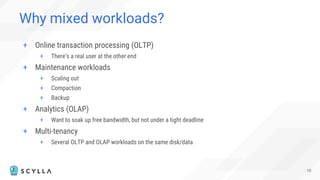
+ Online transaction processing (OLTP)
+ There’s a real user at the other end
+ Maintenance workloads
+ Scaling out
+ Compaction
+ Backup
+ Analytics (OLAP)
+ Want to soak up free bandwidth, but not under a tight deadline
+ Multi-tenancy
+ Several OLTP and OLAP workloads on the same disk/data
Why mixed workloads?
10
Prevent one workload from dominating
and hurting another workload
The Challenge
11
Part II
Understanding Disks
12
Introducing Diskplorer
+ Tool to test disks at a variety of mixed workloads
+ Open source: https://github.com/scylladb/diskplorer
+ Python, fio, matplotlib
+ Fancy graphs
+ Hours of fun!
13
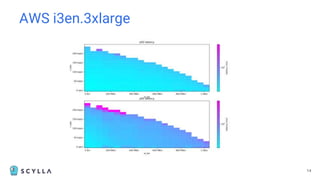
AWS i3en.3xlarge
14
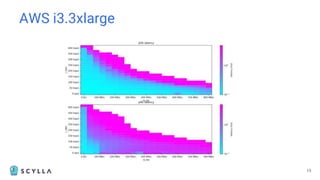
AWS i3.3xlarge
15
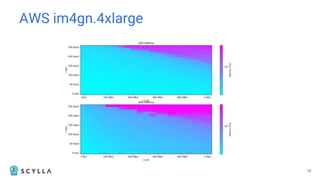
AWS im4gn.4xlarge
16
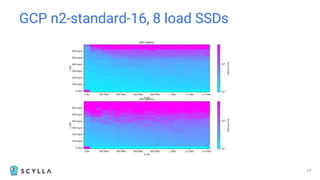
GCP n2-standard-16, 8 load SSDs
17
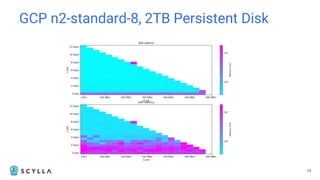
GCP n2-standard-8, 2TB Persistent Disk
18
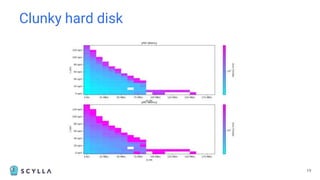
Clunky hard disk
19
Part III
Working with Disks
20
21
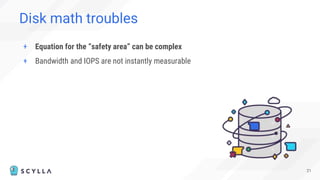
+ Equation for the “safety area” can be complex
+ Bandwidth and IOPS are not instantly measurable
Disk math troubles
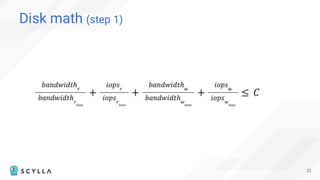
Disk math (step 1)
22
23
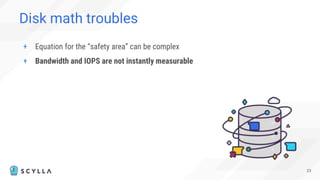
+ Equation for the “safety area” can be complex
+ Bandwidth and IOPS are not instantly measurable
Disk math troubles
Token bucket algo (and its math)
24
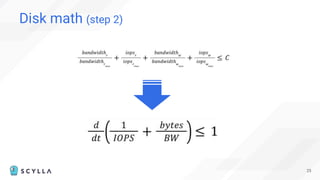
Disk math (step 2)
25
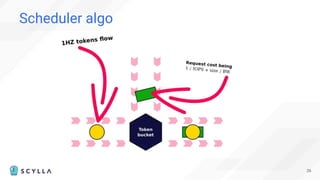
Scheduler algo
26
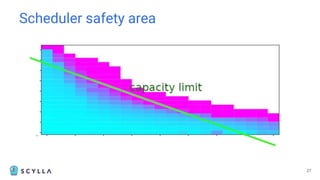
Scheduler safety area
27
28
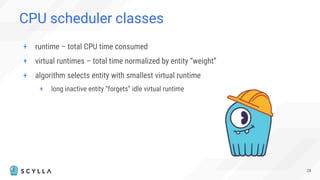
+ runtime – total CPU time consumed
+ virtual runtimes – total time normalized by entity “weight”
+ algorithm selects entity with smallest virtual runtime
+ long inactive entity “forgets” idle virtual runtime
CPU scheduler classes
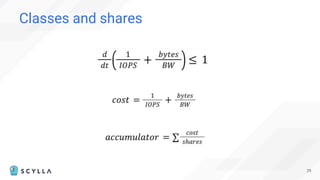
Classes and shares
29
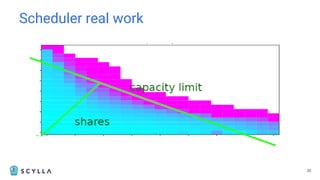
Scheduler real work
30
United States
2445 Faber St, Suite #200
Palo Alto, CA USA 94303
Israel
Maskit 4
Herzliya, Israel 4673304
www.scylladb.com
@scylladb
Thank You!
avi@scylladb.com
@avikivity