Computer Science
Library Skills Training
October 2016
Pepler Head
pv.head@uct.ac.za
In this session we will be looking at:
• Effective searching
• Searching using Google Scholar, ACM Digital Library &
IEEE Xplore
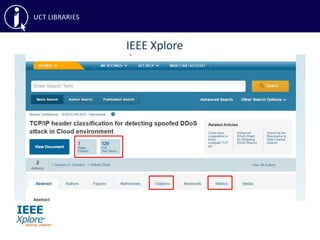
• Article/publication metrics
• Reference Managers, RefWorks & EndNote
• Access articles that UCT Libraries does not subscribe to
Effective Searching:
How?
Using Boolean operators
Identifying key words
Conducting phrase searching and using quotation marks
Why?
Helps find relevant/accurate results
Saves time
Goes beyond finding anything and everything
Effective Searching:
Topic:
Perceptions of Cloud Computing in South African Government
Identify Keyword:
Cloud Computing
South Africa
Government
Search phrase:
“Cloud Computing” AND “South Africa” AND Government
Effective Searching:
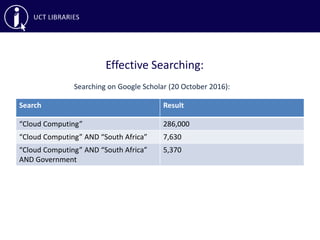
Searching on Google Scholar (20 October 2016):
Search Result
“Cloud Computing” 286,000
“Cloud Computing” AND “South Africa” 7,630
“Cloud Computing” AND “South Africa”
AND Government
5,370
Effective Searching:
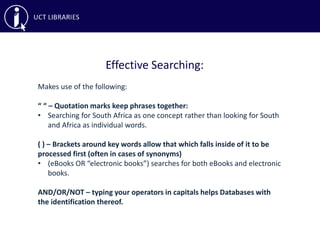
Makes use of the following:
“ “ – Quotation marks keep phrases together:
• Searching for South Africa as one concept rather than looking for South
and Africa as individual words.
( ) – Brackets around key words allow that which falls inside of it to be
processed first (often in cases of synonyms)
• (eBooks OR “electronic books”) searches for both eBooks and electronic
books.
AND/OR/NOT – typing your operators in capitals helps Databases with
the identification thereof.
Effective Searching:
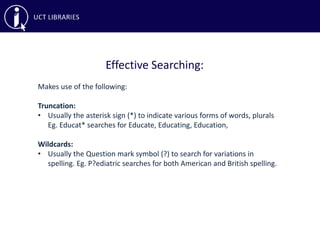
Makes use of the following:
Truncation:
• Usually the asterisk sign (*) to indicate various forms of words, plurals
Eg. Educat* searches for Educate, Educating, Education,
Wildcards:
• Usually the Question mark symbol (?) to search for variations in
spelling. Eg. P?ediatric searches for both American and British spelling.
Effective Searching:
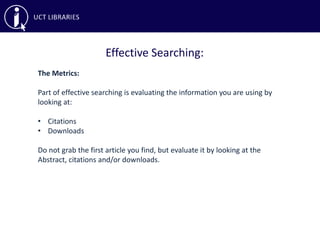
The Metrics:
Part of effective searching is evaluating the information you are using by
looking at:
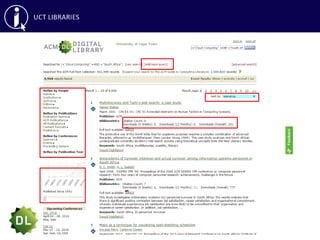
• Citations
• Downloads
Do not grab the first article you find, but evaluate it by looking at the
Abstract, citations and/or downloads.
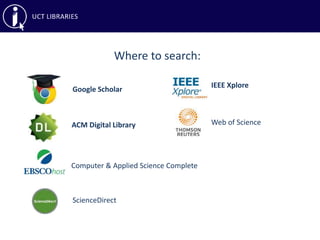
Where to search:
Google Scholar
ACM Digital Library
Computer & Applied Science Complete
ScienceDirect
IEEE Xplore
Web of Science
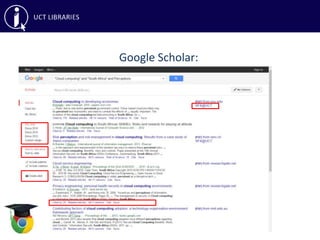
Google Scholar:
• Search all scholarly literature from one convenient place
• Explore related works, citations, authors, and publications
• Locate the complete document through your library or on
the web
• Keep up with recent developments in any area of research
• Check article citations
Google Scholar:
• If the search results are too specific for your needs, check out
what they're citing in their "References" sections. Referenced
works are often more general in nature.
• Similarly, if the search results are too basic for you, click "Cited
by" to see newer papers that referenced them. These newer
papers will often be more specific.
• Explore! There's rarely a single answer to a research question.
Click "Related articles" or "Cited by" to see closely related work,
or search for author's name and see what else they have written.
Google Scholar:
Google Scholar does not search in exactly the same way as the
“academic” databases.
Truncation:
• Google Scholar does not recognize truncation symbols,
instead it uses automatic stemming. It looks for the word
you type in plus additional letters (“South Africa”, “South
African”)
Exact Word searching:
• By Default Google Scholar will search for synonyms of your
search word. To avoid this, it is best to use quotation marks
“ “
Google Scholar:
Boolean Operators:
• Google Scholar automatically inserts the AND operator
between words, unless you insert the OR operator.
• When using the operators, always capitalize it so it can be
identified as a command and not as part of the search
phrase
• Insert a dash (-) in front of a word to exclude results that
include that word
Google Scholar:
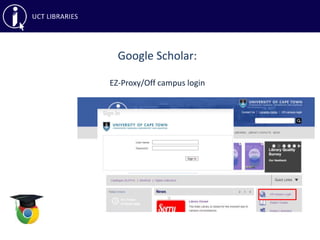
EZ-Proxy/Off campus login
Google Scholar:
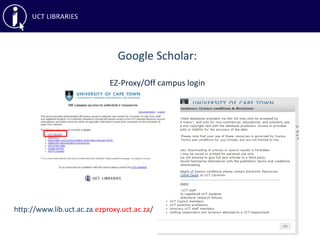
EZ-Proxy/Off campus login
http://www.lib.uct.ac.za.ezproxy.uct.ac.za/
Google Scholar:
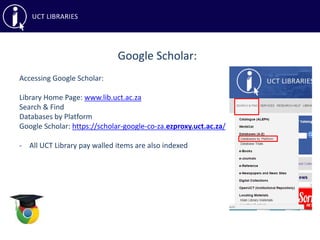
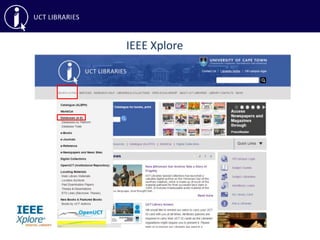
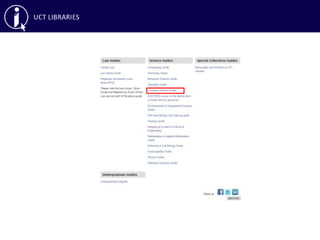
Accessing Google Scholar:
Library Home Page: www.lib.uct.ac.za
Search & Find
Databases by Platform
Google Scholar: https://scholar-google-co-za.ezproxy.uct.ac.za/
- All UCT Library pay walled items are also indexed
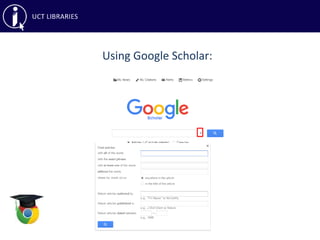
Using Google Scholar:
Google Scholar:
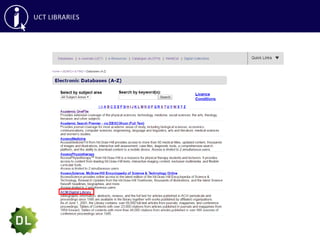
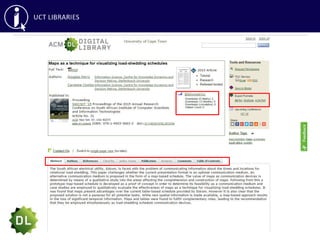
ACM Digital Library
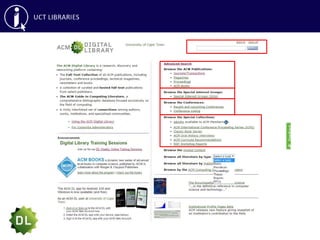
The ACM Digital Library (DL) is the most comprehensive collection of full-text
articles and bibliographic records in existence today covering the fields of
computing and information technology containing
• 407,367 Full-text articles
• 2.0+ Million Pages of full-text articles
• 18,000+ New full-text articles added each year
• 44+ High Impact Journals with 2-3 new journals being launched each year
• 275+ Conference Proceedings Titles added each year
• 2,000+ Proceedings Volumes
• 8 Magazines (including the flagship Communications of the ACM, the most
heavily cited publication in the field of computing according to Thomson-
Reuters)
• 37 Technical Newsletters from ACM's Special Interest Groups (SIGs)
• 6,500+ Video files
• 594 Audio files
Using ACM Digital Library
Basic Searching
• Type key word in lower case
• You can enter a question or concept in plain language (ACM
accommodates both plain language searching & key word searching)
• Capitalize proper nouns
• Use quotation marks (“”) for exact phrase searching
• Use + or – to include or exclude terms
Topic Searches
• If your key word matches an existing topic, you will find that your results
list includes documents that contain more than just the word itself,
because ACM automatically expands the search to include all the words
defined as part of the topic.
• If you don’t want the term expanded as a topic, use quotation marks for
exact phrase searching
Using ACM Digital Library
Searching with Wildcards:
• Wildcards function as truncation in ACM Digital Library
• Works with the asterisk symbol (*)
• Col*r returns results for color and colour and all words beginning with
col ending with r
Zone Searches:
• These are specific regions of documents that can be searched
• Available in Markup Language
• To search a document zone, type the name of the zone, a colon (:), and
the search terms.
• Searching h1:cloud computing returns results with the word cloud
computing in the <h1> tag of an HTML document.
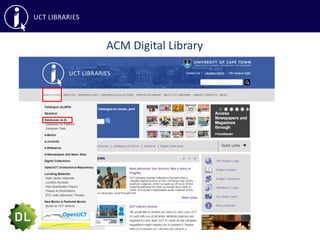
ACM Digital Library
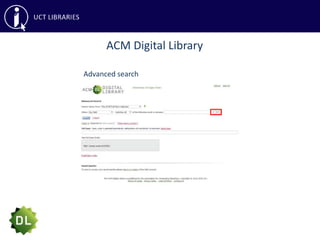
ACM Digital Library
Advanced search
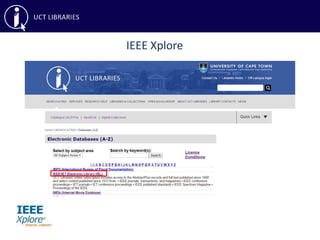
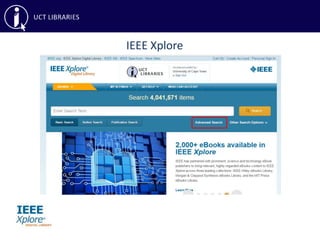
IEEE Xplore
The IEEE Xplore digital library is a powerful resource for discovery and
access to scientific and technical content published by the IEEE
(Institute of Electrical and Electronics Engineers) and its publishing
partners.
IEEE Xplore provides web access to more than 3.5-million full-text
documents from some of the world's most highly cited publications in
electrical engineering, computer science and electronics.
The content in IEEE Xplore comprises over 160 journals, over 1,200
conference proceedings, more than 2,500 technical standards, over
1,000 eBooks, and over 300 courses. Approximately 25,000 new
documents are added to IEEE Xplore each month.
IEEE Xplore
Searching:
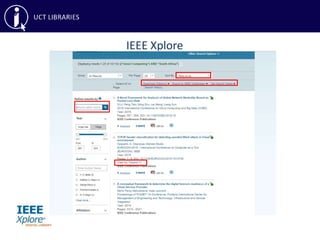
• Use key word for searching the database
• IEEE does automatic stemming, searching for plurals and other
forms of the key word.
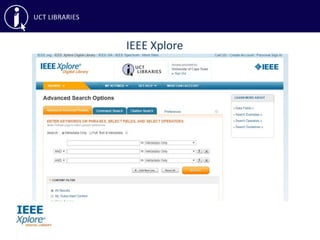
• Nesting the keyword ensures that the search is performed as you
intend (Advanced search can assist with this)
• Quotation marks (“ “) is used for exact searching.
• Use wildcards, asterisk symbol (*) for words with different spelling.
Example searching computer will return computers, but searching
computer* will return computers and computerize.
IEEE Xplore
IEEE Xplore
IEEE Xplore
IEEE Xplore
IEEE Xplore
IEEE Xplore
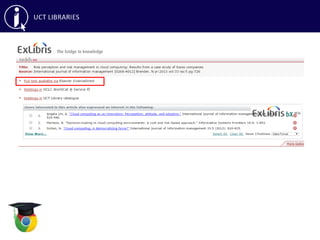
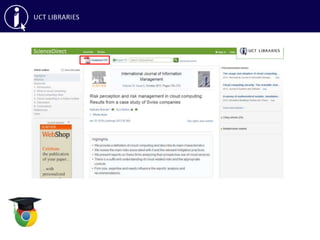
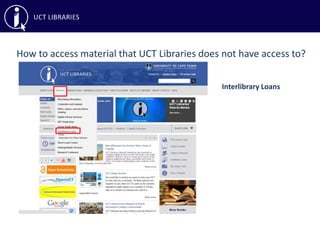
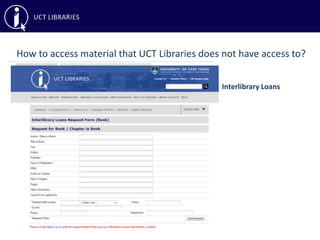
How to access material that UCT Libraries does not have access to?
Interlibrary Loans
How to access material that UCT Libraries does not have access to?
Interlibrary Loans
How to access material that UCT Libraries does not have access to?
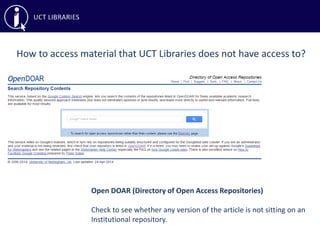
Open DOAR (Directory of Open Access Repositories)
Check to see whether any version of the article is not sitting on an
Institutional repository.
Citation Managers:
• RefWorks and EndNote are reference management tools that enables you
to store and organise your references in your own personal database.
• Both have a write-n-cite plugin for Word that allows you to insert your in
text references and reference list directly in Word
• Build up your OWN PERSONAL DATABASE of references
• FREE for Students and Alumni at UCT
• Store references SAFELY on the RefWorks server
• ORGANISE your references in folders
• IMPORT REFERENCES from databases and the Web
• SEARCH your references with the RefWorks search engine
• SAVE the abstracts of articles
• Link to FULL TEXT
• CREATE BIBLIOGRAPHIES automatically
RefWorks:
RefWorks:
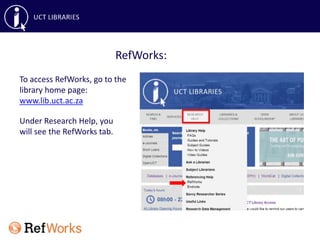
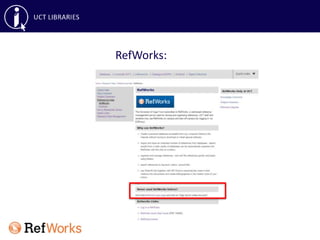
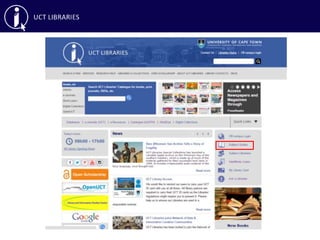
To access RefWorks, go to the
library home page:
www.lib.uct.ac.za
Under Research Help, you
will see the RefWorks tab.
RefWorks:
RefWorks:
EndNote:
• Mainly desktop based
• Update and maintain references across EndNote and sync with
other devices
• Set preferences to create clear, organized, and easily searchable
names for your PDF documents as you import them.
• Read, highlight and comment on PDF’s within EndNote’s PDF
viewer.
• Organise your research materials better by using new reference
types such as Interview, Podcast, Conference Paper, and Press
Release
• Create your bibliography automatically
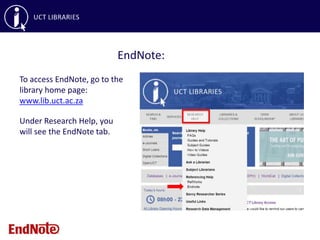
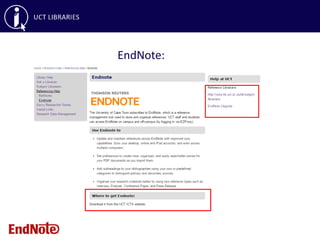
To access EndNote, go to the
library home page:
www.lib.uct.ac.za
Under Research Help, you
will see the EndNote tab.
EndNote:
EndNote:
Further Assistance:
Please feel free to email me:
Pepler Head - pv.head@uct.ac.za
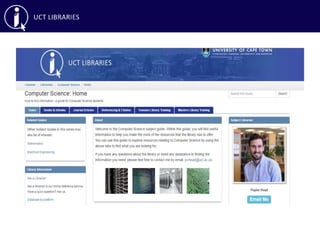
Remember the Computer Science Library Guide:
http://libguides.lib.uct.ac.za/chemistry
Also have a look at UCT Libraries’ YouTube channel:
https://www.youtube.com/user/UCTLibraries
Check out the Savvy Reseacher Series:
http://www.lib.uct.ac.za/lib/savvy-researcher-workshop-series
Thank you,
any questions?

Computer Science Library Training

  • 1.
    Computer Science Library SkillsTraining October 2016 Pepler Head pv.head@uct.ac.za
  • 2.
    In this sessionwe will be looking at: • Effective searching • Searching using Google Scholar, ACM Digital Library & IEEE Xplore • Article/publication metrics • Reference Managers, RefWorks & EndNote • Access articles that UCT Libraries does not subscribe to
  • 3.
    Effective Searching: How? Using Booleanoperators Identifying key words Conducting phrase searching and using quotation marks Why? Helps find relevant/accurate results Saves time Goes beyond finding anything and everything
  • 4.
    Effective Searching: Topic: Perceptions ofCloud Computing in South African Government Identify Keyword: Cloud Computing South Africa Government Search phrase: “Cloud Computing” AND “South Africa” AND Government
  • 5.
    Effective Searching: Searching onGoogle Scholar (20 October 2016): Search Result “Cloud Computing” 286,000 “Cloud Computing” AND “South Africa” 7,630 “Cloud Computing” AND “South Africa” AND Government 5,370
  • 6.
    Effective Searching: Makes useof the following: “ “ – Quotation marks keep phrases together: • Searching for South Africa as one concept rather than looking for South and Africa as individual words. ( ) – Brackets around key words allow that which falls inside of it to be processed first (often in cases of synonyms) • (eBooks OR “electronic books”) searches for both eBooks and electronic books. AND/OR/NOT – typing your operators in capitals helps Databases with the identification thereof.
  • 7.
    Effective Searching: Makes useof the following: Truncation: • Usually the asterisk sign (*) to indicate various forms of words, plurals Eg. Educat* searches for Educate, Educating, Education, Wildcards: • Usually the Question mark symbol (?) to search for variations in spelling. Eg. P?ediatric searches for both American and British spelling.
  • 8.
    Effective Searching: The Metrics: Partof effective searching is evaluating the information you are using by looking at: • Citations • Downloads Do not grab the first article you find, but evaluate it by looking at the Abstract, citations and/or downloads.
  • 9.
    Where to search: GoogleScholar ACM Digital Library Computer & Applied Science Complete ScienceDirect IEEE Xplore Web of Science
  • 10.
    Google Scholar: • Searchall scholarly literature from one convenient place • Explore related works, citations, authors, and publications • Locate the complete document through your library or on the web • Keep up with recent developments in any area of research • Check article citations
  • 11.
    Google Scholar: • Ifthe search results are too specific for your needs, check out what they're citing in their "References" sections. Referenced works are often more general in nature. • Similarly, if the search results are too basic for you, click "Cited by" to see newer papers that referenced them. These newer papers will often be more specific. • Explore! There's rarely a single answer to a research question. Click "Related articles" or "Cited by" to see closely related work, or search for author's name and see what else they have written.
  • 12.
    Google Scholar: Google Scholardoes not search in exactly the same way as the “academic” databases. Truncation: • Google Scholar does not recognize truncation symbols, instead it uses automatic stemming. It looks for the word you type in plus additional letters (“South Africa”, “South African”) Exact Word searching: • By Default Google Scholar will search for synonyms of your search word. To avoid this, it is best to use quotation marks “ “
  • 13.
    Google Scholar: Boolean Operators: •Google Scholar automatically inserts the AND operator between words, unless you insert the OR operator. • When using the operators, always capitalize it so it can be identified as a command and not as part of the search phrase • Insert a dash (-) in front of a word to exclude results that include that word
  • 14.
  • 15.
    Google Scholar: EZ-Proxy/Off campuslogin http://www.lib.uct.ac.za.ezproxy.uct.ac.za/
  • 16.
    Google Scholar: Accessing GoogleScholar: Library Home Page: www.lib.uct.ac.za Search & Find Databases by Platform Google Scholar: https://scholar-google-co-za.ezproxy.uct.ac.za/ - All UCT Library pay walled items are also indexed
  • 17.
  • 18.
  • 21.
    ACM Digital Library TheACM Digital Library (DL) is the most comprehensive collection of full-text articles and bibliographic records in existence today covering the fields of computing and information technology containing • 407,367 Full-text articles • 2.0+ Million Pages of full-text articles • 18,000+ New full-text articles added each year • 44+ High Impact Journals with 2-3 new journals being launched each year • 275+ Conference Proceedings Titles added each year • 2,000+ Proceedings Volumes • 8 Magazines (including the flagship Communications of the ACM, the most heavily cited publication in the field of computing according to Thomson- Reuters) • 37 Technical Newsletters from ACM's Special Interest Groups (SIGs) • 6,500+ Video files • 594 Audio files
  • 22.
    Using ACM DigitalLibrary Basic Searching • Type key word in lower case • You can enter a question or concept in plain language (ACM accommodates both plain language searching & key word searching) • Capitalize proper nouns • Use quotation marks (“”) for exact phrase searching • Use + or – to include or exclude terms Topic Searches • If your key word matches an existing topic, you will find that your results list includes documents that contain more than just the word itself, because ACM automatically expands the search to include all the words defined as part of the topic. • If you don’t want the term expanded as a topic, use quotation marks for exact phrase searching
  • 23.
    Using ACM DigitalLibrary Searching with Wildcards: • Wildcards function as truncation in ACM Digital Library • Works with the asterisk symbol (*) • Col*r returns results for color and colour and all words beginning with col ending with r Zone Searches: • These are specific regions of documents that can be searched • Available in Markup Language • To search a document zone, type the name of the zone, a colon (:), and the search terms. • Searching h1:cloud computing returns results with the word cloud computing in the <h1> tag of an HTML document.
  • 24.
  • 27.
  • 30.
    IEEE Xplore The IEEEXplore digital library is a powerful resource for discovery and access to scientific and technical content published by the IEEE (Institute of Electrical and Electronics Engineers) and its publishing partners. IEEE Xplore provides web access to more than 3.5-million full-text documents from some of the world's most highly cited publications in electrical engineering, computer science and electronics. The content in IEEE Xplore comprises over 160 journals, over 1,200 conference proceedings, more than 2,500 technical standards, over 1,000 eBooks, and over 300 courses. Approximately 25,000 new documents are added to IEEE Xplore each month.
  • 31.
    IEEE Xplore Searching: • Usekey word for searching the database • IEEE does automatic stemming, searching for plurals and other forms of the key word. • Nesting the keyword ensures that the search is performed as you intend (Advanced search can assist with this) • Quotation marks (“ “) is used for exact searching. • Use wildcards, asterisk symbol (*) for words with different spelling. Example searching computer will return computers, but searching computer* will return computers and computerize.
  • 32.
  • 33.
  • 34.
  • 35.
  • 36.
  • 37.
  • 38.
    How to accessmaterial that UCT Libraries does not have access to? Interlibrary Loans
  • 39.
    How to accessmaterial that UCT Libraries does not have access to? Interlibrary Loans
  • 40.
    How to accessmaterial that UCT Libraries does not have access to? Open DOAR (Directory of Open Access Repositories) Check to see whether any version of the article is not sitting on an Institutional repository.
  • 41.
    Citation Managers: • RefWorksand EndNote are reference management tools that enables you to store and organise your references in your own personal database. • Both have a write-n-cite plugin for Word that allows you to insert your in text references and reference list directly in Word
  • 42.
    • Build upyour OWN PERSONAL DATABASE of references • FREE for Students and Alumni at UCT • Store references SAFELY on the RefWorks server • ORGANISE your references in folders • IMPORT REFERENCES from databases and the Web • SEARCH your references with the RefWorks search engine • SAVE the abstracts of articles • Link to FULL TEXT • CREATE BIBLIOGRAPHIES automatically RefWorks:
  • 43.
    RefWorks: To access RefWorks,go to the library home page: www.lib.uct.ac.za Under Research Help, you will see the RefWorks tab.
  • 44.
  • 45.
  • 46.
    EndNote: • Mainly desktopbased • Update and maintain references across EndNote and sync with other devices • Set preferences to create clear, organized, and easily searchable names for your PDF documents as you import them. • Read, highlight and comment on PDF’s within EndNote’s PDF viewer. • Organise your research materials better by using new reference types such as Interview, Podcast, Conference Paper, and Press Release • Create your bibliography automatically
  • 47.
    To access EndNote,go to the library home page: www.lib.uct.ac.za Under Research Help, you will see the EndNote tab. EndNote:
  • 48.
  • 49.
    Further Assistance: Please feelfree to email me: Pepler Head - pv.head@uct.ac.za Remember the Computer Science Library Guide: http://libguides.lib.uct.ac.za/chemistry Also have a look at UCT Libraries’ YouTube channel: https://www.youtube.com/user/UCTLibraries Check out the Savvy Reseacher Series: http://www.lib.uct.ac.za/lib/savvy-researcher-workshop-series
  • 53.

Editor's Notes

  • #5 Searching the entire phrase will give less accurate/relevant results.
  • #6 You need to search more accurately
  • #9 Downloads are a lesser metrics than citation, but can be used when that is all you have.
  • #29 Sign in required to save search query
  • #39 You can also try emailing authors with a polite request for articles
  • #42 There are many other reference management tools, but these are the two main ones that UCT Libraries support.
  • #46 Go live from this slide to RefWorks
  • #47 Go live from this slide to RefWorks