Library Training:
School of Accountancy
HanlieStrydom
FacultyLibrarian:Economicand ManagementSciences
hanlies@sun.ac.za
In this session we’ll be looking at
Search techniques (Identify Keywords & use Boolean;
Quick& Easy Search Technique; Pearl Growing Search
Technique)
Distinguishing between sources (referencing)
 evaluating sources
Finding credible academic sources
Plagiarism
ChatGPT and other AI tools
2
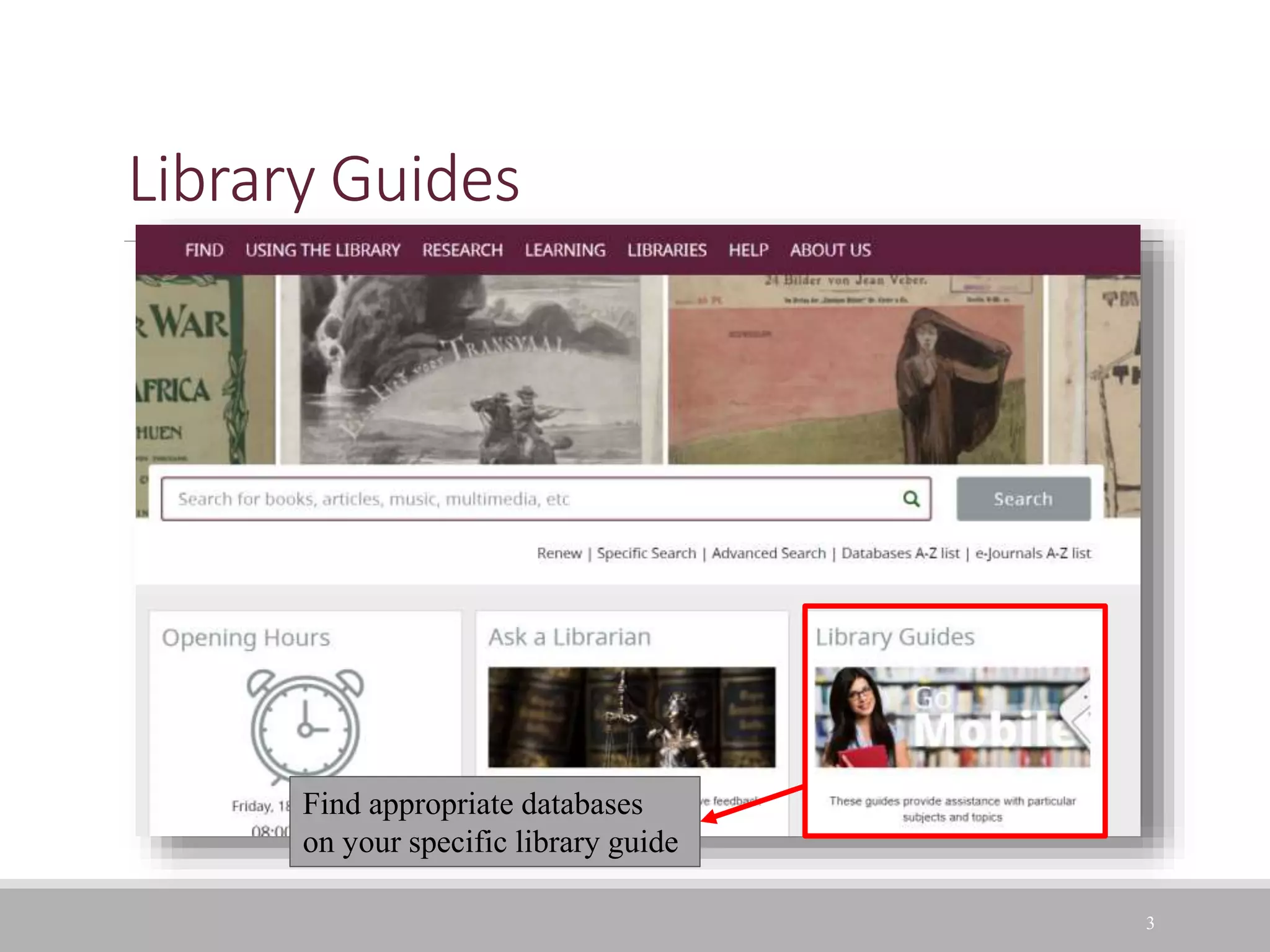
Library Guides
3
Find appropriate databases
on your specific library guide
4
Databases – what is it?
A database is an electronic index (list) to journal or
magazine articles, containing citations, abstracts
and often either the full text of the articles, or links
to the full text.
It allows you to search for information using:
Keywords
Titles
Authors
Subjects
5
Searching for sources
How to search effectively
Step 1: Identify your keywords
6
Write down your topic:
The influence of the internet on real estate agencies
Main Concepts:
internet
Real estate agencies
Step 2: Identify Synonyms
7
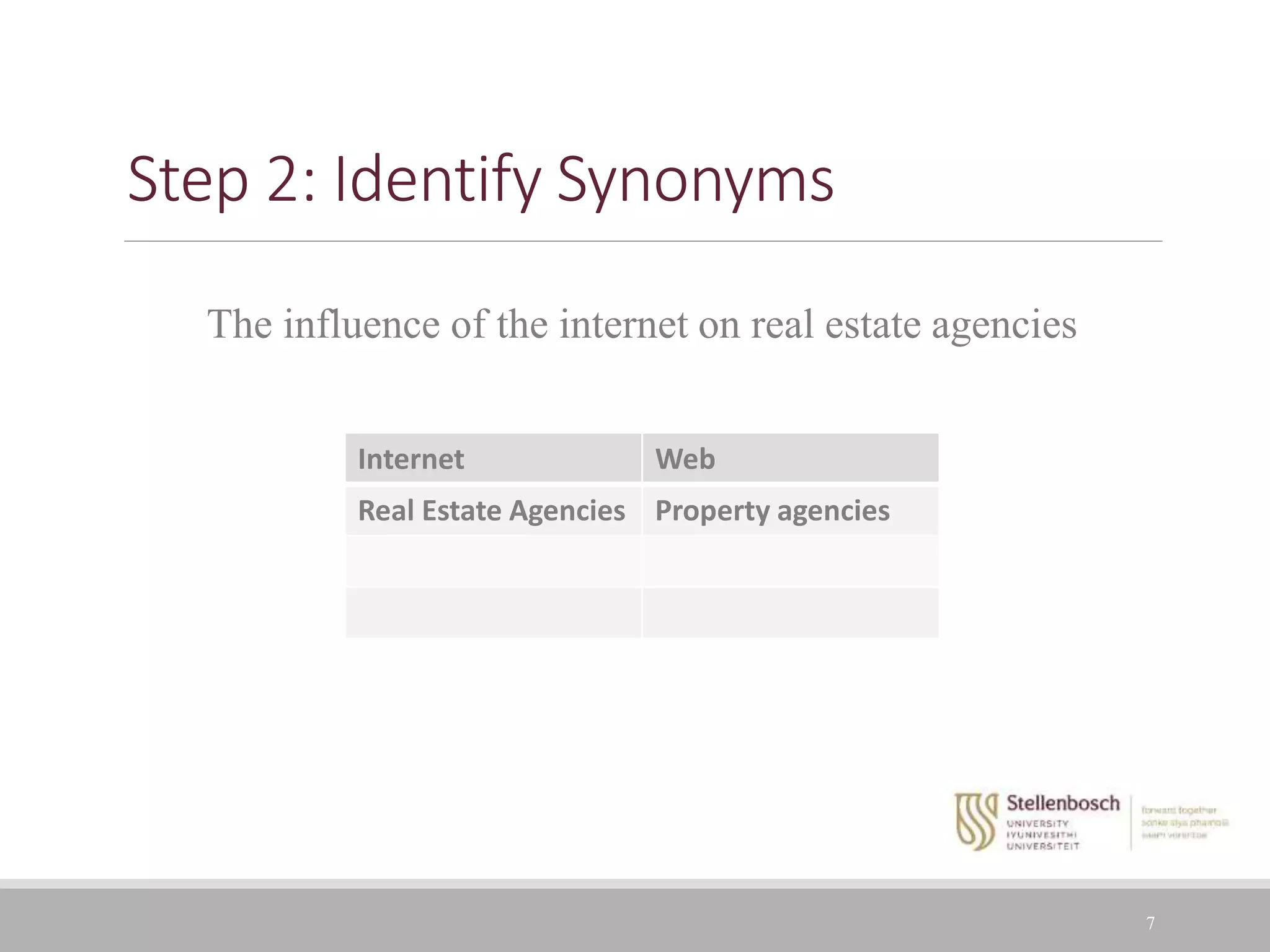
Internet Web
Real Estate Agencies Property agencies
The influence of the internet on real estate agencies
Step 3: Combine Keywords
8
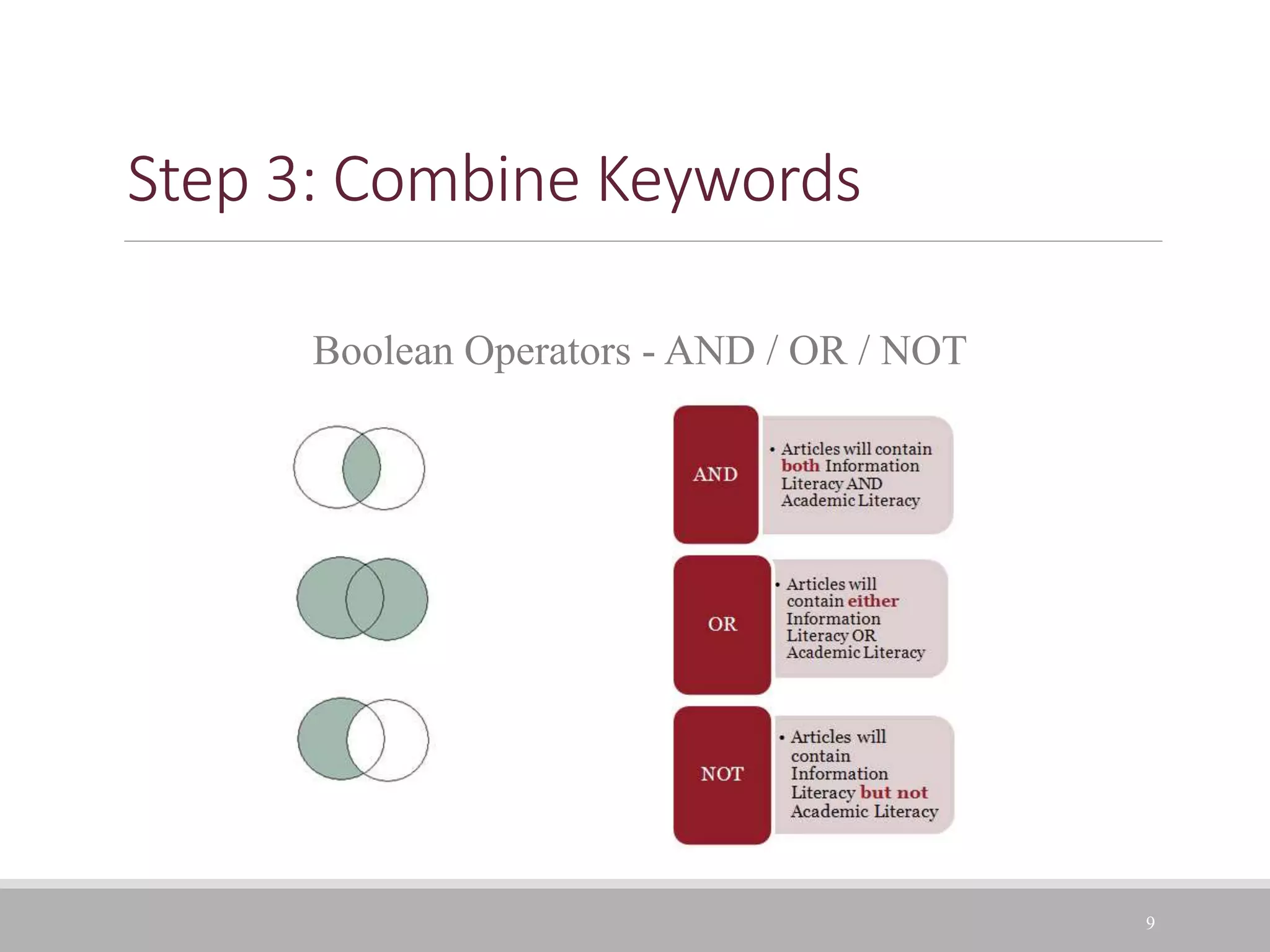
Boolean Operators - AND / OR / NOT
AND – returns results with both keywords
OR – returns results with one or the other keyword
NOT – returns results excluding specific keywords
Use the Boolean Machine for visualizing the effects
of Boolean operators .
Step 3: Combine Keywords
9
Boolean Operators - AND / OR / NOT
Step 3: Combine Keywords
10
Boolean Operators - AND / OR / NOT
Quotation Marks “ ” – keep keywords together, for
exact phrase searching
Brackets ( ) – keep concepts together, used for
synonyms
Step 3: Combine Keywords
11
Search phrase:
Internet AND “real estate agencies”
(Internet OR web) AND (“real estate
agencies” OR “property agencies”)
Finding credible academic sources
Reliability:
From a reputable source/institution- publisher, University, Research Unit,
Company
Authority:
Creator is an expert in their field, and affiliated with a reputable institution
Validity :
The research was conducted in a manner that is commonly accepted in the
field, and is evident in the article
Accuracy:
The information can be verified
12
Good news
Using Academic Databases provided by the library will
assist you in finding relevant, credible information for your
assignments. Examples:
SUN Search (Library Catalogue)
Scopus
Google Scholar
Emerald
13
Reliable internet sources
Any Website ending in:
.org; .gov; .edu; .ac
14
15
Distinguishing between sources
Book Journal Article
Report
16
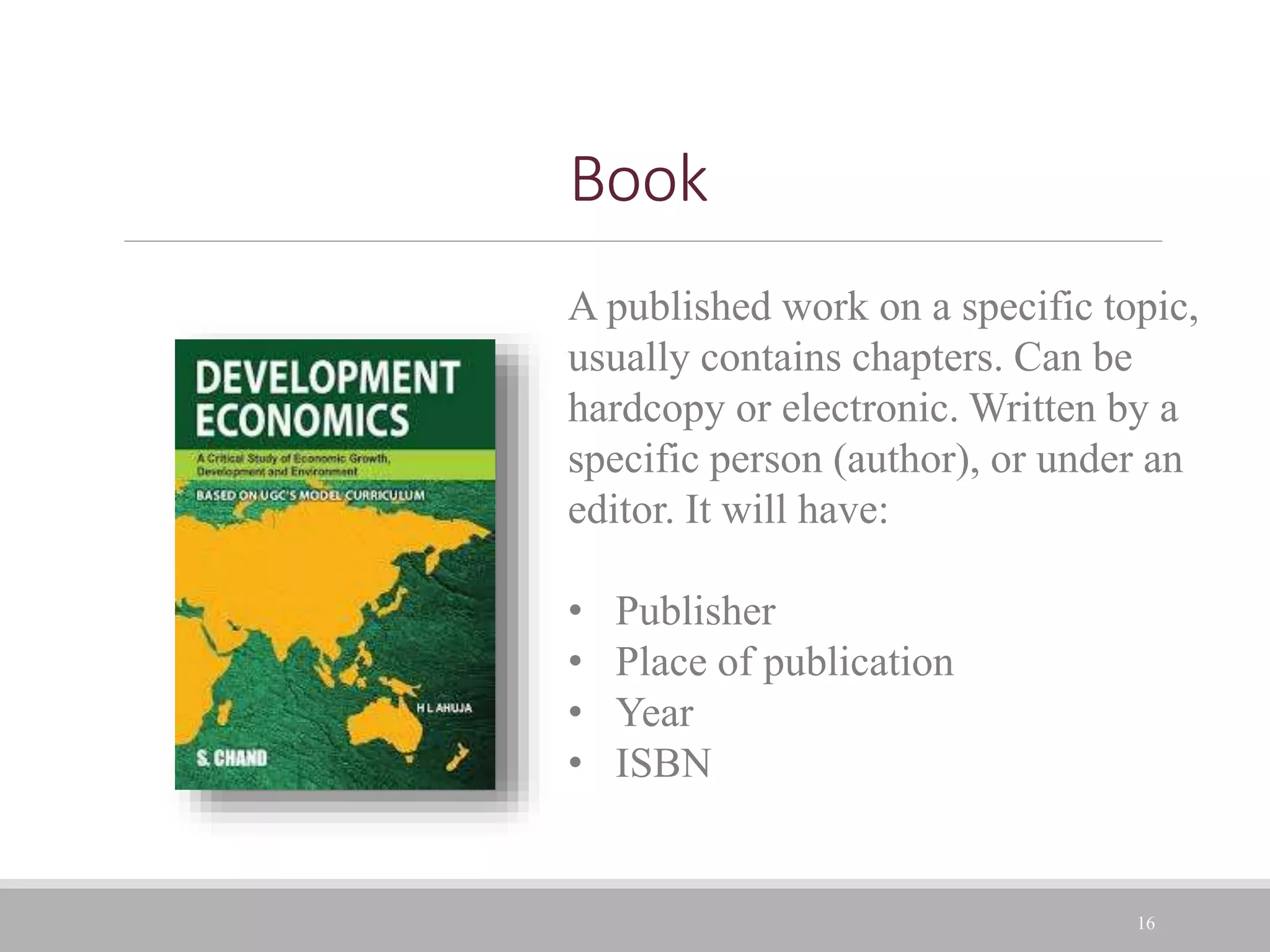
Book
A published work on a specific topic,
usually contains chapters. Can be
hardcopy or electronic. Written by a
specific person (author), or under an
editor. It will have:
• Publisher
• Place of publication
• Year
• ISBN
17
Book - Example
Search the library Catalogue for book on
Management Accounting
18
Book Chapter
Be careful of chapter in books that you
find electronically
Example:
Reflexivity and Development Economics
https://link.springer.com/chapter/10.1057/9780230250598_
4
19
Academic Journal
A periodical or serial publication in
which information on a specific topic
is published in article format. It can
be electronic or hard copy. It will
have:
• Title
• Publisher
• Year
• Volume number
• Issue number
• ISSN
20
Journal - Example
Search Meditari Accountancy Research
21
Academic Article
Topic specific information within an
academic discipline, published in a
Journal. It can be electronic or hard
copy. It will have:
• Source Title References
• Article title
• Abstract (summary)
• Year
• Volume number
• Issue number
• Page number
22
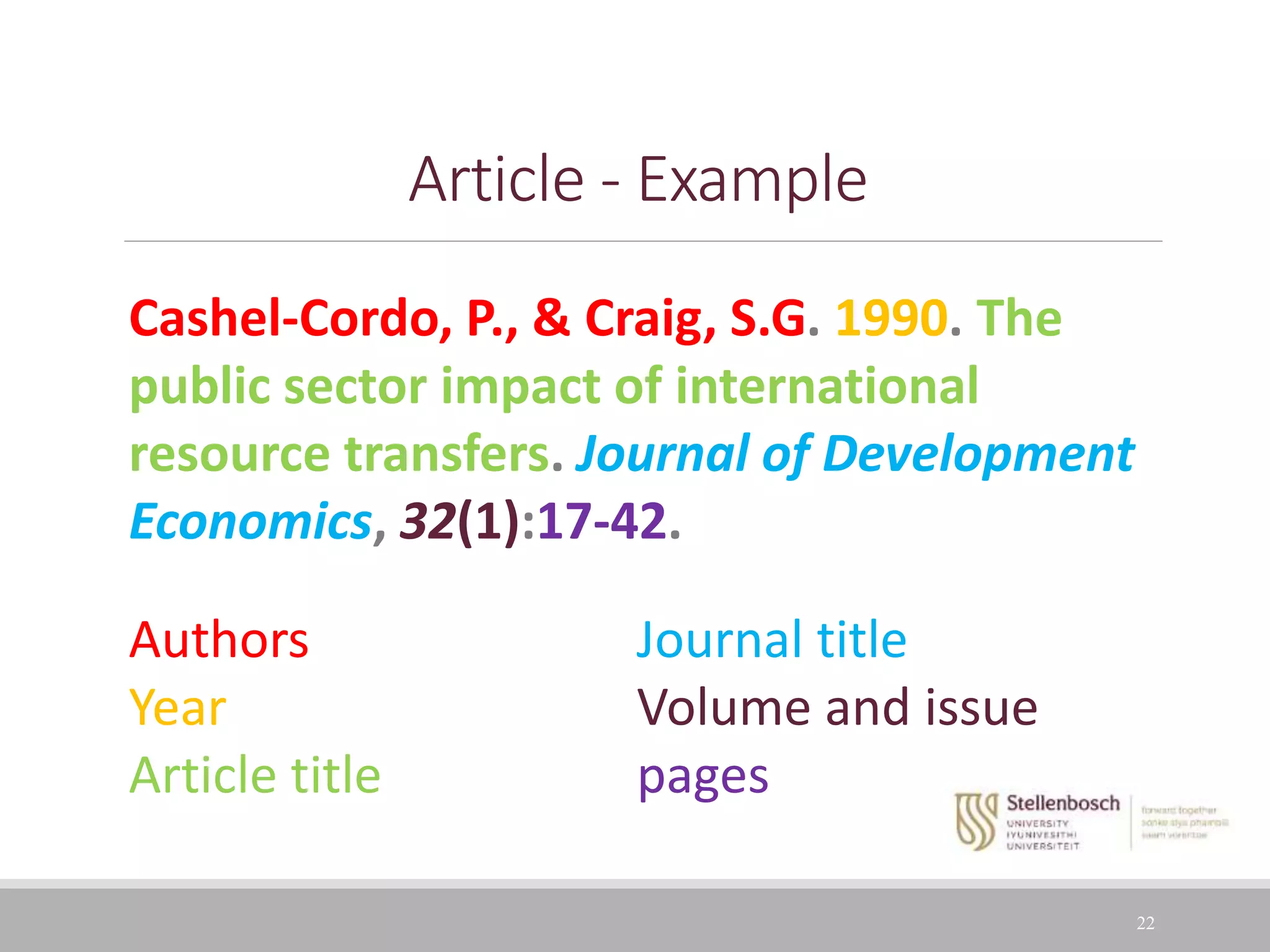
Article - Example
Cashel-Cordo, P., & Craig, S.G. 1990. The
public sector impact of international
resource transfers. Journal of Development
Economics, 32(1):17-42.
Authors Journal title
Year Volume and issue
Article title pages
23
Report
A document that presents
information in an organized format
for a specific audience and purpose,
reporting something that has been
observed, done or investigated. Can
be annual or once off. It will have
• Report title
• Author
• Corporate body/Company
• Year
24
Report - Example
World Health Statistics 2018:
Monitoring Health For the SDG’s
Referencing - Key takeaways
25
The purpose of the reference list is to allow your sources to be found by
your reader. It also gives credit to authors you have consulted for their
ideas
Know the Referencing Style that you are using
Make sure what you are referencing, different material types are
displayed differently in the bibliography
Makes sure that your in-text citations match your bibliography
Most important, be CONSISTENT
Referencing - Help
26
Referencing - Help
27
Referencing - Help
28
Plagiarism
Plagiarism is the theft and use of the ideas, material and
other intellectual property of others that are passed off as
one’s own
This can take multiple forms
29
OBVIOUS FORMS:
Buying / borrowing a paper and
copying it
Hiring somebody to write for you
Cutting and pasting text
Direct translations
Citing sources you didn’t use
LESS OBVIOUS FORMS:
Not giving proper credit
Not referencing images, etc.
Improper paraphrasing
Failing to give a proper reference
Not acknowledging outsourcing (eg.
Data)
Plagiarism thought tree
30
Spot the plagiarism
31
Is this plagiarism?
Timmer asserts that the fundamental role of prices in
a market economy is to serve as signals for
allocating both consumption and investment
resources (Timmer, 2002: 1507). This is important,
because of the…
Spot the plagiarism
32
Is this plagiarism?
Timmer asserts that the fundamental role of prices
in a market economy is to serve as signals for
allocating both consumption and investment
resources (Timmer, 2002: 1507). This is important,
because of the…
Different font, so copied and pasted
No quotation marks
Reference in wrong place
Spot the plagiarism
33
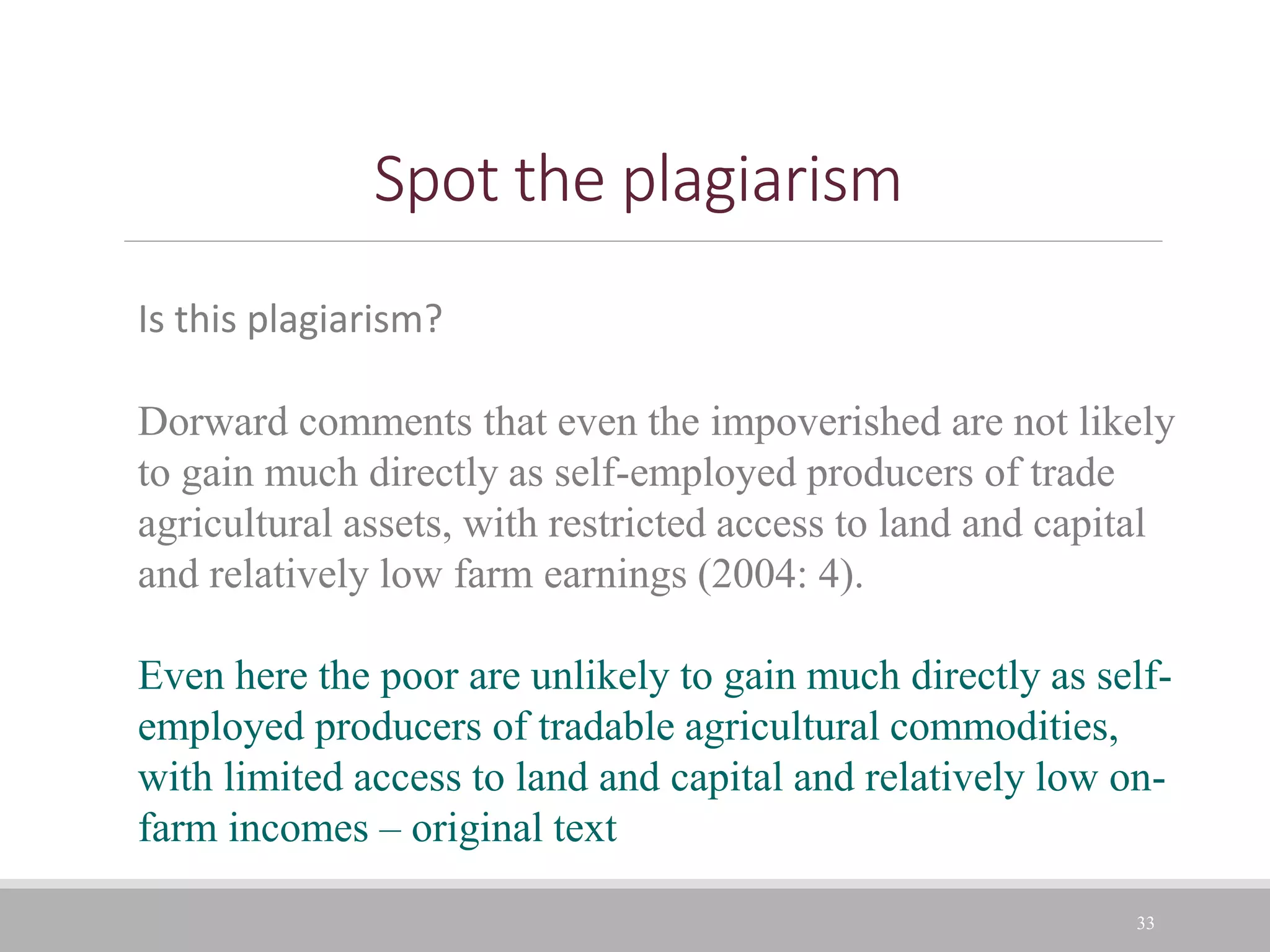
Is this plagiarism?
Dorward comments that even the impoverished are not likely
to gain much directly as self-employed producers of trade
agricultural assets, with restricted access to land and capital
and relatively low farm earnings (2004: 4).
Even here the poor are unlikely to gain much directly as self-
employed producers of tradable agricultural commodities,
with limited access to land and capital and relatively low on-
farm incomes – original text
Spot the plagiarism
34
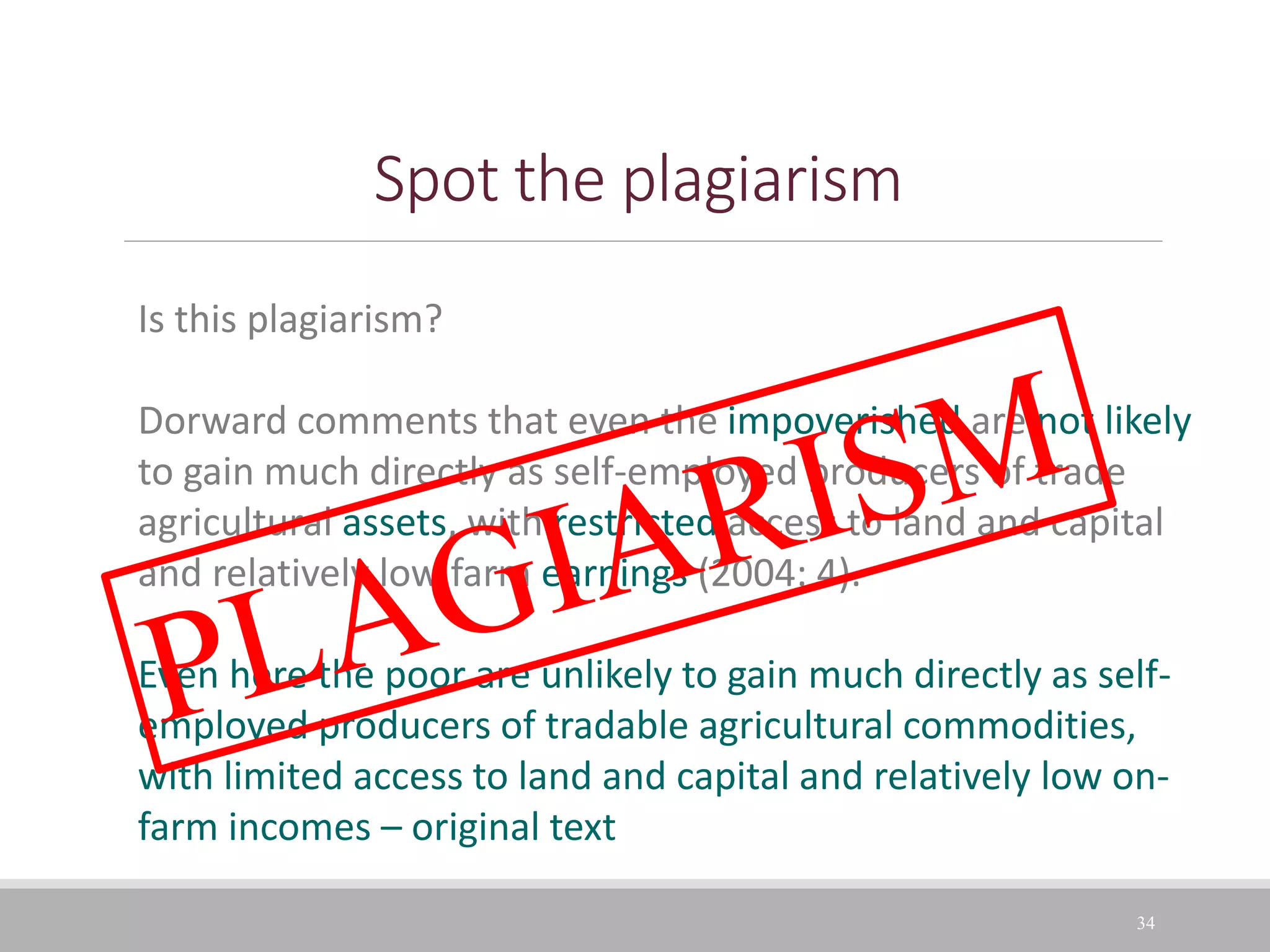
Is this plagiarism?
Dorward comments that even the impoverished are not likely
to gain much directly as self-employed producers of trade
agricultural assets, with restricted access to land and capital
and relatively low farm earnings (2004: 4).
Even here the poor are unlikely to gain much directly as self-
employed producers of tradable agricultural commodities,
with limited access to land and capital and relatively low on-
farm incomes – original text
Spot the plagiarism
35
Is this plagiarism?
“In his 1991 review, Sherman Robinson highlights the
theoretical tension between the neoclassical paradigm and
AGE models with financial behaviour” (Hertel, 2002: 1376).
Spot the plagiarism
Is this plagiarism?
Ask ChatGPT: write a short paragraph about the importance of using
credible sources for academic assignments.
Answer:
Using credible sources is crucial for academic assignments. These
sources provide accurate and reliable information, ensuring the
integrity of your work. Authored by experts and subjected to peer-
review, credible sources enhance your arguments and demonstrate
academic integrity. They also help you avoid misinformation and bias.
Prioritizing credible sources strengthens your assignments and
showcases your ability to analyze reliable information.
36
ChatGPT and other AI tools
The line between the right way and the wrong way of using ChatGPT is
often blurred
Follow the guidance from your lecturers
AI Use Disclosure Statement
The Faculty recommends that AI use be declared, and it includes a
student declaration form, that requires an indication of the AI tools
used, as well as where and what it were used for, and a justification for
claims that the work is the student’s own.
37
ChatGPT and other AI tools
Responsible use of AI tools (continue)
Accountability (including the ideas of acknowledgement and
attribution)
You are responsible for what you create and how it impacts
others and society. AI tools don't have accountability. It is thus
your responsibility to ensure that work submitted under your
name is factually correct.
Authenticity
You may use AI tools to assist where relevant, but not to
complete the assignment on your behalf.
38
ChatGPT and other AI tools
Responsible use of AI tools
Fairness
Your use of AI tools/ systems should be ethical and responsible
and should comply with academic integrity standards
Transparency
You should clearly and honestly declare the use of AI tools and
their outputs as well as the extent of the use, i.e. refer to the
'search strategy' and rationale that informed this
39
Challenges and possibilities of AI Tools
Challenges
•There is a mix of correct and incorrect information
•Has limited knowledge of the world after 2020
•Likelihood of biased content is high.
Benefits
•Can provide simple explanations to well known, non-controversial
topics
•Can provide sample text
•Can create a list of keywords, search terms
40
Plagiarism- Key takeaways
In order not to plagiarize, know the magical secret: Cite your sources!
Citing your sources is also important for your readers:
To show you did research – it gives legitimacy and validity to your
argument
To show where your information comes from – use reliable sources
Your readers can check the sources if there are questions –
additional info
To point your readers to useful sources – if they want to dig deeper
In general, don't use AI tools as a "source" of information because it mixes
correct and incorrect information. It isn't (yet) considered a credible source for
academic research and writing
41
Plagiarism - Help
42
The information listed below will assist you in helping to avoid
plagiarism and understanding the consequences.
•Plagiarism
•SU Policy on Plagiarism (In Support of Academic Integrity)
•SU Procedure for the Investigation and Management of
Allegations of Plagiarism
•Using Turnitin software to detect plagiarism
Research help
43
44
Thank you – Any Questions?

Effective Searching - Management Accoutning

  • 1.
    Library Training: School ofAccountancy HanlieStrydom FacultyLibrarian:Economicand ManagementSciences hanlies@sun.ac.za
  • 2.
    In this sessionwe’ll be looking at Search techniques (Identify Keywords & use Boolean; Quick& Easy Search Technique; Pearl Growing Search Technique) Distinguishing between sources (referencing)  evaluating sources Finding credible academic sources Plagiarism ChatGPT and other AI tools 2
  • 3.
    Library Guides 3 Find appropriatedatabases on your specific library guide
  • 4.
    4 Databases – whatis it? A database is an electronic index (list) to journal or magazine articles, containing citations, abstracts and often either the full text of the articles, or links to the full text. It allows you to search for information using: Keywords Titles Authors Subjects
  • 5.
    5 Searching for sources Howto search effectively
  • 6.
    Step 1: Identifyyour keywords 6 Write down your topic: The influence of the internet on real estate agencies Main Concepts: internet Real estate agencies
  • 7.
    Step 2: IdentifySynonyms 7 Internet Web Real Estate Agencies Property agencies The influence of the internet on real estate agencies
  • 8.
    Step 3: CombineKeywords 8 Boolean Operators - AND / OR / NOT AND – returns results with both keywords OR – returns results with one or the other keyword NOT – returns results excluding specific keywords Use the Boolean Machine for visualizing the effects of Boolean operators .
  • 9.
    Step 3: CombineKeywords 9 Boolean Operators - AND / OR / NOT
  • 10.
    Step 3: CombineKeywords 10 Boolean Operators - AND / OR / NOT Quotation Marks “ ” – keep keywords together, for exact phrase searching Brackets ( ) – keep concepts together, used for synonyms
  • 11.
    Step 3: CombineKeywords 11 Search phrase: Internet AND “real estate agencies” (Internet OR web) AND (“real estate agencies” OR “property agencies”)
  • 12.
    Finding credible academicsources Reliability: From a reputable source/institution- publisher, University, Research Unit, Company Authority: Creator is an expert in their field, and affiliated with a reputable institution Validity : The research was conducted in a manner that is commonly accepted in the field, and is evident in the article Accuracy: The information can be verified 12
  • 13.
    Good news Using AcademicDatabases provided by the library will assist you in finding relevant, credible information for your assignments. Examples: SUN Search (Library Catalogue) Scopus Google Scholar Emerald 13
  • 14.
    Reliable internet sources AnyWebsite ending in: .org; .gov; .edu; .ac 14
  • 15.
  • 16.
    16 Book A published workon a specific topic, usually contains chapters. Can be hardcopy or electronic. Written by a specific person (author), or under an editor. It will have: • Publisher • Place of publication • Year • ISBN
  • 17.
    17 Book - Example Searchthe library Catalogue for book on Management Accounting
  • 18.
    18 Book Chapter Be carefulof chapter in books that you find electronically Example: Reflexivity and Development Economics https://link.springer.com/chapter/10.1057/9780230250598_ 4
  • 19.
    19 Academic Journal A periodicalor serial publication in which information on a specific topic is published in article format. It can be electronic or hard copy. It will have: • Title • Publisher • Year • Volume number • Issue number • ISSN
  • 20.
    20 Journal - Example SearchMeditari Accountancy Research
  • 21.
    21 Academic Article Topic specificinformation within an academic discipline, published in a Journal. It can be electronic or hard copy. It will have: • Source Title References • Article title • Abstract (summary) • Year • Volume number • Issue number • Page number
  • 22.
    22 Article - Example Cashel-Cordo,P., & Craig, S.G. 1990. The public sector impact of international resource transfers. Journal of Development Economics, 32(1):17-42. Authors Journal title Year Volume and issue Article title pages
  • 23.
    23 Report A document thatpresents information in an organized format for a specific audience and purpose, reporting something that has been observed, done or investigated. Can be annual or once off. It will have • Report title • Author • Corporate body/Company • Year
  • 24.
    24 Report - Example WorldHealth Statistics 2018: Monitoring Health For the SDG’s
  • 25.
    Referencing - Keytakeaways 25 The purpose of the reference list is to allow your sources to be found by your reader. It also gives credit to authors you have consulted for their ideas Know the Referencing Style that you are using Make sure what you are referencing, different material types are displayed differently in the bibliography Makes sure that your in-text citations match your bibliography Most important, be CONSISTENT
  • 26.
  • 27.
  • 28.
  • 29.
    Plagiarism Plagiarism is thetheft and use of the ideas, material and other intellectual property of others that are passed off as one’s own This can take multiple forms 29 OBVIOUS FORMS: Buying / borrowing a paper and copying it Hiring somebody to write for you Cutting and pasting text Direct translations Citing sources you didn’t use LESS OBVIOUS FORMS: Not giving proper credit Not referencing images, etc. Improper paraphrasing Failing to give a proper reference Not acknowledging outsourcing (eg. Data)
  • 30.
  • 31.
    Spot the plagiarism 31 Isthis plagiarism? Timmer asserts that the fundamental role of prices in a market economy is to serve as signals for allocating both consumption and investment resources (Timmer, 2002: 1507). This is important, because of the…
  • 32.
    Spot the plagiarism 32 Isthis plagiarism? Timmer asserts that the fundamental role of prices in a market economy is to serve as signals for allocating both consumption and investment resources (Timmer, 2002: 1507). This is important, because of the… Different font, so copied and pasted No quotation marks Reference in wrong place
  • 33.
    Spot the plagiarism 33 Isthis plagiarism? Dorward comments that even the impoverished are not likely to gain much directly as self-employed producers of trade agricultural assets, with restricted access to land and capital and relatively low farm earnings (2004: 4). Even here the poor are unlikely to gain much directly as self- employed producers of tradable agricultural commodities, with limited access to land and capital and relatively low on- farm incomes – original text
  • 34.
    Spot the plagiarism 34 Isthis plagiarism? Dorward comments that even the impoverished are not likely to gain much directly as self-employed producers of trade agricultural assets, with restricted access to land and capital and relatively low farm earnings (2004: 4). Even here the poor are unlikely to gain much directly as self- employed producers of tradable agricultural commodities, with limited access to land and capital and relatively low on- farm incomes – original text
  • 35.
    Spot the plagiarism 35 Isthis plagiarism? “In his 1991 review, Sherman Robinson highlights the theoretical tension between the neoclassical paradigm and AGE models with financial behaviour” (Hertel, 2002: 1376).
  • 36.
    Spot the plagiarism Isthis plagiarism? Ask ChatGPT: write a short paragraph about the importance of using credible sources for academic assignments. Answer: Using credible sources is crucial for academic assignments. These sources provide accurate and reliable information, ensuring the integrity of your work. Authored by experts and subjected to peer- review, credible sources enhance your arguments and demonstrate academic integrity. They also help you avoid misinformation and bias. Prioritizing credible sources strengthens your assignments and showcases your ability to analyze reliable information. 36
  • 37.
    ChatGPT and otherAI tools The line between the right way and the wrong way of using ChatGPT is often blurred Follow the guidance from your lecturers AI Use Disclosure Statement The Faculty recommends that AI use be declared, and it includes a student declaration form, that requires an indication of the AI tools used, as well as where and what it were used for, and a justification for claims that the work is the student’s own. 37
  • 38.
    ChatGPT and otherAI tools Responsible use of AI tools (continue) Accountability (including the ideas of acknowledgement and attribution) You are responsible for what you create and how it impacts others and society. AI tools don't have accountability. It is thus your responsibility to ensure that work submitted under your name is factually correct. Authenticity You may use AI tools to assist where relevant, but not to complete the assignment on your behalf. 38
  • 39.
    ChatGPT and otherAI tools Responsible use of AI tools Fairness Your use of AI tools/ systems should be ethical and responsible and should comply with academic integrity standards Transparency You should clearly and honestly declare the use of AI tools and their outputs as well as the extent of the use, i.e. refer to the 'search strategy' and rationale that informed this 39
  • 40.
    Challenges and possibilitiesof AI Tools Challenges •There is a mix of correct and incorrect information •Has limited knowledge of the world after 2020 •Likelihood of biased content is high. Benefits •Can provide simple explanations to well known, non-controversial topics •Can provide sample text •Can create a list of keywords, search terms 40
  • 41.
    Plagiarism- Key takeaways Inorder not to plagiarize, know the magical secret: Cite your sources! Citing your sources is also important for your readers: To show you did research – it gives legitimacy and validity to your argument To show where your information comes from – use reliable sources Your readers can check the sources if there are questions – additional info To point your readers to useful sources – if they want to dig deeper In general, don't use AI tools as a "source" of information because it mixes correct and incorrect information. It isn't (yet) considered a credible source for academic research and writing 41
  • 42.
    Plagiarism - Help 42 Theinformation listed below will assist you in helping to avoid plagiarism and understanding the consequences. •Plagiarism •SU Policy on Plagiarism (In Support of Academic Integrity) •SU Procedure for the Investigation and Management of Allegations of Plagiarism •Using Turnitin software to detect plagiarism
  • 43.
  • 44.
    44 Thank you –Any Questions?

Editor's Notes

  • #6 Now that we’ve looked at different sources and how to identify them, we will move on to searching for sources, and searching effectively
  • #13 Credibility is a combination of Reliability, Authority, Validity and Accuracy
  • #15 Credibility is a combination of Reliability, Authority, Validity and Accuracy
  • #16 To be able to reference properly, it is important to know what document type you are working with, since different document types are formatted differently in the bibliography or reference list. We are going to start by looking at different document types and how to identify them, so we can understand the components that make up the reference list. This may seem very basic, but we are going to look at how to identify a book, a journal, a journal article, and a report. These are only a hand full of documents types that you may encounter while conducting research.
  • #17 Let’s start with a book.
  • #19 These you will often find on Google or Google Scholar.
  • #20 Articles appear in Academic journals.
  • #22 Similar to the journal, only now it will have a source title (journal) and an article title with a year, volume, issue number and references.
  • #26 Credibility is a combination of Reliability, Authority, Validity and Accuracy
  • #27 Credibility is a combination of Reliability, Authority, Validity and Accuracy
  • #28 Credibility is a combination of Reliability, Authority, Validity and Accuracy
  • #29 Credibility is a combination of Reliability, Authority, Validity and Accuracy
  • #32 Credibility is a combination of Reliability, Authority, Validity and Accuracy
  • #33 Credibility is a combination of Reliability, Authority, Validity and Accuracy
  • #34 Credibility is a combination of Reliability, Authority, Validity and Accuracy
  • #35 Credibility is a combination of Reliability, Authority, Validity and Accuracy
  • #36 Credibility is a combination of Reliability, Authority, Validity and Accuracy
  • #43 Credibility is a combination of Reliability, Authority, Validity and Accuracy
  • #44 Credibility is a combination of Reliability, Authority, Validity and Accuracy