CS6551 Computer Networks
Unit3 : Routing
Dr. R.Perumalraja, Professor & Head
Department of Information Technology, VCET.
CS6551 Computer Networks, Unit 3 : Routing
2.
Topics to becovered
Routing
RIP, OSPF, metrics
Switch basics
Global Internet
Areas, BGP, EGP, IPv6
Multicast addresses and Multicast routing
DVMRP, PIM
CS6551 Computer Networks, Unit 3 : Routing
2
3.
Routing Algorithms
Objectiveof routing algorithms is to calculate / select the optimum
path for reaching the destination
The simplest form of routing is “flooding”: a source s sends the
message to all its neighbors; when a node other than destination t
receives the message the first time it re-sends it to all its neighbors.
Optimization Criteria
Number of Hops
Cost
Delay
Throughput
There are two basic approaches to shortest-path routing
Link State Routing. e.g. OSPF, an intra-domain routing protocol
Distance Vector Routing. e.g. RIP, an intra-domain routing protocol
3
CS6551 Computer Networks, Unit 3 : Routing
4.
Routing process ata router
Contains Routing and Forwarding Table (FT)
Destination address based forwarding
RT is to identify the next-hop node
FT is to identify the Outgoing interface of next node
Longest prefix matching
Routing Table
4
CS6551 Computer Networks, Unit 3 : Routing
DA=my_add or
DA= IP brdcst add.
?
RT entry =
complete DA?
RT entry =
Destn. n/w id?
Default entry
exists?
No
No
No
No
Yes
Yes
Yes
Yes
Deliver datagram to
protocol module
(TCP/UDP) specified
in IP hdr.
Send pkt. to next-hop
router or to directly
connected interface.
Send pkt. to next-hop
router or to directly
connected interface.
Send pkt. to
next-hop router.
Datagram undeliverable. (Use ICMP to inform source.)
Receive incoming pkt.
DA Next hop
router
Network
Interface
Host entry 198.168.7.3 X 2
Host entry 198.168.7.4 X 3
Host entry 198.168.7.1 198.168.7.5 1
Host entry 198.168.7.2 198.168.7.5 1
N/w entry 198.100.x.x 198.100.9.1 4
N/w entry 128.72.x.x 128.72.55.4 5
Default x.x.x.x 128.84.73.1 6
5.
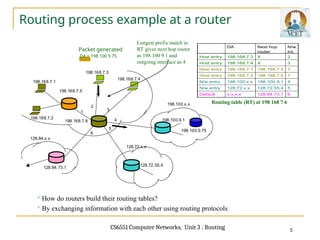
Routing process exampleat a router
5
CS6551 Computer Networks, Unit 3 : Routing
How do routers build their routing tables?
By exchanging information with each other using routing protocols
DA = 198 100 9 75
Packet generated
198.168.7.4
198.168.7.3
198.168.7.1
198.168.7.2
198.168.7.5
198.168.7.6
198.100.x.x
198.100.9.1
128.72.x.x
128.72.55.4
128.84.x.x
128.84.73.1
2
3
4
5
6
1
198.100.9.75
DA Next hop
router
N/w
Int.
Host entry 198.168.7.3 X 2
Host entry 198.168.7.4 X 3
Host entry 198.168.7.1 198.168.7.5 1
Host entry 198.168.7.2 198.168.7.5 1
N/w entry 198.100.x.x 198.100.9.1 4
N/w entry 128.72.x.x 128.72.55.4 5
Default x.x.x.x 128.84.73.1 6
Routing table (RT) at 198 168 7 6
Longest prefix match in
RT gives next hop router
as 198 100 9 1 and
outgoing interface as 4
6.
CS6551 Computer Networks,Unit 3 : Routing
Intra and Inter-domain Routing
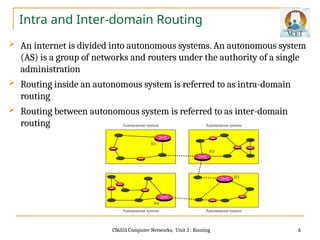
An internet is divided into autonomous systems. An autonomous system
(AS) is a group of networks and routers under the authority of a single
administration
Routing inside an autonomous system is referred to as intra-domain
routing
Routing between autonomous system is referred to as inter-domain
routing
6
7.
CS6551 Computer Networks,Unit 3 : Routing
Distance Vector Routing
a.k.a. bellman-ford algorithm
In distance vector routing, each node maintains a table for the least cost
route between any two nodes with minimum distance
Initially, each node knows the distance (cost) to each of its directly
connected neighbors.
Nodes construct a vector (Destination, Cost, NextHop) and distributes
it to neighbors.
Nodes update/compute routing table to every other node via NextHop
using the information obtained from its neighbors.
Each node shares its routing table with its immediate neighbors
periodically and when there is a change.
Distance vector routing is distributed, i.e., algorithm is run
7
8.
CS6551 Computer Networks,Unit 3 : Routing
Initialization
At the beginning, each node can know only the distance between itself
and its immediate neighbors, those directly connected to it
8
9.
CS6551 Computer Networks,Unit 3 : Routing
Routing Update
Routing Update takes place in 3 steps:
The receiving node needs to add the cost between itself and the sending
node to each value in the second column of RT
Add the name of the sending node in the 3rd
column, if the receiving node
uses the information because sending node is the next node in the route
Receiving node compare and update each row of its old table with the
corresponding row of the received table.
If the next-node entry is different, the receiving node chooses the row with
the smaller cost. If there is a tie, Kept the old one
If the route distance is infinity, the receiving node chooses the new row. For
example, if node C has previously advertised a route to node X with distance
3. Suppose if there is no path between C and X, node C now advertises this
route with a distance of infinity. Node A must not ignore this value even
though its old entry is smaller.
9
CS6551 Computer Networks,Unit 3 : Routing
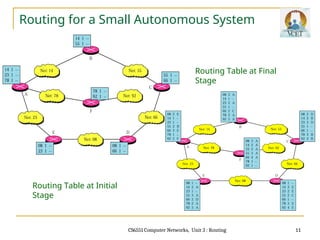
Routing for a Small Autonomous System
11
Routing Table at Initial
Stage
Routing Table at Final
Stage
12.
CS6551 Computer Networks,Unit 3 : Routing
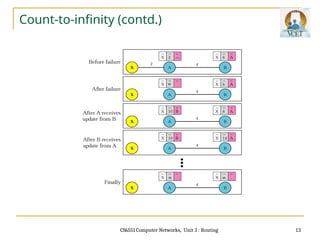
Count-to-infinity or loop instability problem
Suppose link from node A to E goes down. 2
Node A advertises a distance of ∞ to E to its neighbors.
Node B receives periodic update from C before A’s update reaches B,
Node B updated by C, concludes that E can be reached in 3 hops via C.
Node B advertises to A as 3 hops to reach E
Node A in turn updates C with a distance of 4 hops to E and so on.
Thus nodes update each other until cost to E reaches infinity, i.e., no
convergence.
Routing table does not stabilize. This problem is called loop instability
or count to infinity
12
CS6551 Computer Networks,Unit 3 : Routing
Solutions to two-node instability
14
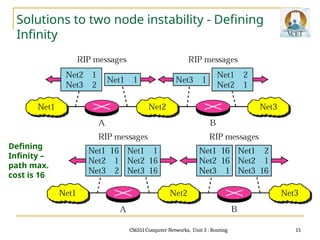
Defining Infinity. In DV protocol, define the distance between each
node to be 1 and define 16 as infinity. Therefore, the distance vector
cannot be used in large systems
Split Horizon. When a node updates its neighbors, it does not send
those routes it learned from each neighbor back to that neighbor. This
is known as split horizon.
Split Horizon and Poison Reverse. It allows nodes to advertise
routes it learnt from a node back to that node, but with a warning
message
Now the node B can still advertise the value of X, but if the source of
information is A, it can replace the distance with infinity as a warning:
15.
CS6551 Computer Networks,Unit 3 : Routing
Solutions to two node instability - Defining
Infinity
15
Defining
Infinity –
path max.
cost is 16
16.
CS6551 Computer Networks,Unit 3 : Routing
Routing Information Protocol (RIP)
16
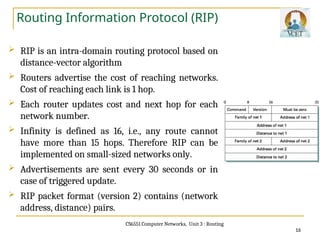
RIP is an intra-domain routing protocol based on
distance-vector algorithm
Routers advertise the cost of reaching networks.
Cost of reaching each link is 1 hop.
Each router updates cost and next hop for each
network number.
Infinity is defined as 16, i.e., any route cannot
have more than 15 hops. Therefore RIP can be
implemented on small-sized networks only.
Advertisements are sent every 30 seconds or in
case of triggered update.
RIP packet format (version 2) contains (network
address, distance) pairs.
17.
CS6551 Computer Networks,Unit 3 : Routing
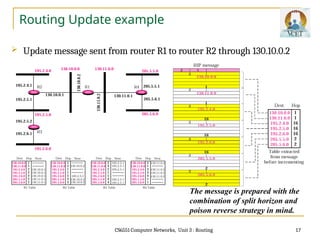
Routing Update example
Update message sent from router R1 to router R2 through 130.10.0.2
17
The message is prepared with the
combination of split horizon and
poison reverse strategy in mind.
18.
CS6551 Computer Networks,Unit 3 : Routing
Timer in RIP
18
RIP uses 3 timers. The periodic timer controls the sending of messages,
the expiration timer governs the validity of a route, and the garbage
collection timer advertises the failure of a route
Every time a new update for the route is received, Expiration timer is
reset to 180. If the timer is expired, the hop count of the route is set to
16, which means the destination is unreachable
When the information about a route becomes invalid, the router does
not immediately purge that route from its table Instead, it continues to
advertise the route with a metric value of 16 until the Garbage timer
reaches to 0
19.
CS6551 Computer Networks,Unit 3 : Routing
RIP: link failure, recovery
If no advertisement heard after 180 sec neighbor/link declared as
dead
routes via neighbor invalidated
new advertisements sent to neighbors
neighbors in turn send out new advertisements (if tables changed)
link failure info quickly (?) propagates to entire net
Poison reverse is used to prevent ping-pong loops (infinite distance =
16 hops)
19
20.
CS6551 Computer Networks,Unit 3 : Routing
RIP Timer - Example
A routing table has 20 entries. It does not receive information about
five routes for 200 s. How many timers are running at this time?
Solution: The 21 timers are listed below
Periodic timer: 1
Expiration timer: 20−5= 15
Garbage collection timer: 5
20
21.
CS6551 Computer Networks,Unit 3 : Routing
Link State Routing
Open Shortest Path First (OSPF) algorithm uses the Link State Protocol,
developed by IETF IGP working group, RFC2328
In LSR, each node knows state of link to its neighbors and cost. Hence,
each router floods link-state information through its neighbors to other
routers
Based on the flooded link-state information, each router maintains a
complete link-state database
Based on the link-state database, a routing table is constructed using
SPF (e.g., Dijkstra’s) algorithm
Link-state routing relies on two mechanisms
Reliable flooding−distribution of Link State Path (LSP) to all other nodes
Forward Search algorithm−Route calculation from accumulated LSPs.
21
22.
CS6551 Computer Networks,Unit 3 : Routing
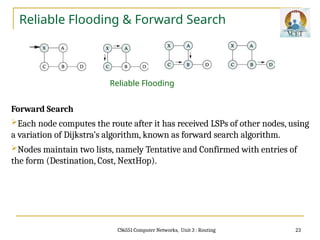
Reliable Flooding
Nodes create an update packet called link-state packet (LSP) and sends
out on each of its links, that contains :
ID of the node
List of neighbors for that node and associated cost
64-bit Sequence number
Time to live
When a node receives a LSP, checks if it has an LSP already for that node
If not, it stores that LSP, else it keeps the LSP with larger sequence number.
Forwards the LSP on all other links except the incoming one.
Thus recent LSP of a node reaches all nodes, i.e., reliable flooding
LSP is generated either periodically or when there is a change in the n/w
topology
22
23.
CS6551 Computer Networks,Unit 3 : Routing
Reliable Flooding & Forward Search
Forward Search
Each node computes the route after it has received LSPs of other nodes, using
a variation of Dijkstra’s algorithm, known as forward search algorithm.
Nodes maintain two lists, namely Tentative and Confirmed with entries of
the form (Destination, Cost, NextHop).
23
Reliable Flooding
24.
CS6551 Computer Networks,Unit 3 : Routing
Forward Search Algorithm
Algorithm
•Initialize the Confirmed list with an entry for
the Node (Cost = 0).
•Node just added to Confirmed list is called
Next. Its LSP is examined.
•For each neighbor of Next, calculate cost to
reach each neighbor: Cost (Node to Next) +
Cost (Next to Neighbor).
•If Neighbor is not in any list, then add
(Neighbor, Cost, NextHop) to Tentative list.
•If Neighbor is in Tentative list, then retain
entry with the least cost.
•If Tentative list is empty then Stop,
•Move least cost entry from Tentative list to
Confirmed list. Go to Step 2.
24
Step Confirmed Tentative Comment (routing table for node D)
1 (D, 0, –) D is moved to Confirmed list initially
2 (D, 0, –)
(B, 11, B)
(C, 2, C)
Based on D's LSP, its immediate
neighbors B and C are
added to Tentative list
3
(D, 0, –)
(C, 2, C)
(B, 11, B)
Lowest cost entry C in Tentative list is
moved to Confirmed
list. C's LSP is to be examined next
4
(D, 0, –)
(C, 2, C)
(B, 5, C)
(A, 12, C)
Cost to reach B through C is 5, so the
entry (B, 11, B) is
replaced. C's neighbor A is also added
to Tentative list
5
(D, 0, –)
(C, 2, C)
(B, 5, C)
(A, 12, C)
Lowest cost entry B is moved to
Confirmed list. B's LSP is
examined next.
6
(D, 0, –)
(C, 2, C)
(B, 5, C)
(A, 10, C)
Since A could be reached through B at
a lower cost than the
existing one, the Tentative list entry
(A, 12, C) is replaced to
(A, 10, C)
7
(D, 0, –)
(C, 2, C)
(B, 5, C)
(A, 10, C)
Node A is moved to Confirmed list.
Process completed, since
tentative list has no entries
25.
CS6551 Computer Networks,Unit 3 : Routing
Features of OSPF
Use flexible metrics instead of only hop count
Supports variable-length subnetting
Supports multiple routes; one for each IP type of service (ToS)
Quick convergence
Uses multicast rather than broadcast of its messages to reduce network
load
Authentication―Routing updates are authenticated to prevent
malicious nodes from providing false costs.
Scalable: OSPF is more scalable using network hierarchy w.r.t areas
Load balancing―Traffic is evenly distributed by assigning uniform cost
to various routes to a destination.
25
26.
CS6551 Computer Networks,Unit 3 : Routing
Hierarchical OSPF
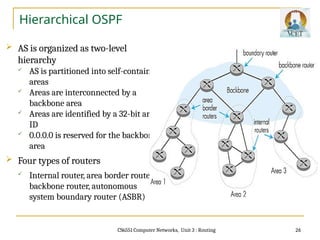
AS is organized as two-level
hierarchy
AS is partitioned into self-contained
areas
Areas are interconnected by a
backbone area
Areas are identified by a 32-bit area
ID
0.0.0.0 is reserved for the backbone
area
Four types of routers
Internal router, area border router,
backbone router, autonomous
system boundary router (ASBR)
26
27.
CS6551 Computer Networks,Unit 3 : Routing
OSPF Operations
Hello protocol
Hello packets are transmitted to all interfaces periodically
Discover neighbors, establish and maintain neighbor adjacency relationships
Elect Designated Router (DR) if multiple routers are in a broadcast network
Database synchronization
Two neighboring routers exchange database description packets to
synchronize their link-state databases.
Database description includes only a list of LSA headers. New or more up-to-
date LSAs will be requested later
Propagation of link-state information: Reliable Flooding
Building of routing table: Routing algorithm may use Forward Search
27
28.
CS6551 Computer Networks,Unit 3 : Routing
Routing metrics
Hop (Uniform cost to all links)
Easy to calculate least-cost route.
Latency, Bandwidth, etc., are not considered. For eg. links with latency 250 ms and
1 ms ; links with BW 1 Mbps and 100 Mbps are treated similarly
Original ARPANET (queue length as its routing metric)
Higher cost was assigned for links with long queue than shorter ones.
Packets moved towards short queues, but not towards destination.
Bandwidth and latency were not considered.
ARPANETs new routing mechanism was as follows
Bandwidth, latency and delay was used to estimate load, rather than queue
length.
ArrivalTime and DepartTime of a packet at a router was recorded.
Weights were assigned to links based on avg. delay for packets over that link.
28
29.
CS6551 Computer Networks,Unit 3 : Routing
Limitations of IPV4 & Advantages of IPV6
Limitations of IPV4
Despite subnetting and CIDR, address depletion is still a long-term problem.
Internet must accommodate real-time audio and video transmission that
requires minimum delay strategies and reservation of resources.
Internet must provide encryption and authentication of data for some
applications.
Advantages of IPv6 over IPv4
Address space―IPv6 uses 128-bit address whereas IPv4 uses 32-bit address.
Hence IPv6 has huge address space than IPv4
Header format―Unlike IPv4, optional headers are separated from base
header in IPv6. Each router thus need not process unwanted information
Extensible―Unassigned IPv6 addresses can accommodate needs of future
technologies.
29
30.
CS6551 Computer Networks,Unit 3 : Routing
Features of IPV6
IPv6 solved address space exhaustion in IPv4 and offers rich set of
services
128-bit addresses to handle up to 3.4 ×1038 nodes
IPv6 uses classless addressing, but classification is based on MSBs
IPv6 unicast addresses start with 001 prefix
Multicast start with a byte of 1s
Reserved addresses start with a byte of 0s
Support real-time services
Enhanced Authentication and security
End-to-end fragmentation
Enhanced routing functionality, including support for mobile hosts
30
31.
CS6551 Computer Networks,Unit 3 : Routing
IPV6 Addressing
Classless addressing/routing (similar to CIDR)
Notation: x:x:x:x:x:x:x:x(x= 16-bit hex number)
Contiguous 0s are compressed: 47CD::A456:0124
IPv6 compatible IPv4 address: ::128.42.1.87
Address assignment
Provider based and geographic based.
Address Aggregation
IPv6 provides aggregation by assigning prefixes at continental level to reduce
routing table entries. For example, addresses in Europe to have a common
prefix, then routers in other continents would need one routing table entry
for all networks in Europe..
31
32.
CS6551 Computer Networks,Unit 3 : Routing
IPV6 Header
Base header is 40 bytes long
Version – specifies the IP version, i.e., 6.
TrafficClass – defines priority of the packet with
respect to traffic congestion.
FlowLabel – provides special handling for a
particular flow of data.
PayloadLen – gives length of the packet,
excluding header.
NextHeader – contains a pointer to optional
headers following IP header.
HopLimit – specifies lifetime of the packet.
SourceAddress / DestinationAddress – 16-byte
addresses of source and destination host
32
33.
CS6551 Computer Networks,Unit 3 : Routing
Extension Headers of IPV6
Base header may be followed by six extension headers in specific order.
Each extension header contains a NextHeader field to identify the header
following it.
Hop-by-Hop – source host passes information to all routers
Source Routing -routing information (strict/loose) provided by the source
Fragmentation
Authentication – used to validate the sender and ensures data integrity
Security for Payload - provides confidentiality against eavesdropping
Destination - source host information is passed to the destination only
33