COMPUTER
FUNDAMENTALS
~FATHIMA LIDIYA~
Chapter 1-
COMPUTER FUNDAMENTALS
• Working of a computer
• Parts of a computer
• Hardware
• Processing
• Software
• Storage Devices
Working of a COMPUTER
• A computer accepts data or information, processes it with
the help of the processing unit, and finally generates an
output.
• In order to complete the above task, the computer follows
3 steps: Input, Process, and Output.
• These steps are together known as Input-Process-Output
(IPO) cycle
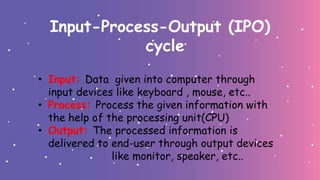
Input-Process-Output (IPO)
cycle
• Input: Data given into computer through
input devices like keyboard , mouse, etc..
• Process: Process the given information with
the help of the processing unit(CPU)
• Output: The processed information is
delivered to end-user through output devices
like monitor, speaker, etc..
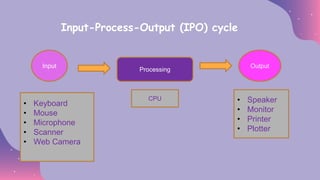
Input-Process-Output (IPO) cycle
Input Output
Processing
• Keyboard
• Mouse
• Microphone
• Scanner
• Web Camera
• Speaker
• Monitor
• Printer
• Plotter
CPU
COMPUTER HARDWARE
Computer hardware refers to those part of a
computer which we can touch and feel. Eg:
Keyboard, Monitor, Scanner , CPU, etc ….
Peripheral devices: All the input and output devices
connected to CPU with or without cables.
Computer Hardware Parts
Different parts present inside a CPU BOX
• CPU (Processor)
• CD/DVD drive
• Hard disk drive
• RAM
• Motherboard
• Computer fan
• Power supply
Central Processing Unit (CPU)
CPU is the most important hardware part of a computer.
It is the only processing device for a computer. Hence
it is called as the brain of the computer . It contain 3
parts:
• Arithmetic Logic Unit(ALU)
• Control Unit (CU)
• Memory Unit (MU)
Functions of ALU
Arithmetic Logic Unit (ALU) : It helps to perform
mathematical (+,-, *,/) calculations and logical (<,>,=)
comparisons
Functions of CU
Control unit : It helps to control the transfer
of data and information between ALU and MU .
i e, the control unit fetches instructions from
the memory, decodes them, and directs them to
various units like ALU or MU to perform the
specified tasks.
Functions of MU
Memory Unit : It is the main memory which is
also called as primary memory. Data provided
by the input device and the result of that
processed data is temporarily stored in this
memory unit.
COMPUTER SOFTWARE
Computer software is a set of instructions that
tells the computer how to do a particular work.
We cannot touch software. Examples: Microsoft
windows, WordPad, Paint, Calculator, Games, etc.
There are two types of software's:
 Application software
 System software
Application Software
Application Software perform a specific task
on the computer. Eg: Paint, Notepad,
Calculator, Calendar, etc..
Paint helps to color your drawings, Calculator
helps to do mathematical calculations, Calendar
helps to find date /day, etc.…
System Software
• It controls and manage all activities in the computer.
• Helps application software run on the computer.
• Eg: Operating System of computer, tablets and
mobile phones.
• Operating system is the heart of a computer system.
• Different operating systems are Microsoft Windows,
Linux, Android, Mac OS, etc..
STORAGE DEVICES
Storage devices are the devices which can store
data permanently.
There are different types of storage devices.
Example:
 Hard Disk
 External Hard Drive
 CD,DVD and Blu-ray Disc
 Pen Drive
 Memory Card
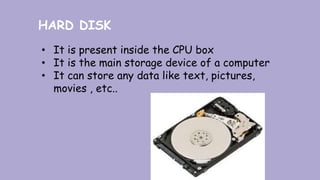
HARD DISK
• It is present inside the CPU box
• It is the main storage device of a computer
• It can store any data like text, pictures,
movies , etc..
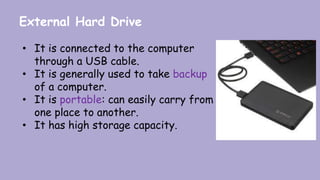
External Hard Drive
• It is connected to the computer
through a USB cable.
• It is generally used to take backup
of a computer.
• It is portable: can easily carry from
one place to another.
• It has high storage capacity.
CD , DVD , Blu-ray Disc
• CD, DVD, Blu-ray disc are used
to store data permanently.
• CD-Compact Disc
• DVD-Digital Versatile Disc
• The storage capacity of Blu-ray
disc is higher than that of CD
and DVD
• The storage storage capacity of
DVD is higher than CD
The order of storage capacity : CD < DVD < Blu-ray Disc
Pen Drive
• It is also known as Flash Drive.
• It is connected to the computer through a
USB port.
• It is small and portable.
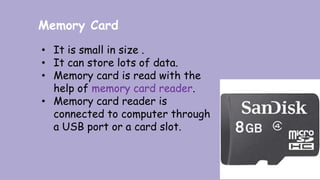
Memory Card
• It is small in size .
• It can store lots of data.
• Memory card is read with the
help of memory card reader.
• Memory card reader is
connected to computer through
a USB port or a card slot.
THANKS

Computer fundamentals

  • 1.
  • 2.
    Chapter 1- COMPUTER FUNDAMENTALS •Working of a computer • Parts of a computer • Hardware • Processing • Software • Storage Devices
  • 3.
    Working of aCOMPUTER • A computer accepts data or information, processes it with the help of the processing unit, and finally generates an output. • In order to complete the above task, the computer follows 3 steps: Input, Process, and Output. • These steps are together known as Input-Process-Output (IPO) cycle
  • 4.
    Input-Process-Output (IPO) cycle • Input:Data given into computer through input devices like keyboard , mouse, etc.. • Process: Process the given information with the help of the processing unit(CPU) • Output: The processed information is delivered to end-user through output devices like monitor, speaker, etc..
  • 5.
    Input-Process-Output (IPO) cycle InputOutput Processing • Keyboard • Mouse • Microphone • Scanner • Web Camera • Speaker • Monitor • Printer • Plotter CPU
  • 6.
    COMPUTER HARDWARE Computer hardwarerefers to those part of a computer which we can touch and feel. Eg: Keyboard, Monitor, Scanner , CPU, etc …. Peripheral devices: All the input and output devices connected to CPU with or without cables.
  • 7.
  • 8.
    Different parts presentinside a CPU BOX • CPU (Processor) • CD/DVD drive • Hard disk drive • RAM • Motherboard • Computer fan • Power supply
  • 9.
    Central Processing Unit(CPU) CPU is the most important hardware part of a computer. It is the only processing device for a computer. Hence it is called as the brain of the computer . It contain 3 parts: • Arithmetic Logic Unit(ALU) • Control Unit (CU) • Memory Unit (MU)
  • 10.
    Functions of ALU ArithmeticLogic Unit (ALU) : It helps to perform mathematical (+,-, *,/) calculations and logical (<,>,=) comparisons
  • 11.
    Functions of CU Controlunit : It helps to control the transfer of data and information between ALU and MU . i e, the control unit fetches instructions from the memory, decodes them, and directs them to various units like ALU or MU to perform the specified tasks.
  • 12.
    Functions of MU MemoryUnit : It is the main memory which is also called as primary memory. Data provided by the input device and the result of that processed data is temporarily stored in this memory unit.
  • 13.
    COMPUTER SOFTWARE Computer softwareis a set of instructions that tells the computer how to do a particular work. We cannot touch software. Examples: Microsoft windows, WordPad, Paint, Calculator, Games, etc. There are two types of software's:  Application software  System software
  • 14.
    Application Software Application Softwareperform a specific task on the computer. Eg: Paint, Notepad, Calculator, Calendar, etc.. Paint helps to color your drawings, Calculator helps to do mathematical calculations, Calendar helps to find date /day, etc.…
  • 15.
    System Software • Itcontrols and manage all activities in the computer. • Helps application software run on the computer. • Eg: Operating System of computer, tablets and mobile phones. • Operating system is the heart of a computer system. • Different operating systems are Microsoft Windows, Linux, Android, Mac OS, etc..
  • 16.
    STORAGE DEVICES Storage devicesare the devices which can store data permanently. There are different types of storage devices. Example:  Hard Disk  External Hard Drive  CD,DVD and Blu-ray Disc  Pen Drive  Memory Card
  • 17.
    HARD DISK • Itis present inside the CPU box • It is the main storage device of a computer • It can store any data like text, pictures, movies , etc..
  • 18.
    External Hard Drive •It is connected to the computer through a USB cable. • It is generally used to take backup of a computer. • It is portable: can easily carry from one place to another. • It has high storage capacity.
  • 19.
    CD , DVD, Blu-ray Disc • CD, DVD, Blu-ray disc are used to store data permanently. • CD-Compact Disc • DVD-Digital Versatile Disc • The storage capacity of Blu-ray disc is higher than that of CD and DVD • The storage storage capacity of DVD is higher than CD The order of storage capacity : CD < DVD < Blu-ray Disc
  • 20.
    Pen Drive • Itis also known as Flash Drive. • It is connected to the computer through a USB port. • It is small and portable.
  • 21.
    Memory Card • Itis small in size . • It can store lots of data. • Memory card is read with the help of memory card reader. • Memory card reader is connected to computer through a USB port or a card slot.
  • 22.