Creative Learning&
    Applied Programming


Computer Basics
  HARDWARE
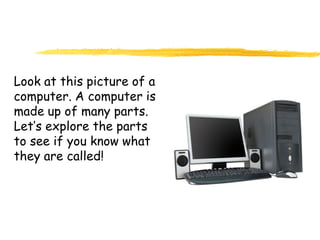
Look at this picture of a
computer. A computer is
made up of many parts.
Let’s explore the parts
to see if you know what
they are called!
The Monitor

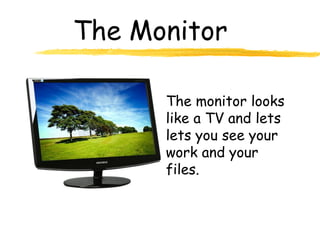
      The monitor looks
      like a TV and lets
      lets you see your
      work and your
      files.
The CPU

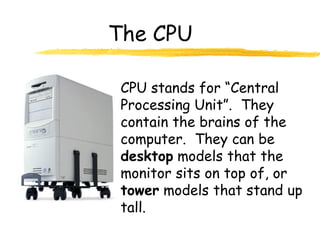
 CPU stands for “Central
 Processing Unit”. They
 contain the brains of the
 computer. They can be
 desktop models that the
 monitor sits on top of, or
 tower models that stand up
 tall.
Floppy Disk Drive
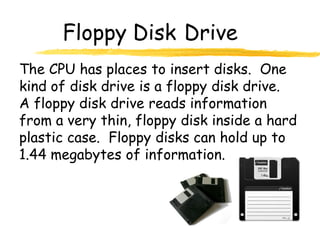
The CPU has places to insert disks. One
kind of disk drive is a floppy disk drive.
A floppy disk drive reads information
from a very thin, floppy disk inside a hard
plastic case. Floppy disks can hold up to
1.44 megabytes of information.
CD-ROM Disk Drive
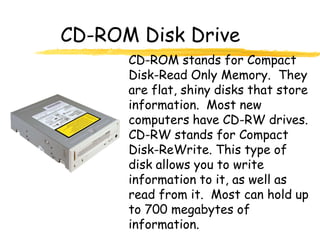
      CD-ROM stands for Compact
      Disk-Read Only Memory. They
      are flat, shiny disks that store
      information. Most new
      computers have CD-RW drives.
      CD-RW stands for Compact
      Disk-ReWrite. This type of
      disk allows you to write
      information to it, as well as
      read from it. Most can hold up
      to 700 megabytes of
      information.
DVD Drive/Burner


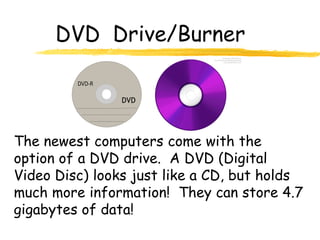
The newest computers come with the
option of a DVD drive. A DVD (Digital
Video Disc) looks just like a CD, but holds
much more information! They can store 4.7
gigabytes of data!
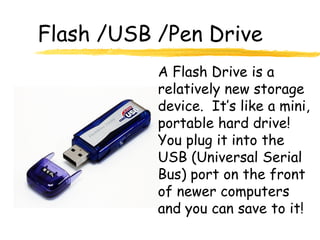
Flash /USB /Pen Drive
           A Flash Drive is a
           relatively new storage
           device. It’s like a mini,
           portable hard drive!
           You plug it into the
           USB (Universal Serial
           Bus) port on the front
           of newer computers
           and you can save to it!
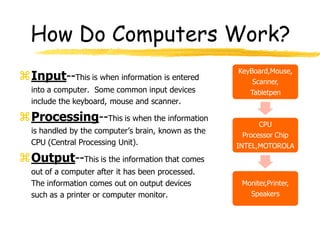
How Do Computers Work?
                                                     KeyBoard,Mouse,
Input--This is when information is entered              Scanner,
  into a computer. Some common input devices            Tabletpen
  include the keyboard, mouse and scanner.

Processing--This is when the information                  CPU
  is handled by the computer’s brain, known as the
                                                      Processor Chip
  CPU (Central Processing Unit).                     INTEL,MOTOROLA
Output--This is the information that comes
  out of a computer after it has been processed.
  The information comes out on output devices         Moniter,Printer,
  such as a printer or computer monitor.                Speakers
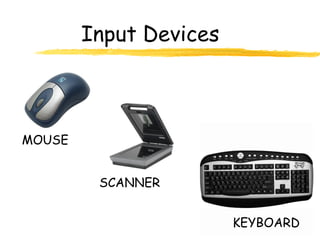
Input Devices


MOUSE


         SCANNER


                        KEYBOARD
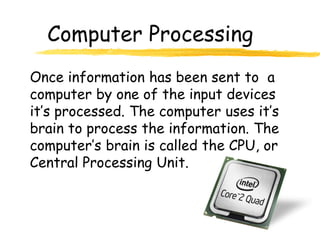
Computer Processing
Once information has been sent to a
computer by one of the input devices
it’s processed. The computer uses it’s
brain to process the information. The
computer’s brain is called the CPU, or
Central Processing Unit.
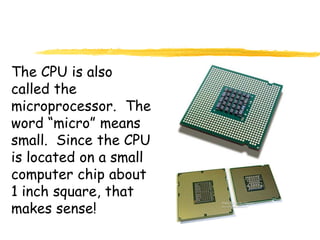
The CPU is also
called the
microprocessor. The
word “micro” means
small. Since the CPU
is located on a small
computer chip about
1 inch square, that
makes sense!
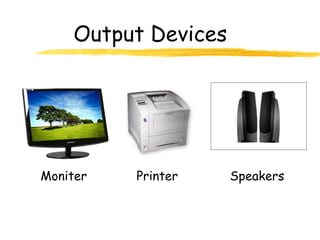
Output Devices


Moniter   Printer    Speakers
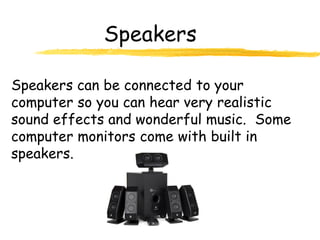
Speakers

Speakers can be connected to your
computer so you can hear very realistic
sound effects and wonderful music. Some
computer monitors come with built in
speakers.
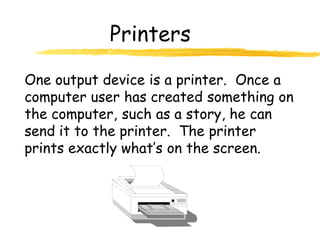
Printers

One output device is a printer. Once a
computer user has created something on
the computer, such as a story, he can
send it to the printer. The printer
prints exactly what’s on the screen.
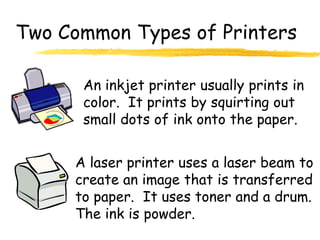
Two Common Types of Printers

      An inkjet printer usually prints in
      color. It prints by squirting out
      small dots of ink onto the paper.


     A laser printer uses a laser beam to
     create an image that is transferred
     to paper. It uses toner and a drum.
     The ink is powder.
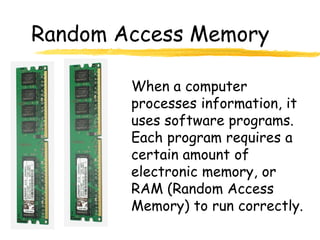
Random Access Memory

        When a computer
        processes information, it
        uses software programs.
        Each program requires a
        certain amount of
        electronic memory, or
        RAM (Random Access
        Memory) to run correctly.
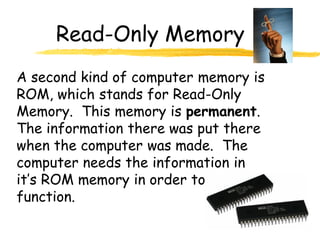
Read-Only Memory
A second kind of computer memory is
ROM, which stands for Read-Only
Memory. This memory is permanent.
The information there was put there
when the computer was made. The
computer needs the information in
it’s ROM memory in order to
function.
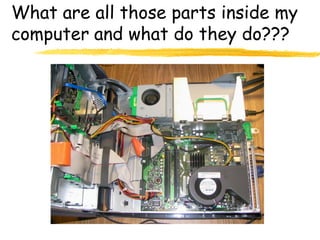
What are all those parts inside my
computer and what do they do???
Computer Hardware
Hard Drive
Motherboard
Sound Card and Video Card
Memory Card
Power Supply
NIC Card
BIOS
Hard Disk Drive
The Hard Disk Drive is a magnetic storage
device. All the computer programs and files
you create and save are located there. This is
permanent storage (at least until you uninstall
software or delete a file). The hard drive is
normally signified by the drive letter “C”.
Today’s hard drives can store a HUGE amount
of information. A new computer might have a
hard drive that will hold 250 GB’s!
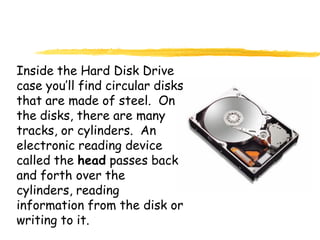
Inside the Hard Disk Drive
case you’ll find circular disks
that are made of steel. On
the disks, there are many
tracks, or cylinders. An
electronic reading device
called the head passes back
and forth over the
cylinders, reading
information from the disk or
writing to it.
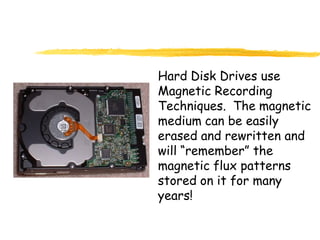
Hard Disk Drives use
Magnetic Recording
Techniques. The magnetic
medium can be easily
erased and rewritten and
will “remember” the
magnetic flux patterns
stored on it for many
years!
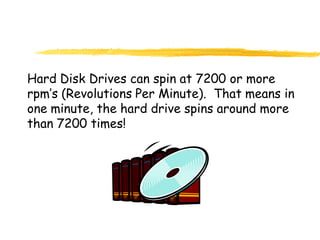
Hard Disk Drives can spin at 7200 or more
rpm’s (Revolutions Per Minute). That means in
one minute, the hard drive spins around more
than 7200 times!
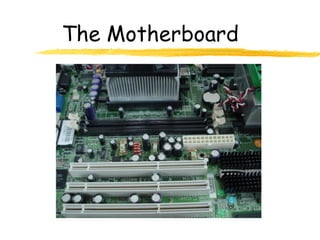
The Motherboard
Your computer couldn’t work without the
motherboard. It ties everything together! It
allows every part of your computer to receive
power and communicate with each other.
Everything that runs the computer or enhances
it’s performance is either part of the
motherboard or plugs into one of it’s expansion
slots or ports.
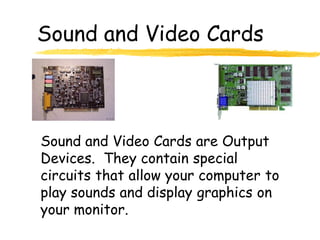
Sound and Video Cards


Sound and Video Cards are Output
Devices. They contain special
circuits that allow your computer to
play sounds and display graphics on
your monitor.
Memory Card
   Remember RAM (Random Access Memory)
       and ROM (Read-Only Memory)?
RAM cards will remember what you tell them
and can even change to remember new
information. But, when the computer is turned
off, it forgets everything you did! That’s why
you always save your work!
ROM is good at remembering, but cannot change
it’s mind. It holds the information that was
built into it!
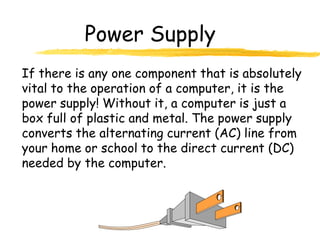
Power Supply
If there is any one component that is absolutely
vital to the operation of a computer, it is the
power supply! Without it, a computer is just a
box full of plastic and metal. The power supply
converts the alternating current (AC) line from
your home or school to the direct current (DC)
needed by the computer.
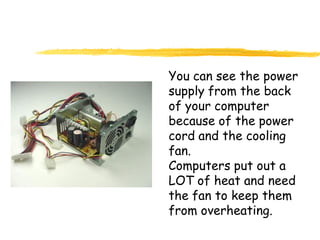
You can see the power
supply from the back
of your computer
because of the power
cord and the cooling
fan.
Computers put out a
LOT of heat and need
the fan to keep them
from overheating.
Network Interface Card

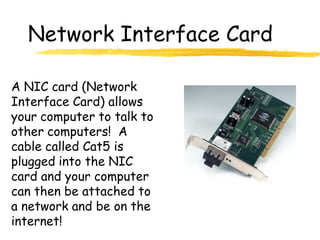
A NIC card (Network
Interface Card) allows
your computer to talk to
other computers! A
cable called Cat5 is
plugged into the NIC
card and your computer
can then be attached to
a network and be on the
internet!
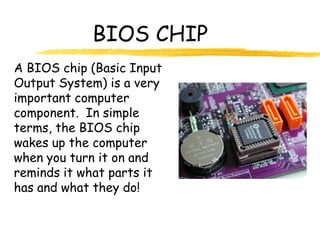
BIOS CHIP
A BIOS chip (Basic Input
Output System) is a very
important computer
component. In simple
terms, the BIOS chip
wakes up the computer
when you turn it on and
reminds it what parts it
has and what they do!
Just the beginning…..
We just touched on the very basics with
this presentation! There is so much more
to understanding computers. There are
books that are thousands of pages long
that explain how they work in great
detail. But now maybe you understand
them more than you did before and you’ll
want to keep learning.
            Keep computing!

Computer basics

  • 1.
    Creative Learning& Applied Programming Computer Basics HARDWARE
  • 2.
    Look at thispicture of a computer. A computer is made up of many parts. Let’s explore the parts to see if you know what they are called!
  • 3.
    The Monitor The monitor looks like a TV and lets lets you see your work and your files.
  • 4.
    The CPU CPUstands for “Central Processing Unit”. They contain the brains of the computer. They can be desktop models that the monitor sits on top of, or tower models that stand up tall.
  • 5.
    Floppy Disk Drive TheCPU has places to insert disks. One kind of disk drive is a floppy disk drive. A floppy disk drive reads information from a very thin, floppy disk inside a hard plastic case. Floppy disks can hold up to 1.44 megabytes of information.
  • 6.
    CD-ROM Disk Drive CD-ROM stands for Compact Disk-Read Only Memory. They are flat, shiny disks that store information. Most new computers have CD-RW drives. CD-RW stands for Compact Disk-ReWrite. This type of disk allows you to write information to it, as well as read from it. Most can hold up to 700 megabytes of information.
  • 7.
    DVD Drive/Burner The newestcomputers come with the option of a DVD drive. A DVD (Digital Video Disc) looks just like a CD, but holds much more information! They can store 4.7 gigabytes of data!
  • 8.
    Flash /USB /PenDrive A Flash Drive is a relatively new storage device. It’s like a mini, portable hard drive! You plug it into the USB (Universal Serial Bus) port on the front of newer computers and you can save to it!
  • 9.
    How Do ComputersWork? KeyBoard,Mouse, Input--This is when information is entered Scanner, into a computer. Some common input devices Tabletpen include the keyboard, mouse and scanner. Processing--This is when the information CPU is handled by the computer’s brain, known as the Processor Chip CPU (Central Processing Unit). INTEL,MOTOROLA Output--This is the information that comes out of a computer after it has been processed. The information comes out on output devices Moniter,Printer, such as a printer or computer monitor. Speakers
  • 10.
    Input Devices MOUSE SCANNER KEYBOARD
  • 11.
    Computer Processing Once informationhas been sent to a computer by one of the input devices it’s processed. The computer uses it’s brain to process the information. The computer’s brain is called the CPU, or Central Processing Unit.
  • 12.
    The CPU isalso called the microprocessor. The word “micro” means small. Since the CPU is located on a small computer chip about 1 inch square, that makes sense!
  • 13.
    Output Devices Moniter Printer Speakers
  • 14.
    Speakers Speakers can beconnected to your computer so you can hear very realistic sound effects and wonderful music. Some computer monitors come with built in speakers.
  • 15.
    Printers One output deviceis a printer. Once a computer user has created something on the computer, such as a story, he can send it to the printer. The printer prints exactly what’s on the screen.
  • 16.
    Two Common Typesof Printers An inkjet printer usually prints in color. It prints by squirting out small dots of ink onto the paper. A laser printer uses a laser beam to create an image that is transferred to paper. It uses toner and a drum. The ink is powder.
  • 17.
    Random Access Memory When a computer processes information, it uses software programs. Each program requires a certain amount of electronic memory, or RAM (Random Access Memory) to run correctly.
  • 18.
    Read-Only Memory A secondkind of computer memory is ROM, which stands for Read-Only Memory. This memory is permanent. The information there was put there when the computer was made. The computer needs the information in it’s ROM memory in order to function.
  • 19.
    What are allthose parts inside my computer and what do they do???
  • 20.
    Computer Hardware Hard Drive Motherboard SoundCard and Video Card Memory Card Power Supply NIC Card BIOS
  • 21.
    Hard Disk Drive TheHard Disk Drive is a magnetic storage device. All the computer programs and files you create and save are located there. This is permanent storage (at least until you uninstall software or delete a file). The hard drive is normally signified by the drive letter “C”. Today’s hard drives can store a HUGE amount of information. A new computer might have a hard drive that will hold 250 GB’s!
  • 22.
    Inside the HardDisk Drive case you’ll find circular disks that are made of steel. On the disks, there are many tracks, or cylinders. An electronic reading device called the head passes back and forth over the cylinders, reading information from the disk or writing to it.
  • 23.
    Hard Disk Drivesuse Magnetic Recording Techniques. The magnetic medium can be easily erased and rewritten and will “remember” the magnetic flux patterns stored on it for many years!
  • 24.
    Hard Disk Drivescan spin at 7200 or more rpm’s (Revolutions Per Minute). That means in one minute, the hard drive spins around more than 7200 times!
  • 25.
  • 26.
    Your computer couldn’twork without the motherboard. It ties everything together! It allows every part of your computer to receive power and communicate with each other. Everything that runs the computer or enhances it’s performance is either part of the motherboard or plugs into one of it’s expansion slots or ports.
  • 27.
    Sound and VideoCards Sound and Video Cards are Output Devices. They contain special circuits that allow your computer to play sounds and display graphics on your monitor.
  • 28.
    Memory Card Remember RAM (Random Access Memory) and ROM (Read-Only Memory)? RAM cards will remember what you tell them and can even change to remember new information. But, when the computer is turned off, it forgets everything you did! That’s why you always save your work! ROM is good at remembering, but cannot change it’s mind. It holds the information that was built into it!
  • 29.
    Power Supply If thereis any one component that is absolutely vital to the operation of a computer, it is the power supply! Without it, a computer is just a box full of plastic and metal. The power supply converts the alternating current (AC) line from your home or school to the direct current (DC) needed by the computer.
  • 30.
    You can seethe power supply from the back of your computer because of the power cord and the cooling fan. Computers put out a LOT of heat and need the fan to keep them from overheating.
  • 31.
    Network Interface Card ANIC card (Network Interface Card) allows your computer to talk to other computers! A cable called Cat5 is plugged into the NIC card and your computer can then be attached to a network and be on the internet!
  • 32.
    BIOS CHIP A BIOSchip (Basic Input Output System) is a very important computer component. In simple terms, the BIOS chip wakes up the computer when you turn it on and reminds it what parts it has and what they do!
  • 33.
    Just the beginning….. Wejust touched on the very basics with this presentation! There is so much more to understanding computers. There are books that are thousands of pages long that explain how they work in great detail. But now maybe you understand them more than you did before and you’ll want to keep learning. Keep computing!