Multi Sensor Data Fusion In Target
Tracking
S.Vasuhi
Guided by:
Dr.V.Vaidehi
Prof. & Head,
Dept. of Electronics Engineering
Madras Institute of Technology,Chennai
Objective
• To perform data fusion within the sampling
interval, the fusion information has to be sent
to the tracking center for accurate future
prediction.
• Both computational load and communication
load are to be minimized.
• If conventional algorithms are not suitable
due to computation overhead, Fuzzy logic
fusion and its hardware realization will be
investigated
Areas of Use
Military applications:
–Automated target recognition (e.g. smart
weapons)
–Guidance for autonomous vehicles
–Remote sensing
–Battlefield surveillance
Nonmilitary applications:
–Robotic navigation
–Airport Surveillance
–Medical diagnosis
Elements of Multiple Target Tracking
• Detection
• Recognition
• Identification
• Tracking
• Change detection
• Decision making
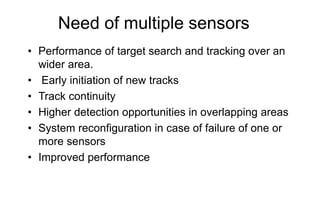
Need of multiple sensors
• Performance of target search and tracking over an
wider area.
• Early initiation of new tracks
• Track continuity
• Higher detection opportunities in overlapping areas
• System reconfiguration in case of failure of one or
more sensors
• Improved performance
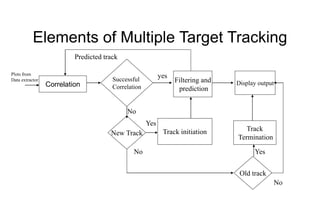
Elements of Multiple Target Tracking
Correlation
Filtering and
prediction
Display output
Track
Termination
Track initiation
Successful
Correlation
New Track
Old track
yes
No
Yes
No
Yes
No
Plots from
Data extractor
Predicted track
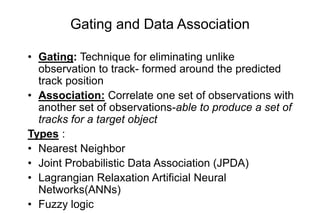
Gating and Data Association
• Gating: Technique for eliminating unlike
observation to track- formed around the predicted
track position
• Association: Correlate one set of observations with
another set of observations-able to produce a set of
tracks for a target object
Types :
• Nearest Neighbor
• Joint Probabilistic Data Association (JPDA)
• Lagrangian Relaxation Artificial Neural
Networks(ANNs)
• Fuzzy logic
Position and Attribute Estimation
• Is the process of taking the associated measurements and
calculating target states
Types :
• Kalman Filter
• Multiple model Algorithms
• Multiple resolutional Filtering
• Particle Filtering
• Artificial Intelligent Approaches
i) Rule – Based
ii) Artificial Neural Networks (ANNs)
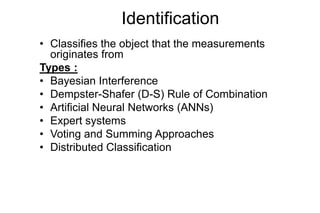
Identification
• Classifies the object that the measurements
originates from
Types :
• Bayesian Interference
• Dempster-Shafer (D-S) Rule of Combination
• Artificial Neural Networks (ANNs)
• Expert systems
• Voting and Summing Approaches
• Distributed Classification
What is Data Fusion?
• Process of combining information from multiple
sensors and/or data sources
• Composed of several sensors (Primary and
secondary Radar, Passive sensors, Acoustic
Sensors, Image sensors, etc.,) that provide
data (Detections, Attributes ,Tracks) of every
element in the covered environment
• The fused data is presented to controllers after
being merged at the fusion center.
Need of data fusion
• Increased confidence
• Reduced ambiguity
• Improved detection
• Increased robustness
• Enhanced spatial and temporal coverage
• Decreased cost
Fusion Techniques
Fusion types:
• Measurement fusion: Directly fuses the sensor
measurements to obtain a combined measurement
• Track to Track Fusion: The filtered outputs of the data
are suitably combined in the fusion center to obtain an
improved state estimates
• Fusion Techniques are drawn from:
i) Pattern Recognition
ii) Statistical estimation
iii) Artificial Intelligence
Fusion Architectures
• Centralized Architecture – Both Tracking and data
fusion are done at the centralized data fusion center
–Accurate tracking, Do both multiple target tracking and data fusion
• Distributed Architecture – Maintain central and local
tracks (for each sensor)-The distributed processing of measures
that allow to adapt the functions specifically to each type of sensor, the capacity
to calibrate sensor
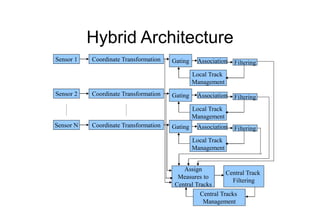
• Hybrid Architecture – Combination of the
Centralized and Distributed Architecture – High accuracy
systematic error robustness and distribution of computational load
Centralized Architecture
Sensor1
Sensor2
Sensor N
Coordinate Transformation
Gating
Central Tracks
Management
Association Filtering
Distributed Architecture
Sensor1 Coordinate Transformation Gating
Local Track
Management
Association Filtering
Sensor2 Coordinate Transformation Gating
Local Track
Management
Association Filtering
Sensor N Coordinate Transformation Gating
Local Track
Management
Association Filtering
Fusion of
Local
Tracks
Hybrid Architecture
Sensor 1 Coordinate Transformation Gating
Local Track
Management
Association Filtering
Sensor 2 Coordinate Transformation Gating
Local Track
Management
Association Filtering
Sensor N Coordinate Transformation Gating
Local Track
Management
Association Filtering
Assign
Measures to
Central Tracks
Central Track
Filtering
Central Tracks
Management
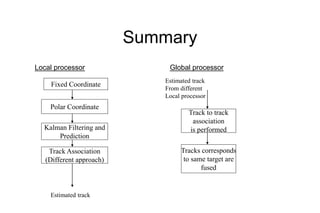
Summary
Local processor Global processor
Fixed Coordinate
Polar Coordinate
Kalman Filtering and
Prediction
Track Association
(Different approach)
Estimated track
Estimated track
From different
Local processor
Track to track
association
is performed
Tracks corresponds
to same target are
fused
Implementation of weighted least square method
ASSUMPTIONS
• Two non-maneuvering targets in a clutter free
environment.
• Zero mean, white Gaussian process noise
SENSOR 1:
• Scan rate: 0.5 sec
• Scans : 150
• Location in LLA
– Latitude –10.502
– Longitude –80.1
– Altitude –10
• Standard deviation of errors in
– Range – 50 m
– Azimuth – 0.005759 radians
– Elevation – 0.0171radians
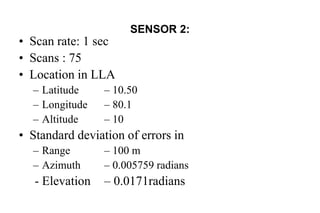
SENSOR 2:
• Scan rate: 1 sec
• Scans : 75
• Location in LLA
– Latitude – 10.50
– Longitude – 80.1
– Altitude – 10
• Standard deviation of errors in
– Range – 100 m
– Azimuth – 0.005759 radians
- Elevation – 0.0171radians
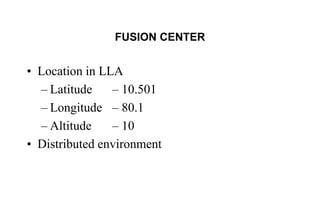
FUSION CENTER
• Location in LLA
– Latitude – 10.501
– Longitude – 80.1
– Altitude – 10
• Distributed environment
Zi
Compute
X k/k-1 , P (k/k-1)
Compute
X k/k-1 , P (k/k-1)
Compute State
Estimate Xi(k/k)
Compute State
Estimate Xj(k/k)
Gain Ki
Computer Estimation
Error
ei(k) = X k/k-1 – Xk/k
Computer Estimation
Error
ej(k) = X k/k-1 – Xk/k
Compute
Covariance Pi(k/k)
Compute
Covariance Pj(k/k)
Xj( k/k) , Pj(k/k)
Fusion Center
Xi( k/k) , Pi(k/k)
Kj
Zj
FLOWCHART
Compute
Covariance of fused estimates
ij (k) = xi(k/k) – xj(k/k)
Fuse the estimates using fusion equation
Different
Target
Compute
Covariance of ij (k)
Compute D
NO
YES
Is D<D
STOP
Sensor i Sensor j
Xi( k/k) , Pi(k/k) Xj( k/k) , Pj(k/k
WLS EQUATIONS
C=[HTP-1H] -1
K=CHTP-1
Y = Kx
• P- Prediction error covariances from individual
sensors
• H- Measurement matrix
• C- Error co variances calculated at the fusion centre
• K - Weights given to the estimates at fusion centre
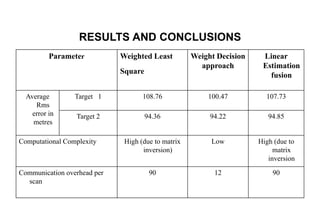
RESULTS AND CONCLUSIONS
Parameter Weighted Least
Square
Weight Decision
approach
Linear
Estimation
fusion
Average
Rms
error in
metres
Target 1 108.76 100.47 107.73
Target 2 94.36 94.22 94.85
Computational Complexity High (due to matrix
inversion)
Low High (due to
matrix
inversion
Communication overhead per
scan
90 12 90
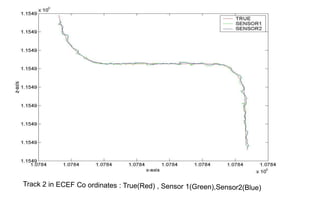
Track 1 in ECEF Co ordinates : True ( Red) , Sensor 1(Green),Sensor2(Blue)
Fused Track 1 in ECEF Co ordinates : True(Blue) , WLS(Red)
Track 2 in ECEF Co ordinates : True(Blue) , WLS(Red)
Average rms error for track1: WLS(Red), LEF(Blue),WD(Green)
Average rms error for track2: WLS(Red), LEF(Blue),WD(Green)
rms error in x direction for track1: WLS(Red), LEF(Blue),WD(Green)
rms error in y direction for track1: WLS(Red), LEF(Blue),WD(Green)
rms error in z direction for track1: WLS(Red), LEF(Blue),WD(Green)
rms error in x direction for track2: WLS(Red), LEF(Blue),WD(Green)
rms error in y direction for track2: WLS(Red), LEF(Blue),WD(Green)
rms error in z direction for track 2 WLS(Red), LEF(Blue),WD(Green)
References
1.Duncan Smith and Sameer Singh “Approaches to Multisensor Data Fusion in
Target Tracking: A Survey”IEEE Trans. on Knowledge and data Engineering,
vol.18 No.12 Dec-2006
2.Robert J. Elliott and John van der Hoek” Optimal Linear Estimation and Data
Fusion” IEEE Transactions on automatic control, vol. 51, no. 4, april 2006
3. Y.Zhang,H.Leung,T.Lo,J.Litva “Distributed sequential nearest neighbour multitarget
tracking algorithm” IEE Proc.-Radar, Sonar Navig., Vol. 143, No. 4, August 1996
4. Joaqu´ın M´ıguez and Antonio Art´es-Rodr´ıguez. “A monte carlo method for joint
node location and maneuvering target tracking in a sensor network” 2006 IEEE
5. Jie Zhou, Yunmin Zhu, Zhisheng You, and Enbin Song “An Efficient Algorithm for
Optimal Linear Estimation Fusion in Distributed Multisensor Systems “IEEE
Transactions on systems, man, and cybernetics—part a: systems and humans,
vol. 36, no. 5, september 2006
6. Mark B. Yeary, Yan Zhai, Tian-You Yu,, Shamim Nematifar,” Spectral Signature
Calculations and Target Tracking for Remote Sensing” IEEE transactions on
instrumentation and measurement, vol. 55, no. 4, august 2006
7. T. Owens Walker III, Murali Tummala, and J. Bret Michael” Pulse Transmission
Scheduling for a Distributed System of Cooperative Radars” Proceedings of the
2006 IEEE/SMC International Conference on System of Systems Engineering
Continue…
8. Don Koks and Subhash Challa “An introduction to Bayesian and Dempster –
Shafer Data Fusion” DSTO-TR-1436 Defence Science and Technology
Organisation.
9.. Sheng Tang, “Data Fusion of Multisensor Data”, Fourth International Conference
on knowledge – Based Intelligent Engineering systems & Allied Technologies,
IEEE 2000.
10. D.P.Atherton, J.A.Bather and A.J.Briggs “Data fusion for several Kalman filters
tracking a single target”, IEE Proc on Radar Sonar Navig., Vol 152, No. 5 ,
October 2005.
11. XU Yu JIN Yihui and ZHOU Yan, “Several methods of radar data fusion”, IEEE
2002.
12. Eric Granger, Mark A. Rubin, Stephen Grossberg and Pierre Lavoie, “A What-
and-Where Fusion Neural Network for Recognition and Tracking of Multiple
Radar Emitters”, December, 2000
13. M. Abdulghafour, T. Chandra, and M. A. Abidi, "Data Fusion Through Fuzzy Logic
Applied to Feature Extraction From Multi-Sensory Images", Proc. Int'l Conf.
Robotics and Automation, Vol. 2, pp. 359-366, Atlanta, GA, May 1993.
14. Rong Li X.(2003) ‘Optimal Linear Estimation Fusion – Part I ,Unified Fusion
Rules’,IEEE Transactions on Information Theory, Vol.49,pp 2192-2207.
15. Rong Li X.(2003) , Jie Wang ,‘Unified Optimal Linear Estimation Fusion – Part
II Discussions and Examples’, IEEE Transactions on Information Theory
16. Y.Zhang, H.Leung, T.Lo, J.Litva, ‘ Distributed sequential nearest neighbour
multitarget tracking algorithm’ IEEE Transactions 1996.

Multi Sensor Data Fusion In Target Tracking

  • 1.
    Multi Sensor DataFusion In Target Tracking S.Vasuhi Guided by: Dr.V.Vaidehi Prof. & Head, Dept. of Electronics Engineering Madras Institute of Technology,Chennai
  • 2.
    Objective • To performdata fusion within the sampling interval, the fusion information has to be sent to the tracking center for accurate future prediction. • Both computational load and communication load are to be minimized. • If conventional algorithms are not suitable due to computation overhead, Fuzzy logic fusion and its hardware realization will be investigated
  • 3.
    Areas of Use Militaryapplications: –Automated target recognition (e.g. smart weapons) –Guidance for autonomous vehicles –Remote sensing –Battlefield surveillance Nonmilitary applications: –Robotic navigation –Airport Surveillance –Medical diagnosis
  • 4.
    Elements of MultipleTarget Tracking • Detection • Recognition • Identification • Tracking • Change detection • Decision making
  • 5.
    Need of multiplesensors • Performance of target search and tracking over an wider area. • Early initiation of new tracks • Track continuity • Higher detection opportunities in overlapping areas • System reconfiguration in case of failure of one or more sensors • Improved performance
  • 6.
    Elements of MultipleTarget Tracking Correlation Filtering and prediction Display output Track Termination Track initiation Successful Correlation New Track Old track yes No Yes No Yes No Plots from Data extractor Predicted track
  • 7.
    Gating and DataAssociation • Gating: Technique for eliminating unlike observation to track- formed around the predicted track position • Association: Correlate one set of observations with another set of observations-able to produce a set of tracks for a target object Types : • Nearest Neighbor • Joint Probabilistic Data Association (JPDA) • Lagrangian Relaxation Artificial Neural Networks(ANNs) • Fuzzy logic
  • 8.
    Position and AttributeEstimation • Is the process of taking the associated measurements and calculating target states Types : • Kalman Filter • Multiple model Algorithms • Multiple resolutional Filtering • Particle Filtering • Artificial Intelligent Approaches i) Rule – Based ii) Artificial Neural Networks (ANNs)
  • 9.
    Identification • Classifies theobject that the measurements originates from Types : • Bayesian Interference • Dempster-Shafer (D-S) Rule of Combination • Artificial Neural Networks (ANNs) • Expert systems • Voting and Summing Approaches • Distributed Classification
  • 10.
    What is DataFusion? • Process of combining information from multiple sensors and/or data sources • Composed of several sensors (Primary and secondary Radar, Passive sensors, Acoustic Sensors, Image sensors, etc.,) that provide data (Detections, Attributes ,Tracks) of every element in the covered environment • The fused data is presented to controllers after being merged at the fusion center.
  • 11.
    Need of datafusion • Increased confidence • Reduced ambiguity • Improved detection • Increased robustness • Enhanced spatial and temporal coverage • Decreased cost
  • 12.
    Fusion Techniques Fusion types: •Measurement fusion: Directly fuses the sensor measurements to obtain a combined measurement • Track to Track Fusion: The filtered outputs of the data are suitably combined in the fusion center to obtain an improved state estimates • Fusion Techniques are drawn from: i) Pattern Recognition ii) Statistical estimation iii) Artificial Intelligence
  • 13.
    Fusion Architectures • CentralizedArchitecture – Both Tracking and data fusion are done at the centralized data fusion center –Accurate tracking, Do both multiple target tracking and data fusion • Distributed Architecture – Maintain central and local tracks (for each sensor)-The distributed processing of measures that allow to adapt the functions specifically to each type of sensor, the capacity to calibrate sensor • Hybrid Architecture – Combination of the Centralized and Distributed Architecture – High accuracy systematic error robustness and distribution of computational load
  • 14.
    Centralized Architecture Sensor1 Sensor2 Sensor N CoordinateTransformation Coordinate Transformation Coordinate Transformation Gating Central Tracks Management Association Filtering
  • 15.
    Distributed Architecture Sensor1 CoordinateTransformation Gating Local Track Management Association Filtering Sensor2 Coordinate Transformation Gating Local Track Management Association Filtering Sensor N Coordinate Transformation Gating Local Track Management Association Filtering Fusion of Local Tracks
  • 16.
    Hybrid Architecture Sensor 1Coordinate Transformation Gating Local Track Management Association Filtering Sensor 2 Coordinate Transformation Gating Local Track Management Association Filtering Sensor N Coordinate Transformation Gating Local Track Management Association Filtering Assign Measures to Central Tracks Central Track Filtering Central Tracks Management
  • 17.
    Summary Local processor Globalprocessor Fixed Coordinate Polar Coordinate Kalman Filtering and Prediction Track Association (Different approach) Estimated track Estimated track From different Local processor Track to track association is performed Tracks corresponds to same target are fused
  • 18.
    Implementation of weightedleast square method ASSUMPTIONS • Two non-maneuvering targets in a clutter free environment. • Zero mean, white Gaussian process noise
  • 19.
    SENSOR 1: • Scanrate: 0.5 sec • Scans : 150 • Location in LLA – Latitude –10.502 – Longitude –80.1 – Altitude –10 • Standard deviation of errors in – Range – 50 m – Azimuth – 0.005759 radians – Elevation – 0.0171radians
  • 20.
    SENSOR 2: • Scanrate: 1 sec • Scans : 75 • Location in LLA – Latitude – 10.50 – Longitude – 80.1 – Altitude – 10 • Standard deviation of errors in – Range – 100 m – Azimuth – 0.005759 radians - Elevation – 0.0171radians
  • 21.
    FUSION CENTER • Locationin LLA – Latitude – 10.501 – Longitude – 80.1 – Altitude – 10 • Distributed environment
  • 22.
    Zi Compute X k/k-1 ,P (k/k-1) Compute X k/k-1 , P (k/k-1) Compute State Estimate Xi(k/k) Compute State Estimate Xj(k/k) Gain Ki Computer Estimation Error ei(k) = X k/k-1 – Xk/k Computer Estimation Error ej(k) = X k/k-1 – Xk/k Compute Covariance Pi(k/k) Compute Covariance Pj(k/k) Xj( k/k) , Pj(k/k) Fusion Center Xi( k/k) , Pi(k/k) Kj Zj FLOWCHART
  • 23.
    Compute Covariance of fusedestimates ij (k) = xi(k/k) – xj(k/k) Fuse the estimates using fusion equation Different Target Compute Covariance of ij (k) Compute D NO YES Is D<D STOP Sensor i Sensor j Xi( k/k) , Pi(k/k) Xj( k/k) , Pj(k/k
  • 24.
    WLS EQUATIONS C=[HTP-1H] -1 K=CHTP-1 Y= Kx • P- Prediction error covariances from individual sensors • H- Measurement matrix • C- Error co variances calculated at the fusion centre • K - Weights given to the estimates at fusion centre
  • 25.
    RESULTS AND CONCLUSIONS ParameterWeighted Least Square Weight Decision approach Linear Estimation fusion Average Rms error in metres Target 1 108.76 100.47 107.73 Target 2 94.36 94.22 94.85 Computational Complexity High (due to matrix inversion) Low High (due to matrix inversion Communication overhead per scan 90 12 90
  • 26.
    Track 1 inECEF Co ordinates : True ( Red) , Sensor 1(Green),Sensor2(Blue)
  • 28.
    Fused Track 1in ECEF Co ordinates : True(Blue) , WLS(Red)
  • 29.
    Track 2 inECEF Co ordinates : True(Blue) , WLS(Red)
  • 30.
    Average rms errorfor track1: WLS(Red), LEF(Blue),WD(Green)
  • 31.
    Average rms errorfor track2: WLS(Red), LEF(Blue),WD(Green)
  • 32.
    rms error inx direction for track1: WLS(Red), LEF(Blue),WD(Green)
  • 33.
    rms error iny direction for track1: WLS(Red), LEF(Blue),WD(Green)
  • 34.
    rms error inz direction for track1: WLS(Red), LEF(Blue),WD(Green)
  • 35.
    rms error inx direction for track2: WLS(Red), LEF(Blue),WD(Green)
  • 36.
    rms error iny direction for track2: WLS(Red), LEF(Blue),WD(Green)
  • 37.
    rms error inz direction for track 2 WLS(Red), LEF(Blue),WD(Green)
  • 38.
    References 1.Duncan Smith andSameer Singh “Approaches to Multisensor Data Fusion in Target Tracking: A Survey”IEEE Trans. on Knowledge and data Engineering, vol.18 No.12 Dec-2006 2.Robert J. Elliott and John van der Hoek” Optimal Linear Estimation and Data Fusion” IEEE Transactions on automatic control, vol. 51, no. 4, april 2006 3. Y.Zhang,H.Leung,T.Lo,J.Litva “Distributed sequential nearest neighbour multitarget tracking algorithm” IEE Proc.-Radar, Sonar Navig., Vol. 143, No. 4, August 1996 4. Joaqu´ın M´ıguez and Antonio Art´es-Rodr´ıguez. “A monte carlo method for joint node location and maneuvering target tracking in a sensor network” 2006 IEEE 5. Jie Zhou, Yunmin Zhu, Zhisheng You, and Enbin Song “An Efficient Algorithm for Optimal Linear Estimation Fusion in Distributed Multisensor Systems “IEEE Transactions on systems, man, and cybernetics—part a: systems and humans, vol. 36, no. 5, september 2006 6. Mark B. Yeary, Yan Zhai, Tian-You Yu,, Shamim Nematifar,” Spectral Signature Calculations and Target Tracking for Remote Sensing” IEEE transactions on instrumentation and measurement, vol. 55, no. 4, august 2006 7. T. Owens Walker III, Murali Tummala, and J. Bret Michael” Pulse Transmission Scheduling for a Distributed System of Cooperative Radars” Proceedings of the 2006 IEEE/SMC International Conference on System of Systems Engineering
  • 39.
    Continue… 8. Don Koksand Subhash Challa “An introduction to Bayesian and Dempster – Shafer Data Fusion” DSTO-TR-1436 Defence Science and Technology Organisation. 9.. Sheng Tang, “Data Fusion of Multisensor Data”, Fourth International Conference on knowledge – Based Intelligent Engineering systems & Allied Technologies, IEEE 2000. 10. D.P.Atherton, J.A.Bather and A.J.Briggs “Data fusion for several Kalman filters tracking a single target”, IEE Proc on Radar Sonar Navig., Vol 152, No. 5 , October 2005. 11. XU Yu JIN Yihui and ZHOU Yan, “Several methods of radar data fusion”, IEEE 2002. 12. Eric Granger, Mark A. Rubin, Stephen Grossberg and Pierre Lavoie, “A What- and-Where Fusion Neural Network for Recognition and Tracking of Multiple Radar Emitters”, December, 2000 13. M. Abdulghafour, T. Chandra, and M. A. Abidi, "Data Fusion Through Fuzzy Logic Applied to Feature Extraction From Multi-Sensory Images", Proc. Int'l Conf. Robotics and Automation, Vol. 2, pp. 359-366, Atlanta, GA, May 1993.
  • 40.
    14. Rong LiX.(2003) ‘Optimal Linear Estimation Fusion – Part I ,Unified Fusion Rules’,IEEE Transactions on Information Theory, Vol.49,pp 2192-2207. 15. Rong Li X.(2003) , Jie Wang ,‘Unified Optimal Linear Estimation Fusion – Part II Discussions and Examples’, IEEE Transactions on Information Theory 16. Y.Zhang, H.Leung, T.Lo, J.Litva, ‘ Distributed sequential nearest neighbour multitarget tracking algorithm’ IEEE Transactions 1996.